34 Best Ecommerce Platforms in 2026
This guide covers the full range of ecommerce platforms from beginner SaaS builders (Shopify, Wix, Squarespace) to creator storefronts (Gumroad, Lemon Squeezy, Paddle), open-source self-hosted platforms (WooCommerce, Magento, PrestaShop), and enterprise headless commerce (commercetools, Elastic Path, Saleor). All pricing verified March 2026. Transaction fees listed are in addition to standard payment processor fees unless noted as merchant of record.

Shopify
Shopify is the world's leading hosted ecommerce platform, powering 5.2 million live stores globally. It covers the complete commerce stack from storefront to checkout, inventory, shipping, and payments. The Basic plan handles new stores, Grow suits expanding businesses needing up to 5 staff accounts and analytics, and Advanced supports high-volume stores with custom reporting and lower card rates. Shopify Plus handles enterprise-grade multi-store and B2B operations. Third-party transaction fees are charged on all plans when not using Shopify Payments (2% on Basic, 1% on Grow, 0.6% on Advanced). Shopify's app ecosystem exceeds 8,000 apps. New merchants can access the first 3 months for $1/month.

- • 8,000+ app ecosystem: the largest third-party app library of any ecommerce platform
- • Shopify Payments: built-in Stripe-powered payment processing eliminating third-party transaction fees
- • Abandoned cart recovery: included on all full storefront plans from Basic upward
- • Shopify Markets: multi-currency and multi-language international selling from one admin
- • Shopify Flow: no-code workflow automation for inventory rules, order tagging, and customer segmentation
Shopify is the default recommendation for most new and growing ecommerce businesses. The combination of ease of use, reliability, and the 8,000+ app ecosystem covers almost any use case.
WooCommerce
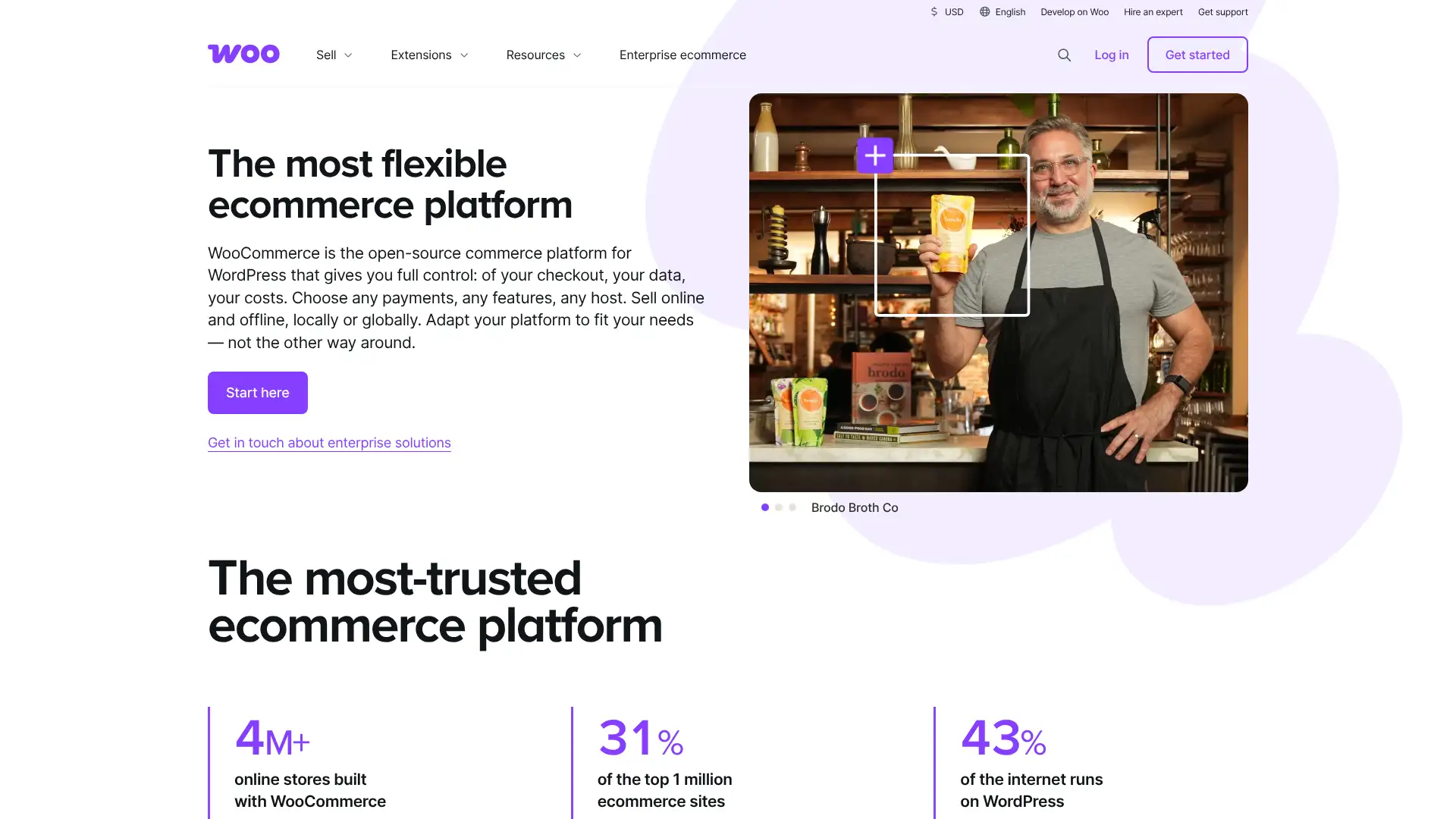
WooCommerce is a free open-source WordPress plugin that transforms any WordPress site into an ecommerce store. It powers 37% of all online stores globally, making it the most widely used ecommerce solution by market share. The plugin itself is free; costs come from WordPress hosting ($10-100+/month), premium plugins (subscriptions $199/year, product add-ons $99/year), and payment gateway fees. WooCommerce's strength is WordPress's 59,000+ plugin ecosystem and best-in-class SEO with Yoast and RankMath. Data and store infrastructure remain fully under the merchant's control, with no vendor lock-in. Technical maintenance (updates, security, performance) is the merchant's responsibility.
- • Free open-source plugin: no platform licensing fee and no transaction fees beyond payment processor rates
- • WordPress SEO: best-in-class SEO via Yoast and RankMath, full URL structure control, sitemap generation
- • 59,000+ WordPress plugins: the largest plugin ecosystem of any ecommerce platform
- • Full data ownership: no vendor lock-in, store database hosted on merchant-controlled infrastructure
- • WooCommerce Blocks: Gutenberg block-based product grids, cart, and checkout for the WordPress editor

WooCommerce is the right choice for merchants who want full data ownership, no platform transaction fees, and the best possible SEO control. The 59,000-plugin ecosystem means virtually any feature is achievable.
BigCommerce
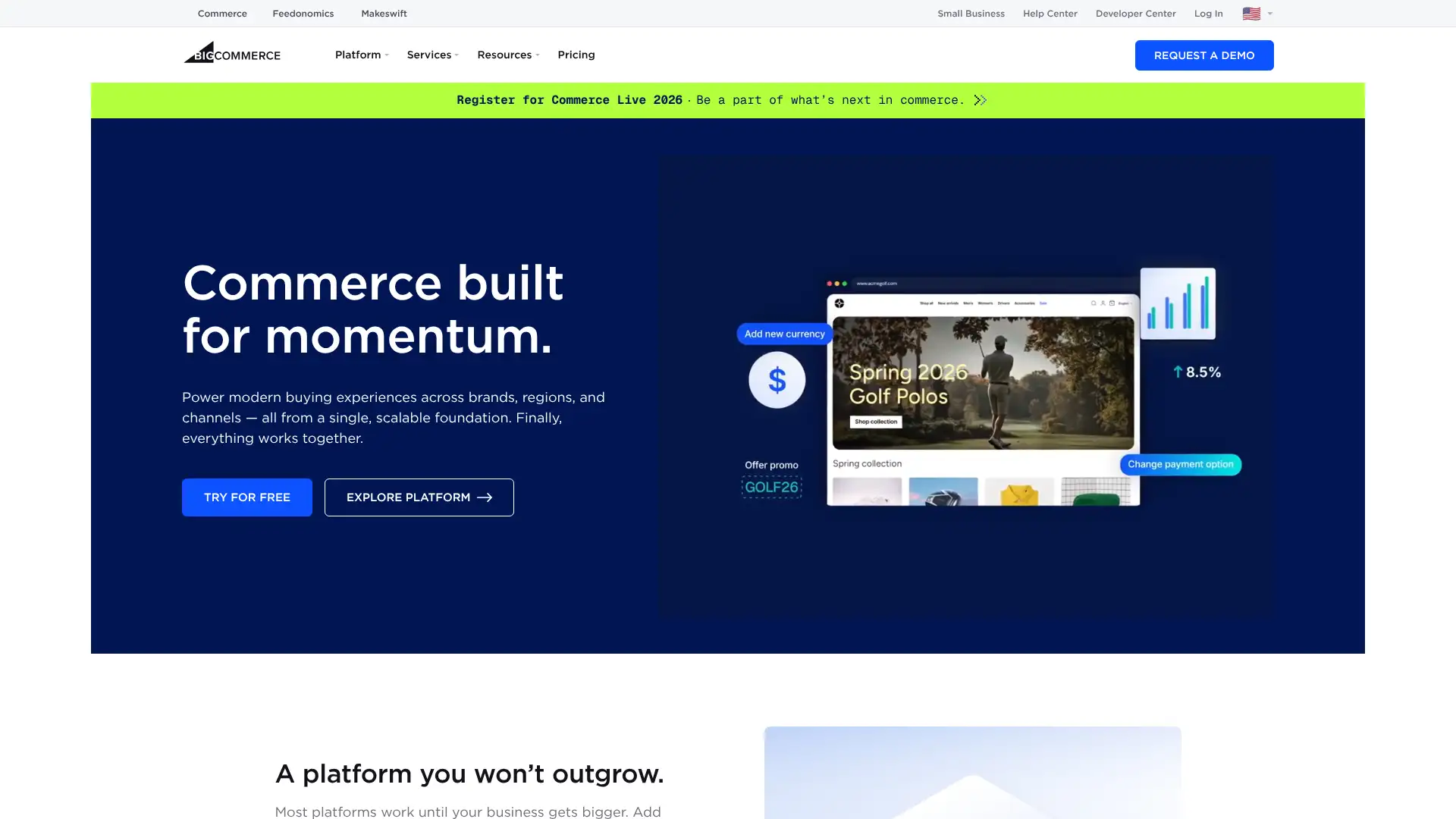
BigCommerce is the closest direct SaaS competitor to Shopify, differentiated by zero transaction fees on all plans and significantly more built-in functionality without requiring paid apps. It includes faceted search, product filtering, customer segmentation, Google AMP, and 100+ currency support natively. Plans are tiered by annual GMV: Standard handles up to $50K, Plus up to $180K, Pro up to $400K. When a merchant exceeds the GMV threshold, BigCommerce automatically upgrades the plan. This GMV-based upgrade model creates unpredictability at growth inflection points. BigCommerce has 65+ payment gateway integrations and supports 140+ currencies.
- • Zero transaction fees on all plans: no platform surcharge when using any of the 65+ integrated payment gateways
- • Faceted search and product filtering built-in: no app required for category filtering on Pro and above
- • 100+ currencies natively: built-in multi-currency support without a plugin or app
- • B2B built-in: customer groups, quote management, and wholesale pricing available without Shopify Plus
- • Headless via BigCommerce Catalyst: Next.js starter storefront for headless deployments
BigCommerce is the best hosted SaaS alternative to Shopify for stores doing over $50K/year in annual sales. The zero transaction fees and more built-in B2B features make the total cost of ownership lower than Shopify at volume.

Squarespace ecommerce
Squarespace is primarily a website builder that added ecommerce capability, making it the best choice for creative businesses where brand aesthetics matter more than commerce depth. All four plans now include ecommerce functionality. The Basic plan charges a 2% transaction fee on store sales and 7% on digital products and memberships. Core and higher plans eliminate transaction fees on physical products. Squarespace does not support multi-currency selling, making it unsuitable for international stores. The extension marketplace has approximately 50 official add-ons, far fewer than Shopify or BigCommerce. Template quality is the strongest in the category.

- • 194+ professionally designed templates: the best-looking template library of any ecommerce platform
- • Squarespace Payments: built-in payment processing with no third-party fees on Core and above
- • Unlimited products on all plans: no product count limit regardless of plan tier
- • Acuity Scheduling integration: appointment booking for service businesses alongside product selling
- • Squarespace Blueprint AI: AI-powered website builder generates a site draft in minutes
Squarespace ecommerce is the best ecommerce platform for creative businesses, photographers, artists, and small product-catalog stores where brand aesthetics are the priority. Not suitable for large catalogs, international multi-currency selling, or high-volume stores that need a deep app ecosystem.
Wix ecommerce
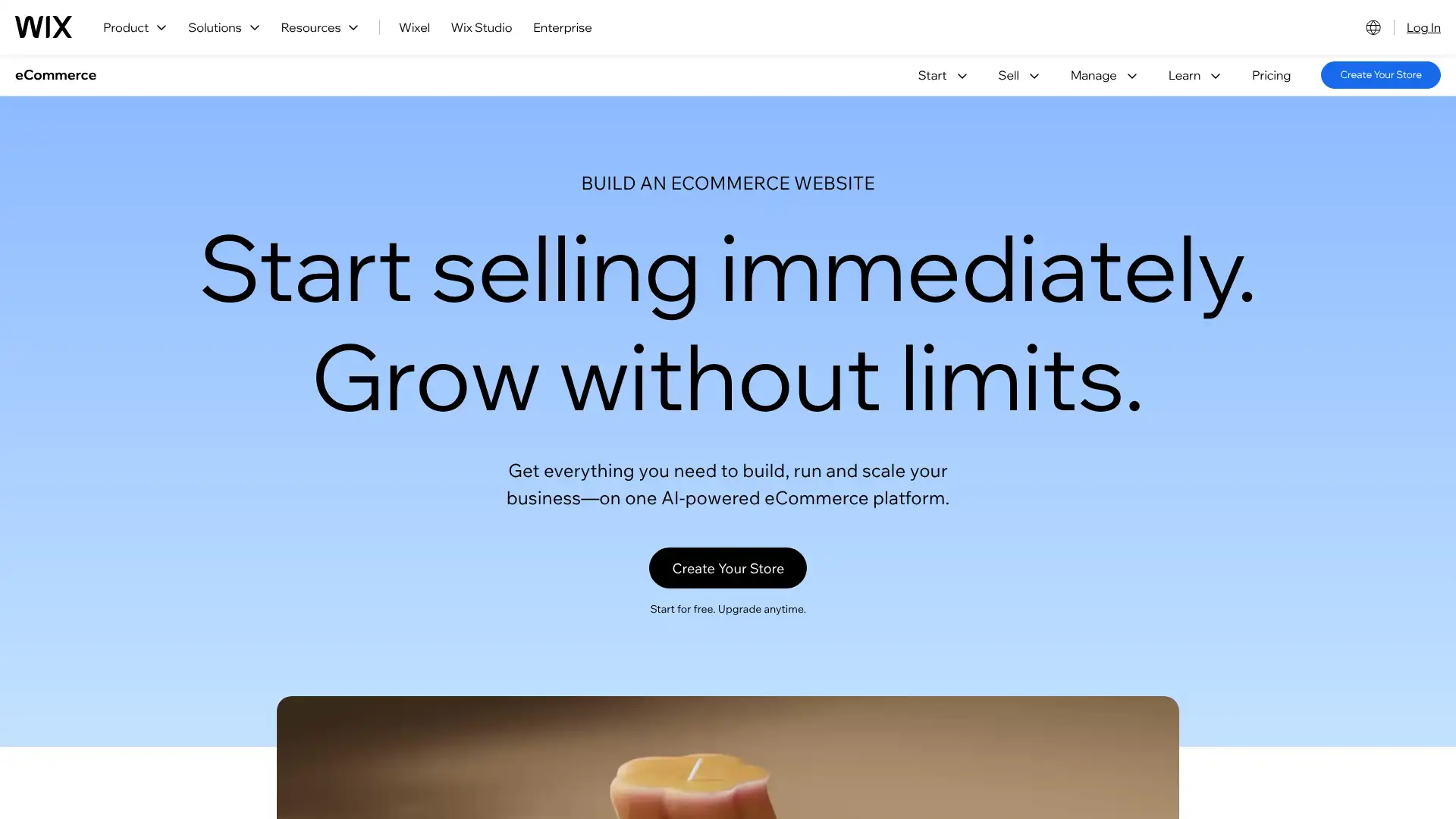
Wix is a general-purpose website builder with strong ecommerce functionality available from the Core plan ($29/month) upward. The AI website builder can generate a complete store from a description in minutes, which is the fastest path to a live store of any platform reviewed. Wix supports POS integration (Wix Payments), omnichannel selling, dropshipping, and up to 50,000 products. Wix has a critical limitation: you cannot switch templates after publishing, and migrating data out of Wix is among the most difficult of any platform. This creates genuine vendor lock-in risk for stores that outgrow the platform.
- • Wix AI builder: generates a complete store from a text prompt in minutes, the fastest setup of any platform
- • 2,000+ templates: the largest template library of any ecommerce platform reviewed
- • POS integration: Wix Payments syncs online and in-person sales with unified inventory management
- • Dropshipping: built-in dropshipping connections without a third-party app
- • Wix Payments: 0% transaction fees on Business and Business Elite when using Wix's payment processor
Wix ecommerce is the best choice for complete beginners who want to launch a store quickly without technical knowledge. The AI builder and 2,000+ templates remove virtually all setup friction.
Adobe Commerce (Magento)
Adobe Commerce (formerly Magento) is the enterprise evolution of the Magento open-source platform, acquired by Adobe in 2018. It is designed for large retailers needing multi-store, multi-language, multi-currency operations from a single backend. The open-source community edition (Magento Open Source) remains free. Adobe Commerce Cloud (the managed SaaS version) starts around $40,000/year and scales with GMV. License cost for the on-premise enterprise edition ranges from $25,000 to $100,000+ annually based on GMV. Adobe Commerce is used by enterprise retailers who have in-house development teams or agency partners. Security patches require manual application and are a significant operational overhead.

- • Multi-store architecture: manage multiple distinct storefronts from a single admin panel
- • B2B module: native B2B features including company accounts, quote management, and purchase orders
- • PWA Studio: headless PWA frontend framework for decoupled storefront development
- • 60,000+ Magento Marketplace extensions: large commercial extension ecosystem
- • Adobe Experience Platform integration: connects to Adobe Analytics, Target, and Campaign for enterprise marketing
Adobe Commerce is the right choice for large retailers with in-house development teams who need multi-store management, advanced B2B features, and full infrastructure control. The enterprise license and implementation complexity make it unsuitable for small to mid-market merchants.
PrestaShop
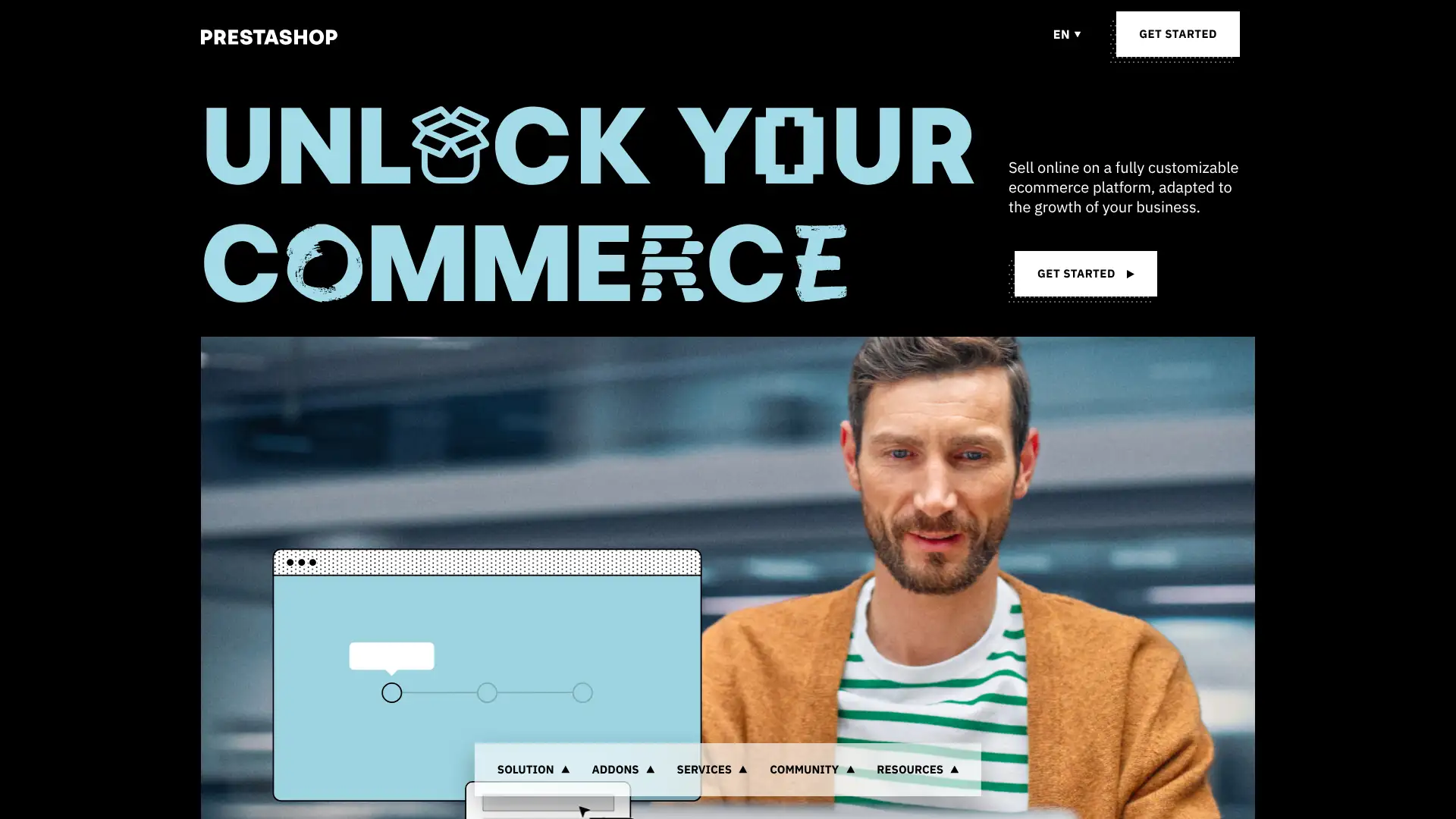
PrestaShop is a free open-source ecommerce platform written in PHP, powering over 300,000 active stores worldwide, with particularly strong adoption in France, Spain, and Latin America. The platform itself is free to download and self-host. Costs come from hosting ($10-100+/month), premium modules and themes, and optional PrestaShop platform services. The module marketplace contains over 5,000 modules for extensions. PrestaShop has strong native multilingual support (75+ languages) and multi-currency out of the box, making it popular for European merchants who need localisation features. Technical knowledge is required for installation and maintenance.
- • Native multilingual support: 75+ languages built-in without additional modules
- • Multi-store management: run multiple storefronts from one admin panel
- • 5,000+ modules on PrestaShop Marketplace: commercial extension library for any functionality
- • Native multi-currency: supports multiple currencies with real-time exchange rates without plugins
- • PrestaShop Horizon: modernised admin interface introduced in recent versions
PrestaShop is the best free open-source platform for European merchants who need native multilingual and multi-currency support without additional modules. Strong for mid-size stores with development resources. For merchants who want a managed SaaS platform without server management, Shopify or BigCommerce eliminate the infrastructure overhead.
OpenCart
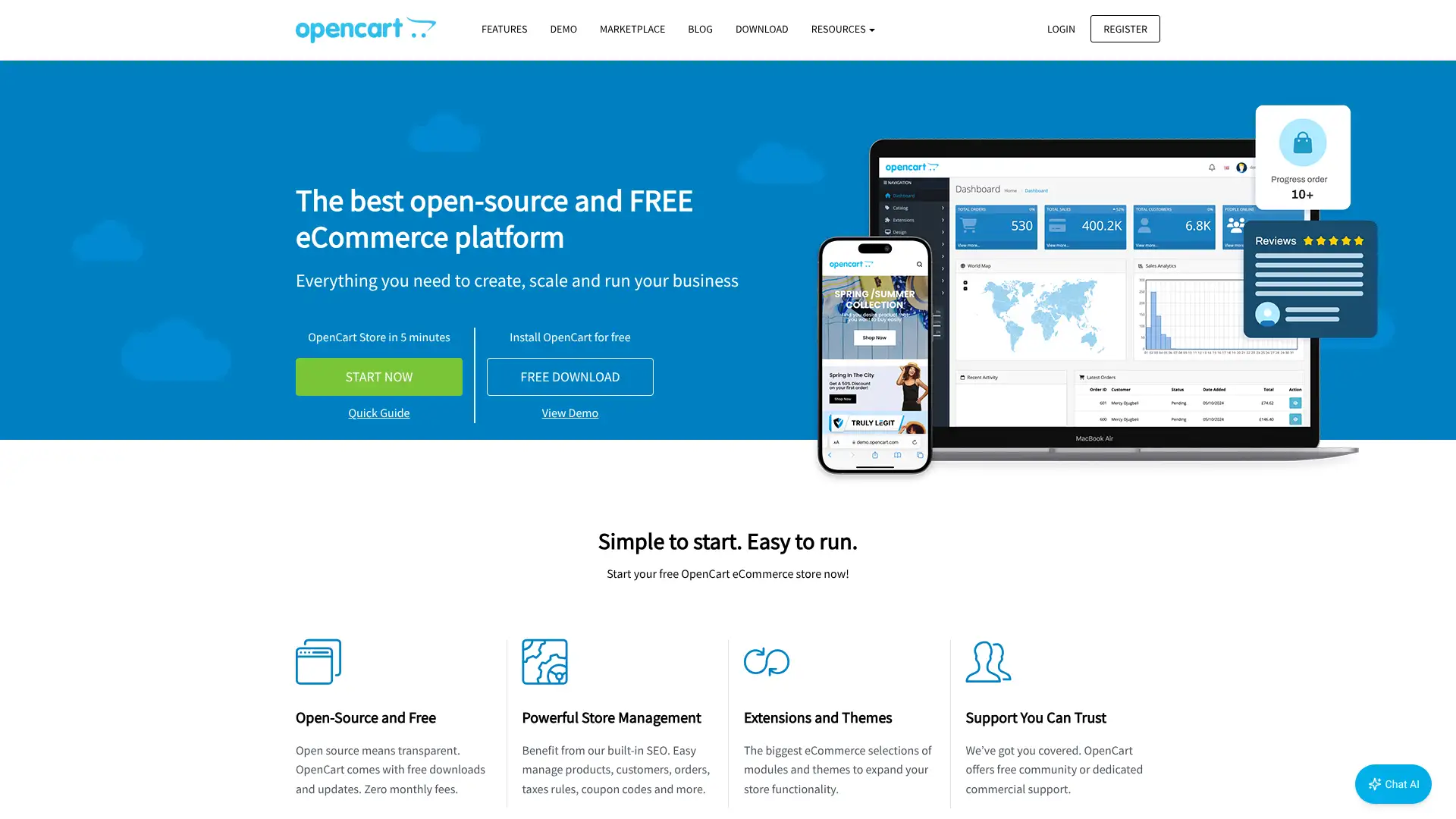
OpenCart is a free open-source PHP ecommerce platform powering over 470,000 stores worldwide. It is lighter and simpler than Magento or PrestaShop, making it easier to set up for developers with basic PHP knowledge. The admin interface is straightforward with product management, order management, and reporting built in. OpenCart has 13,000+ free and paid extensions. Multi-store functionality allows managing multiple storefronts from one admin. It lacks some advanced features of PrestaShop or Magento out of the box, but its simplicity and low resource requirements make it practical for small stores with basic requirements.
- • Multi-store: manage multiple storefronts from a single admin panel without additional cost
- • 13,000+ extensions: marketplace covering payment gateways, shipping, marketing, and themes
- • Multi-language and multi-currency: built-in support for international selling
- • Lightweight codebase: lower server resource requirements than Magento or PrestaShop
- • Product reviews and ratings: customer review system included without an extension
OpenCart is a practical choice for small stores with simple requirements where a developer wants a lightweight PHP platform without the complexity of Magento or PrestaShop. For stores that need more sophisticated features, PrestaShop provides richer out-of-the-box functionality.
Volusion
Volusion is one of the original hosted SaaS ecommerce platforms, operating since 1999. It differentiates itself through live phone and chat customer support on all plans, which is a meaningful advantage for non-technical merchants compared to Shopify's email-only support on lower tiers. Volusion includes bulk product import, an inventory grid for managing variants, and a built-in analytics dashboard. Plans are limited by annual GMV (Volusion upgrades or charges overage when GMV limits are exceeded). Volusion has faced financial difficulties in recent years including a 2020 bankruptcy filing, though it emerged from restructuring and remains operational.

- • Live phone and chat support on all plans: unlike Shopify, which restricts phone support to higher tiers
- • Bulk product import: CSV import for large catalog uploads without manual entry
- • Inventory grid: manage product variants and stock levels across categories in one view
- • Built-in newsletter tool: email marketing on Professional and above without a third-party service
- • StripePay integration: Stripe payments supported alongside Volusion's native payment processing
Volusion is a reasonable choice for US merchants who specifically value live phone support on a low-cost plan and need bulk catalog management tools. The 2020 bankruptcy and platform emergence creates some consideration for merchants evaluating long-term platform stability.
Shift4Shop (3dcart)
Shift4Shop (formerly 3dcart) offers one of the most compelling free plans in ecommerce: US merchants who use Shift4 Payments as their payment processor and process a minimum of $500/month receive the full-featured End-to-End plan at $0/month. This includes unlimited products, no GMV limits, all built-in features, and no transaction fees beyond Shift4's 2.9% + $0.30 standard rate. Shift4Shop added Affirm BNPL and enhanced Klaviyo integration in 2025. The platform has a comprehensive feature set but a less polished design compared to Shopify or Squarespace. The $0 plan is restricted to US merchants; international merchants pay from $29/month.

- • Free full-featured plan for US merchants: $0/month when using Shift4 Payments with minimum $500/month in processing
- • Affirm BNPL: buy now, pay later option integrated natively for checkout conversion
- • Klaviyo integration: enhanced email marketing automation connected to store purchase data
- • Amazon and eBay marketplace feeds: native marketplace product feed sync without third-party apps
- • 500+ free themes: the largest free theme library of any ecommerce platform in the comparison
Shift4Shop is the best value ecommerce platform for US merchants who want zero platform cost and are comfortable using Shift4 as their payment processor. The free End-to-End plan provides comparable functionality to Shopify Basic and Grow without the monthly subscription.
Ecwid by Lightspeed
Ecwid is unique among ecommerce platforms: it embeds as a store widget into any existing website (WordPress, Squarespace, Wix, custom HTML) without requiring a full platform migration. This makes it the best option for merchants who have an existing site and want to add ecommerce without rebuilding. Ecwid was acquired by Lightspeed in 2022. Pricing changed in March 2026 with increases to the Venture, Business, and Unlimited plans. The free Starter plan supports up to 10 products with a .ecwid.com subdomain. Social selling on TikTok, Instagram, and Facebook is available on paid plans. POS sync with Lightspeed Retail, Square, and Clover is a key feature for brick-and-mortar retailers adding online selling.

- • Embeddable widget: add an ecommerce store to any existing website by pasting a code snippet
- • POS sync: connect to Lightspeed Retail, Square, or Clover for unified online and in-person inventory
- • TikTok for Business: launch TikTok product ads directly from the Ecwid admin without a CSV export
- • Buy Now button: embed a single-product checkout button anywhere (blog, landing page, link in bio)
- • Apple Wallet order tracking: customers track orders via Wallet push notifications post-checkout
Ecwid by Lightspeed is the best choice for merchants who have an existing website and want to add selling capability without platform migration. The embed approach is its core differentiator. For merchants starting from scratch or building a full ecommerce-first presence, Shopify or BigCommerce provide more complete standalone platforms.
Big Cartel
Big Cartel is built specifically for artists, musicians, and independent makers. It has a genuine free plan (no credit card required, no expiry) for up to 5 products. Paid plans unlock more products (50 on the $15 plan, 500 on the $30 plan) with no transaction fees beyond payment processor rates. The platform intentionally stays simple: there are no apps, no upsells, and no transaction fees. The trade-off is limited functionality compared to Shopify. PayPal and Stripe are the two supported payment processors. Bulk discount codes, inventory tracking, and real-time sales stats are available on paid plans. Best suited for creative sellers with a focused small catalog.

- • Genuine free plan: up to 5 products with no expiry and no credit card required
- • No transaction fees on any plan: pay only payment processor fees (Stripe or PayPal)
- • Simple product management: designed for artists selling a small focused collection
- • Google Analytics integration: track traffic and conversions without a separate app
- • Bulk discount codes: create and distribute discount codes from the Platinum plan
Big Cartel is the best free option for artists, musicians, and independent makers selling a small focused product collection. The no-transaction-fee model and genuine free plan with no expiry make it genuinely useful for early-stage creative sellers.
Sellfy
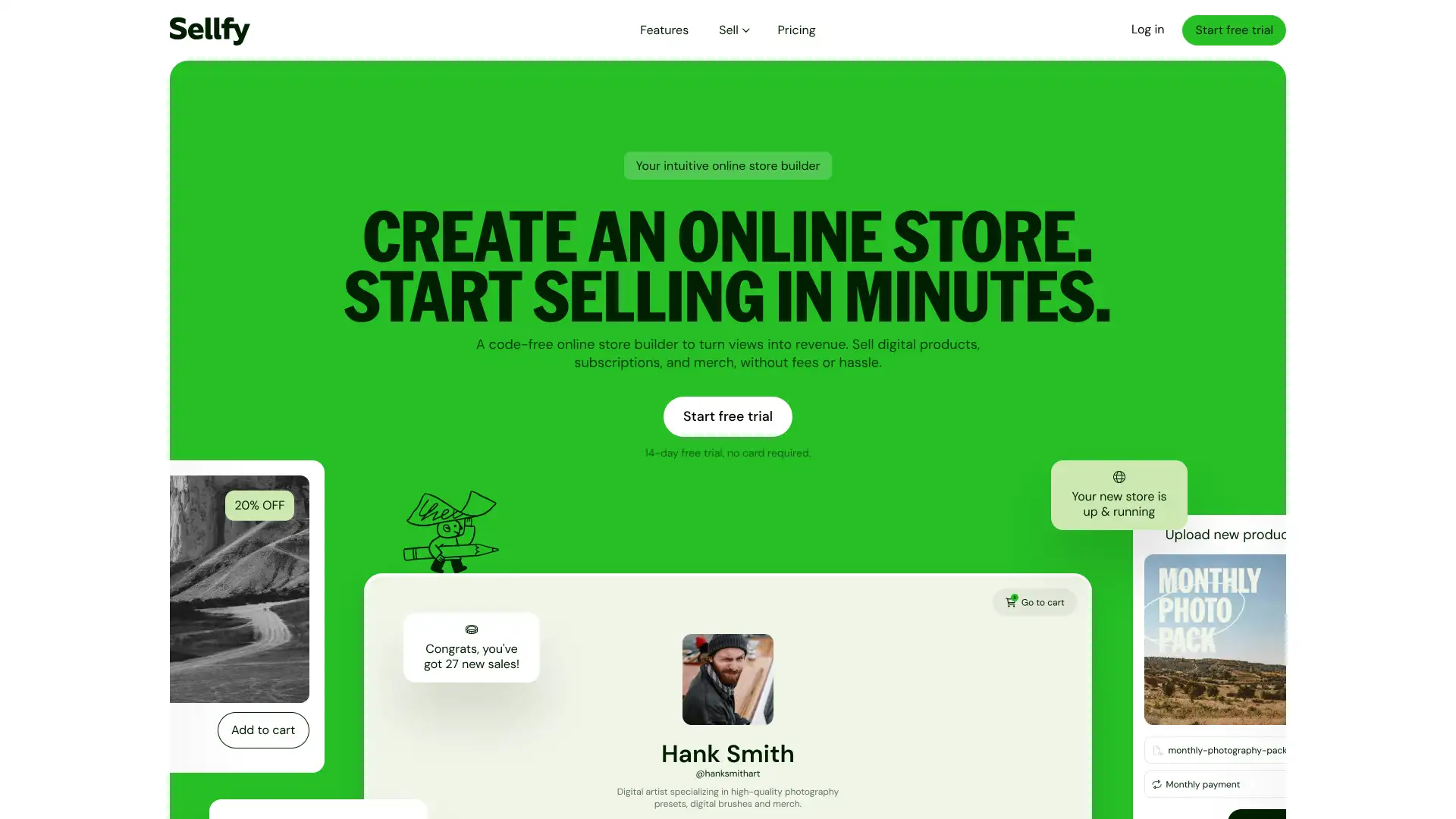
Sellfy is a hosted creator commerce platform for digital products, physical goods, subscriptions, and print-on-demand merchandise, all from one storefront without needing plugins. Unlike Gumroad, Sellfy charges no transaction fees on any paid plan (payment processor fees still apply). The print-on-demand integration allows creators to upload designs, and Sellfy handles printing and shipping automatically without upfront inventory. Paid plans have annual sales caps ($10K on Starter, $50K on Business, $200K on Premium). Sellfy also offers embeddable buy buttons and product cards for embedding individual products on external sites.
- • Print-on-demand: upload designs, Sellfy prints and ships merchandise automatically without upfront stock
- • 0% transaction fees on all paid plans: pay only Stripe/PayPal processor rates
- • Embeddable buy buttons: embed individual products or a full storefront widget on any external website
- • Digital product delivery: automatic file delivery after purchase with PDF stamping for ebooks
- • Email marketing: built-in email campaigns to product buyers without a third-party email tool
Sellfy is the best all-in-one platform for creators who sell a mix of digital downloads, physical goods, and print-on-demand merchandise. The 0% transaction fees and built-in POD differentiate it from Gumroad.
Gumroad
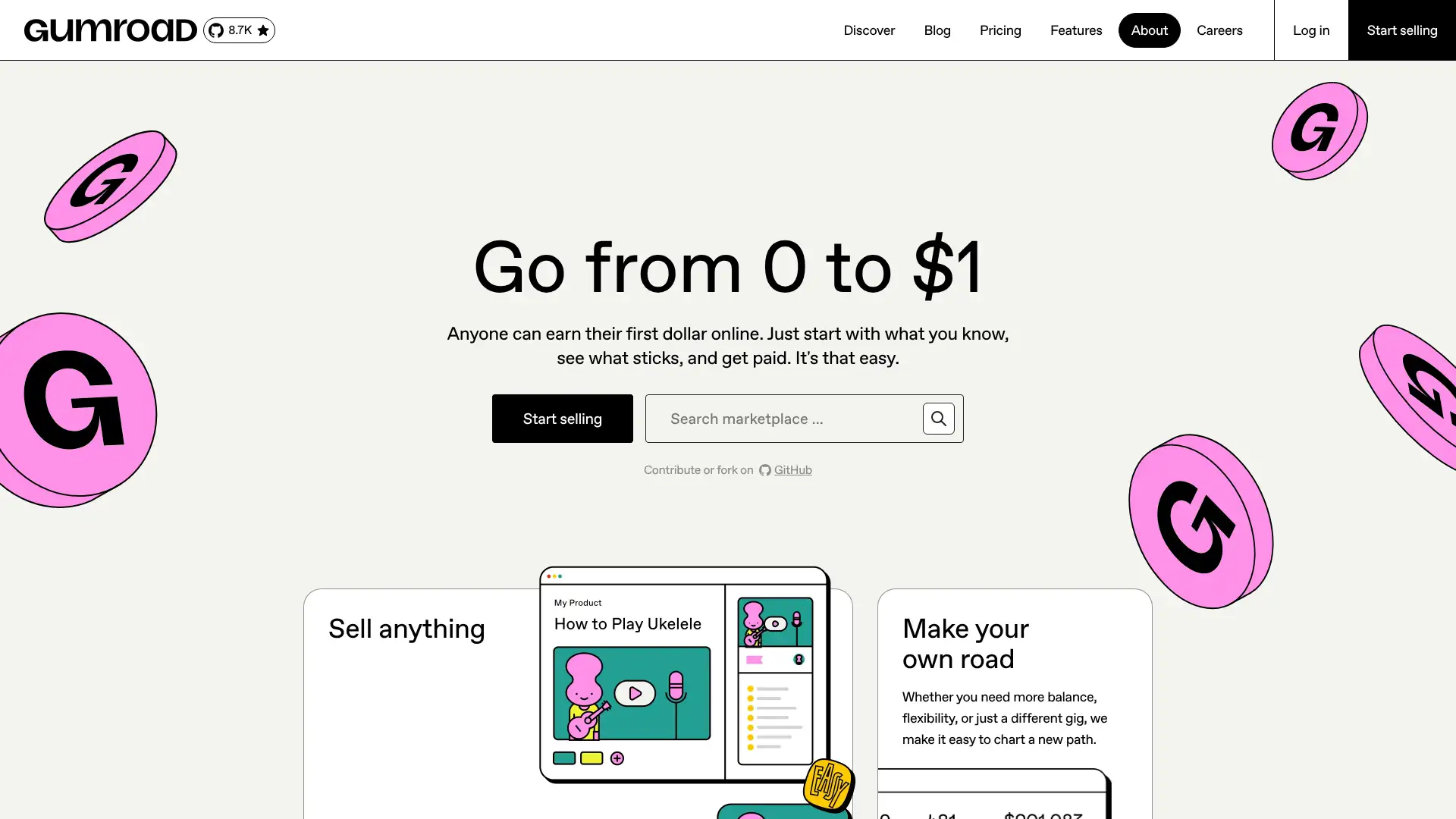
Gumroad is the original digital creator commerce platform, launched in 2011, with over 10 million buyers in its marketplace. The free plan allows unlimited products with a 10% + fees per sale charge. Gumroad's key differentiator is its built-in marketplace, which drives organic discovery traffic for creators without an existing audience. The platform handles taxes on sales in US states where required, but does not act as a full merchant of record for international VAT, which is a significant liability for creators selling digital products globally. Paid plans start at $10/month with reduced fees. Gumroad's simplicity is both its strength and limitation: setup takes minutes, but advanced features like subscriptions, license keys, and tax compliance are limited.
- • Built-in creator marketplace: products listed on Gumroad can be discovered by existing buyers organically
- • Instant activation: start selling within minutes with no approval process
- • Digital product delivery: ebooks, videos, audio, software, and PDFs delivered automatically on purchase
- • Pre-orders: accept pre-orders and charge when a product ships
- • Email list building: every buyer added to the seller's email list automatically
Gumroad is the best starting point for new creators who lack an existing audience and want organic discovery through Gumroad's marketplace. The 10% commission becomes expensive at volume: a creator doing $5,000/month in sales pays $500/month in Gumroad fees versus around $100 on Lemon Squeezy.
Lemon Squeezy
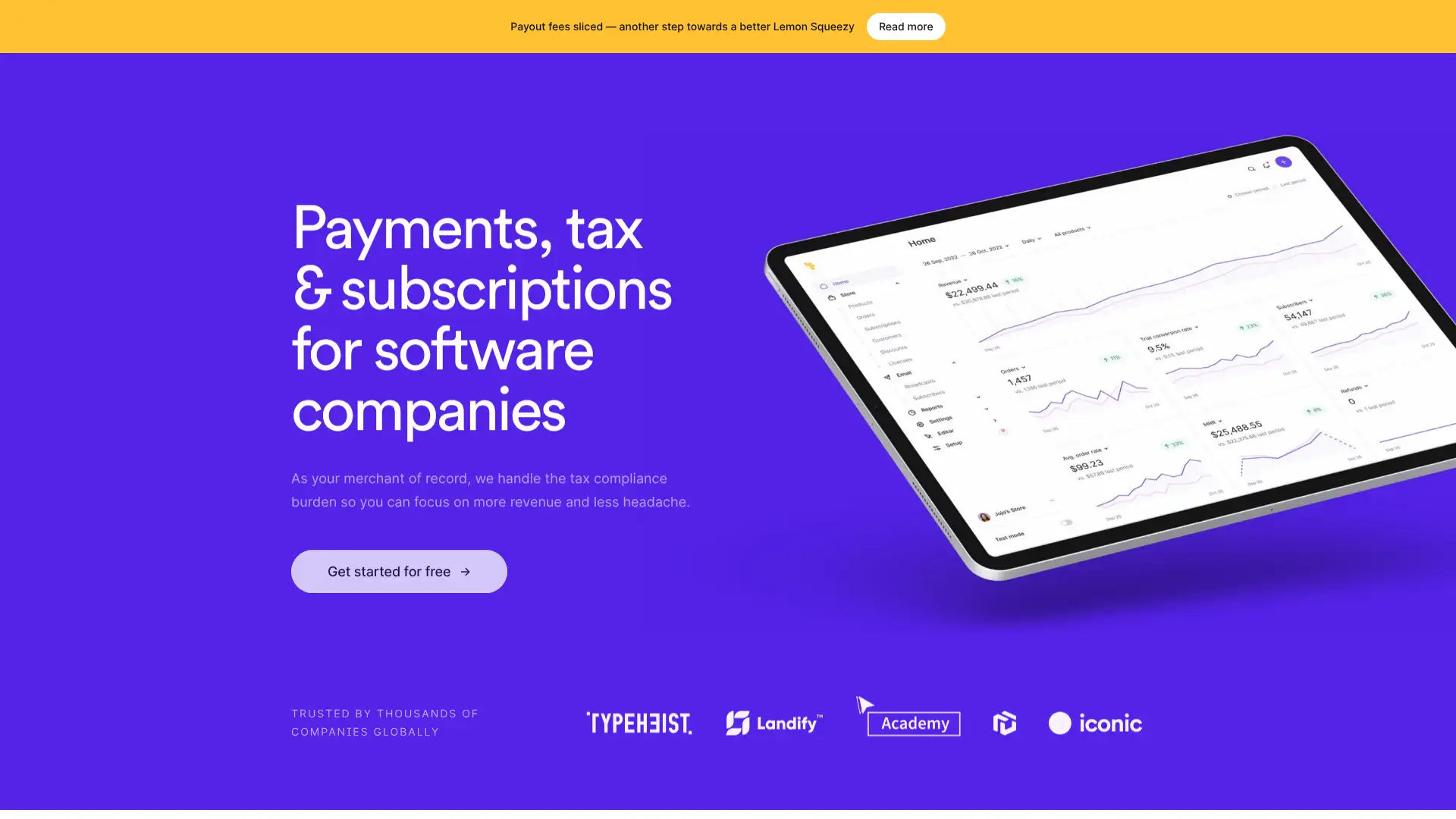
Lemon Squeezy acts as the merchant of record for every transaction, taking full legal responsibility for tax compliance (VAT, GST, sales tax) across 135+ countries. This means sellers receive clean payouts with all tax handling done by Lemon Squeezy. It is built specifically for developers selling software, SaaS subscriptions, plugins, templates, and digital licenses. License key delivery, subscription billing with failed payment recovery, and a developer-friendly API are core features. Lemon Squeezy was acquired by Stripe in July 2024. Post-acquisition, users report longer onboarding approval times and an extended sign-up review process. There is no monthly subscription fee: the platform charges 5% + $0.50 per transaction.
- • Merchant of record: Lemon Squeezy assumes full legal liability for VAT, GST, and sales tax across 135+ countries
- • License key delivery: automatic unique license key issued on software purchase for piracy prevention
- • Subscription billing: recurring SaaS billing with automated dunning and failed payment recovery
- • Developer API: RESTful API for programmatic checkout, webhooks, and customer lifecycle management
- • Built-in email list: every buyer added to seller's list with automatic segmentation
Lemon Squeezy is the best choice for independent developers, SaaS founders, and plugin creators who sell globally and need automatic VAT/GST compliance. The merchant-of-record model eliminates the most significant legal risk of global digital product sales.
Paddle
Paddle is a revenue delivery platform and merchant of record used by SaaS companies and software businesses. Unlike Lemon Squeezy which targets indie creators, Paddle is positioned for established SaaS and software companies with higher revenue volumes and enterprise requirements. Paddle handles tax compliance across 200+ countries, supports 200+ payment methods including local payment methods in emerging markets, and provides subscription management with automatic churn recovery. Paddle charges 5% + $0.50 per transaction (all-inclusive, covering tax remittance). Paddle is generally harder to get started on than Lemon Squeezy, with higher minimum revenue requirements and a business review process.

- • Merchant of record across 200+ countries: the broadest international coverage of any MOR platform
- • 200+ payment methods: local payment methods in emerging markets not supported by Stripe or Gumroad
- • Subscription management: recurring billing with dunning, plan changes, pauses, and cancellation flows
- • Fraud protection: Paddle assumes chargeback liability as the merchant of record
- • Paddle Retain: automated subscription churn recovery including card update prompts and pause options
Paddle is the right choice for established SaaS businesses with recurring revenue who need the broadest possible international payment coverage and comprehensive tax compliance. For indie creators and smaller developers who want fast onboarding without a revenue requirement, Lemon Squeezy provides the same merchant-of-record model with easier
Podia
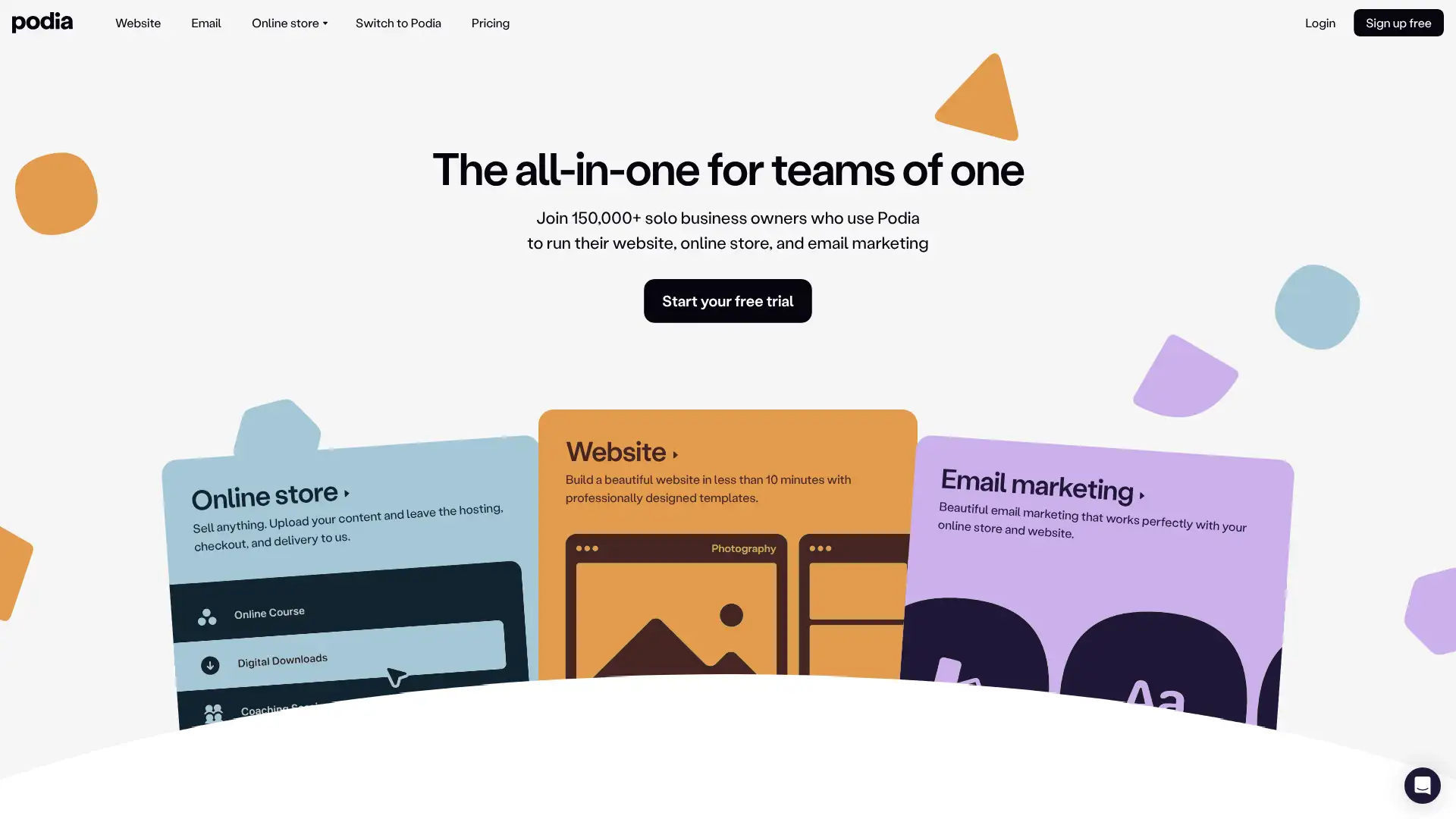
Podia is an all-in-one platform combining online course hosting, digital product sales, community, website builder, and email marketing in one dashboard. It targets knowledge creators, coaches, and educators who want to reduce the number of separate tools in their stack. Unlike pure course platforms like Teachable or Thinkific, Podia also handles digital downloads and memberships. The platform has no transaction fees on paid plans. Email marketing is included but priced based on subscriber count above the base tier. The Starter plan is free with an 8% transaction fee.
- • Online course builder: drip-schedule lessons, quizzes, progress tracking, and certificates
- • Digital downloads: sell ebooks, templates, audio, and other files alongside courses
- • Community: built-in community spaces for course students and membership subscribers
- • Email marketing: broadcast and automation sequences to students and buyers without ConvertKit
- • Website builder: landing pages and a full site built around the course and product catalog
Podia is the best all-in-one platform for knowledge creators who want to sell courses, memberships, and digital products while building an email list and community without assembling multiple separate tools. For creators who primarily sell software or SaaS subscriptions, Lemon Squeezy provides better developer tooling.
Square Online
Square Online is the ecommerce extension of Square's point-of-sale ecosystem, providing a free online store that synchronises inventory, orders, and customer data with Square POS hardware. The free plan includes a complete online store (with Square branding and a .square.site subdomain). Paid plans from $29/month unlock custom domains, no Square branding, and additional shipping and marketing features. Square Online is specifically designed for physical retailers who already use Square POS and want to add online selling without a separate platform. Square processes payments at 2.9% + $0.30 per online transaction on all plans.

- • Native Square POS sync: inventory, orders, and customer data sync between online and physical stores in real time
- • Free complete online store: functional storefront including unlimited products at $0/month
- • Curbside pickup and local delivery: built-in fulfilment options for local retailers
- • Instagram and Facebook selling: sync products to social media channels on paid plans
- • Square appointments: booking system integration for service businesses
Square Online is the best choice for brick-and-mortar retailers already using Square POS who want to add an online store without switching payment processors or managing two separate inventory systems. For merchants building an ecommerce-first business without physical retail, Shopify or BigCommerce provide more complete commerce tooling.
Weebly
Weebly is a drag-and-drop website builder with ecommerce capability, acquired by Square in 2018. It shares Square's payment infrastructure and integrates with Square POS for in-person selling. The free plan includes an online store with Square processing. Weebly is positioned at the simpler end of the website builder spectrum: less powerful than Wix but easier to use. Product limits and feature depth vary by plan. Weebly has been largely stagnant in feature development since the Square acquisition, as Square focuses primarily on Square Online for ecommerce. Weebly is suitable for very simple stores where ease of use is the primary requirement.

- • Square POS integration: sync with Square hardware for in-person and online selling from one inventory
- • Free plan with online store: complete ecommerce functionality at $0, including unlimited products on Professional+
- • Drag-and-drop editor: simpler and more beginner-friendly than Wix for non-technical users
- • Product reviews: customer review system available on Performance plan
- • App Centre: Weebly's extension marketplace for additional functionality
Weebly is a reasonable starting point for merchants who want the simplest possible website builder with basic ecommerce and Square POS integration. Limited new feature development since the Square acquisition means Weebly is not a platform to build a growing business on.
GoDaddy ecommerce
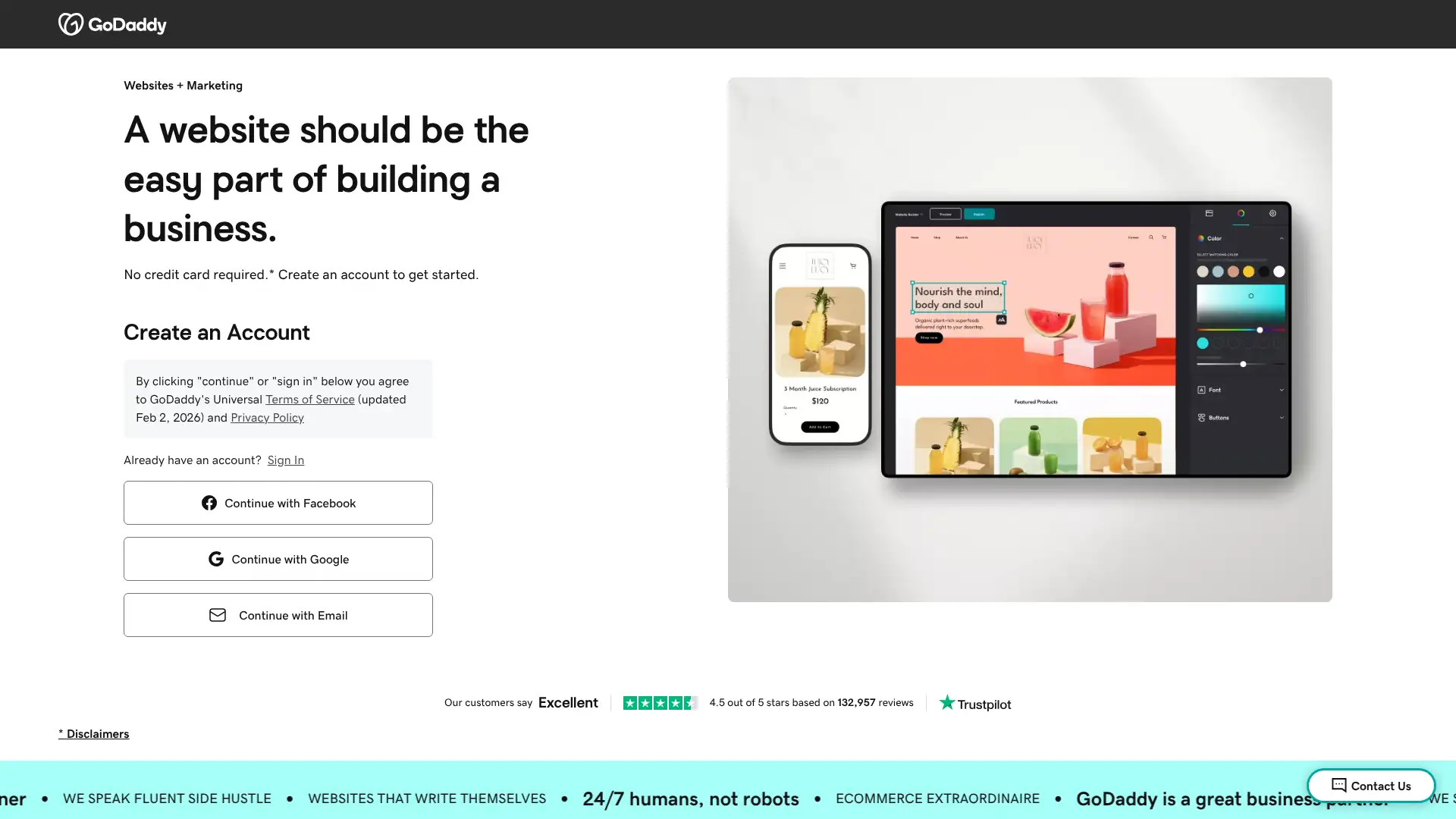
GoDaddy's ecommerce offering is built into its website builder plans and targeted at small businesses who are already GoDaddy customers (domain registration, hosting). It includes a fast AI-assisted setup, built-in SEO tools, email and social marketing, and appointment booking. GoDaddy's ecommerce is less feature-rich than Shopify or BigCommerce, but the Commerce plan at $20.99/month is one of the most affordable paid ecommerce plans among builders. The platform integrates with marketplaces (Amazon, eBay, Etsy) and social channels on higher tiers. GoDaddy processes payments at 2.3% + $0 on the Commerce plan.
- • AI-assisted setup: fast site generation from a business description with pre-populated product pages
- • Marketplace sync: Amazon, eBay, and Etsy product sync on Business Plus and above
- • Built-in email marketing: email campaigns to customers without Klaviyo or Mailchimp
- • Appointment booking: service business booking integrated with the online store
- • 2.3% + $0 processing: lower than Shopify (2.9% + $0.30) for in-person transactions
GoDaddy ecommerce is the most cost-effective full ecommerce plan for small businesses already in the GoDaddy ecosystem (domain, hosting, email). For businesses starting fresh or expecting significant ecommerce growth, Shopify or BigCommerce provide more commerce depth and larger app ecosystems.
Zyro ecommerce
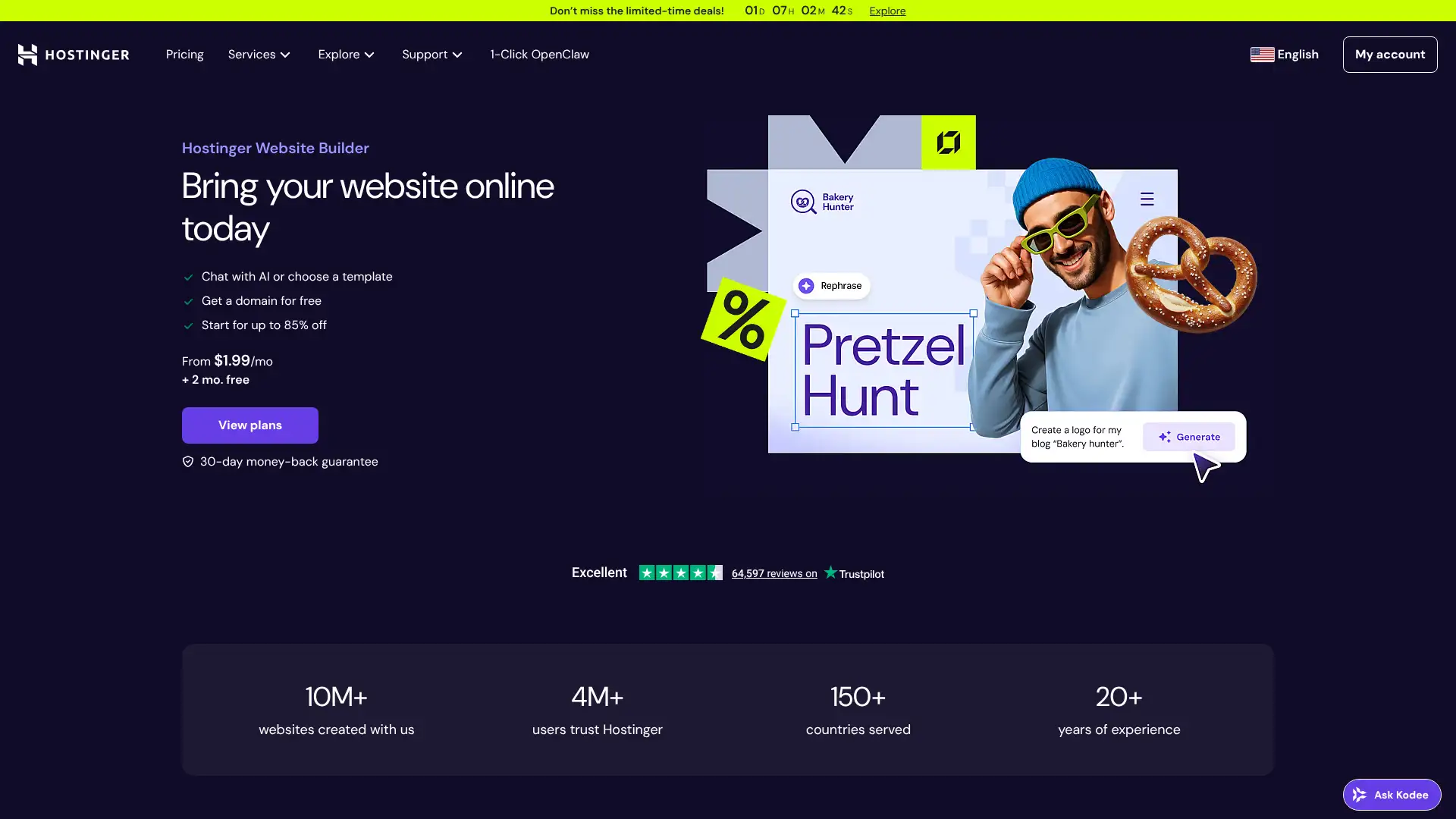
Zyro was rebranded as Hostinger Website Builder in 2023 when Hostinger (Zyro's parent company) consolidated its products. The ecommerce functionality is now available through Hostinger's website builder plans. It is positioned as a budget-friendly alternative to Wix and Squarespace, offering AI-powered website and logo generation at the lowest price point of any full ecommerce builder. Hostinger's ecommerce plans start at $3.99/month. The feature set is more limited than Shopify or Wix, but the price-to-feature ratio is the best of any hosted ecommerce builder for very simple stores. Previously marketed as Zyro, all new users access this through Hostinger's website builder.
- • AI logo maker: generates branded logo from business name and industry without a designer
- • 0% transaction fees on all plans: no platform surcharge beyond payment processor rates
- • Unlimited products on all ecommerce plans: no product count limit
- • AI content writer: generates product descriptions and page copy automatically
- • Heatmap analytics: built-in visitor behaviour heatmap without a third-party tool
Zyro ecommerce is the best choice for merchants who want the lowest possible monthly cost for a full ecommerce store with 0% transaction fees and AI tools. For stores expecting to grow significantly or needing a larger app ecosystem, Shopify or BigCommerce provide better long-term scalability at a
Saleor
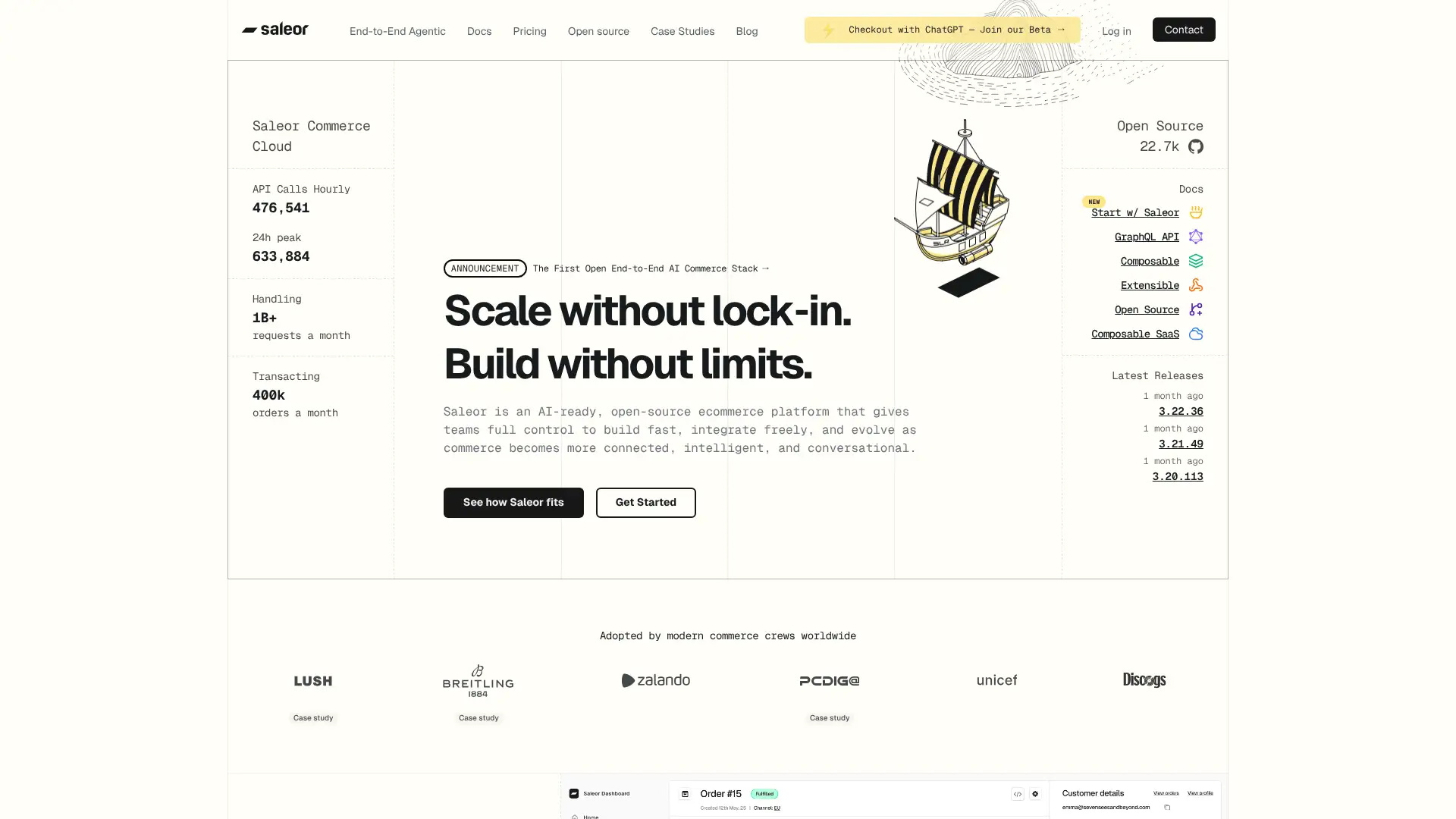
Saleor is an open-source headless ecommerce platform built on Python, Django, and GraphQL, positioned as an open-source alternative to enterprise platforms. It is GraphQL-first: all commerce operations (products, carts, orders, payments) are exposed through a GraphQL API, making it a natural fit for JavaScript frontend teams using Next.js or React. Saleor Cloud provides managed hosting with cloud pricing based on monthly order volume. The self-hosted version is free. Saleor requires significant developer investment for setup, hosting, security, and maintenance. It is used by brands requiring multi-currency, multi-channel, and multi-language at scale.
- • GraphQL-first API: every commerce operation available via GraphQL for modern JavaScript frontend integration
- • Multi-channel: separate storefronts, pricing rules, and inventory for different channels from one backend
- • Multi-currency and multi-language: international commerce built into the core, not an add-on
- • Django admin: full-featured management dashboard for product, order, and customer management
- • Storefront examples: Next.js and React storefront starter kits available on GitHub
Saleor is the best open-source headless commerce platform for teams with Python expertise who want GraphQL-native architecture and full code ownership. For JavaScript-native teams, Medusa.js provides a Node.js-based alternative with equivalent flexibility. For managed enterprise headless commerce without self-hosted infrastructure, commercetools provides a fully managed MACH platform.
Medusa.js
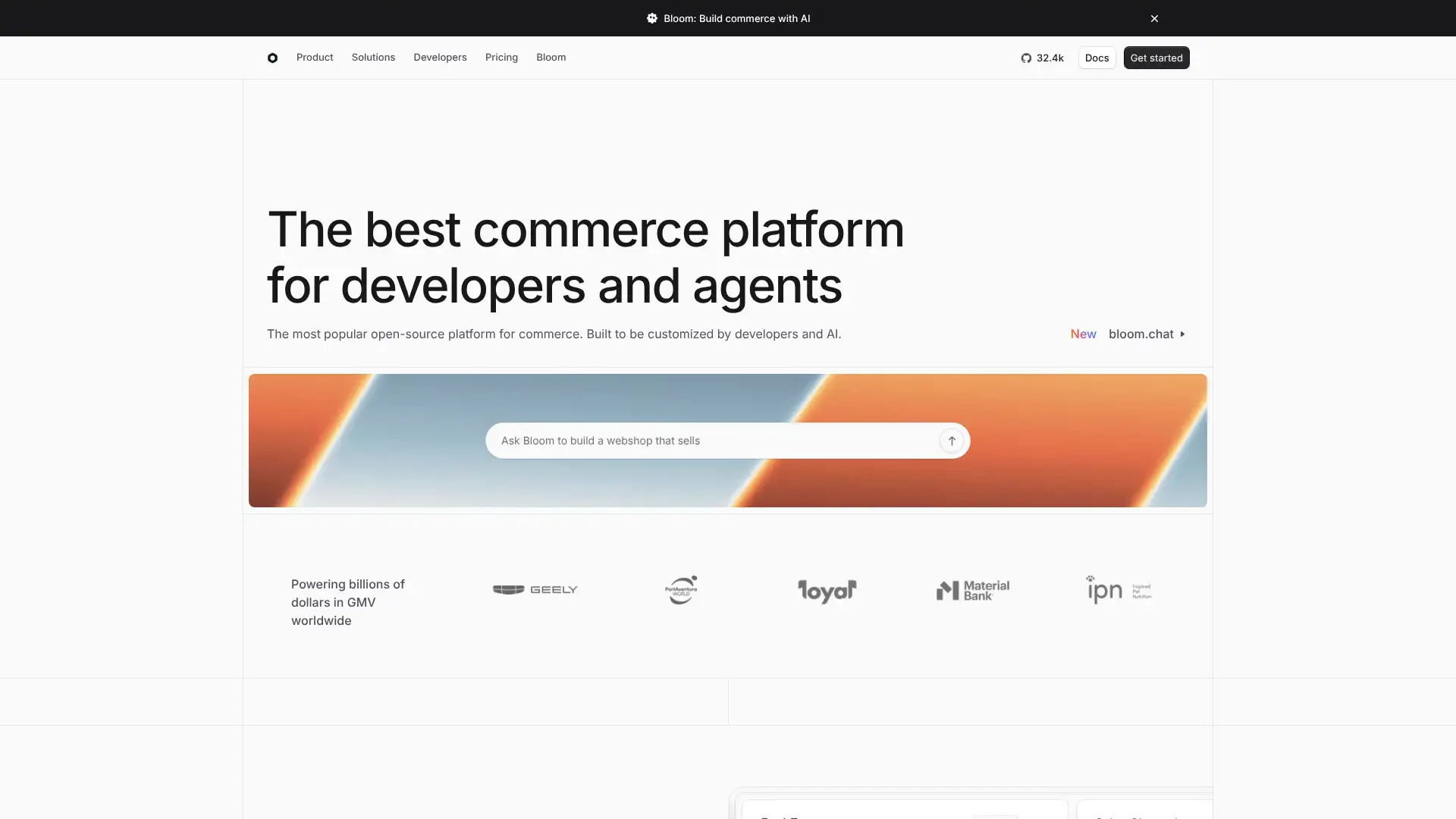
Medusa is an open-source Node.js headless commerce framework positioning itself as the open-source Shopify alternative. It provides a modular commerce backend with REST APIs, a React-based admin dashboard, and starter Next.js storefront. Medusa is MIT-licensed with no licensing fees and no GMV-based charges. The framework is module-based: developers can replace individual modules (cart, payment, inventory) with custom implementations. Managed hosting via Medusa Cloud starts at around $29/month. Medusa is used by Mitsubishi Motors, Viessmann, and other established brands for custom commerce experiences.
- • Module-based architecture: replace any commerce module (cart, payment, order) with a custom implementation
- • REST APIs: standard REST API with built-in Stripe, PayPal, and Klarna payment provider integrations
- • Multi-region support: separate pricing, currency, and tax rules per region from one backend
- • Next.js storefront starter: production-ready storefront example available on GitHub for fast launch
- • Active Discord community: responsive development team and growing contributor community
Medusa.js is the best open-source headless commerce platform for JavaScript and Node.js teams who want complete customisation with no licensing fees. The module-based architecture and active community make it the most developer-friendly open-source commerce option in 2026.
nopCommerce
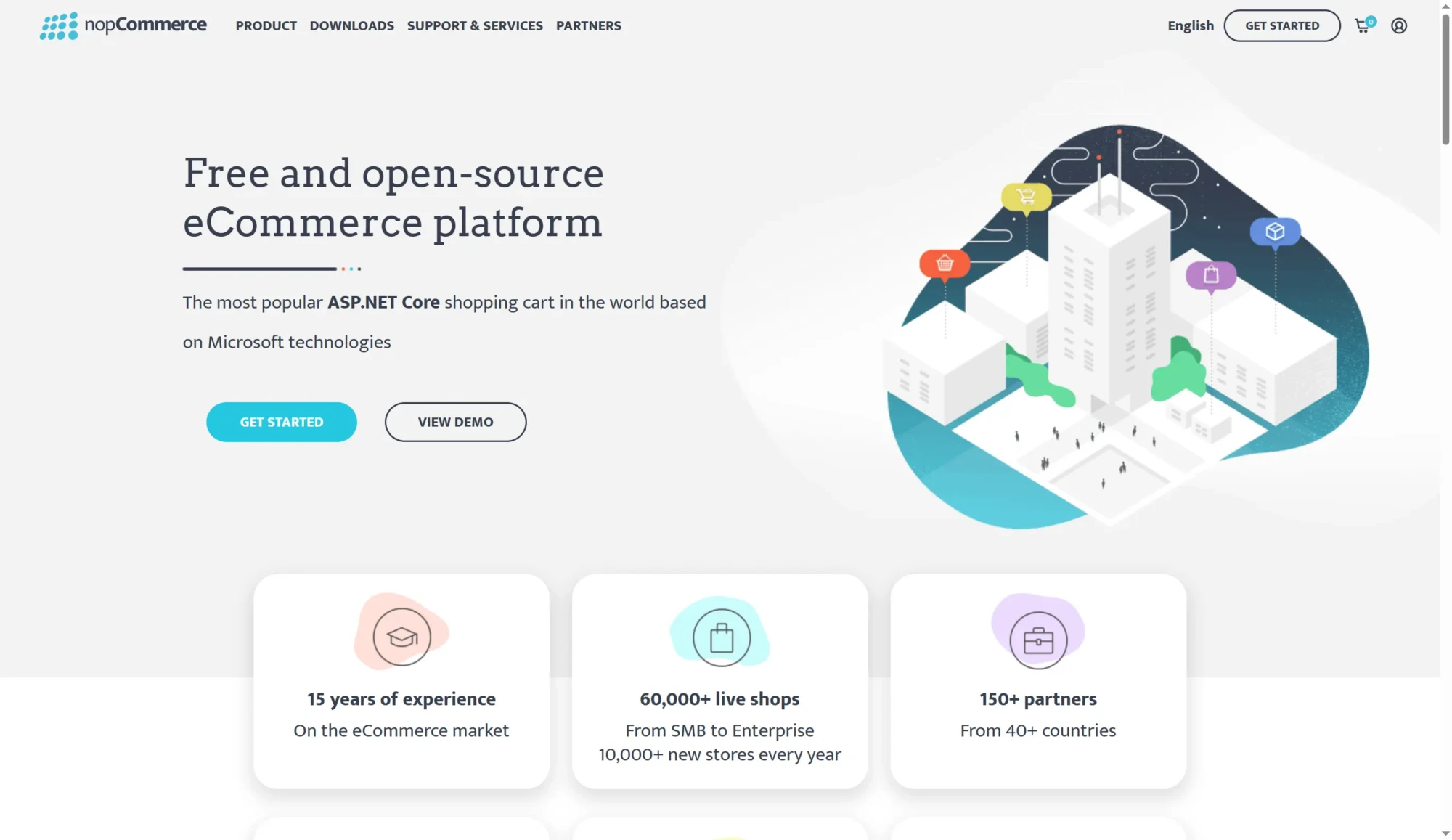
nopCommerce is an open-source ecommerce platform built on ASP.NET Core, making it the primary choice for .NET and Microsoft technology stack teams. It is PCI DSS compliant and supports over 1,500 integrations through the nopCommerce Marketplace. Features include multi-vendor support, multi-store management, omnichannel commerce, headless architecture, and extensive SEO tools. The community has over 250,000 members. nopCommerce is free and open-source under a custom license that allows commercial use, but charges $250 for a copyright removal key to remove the footer attribution.
- • ASP.NET Core: built for .NET developers on Microsoft technology stack
- • 1,500+ marketplace integrations: commercial and free plugins covering payments, shipping, and marketing
- • Multi-vendor marketplace: allow multiple sellers on one storefront with separate vendor accounts
- • Multi-store: manage multiple storefronts from a single admin with per-store configuration
- • PCI DSS compliant: built-in compliance features for payment card security
nopCommerce is the best open-source ecommerce platform for .NET and Microsoft stack development teams. Comprehensive features, PCI DSS compliance, and 1,500+ integrations make it enterprise-capable. For non-.NET teams, WooCommerce (PHP/WordPress), Medusa (Node.js), or Saleor (Python) are better technology fits.
CS-Cart
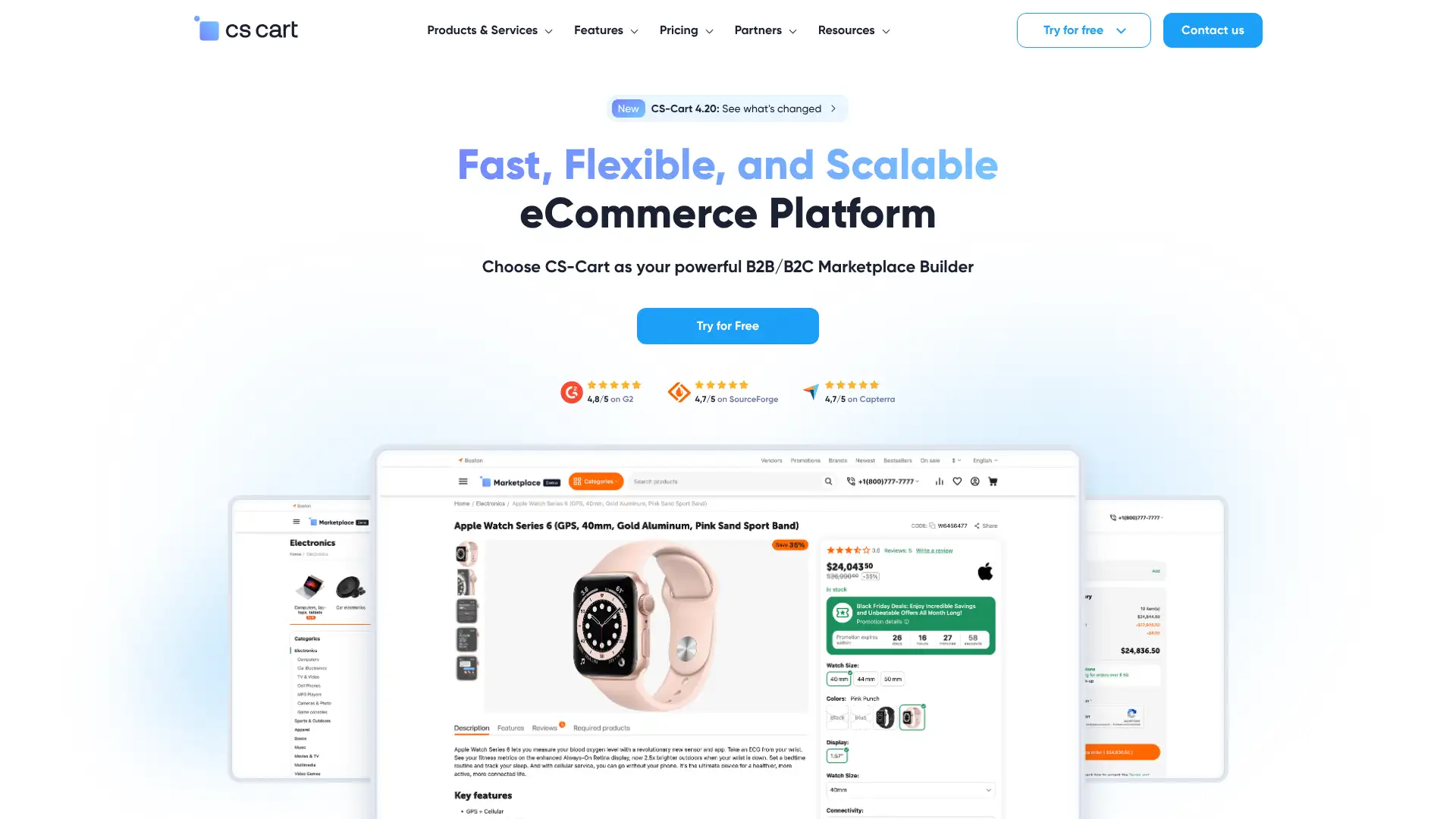
CS-Cart is a PHP-based ecommerce platform with two primary versions: a single-vendor store and a multi-vendor marketplace edition. The multi-vendor edition is one of the few ecommerce platforms specifically designed for building Amazon-style marketplaces where multiple independent sellers list products and the platform operator takes a commission. CS-Cart charges a one-time license fee rather than a monthly subscription. The Store Builder license is $785 for a perpetual single-store license. Multi-vendor marketplace license starts at $1,450. Annual software update subscriptions are optional.
- • Multi-vendor marketplace: multiple independent sellers with separate vendor accounts, commissions, and dashboards
- • One-time license: no ongoing monthly platform fee, only hosting and optional update subscription
- • Vendor payout management: automated commission calculation and vendor payment distribution
- • 500+ add-ons: CS-Cart Marketplace extension library for additional functionality
- • 300+ payment gateways: one of the most extensive payment gateway support lists of any PHP platform
CS-Cart is the best platform for building a multi-vendor marketplace where independent sellers list and manage their products. The marketplace architecture is purpose-built rather than retrofitted.
Shopware
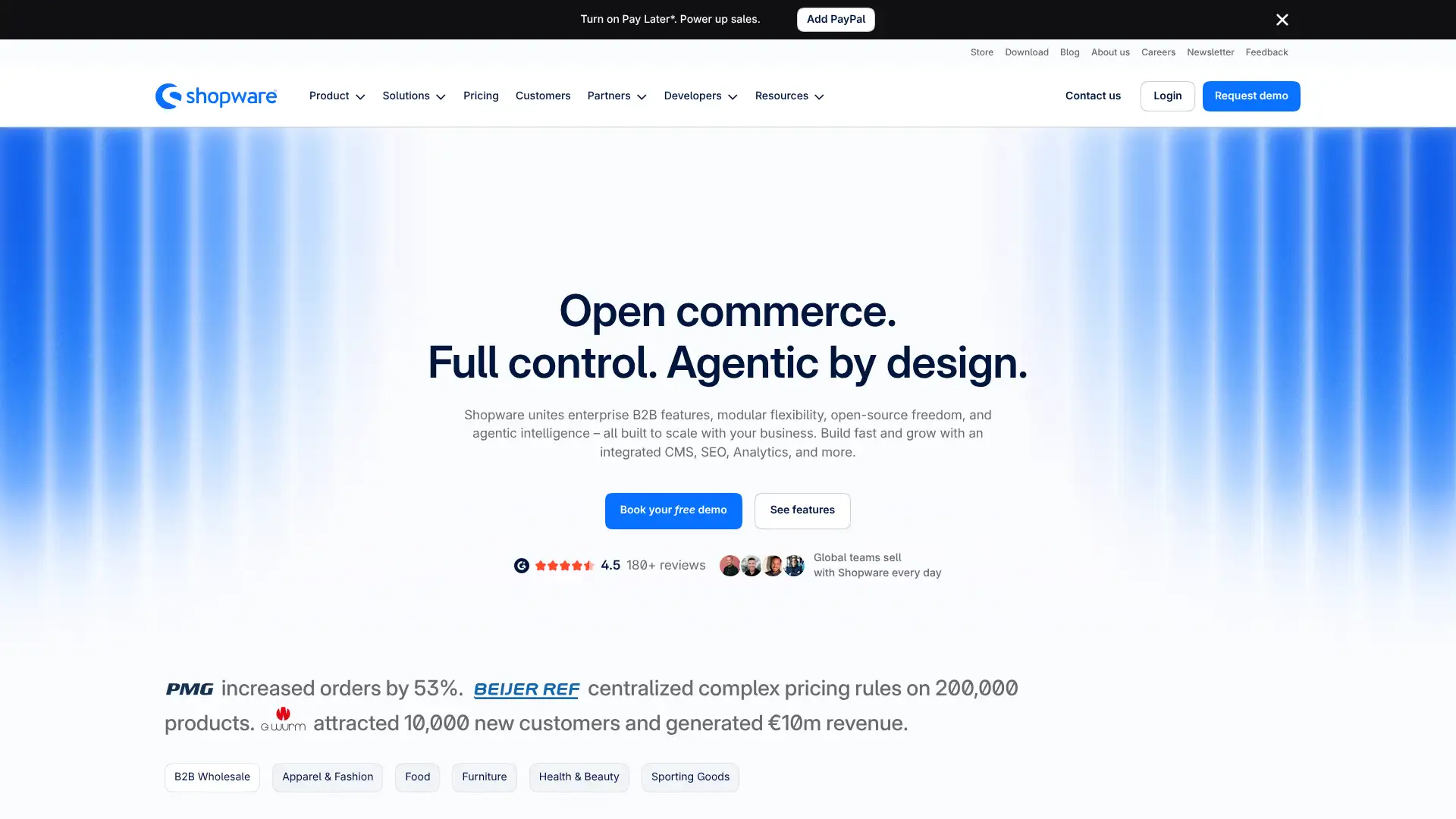
Shopware is a German-origin open-source ecommerce platform built on Symfony and Vue.js, widely used in the DACH region (Germany, Austria, Switzerland) and increasingly internationally. Shopware 6 introduced a headless-capable architecture with an API-first design, storefront customisation through Shopping Experiences (drag-and-drop content builder), and rule-based pricing and promotions. The Community Edition is free. Shopware Rise (previously Professional) and Evolve plans add managed hosting and commercial support. Shopware is particularly strong for B2B commerce with native B2B features in the commercial editions.
- • Shopping Experiences: drag-and-drop content builder for creating rich product pages and landing pages
- • Rule Builder: no-code rule engine for complex pricing, discounts, and personalisation conditions
- • B2B Suite: company accounts, individual customer pricing, quote requests, and approval workflows
- • Flow Builder: no-code automation for order processing, email triggers, and workflow automation
- • Headless-ready: API-first architecture with REST and Store API for decoupled frontend deployments
Shopware is the best ecommerce platform for DACH-region merchants and European mid-market businesses who want open-source flexibility with strong B2B capabilities. The Rule Builder and Shopping Experiences provide powerful merchandising without custom development. For globally-focused stores outside Europe, Shopify and BigCommerce have deeper English-language support communities.
Bagisto
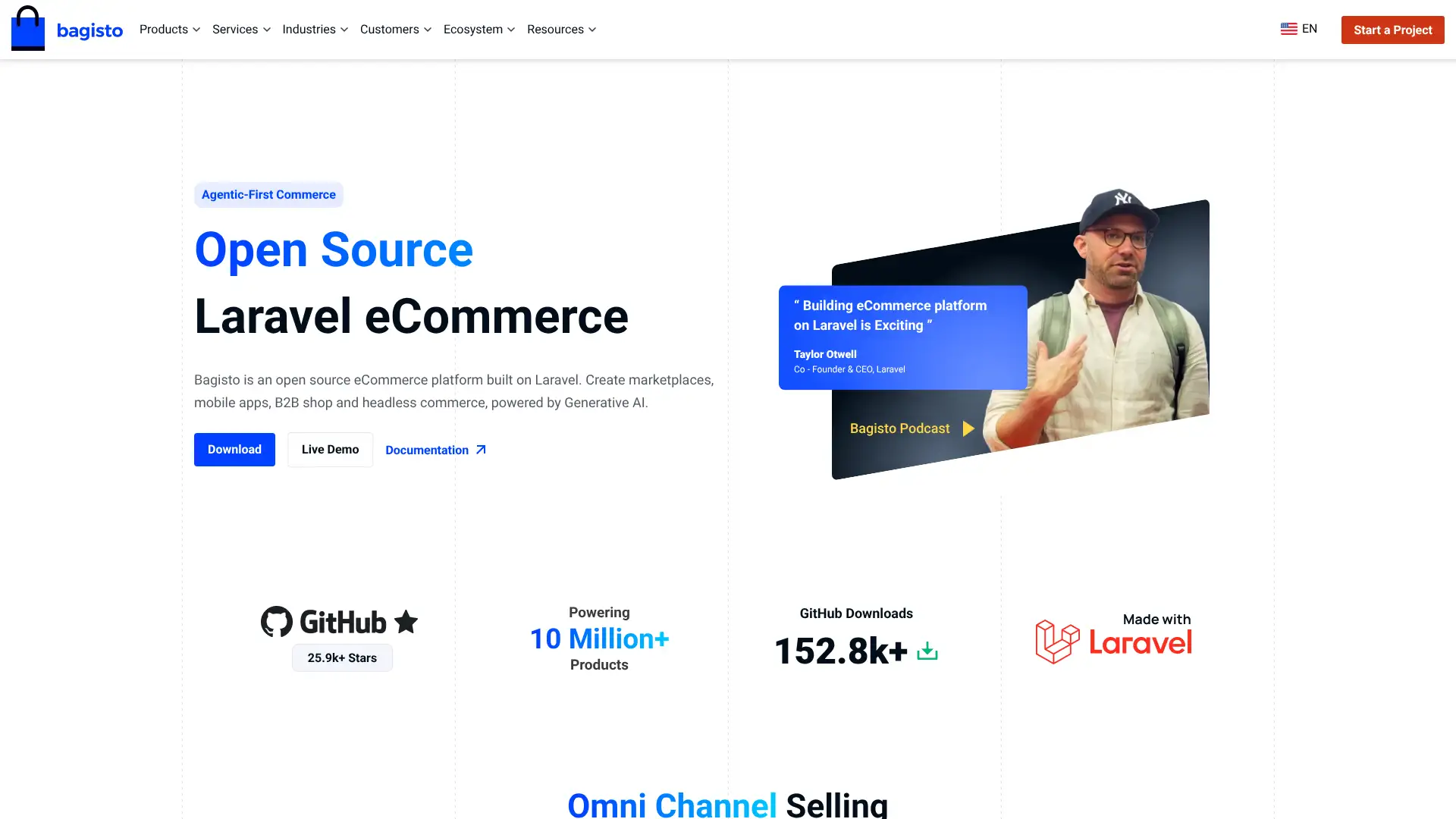
Bagisto is a free open-source ecommerce platform built on Laravel, the most popular modern PHP framework. It is actively maintained by the Webkul community and offers multi-channel selling, customer groups, multiple payment method integrations, custom product attributes, multi-currency, and core web vitals optimisation. The extension marketplace extends functionality. Bagisto is designed for PHP teams who want a Laravel-based alternative to WooCommerce (which requires WordPress) or PrestaShop. Laravel's expressive ORM and routing make Bagisto easier to extend than traditional PHP platforms.
- • Laravel-based: modern PHP framework foundation for clean, extensible ecommerce architecture
- • Multi-channel selling: sell on multiple channels (web, mobile, social) from one unified backend
- • Custom product attributes: define custom product fields without modifying core code
- • Core Web Vitals optimisation: built-in performance features for SEO and Google PageSpeed
- • Multi-currency with auto-conversion: automatic currency rate conversion for international stores
Bagisto is the best open-source ecommerce platform for PHP teams who use Laravel and want a modern, extensible framework-native commerce solution. For teams using WordPress, WooCommerce is the natural fit. For teams wanting the largest possible extension ecosystem, PrestaShop or WooCommerce have significantly larger module libraries.
Sylius
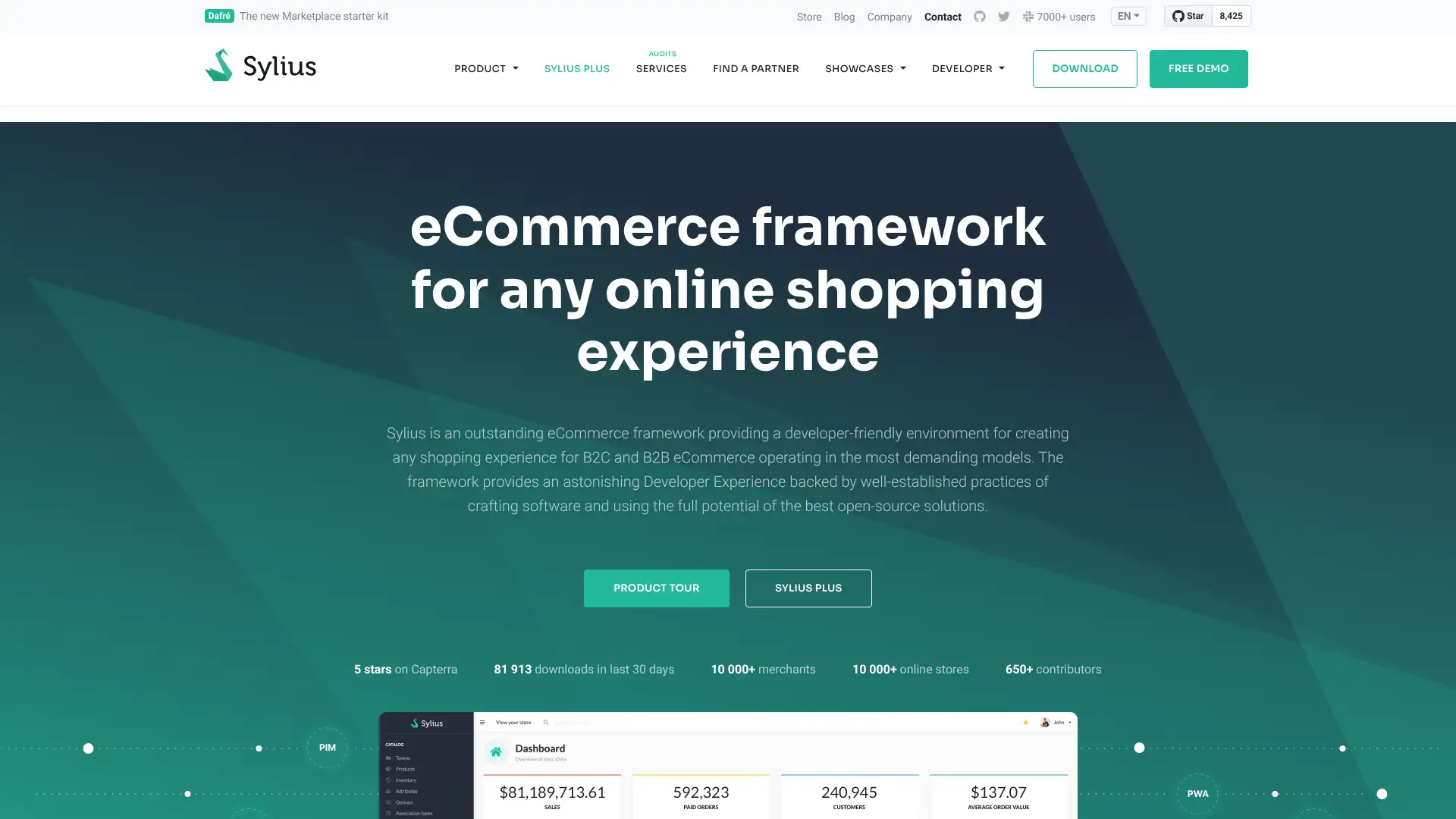
Sylius is a modern open-source headless ecommerce platform built on the Symfony full-stack PHP framework, targeting enterprise and mid-market brands. Its modular and decoupled architecture allows developers to implement only the commerce components they need, without the limitations of a monolithic system. Sylius supports headless deployments and PWA, making it adaptable to modern frontend frameworks. Sylius Plus is a commercial extension providing a loyalty system, multi-source inventory, and advanced user permissions, priced on GMV. Sylius is used for custom and complex commerce requirements where Symfony expertise is available.
- • Symfony foundation: modular component architecture built on PHP's most powerful full-stack framework
- • Headless and PWA ready: REST API and Storefront API for decoupled frontends
- • Multi-source inventory: manage inventory from multiple warehouse locations (Plus edition)
- • Loyalty system: points, rewards, and customer loyalty programme (Plus edition)
- • Unlimited scalability: used by enterprise brands for complex multi-channel commerce
Sylius is the best open-source ecommerce platform for enterprise teams with deep Symfony PHP expertise who need modular, scalable headless architecture. For teams without Symfony knowledge, Medusa.js (Node.js) or WooCommerce (WordPress/PHP) provide more accessible alternatives.
Gambio
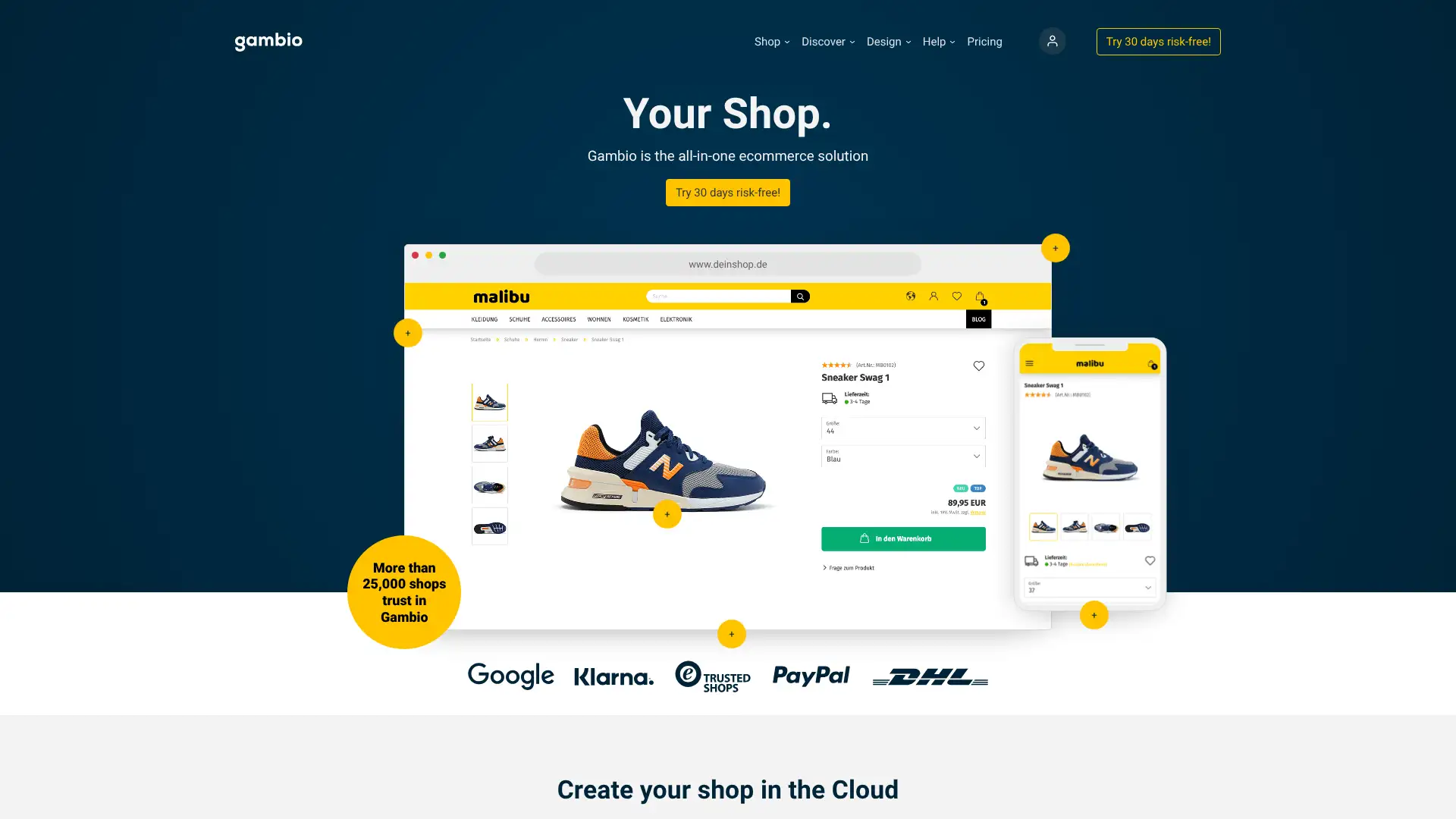
Gambio is a German all-in-one ecommerce software platform primarily used by small and medium-sized businesses in the German-speaking region. It has been operating since 2004 and has strong roots in the GX3 open-source project. Gambio provides automatic updates, German payment methods (Klarna, SOFORT, PayPal PLUS), GDPR-compliant data management, and integration with German-specific logistics (DHL, Hermes, DPD). Gambio Cloud is a hosted SaaS version. Gambio Hub provides the on-premise licensed version with annual support. It does not offer multi-shop functionality in the standard edition.
- • GDPR-compliant: built for German legal requirements including cookie consent and data handling
- • German payment integration: Klarna, SOFORT, PayPal PLUS, and German direct debit built in
- • DHL and German logistics: native integration with Germany's major parcel carriers
- • Automatic updates: managed cloud version updates automatically without developer intervention
- • Gambio App Store: extensions for additional functionality specific to German market requirements
Gambio is the right choice for German-speaking small and medium businesses who want a fully GDPR-compliant platform with native German payment and logistics integrations without custom development. For mid-market or enterprise German businesses needing headless capabilities or B2B features, Shopware is the more powerful alternative.
OXID eSales
OXID eSales is a German open-source PHP ecommerce platform operating since 2003, primarily used by small and mid-sized businesses in the DACH region. It is known for its ERP integration capabilities, clean GDPR-compliant architecture, and German-market-specific features. OXID offers a free Community Edition and a commercial Enterprise Edition. The platform has a strong track record in German B2B commerce and is used by established German retailers. The extension library provides additional modules for specific requirements. OXID eShop requires PHP development expertise for customisation.

- • ERP integration: pre-built connectors for SAP, JTL, and German ERP systems
- • GDPR-compliant architecture: German data protection requirements built into the core
- • B2B features: customer-specific pricing, customer groups, and order management for business buyers
- • Extension library: commercial modules for German-specific payment, logistics, and marketing requirements
- • Multi-language and multi-currency: international selling capabilities in all editions
OXID eSales is the best open-source ecommerce platform for German SMBs and mid-market businesses that need strong ERP integration (particularly SAP) alongside GDPR-compliant architecture. For DACH businesses without specific ERP integration requirements, Shopware provides a more modern architecture with stronger headless capabilities.
Lightspeed ecommerce
Lightspeed is a commerce platform originally built around physical retail POS systems that expanded into ecommerce. The Ecwid platform (acquired 2022) powers Lightspeed's ecommerce storefronts. Lightspeed's primary value proposition is unified brick-and-mortar and online commerce: inventory, orders, and customer data sync between POS and ecommerce in real time. Lightspeed Retail POS plans include ecommerce as part of the subscription. Standalone ecommerce is available through Ecwid by Lightspeed. The platform is best for established physical retailers adding online selling, not for ecommerce-first businesses.

- • Real-time POS sync: inventory, orders, and customer data synchronise between physical and online stores
- • Unified inventory: single product catalog manages both in-store and online stock in real time
- • Lightspeed Payments: integrated payment processing for both in-person and online transactions
- • eCommerce (E-Series): Ecwid-powered online storefront included in all Retail POS plans
- • Advanced inventory management: purchase orders, low-stock alerts, and serial number tracking
Lightspeed ecommerce is the right choice for established brick-and-mortar retailers with existing Lightspeed POS infrastructure who want unified online and in-person commerce. For new businesses starting with ecommerce, Shopify's POS product or Square Online provide lower-cost alternatives with comparable POS integration.
commercetools
commercetools is the enterprise leader in composable MACH commerce (Microservices, API-first, Cloud-native, Headless). It is used by Audi, Bang and Olufsen, and Express to power complex omnichannel retail experiences. The platform is entirely API-first: there is no storefront included, only backend commerce APIs. All frontend development is custom. This architectural purity provides maximum flexibility but requires 3-12 month implementation timelines and $50,000-$200,000+ first-year total cost of ownership including implementation, licensing, and custom development. commercetools is not suitable for businesses without a dedicated engineering team.

- • MACH architecture: fully composable microservices replacing the monolithic ecommerce platform model
- • Each service independently scalable: cart, checkout, product, and order services scale separately
- • Multi-region and multi-currency: global commerce with regional deployments built into the core
- • Import and Export API: bulk data migration and integration with existing enterprise systems
- • Connect: pre-built connectors for Salesforce, SAP, and enterprise systems
commercetools is the right choice for Fortune 500 and enterprise global retailers who need maximum architectural flexibility, full composability, and the ability to replace any platform component with best-of-breed alternatives. For mid-market businesses or any team without a dedicated 5+ person engineering team, the cost and complexity make commercetools inappropriate.
Elastic Path
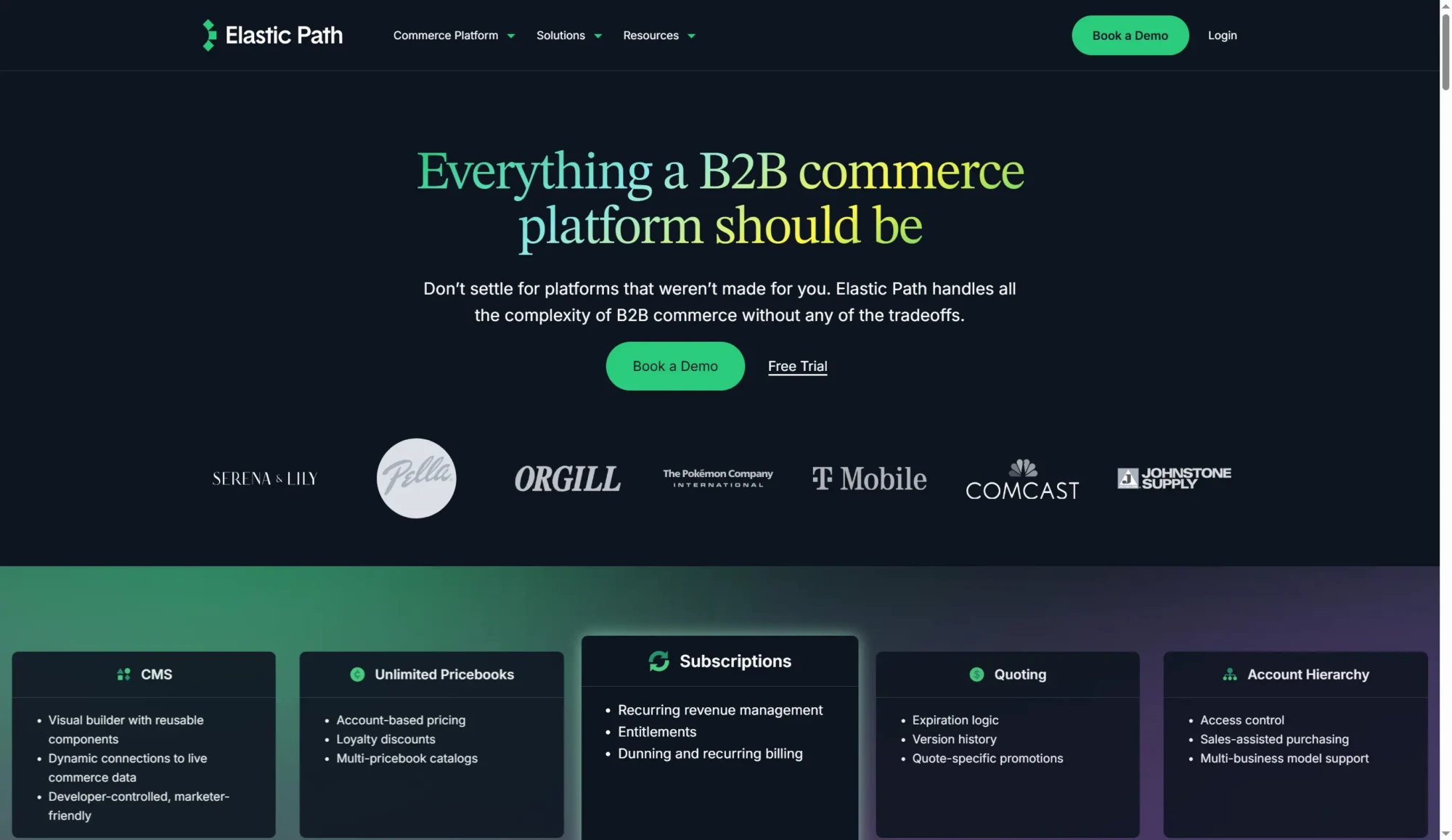
Elastic Path is an enterprise composable commerce platform targeting large businesses with sophisticated product information management (PIM) requirements alongside commerce functionality. It competes directly with commercetools for enterprise deals but differentiates through built-in PIM capabilities and a focus on B2C brands with complex product catalogs (configurable products, bundling, personalised pricing). Elastic Path pricing starts at $50,000/year, reflecting its enterprise positioning. Like commercetools, it requires significant technical investment and dedicated engineering resources for implementation.
- • Built-in PIM: product information management integrated with commerce, not a separate system
- • Composable architecture: replace any commerce service via API without platform-wide migration
- • Personalised pricing: customer-specific and segment-specific pricing rules at scale
- • Product configurator: complex product bundles and configurations managed natively
- • Multi-store management: multiple storefronts from a single catalog and pricing backend
Elastic Path is the right choice for enterprise B2C retailers with highly complex product catalogs where built-in PIM functionality eliminates the need for a separate PIM system alongside the commerce platform. For enterprise retailers without complex PIM requirements, commercetools provides equivalent composable architecture.
XT-Commerce
XT-Commerce is a German PHP ecommerce platform derived from the osCommerce open-source project, primarily used in DACH-region small and medium businesses. It provides a self-hosted PHP store with a commercial license, template system, and plugin marketplace. XT-Commerce includes GDPR-compliant data handling, German payment method integrations (Klarna, PayPal, SOFORT), and standard ecommerce features including product management, order processing, and customer accounts. It is less feature-rich than Shopware or WooCommerce but has a long operating history in the German market. New cloud-hosted plans are available.
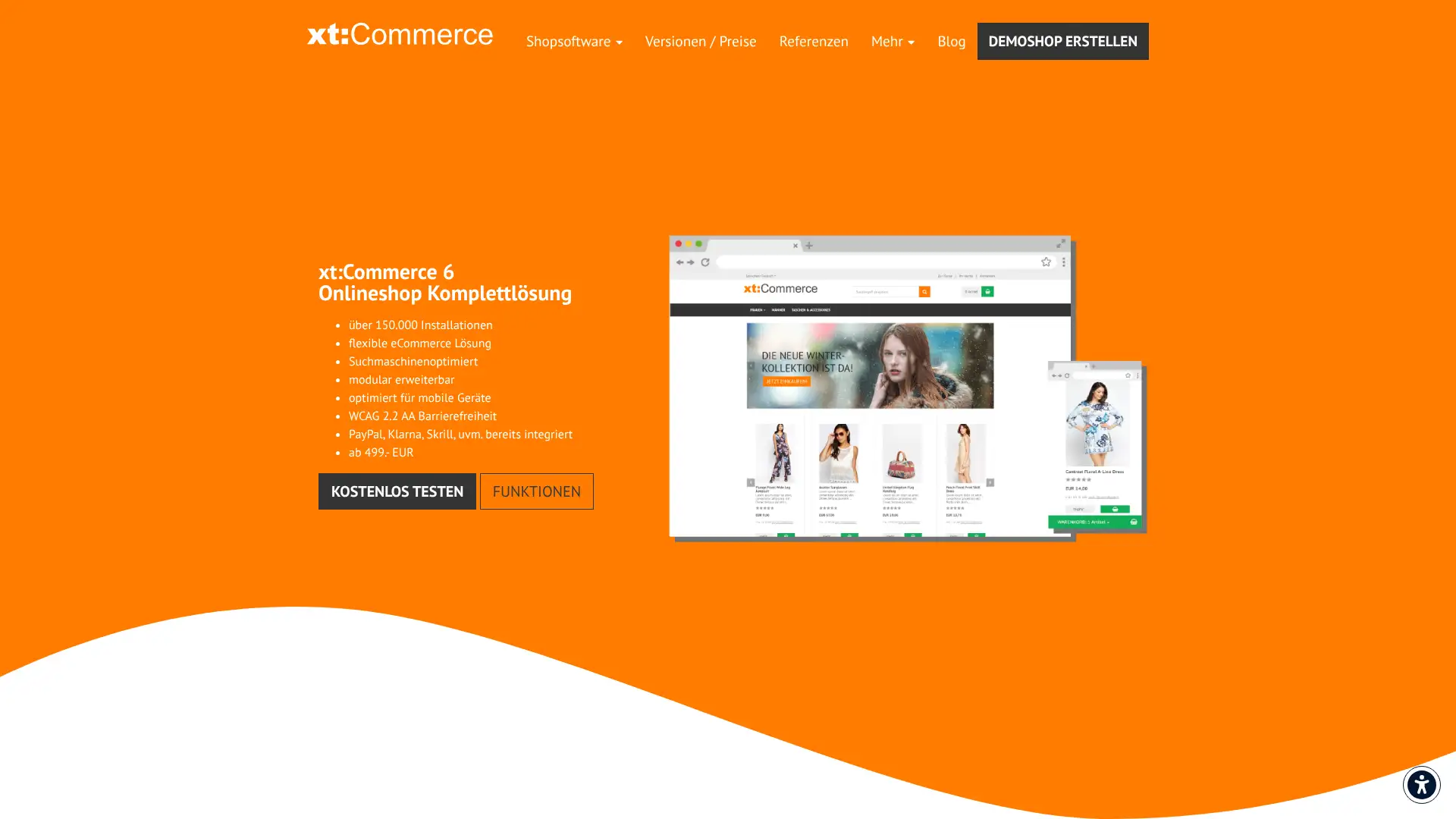
- • German payment methods: Klarna, SOFORT, PayPal PLUS, and German direct debit natively integrated
- • GDPR compliance: German data protection requirements built into the platform architecture
- • DHL and German logistics: native German carrier integration for automated shipping label generation
- • Template system: customisable storefront templates without core code modification
- • Plugin marketplace: commercial and free extensions for German-specific functionality
XT-Commerce is a practical choice for small German businesses that want a simple, GDPR-compliant online store with German payment and logistics integrations and minimal technical overhead. For businesses expecting growth or needing more advanced ecommerce features, Shopware provides a significantly more modern and capable platform within the