30 Best HR Software in 2026
This guide covers five categories of HR software in 2026: Core HRIS and payroll (BambooHR, Gusto, Rippling, and US mid-market platforms) for day-to-day people operations; Enterprise HCM (Workday, ADP, UKG, Dayforce, Oracle, SAP) for large organisations; Regional platforms (Personio, Factorial, BreatheHR, Cezanne, Humi, ELMO) for European, UK, Canadian, and APAC teams; Global EOR and payroll (Deel, Remote, Oyster, Multiplier, Papaya Global) for internationally distributed teams; and Performance and engagement (Lattice, 15Five, Culture Amp, Peoplebox, Leapsome) for building people-first cultures. All pricing is in USD unless otherwise stated.
BambooHR
BambooHR is one of the most widely adopted HRIS platforms for companies between 25 and 1,000 employees, serving 34,000+ customers managing approximately 3 million employees across 190 countries. It offers two core tiers, Essentials and Advantage, covering employee data management, time-off tracking, onboarding, reporting, and performance management. Payroll, time tracking, and benefits administration are available as paid add-ons rather than bundled in the base plan. Pricing is quote-based: companies with 25 or fewer employees pay a flat monthly fee (approximately $108/month for 20 employees), and larger teams are charged per employee per month (estimated $5.40-$22 PEPM depending on tier and modules). BambooHR does not support international payroll natively; it partners with Remote for EOR services as an add-on.
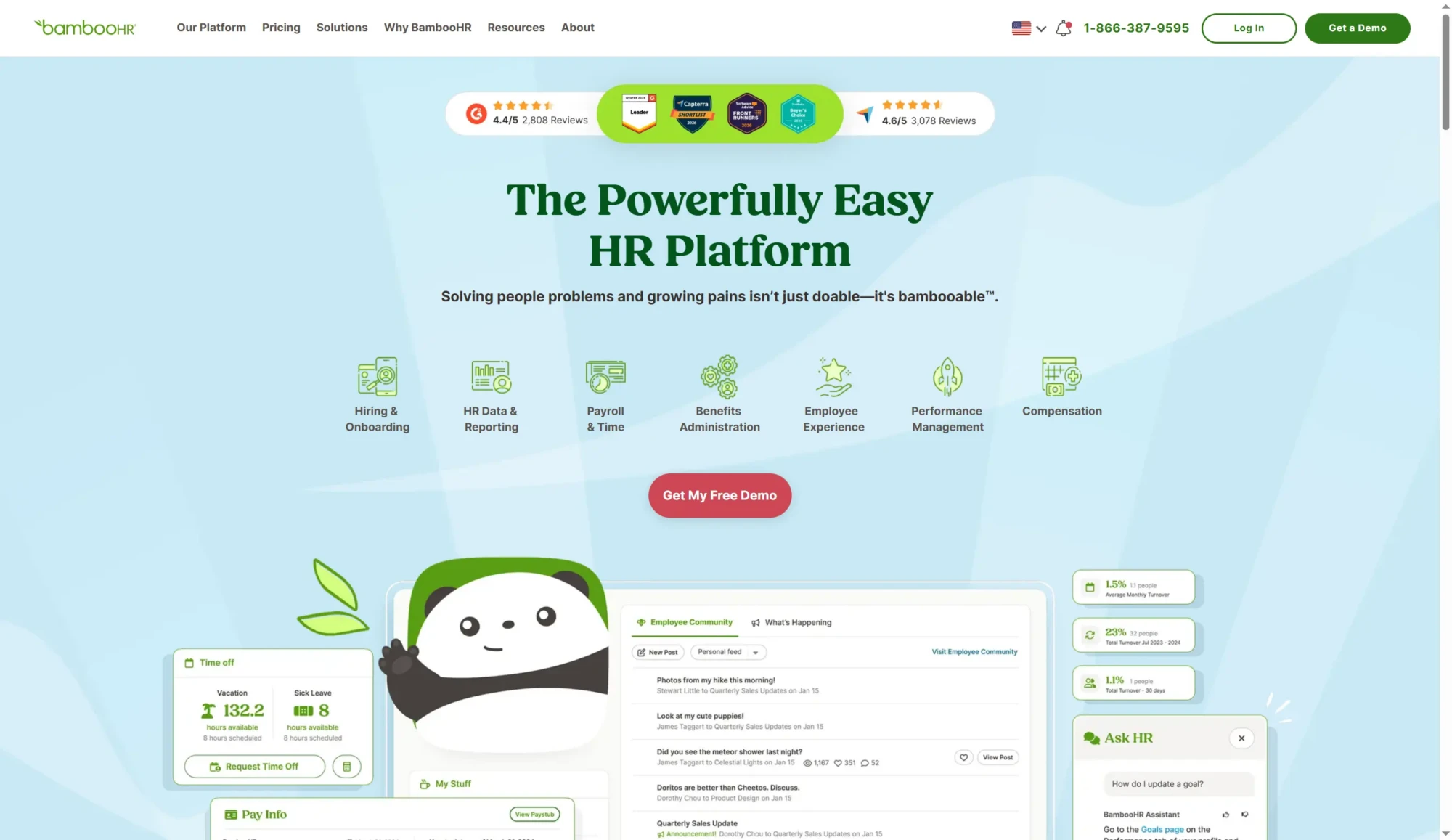
- • Employee self-service portal: employees update their own records, benefits, and time-off requests
- • Onboarding workflows: automated task lists, e-signatures, and document collection for new hires
- • Performance management: goal tracking, peer feedback, and review cycle automation on Advantage
- • HR reporting and analytics: pre-built and custom reports on headcount, turnover, and compensation
- • 7-day free trial and 15% nonprofit discount: accessible evaluation and nonprofit pricing
BambooHR is the best HRIS for companies of 25-500 employees that want a polished people platform for US-based teams. The base plan handles employee records, onboarding, and basic performance management well.
Gusto
Gusto is the most popular HR and payroll platform for small US businesses, serving over 400,000 companies. It stands out for transparent published pricing (unlike BambooHR or Rippling), starting at $49/month plus $6/employee for the Simple plan. The Simple plan covers full-service payroll, automated tax filings for all 50 states, employee self-service, and basic onboarding. The Plus plan ($80/month + $12/employee) adds time tracking, PTO policies, and team management. The Premium plan ($180/month + $22/employee) adds HR advisory, compliance alerts, and priority support. Gusto recently added international EOR capabilities through a partnership with Remote, covering approximately nine countries initially with plans to expand.
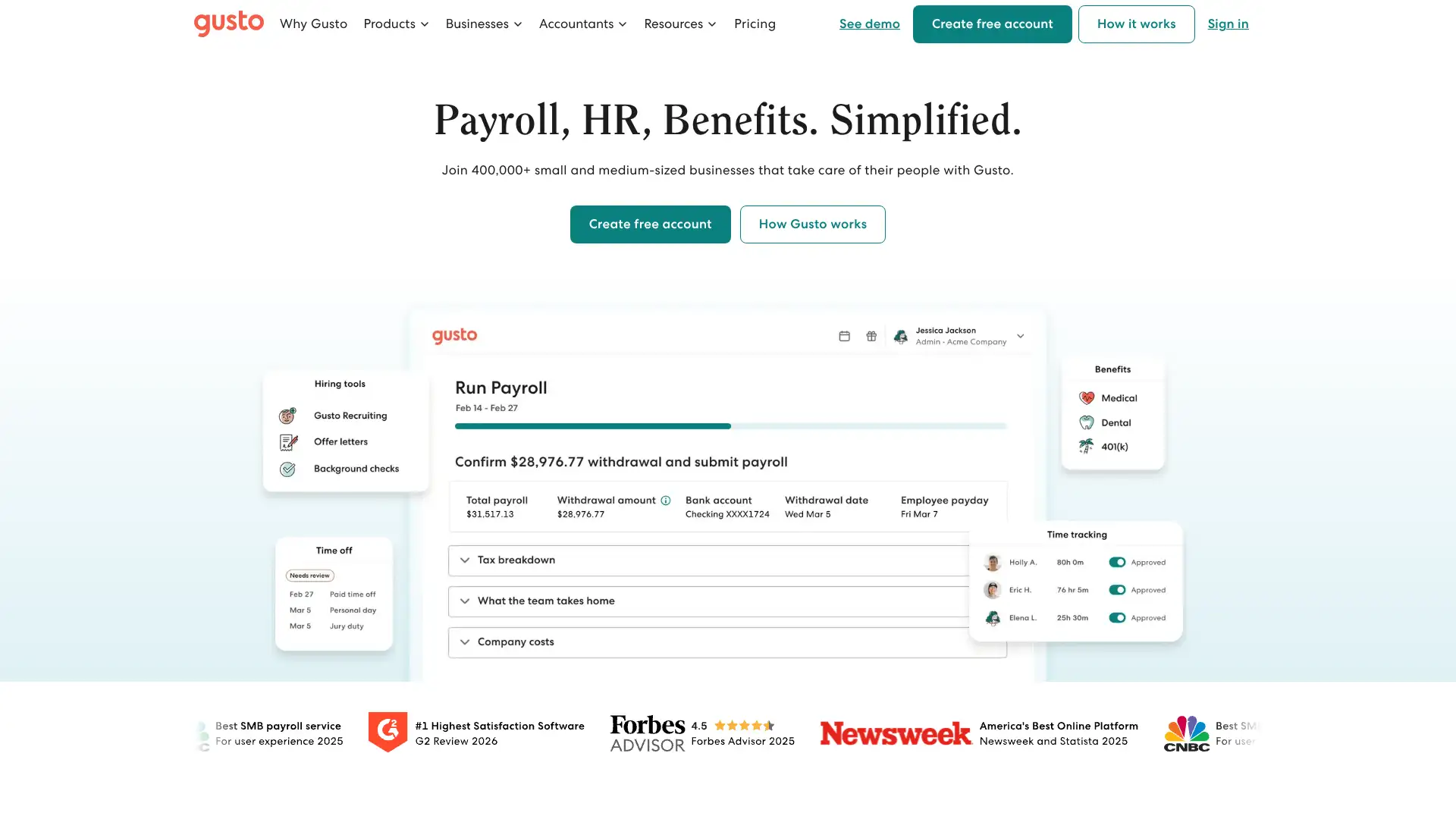
- • Automated multi-state payroll with all 50-state tax filing: the most reliable US payroll in the SMB tier
- • Transparent published pricing: no sales call needed to get a quote, unlike BambooHR or Rippling
- • Benefits administration: health, dental, vision, 401k, and commuter benefits in one dashboard
- • Contractor management: pay contractors and employees on the same platform with no base fee for contractors only
- • International EOR via Remote partnership: hire in approximately 9 countries with Gusto as the interface
Gusto is the best choice for US small businesses that want straightforward, transparent pricing with reliable multi-state payroll and benefits in one subscription. The published pricing makes budget planning simple.
Rippling
Rippling is a modular workforce management platform combining HR, IT, and finance under one identity layer. Unlike Gusto or BambooHR, Rippling manages employee devices, software access, and payroll alongside HR data from a single system of record. The platform starts at approximately $8/employee/month for the core platform, with payroll, global payroll, IT device management, app provisioning, and EOR services each priced as separate add-on modules. The key differentiator is IT-HR integration: when an employee is onboarded, their laptop ships, software accounts are created, and payroll is set up from one workflow. Rippling supports global payroll in 50+ countries. Quote-based pricing makes it harder to budget upfront, but mid-market companies (50-200 employees) often pay $400-800/month for HR and payroll combined.
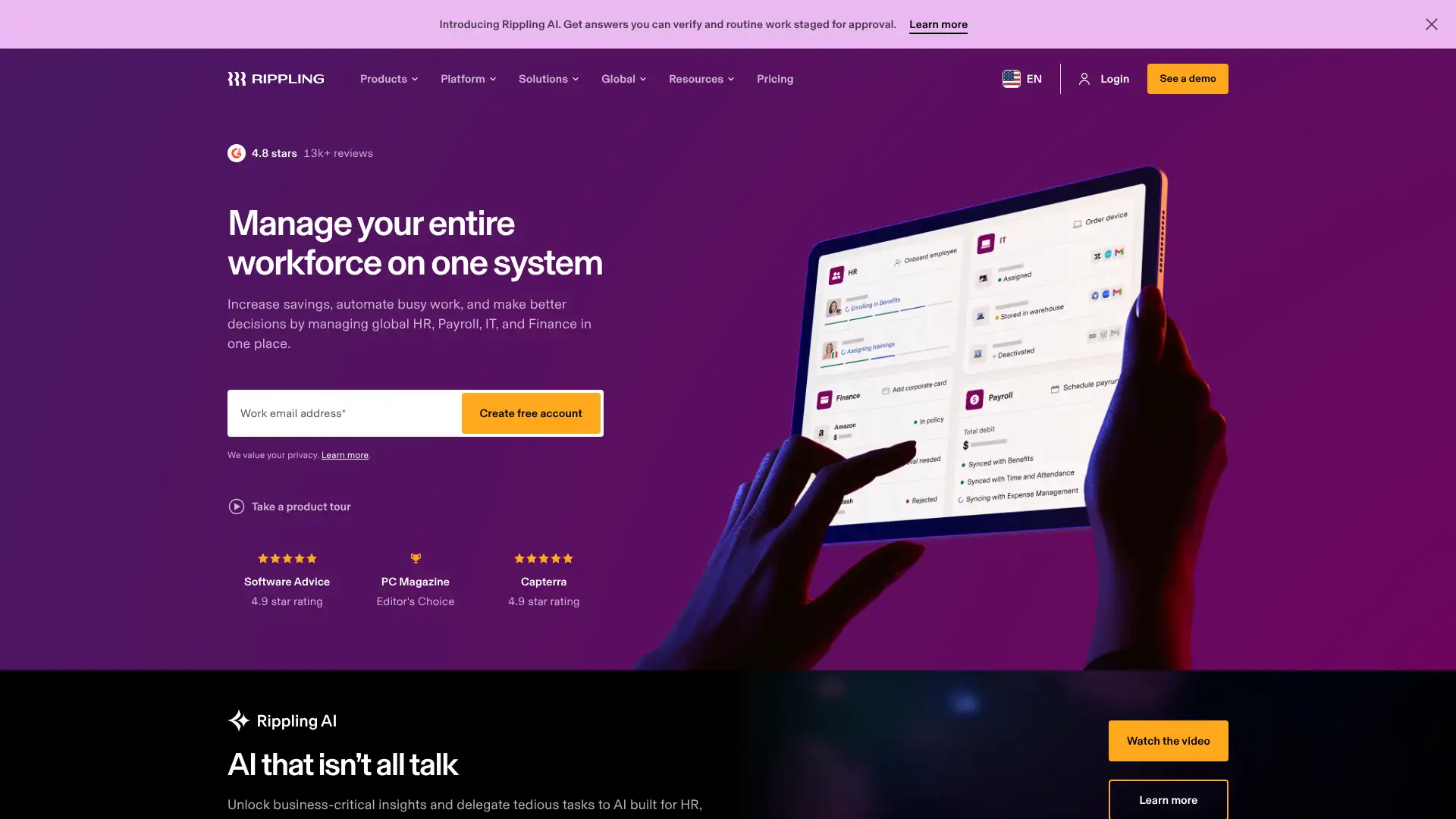
- • Unified HR-IT-Finance platform: onboard employees with devices provisioned and accounts created simultaneously
- • 500+ integrations: broadest integration ecosystem in the HR software market
- • Global payroll in 50+ countries: native international payroll without a separate EOR vendor
- • Workflow automation: trigger actions across HR, IT, and finance from a single event
- • Mobile Device Management (MDM): manage company laptops and phones alongside HR data
Rippling is the best HR platform for companies that manage device provisioning, software access, and payroll and want a single system of record for all three. The IT-HR integration is unique in the market.
Workday HCM
Workday is the leading enterprise-grade HCM platform, widely regarded as the default choice for Fortune 500 companies and organisations above 1,000 employees. It was the first cloud-native HRIS when it launched in 2005, which gave it a modern architecture advantage over legacy on-premise competitors. Workday combines HCM (HR, talent, payroll) and financial management in one unified platform, distinguishing it from other HR-only vendors. Pricing is enterprise-custom with annual contracts typically in the six figures; independent estimates place Workday at $34-100 per employee per month for the HCM suite. Workday is expanding its mid-market footprint with simplified packaging, but remains primarily enterprise-focused with lengthy implementation timelines of 6-18 months.
- • Unified HCM and financial management: HR and finance share the same database for real-time workforce cost visibility
- • Advanced people analytics: AI-powered workforce planning, skills intelligence, and pay equity analysis
- • Global payroll in 40+ countries: multi-country payroll with country-specific compliance built in
- • Continuous updates: two major releases per year with features available to all customers simultaneously
- • Industry-leading compliance: the most comprehensive regulatory coverage of any HR platform reviewed
Workday HCM is the right choice for Fortune 500 companies and large global organisations that need the most advanced HCM, financial planning, and people analytics in a unified cloud-native platform. For organisations under 500 employees, the cost and implementation burden are prohibitive.
ADP
ADP is the world's largest payroll provider, processing payroll for one in six US private-sector employees and holding 9.9% global payroll market share as of 2024. ADP offers three primary product lines for different scales: ADP Run for small businesses (1-49 employees), ADP Workforce Now for mid-market (50-1,000 employees), and ADP Lyric HCM for enterprise. Pricing is quote-based and famously opaque; buyers report significant variation depending on negotiation. ADP's core strength is payroll accuracy and tax compliance across all 50 states and 140+ countries, backed by 70+ years of experience. ADP Lyric HCM, launched in recent years, adds AI-driven insights and predictive analytics. The acquisition of Celergo bolstered its global payroll capabilities.
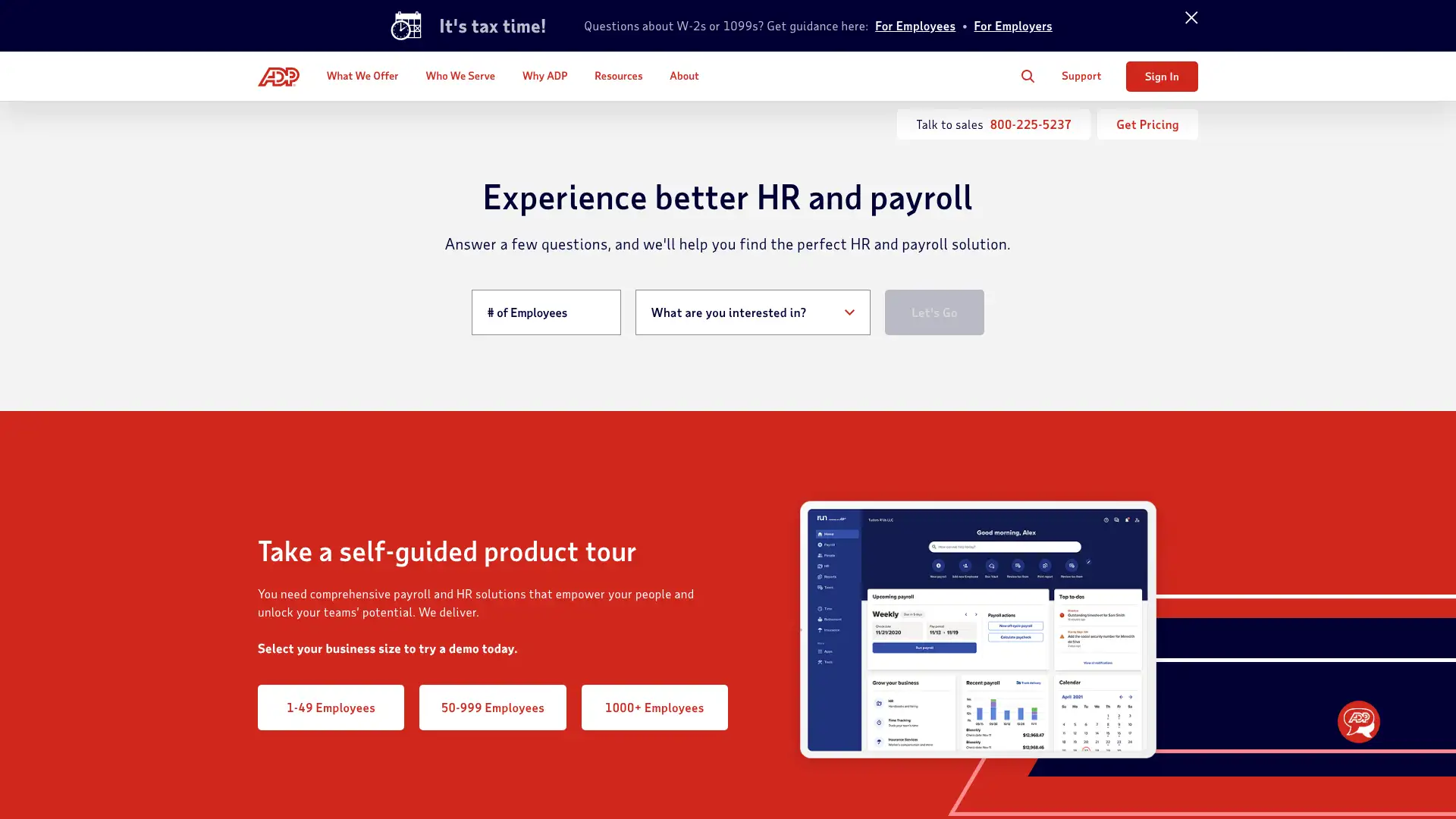
- • 140+ countries payroll: the most geographically extensive payroll infrastructure of any provider reviewed
- • 70+ years of payroll experience: deepest institutional knowledge of US and global tax compliance
- • ADP Celergo: global payroll engine acquired to handle multi-country payroll calculation
- • PEO services: ADP TotalSource provides co-employment for small businesses wanting outsourced HR
- • AI-driven insights in ADP Lyric: predictive workforce analytics and anomaly detection in payroll
ADP is the right choice when payroll accuracy, regulatory compliance, and a 70-year institutional track record are more important than interface modernity or pricing transparency. The deepest global payroll infrastructure of any provider.
Paychex
Paychex is the second-largest US payroll provider, processing payroll for approximately one in twelve American private sector employees. Its primary product for mid-market businesses is Paychex Flex, a cloud-based HCM platform covering payroll, tax compliance, benefits administration, time and attendance, and HR management. Paychex differentiates from ADP with a dedicated payroll specialist assigned to each account, a dedicated support model that reduces the call-centre experience. Pricing is quote-based and generally similar to ADP's pricing band. Paychex is piloting generative AI pay-query bots for deployment in 2026 through its continued R&D investment.
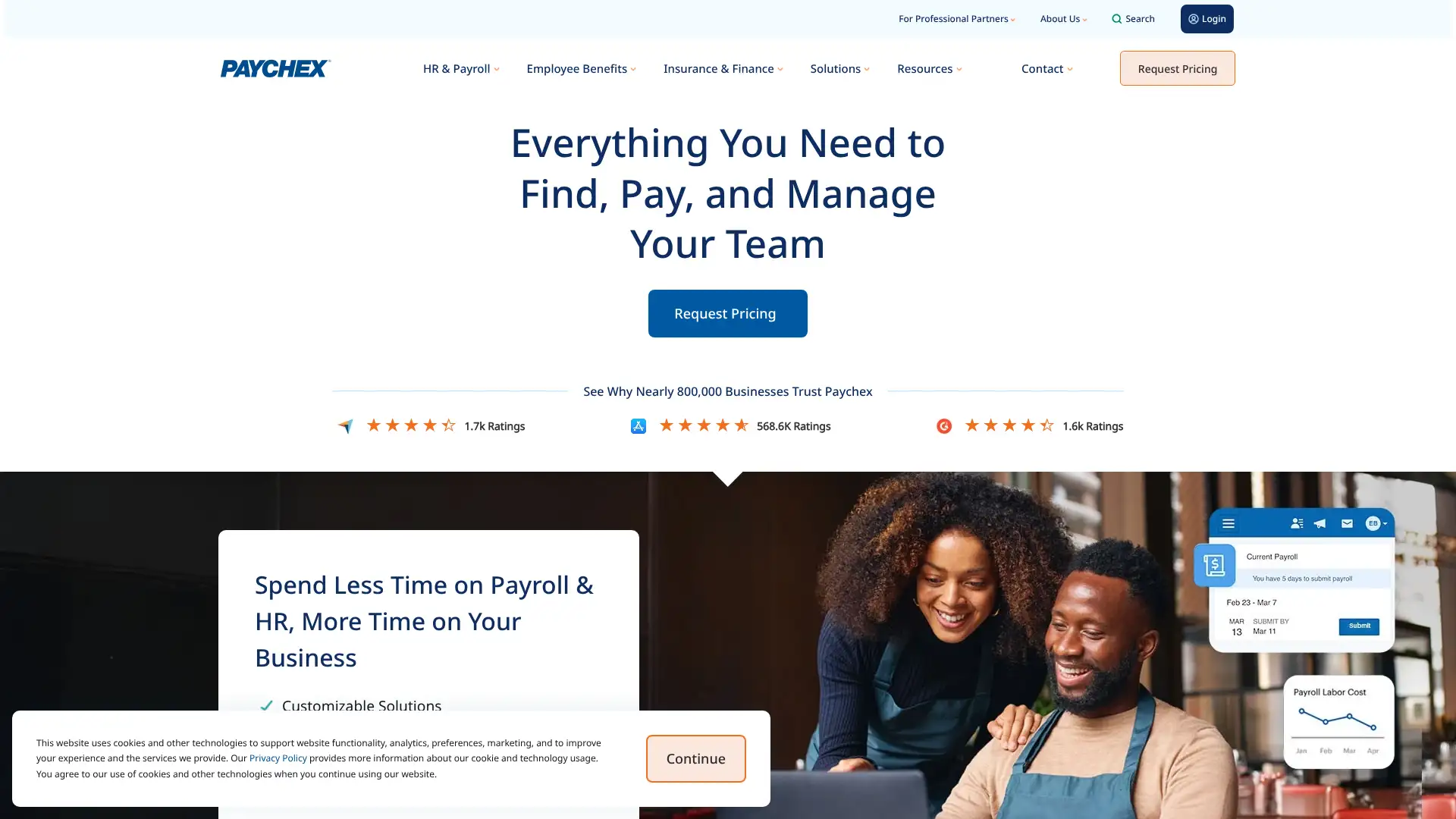
- • Dedicated payroll specialist: each account gets an assigned specialist rather than a generic call centre
- • 50-year history: one of the oldest payroll providers with deep institutional compliance knowledge
- • Paychex Flex mobile app: employee self-service for payslips, W-2s, and benefits on mobile
- • PEO services: Paychex PEO for co-employment and outsourced HR for smaller businesses
- • Time and attendance hardware: physical time clocks integrate with Paychex Flex
Paychex is the best payroll provider for US mid-market businesses where a dedicated support specialist is valued over interface modernity. The 50-year institutional track record and dedicated specialist model differentiate it from ADP's more call-centre-oriented support.
Paylocity
Paylocity is a cloud-based HCM platform designed for mid-market businesses (50-1,000 employees) with a strong emphasis on user experience and employee engagement. It is consistently rated above ADP and Paychex on independent review platforms for interface quality. Paylocity includes a social recognition and engagement module (Community) that functions like an internal social feed, distinguishing it from pure payroll competitors. Its Workforce Analytics module provides pre-built dashboards for headcount trends, turnover, and compensation. Paylocity pricing is quote-based and generally falls in the $15-25 PEPM range for a full suite including payroll, benefits, and time.
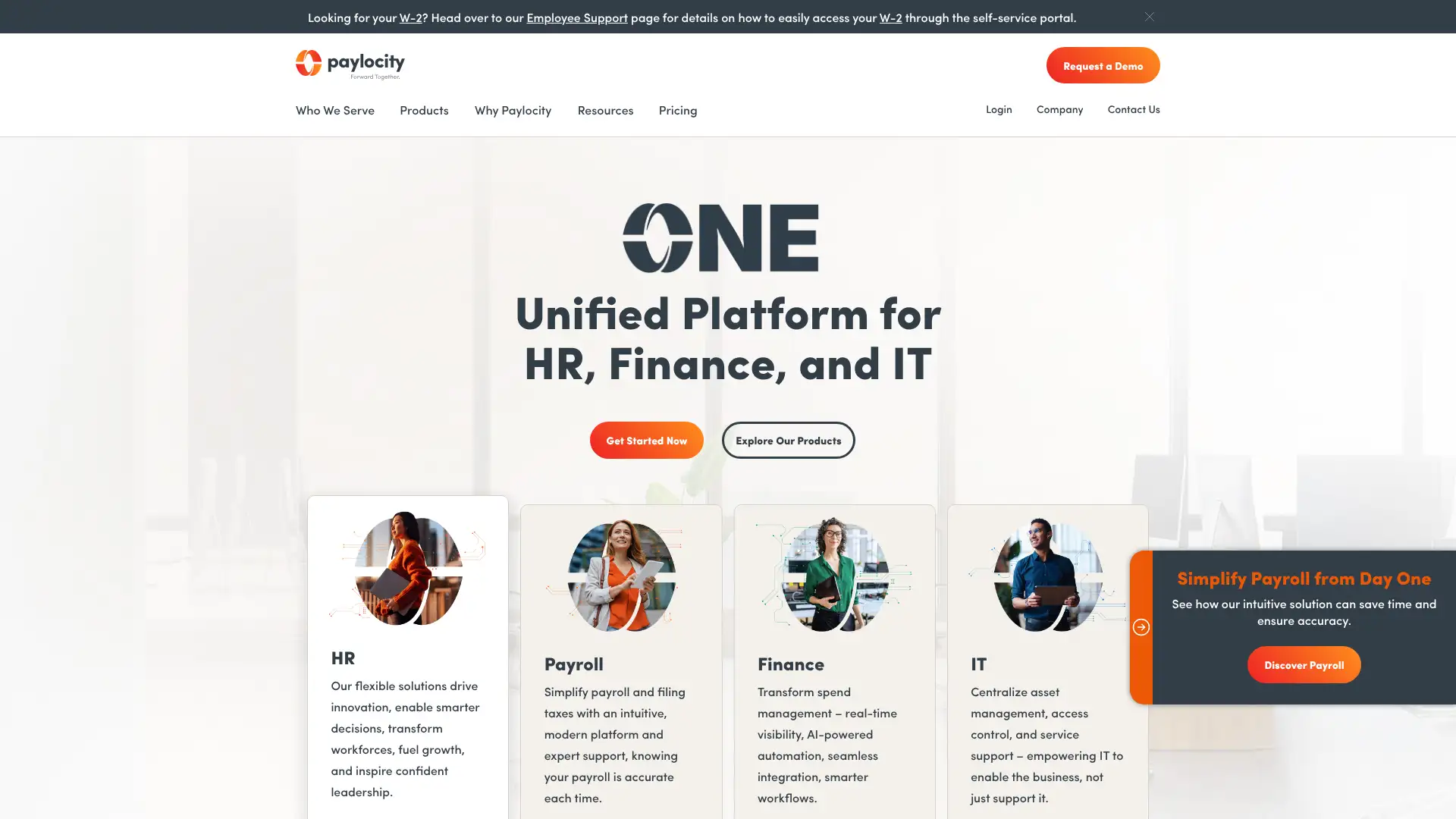
- • Community social module: internal social feed, shoutouts, and recognition that drives engagement
- • Modern mobile-first UX: consistently rated the highest for interface quality among US payroll platforms
- • Workforce Analytics: pre-built and custom dashboards for turnover, headcount, and compensation trends
- • On-demand pay: employees can access earned wages before payday at no extra cost to the employer
- • Learning management: built-in LMS for training content and compliance certification tracking
Paylocity is the best mid-market US HCM platform for companies that prioritise interface quality, employee engagement features, and on-demand pay alongside standard payroll and benefits. For international payroll requirements, Rippling or Workday are more capable. For small businesses, Gusto provides comparable payroll features at lower cost.
Paycom
Paycom is a mid-market HCM platform (50-2,000 employees) built on a single-database architecture where all HR functions share one data layer, eliminating the integration issues common in modular platforms. Its standout product is Beti, an employee-driven payroll tool where employees review and correct their own payroll data before it is submitted, reducing employer payroll errors significantly. Paycom's single-database model means real-time data consistency across payroll, HR, time, benefits, and talent management without any internal data syncing. A 2025 AI dashboard update added Self-Service Insights for personalised wage projections and automated garnishment calculations.
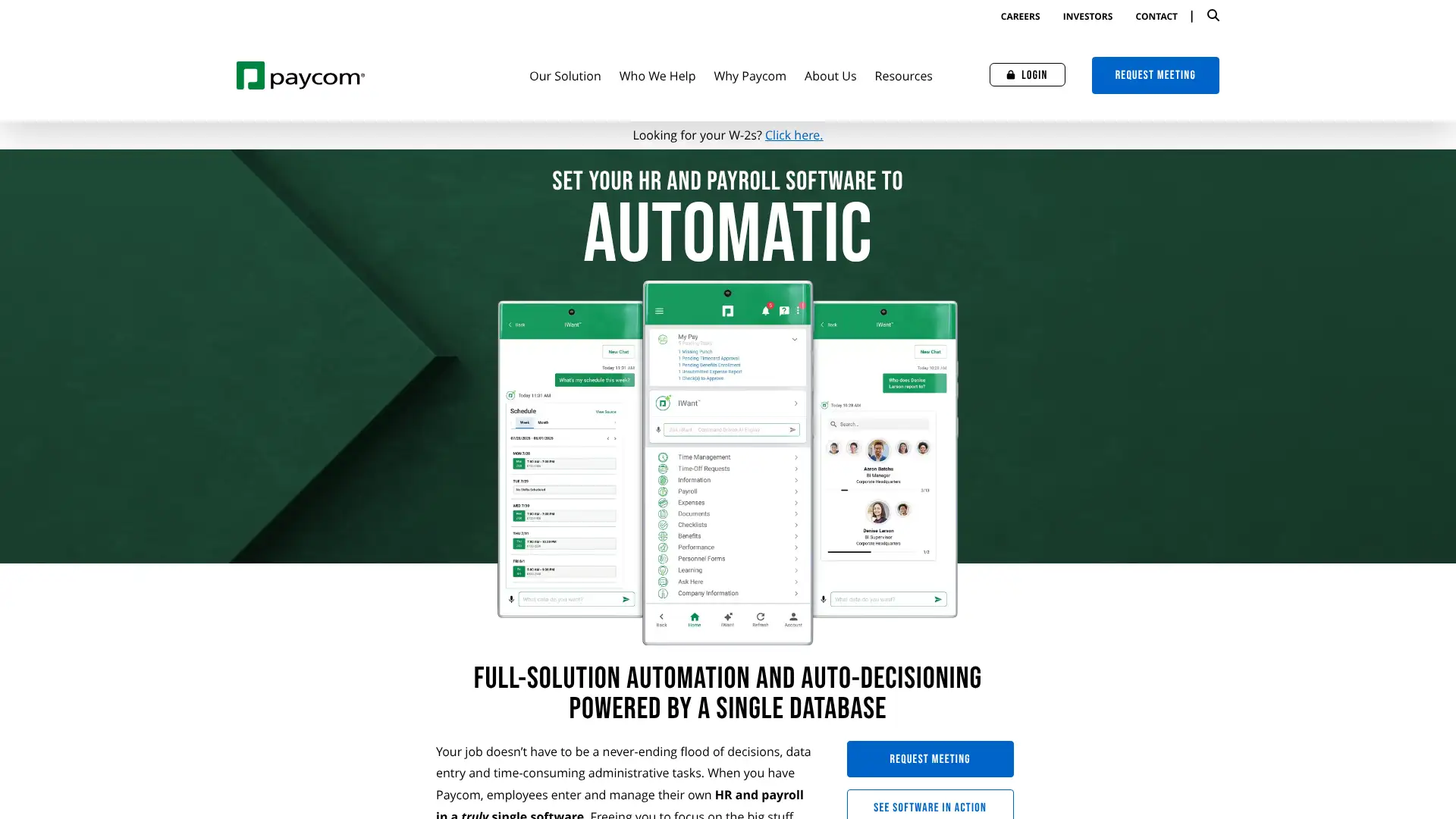
- • Beti employee payroll verification: employees review and correct their own pay data before submission
- • Single-database architecture: all modules share one data layer, eliminating integration latency
- • Self-Service Insights dashboard: AI-powered wage projections and automated garnishment calculations
- • Talent management suite: recruiting, onboarding, performance, learning, and succession in one platform
- • Expense management module: integrated expense reporting without a separate tool
Paycom is the best mid-market HCM platform for companies that want a single-database architecture with no internal integration dependencies and the unique Beti employee payroll verification feature. For international operations, Rippling or Workday provide better global coverage. For small businesses, Gusto is more accessible.
UKG Pro
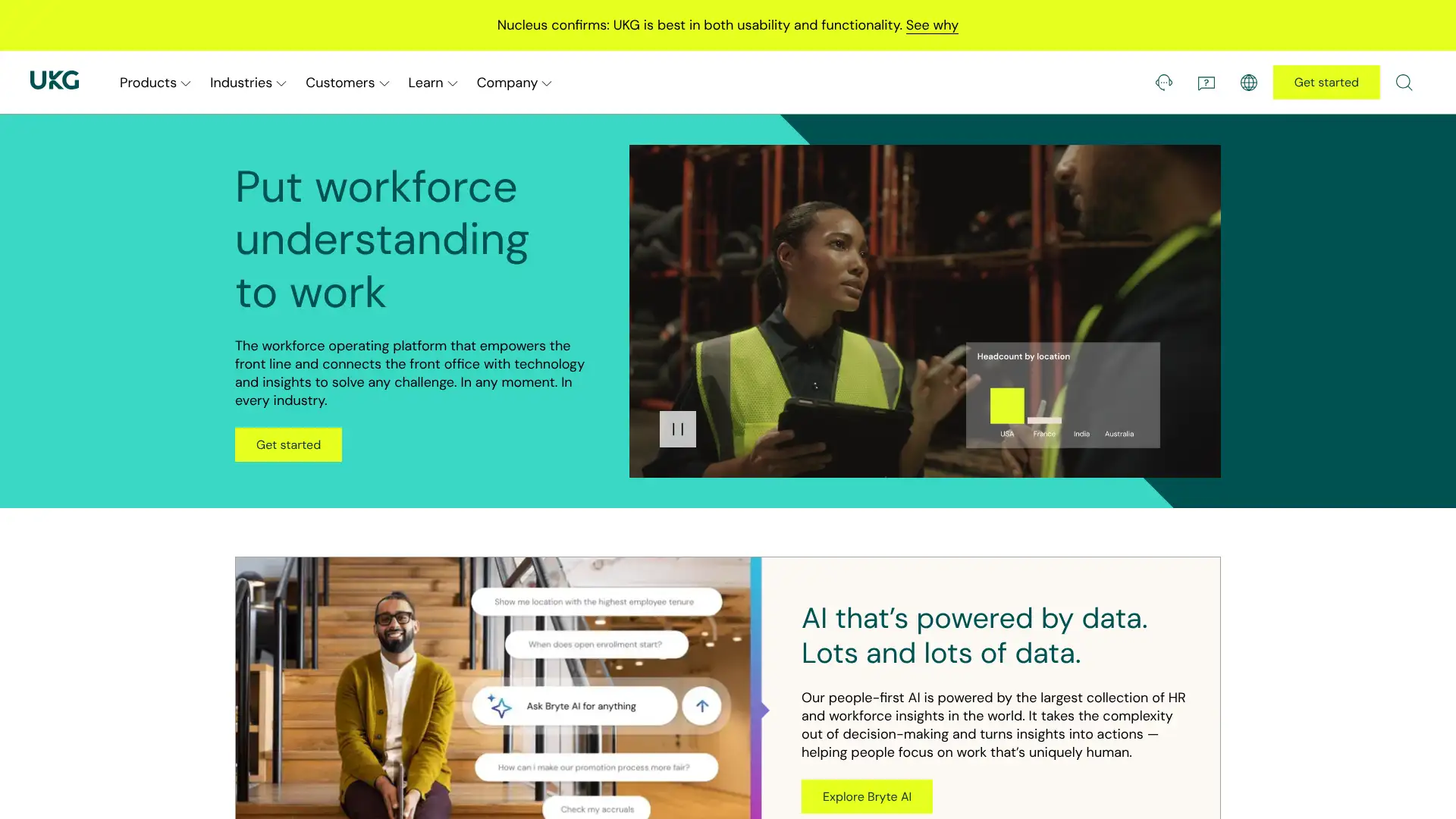
UKG (Ultimate Kronos Group) was formed by the merger of Ultimate Software and Kronos in 2020, combining two enterprise HR and workforce management companies. UKG Pro is the flagship enterprise HCM platform, covering HR, payroll, talent management, and learning. UKG Ready serves the mid-market. UKG's primary differentiator is its workforce management capabilities: advanced scheduling, time and attendance, and labour analytics for shift-based workforces in retail, healthcare, manufacturing, and hospitality. A Spring 2025 update added AI-powered payroll validation agents that automatically flag discrepancies and suggest corrective entries. Pricing is enterprise custom and generally positions UKG Pro at the higher end compared to ADP and Ceridian.
- • Advanced workforce management: the most sophisticated scheduling and time-attendance of any HR platform
- • AI payroll validation agents: automatically flag discrepancies and suggest corrections before payroll runs
- • UKG Dimensions: purpose-built workforce management for complex shift and hourly operations
- • 20+ language support: suitable for diverse global workforces
- • Strong post-merger integration: HR and WFM data unified after the 2020 Kronos-Ultimate merger
UKG Pro is the right enterprise HCM for organisations with complex shift-based, hourly, or distributed workforces in retail, healthcare, manufacturing, or logistics. The workforce management and scheduling capabilities are unmatched. For office-based salaried workforces, Workday or Ceridian Dayforce provide comparable HCM at lower complexity.
Ceridian Dayforce
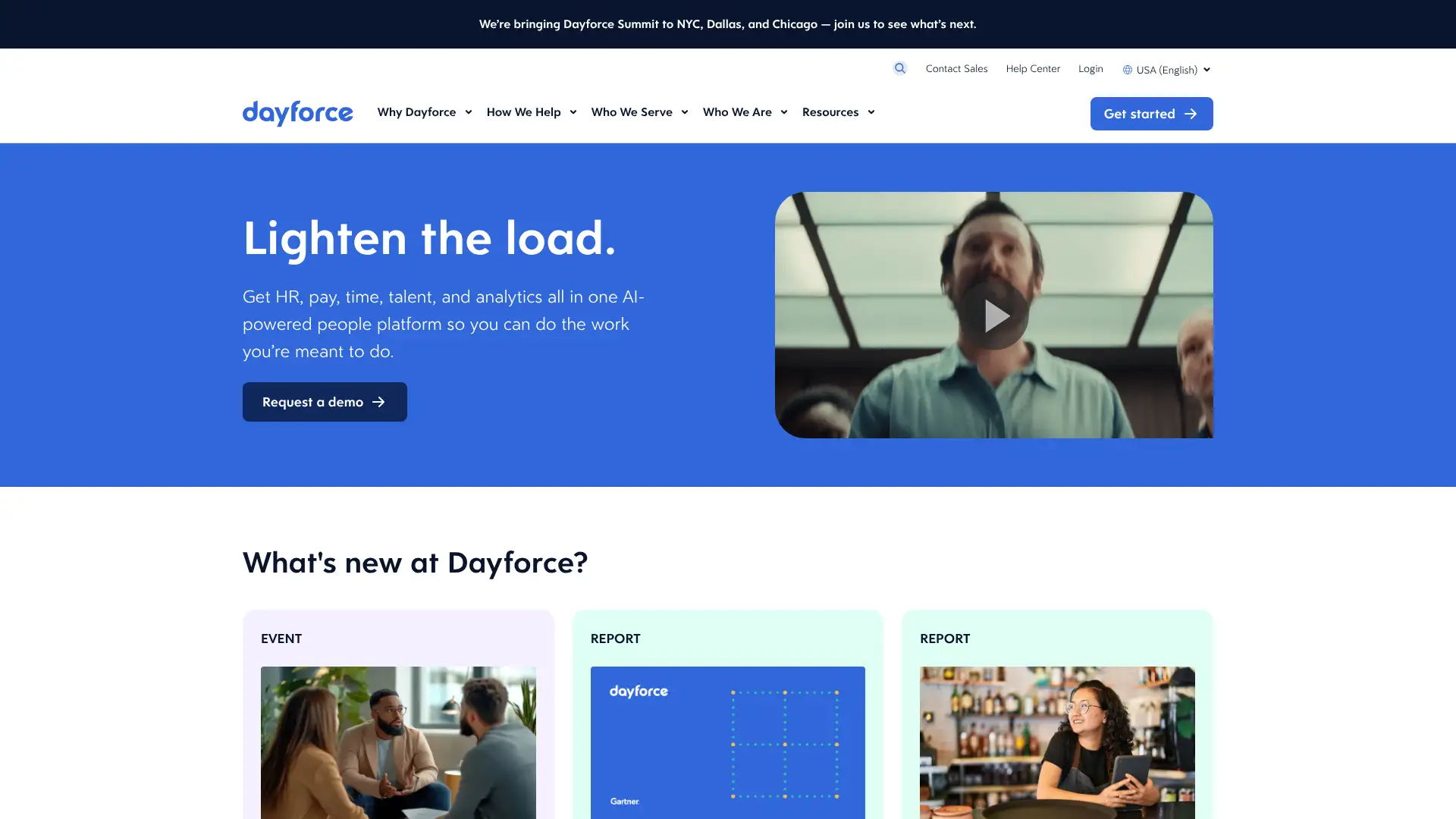
Ceridian rebranded its flagship platform to Dayforce in 2024, positioning it as a global people platform combining payroll, HR, benefits, talent, and workforce management. Dayforce's primary technical differentiator is its continuous payroll calculation engine: unlike batch-processing systems that calculate payroll only when run, Dayforce continuously calculates pay throughout the pay period, flagging overtime and compliance issues in real time rather than at payday. This makes it particularly valuable for regulated industries with complex labour laws. Ceridian acquired Aptitude Software in 2024 to enhance its global payroll engine, and launched Dayforce Assist in Q1 2025, applying AI to automate exception handling, payroll corrections, and regulatory reporting.
- • Continuous payroll calculation: calculates pay in real time throughout the pay period, not just at run time
- • Single-database architecture: HR, payroll, time, and benefits share one data layer with no syncing latency
- • Dayforce Assist: AI-powered payroll exception handling and regulatory reporting automation (launched Q1 2025)
- • Global payroll in 160+ countries: enhanced by the Aptitude Software acquisition in 2024
- • Best-in-class scheduling: workforce management capabilities competitive with UKG for shift-based operations
Ceridian Dayforce is the best HCM for organisations where payroll accuracy and real-time compliance visibility are paramount: regulated industries, shift-based operations, and global payrolls where batch errors are costly. Dayforce's continuous calculation engine is technically the most advanced in the market.
HiBob
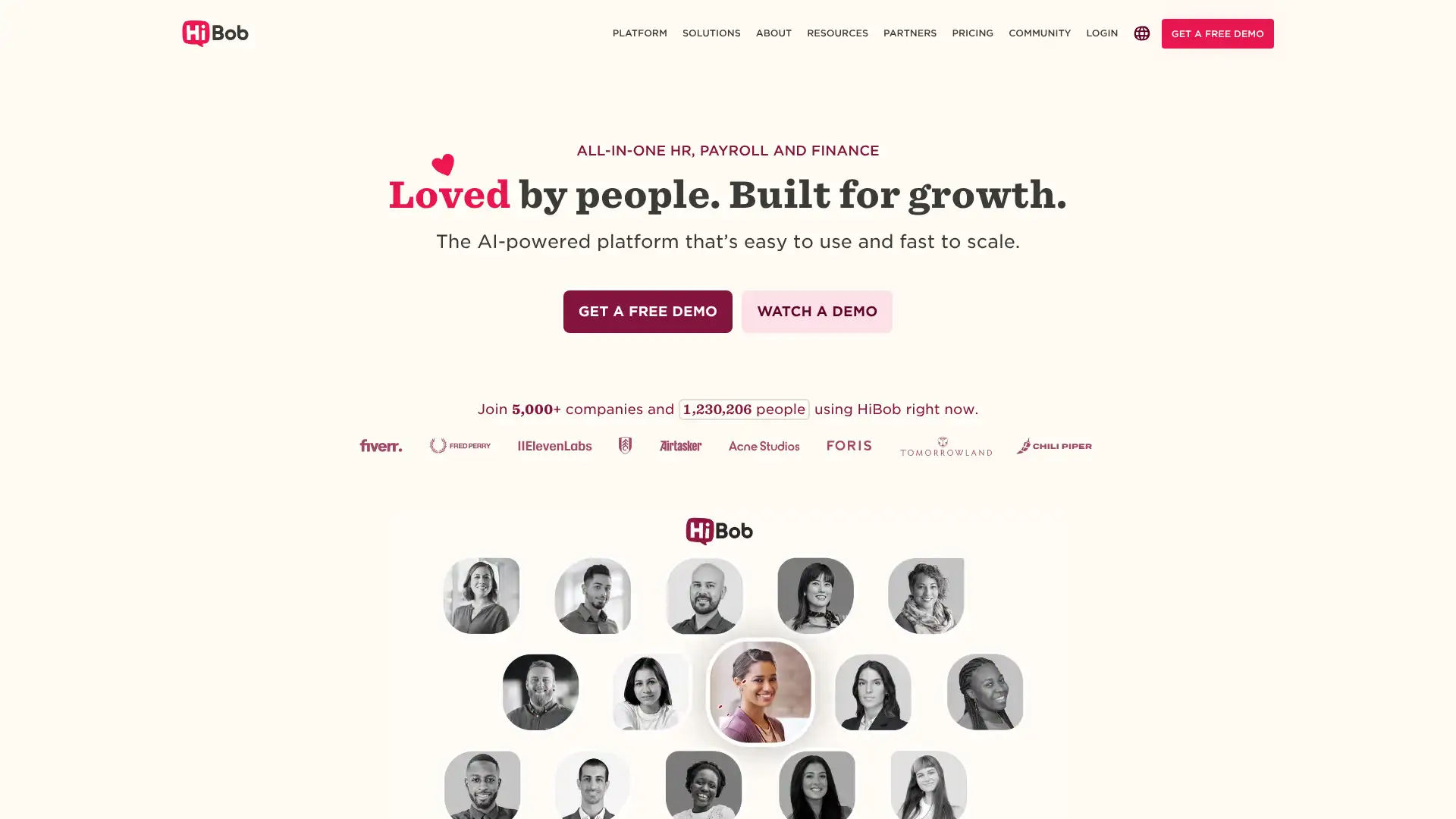
HiBob (Bob) is a modern HR platform designed for mid-market companies (50-500 employees) with global or distributed teams. It is frequently cited alongside Rippling and Personio as one of the three leading modern HR platforms for growing companies outside the enterprise tier. HiBob's interface is widely praised as the most engaging and employee-friendly in the category, with a social-media-like home feed, club functionality, and shoutout features. It offers core HRIS, onboarding, payroll (via local integrations), time and attendance, benefits, performance management, compensation, and people analytics. HiBob is headquartered in New York and Tel Aviv. Pricing is custom and typically falls in the $10-20 PEPM range.
- • Most engaging employee-facing interface: social feed, clubs, and shoutouts drive platform adoption
- • Compensation management: salary benchmarking, equity tracking, and merit review cycles
- • People analytics: real-time workforce dashboards for headcount, attrition, and diversity
- • Customisable onboarding journeys: role-specific onboarding workflows with task automation
- • 200+ integrations: connects with most HR, finance, and productivity tools
HiBob is the best people platform for mid-market companies (50-500 employees) that prioritise employee engagement, compensation management, and people analytics and are happy to use local payroll integrations rather than native payroll. For companies that want native payroll in one platform, Rippling or BambooHR with the payroll
Personio
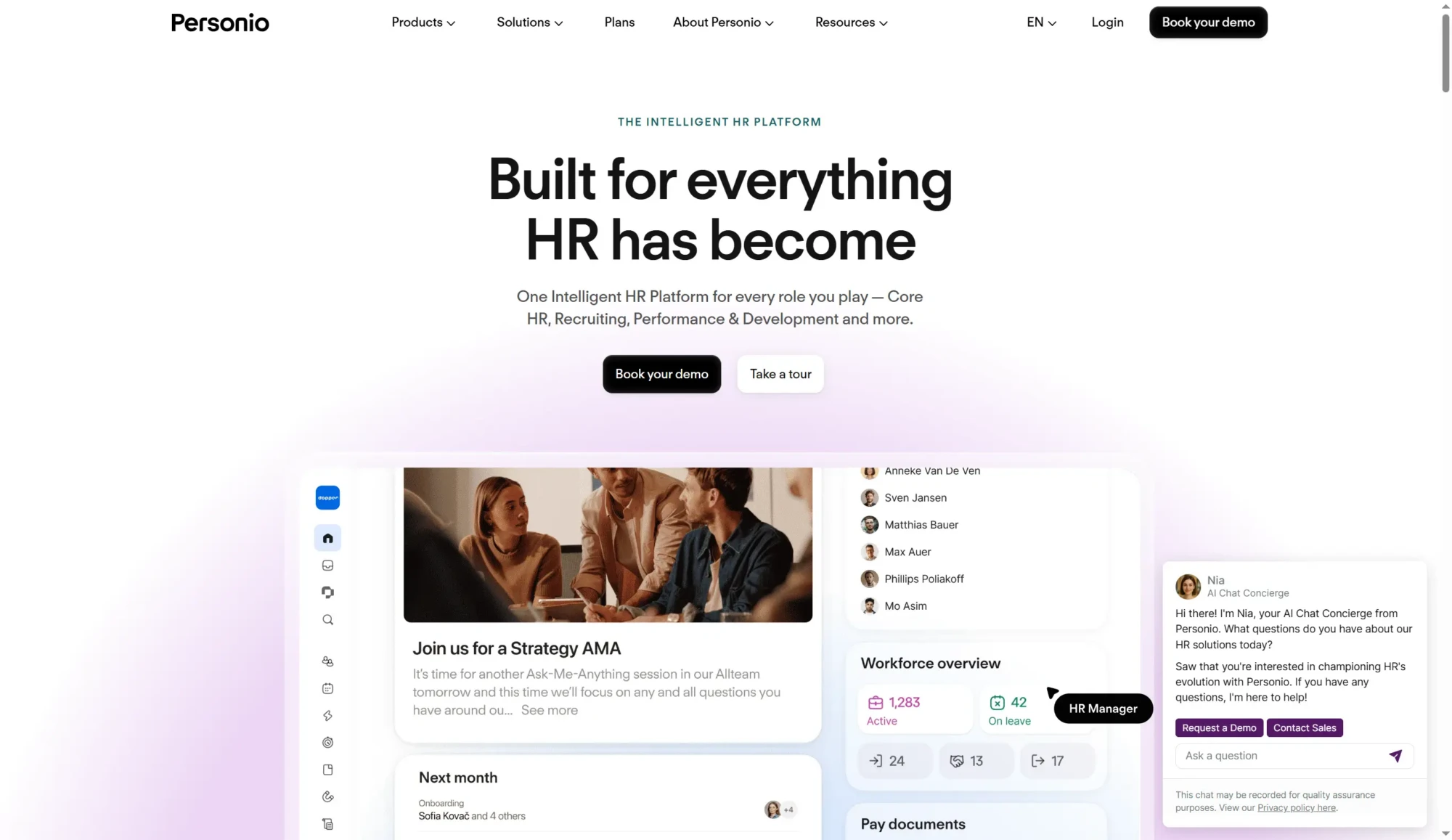
Personio is the leading HR platform for small and mid-sized businesses in German-speaking and European markets, serving 15,000+ companies ranging from 10 to 2,000 employees. It centralises employee data, automates HR tasks, and handles recruitment, onboarding, performance management, and preliminary payroll across Europe and the UK. Personio integrates with 200+ tools and connects to local payroll providers in major European countries. Pricing was previously published in tiers but has moved to custom quotes; industry estimates suggest EUR 2.88-4.43 per employee per month for core plans with a 10% discount for annual prepayment. Personio is particularly strong for German, Austrian, and Swiss labour law compliance.
- • 200+ integrations: the broadest European HR integration ecosystem, including payroll by country
- • German/Swiss/Austrian compliance: purpose-built for DACH labour law and data protection requirements
- • Recruitment module: publish to 600+ job boards and manage the full hiring pipeline
- • Workflow automation: conditional approval flows, task checklists, and document management
- • People analytics: org chart, headcount, and attrition dashboards with export capability
Personio is the best HR platform for European companies (especially Germany, Austria, and Switzerland) needing a compliant, integrated HR system with strong localisation. For US-based companies, BambooHR or Rippling are more native. For global distributed teams, HiBob or Rippling provide better multi-region support.
Factorial
Factorial is a Barcelona-based HR software company founded in 2016, targeting SMBs in Spain, France, Italy, Mexico, and broader Europe with an all-in-one HR platform at competitive pricing. It covers time tracking, leave management, payroll (integrated with local providers), performance management, recruiting, and onboarding. Factorial differentiates from Personio with slightly lower pricing, a more modern mobile-first interface, and stronger time-tracking automation for hourly workers. Plans start at approximately EUR 5/employee/month for the core tier. Factorial has grown rapidly and raised significant venture capital, expanding its coverage across Latin America and Europe.
- • Mobile-first time tracking: GPS clock-in and out for hourly workers and distributed teams
- • Leave management automation: absence workflows, approval routing, and compliance by country
- • Performance reviews and OKRs: goal tracking and 360-degree feedback on Business plan
- • Recruiting pipeline: ATS with job board publishing and candidate tracking
- • Latin America and Europe coverage: multi-country compliance for EMEA and LATAM markets
Factorial is the best HR platform for early-stage European and Latin American companies that want an all-in-one tool at a lower price point than Personio. The mobile-first time tracking is particularly strong for teams with hourly or field workers.
BreatheHR
BreatheHR is a UK-based HR software platform specifically designed for small businesses in the UK, covering holiday management, absence tracking, performance management, document storage, and basic HR reporting. It operates on a flat-rate subscription model based on headcount bands rather than per-employee pricing, making cost planning simple. The Starter plan costs approximately GBP 9/month for up to 10 employees. BreatheHR is not a payroll platform; it integrates with accounting tools like Xero and Sage for payroll processing. It is often the first HR system UK businesses adopt when outgrowing spreadsheets, before moving to more comprehensive platforms like Personio or HiBob.
- • Flat-rate pricing by headcount band: the simplest and most predictable HR software pricing model reviewed
- • UK-specific compliance: designed for UK holiday allowances, statutory leave, and employment law
- • Xero and Sage integration: connects with UK payroll tools rather than duplicating payroll functionality
- • Simple setup: typically deployed within a day for small UK teams
- • GDPR-compliant document storage: securely store employee documents within UK data jurisdiction
BreatheHR is the best starting point for UK small businesses (under 100 employees) that are moving from spreadsheets to their first HR system and need holiday management, absence tracking, and document storage at a predictable flat monthly fee. For companies with growth plans that will eventually require
Zenefits (now TriNet HR)
Zenefits was acquired by TriNet in 2022 and continues to operate as TriNet HR Platform, a standalone HRIS offering HR, benefits administration, payroll, and time tracking. The TriNet acquisition added PEO co-employment services alongside the software platform, giving TriNet HR a unique combination of self-service HR software and optional outsourced HR via co-employment. TriNet HR Platform provides flat-fee pricing (not percentage-of-payroll), meaning employer raises do not affect platform costs. TriNet processes payroll for approximately one in twelve US employees. The platform is IRS-certified and ESAC-accredited as a PEO.
- • Flat-fee PEO pricing: raises do not increase platform costs, unlike percentage-of-payroll models
- • IRS-certified and ESAC-accredited PEO: the most trusted compliance credentials for PEO services
- • Three-click payroll: automatic data sync reduces manual payroll steps
- • Group health benefits through PEO: access to enterprise health plans at smaller-business pricing
- • Industry-specific HR guidance: specialised HR support across technology, finance, healthcare, and retail
Zenefits is the best choice for US small businesses that want both a modern HR software platform and the option to add PEO co-employment for better group health insurance pricing and outsourced HR compliance. The flat-fee PEO pricing model is more predictable than percentage-of-payroll alternatives.
Justworks
Justworks is a modern Professional Employer Organisation (PEO) designed for small US businesses (1-200 employees) that want to access enterprise-grade benefits and outsource HR compliance without the complexity of traditional PEOs. Unlike software-first platforms like Gusto or BambooHR, Justworks is a co-employer: it assumes shared employment liability with the client company, enabling small businesses to access large-group health insurance rates typically only available to Fortune 500 companies. Pricing is flat-rate per employee per month rather than percentage of payroll. Justworks added EOR capabilities for international hiring in limited markets. It is IRS-certified and ESAC-accredited.
- • Fortune 500 health benefits access: small businesses get large-group insurance rates through co-employment
- • Flat-rate PEPM pricing: stable costs regardless of salary levels or pay raises
- • IRS-certified ESAC-accredited PEO: the strongest compliance credentials for co-employment services
- • 24/7 customer support: available around the clock, not just during business hours
- • Clean modern interface: the most polished PEO software experience available
Justworks is the best PEO for small US businesses (under 200 employees) where access to affordable enterprise-grade health benefits is the primary motivation. The flat-rate pricing and clean interface differentiate it from traditional PEOs.
Sapling (now part of Kallidus)
Sapling was an employee onboarding and people operations platform that was acquired by Kallidus in 2022. It continues to operate under the Sapling brand within the Kallidus portfolio. Sapling specialises in structured onboarding workflows, preboarding experiences, and HRIS data management for mid-market companies (50-1,000 employees). It integrates with major HRIS platforms including BambooHR, Workday, and ADP rather than replacing them, positioning itself as an onboarding layer on top of existing HR systems. Pricing is custom and generally falls in the $6-10 PEPM range.
- • Preboarding experience: structured workflows that begin before an employee's first day
- • HRIS integrations: works alongside BambooHR, Workday, ADP rather than replacing them
- • Onboarding task automation: conditional task checklists based on role, location, and department
- • Document management: e-signatures, document templates, and storage in onboarding workflows
- • Offboarding workflows: structured exit processes to ensure knowledge transfer and system access removal
Sapling is the right choice for mid-market companies with an existing HRIS that want to add structured preboarding and onboarding workflows without switching their core HR system. For companies without an existing HRIS, BambooHR or HiBob include onboarding as part of a complete platform.
Cezanne HR
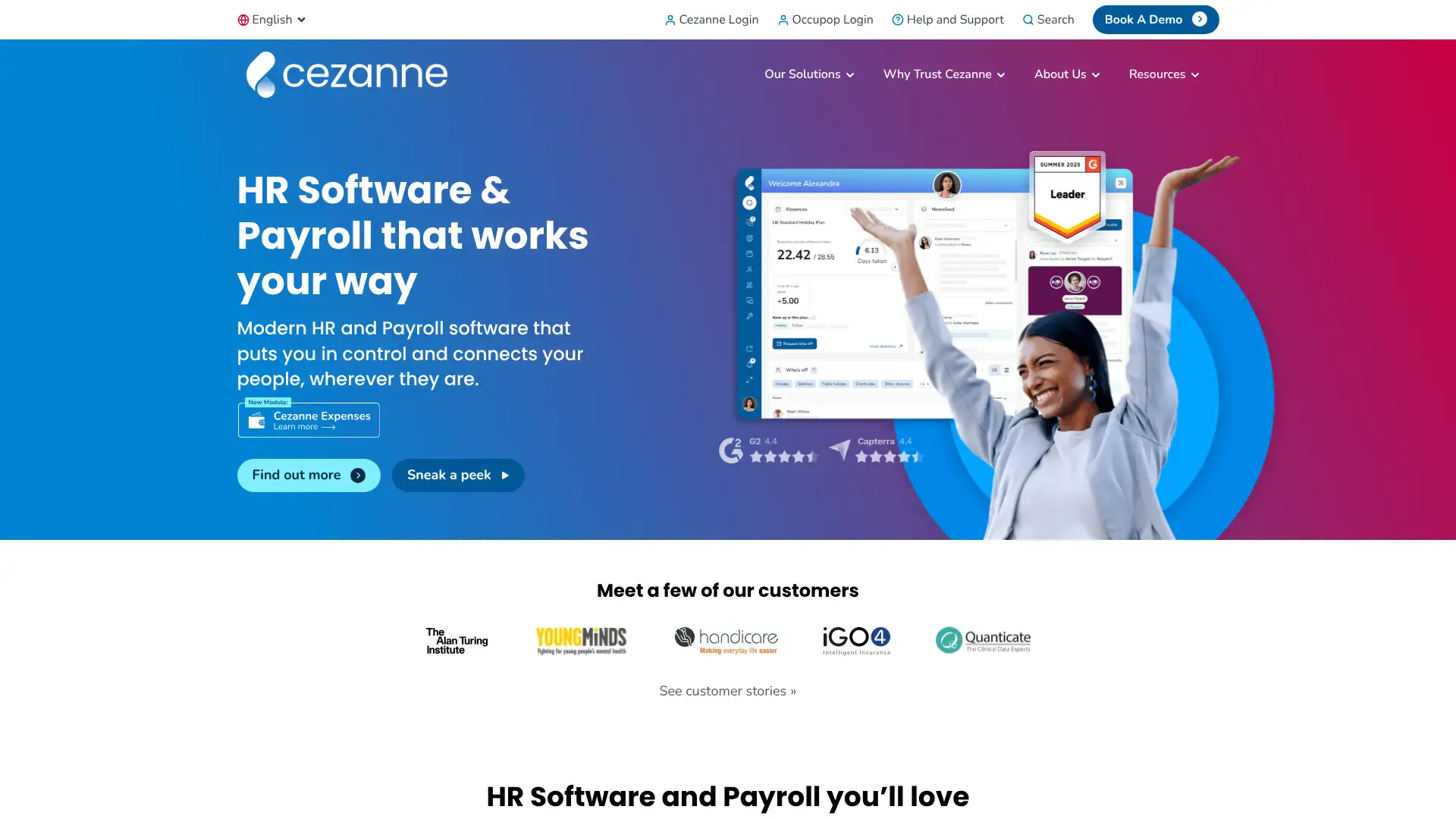
Cezanne HR is a UK-based HRIS platform built for mid-market organisations (100-3,000 employees) with a modular structure allowing companies to buy only the modules they need. The core People module is required, with optional modules for Absence Management, Performance Management, Time Tracking, and Recruitment. This modular approach means entry pricing is lower than bundled competitors, but the full-featured cost is comparable. Cezanne HR is particularly strong for UK and European compliance with GDPR-compliant data storage, right-to-work management, and UK-specific absence types (SSP, maternity, paternity). Data is hosted in the UK/EU.
- • Modular pricing: buy only the modules you need, reducing cost for core-HR-only requirements
- • UK/EU data hosting: data stored in UK/EU jurisdictions for GDPR and data sovereignty compliance
- • UK-specific absence management: SSP, maternity, paternity, and right-to-work tracking built in
- • Right-to-work document management: passport, visa, and work permit tracking and alerts
- • Configuration-first approach: highly configurable workflows and fields without developer involvement
Cezanne HR is the best HRIS for UK and European mid-market companies (100-3,000 employees) that need modular pricing, GDPR-compliant UK/EU data hosting, and comprehensive UK absence management including SSP, right-to-work, and statutory leave types. For companies wanting a modern employee-facing experience, HiBob provides better engagement features.
Humi
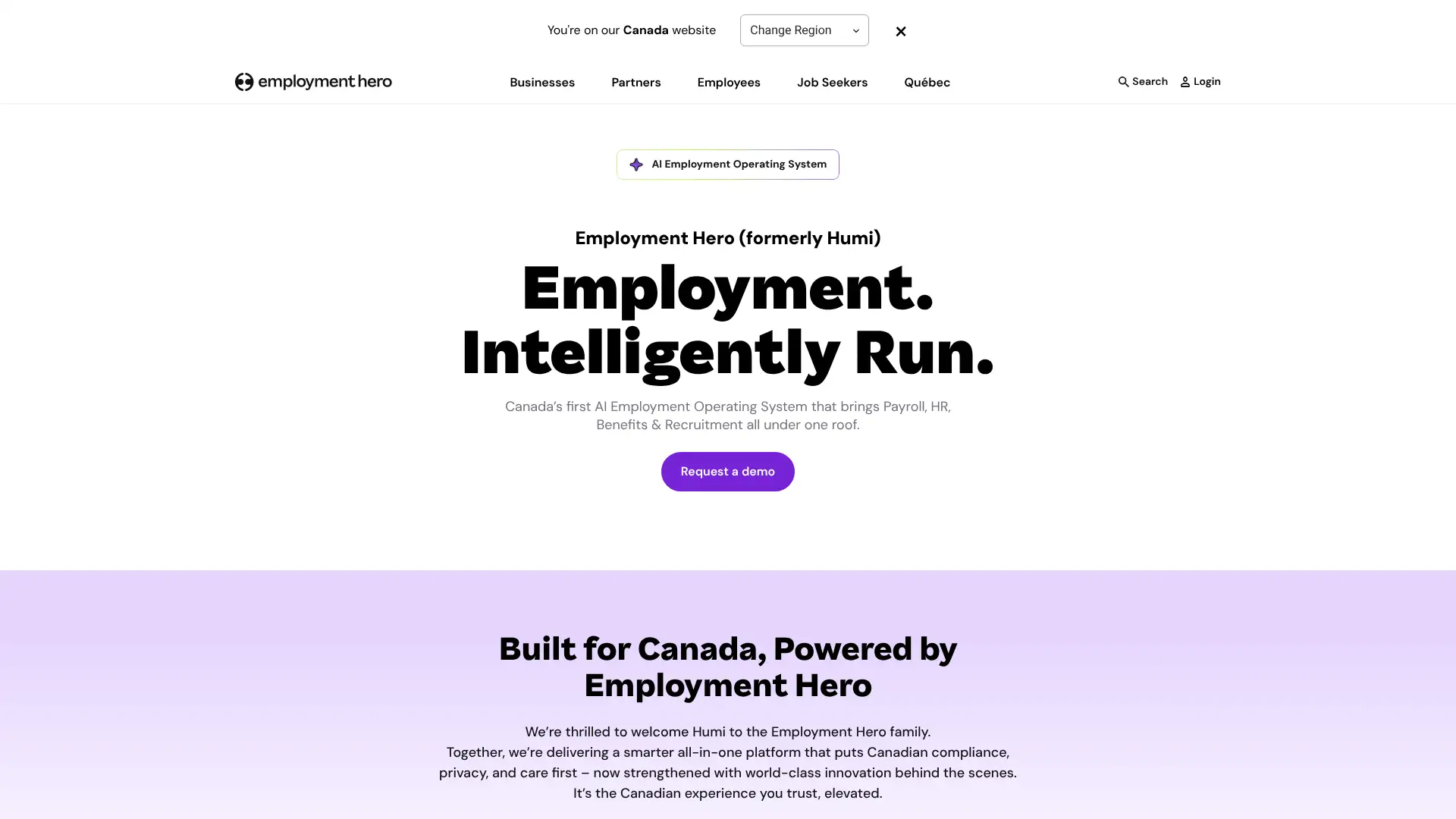
Humi is a Canadian HR software platform designed specifically for Canadian businesses, covering payroll, benefits, time off, performance management, onboarding, and HR compliance. It is one of the few HR platforms purpose-built for Canadian employment law across all provinces, handling Quebec-specific payroll requirements, ROE (Record of Employment) filing, and provincial statutory leave compliance. Pricing starts at approximately CAD 6/employee/month for the Starter plan. Humi integrates with QuickBooks, Xero, and major Canadian benefits providers. It targets Canadian SMBs from 10 to 500 employees.
- • Canadian payroll compliance: ROE filing, Quebec payroll, and all provincial statutory leave built in
- • Benefits administration: direct connections to major Canadian insurance and benefits providers
- • All-province employment law compliance: statutory leaves vary by province, all supported natively
- • QuickBooks and Xero integration: connects with the most common Canadian accounting tools
- • French/English bilingual support: bilingual interface for Quebec and bilingual organisations
Humi is the best HR platform for Canadian businesses (10-500 employees) that need purpose-built Canadian employment law compliance including ROE filing, Quebec payroll, and provincial statutory leave. For Canadian companies with US employees, Rippling or BambooHR with a US payroll integration provide better cross-border coverage.
Papaya Global
Papaya Global is a global workforce management platform built primarily for enterprise finance teams managing complex multi-entity payroll across many countries. It covers 160+ countries and is designed for organisations already running their own entities who need to consolidate and standardise payroll reporting across them. Rather than being primarily an EOR provider, Papaya positions itself as a payroll aggregation platform: processing payroll locally in each country and consolidating output into a single financial reporting layer for CFOs and finance teams. EOR services are also available at custom pricing (approximately EUR 400-550/month estimates). Pricing is custom for mid-market and enterprise deployments, with most engagements reportedly starting around $50,000 annually.
- • Single global payroll dashboard: consolidate all country payrolls into one GL-mapped financial view
- • SOC 2-compliant audit trails: payroll journals and regulatory documentation for enterprise audits
- • FX and cross-border payments: automated multicurrency payroll payments with FX management
- • 160+ country payroll engine: in-country validated payroll calculation across all markets
- • ERP and HCM integrations: connects with SAP, Oracle, Workday, and major financial systems
Papaya Global is the right platform for large enterprises (500+ employees across 5+ countries with own entities) that need to consolidate fragmented global payroll into a single finance-grade reporting system. For EOR-first hiring or companies without complex multi-entity payroll, Deel or Remote provide simpler alternatives at lower cost.
Lattice
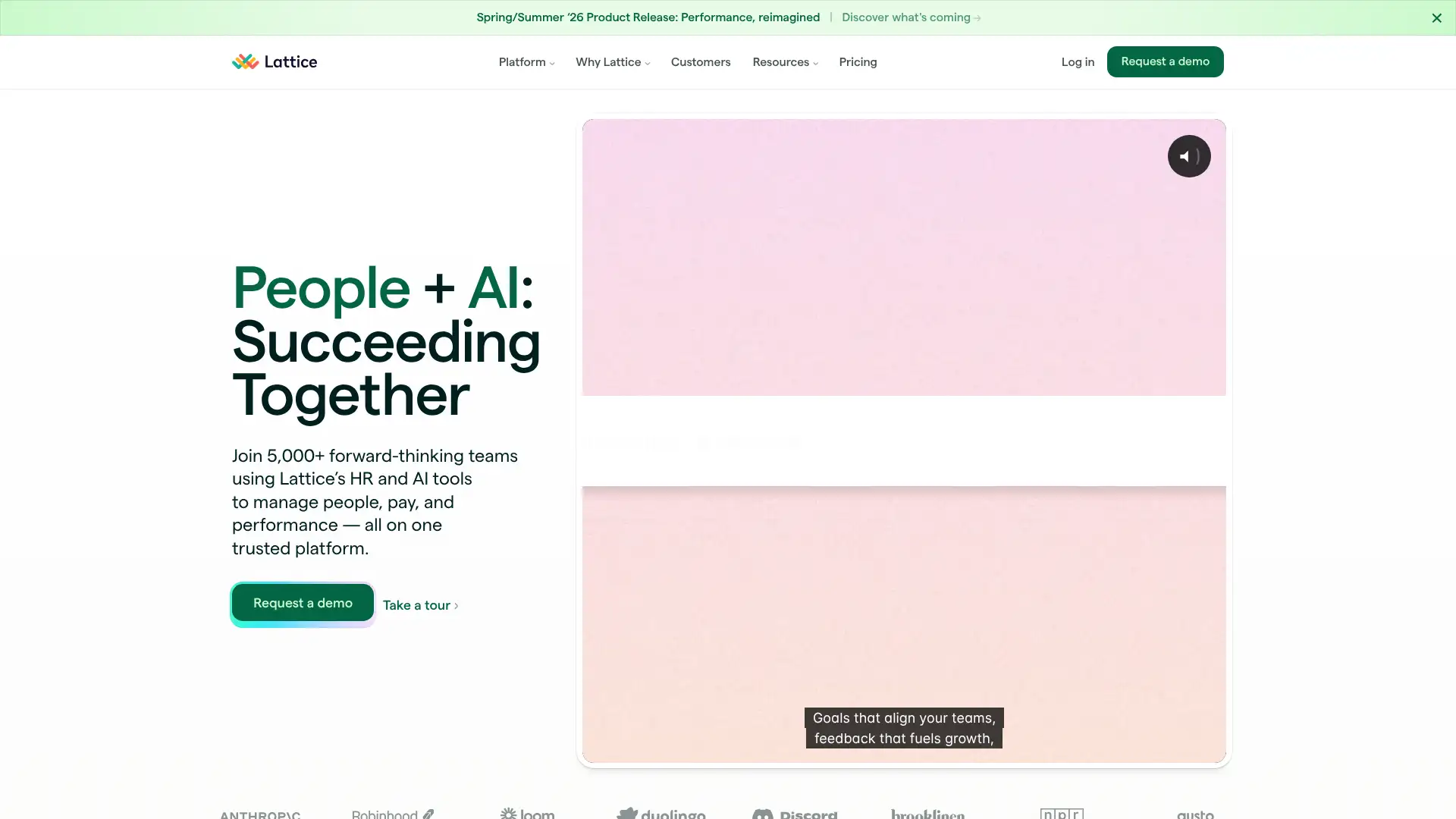
Lattice is a performance management and employee engagement platform that has become the default choice for growth-stage tech companies building structured performance cultures. It combines goals and OKRs, 360-degree reviews, continuous feedback, engagement surveys, and compensation management in a modular structure. Lattice added an HRIS in recent years, making it possible to consolidate core HR and performance management in one platform. Pricing is module-based and not publicly published; third-party estimates place the full platform at $11-20 per employee per month depending on modules selected. It is best known for its polished interface and strong integrations with Slack, Google Workspace, and major HRIS platforms.
- • 360-degree performance reviews: self-assessments, peer feedback, upward manager evaluation in one cycle
- • Goals and OKRs: individual and team goal alignment with company objectives and progress tracking
- • Compensation management: real-time salary benchmarking and merit review cycles
- • Engagement surveys: eNPS and pulse surveys with AI-driven action prioritisation
- • Manager effectiveness scoring: combines engagement, turnover, and feedback into a single manager score
Lattice is the best performance management platform for mid-sized growth companies (100-2,000 employees) that want a comprehensive tool covering OKRs, 360 reviews, compensation management, and engagement in one place. For companies that primarily need engagement surveys, Culture Amp provides deeper analytics.
15Five
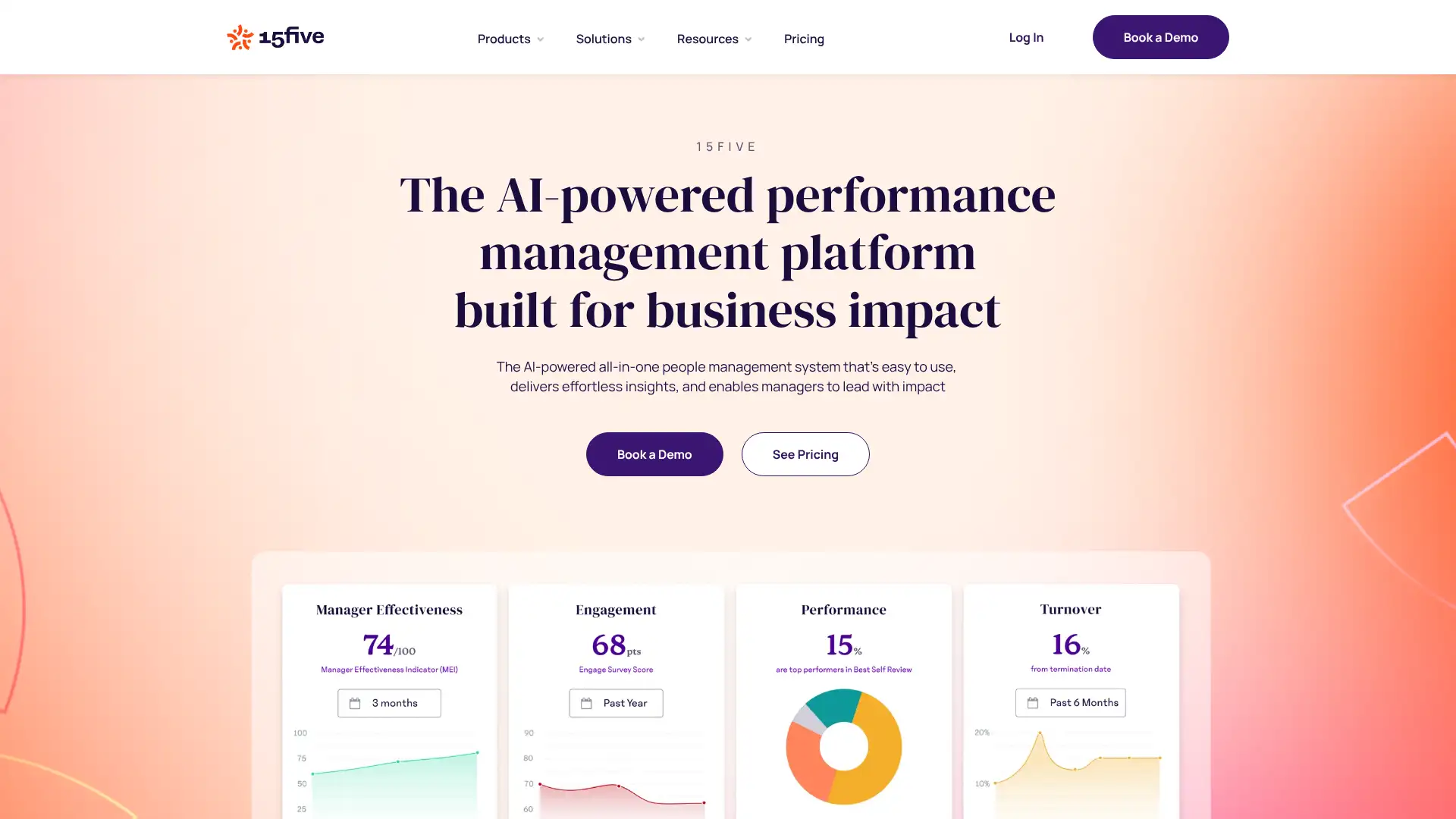
15Five is a performance management platform founded on the concept of weekly 5-minute check-ins (originally 15 minutes of employee work summarised in 5 minutes, hence the name). It covers weekly check-ins, OKRs, 1:1 meeting tools, 360-degree reviews, engagement surveys, and a Manager Effectiveness Indicator that scores managers based on their team's engagement, turnover, and upward feedback. 15Five recently added an LMS for learning and development courses and a compensation management module. It acquired an employee engagement platform and continues integrating engagement analytics. Pricing is approximately $9-15 per employee per month for the full performance management platform.
- • Weekly check-ins: structured 5-minute manager-employee updates driving continuous feedback culture
- • Manager Effectiveness Indicator: composite score combining engagement, turnover, 1:1 frequency, and upward feedback
- • Engagement surveys: eNPS and pulse surveys with AI identification of engagement drivers
- • High Fives recognition: peer recognition feature integrated into the weekly workflow
- • LMS integration: learning and development courses and progression tracking alongside performance
15Five is the best performance management platform for cost-conscious mid-market companies (50-500 employees) that want continuous feedback culture, strong manager development tools, and recognition features at a lower price than Lattice. For large enterprises needing sophisticated review configuration, Lattice or Leapsome provide more customisation.
Culture Amp
Culture Amp is an employee experience platform founded by organisational psychologists in Melbourne, Australia, with a focus on research-backed engagement surveys and people analytics. It was built engagement-first and expanded into performance management, though its DNA remains data-centric and survey-led. The platform is used by 6,500+ companies and is particularly popular in mid-to-large companies (200+ employees) where people analytics and benchmarking against industry data are priorities. Culture Amp provides science-backed survey templates, detailed analytics with industry benchmarking, and AI-driven action recommendations. Pricing is approximately $5-11 per employee per month depending on modules.
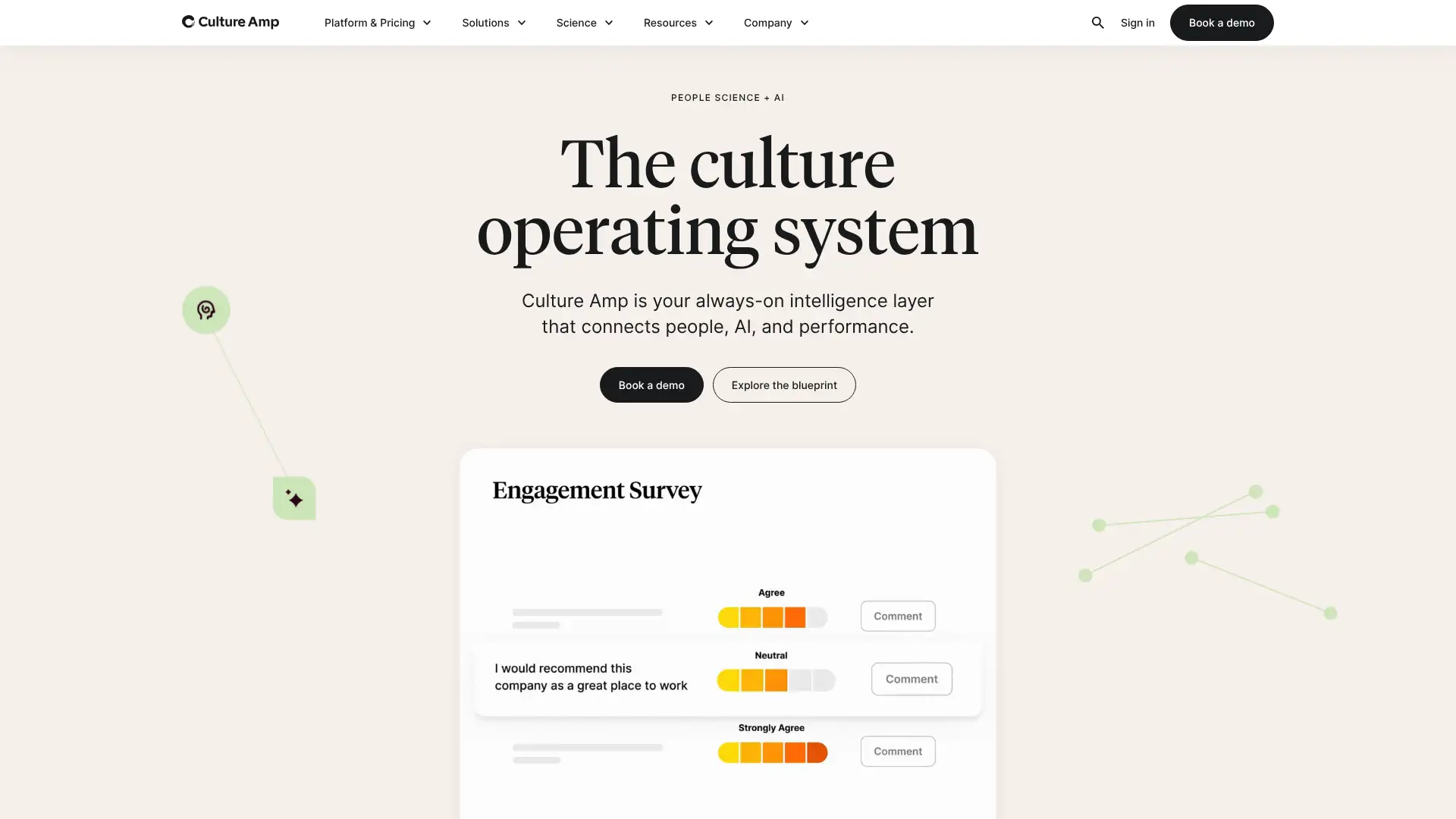
- • Science-backed survey design: templates created by I/O psychologists for statistical reliability
- • Industry benchmarking: compare engagement scores against 6,500+ companies in the Culture Amp database
- • AI action prioritisation: machine learning identifies which engagement levers will have the biggest impact
- • 360-degree reviews: peer, self, and manager assessments with anonymisation controls
- • People science team: in-house organisational psychologists available for larger customers
Culture Amp is the best employee engagement platform for companies where data-driven people analytics, industry benchmarking, and science-backed survey design are priorities. The organisational psychology foundation differentiates it from Lattice or 15Five which are more performance-management-led.
Peoplebox
Peoplebox is an OKR and performance management platform that differentiates by integrating directly with business data sources (Salesforce, HubSpot, Jira, Looker) to auto-update goal progress from real business metrics rather than requiring manual updates. Its AI-powered coaching provides automated 1:1 agenda suggestions and feedback nudges based on goal performance data. Peoplebox targets companies that want OKR management tightly connected to product and revenue metrics rather than just HR performance reviews. Pricing is approximately $7-15 per employee per month for the full platform. It is particularly popular with product and engineering teams.
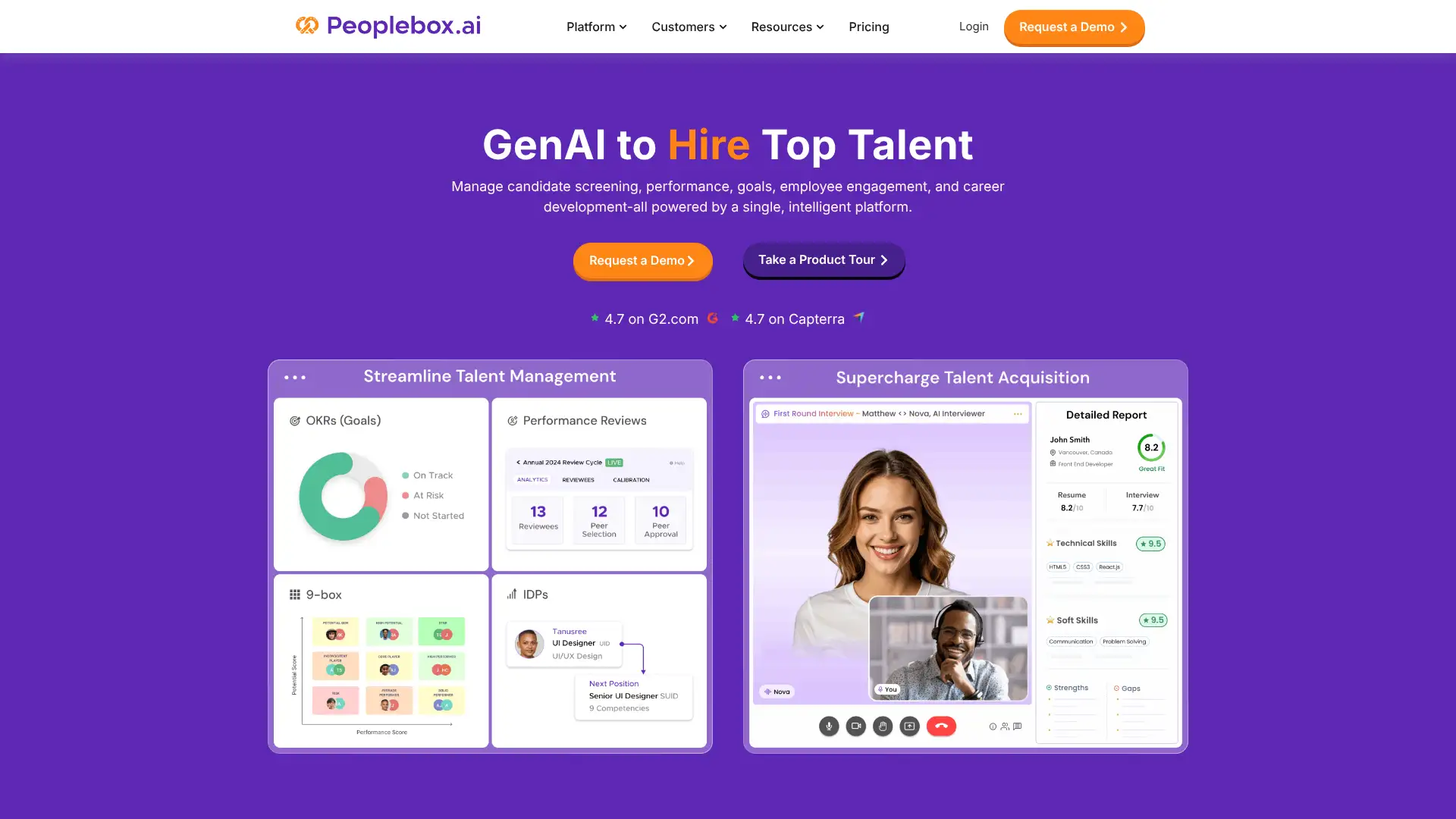
- • Business metric auto-update: OKR progress pulled automatically from Salesforce, HubSpot, Jira, Looker
- • AI 1: 1 coaching: automated agenda suggestions and nudges based on goal performance data
- • Alignment visualisation: cascading OKR tree showing how team goals connect to company objectives
- • Slack and Teams integration: OKR updates and check-in nudges within existing communication tools
- • Performance review integration: peer feedback and review cycles connected to goal achievement data
Peoplebox is the best OKR platform for product and engineering-led companies that want goal progress to auto-update from Salesforce, HubSpot, Jira, and Looker rather than relying on manual updates. The AI coaching layer reduces manager oversight burden.
Leapsome
Leapsome is a Munich-based people enablement platform that G2 rates highest in its category (4.8/5 from 2,305 reviews as of early 2026). It combines performance management, engagement surveys, OKRs, learning management, compensation management, onboarding, and an HRIS in one platform, making it the broadest single-vendor option in the performance management category. Leapsome is particularly strong in Europe and with companies that want to consolidate multiple HR tools into one platform. Pricing is approximately $9-15 per employee per month for the core performance modules with additional modules available. Implementation and customisation are supported by a dedicated customer success team.
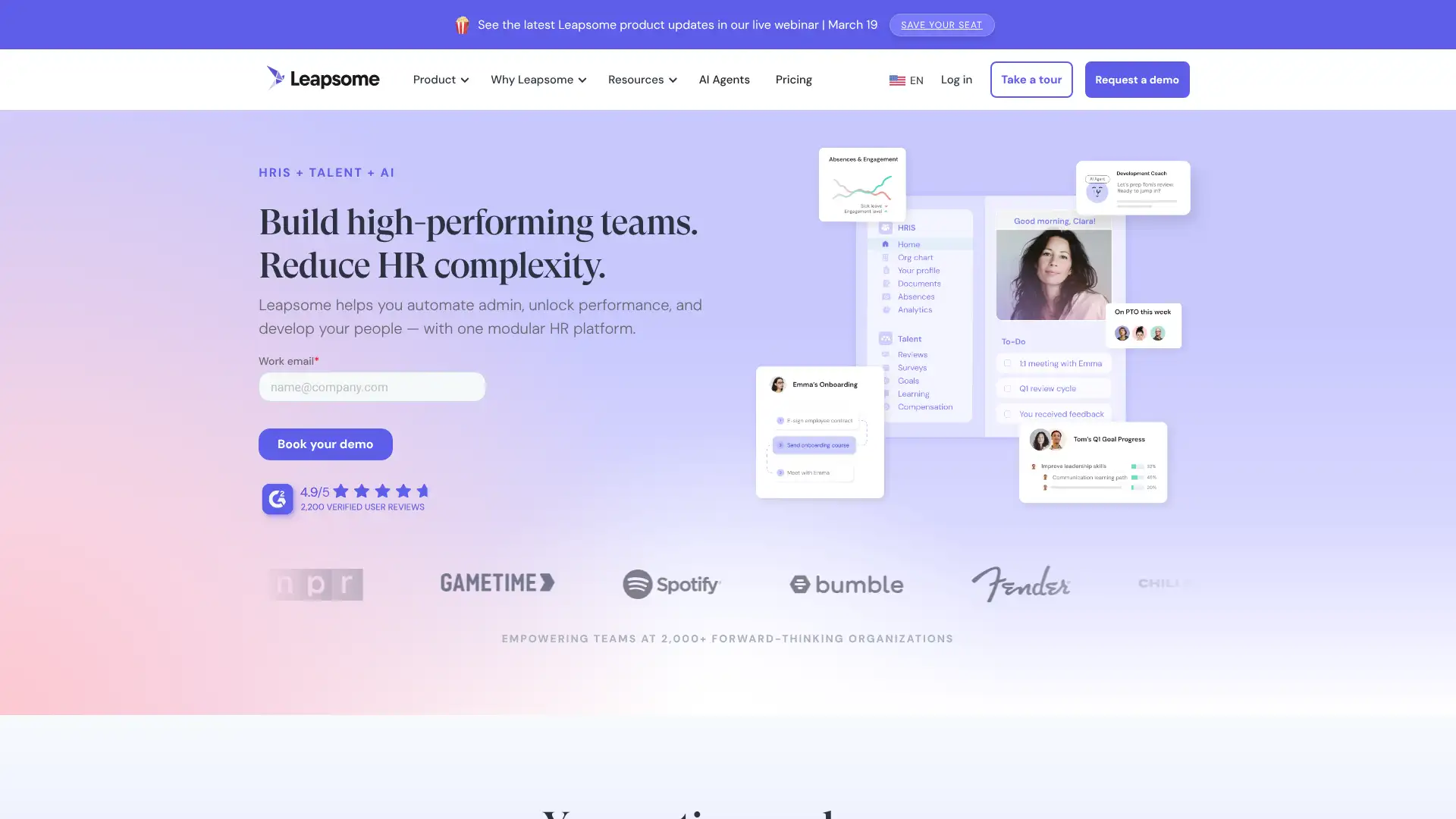
- • Widest breadth of features in one platform: performance, surveys, OKRs, learning, compensation, HRIS
- • Highly customisable review processes: use best-practice templates or fully configure everything
- • 4.8/5 G2 rating from 2,305+ reviews: highest rated performance management platform on G2
- • European data residency: GDPR-compliant hosting with EU data sovereignty
- • Multilingual support: fully localised platform experience for global teams
Leapsome is the best people enablement platform for companies that want to consolidate performance management, learning, engagement surveys, OKRs, and compensation management in one highly rated platform. The G2 rating of 4.8/5 from 2,300+ reviews reflects consistent customer satisfaction.
Sage People
Sage People is a cloud HR and people system built on the Salesforce Platform, targeting multinational mid-market organisations (200-5,000 employees). Because it runs on Salesforce, it benefits from Salesforce's enterprise-grade reliability, customisation capabilities, and integration ecosystem. Sage People provides configurable dashboards, AI-powered candidate matching, time-off management, performance management, and workforce analytics. The Salesforce foundation means organisations with existing Salesforce investments can embed HR data directly into their CRM and ERP workflows. Pricing is custom and typically positioned above mid-market HRIS platforms like HiBob.
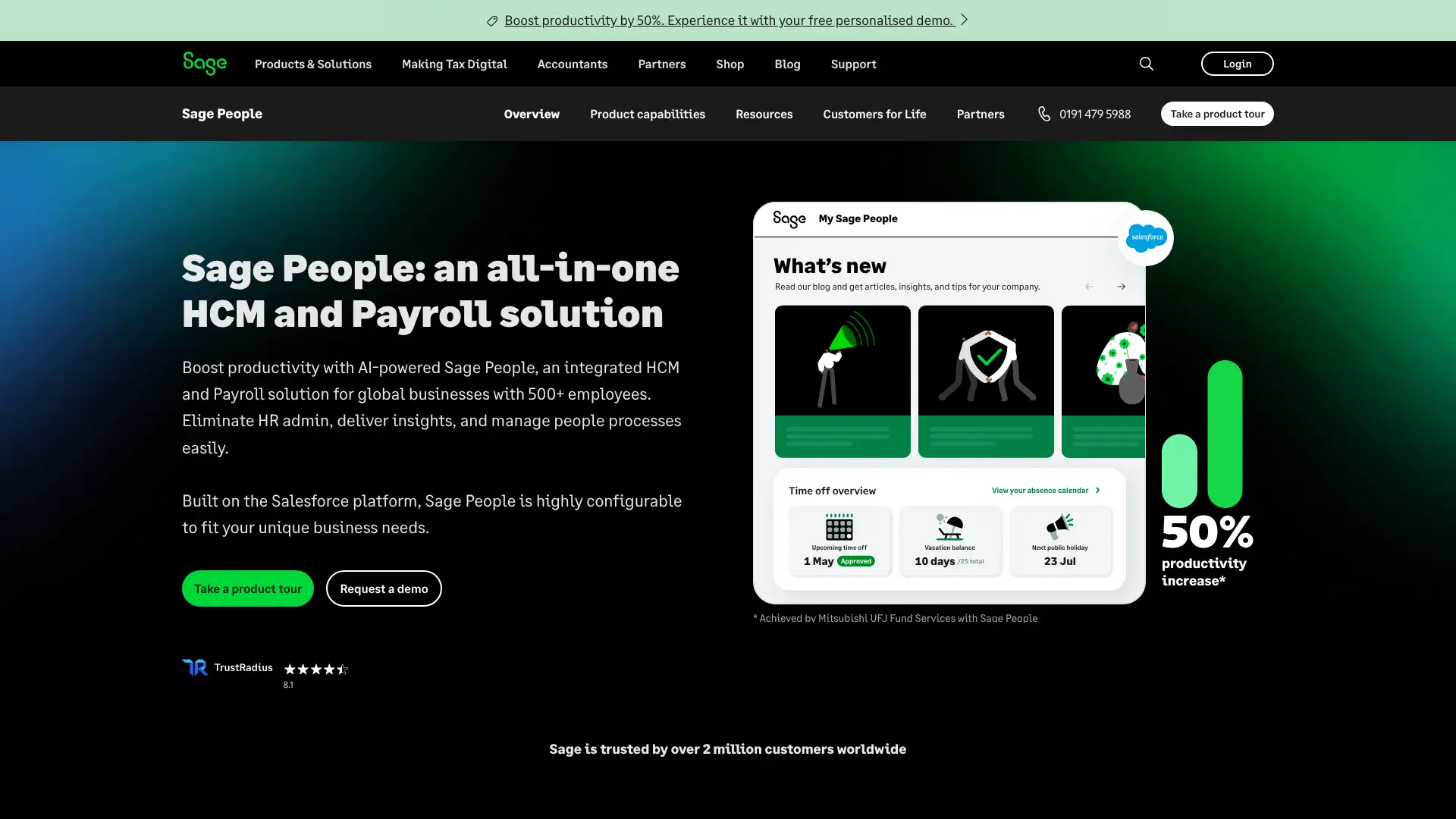
- • Built on Salesforce Platform: inherits Salesforce reliability, security, and App Exchange integrations
- • Customisable dashboards: Salesforce report builder for highly tailored HR analytics
- • AI candidate matching: AI-powered matching of internal candidates to open roles
- • Multi-country support: configured for multi-country HR management across Europe, US, and APAC
- • Salesforce ecosystem integration: HR data flows directly into Salesforce CRM and ERP workflows
Sage People is the right choice for multinational mid-market organisations (200-5,000 employees) that are already standardised on Salesforce and want HR data embedded in the same platform as their CRM and ERP. For organisations without Salesforce, the platform dependency makes it unnecessarily complex compared to HiBob or BambooHR.
Oracle HCM Cloud
Oracle HCM Cloud is an enterprise human capital management suite targeting large organisations (1,000+ employees) that typically also use Oracle's financial management and ERP products. It covers core HR, talent management, payroll, time and labour, benefits, learning, and workforce management in a unified cloud suite. The key differentiator is Oracle's combination of HCM and ERP in one data ecosystem: HR data, financial data, and project data share the same database, enabling seamless workforce cost reporting across HR and finance. Implementation typically requires 12-24 months and significant professional services investment. Oracle competes directly with Workday in the enterprise HCM segment.
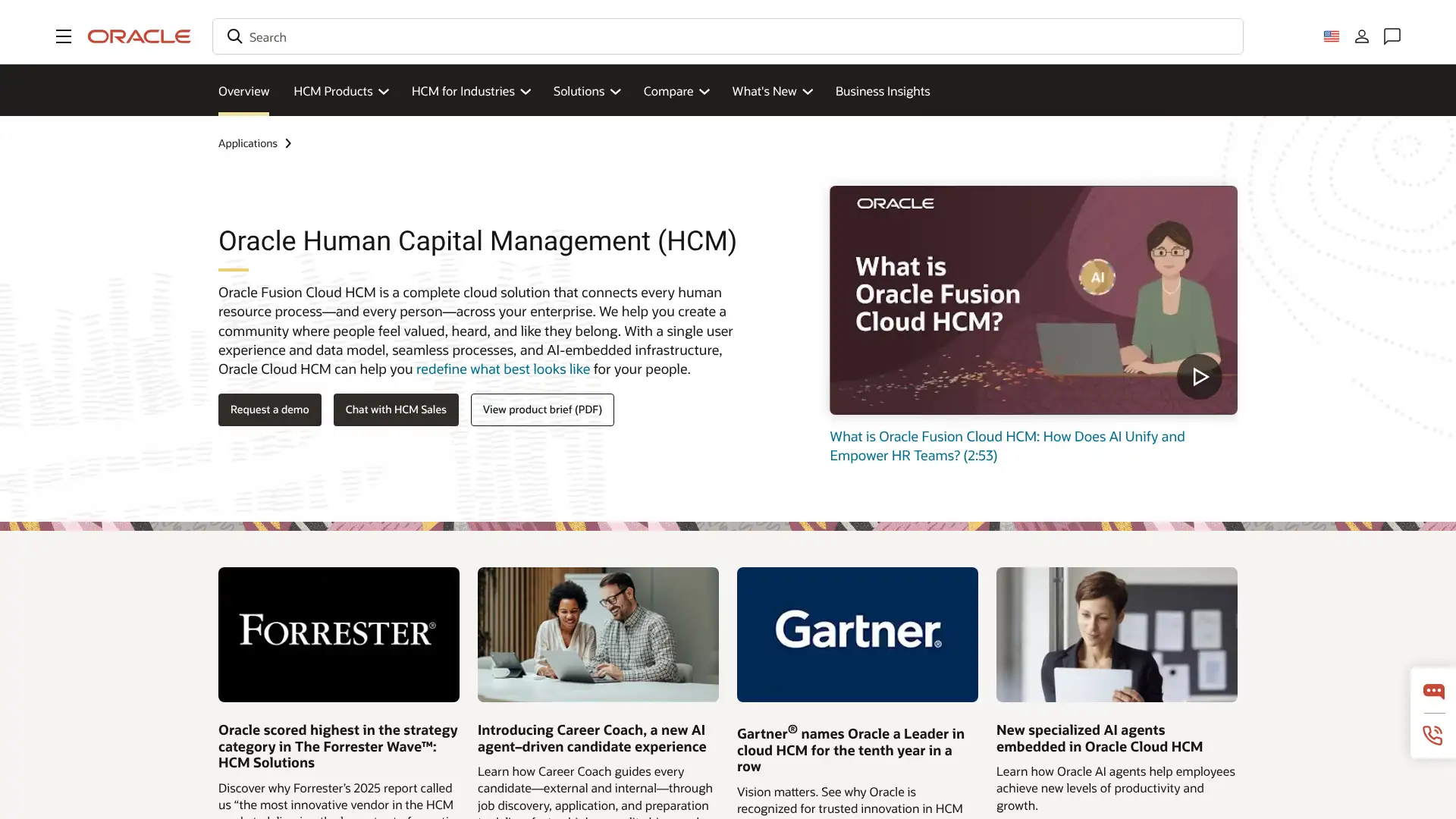
- • Unified HR and ERP data: HR headcount, costs, and project data share one database with financials
- • Global payroll: Oracle Payroll covers multi-country payroll calculation
- • AI-powered talent management: skills inference and internal mobility matching
- • Learning Management System: built-in LMS for enterprise-scale training and compliance
- • Oracle Cloud Infrastructure: HCM runs on OCI, providing native cloud reliability
Oracle HCM Cloud is the right choice for large enterprises already running Oracle Fusion ERP who want unified HR and financial data in the same Oracle ecosystem. For organisations not already on Oracle, Workday provides a more modern HCM experience with comparable enterprise-grade features.
SAP SuccessFactors
SAP SuccessFactors is the largest enterprise HR software by user count, deployed by 10,000+ organisations covering approximately 280 million users across 200 countries. It covers the full employee lifecycle: recruiting, onboarding, core HR (Employee Central), payroll, performance and goals, learning, compensation, succession planning, and workforce analytics. SAP SuccessFactors integrates natively with SAP S/4HANA ERP, making it the default HR choice for organisations already running SAP financial systems. Recent investment has focused on AI: SAP SuccessFactors AI Recruiting, learning recommendations, and natural language HR queries are part of the 2024-2025 roadmap. Pricing is enterprise-custom with modular add-on pricing.
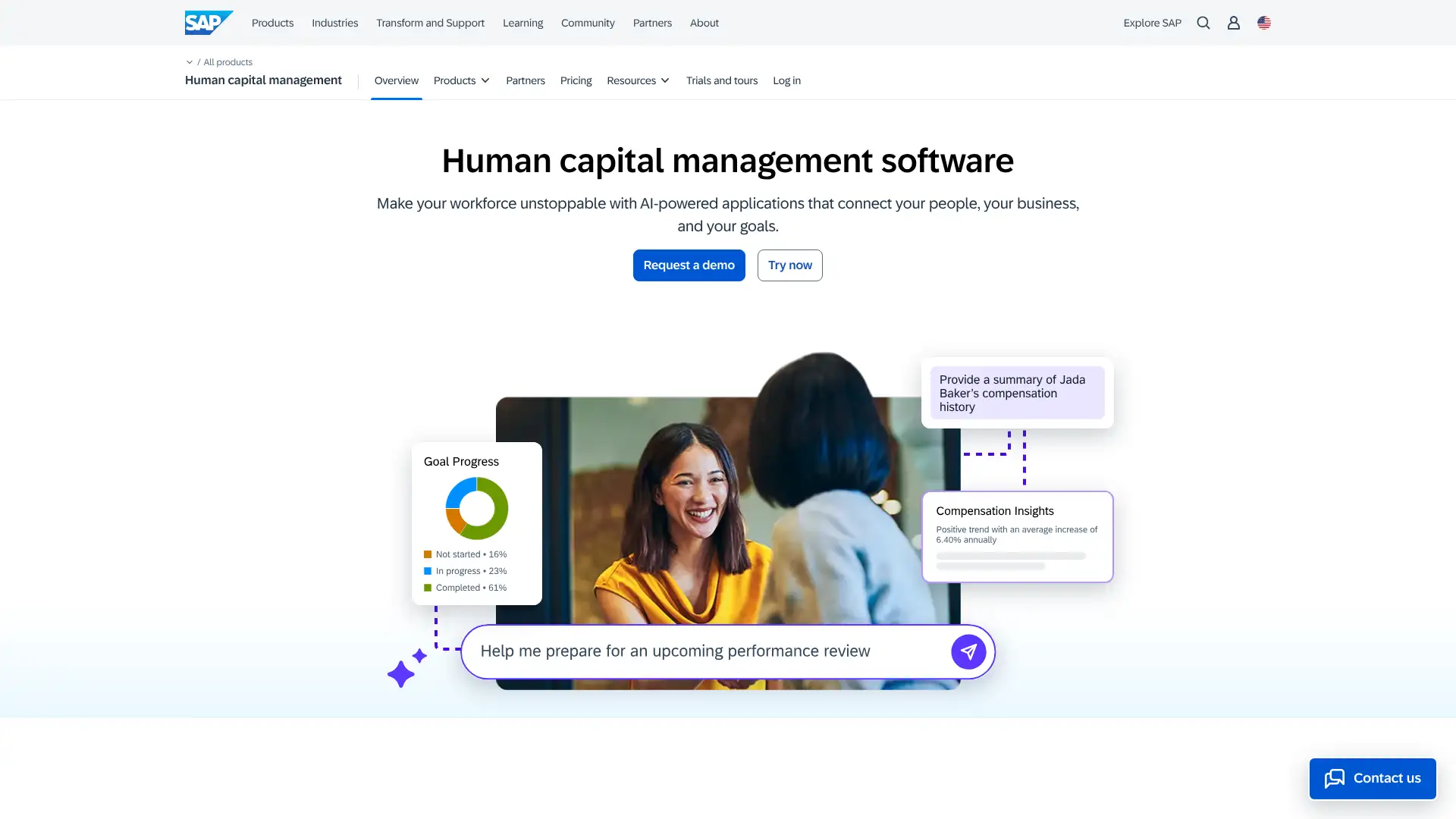
- • 280 million users across 200 countries: the most widely deployed enterprise HR platform globally
- • SAP S/4HANA integration: native connection to the world's most widely used ERP system
- • Global payroll in 45+ countries: SAP native payroll calculation, not partner-dependent
- • AI recruiting and learning recommendations: embedded AI across talent acquisition and development
- • Succession and workforce planning: enterprise-grade succession management and headcount forecasting
SAP SuccessFactors is the right choice for large enterprises that run SAP S/4HANA ERP and want native HR integration without cross-vendor data complexity. For the 280 million current users, the switching cost is prohibitive.
Connecteam
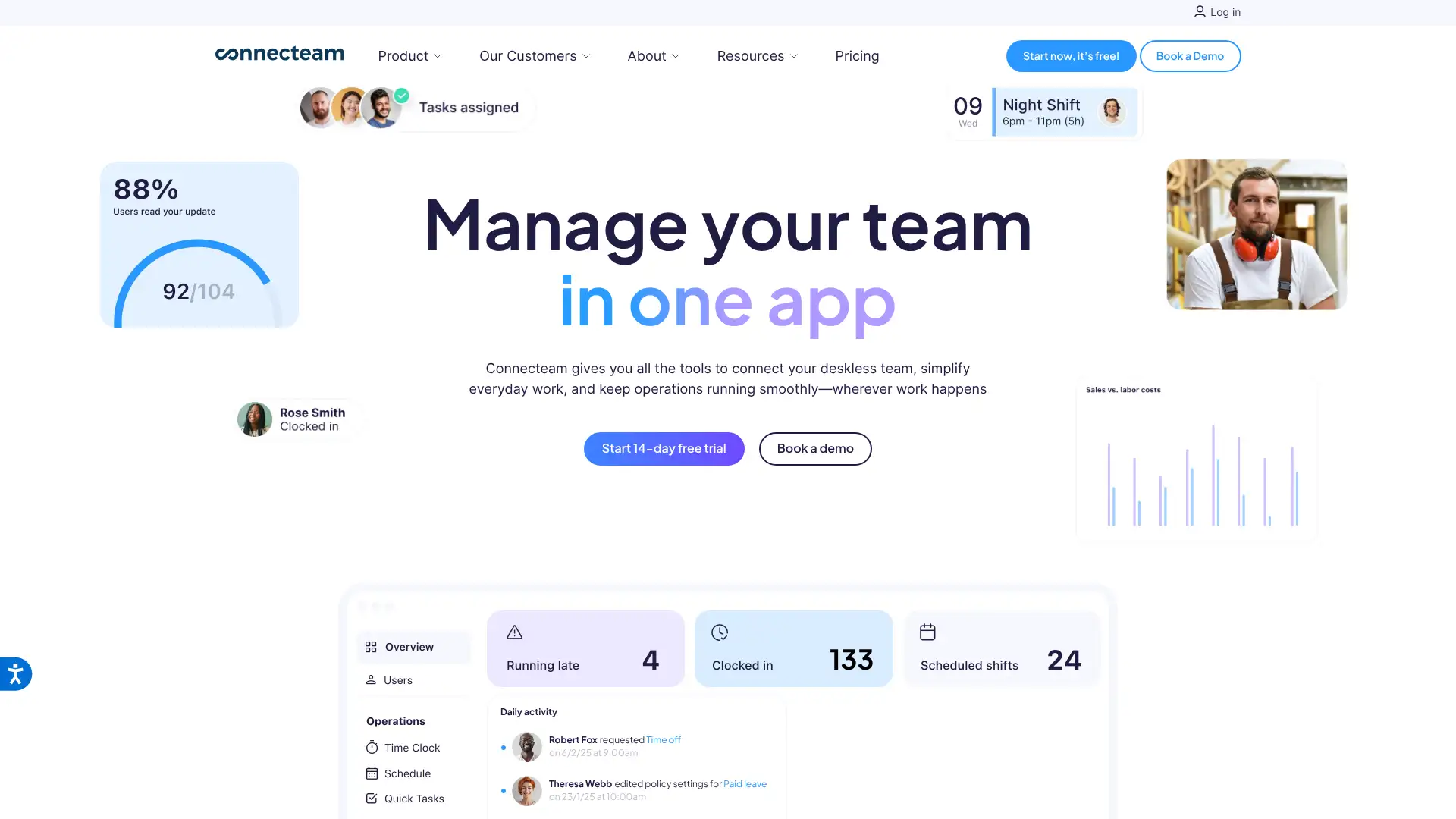
Connecteam is a mobile-first HR and operations platform built specifically for frontline and deskless workforces in industries like construction, retail, hospitality, healthcare, and field services. Unlike most HR platforms designed for desk workers with computers, Connecteam is built to be operated entirely from a smartphone. It covers scheduling, time tracking, task management, employee communications, training, and basic HR in a single mobile app. Pricing is flat-rate per plan (not per employee) for up to 30 users, then per-employee beyond that: the Business plan is $49/month for the first 30 users, making it the most cost-efficient HR platform for small hourly workforces. A free plan is available for up to 10 users.
- • Mobile-first architecture: the entire platform operates from a smartphone, no desktop required
- • GPS time clock: employees clock in and out from their phone with location verification
- • Shift scheduling: drag-and-drop schedule builder with availability and overtime alerts
- • In-app communications: chat, updates, and announcements replacing WhatsApp for work
- • Digital checklists and tasks: operational task management for field and frontline workers
Connecteam is the best HR platform for businesses with frontline, hourly, or deskless workforces in construction, hospitality, retail, or field services. The mobile-first architecture and free plan for up to 10 users are unique in the HR software market.
Namely
Namely is a mid-market HCM platform positioned as the bridge between entry-level tools like Gusto or BambooHR and enterprise systems like Workday. It targets companies of 50-1,000 employees and offers HRIS, payroll, benefits administration, time management, and talent management in one platform. Namely's unique differentiator is a social-media-like company news feed integrated into the HRIS, driving employee engagement alongside administrative HR. The Namely Now tier starts at approximately $9 per employee per month. User reviews note that payroll issues and support responsiveness have been cited as concerns in independent reviews, suggesting a performance gap compared to newer competitors.
- • Social company news feed: social-media-style internal communications integrated with HRIS
- • Configurable payroll: US payroll with multi-state filing and benefits integration
- • Benefits administration: open enrollment, life event management, and carrier integrations
- • Mobile app: employee self-service for pay stubs, time off, and benefits on mobile
- • HR advisory services: optional managed HR and benefits brokerage services
Namely is an option for mid-market US companies that want a social HRIS with HR advisory services. However, recurring user review concerns about payroll reliability and support responsiveness suggest evaluating BambooHR, Rippling, or Paylocity first at this price point before committing.