Spoken Word Generator
A free AI spoken word generator writes powerful slam poetry and performance pieces. Enter a theme and emotional tone to get a spoken word poem with rhythm, repetition, and raw expression.
What Is a Spoken Word Generator?
A spoken word generator is an AI tool that writes performance poetry designed to be heard rather than read. Spoken word, slam poetry, and performance poetry are oral traditions — the rhythm, breath, cadence, and timing of delivery are as important as the words themselves. This generator produces pieces built for the stage: with deliberate repetition, driving rhythm, concrete imagery, and emotional arcs that build toward a powerful climax.
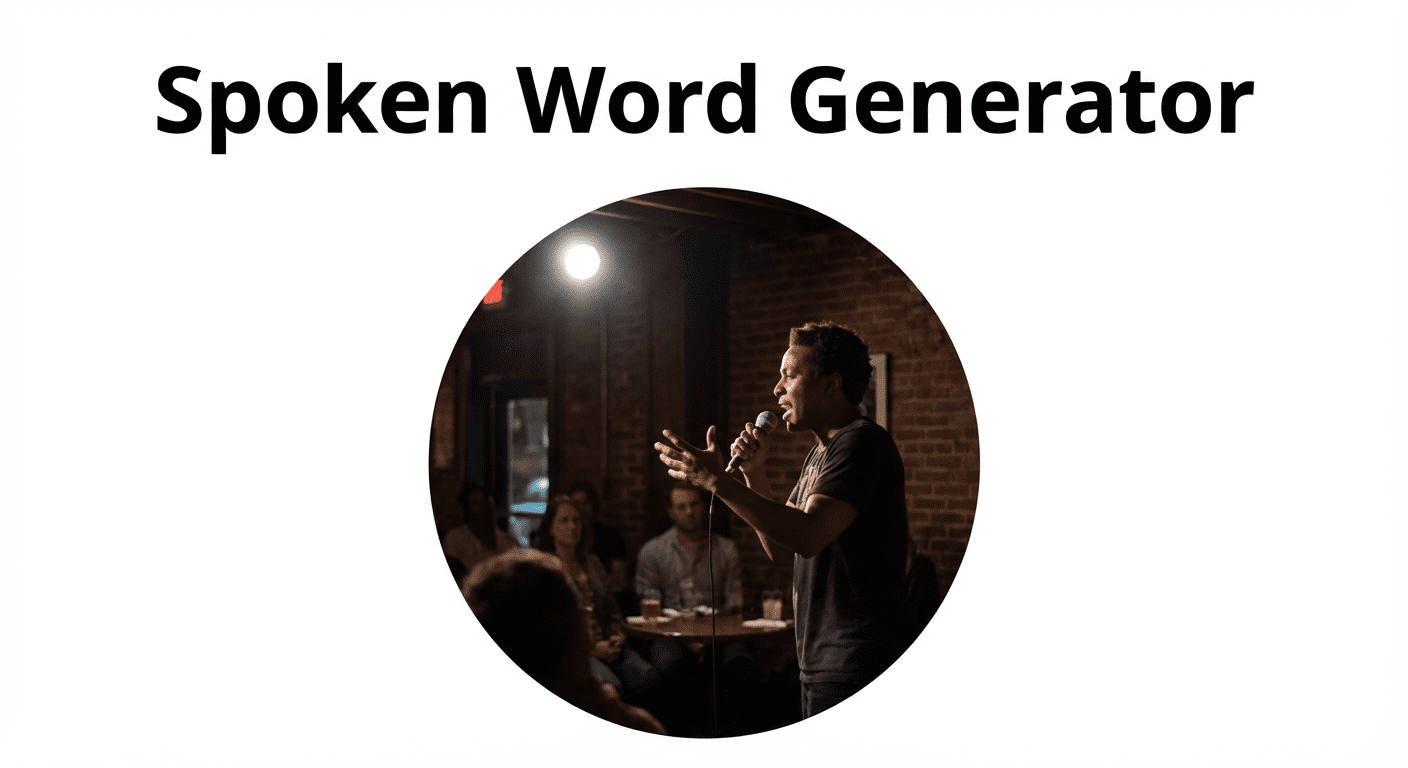
Spoken word has evolved into one of the most vital and politically alive literary forms of the past four decades. From the early slam stages of the 1980s to the YouTube-driven global reach of channels like Button Poetry spoken word and slam videos, the form continues to draw new voices and new audiences. The national competitive slam circuit is organized by Poetry Slam Inc national slam organization, which oversees regional and national events across the United States. For a broader look at performance poetry's impact in public discourse, TED Talks spoken word and performance poetry features some of the most watched spoken word performances available online.
How the Spoken Word Generator Works
Enter a Theme
The Topic/Theme field is the only required text input and the most important creative decision. Enter the specific subject your piece will address — not "society" but "the school-to-prison pipeline," not "love" but "loving someone who does not love themselves," not "identity" but "being mixed race in a world that forces you to choose." The more specific your topic, the more concrete and emotionally resonant the output will be. Spoken word thrives on particularity — vague subjects produce vague poems.
Choose Emotion and Style
The Emotion dropdown sets the emotional temperature of the piece. Anger/Protest produces forceful, accusatory, politically charged language. Love generates tender, searching, intimate expression. Identity produces introspective, questioning language about self and belonging. Social Justice focuses outward on systems and accountability. Loss/Grief slows the pace and deepens the imagery. Empowerment builds toward affirmation and agency. Joy produces light, celebratory, rhythmically generous language. Nostalgia reaches toward memory with longing and detail.
The Style dropdown determines the performance tradition the piece draws from. Slam Poetry emphasizes competitive performance energy: a strong hook, punchy short lines, and climactic delivery. Spoken Word is more expansive and lyrical, with longer breathing room and less aggressive pacing. Performance Poetry includes explicit theatrical cues — pauses, tempo changes, physical direction notes — built into the text. Rap-Poetry Hybrid uses rhythmic flow, internal rhymes, and beat-aware phrasing that sits between the hip-hop tradition and formal poetry.
Get a Performance Piece
Click Generate Spoken Word and receive a complete performance piece at the length you specified — from a tight 1-minute opener to a full 5-minute featured set piece. The output is ready to read aloud immediately. Continue the chat to request a different emotional register, tighten specific stanzas, add a chorus or refrain, or ask for a version with more or less profanity for different venue requirements.
Spoken Word vs Slam Poetry
Performance-Focused Writing
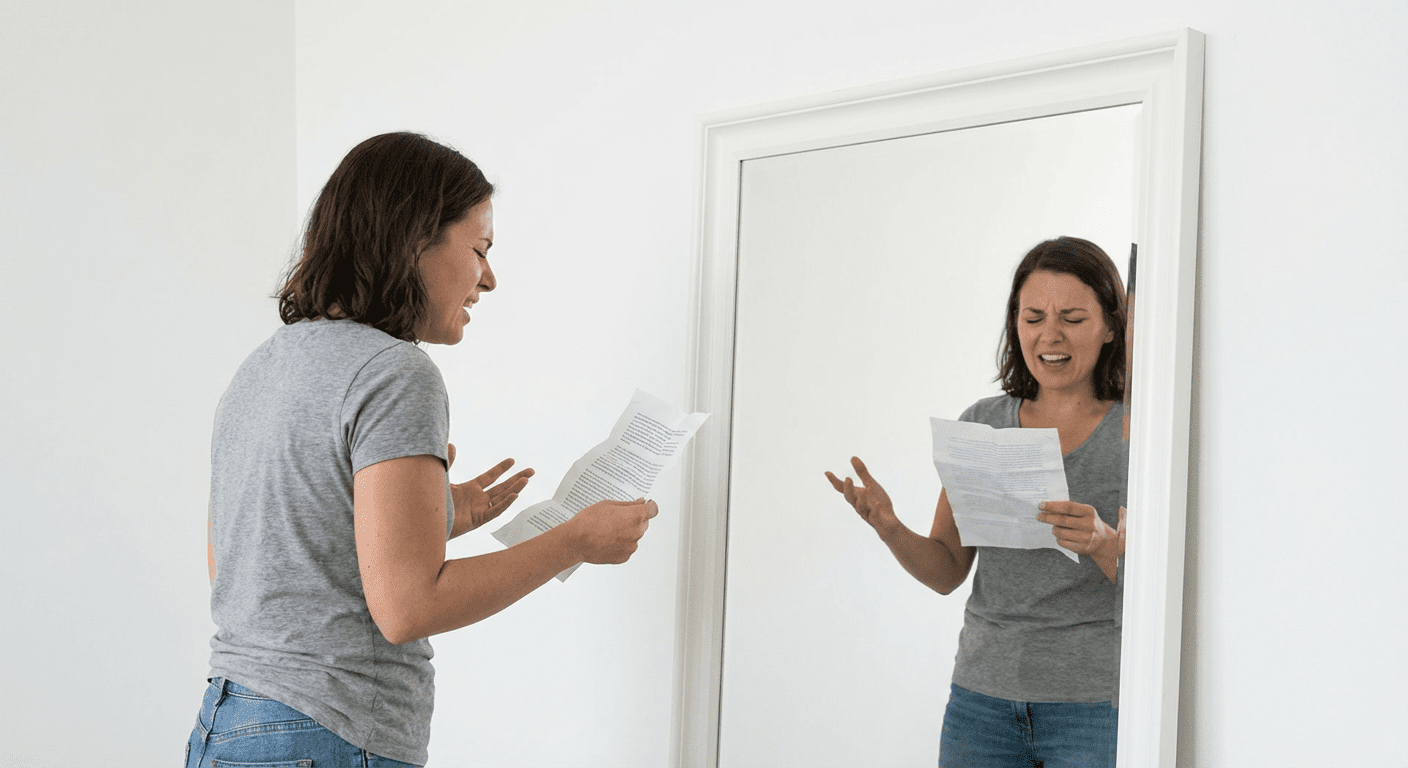
Both spoken word and slam poetry are performance forms, but they exist on a spectrum. Spoken word is the broader category — any poetry written primarily for oral delivery falls under this umbrella. It includes confessional autobiography, political address, love poetry, comedy, and experimental sound work. The page is a script, not a final destination. Spoken word poets often perform from memory, making direct eye contact with audiences and using their voice, body, and timing as expressive instruments alongside the words.
Scoring and Competition
Slam poetry is spoken word in a competitive format. At a poetry slam, poets perform original work in rounds and are scored by judges — typically audience members chosen at random — on a scale of zero to ten. The competitive element was introduced by Marc Kelly Smith in Chicago in 1984, originally as a way to energize poetry readings and make poetry more democratic and accessible. Standard slam rounds run three minutes with point deductions for going over time, which is why so much slam poetry has a rhythmically tight, economically written quality — every line has to earn its place.
Open Mic Culture
Open mics are the entry point for most spoken word performers. Unlike slams, open mics are non-competitive — anyone can sign up, take the stage, and perform for a set amount of time (usually two to three minutes). Open mics exist in cafes, bookshops, community centers, universities, and bars across the world and serve as both training grounds for new writers and regular performance spaces for established performers. The atmosphere is supportive and communal. Using the 2-minute length option in this generator produces output well-suited to the standard open mic slot. For other writing tools that produce content for live sharing and social performance, the rap lyrics generator overlaps significantly in style and application.
Elements of Great Spoken Word
Rhythm and Repetition
Rhythm is the engine of spoken word. Unlike page poetry, which can rely on visual spacing and punctuation to guide pace, spoken word must create its own timing through syllable count, line length, and deliberate repetition. The best spoken word uses anaphora — repeated opening phrases — to build emotional momentum: "I am not your / I am not your / I am not your—" creates a pulse that an audience can feel before the line is even completed. Repetition also functions as a memory device, helping audiences track themes and returning phrases across a longer performance.
Emotional Authenticity
Spoken word audiences are exceptionally attuned to inauthenticity. A performance that feels borrowed or performative — anger that is not rooted in experience, love that sounds like a hallmark card — falls flat in a way that page poetry can sometimes escape. The most powerful spoken word pieces feel like they could only have come from the person performing them. When using this generator, the more specific and personal the topic you provide, the more authentic the language will feel. Use the AI output as a scaffold and bring your own lived detail to it — your grandmother's specific phrase, the exact street name, the particular smell of the place.
Imagery and Metaphor
Strong spoken word does not tell an audience how to feel — it shows them something specific enough that they feel it themselves. A poem about grief does not say "I was devastated" — it describes the two plates still in the cabinet, the voicemail you cannot delete, the way you still reach for someone's hand at movies. Concrete imagery grounds abstract emotion in the physical world, making it available to audiences whose specific experiences differ from the poet's. Extended metaphors that run through an entire piece — "my body is a country that does not appear on any map" — give the audience something to hold onto as the piece moves.
The Build and Climax
The most effective spoken word pieces are structured around a build — a gradual escalation of emotional intensity, rhythmic pace, and linguistic density that peaks in the final third or final stanza. The build is often achieved through accumulation: adding images, shortening lines, increasing repetition, raising volume. The climax arrives at the moment of maximum emotional charge — the line the audience will remember, the image that crystallizes everything the poem has been approaching. The closing line then does one of two things: it lands the final blow (for protest or anger pieces) or it opens out into silence (for grief or love pieces). The hook generator can help you craft a powerful opening line to match your climax.
Spoken Word Examples
Example 1 - Social Justice Spoken Word
Topic: housing inequality | Emotion: Anger/Protest | Style: Slam Poetry | Length: 2 Minutes
They say the rent is too damn high
but what they mean is
your kind is too damn here.
I have watched three families pack their whole lives
into a U-Haul and a cousin's couch,
watched the coffee shops replace the corner stores,
watched the murals go up the same week the neighbors go out.
You call it revitalization.
We call it by its name.
This city has always had two maps —
one for the ones who get to stay,
and one for the ones who get to leave.
I am standing at the edge of the second map
and I am not moving.
Note: Short, punchy lines. Accusatory second-person address. Repetition of "watched." Strong closing refusal.
Example 2 - Love and Identity Piece
Topic: being the child of immigrants | Emotion: Identity | Style: Spoken Word | Length: 2 Minutes
My mother carried a country in her hands
the whole way across the water.
Not a flag, not a passport —
her mother's recipe for jollof,
the particular way she braided my sister's hair,
the proverbs she said in Yoruba
when English did not have the right shape for the feeling.
I grew up between two languages
and fluent in neither.
Too American for home,
too something-else for here.
But I have started to understand
that the hyphen is not a wound —
it is a bridge.
And I am learning to walk it
in both directions.
Note: Lyrical, imagery-grounded. Extended metaphor of the hyphen. Builds from concrete detail to abstract insight.
Using Spoken Word for Different Topics
The topic you choose for spoken word profoundly shapes the form the piece takes. Social justice topics naturally gravitate toward accusatory second-person address ("you built this system"), communal first-person plural ("we are still here"), and structural repetition that functions like a chant. Love and relationship topics work best with intimate, sensory detail — specific objects, specific moments, specific sensations. Identity pieces tend to move between personal and political, using the body and its social context as the terrain of the poem.
Grief and loss produce the most formally varied spoken word — some pieces slow to near-silence, others accelerate into breathless lists of everything that was present and is now absent. Empowerment pieces build deliberately and end with maximum upward energy. Joy pieces often break formal expectations — laughter interrupting rhythm, unexpected whimsy in language that could have been earnest.
For topics that blend music and spoken performance, our song lyrics generator and rap lyrics generator produce content closer to the musical end of the spoken-word-to-music spectrum. For general poetry in formats other than performance, the poem generator covers a wide range of poetic styles and the AI poetry generators hub lists every poetry tool available on this site.
The Rap-Poetry Hybrid Style
The boundary between slam poetry and rap has always been porous. Hip-hop emerged from many of the same oral traditions that feed spoken word — the Black oral tradition, the signifying and dozens traditions, the street preacher and the blues singer. Poets like Gil Scott-Heron, The Last Poets, and Amiri Baraka directly influenced early rap. Spoken word artists like Saul Williams, Sarah Kay, and Def Poetry Jam performers have influenced contemporary hip-hop in return.
The Rap-Poetry Hybrid style in this generator is specifically calibrated for pieces that occupy this middle ground: rhythmically tight enough to be performed over a beat, lyrically complex enough to stand alone as poetry, with internal rhyme schemes, multisyllabic rhymes, and the kind of wordplay that rewards close listening. These pieces work equally well in slam contexts and freestyle/open mic contexts. They can function as writing the way an AI diss track generator produces aggressive rap-adjacent content, but oriented toward artistic expression rather than competitive battle rap.
Preparing for an Open Mic or Slam
Once you have generated a spoken word piece you want to perform, the work of preparation begins. Read the piece aloud immediately — what reads well on screen often needs adjustment to flow naturally in your voice. Notice where you run out of breath and add line breaks. Find the words that feel awkward in your mouth and find alternatives. Mark where you want to slow down, pause, or raise your voice.
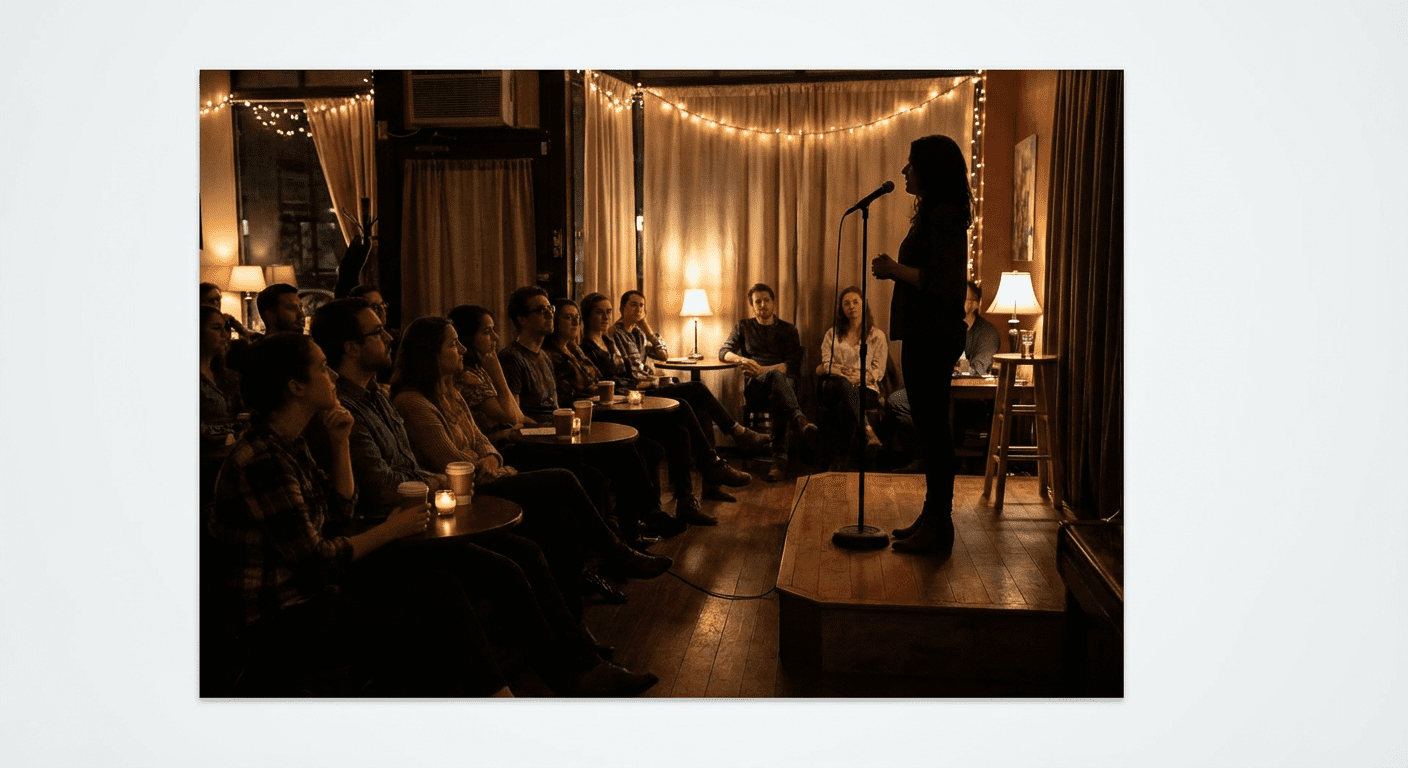
Memorization, or at least deep familiarity with the text, transforms a performance. Audiences connect with performers who can look at them rather than at a page. Even partial memorization — knowing the first and last stanzas cold, using notes only for the middle — improves audience engagement significantly. Record yourself performing and listen back. Time yourself against the venue's limit. Give yourself three or four full rehearsals before performing for an audience.
For written content that helps frame or promote a performance, tools like the free AI poetry generator can produce companion pieces, and the AI bio generator helps you write a performer bio for event programs and social media.
Frequently Asked Questions
Is this spoken word generator free?
Yes. Completely free with no signup required. Generate slam poems, spoken word pieces, and performance poetry at any length across any topic and emotional tone.
Can it write slam poetry?
Yes. Select Slam Poetry from the Style dropdown for competitive performance energy — strong hooks, punchy lines, rhythmic drive, and a powerful closer designed for scoring well in slam competition.
Does it include performance cues?
Yes, particularly for the Performance Poetry style. The AI includes pacing notes built into the text. All styles are written for spoken delivery rather than silent reading, with natural breath breaks and rhythm built into the line structure.
Can I use it for an open mic?
Yes. The 2-minute length matches the standard open mic slot. The 3-minute option works for slightly longer sets. All outputs are performance-ready and can be used as-is or personalized with your own specific details and experiences.
What topics work best?
Specific, personal, and social topics produce the strongest spoken word. Identity, social justice, immigration, grief, love, and family all work well. Avoid overly abstract subjects — the more concrete the topic, the more vivid the language. Give the AI specific details in the topic field for the best results.