
German Name Generator tool
Our german name generator helps you create authentic German first names, surnames, full names, noble "von" houses and compound double names in seconds, with a one-line meaning note on every result.
Generate believable german names from real parish records
AI Free Forever's german names generator is built on the four real layers of DACH naming - medieval Old High German roots, saint-day Catholic and Protestant baptismal tradition, trade-and-place-derived surnames recorded in parish books since the 1300s, and modern Germany / Austria / Switzerland usage - so every name reads like one a real registrar would actually paper. Some popular german names you'll already know include Hans, Klaus, Werner, Friedrich, Wilhelm, Greta, Heidi, Ingrid, Müller, Schneider, Schmidt and von Habsburg.
Pick a name type, era, region, gender and character vibe in order to spin up names tailored to medieval Holy Roman Empire fiction, Prussian and Bavarian period drama, German-American genealogy lookups and modern DACH baby-name shortlists - every result ships with a one-line meaning note so you know instantly which trade, saint-day or Old High German element it traces back to.
How to craft an authentic German Name
German names are built by picking one of four real surname families - trade (Schmidt, Bäcker, Müller), patronymic (Petersen, Lorenz), descriptive (Klein, Schwarz, Lang) or toponymic (Bachmann, Waldhoff, von Neuenburg) - and then layering on an era, region and Christian first name that match the character you have in mind.
Walk through it step by step:
- Pick the name type and surname family. First-name only for a baby or saint-day choice, surname only for a German-American family tree, full name for a novel, "von" name for a noble house, or compound double for a hyphenated southern flavour. Trade surnames cluster heavily (Schmidt, Schneider, Fischer, Bauer, Wagner). Patronymic forms lean north (Petersen, Hansen, Jürgens). Descriptive surnames flag a feature (Klein "small", Schwarz "black", Lang "long"). Toponymic surnames anchor to a place or feature (Bachmann "by the brook", Waldhoff "forest farm").
- Pick the region. Surnames carry strong regional tells - Bavarian families lean on -er and -inger (Huber, Reisinger, Aigner), Swabians on -le and -ler diminutives (Häberle, Maierle), Prussians on flat consonant clusters (Borkmann, Stoltenberg), Austrians on -ner and -gruber (Steiner, Hofgruber), Swiss-Germans on -i and -li (Müller, Brunneli, Frey). First names also shift - Bavaria favours Sepp, Lois, Resi; Hamburg favours Lars, Hauke, Wiebke.
- Pick the era and character vibe. Medieval Holy Roman Empire, Reformation, 19th-century Prussian, Weimar, post-war or modern DACH - each era shifts the sound. Pair with a vibe like noble "von" house, Gründerzeit industrialist, scholar / composer, or modern everyday DACH to push the model into the right register.
- Add optional keywords. Drop in cues like "Black Forest origin, blacksmith ancestor, named after Saint Wolfgang" to bias the result toward a specific theme without locking the name itself.
- Choose how many and hit Generate. Pick a count, generate, then re-roll any time for a fresh batch with the same settings.
German names for genealogy researchers and period-drama writers
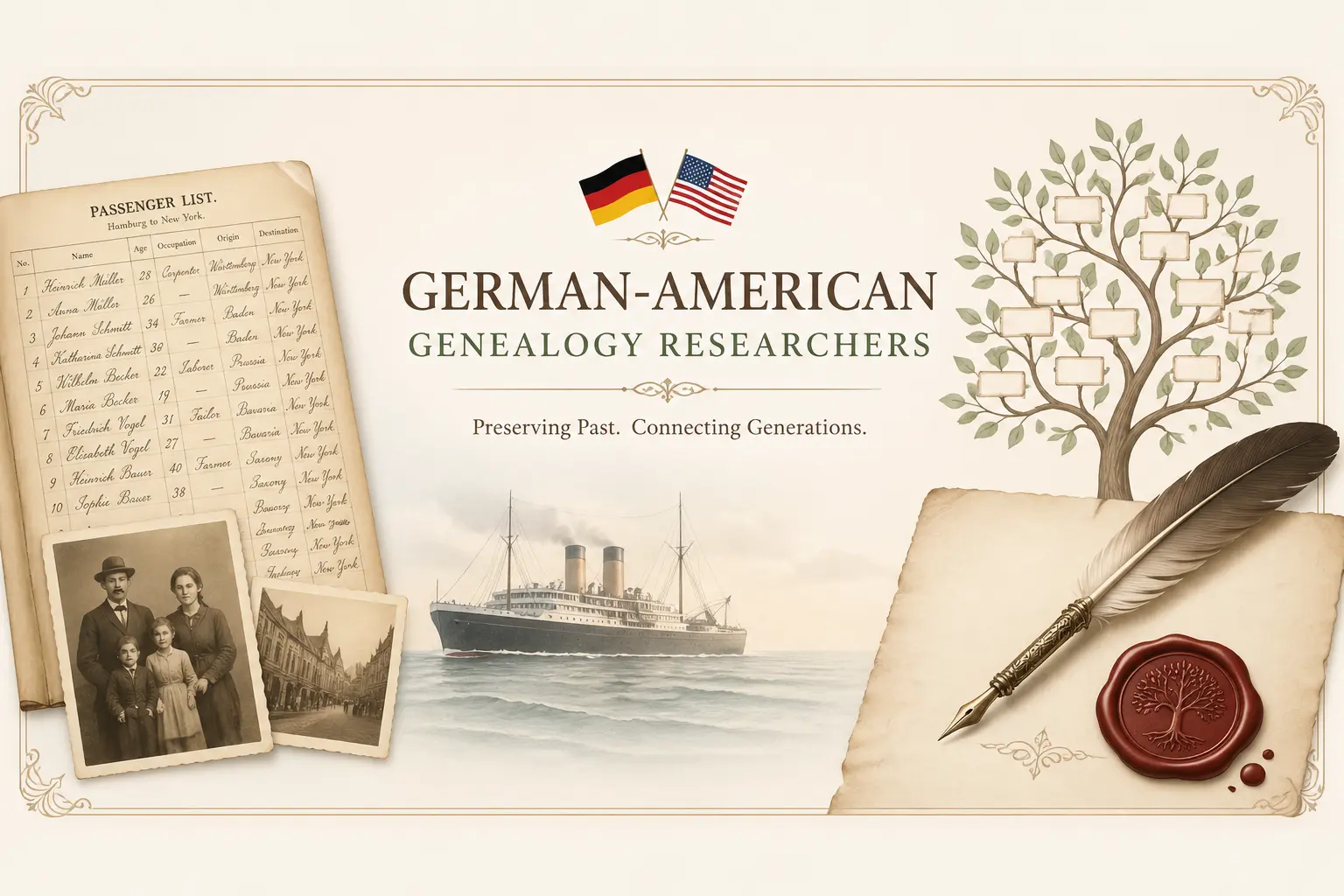
German-American genealogy
Surname plus first-name placeholders for missing branches in 1800s German-American immigration ledgers and Ahnenpass family trees.

Period-drama writers
Authentic Weimar, WWII-era and Holy Roman Empire characters for Babylon Berlin, Dark and Generation War style screenplays.
German baby-name parents
Modern Bavarian, Austrian and Swiss-German boy and girl shortlists with meanings and saint-day roots attached.
30 German names spanning Bavaria, Prussia and modern DACH
A handpicked mix of medieval, Prussian, Bavarian, Austrian and modern German names - copy any one with a click.
Noble "von" houses and aristocratic German names
For aristocratic and Junker families, set Name Type to "Noble von name" and Vibe to "Noble / Aristocratic" - the generator anchors a Christian first name to a toponymic seat with the "von" or "zu" particle, like Maximilian von Falkenstein, Constanze zu Lichtenwald, Friedrich von Eschenbach or Adelheid von Hohenbrück, the way the Almanach de Gotha actually records them.
Medieval, Prussian and modern tiers of German names
German names live in three distinct tiers, and matching the tier to the character is what makes the name land.
- Medieval / Holy Roman Empire - Eberhard, Friedrich, Otto, Adelheid, Hildegard, Brunhilde, Gottfried. Old High German virtue-roots ("hard", "berht", "wolf"). Pick era "Medieval" plus vibe "Knight / Burgher."
- Prussian / 19th-century - Wilhelm, Friedrich-Karl, Otto, Klara, Augusta, Mathilde, Elsa. Long formal Christian compounds, Hohenzollern-flavoured. Pick era "19th century / Prussian" plus vibe "Industrialist (Gründerzeit)."
- Modern DACH - Lukas, Felix, Jonas, Mia, Lena, Emma, Sophie, Maximilian. Short, internationally portable, dominate Bavarian / Austrian / Swiss baby-name registries since 2000. Pick era "Modern DACH" plus vibe "Modern Everyday."
German baby names with meanings
One of the strongest niches for this keyword is parents looking for a German baby name with a real meaning attached. Set Vibe to "Baby Name" and Era to "Modern DACH" and the generator returns names currently topping Standesamt registries plus their saint-day or Old High German root, so you can hand the shortlist to a partner without having to look every name up:
- Boys - Lukas (light), Felix (lucky, blessed), Maximilian (greatest), Jonas (dove), Leon (lion), Finn (fair, white), Noah (rest), Elias (the Lord is my God).
- Girls - Mia (mine, beloved), Lena (light), Emma (whole, universal), Sophie (wisdom), Hannah (grace), Ida (industrious), Greta (pearl), Clara (bright).
German names for boys, girls and gender-neutral characters
German first names are heavily gendered and the suffix usually tells you immediately. Male names tend to end in -er, -ich, -mann, -us (Werner, Friedrich, Hartmann, Markus). Female names tend to end in -a, -e, -in, -trud (Anna, Helene, Karin, Gertrud). Gender-neutral options are rare in standard German but a few short forms work either way (Toni for Anton or Antonia, Sascha for Alexander or Alexandra, Kim, Eike). Surnames do NOT inflect by gender in modern German - Frau Schmidt and Herr Schmidt both carry Schmidt - so set Gender to lock the first-name suffix family without worrying about the surname.
Frequently asked questions about german names
What is the most common German last name?
Müller (miller) is the most common German surname, followed by Schmidt (smith), Schneider (tailor), Fischer (fisherman), Weber (weaver), Meyer (steward / farmer), Wagner (wagonmaker), Becker (baker), Schulz (mayor) and Hoffmann (courtier). All ten are trade-derived and date back to medieval guilds. Pick era "Medieval" with region "Bavaria" or "Prussia" to surface the regional variants.
What are common German first names?
The most common modern German first names are Lukas, Maximilian, Felix, Jonas and Leon for boys, and Mia, Emma, Hannah, Lena and Sophie for girls. Older registries lean Friedrich, Wilhelm, Klaus, Hans, Werner, Greta, Ingrid, Helga, Ursula and Brigitte. Pick era "Modern DACH" or "WWII era" to bias toward each tier.
What are old German names that are rare today?
Beyond the common ten, German parish books are full of striking old names - Eberhard, Reinhard, Adalbert, Sigfried, Hildegard, Kunigunde, Mechthild, Adelheid, Walpurga and Brunhilde. Many encode an Old High German virtue-root ("hard" = brave, "berht" = bright, "wolf" = wolf). Pick era "Medieval" plus vibe "Noble / Aristocratic" or "Knight / Burgher" to surface them.
What does "von" mean in a German name?
"Von" means "of" or "from" and is a nobiliary particle - it links a Christian first name to a toponymic seat (a town, castle or estate the family held). Maximilian von Falkenstein literally means "Maximilian of Falcon-stone." Modern Germany abolished noble titles in 1919 but the "von" survives as part of the family name. "Zu" is rarer and indicates the family still holds the seat.
Are Austrian and Swiss-German names different from German names?
Yes - the regional tells are immediate. Austrian surnames lean on -gruber, -ner and -bauer (Hofgruber, Steiner, Reitbauer). Swiss-German surnames lean on -li, -i and short forms (Müller, Brunneli, Frey). First names diverge too: Bavaria and Austria favour Sepp, Lois, Resi, Hansi; Swiss favour Beat, Heidi, Ueli. Pick region "Austria" or "Swiss-German" to lock the variant.
Are these German names free to use in my novel, film or game?
Yes. Names generated here are free for personal and commercial use - novels, screenplays, indie games, tabletop characters, baby-name shortlists and family-tree placeholders. We do not claim ownership of the output. Re-generate if a name lands too close to a public figure or a well-known historical German.
Can the AI explain umlauts and the regional spelling?
Yes - switch to the Ask AI tab. You can chat about which umlaut belongs in which name, when ß is used (and when ss replaces it), how Bavarian -er differs from Swiss -li, and which saint-day a given Christian name traces back to.
Free German Name Generator
Try it free before the next chapter or genealogy session - lock the region and era, generate, then ask the AI which Old High German root sits inside the name you liked best.