28 Best Warehouse Management Software in 2026
Warehouse management software (WMS) helps businesses control inventory movement, order fulfillment, labor, and shipping across one or more facilities. This list covers the full spectrum: enterprise-grade systems built for complex multi-site distribution networks, mid-market cloud WMS platforms for 3PLs and retailers, and lightweight inventory tools suited to growing ecommerce brands. Pricing and product details were verified in March 2026.
Oracle WMS Cloud
Oracle WMS Cloud (formerly LogFire) is an enterprise-grade warehouse management platform used by manufacturers, retailers, and logistics providers worldwide. It covers wave planning, advanced putaway, labor management, yard management, and real-time analytics. Entry-level subscription pricing starts around $3,000 per month, with mid-size deployments averaging $15,000 to $30,000 per month depending on user count and transaction volume. In 2025, Oracle expanded its AI-driven supply chain integration tools, linking WMS more tightly to its Transportation Management and ERP modules. The platform is recognized as a Leader in the 2025 Gartner Magic Quadrant for Warehouse Management Systems.
- • Advanced wave planning: configurable wave logic for batch, zone, and cluster picking across high-volume distribution centers.
- • Real-time labor management: tracks worker productivity by task type, enabling performance-based workforce optimization.
- • Yard management: schedules dock doors, manages trailer appointments, and tracks yard inventory in real time.
- • IoT and RFID integration: connects to barcode scanners, RFID readers, voice devices, and material handling equipment.
- • Native integration with Oracle SCM Cloud: links warehousing directly to transportation, trade compliance, and ERP financials.
Oracle WMS Cloud is the strongest choice for large enterprises that want a proven cloud-native platform tightly connected to Oracle's broader supply chain suite. The cost and implementation complexity rule it out for smaller operations. Mid-market teams should evaluate Deposco or SnapFulfil before committing to Oracle's price tag.
SAP Extended Warehouse Management
SAP Extended Warehouse Management (EWM) is the enterprise WMS embedded within SAP's Digital Supply Chain suite. It handles inbound and outbound process management, slotting, cross-docking, labor management, RFID, and direct control of automated storage and retrieval systems. SAP EWM is available both as a standalone deployment and embedded within SAP S/4HANA, with pricing starting in the range of $1,000 or more per month depending on the edition and scope. Gartner recognized SAP as a Leader in the 2025 Magic Quadrant for Warehouse Management Systems. Major customers include Amazon, Walmart, Nestlé, and Johnson & Johnson Supply Chain.

- • Embedded SAP S/4HANA integration: warehouse transactions link directly to financials, production, and sales without middleware.
- • Warehouse Robotics (SAP Warehouse Robotics): vendor-agnostic integration with autonomous mobile robots and conveyors via a built-in robotics broker.
- • Automation and Material Flow System: direct control of ASRS, conveyor belts, and sortation systems from within EWM.
- • Slotting and rearrangement: AI-assisted algorithms optimize product placement to reduce pick travel times and improve space utilization.
- • SAP Warehouse Insights: real-time analytics dashboards monitoring labor, throughput, and equipment utilization via IoT data feeds.
SAP EWM is the natural choice for enterprises already running SAP S/4HANA that need industrial-strength warehouse execution with full ERP alignment. Companies outside the SAP ecosystem face painful integration overhead and should compare Oracle WMS or Manhattan before committing.
Manhattan Active WM
Manhattan Associates' Active Warehouse Management is a cloud-native, versionless WMS that unifies distribution, labor management, slotting, automation, and transportation on a single microservices platform. Named a Leader in Gartner's Magic Quadrant for Warehouse Management Systems for the 17th consecutive year in 2025, Manhattan leads on both Completeness of Vision and Ability to Execute. The platform serves over 1,700 customers across 50 countries. Implementation costs typically start in the high six figures and can exceed seven figures for complex multi-site deployments. No pricing is published; all contracts require direct engagement with Manhattan's sales team.

- • Versionless evergreen architecture: continuous quarterly updates without disruptive upgrade projects or system downtime.
- • Embedded Warehouse Execution System (WES): manages robotics, conveyors, and sortation alongside human labor in one application.
- • Intelligent Order Streaming: simultaneous processing of wholesale, retail, and direct-to-consumer demand from a single inventory pool.
- • Labor gamification: real-time task prioritization and motivational dashboards shown to boost worker productivity by up to 20%.
- • Manhattan Automation Network: pre-certified integrations with 40+ robotics and automation vendors for rapid onboarding.
Manhattan Active WM is the premier choice for Fortune 500 retailers, 3PLs, and manufacturers that need best-in-class distribution execution at scale. The price and complexity make it unsuitable for mid-market teams; Deposco or SnapFulfil deliver faster ROI at a fraction of the cost for those segments.
Blue Yonder WMS
Blue Yonder (formerly JDA Software) is a supply chain platform that integrates warehouse management, transportation, workforce, and AI-powered demand planning on a common data cloud. Its WMS has been a Gartner Magic Quadrant Leader since 2012 and was again recognized as a Leader in both the 2025 Gartner Magic Quadrant and the Nucleus Research WMS Value Matrix. The platform serves DHL, Carlsberg, Walgreens, and hundreds of other global brands. Pricing is subscription-based and varies by scale; no public rates are available. Customers like DHL have reported 7% transportation cost savings, while Blue Yonder's own benchmarks cite fulfillment cost reductions of 10–50% post-implementation.
- • Agentic AI Warehouse Agents: real-time AI recommendations across picking, labor, and slotting that operators can act on with a single click.
- • Resource Forecasting: ML-powered predictions of labor, equipment, and asset requirements days in advance to reduce over/understaffing.
- • Robotics Hub: unified onboarding for 40+ robotics and automation vendors through a single integration point within the WMS.
- • Advanced Slotting: continuous AI-driven slotting optimization rather than periodic manual reviews, reducing pick travel by double-digit percentages.
- • Supply Chain Command Center: real-time cross-network visibility linking warehouse data to transportation, inventory, and order management.
Blue Yonder is the best WMS for enterprises that need AI-driven supply chain intelligence layered across planning and warehouse execution, not just a standalone pick-pack-ship system. For teams that only need WMS functionality without the broader supply chain suite, Oracle or Manhattan deliver comparable warehouse capability with less platform overhead.
Infor WMS
Infor WMS is a tier-1, cloud-native warehouse management system built on the Infor OS platform and hosted on AWS. It is recognized as a Leader in the 2025 Gartner Magic Quadrant for Warehouse Management Systems for the seventh consecutive year. The platform is used by distributors, manufacturers, and 3PLs and stands out for its embedded 3D warehouse visualization, built-in AI capabilities, voice processing, and 3PL billing engine. A notable deployment at Fliway in New Zealand handled a 50% increase in daily demand without additional headcount; Endries reported a 40% productivity increase after implementation. Pricing is not published and requires a custom quote.
- • 3D warehouse visualization: interactive 3D floor plan lets managers see live inventory positions, bottlenecks, and space utilization without leaving their desk.
- • Built-in labor management: tracks worker productivity, automates task assignment, and generates labor standards reports natively — no separate LMS module required.
- • 3PL billing and invoicing: configurable activity-based billing engine automates client charge capture and invoice generation, critical for third-party logistics providers.
- • Voice processing: supports voice-directed receiving, picking, and replenishment with major voice hardware vendors for hands-free warehouse operations.
- • Infor WMS Automation Agent: connects to pick-to-light, conveyor systems, sortation systems, and robotics through a single integration framework.
Infor WMS is a strong tier-1 choice for 3PLs, distributors, and manufacturers that want enterprise-grade functionality — especially the built-in 3D visualization and 3PL billing engine — without the Oracle or SAP ecosystem lock-in. Teams outside the enterprise segment will find faster and cheaper results with Deposco or SnapFulfil.
Infios WMS
Infios is the brand formed in March 2025 from the rebranding of Körber Supply Chain Software — itself built on the former HighJump WMS and acquisitions of inconso and MercuryGate TMS. With approximately 1,500 WMS customers and 5,000 total software customers across 70 countries, Infios offers four discrete WMS product lines alongside a Warehouse Control System (WCS), warehouse simulation tools, and a TMS. The platform is deployed as single-tenant SaaS on Oracle Cloud. Its configurable HTML5 interface can be accessed from any browser on any device and integrates with SAP, Oracle, and Infor ERPs. Pricing is not publicly listed and requires a custom quote.
- • Four WMS product lines: Infios supports multiple legacy and modern WMS products under one umbrella, covering the full spectrum from basic to complex Level 4 warehouses.
- • Warehouse simulation: digital twin tooling lets operators model and test new layouts or workflow changes before physical implementation.
- • In-house robotics group: Infios employs its own robotics engineers to accelerate commissioning for high-automation projects.
- • Full HTML5 UI: the first major WMS to deliver a complete browser-native interface, eliminating client-side software installations.
- • MercuryGate TMS integration: native connectivity between WMS and the acquired MercuryGate transportation management system for end-to-end logistics execution.
Infios is a compelling choice for mid-to-large enterprises that need warehouse simulation, robotics depth, and a modular WMS portfolio under one contract. The rebranding from Körber in March 2025 is recent, and buyers should verify which of the four WMS product lines suits their complexity tier before signing.
Deposco
Deposco is an AI-powered supply chain platform built on a single codebase that combines WMS, OMS, DOM, supply chain planning, and 150+ pre-built API connectors. During the 2024 holiday season, Deposco's Bright Warehouse processed $57 billion in GMV across 4,500 merchants, representing 1.2% of total US ecommerce — a 31% year-over-year increase. The platform targets mid-market companies with $50 million to $1 billion in revenue and was recognized in both the 2025 Gartner Magic Quadrant and 2025 SPARK Matrix for WMS. Deposco is known for delivering full deployments in 90 days versus the 12–18 months typical of enterprise WMS. Pricing requires a custom quote.
- • Single codebase platform: WMS, OMS, DOM, analytics, integrations, and supply chain planning run on one shared data layer — not integrated point solutions.
- • Causal AI: identifies root causes of warehouse performance changes rather than only flagging symptoms, enabling proactive corrections.
- • 150+ pre-built API connectors: native integrations to Shopify, Amazon, and 150 other ecommerce and fulfillment platforms reduce implementation time.
- • 3PL billing automation: native billing management eliminates a separate billing point solution for third-party logistics operations.
- • 90-day implementation: consistent track record of full-scope go-live in 90 days, compared to 12–18 months for tier-1 enterprise WMS.
Deposco is the strongest mid-market WMS for brands and 3PLs that need a unified fulfillment platform deployed fast. Its 90-day implementation track record and single-codebase architecture separate it from competitors. Companies requiring heavy manufacturing WMS depth or complex industrial workflows should evaluate SAP EWM or Infor instead.
Logiwa IO
Logiwa IO is a cloud-native fulfillment management system built specifically for direct-to-consumer brands, high-volume 3PLs, and wholesale distributors. The platform uses volume-based pricing rather than per-user pricing, aligning costs with throughput rather than headcount. Radial, a major 3PL, reported onboarding new customers in under a week using Logiwa's Fast Track program. A customer-reported case study noted AI fulfillment optimization cut task completion hours by nearly 60%. Logiwa connects to over 200 ecommerce platforms, marketplaces, and carriers. Pricing is custom and requires a demo; no public rate card exists.
- • Volume-based pricing: charges scale with order throughput rather than user count, so unlimited warehouse staff can access the system without per-seat fees.
- • Headless architecture: every UI action has a matching API endpoint, allowing custom integrations and white-label experiences without forking the codebase.
- • 200+ ecommerce and carrier integrations: natively connects to Shopify, Amazon, Walmart, UPS, FedEx, and 190+ other platforms out of the box.
- • AI fulfillment optimization: picks optimal batching, routing, and sequencing rules in real time to improve picks-per-hour and reduce walking distance.
- • Labor tracking and reporting: logs every digital and physical warehouse action from both desktop and mobile applications for full productivity visibility.
Logiwa IO is the best WMS for high-volume 3PLs and DTC brands that want unlimited user access, fast onboarding, and 200+ native ecommerce integrations. The volume-based pricing model rewards operational growth rather than penalizing it. Teams fulfilling fewer than 200 orders per day will find Extensiv or WarehouseOS more cost-effective.
ShipEdge
ShipEdge is a cloud-based supply chain platform founded in 2008 that converges WMS, OMS, shipping engine, and channel automation in a single system. It is designed for ecommerce companies, 3PLs, and multi-channel retailers of all sizes. ShipEdge's pricing model is volume-based — no per-user fees and no revenue sharing — with starting prices cited around $500 per month. The platform includes cartonization (algorithmic optimal packaging selection), real-time carrier rate shopping, and expiration date management. ShipEdge integrates with Amazon, Shopify, eBay, BigCommerce, WooCommerce, and Magento, and offers pre-negotiated carrier rates of up to 74% off standard parcel pricing.
- • Converged WMS + OMS: single platform manages both warehouse operations and order management — no separate OMS integration required.
- • Cartonization engine: automatically selects optimal box size for each order based on product dimensions to minimize dimensional weight shipping charges.
- • Real-time carrier rate shopping: compares rates across USPS, UPS, FedEx, DHL, and 30+ other carriers at the time of shipment.
- • Expiration date and lot tracking: manages perishable and regulated inventory with FIFO/FEFO rotation and lot-level traceability.
- • Kitting and light manufacturing: supports on-the-fly and pre-built kitting, as well as light assembly workflows within the WMS.
ShipEdge is a cost-effective choice for growing ecommerce brands and boutique 3PLs that want WMS and OMS in one platform without paying per-user fees or separate shipping platform costs. Its cartonization and rate shopping tools deliver immediate cost savings. Larger 3PLs with complex multi-client billing needs will outgrow ShipEdge's reporting capabilities relatively quickly.
Extensiv 3PL Warehouse Manager
Extensiv (formerly 3PL Central, rebranded in 2022) is the leading cloud WMS purpose-built for third-party logistics providers. The platform serves over 1,500 3PLs and accurately manages billions of dollars in inventory, processing more than 1 million orders per week. Extensiv assembles 3PL Central, Skubana, and CartRover into a hub aimed at SMB and lower-mid-market logistics firms. Key features include EDI integration, automated billing management, SmartScan mobile barcode scanning, and real-time customer portals. Pricing is subscription-based with accessible entry points for startups; API access and premium connectors carry additional usage-based charges.
- • Turnkey EDI integration: connects to major retail trading partners through pre-built EDI connections, enabling 3PLs to onboard retail clients without custom development.
- • SmartScan mobile barcode scanning: iPad and Android scanning app for receiving, picking, and inventory counts with no client-side installation required.
- • Automated billing management: generates client invoices automatically based on storage, handling, and value-added service activity captured by the WMS.
- • Customer portal: branded self-service portal lets 3PL clients view live inventory, check order status, and generate reports without calling the warehouse.
- • 250+ ecommerce integrations: connects to Shopify, WooCommerce, Amazon, Walmart, eBay, and 240+ other platforms for automated order pulling and tracking updates.
Extensiv is the go-to WMS for small to mid-sized 3PLs that want a proven, purpose-built platform with strong EDI connectivity and automated billing. It is the most recognized WMS brand in the SMB 3PL segment. Operations processing very high order volumes or requiring deep customization should evaluate Logiwa or Deposco.
ShipHero WMS
ShipHero is a cloud-based WMS built for ecommerce brands and 3PLs managing in-house fulfillment. The platform handles 100+ million shipments annually across its customer base. Key capabilities include AI-optimized pick routing (reported to reduce walk time by 20–33%), Pack-to-Light (LED-guided packing stations that boost throughput up to 450%), real-time carrier rate shopping, and full Shopify integration. The Standard WMS plan starts at $1,995 per month (5 included user seats); the 3PL plan is $2,145 per month. Additional users are $150 each. Enterprise plans are available on request.
- • AI pick routing: machine learning path optimization reduces picker walking time by 20–33% and improves pick density.
- • Pack-to-Light: LED indicator system guides packers to correct compartments, boosting throughput up to 450% versus manual packing.
- • Real-time carrier rate shopping: compares rates across all connected carriers at time of shipment to automatically select the lowest-cost label.
- • 3PL client portal: unlimited branded portals for 3PL clients to view inventory, orders, and transaction history in real time.
- • Shopify deep integration: bi-directional sync of orders, inventory, and tracking data between Shopify and the ShipHero WMS.
ShipHero is an excellent WMS for ecommerce brands and 3PLs processing meaningful order volumes who want published pricing, Pack-to-Light automation, and deep Shopify integration. The $1,995/month floor makes it unsuitable for low-volume operations. Teams with advanced reporting needs should budget for supplemental analytics tooling.
SkuVault Core
SkuVault Core is an ecommerce inventory and warehouse management system acquired by Linnworks in August 2022. It serves over 1,000 retailers across fashion, electronics, sporting goods, and home goods. The platform focuses on real-time inventory accuracy across connected marketplaces and warehouses, barcode-driven pick-pack workflows, and built-in quality control to catch mis-picks before shipment. Since the Linnworks acquisition, SkuVault has expanded to include an Order Management System module for the US market. Pricing is flexible based on monthly order volume and custom requirements; no public rate card is posted.
- • Real-time marketplace sync: inventory levels update across eBay, Amazon, Walmart, and Shopify simultaneously when any sale or warehouse action occurs.
- • Barcode-driven quality control: each pick is verified by barcode scan before an order is confirmed, reducing mis-ship rates.
- • Digital picklists with optimal routing: auto-generated pick paths minimize travel time and enable batch picking for multiple orders simultaneously.
- • Kit and bundle management: kits are tracked at the component level so sellable bundles reflect accurate available inventory across all channels.
- • Demand forecasting and replenishment reports: historical sales data feeds replenishment recommendations to prevent stockouts.
SkuVault Core is a solid choice for multi-channel ecommerce retailers that need reliable inventory sync and barcode-enforced pick accuracy across their own warehouse. The Linnworks acquisition brings OMS integration but has introduced some platform stability concerns that prospects should validate with recent customer references.
Fishbowl
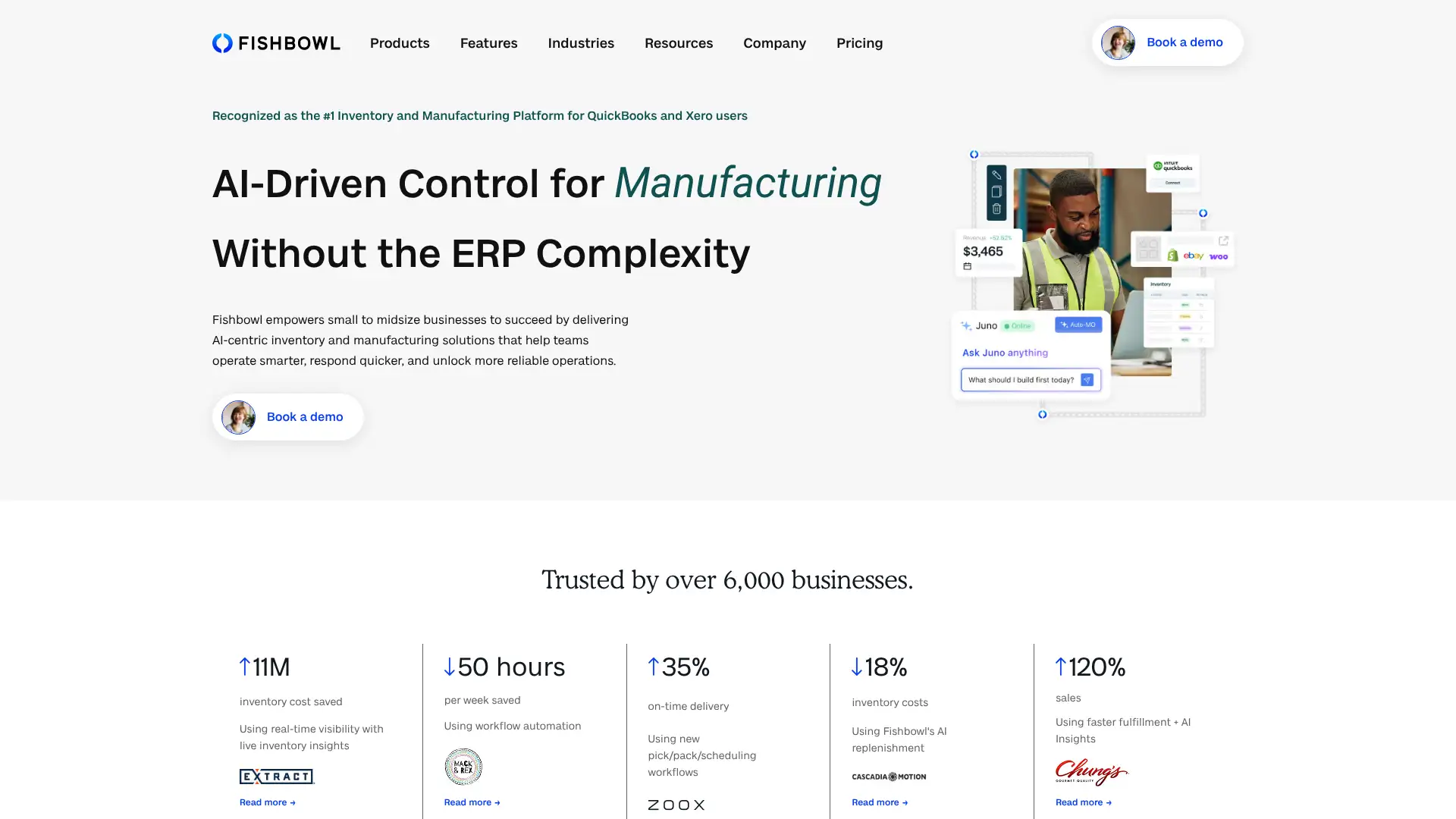
Fishbowl is an inventory and warehouse management platform built for manufacturers, wholesalers, and distributors, with particularly deep integration into QuickBooks Desktop and Online. It handles bill of materials management, work order processing, multi-location inventory, raw material tracking, and finished goods management. Fishbowl is available as both a cloud-hosted and on-premise solution. The platform is used across industries including food and beverage, electronics, automotive, and construction. Pricing is not publicly listed for the enterprise version; legacy information suggests annual fees in the range of several thousand dollars, but current pricing requires a quote.
- • QuickBooks integration: bi-directional real-time sync with QuickBooks Desktop and Online pushes purchase orders, invoices, and inventory valuations automatically.
- • Bill of materials management: supports multi-level BOMs for raw material tracking, sub-assembly production, and finished goods costing.
- • Work order management: creates and tracks manufacturing work orders, allocates raw materials, and records labor time against production jobs.
- • Barcode scanning: mobile and fixed scanner support for receiving, picking, and inventory counting across multiple warehouse locations.
- • Multi-location inventory: tracks inventory across warehouses, bins, and zones with real-time quantity visibility at each storage location.
Fishbowl is the strongest WMS choice for QuickBooks-dependent manufacturers and wholesalers that need BOM management and work order tracking at SMB-scale pricing. As operations grow beyond the SMB segment or require modern cloud-native interfaces, Cin7 or NetSuite WMS are the logical upgrade paths.
NetSuite WMS
NetSuite WMS is a warehouse management module embedded within the Oracle NetSuite cloud ERP platform. It extends NetSuite's core inventory management with directed putaway, wave picking, cartonization, cycle counting, and mobile barcode scanning — all within the same environment as financials, order management, and CRM. Typical first-year all-in cost for SMBs ranges from approximately $25,000 to $50,000 including base subscription, modules, implementation, and training. More complex deployments with multiple warehouses and custom integrations can significantly exceed this range. NetSuite requires an annual subscription, with the WMS module priced as an add-on to the base ERP license.
- • Directed putaway: system-assigned putaway instructions based on configurable rules including weight, zone, proximity, and bin capacity.
- • Wave picking: groups orders into waves for efficient batch picking, reducing picker trips and improving order fulfillment speed.
- • Cartonization: automatically determines optimal carton size for each order to minimize dimensional weight charges and material waste.
- • Mobile barcode scanning: native support for handheld scanners on the warehouse floor for receiving, picking, packing, and cycle counts.
- • Single ERP data model: inventory, financials, orders, and warehouse transactions share one database, eliminating reconciliation between WMS and ERP.
NetSuite WMS is the right choice for companies already running NetSuite ERP that want warehouse management without a separate platform and the integration project it entails. For businesses not yet on NetSuite, or those with complex automated warehouse environments, a dedicated WMS from Deposco, SnapFulfil, or Infor will deliver more capability per dollar.
Zoho Inventory
Zoho Inventory is a cloud-based inventory and order management solution designed for small to mid-sized businesses selling across multiple ecommerce channels. It integrates natively with the broader Zoho ecosystem including Zoho Books, Zoho CRM, and Zoho Analytics, making it particularly cost-effective for teams already in the Zoho suite. The platform manages purchase orders, sales orders, multi-warehouse inventory, shipment tracking, and returns. Plans start at $0 (Free), with paid plans from $29 per month (annual). A notable limitation: Zoho Inventory does not support tracking inventory at the bin location level within a warehouse, which restricts it to simpler warehouse layouts.
- • Zoho ecosystem integration: single sign-on and real-time data flow with Zoho Books (accounting), Zoho CRM (sales), and Zoho Analytics (reporting).
- • Multi-channel order management: pulls orders from Shopify, Amazon, eBay, Etsy, and other platforms into a unified queue.
- • Transfer order management: June 2025 update added a consolidated summary view of inter-warehouse transfer orders including item details and shipment status.
- • Composite items: supports kits and light assemblies with automatic deduction of component inventory upon sale.
- • Shipment tracking: connects to major carriers and provides customers with real-time shipment status updates.
Zoho Inventory is an excellent fit for small ecommerce businesses already using Zoho Books or Zoho CRM who want affordable multi-channel inventory management without deploying a full WMS. The absence of bin-level tracking makes it unsuitable for any operation with a structured warehouse layout requiring location-directed picking.
Sortly
Sortly is a visual, mobile-first inventory and asset tracking platform designed for simplicity. It lets users photograph items, attach barcode or QR code labels, and track inventory across multiple locations from any iOS or Android device. It is not a full WMS — it lacks directed picking, wave planning, or labor management — but serves as an effective lightweight inventory tracker for small businesses, nonprofits, construction teams, and field service operations. Plans range from a free tier to $149 per month, with enterprise pricing available. A 14-day free trial is available on all paid plans.
- • Visual item tracking: high-resolution photos attach to each inventory record so warehouse staff and field teams can visually identify items without memorizing SKU codes.
- • Mobile barcode and QR code scanning: iOS and Android apps scan labels using the phone camera — no dedicated scanner hardware required.
- • Multi-location tracking: organizes inventory into customizable folders by location, room, site, or category with drag-and-drop simplicity.
- • Low stock alerts: notifies users when item quantities drop below a user-defined threshold, supporting manual reordering decisions.
- • Offline access: full inventory access and data entry work offline, with automatic sync when connectivity is restored.
Sortly is the right tool for small businesses, nonprofits, and field teams that need simple, photo-rich asset tracking on a phone — not a WMS for fulfillment operations. Any business processing more than 100 orders per month or needing pick-pack-ship workflows should immediately evaluate Zoho Inventory, SkuVault, or Extensiv instead.
Cin7
Cin7 is a cloud-based inventory and order management platform serving multi-channel retailers, wholesalers, and distributors. It incorporates WMS features, POS, B2B portals, EDI, and demand forecasting on one platform. DEAR Systems was acquired by Cin7 in early 2021 and is now offered as Cin7 Core, while the original Cin7 continues as Cin7 Omni. Cin7 Core (formerly DEAR) is priced starting at $349 per month. Cin7 Omni pricing starts higher and is available on request. The platform connects natively to Shopify, Amazon, WooCommerce, QuickBooks, and Xero. ForesightAI demand forecasting is available as an optional partner integration.
- • Multi-channel inventory sync: real-time inventory updates across Shopify, Amazon, eBay, WooCommerce, and physical POS simultaneously.
- • EDI integration: pre-built EDI connectivity to major retail trading partners for compliant B2B order processing.
- • Assemblies and BOMs: standard manufacturing assemblies included in Core; Advanced Manufacturing available for complex multi-level production workflows.
- • B2B ordering portal: branded wholesale portal lets retail buyers browse inventory and place orders without sales team involvement.
- • Demand forecasting (ForesightAI): AI-powered replenishment suggestions based on historical sales trends and seasonal patterns.
Cin7 is the best multi-channel inventory and order management platform for growing wholesalers and retailers that need EDI, POS, and ecommerce in one subscription. At $349/month for Cin7 Core, it offers enterprise-adjacent functionality at mid-market pricing. Teams with genuinely complex manufacturing workflows should evaluate Katana or Fishbowl for production-centric depth.
Katana MRP
Katana MRP is a cloud-based manufacturing ERP and inventory platform designed for small to mid-sized makers, craft producers, and product companies. It provides visual production scheduling, real-time shop floor control, raw material and finished goods inventory tracking, and built-in purchase order management. Katana integrates natively with Shopify, WooCommerce, QuickBooks, and Xero. Pricing starts at $179 per month (annual billing) for the Starter plan, which covers basic manufacturing and inventory management for up to 100 sales orders per month.
- • Visual production scheduling: drag-and-drop production board shows planned and in-progress manufacturing jobs alongside real-time material availability.
- • Live shop floor control: operators update job progress from the floor in real time, giving planners instant visibility into production status.
- • Bill of materials management: supports multi-level BOMs with sub-assembly tracking and automatic raw material allocation when production orders are confirmed.
- • Shopify integration: pulls Shopify orders directly into Katana's production queue, automatically allocating materials and creating manufacturing jobs.
- • Purchase order management: generates supplier POs when raw material stock drops below minimum levels, with expected receipt dates feeding the production schedule.
Katana MRP is the best choice for small to mid-sized product-based businesses selling on Shopify who want visual production planning and real-time shop floor control at an accessible price. Teams needing a full WMS with directed picking, 3PL billing, or advanced warehouse automation should pair Katana with a dedicated WMS or graduate to NetSuite.
Unleashed Software
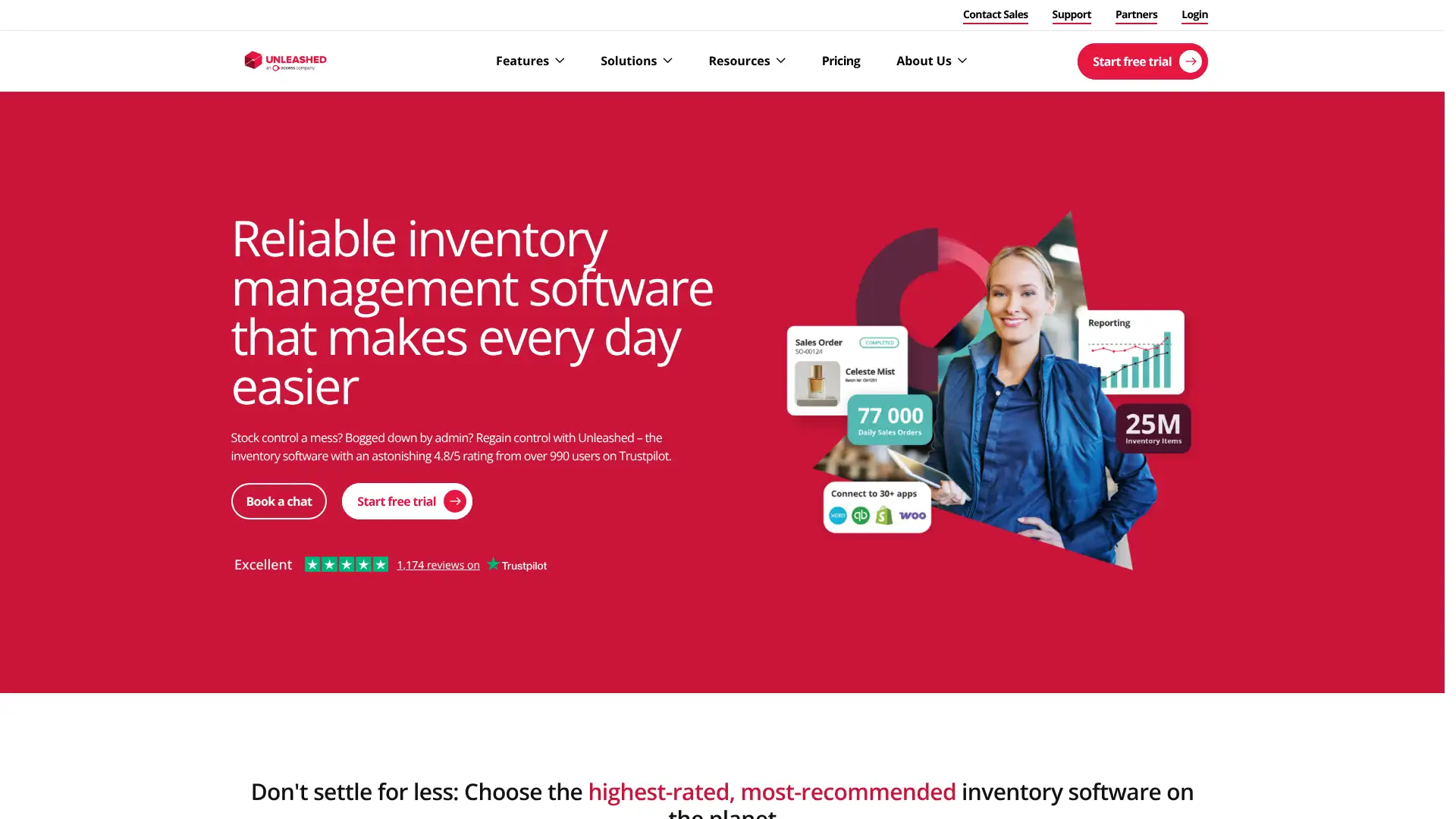
Unleashed Software is a cloud-based inventory management platform built for product-based businesses including wholesalers, distributors, and light manufacturers. It is recognized for particularly strong lot and serial number tracking, assembly management, and demand planning. Unleashed integrates with Shopify, WooCommerce, Amazon, Xero, QuickBooks, and Salesforce. The Startup plan begins at $349 per month (annual), covering unlimited products, users, and basic warehouse management. Advanced demand planning is available through Unleashed's integrated Inventory Planner module.
- • First-class lot and serial tracking: tracks inventory at the batch, lot, and serial number level throughout the entire supply chain from purchase to sale.
- • Assembly management: handles simple and multi-level product assemblies with real-time component deduction and finished goods costing.
- • Demand planning with Inventory Planner: AI-assisted replenishment suggestions based on historical sales velocity and seasonality.
- • B2B sales portal: branded self-service portal lets wholesale customers browse current stock, place orders, and view order history without sales team involvement.
- • Multi-currency and multi-warehouse: manages inventory across multiple locations and currencies, supporting international wholesale operations.
Unleashed Software is the strongest choice for wholesalers and distributors that prioritize lot traceability, multi-currency operations, and a branded B2B portal. Its Xero integration makes it a natural fit for businesses in Australia, UK, and New Zealand. Companies needing WMS-grade picking workflows or high-volume ecommerce integration should evaluate Cin7 or Deposco.
SnapFulfil WMS
SnapFulfil, built by Synergy Logistics, is a cloud-based tier-1 WMS marketed as the only enterprise-grade system that can deploy in 45 days or less. It serves e-commerce, B2B distribution, 3PL, and manufacturing operations. The platform supports wave and waveless picking, batch and cluster picking, task interleaving, cartonization, and RF-enabled workflows through a browser-based interface accessible from any device. SnapFulfil has approximately 260 WMS customers with 43% in North America. SnapControl, a multi-agent robotics orchestration module, was added to support automated warehouse environments. Published pricing starts at approximately $4,000 per month, with a fixed SaaS subscription model.

- • 45-day implementation: structured fast-track deployment program that consistently delivers go-live in 45 days or less — a documented competitive differentiator.
- • Configurable rules engine: operators adapt warehouse workflows, picking logic, and exception handling through configuration rather than custom code.
- • SnapControl robotics orchestration: multi-agent platform that provides device-agnostic, unified control of robotics and automated systems alongside human pickers.
- • Multiple picking methodologies: wave, waveless, batch, cluster, pick-and-pass, and zone picking — all configurable without development work.
- • Browser-based RF interface: supports handheld scanners and mobile devices through any web browser, eliminating client-side software installations.
SnapFulfil is the best tier-1 WMS option for 3PLs and distributors that need enterprise-grade functionality deployed in 45 days without an 18-month ERP project. The fixed monthly SaaS fee and robotics module make it cost-predictable as operations scale. Teams that are under-resourced for self-directed implementations should ensure dedicated project management before committing to the 45-day timeline.
Softeon WMS
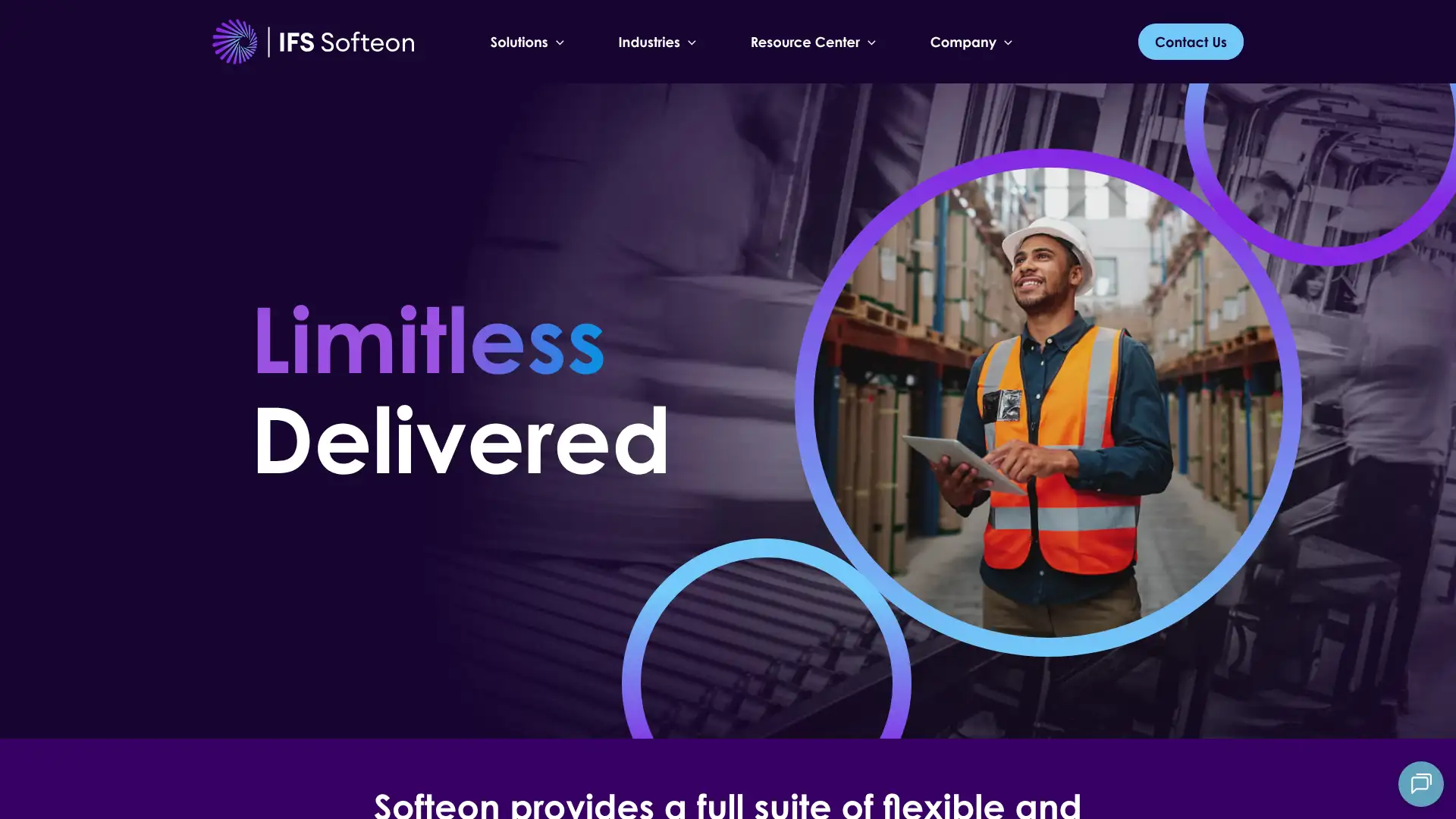
Softeon is a supply chain software company offering a combined WMS and Warehouse Execution System (WES) platform, positioning itself as a single solution for both warehouse management and execution of automation. It serves retail, food and beverage, 3PL, and healthcare verticals. Softeon was listed in the Gartner Magic Quadrant for Warehouse Management Systems and is recognized by analysts for its ability to flex across manual, mechanized, and fully automated warehouse environments. Softeon competes directly with Manhattan Active WM's embedded WES approach. Pricing is not publicly listed and requires direct engagement with sales.
- • Integrated WMS and WES: single platform manages both the warehouse management layer and real-time execution of conveyor, sortation, and robotic systems.
- • Distributed Order Management (DOM): native DOM capability routes orders across fulfillment nodes to optimize delivery cost and speed.
- • Configurable without custom code: business rules, workflows, and UI elements are configured through a rules engine rather than through code changes.
- • Support for manual to fully automated facilities: scales from basic pick-pack-ship operations to lights-out automated distribution centers on the same platform.
- • Labor management: tracks individual worker performance, automates task assignment, and provides productivity dashboards in real time.
Softeon is a compelling choice for distribution centers that want to consolidate WMS and WES on a single platform without the complexity of a tier-1 enterprise implementation. Its configurability is a genuine strength. Buyers should invest in thorough reference checking given Softeon's smaller market footprint relative to the enterprise leaders.
Made4net WMS
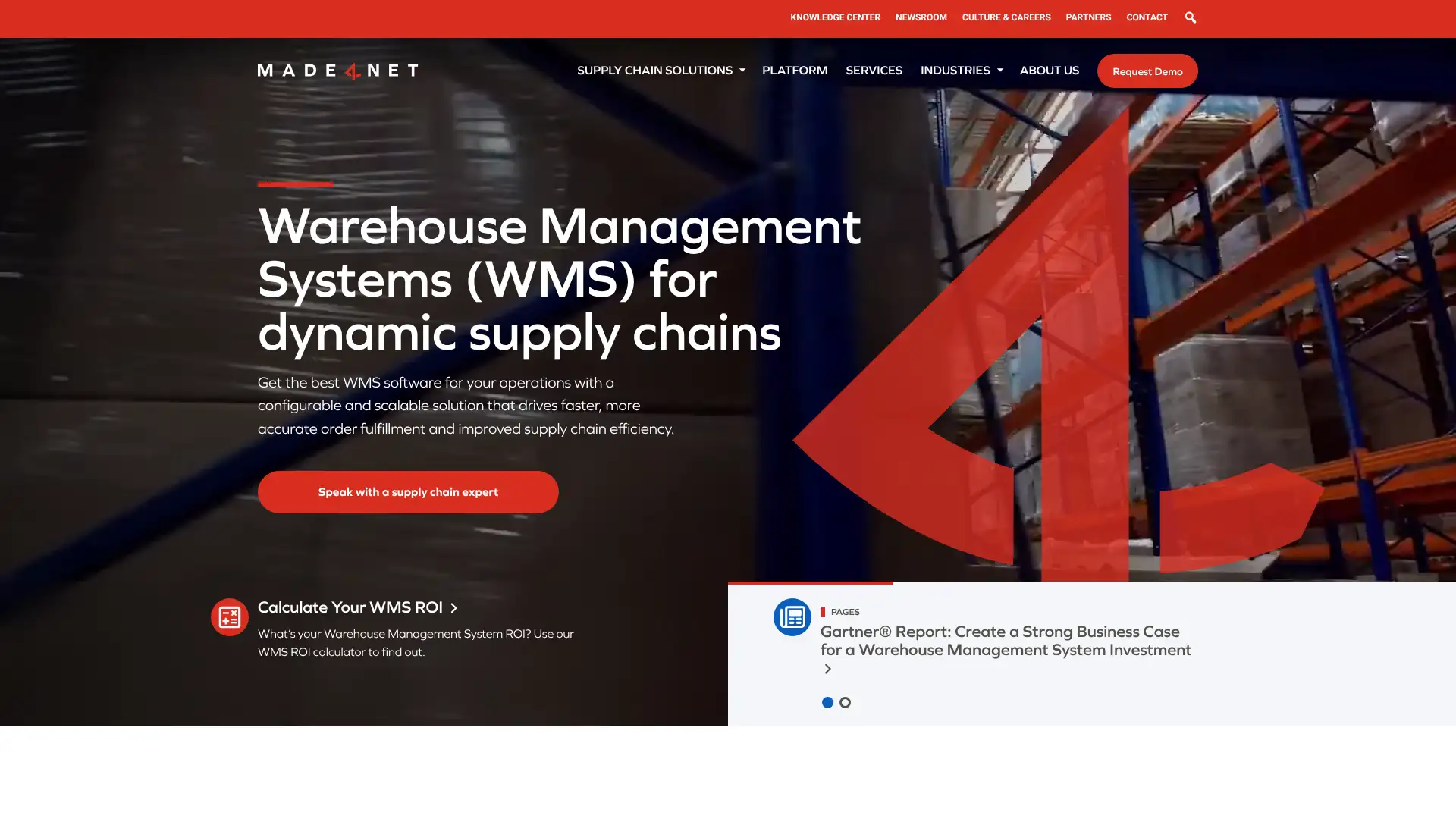
Made4net is a global cloud WMS provider recognized in both the 2025 Gartner Magic Quadrant and 2025 Midmarket Context Magic Quadrant for Warehouse Management Systems — one of the few vendors to appear in both reports. The company was acquired by Ingka Holding (IKEA's parent) in May 2023, significantly expanding its international footprint. Made4net's SCExpert platform integrates WMS, yard management, dynamic route management, proof of delivery, and warehouse automation in a single end-to-end supply chain execution suite. In February 2026, Made4net launched its AI Journey initiative, embedding AI-driven analytics and exception management across the platform.
- • Dual Gartner recognition: featured in both the standard and midmarket Gartner Magic Quadrant for WMS in 2025, validating coverage across a wide range of operation sizes.
- • Yard management integration: native yard management tracks trailers, dock appointments, and yard moves within the same platform as the WMS.
- • Dynamic route management and proof of delivery: extends WMS execution from the dock through last-mile delivery with driver-app proof of delivery capture.
- • AI Journey (2026): embedded AI analytics identify performance anomalies, root causes, and optimization opportunities across inventory, labor, and order management.
- • Warehouse automation integration: connects to robotic systems, conveyors, and sorters to orchestrate automated and manual processes from a unified interface.
Made4net is a strong contender for mid-market and enterprise operations that need integrated yard management, route management, and proof of delivery alongside a cloud WMS — all from a single vendor. The Ingka/IKEA backing adds financial credibility. Operations purely focused on warehouse execution without the extended last-mile scope will find Deposco or SnapFulfil a faster path to ROI.
Cadre Technologies
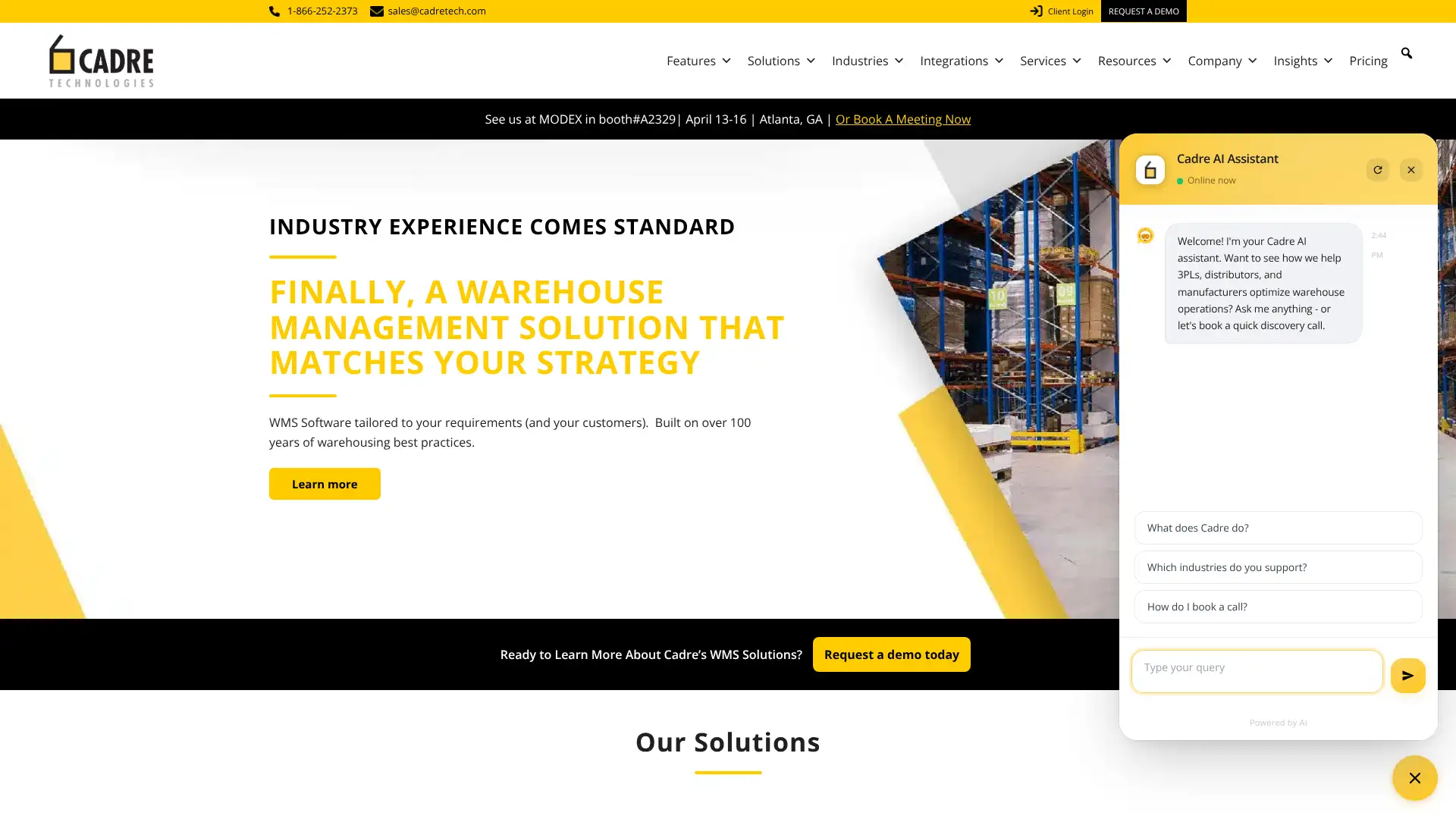
Cadre Technologies is a Clearwater, Colorado-based provider of cloud-based WMS and supply chain visibility solutions built for 3PL, 4PL, and distribution operations. Its flagship product, Cadre Warehouse Management, is designed to handle complex multi-client warehousing scenarios with built-in client visibility portals, billing management, and inventory traceability. Cadre differentiates through its focus on regulated industries — including cold storage and healthcare — and its 4PL network management capabilities. Pricing is not publicly listed and requires a custom quote.
- • Multi-client warehouse management: manages inventory for multiple 3PL clients from a single facility with strict segregation of client data and billing.
- • Client visibility portal: real-time self-service portals give each 3PL client direct visibility into their inventory, orders, and billing without warehouse staff involvement.
- • 4PL network management: extends beyond single-site WMS to orchestrate inventory and fulfillment across a network of warehouse partners.
- • Cold storage and regulated inventory support: built-in lot tracking, temperature zone management, and audit trails for food, pharma, and healthcare applications.
- • Billing management: activity-based billing engine captures all value-added services and generates automated invoices for each client.
Cadre Technologies is worth evaluating for 3PLs and 4PLs managing regulated inventory — especially cold storage and healthcare — where compliance documentation and multi-client billing are operational requirements rather than nice-to-haves. Smaller 3PLs without regulated inventory complexity will find Extensiv or Datex a more proven and accessible starting point.
Datex Footprint WMS
Datex, in operation since 1978, provides its Footprint WMS platform to 3PLs, cold storage operators, life sciences companies, and industrial distributors. The platform was recognized by Gartner as a Notable Vendor in the 2025 Midmarket Context Magic Quadrant for Warehouse Management Systems — for the second consecutive year. In March 2025, Datex launched Datex Studio, a low-code application platform (LCAP) that lets customers customize screens, workflows, and business rules without a developer. The LCAP claims to reduce customer onboarding time by up to 3x. Pricing requires a custom quote; no public rates are available.
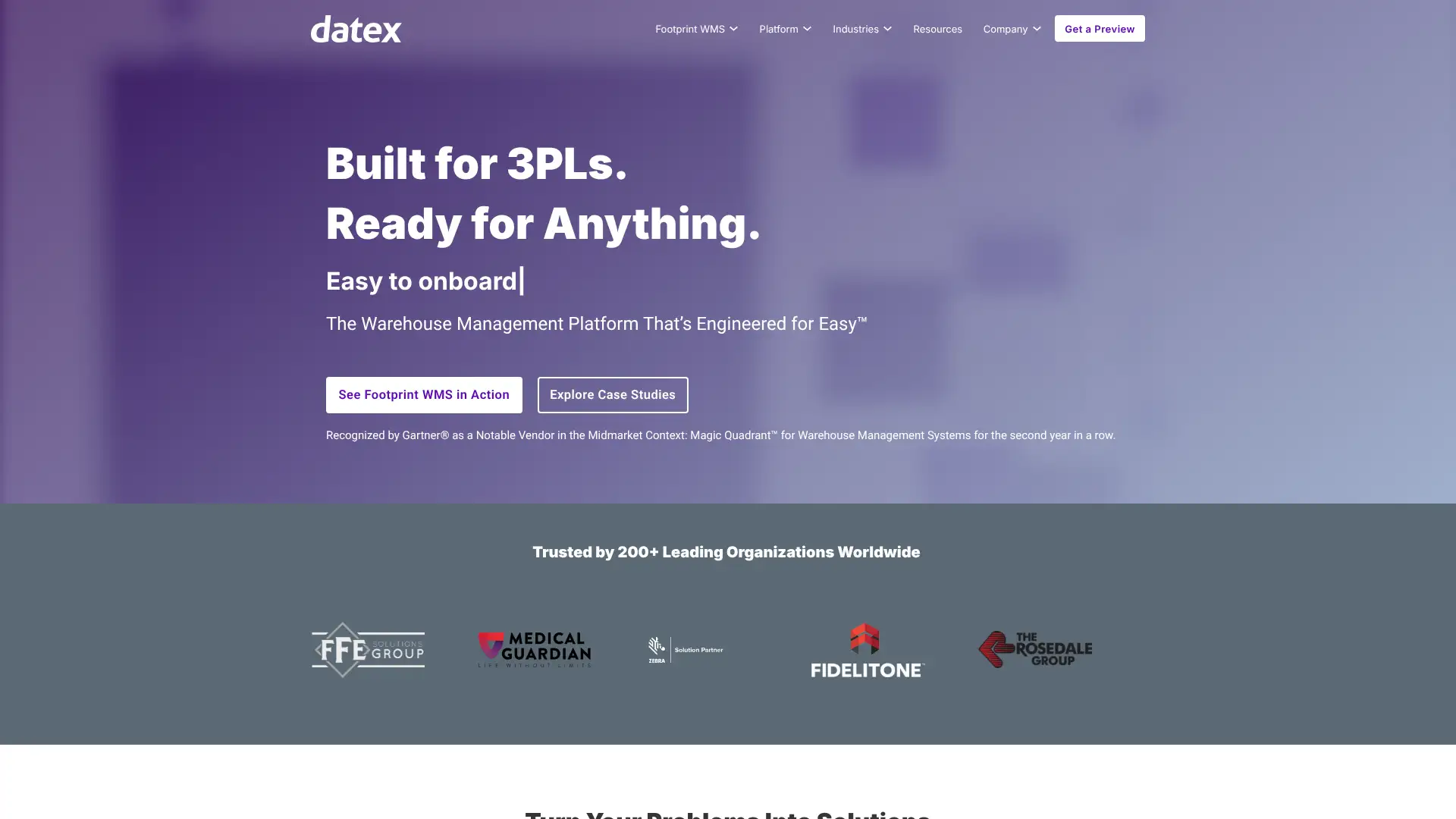
- • Datex Studio LCAP: low-code platform lets warehouse operators design custom screens, workflows, and automation rules without developer involvement, reducing customization cost.
- • Cold storage and lot tracking: purpose-built for food and pharma with temperature zone management, expiration date tracking, lot recalls, and regulatory audit trails.
- • 200+ pre-built EDI and API integrations: native connections to major ERP systems, carriers, and trading partners via a unified integration framework.
- • Customer ePortal: clients of Datex-powered 3PLs get self-service access to live inventory and shipment data, reducing inbound support calls.
- • AI-driven analytics: AI insights layer identifies high-impact optimization opportunities across inventory, labor, and billing across the Footprint WMS platform.
Datex Footprint WMS is a strong choice for mid-market 3PLs in regulated industries — particularly cold storage, food and beverage, and life sciences — where lot tracking, compliance audit trails, and client billing management are operational requirements. The Datex Studio LCAP is a meaningful differentiator for accelerating client onboarding. DTC-focused 3PLs should evaluate Extensiv or Logiwa first.
RFgen Software
RFgen Software is a mobile data collection and barcode scanning platform that extends ERP systems — including SAP, Oracle, and Microsoft Dynamics — with real-time, mobile-enabled warehouse workflows. Rather than a standalone WMS, RFgen acts as a mobile transaction layer that gives warehouse workers access to ERP data and transaction entry through handheld scanners, mobile devices, and tablets. It supports both cloud and on-premise deployment. RFgen includes offline data collection with sync-on-reconnect for areas with limited connectivity. Pricing is not publicly listed; it is based on the ERP environment, number of users, and selected modules.
- • ERP-native mobile transaction layer: extends SAP, Oracle, Microsoft Dynamics, and other ERPs with mobile barcode scanning without replacing the ERP's data model.
- • Offline data collection: warehouse workers capture transactions in areas with no WiFi or cellular signal; data syncs automatically when connectivity is restored.
- • Configurable data collection screens: non-technical administrators can design and modify scanning forms and workflows without developer involvement.
- • RFID integration: supports RFID readers alongside barcode scanners for operations requiring passive or active tag-based inventory tracking.
- • Role-based access control: user authentication and permission levels restrict access to appropriate transaction types by job role.
RFgen is the right tool for organizations that have invested in a major ERP and need real-time mobile barcode scanning and offline data collection without replacing their ERP with a standalone WMS. It is not suitable as a first WMS for operations without an existing ERP backbone or for teams that need directed warehouse workflows beyond what the ERP natively supports.
Descartes Peoplevox
Descartes Peoplevox is an ecommerce-native WMS acquired by Descartes Systems Group in February 2020 for approximately $25 million. Headquartered in London, the platform serves direct-to-consumer brands, pure-play ecommerce retailers, and omnichannel businesses. It deploys in as little as 40 days and is purpose-built for mobile-driven pick-pack-ship operations connecting to Shopify Plus, NetSuite, Loop Returns, and dozens of other ecommerce systems. Customers have reported shipping three times more parcels per day with the same headcount after implementation. Pricing is not publicly listed and is based on order volume and warehouse count.
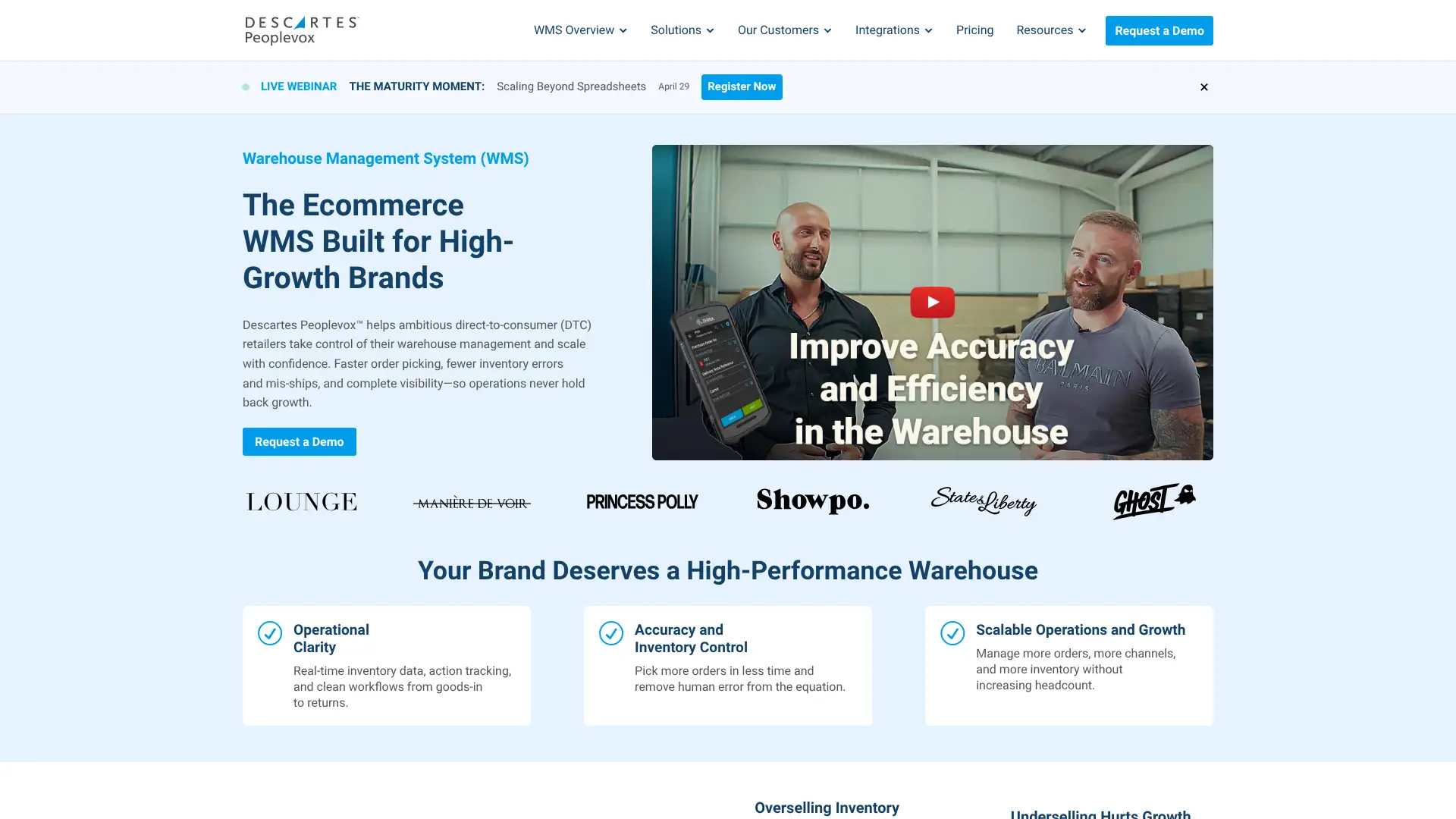
- • DTC-optimized pick-pack workflows: mobile scanning guides pickers through order-by-order or batch pick sequences specifically designed for high-velocity parcel fulfillment.
- • 40-day deployment: structured implementation program consistently delivers live operations in 40 days — standard for Shopify Plus integrations.
- • Shopify Plus native integration: bi-directional real-time sync of orders, inventory, and tracking with Shopify Plus without middleware.
- • Loop Returns integration: automatic RMA creation in Peoplevox when a return is initiated in Loop Returns, providing warehouse visibility of inbound returns.
- • Real-time inventory accuracy: every warehouse action (receiving, picking, packing, transfers) updates inventory in real time across all connected channels.
Descartes Peoplevox is the best WMS for fast-growing DTC brands on Shopify Plus that want a purpose-built ecommerce WMS deployed in 40 days. The Descartes integration ecosystem adds logistics connectivity that competitors lack. Brands with complex B2B fulfillment, 3PL billing needs, or very high order volumes should also evaluate Logiwa and Deposco.
ShipBob WMS
ShipBob is primarily an outsourced ecommerce fulfillment provider operating 60+ warehouses across the US, Europe, Australia, and Canada. Its proprietary WMS is the same system ShipBob built to run its own fulfillment network, now offered to brands as a self-managed option (Merchant Plus). The WMS supports 3,500–120,000 orders per month in a brand-owned warehouse. Core fees include a one-time implementation fee, a monthly software subscription, and a per-order shipping cost component. Pricing is quote-based; independent estimates suggest mid-market monthly software fees around $1,000 or more depending on volume and configuration.

- • ToolBob mobile app: warehouse floor app for batch, auto-cluster, custom cluster, and single-order picking with cycle counting built in.
- • Blended fulfillment: brands using ShipBob's own warehouse network can tap ShipBob's 60+ facilities for overflow capacity or geographic expansion alongside self-managed warehouses.
- • Carrier rate shopping: real-time rate comparison across all connected carriers to select the cheapest label at time of shipment.
- • Inventory placement optimization: recommendations for distributing SKUs across ShipBob's fulfillment center network to minimize average shipping distance.
- • Shopify, Amazon, and WooCommerce integrations: native bi-directional connections to major ecommerce platforms for order pulling and tracking updates.
ShipBob WMS makes the most sense for ecommerce brands already using or seriously considering ShipBob's outsourced fulfillment network — the blended fulfillment value only materializes if the brand is in or planning entry into ShipBob's warehouse ecosystem. Brands managing their own warehouse with no interest in outsourced fulfillment will find ShipHero or Extensiv better value.
WarehouseOS
WarehouseOS (built by Hoj Innovations, based in Salt Lake City, Utah) is a cloud-based warehouse management system designed for small to mid-sized ecommerce brands and 3PLs. The platform is iPad-native and uses a patented grid display (Pick2Grid) that assigns each order to a visual compartment on a physical cart, guiding pickers to the correct location and reducing mis-picks. WarehouseOS claims a 99%+ order accuracy rate via its barcode scan verification at every step. The platform starting price is $350 per month, making it one of the most accessible dedicated WMS options for growing operations. It integrates with Shopify, NetSuite, WooCommerce, ShipStation, and Brightpearl.
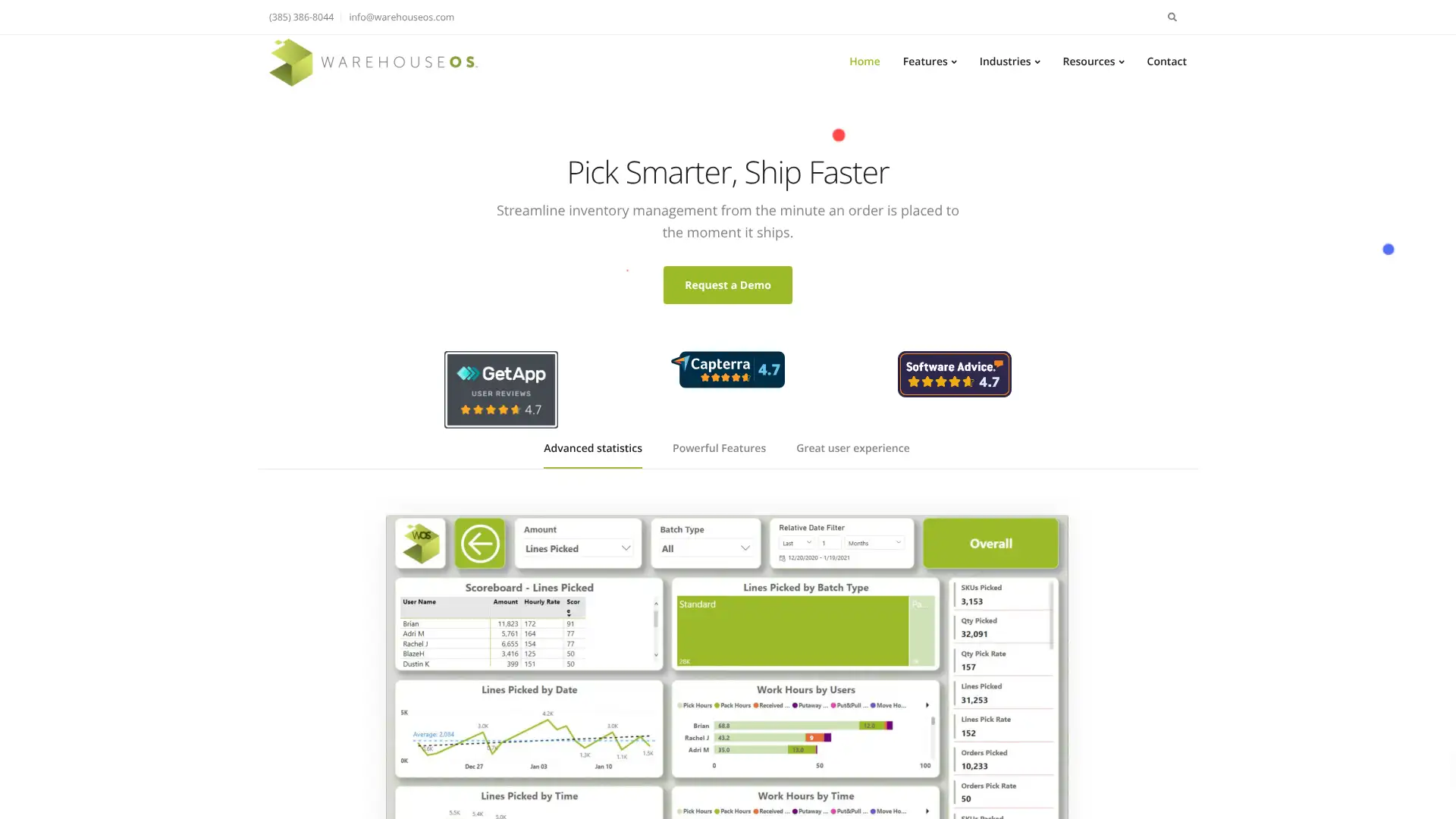
- • Pick2Grid (patented): interactive grid display on an iPad shows which cart compartment each picked item belongs to — eliminating mixed orders without sorting tables.
- • Batch picking up to 100 orders: a single picker can simultaneously pick 100 orders into a barcoded cart, guided entirely by the Pick2Grid display.
- • Barcode scan verification: every item is scanned before it enters a compartment and again at packing, enforcing a two-step accuracy check on every order.
- • Real-time productivity tracking: logs every warehouse action by user and reports picker efficiency, throughput, and error rates in real time.
- • Shopify and ShipStation integration: pulls orders automatically and pushes tracking updates back to the connected ecommerce platform upon shipment.
WarehouseOS is an excellent entry-point WMS for small ecommerce brands and boutique 3PLs that want iPad-native operations, patented batch picking accuracy, and verifiable quality control at $350/month. It is not designed for complex B2B distribution or high-automation environments. Operations growing beyond 10,000 orders per month should evaluate ShipHero or Logiwa as the next step.