29 Best Static Site Generators in 2026
This guide covers two categories: static site generators (tools that compile source files into deployable HTML/CSS/JS) and hosting platforms (services that serve those files to users). All 30 are covered: 15 SSGs and 15 hosting platforms. Pricing verified March 2026. SSGs are generally free open-source tools. Hosting platforms vary from fully free to enterprise-priced. Note: Vercel Hobby plan prohibits commercial use; commercial projects require Pro at $20/user/month.
Next.js
Next.js is the most widely used React framework, created and maintained by Vercel. It supports Static Site Generation (SSG), Server-Side Rendering (SSR), Incremental Static Regeneration (ISR), and Server Actions within a single framework. It runs 43% of the top React-powered sites globally. Next.js is technically a hybrid framework rather than a pure SSG: App Router supports React Server Components for server-side computation per request. ISR allows individual pages to be regenerated on a schedule or on demand without a full rebuild. The framework is technically first-class on Vercel but deployable on any platform via adapters.
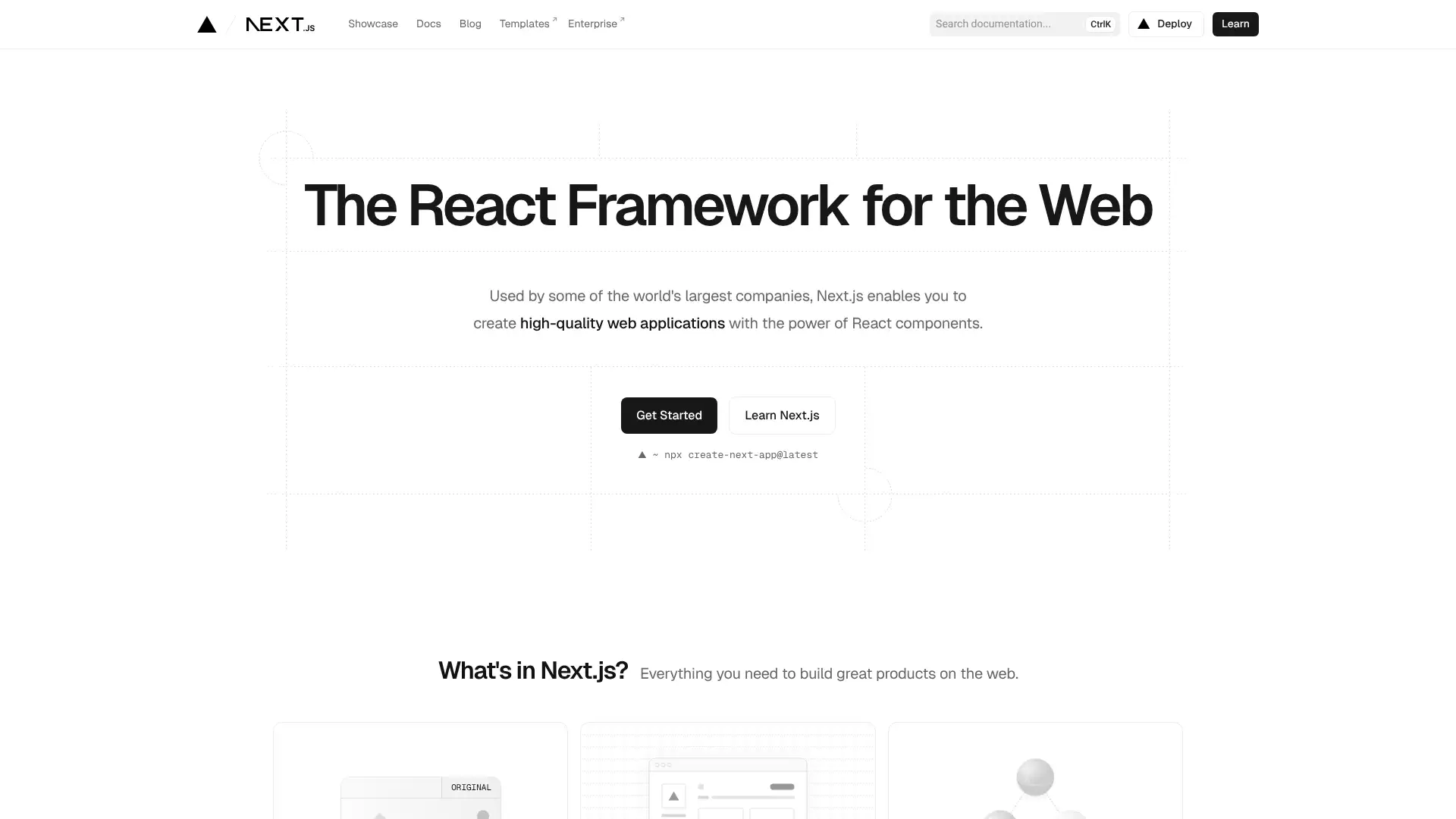
- • App Router: React Server Components enable server-side computation per request with streaming responses
- • ISR (Incremental Static Regeneration): regenerate individual static pages on demand or on a schedule without full rebuild
- • Image optimisation: automatic WebP/AVIF conversion, lazy loading, and responsive sizing built into the framework
- • API Routes: define serverless API endpoints in the same codebase as pages, deploying as serverless functions
- • TypeScript support: first-class TypeScript integration with automatic type-checking in the build process
Next.js is the default choice for React teams who need a mix of static, server-rendered, and API routes in one framework. ISR is a practical solution for content that updates periodically without requiring full rebuilds.
Gatsby
Gatsby is a React-based static site framework with a GraphQL data layer that allows querying data from any source (Markdown files, headless CMS, APIs, databases) using a unified GraphQL schema at build time. Gatsby was acquired by Netlify in 2023. The acquisition has slowed active development as Netlify focuses on platform capabilities rather than advancing the Gatsby framework itself. Gatsby's plugin ecosystem remains extensive. The consensus in 2026 is that for new projects, Astro or Next.js provide better development trajectories, but significant existing Gatsby codebases remain in production.
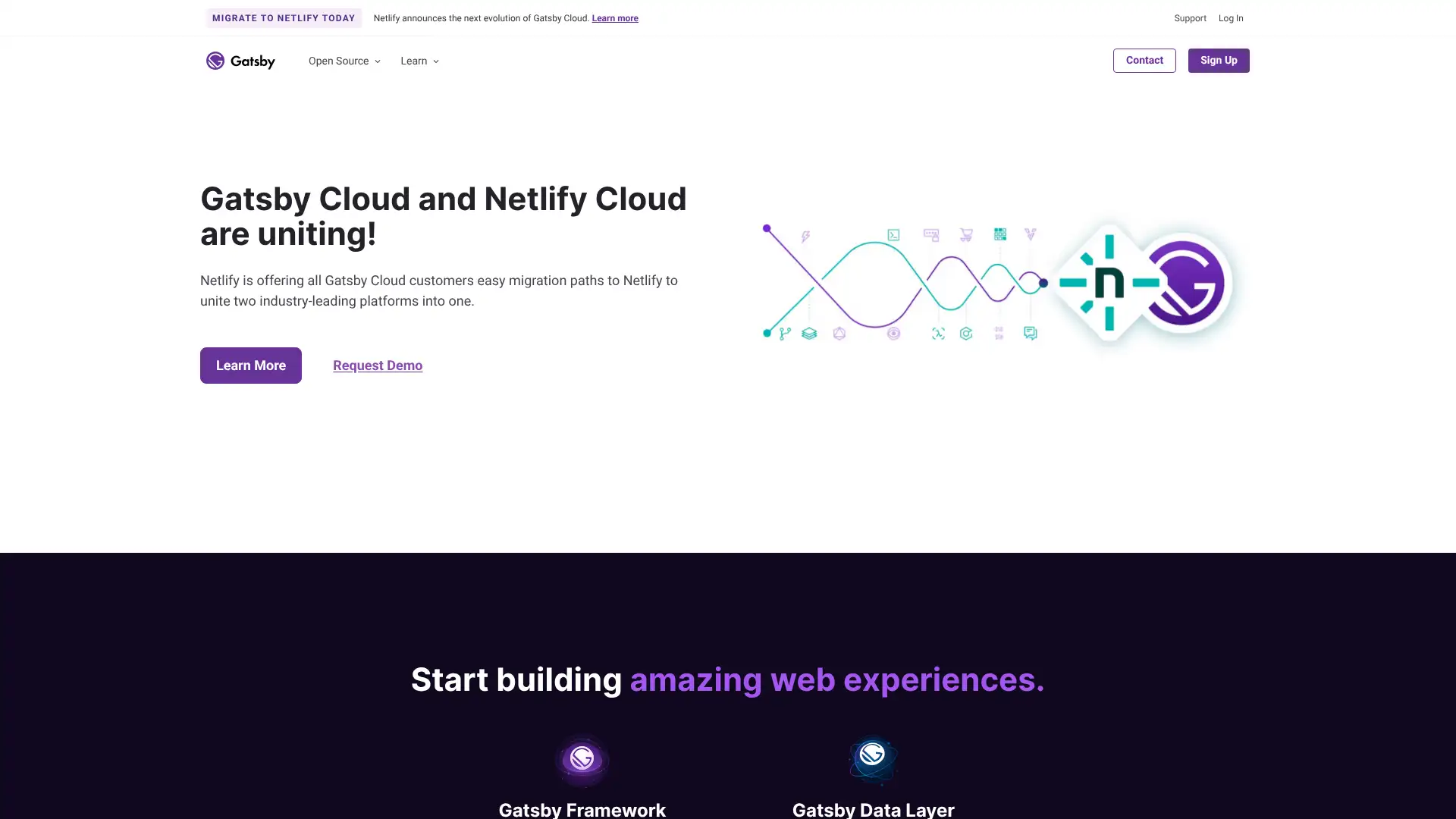
- • GraphQL data layer: query data from any source through a unified GraphQL schema at build time
- • Gatsby Cloud: hosted build infrastructure with incremental builds for large sites (now part of Netlify)
- • Image optimisation plugin: automatic lazy loading, WebP conversion, and blur-up placeholder images
- • 5,000+ plugins: extensive ecosystem covering CMS integrations, analytics, SEO, and more
- • PWA toolkit: service workers and app manifest built in for Progressive Web App functionality
Gatsby is the right choice when maintaining an existing Gatsby codebase or when the GraphQL data layer is specifically needed for multi-source content aggregation. For new projects, Astro provides better performance and active development, while Next.js provides the most complete React hybrid framework.
Hugo
Hugo is written in Go and delivered as a single binary with no runtime dependencies. It consistently achieves the fastest build times of any mainstream SSG: large sites with thousands of pages build in milliseconds. A 'million pages release' in 2024 demonstrated streaming builds for extreme-scale content. Hugo is particularly popular for documentation sites, blogs, and large content archives where build speed is a primary concern. Configuration uses YAML, TOML, or JSON. Templating uses Go's html/template syntax, which is more terse and less approachable than JavaScript templating for teams without Go experience.

- • Fastest build times of any SSG: builds thousands of pages in milliseconds via single Go binary
- • Single binary distribution: no Node.js, Ruby, or runtime dependencies to install or version-manage
- • Built-in multilingual support: translate content and generate per-language sites without plugins
- • Taxonomy system: flexible categorisation (tags, categories, custom) built into the framework
- • Streaming builds: million-pages mode introduced in 2024 for extreme-scale content generation
Hugo is the best SSG when build speed and long-term stability are the primary requirements. Ideal for documentation sites, news archives, and any project with thousands of Markdown pages where incremental builds need to be fast.
Jekyll
Jekyll is the original static site generator, created in 2008 by GitHub co-founder Tom Preston-Werner. It is natively supported by GitHub Pages, which builds and serves Jekyll sites automatically from a repository without any build configuration. Content is written in Markdown with Liquid templates. Jekyll is Ruby-based, which creates friction on machines where Ruby is not pre-installed. Build times become slow for sites above 500 pages. Jekyll remains the most beginner-friendly path to a static site on GitHub Pages, with the entire build-and-deploy pipeline managed automatically.
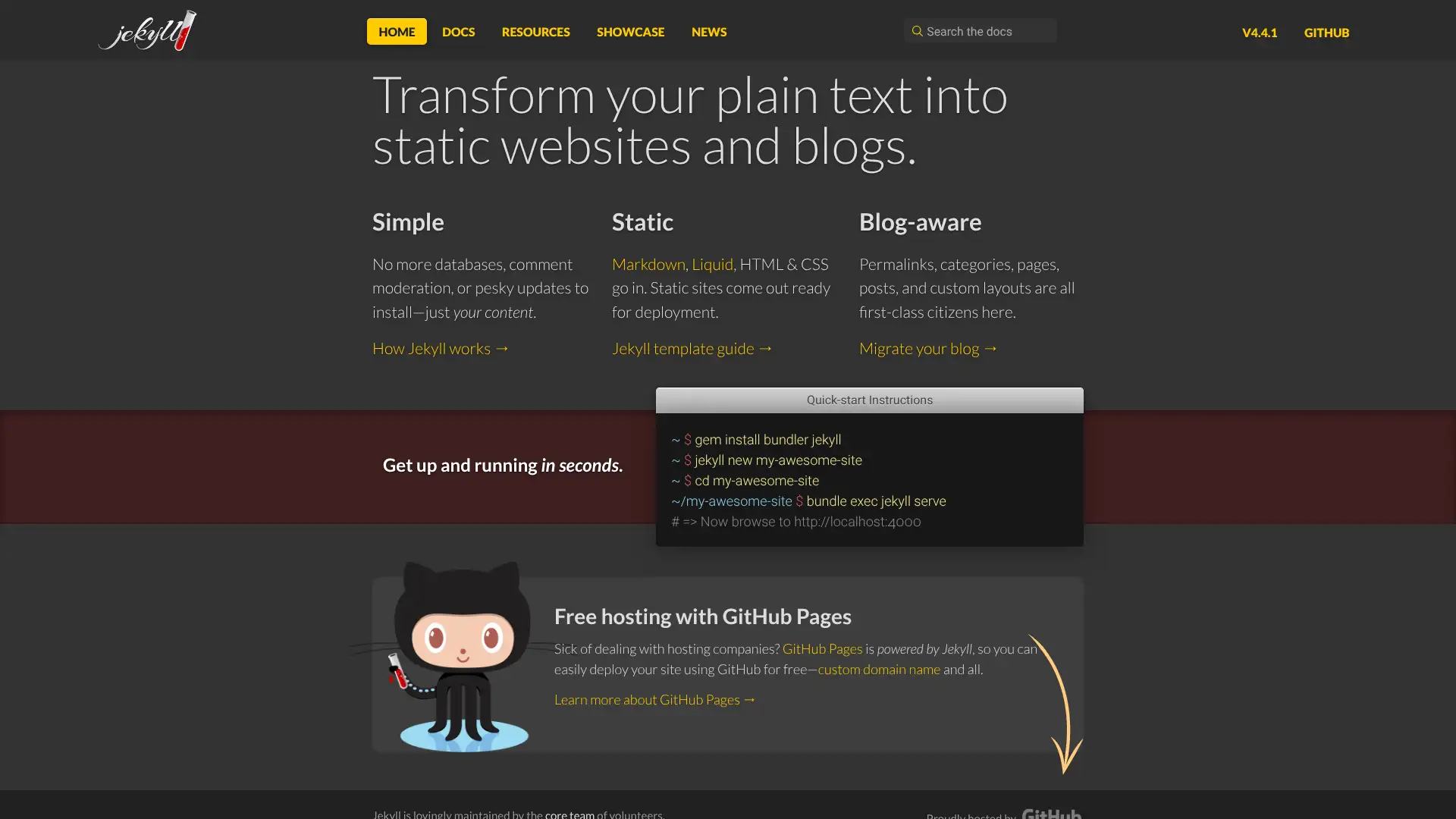
- • Native GitHub Pages integration: push Markdown to a GitHub repository and Jekyll builds and serves the site automatically
- • Liquid templating: simple, readable template language with a large library of examples and tutorials
- • Front matter: YAML metadata in Markdown files controls layout, tags, categories, and custom variables
- • Plugin system: 300+ plugins extend functionality including SEO, pagination, and feed generation
- • 49,000+ GitHub stars: one of the most starred SSG repositories, indicating large community adoption
Jekyll is the right choice specifically for GitHub Pages-hosted sites where zero build configuration is the priority. The native integration eliminates the entire CI/CD setup for simple sites.
Astro
Astro is a modern framework built specifically for content-rich websites that achieves top Lighthouse scores by shipping zero JavaScript by default. Its islands architecture allows selective hydration: only the components that need interactivity receive JavaScript, while everything else remains pure HTML. Astro is framework-agnostic and accepts React, Vue, Svelte, Solid, and other component libraries in the same project. It supports SSG, SSR, and edge deployment. In 2026, Astro consistently scores 100/100 Lighthouse for content-focused sites. It has become the primary recommendation for blogs, documentation, and marketing sites where performance is the priority.
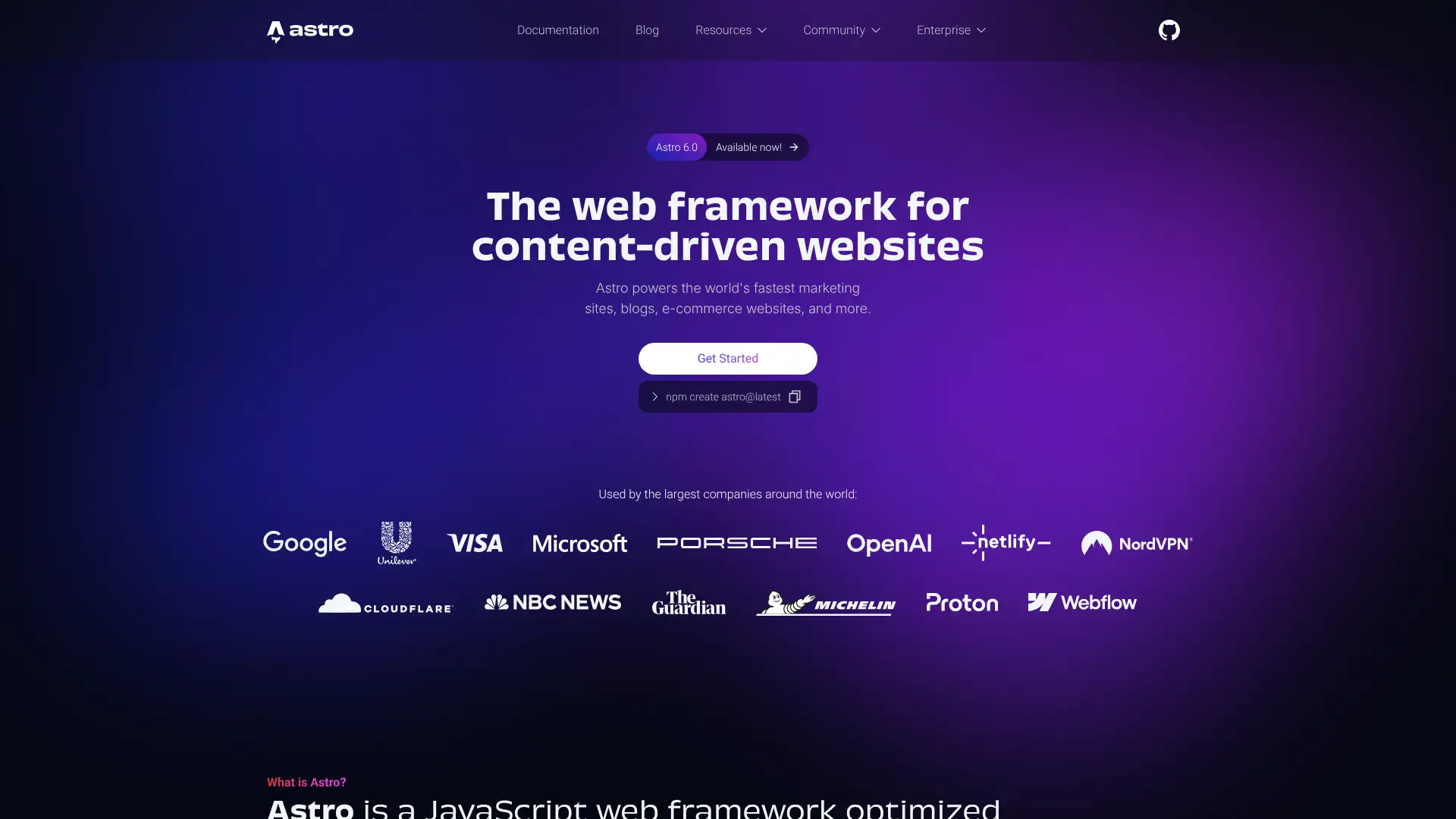
- • Islands architecture: selective hydration lets the developer choose which components receive JavaScript
- • Framework-agnostic: use React, Vue, Svelte, Solid, and other components in the same Astro project
- • Content Collections: typed, schema-validated Markdown/MDX collections with built-in TypeScript types
- • Zero JS by default: Lighthouse 100/100 achievable for content pages without any configuration
- • Astro DB and Server Islands: server-side rendering and database integration for pages that need dynamic data
Astro is the strongest SSG recommendation for 2026 for most new content-focused websites: blogs, documentation, marketing sites, and portfolios. The zero-JS default and islands architecture produce Lighthouse 100 scores without configuration. For full-stack React applications with APIs and server logic, Next.js provides more appropriate tooling.
Eleventy (11ty)
Eleventy (11ty) is a JavaScript-based static site generator that is deliberately minimal: it ships zero client-side JavaScript by default and imposes no framework, no component model, and no client-side bundle. It accepts any templating language (HTML, Markdown, Nunjucks, Liquid, Handlebars, JavaScript, and more) and generates clean HTML. Build times are among the fastest of any JavaScript SSG. Eleventy is the SSG powering web.dev, eslint.org, and netlify.com. It is praised for its flexibility and developer control: it works with whatever folder structure the project already uses.
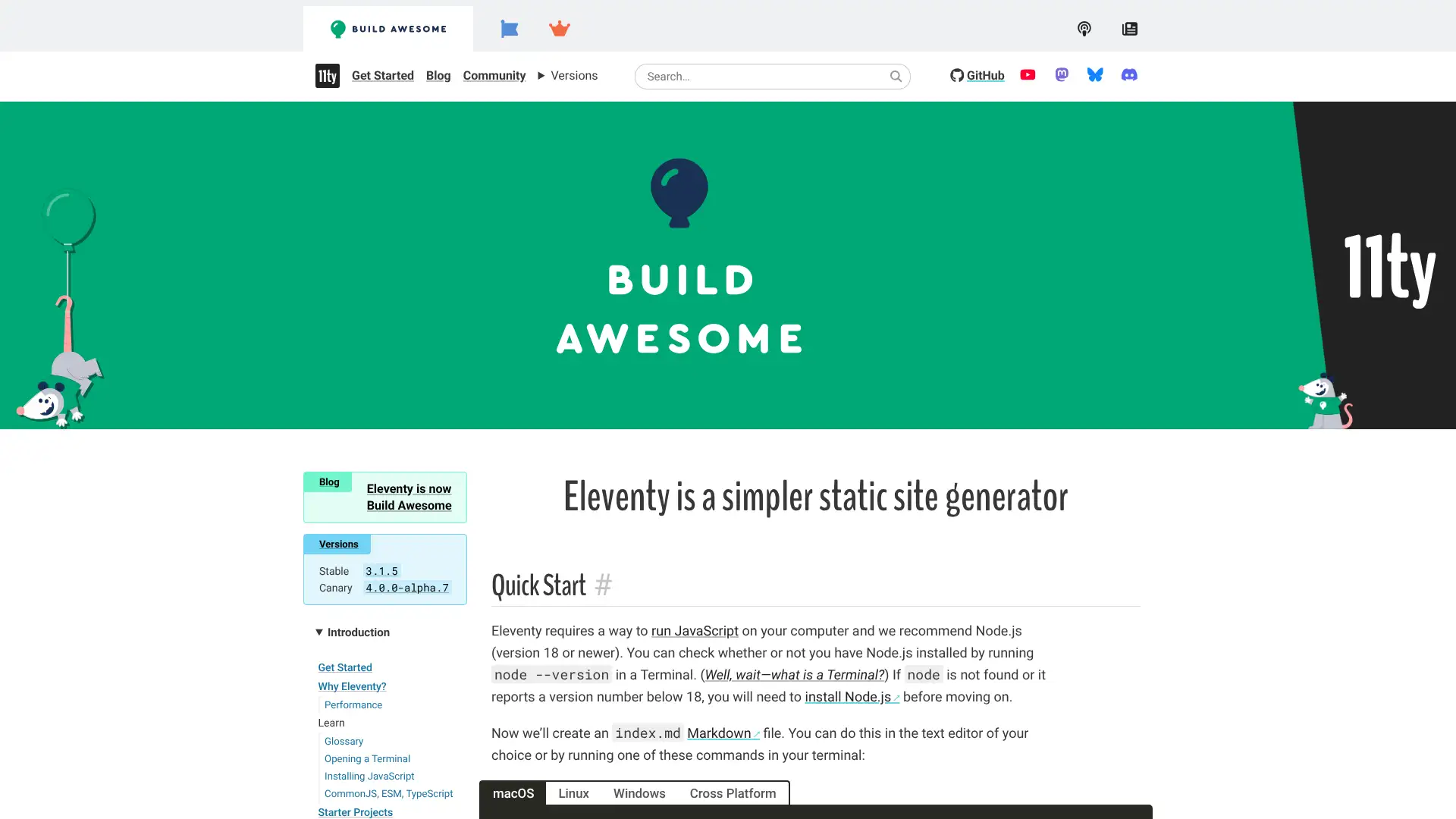
- • Zero client-side JavaScript output: pure HTML generation with no framework runtime shipped to the browser
- • Multi-template language support: use Nunjucks, Liquid, Handlebars, JavaScript template literals, Markdown, or HTML in the same project
- • Flexible folder structure: no required directory layout, works with whatever structure the project has
- • Data cascade: global data, directory data, and per-file data merge in a predictable hierarchy
- • Build speed: among the fastest JavaScript SSGs, processing thousands of pages quickly via Node.js
Eleventy is the best SSG for JavaScript developers who want full control over templating, structure, and build pipeline without any client-side framework opinion. The zero-JavaScript output and flexibility make it ideal for developer documentation, government sites, and any project where performance and developer control are primary requirements.
Nuxt
Nuxt is the Vue.js equivalent of Next.js: a full-stack framework supporting SSG, SSR, ISR, and server-side rendering in a single configuration. Nuxt generates fully static sites via nuxt generate, which pre-renders all routes as HTML at build time. The Nuxt Content module provides a file-based CMS using Markdown and MDX. Nuxt is particularly popular in European developer communities and with teams that use Vue.js rather than React. Nuxt 3 uses Vite and Nitro for significantly faster builds than Nuxt 2.
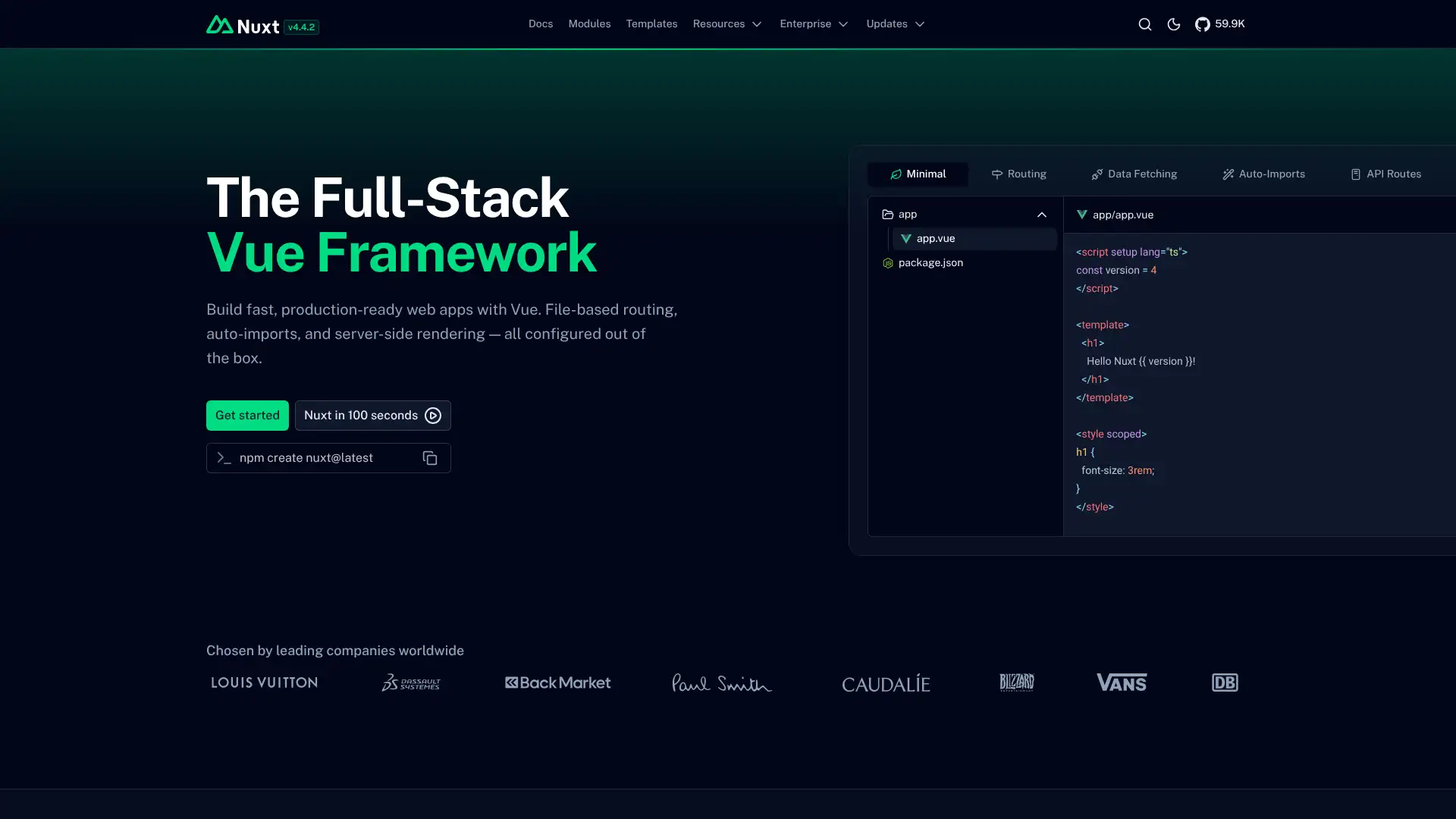
- • Full-stack capability: SSG, SSR, ISR, and API routes in one Nuxt configuration
- • Nuxt Content: file-based CMS module using Markdown and MDX with query API
- • Auto-imports: components, composables, and utilities auto-imported without explicit import statements
- • Nuxt Image: lazy loading, WebP conversion, and responsive image generation as a module
- • Nitro server engine: universal server supporting static export, Node.js, edge functions, and serverless deployment
Nuxt is the default recommendation for Vue.js teams who need a full-stack framework with SSG capability. For pure static content without server-side logic, VitePress (Nuxt's documentation-focused sibling) provides lighter builds. For mixed React/Vue teams, Astro supports both component libraries in the same project.
SvelteKit
SvelteKit is the official full-stack framework for Svelte, providing SSG, SSR, and API routes. Svelte compiles components to vanilla JavaScript at build time rather than shipping a framework runtime: a Svelte app typically has a 30-50% smaller JavaScript bundle than an equivalent React or Vue application. SvelteKit uses Vite for fast builds and supports TypeScript, ESLint, Prettier, and Playwright out of the box. For teams willing to adopt Svelte's component syntax, SvelteKit produces the smallest client-side JavaScript bundles of any meta-framework.
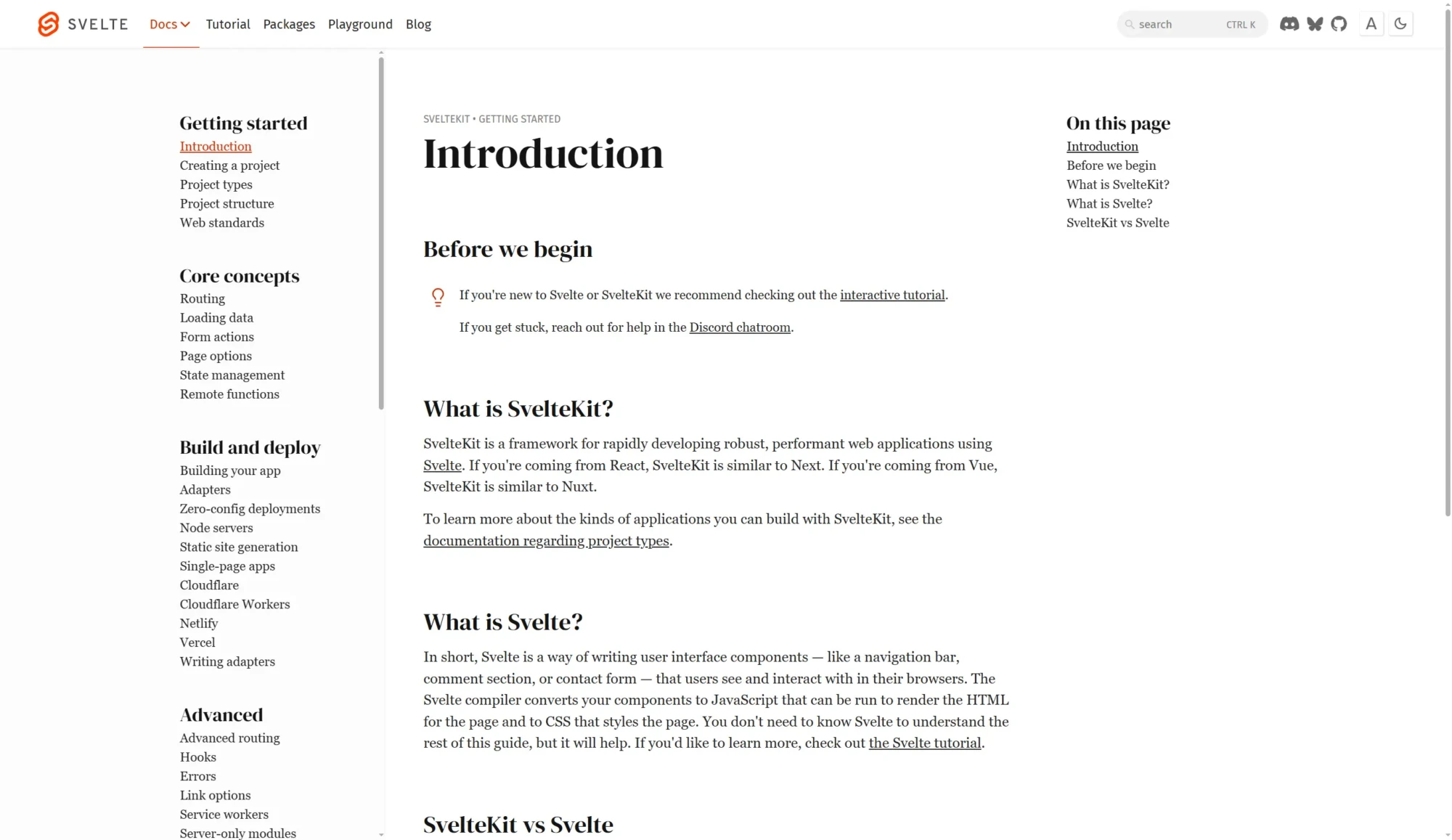
- • Svelte compilation: no framework runtime shipped to the browser, components compile to vanilla JS
- • Smaller JavaScript bundles: typically 30-50% smaller client-side output than React/Vue equivalents
- • Automatic code splitting: only the code needed for the current page is loaded
- • SvelteKit adapters: deploy to Node.js, Vercel, Netlify, Cloudflare Pages, or static export without configuration
- • Vite-based builds: fast hot module replacement in development and quick production builds
SvelteKit is the strongest choice for teams willing to adopt Svelte's syntax in exchange for the smallest possible JavaScript bundles. Svelte's compilation model eliminates the framework runtime from the browser entirely. For teams who need React or Vue compatibility, Next.js and Nuxt are the natural alternatives.
Remix
Remix is a full-stack React framework created by the authors of React Router, acquired by Shopify in 2022. It emphasises native web platform APIs (forms, fetch, cookies) over JavaScript abstractions, server-side data loading via loader functions, and optimistic UI through action functions. Remix is primarily a server-rendered framework: it runs on Node.js, Cloudflare Workers, or Deno. Static generation is possible but not the primary use case. It shares a codebase with React Router 7 (the two merged in 2024) and is best for web applications that need server rendering rather than pre-rendered static sites.

- • Nested routing: URL segments map to nested layout components, enabling granular loading states
- • Loader functions: server-side data loading per route, runs before the page renders on the server
- • Action functions: form submissions handled server-side with built-in form validation and error handling
- • Progressive enhancement: forms and mutations work without JavaScript, adding JavaScript only for enhancement
- • React Router integration: Remix merged with React Router 7 in 2024, sharing a unified codebase
Remix is the right choice for full-stack React web applications that need server-side data loading, form handling, and progressive enhancement. Not the right tool for static content sites, documentation, or blogs where Astro or Eleventy produce better performance with less operational complexity.
VitePress
VitePress is the official documentation framework from the Vue.js team, built on Vite and designed specifically for developer documentation. It is the successor to VuePress and powers the Vue.js, Vite, and Rollup documentation sites. VitePress uses Markdown with Vue component extensions and generates a fast, searchable static site. The default theme provides navigation, sidebar, search, and dark mode out of the box. Build times are fast via Vite. It is optimised narrowly for documentation: not suitable for blogs, marketing sites, or applications.
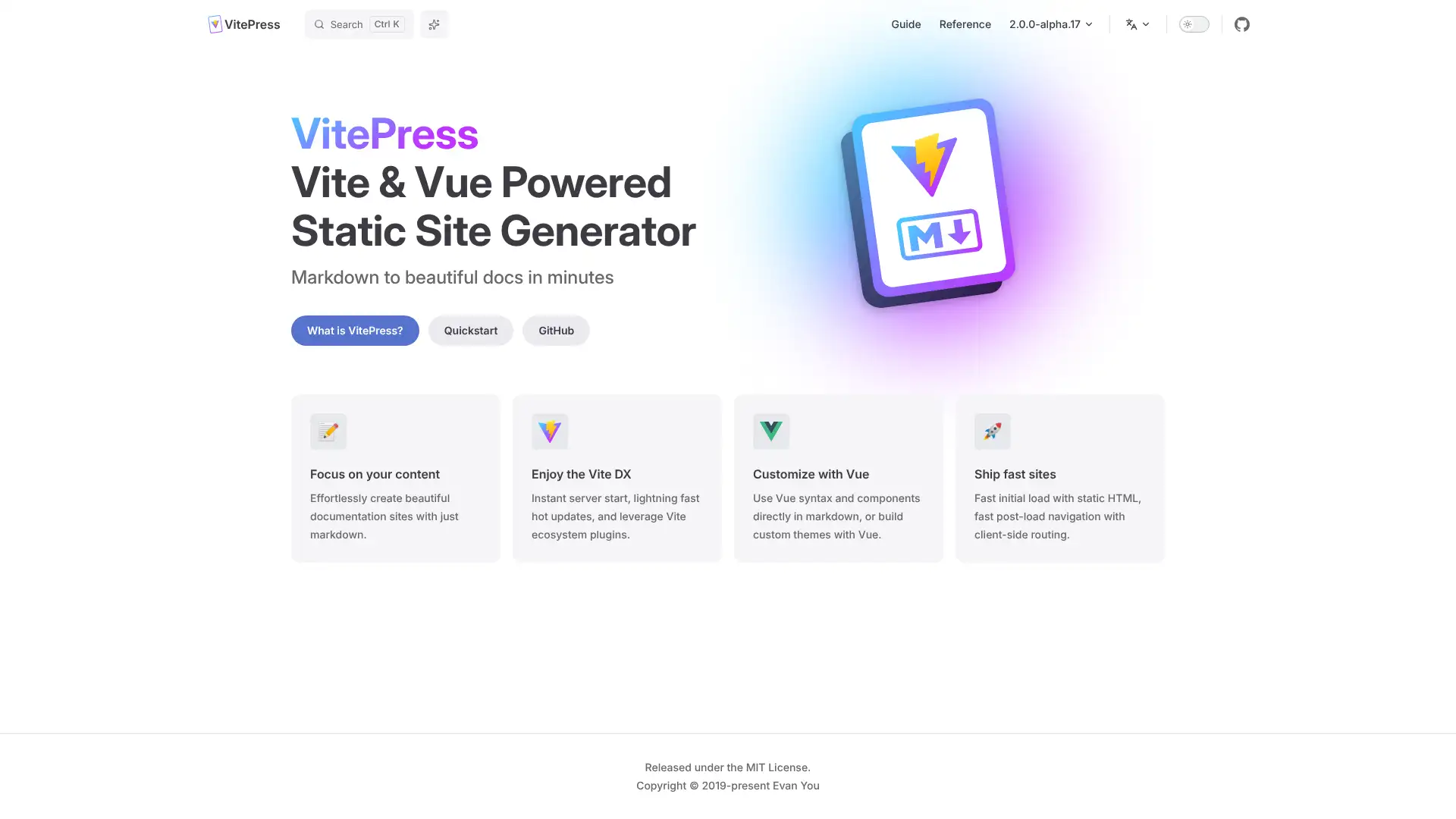
- • Built for documentation: navigation, sidebar, search, versioning, and dark mode included in the default theme
- • Vite-based builds: fast hot module replacement in development and quick production documentation builds
- • Vue components in Markdown: embed interactive Vue components directly in documentation pages
- • Algolia DocSearch integration: built-in support for Algolia's free documentation search service
- • i18n support: localised documentation with language switchers without additional plugins
VitePress is the default recommendation for Vue-ecosystem documentation sites. Combines fast Vite builds with the most complete out-of-the-box documentation theme of any SSG. For React-based documentation, Docusaurus provides an equivalent experience. For framework-agnostic documentation, MkDocs (Python) or Eleventy (JavaScript) are more flexible.
Docusaurus
Docusaurus is an open-source documentation framework maintained by Meta, primarily used by Facebook/Meta open-source projects and widely adopted across the JavaScript ecosystem. It is built on React, supports MDX for interactive documentation pages, provides documentation versioning for multiple API versions, and includes built-in internationalisation (i18n) support. Docusaurus powers documentation for React Native, Jest, Create React App, and hundreds of open-source projects. The combination of versioning and i18n makes it the strongest choice for API documentation with multiple release versions.

- • Documentation versioning: maintain multiple versions of documentation (v1, v2, etc.) with independent content
- • Built-in i18n: translate documentation into multiple languages with a unified crowdin.com integration workflow
- • MDX support: embed interactive React components directly in Markdown documentation pages
- • Algolia search integration: built-in support for Algolia DocSearch on all documentation sites
- • Plugin system: custom plugins extend Docusaurus behaviour including custom page types and integrations
Docusaurus is the strongest documentation framework for JavaScript/React-based projects that need documentation versioning across multiple API releases and internationalisation. For simpler documentation without versioning requirements, VitePress or MkDocs provide faster initial setup.
MkDocs
MkDocs is a Python-based static site generator optimised for documentation. It converts Markdown files to a static HTML site with navigation generated from the directory structure. The Material for MkDocs theme is separately maintained and has become the de facto standard theme, providing a polished documentation experience with search, dark mode, versioning (via mike), tabs, and annotations. MkDocs is particularly popular in Python open-source projects and teams that already use Python tooling.
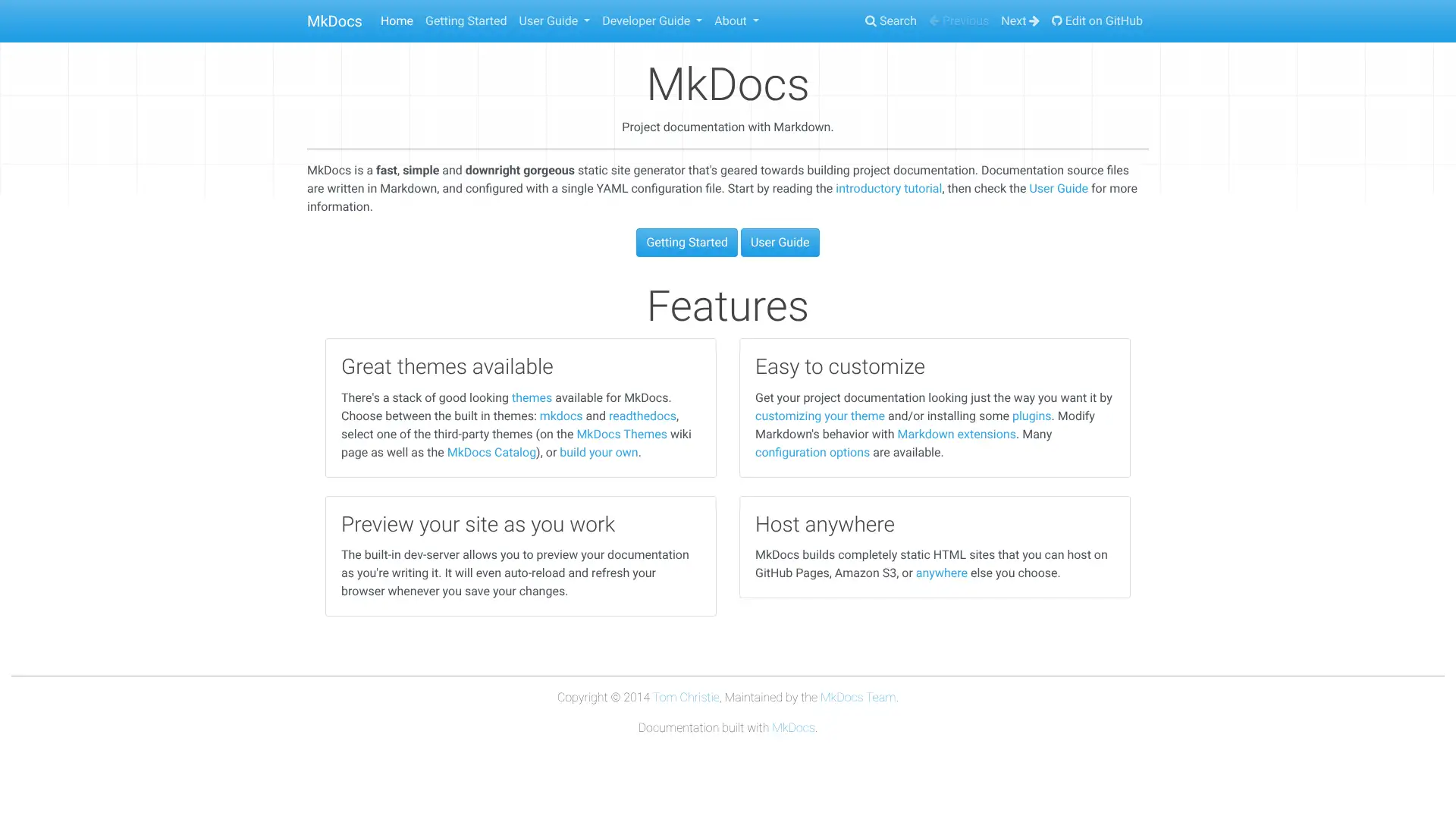
- • Markdown-first: the entire documentation site built from Markdown files with a single mkdocs.yml configuration
- • Material for MkDocs theme: the most popular third-party theme providing search, dark mode, code highlighting, and annotations
- • Navigation auto-generation: directory structure automatically becomes the sidebar navigation
- • mike plugin: documentation versioning allowing multiple versions to coexist at versioned URLs
- • Plugin ecosystem: search, macros, blog, API documentation generation, and more available as Python packages
MkDocs is the best documentation framework for Python open-source projects and any team that prefers Python tooling. The Material for MkDocs theme produces professional documentation results with minimal configuration. For React-component-embedded documentation, Docusaurus provides better MDX integration.
Pelican
Pelican is a Python-based static site generator specifically designed for blogs, converting reStructuredText and Markdown files into a static HTML blog. It is the oldest Python SSG still actively maintained. Pelican is simpler and more opinionated than Hugo or Eleventy, focusing specifically on blog-style sites with categories, tags, archives, and feeds. It has a plugin ecosystem and supports multiple themes. Best suited for Python developers who prefer Python tooling and want a straightforward blogging generator without JavaScript dependencies.
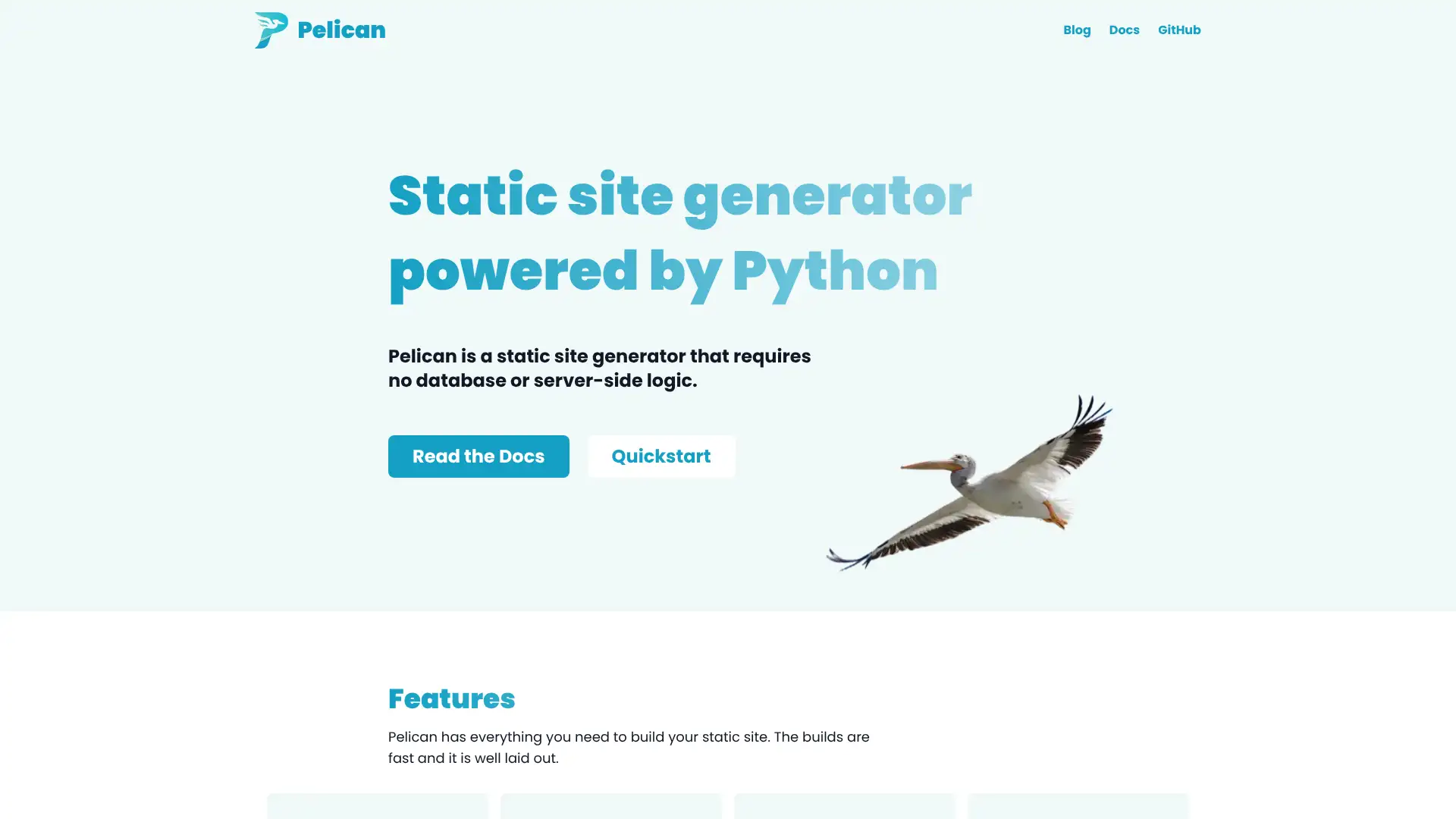
- • Blog-first design: categories, tags, archive pages, RSS and Atom feeds included out of the box
- • reStructuredText and Markdown support: write content in either format within the same site
- • Plugin ecosystem: 100+ plugins for sitemap generation, SEO, search, and theme customisation
- • Multiple themes available: a library of community-contributed themes for different blog styles
- • GitHub Actions integration: Pelican sites easily deploy to GitHub Pages via GitHub Actions
Pelican is the best SSG for Python developers who want a dedicated blogging generator without learning JavaScript. For non-Python teams, Hugo provides faster builds at the same simplicity level, and Eleventy provides JavaScript-based flexibility.
Hexo
Hexo is a Node.js-based static site generator focused on blogging, particularly popular in the Chinese developer community where it is one of the most-used SSGs. It supports Markdown and various templating engines (Nunjucks, EJS, Pug). Hexo has a large ecosystem of themes (500+) and plugins (200+). Deployment commands for GitHub Pages, Netlify, and other platforms are built in. Hexo is similar to Jekyll in workflow but uses Node.js instead of Ruby, eliminating the Ruby dependency friction.
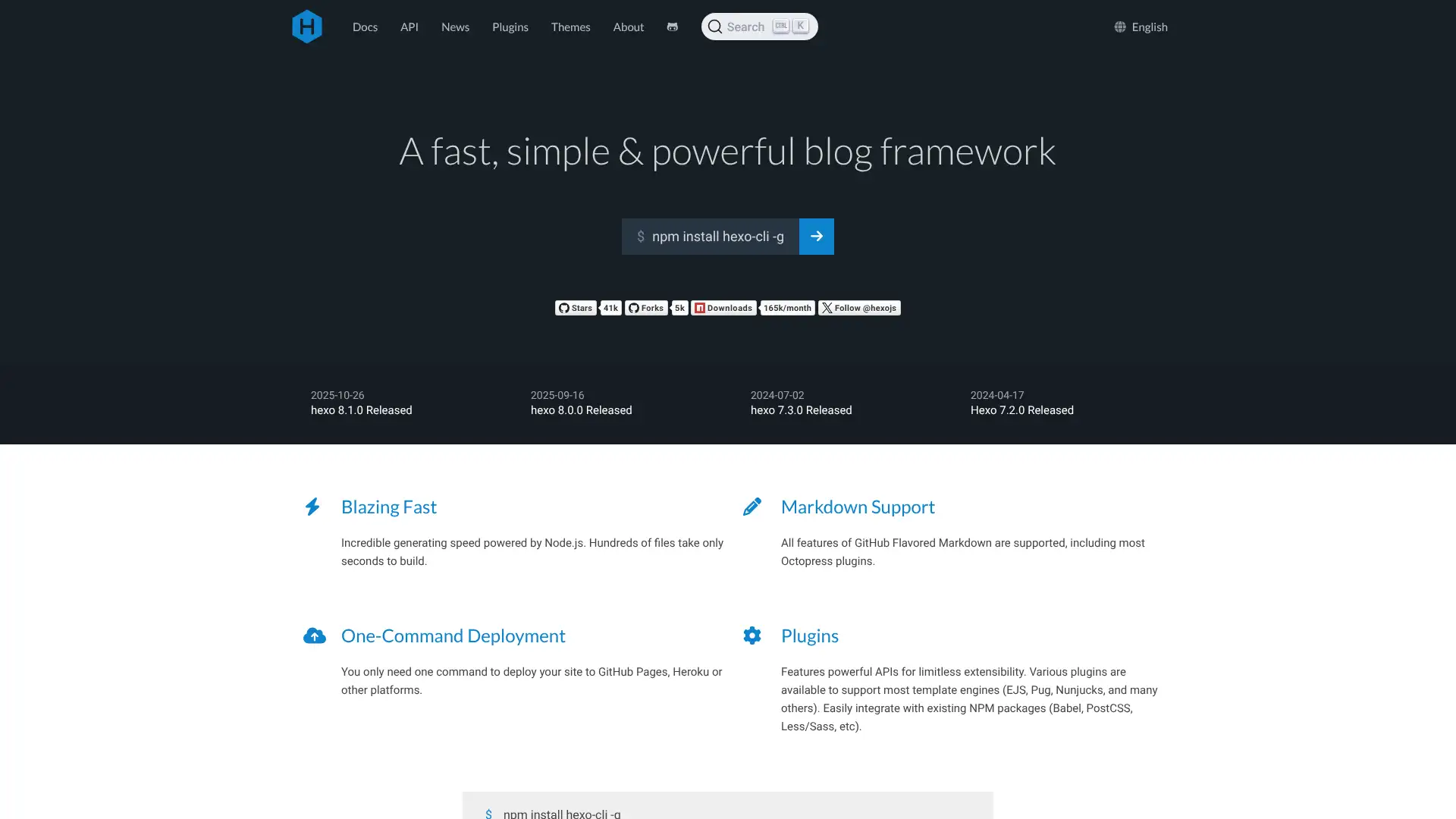
- • 500+ themes: the largest theme library of any blog-focused SSG
- • hexo deploy: built-in deployment commands for GitHub Pages, Netlify, Heroku, and other platforms
- • Tag plugins: custom syntax extensions for embedding code samples, image galleries, and media
- • Internationalization: multi-language site support with per-language themes and configuration
- • npm plugin ecosystem: 200+ plugins extending Hexo functionality via standard npm packages
Hexo is a solid blog generator for Node.js developers who want the largest possible theme library and npm-based plugin ecosystem. For new projects in 2026, Eleventy or Astro provide more modern architecture and better long-term development trajectories.
Middleman
Middleman is a Ruby-based static site generator that has been active since 2009, making it one of the oldest maintained SSGs alongside Jekyll. It uses Haml, Slim, ERB, and other Ruby templating engines. Middleman is particularly used by Ruby on Rails developers who want to use the same toolchain for their marketing or documentation sites. Internationalization, asset pipeline integration, and deploy adapters are all available. Middleman 5 is in active development. Less widely used than in its peak years, but maintained and stable.
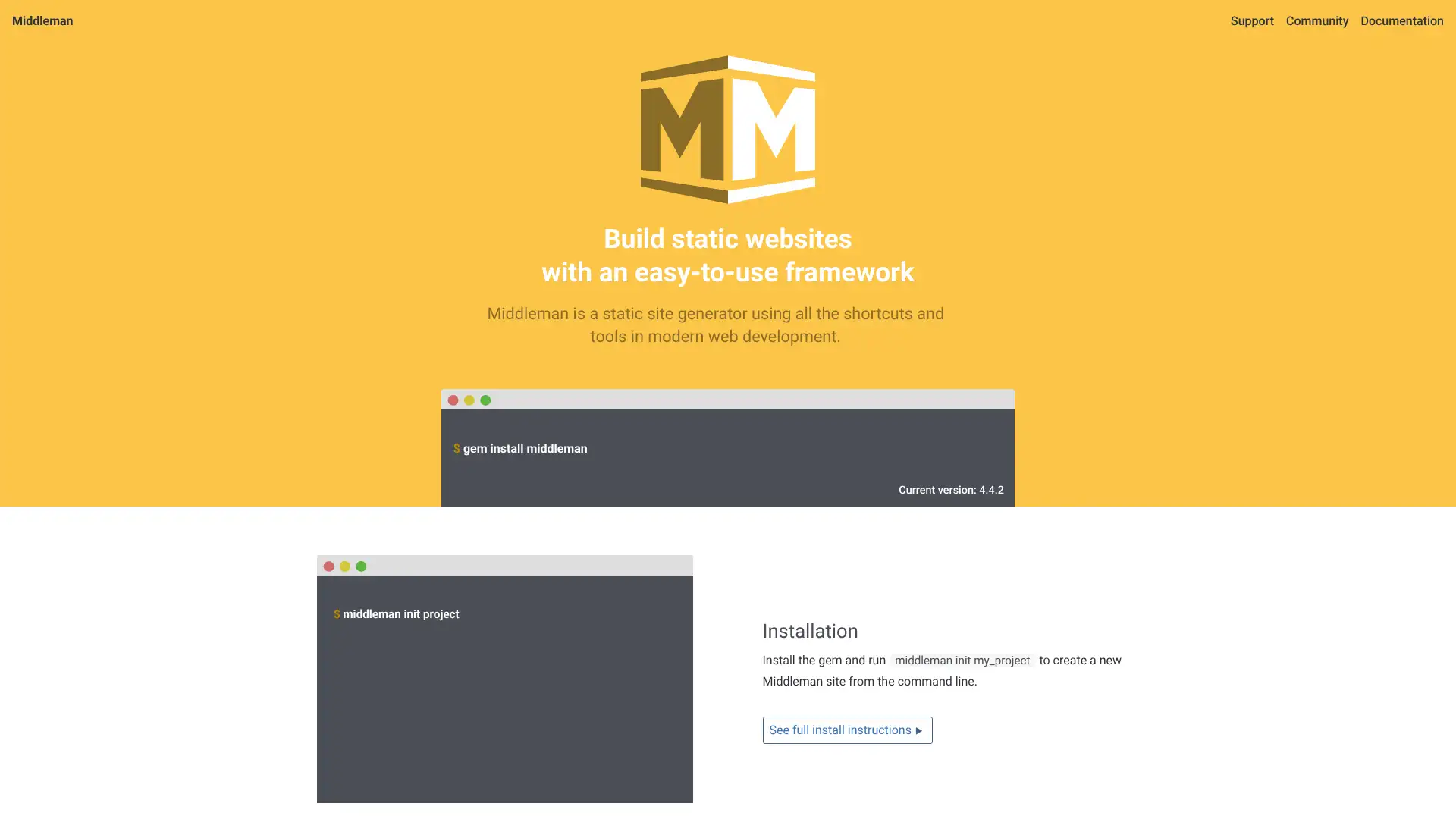
- • Ruby templating: Haml, Slim, and ERB templating familiar to Ruby on Rails developers
- • Asset pipeline: Sprockets or Webpack integration for CSS and JavaScript asset bundling
- • Middleman Deploy: deploy to GitHub Pages, Netlify, S3, and other targets from the CLI
- • i18n support: multi-language site generation with per-language content files
- • Layouts and partials: component-like template reuse familiar from Rails view architecture
Middleman is the right choice for Ruby on Rails development teams who want their static site on the same Ruby toolchain as their application. For teams without Ruby backgrounds, Jekyll covers a similar Ruby-based SSG use case with a larger community, and Hugo provides faster builds without
Netlify
Netlify pioneered JAMstack hosting in 2015 and remains the most framework-agnostic static and serverless hosting platform. It supports every major SSG (Hugo, Gatsby, Astro, Eleventy, Jekyll) and provides a built-in form handling service that eliminates the need for external form backends. Netlify Identity adds user authentication without a separate auth service. In September 2025, Netlify switched to credit-based billing. The free tier reduced build minutes from 300 to 100 per month, making it less attractive for active hobbyist projects compared to previous free tier limits.

- • Built-in form handling: collect form submissions without a backend, accessible via the Netlify dashboard
- • Netlify Identity: user authentication and registration without an external auth service
- • Branch deploys and deploy previews: every branch and pull request gets a unique deployment URL
- • Edge Functions: Deno-based server-side functions at the global edge for dynamic content
- • Netlify Build plugins: community-contributed build pipeline extensions for caching, bundling, and testing
Netlify pioneered the JAMstack deployment model but has lost ground to Cloudflare Pages on both performance and pricing since 2024. The differentiators that remain are built-in form handling (no backend required), Netlify Identity for authentication, and split testing without third-party tools.
Vercel
Vercel is the company that created Next.js, giving it first-class support for every Next.js feature: App Router, Server Actions, ISR, Partial Prerendering, and Fluid Compute. All new Next.js features land on Vercel before being available via adapters on other platforms. The developer experience is widely regarded as the best in the category: preview deployments on pull requests, instant rollbacks, built-in observability, and a polished dashboard. Commercial use requires the Pro plan: the Hobby tier explicitly prohibits any site generating revenue.
- • First-class Next.js support: every App Router feature works on Vercel without adapters or polyfills
- • Fluid Compute: keeps serverless functions warm for concurrent request handling, reducing cold starts by ~25%
- • Preview deployments: every pull request gets a unique HTTPS deployment for visual review
- • Vercel Firewall: DDoS protection and WAF included on Pro and Enterprise plans
- • Vercel Analytics: Core Web Vitals monitoring and real-user performance data without third-party scripts
Vercel is the correct choice for teams heavily invested in Next.js who need first-class App Router and Server Actions support. The developer experience is the best in the category.
Cloudflare Pages
Cloudflare Pages is the highest-value static hosting platform in 2026 for most projects. It provides unlimited bandwidth on all plans, operates from 330+ global edge locations, and includes DDoS protection by default. The edge network is larger than Vercel's and Netlify's combined. Multiple independent benchmarks in 2026 show Cloudflare Pages consistently achieving the lowest TTFB across all global regions. In February 2026, Cloudflare announced Vinext, a reimplementation of 94% of the Next.js API that achieves 4.4x faster builds and 57% smaller client bundles.

- • Unlimited bandwidth on all plans: the only major hosting platform with no bandwidth charges at any tier
- • 330+ global edge locations: largest static site delivery network of any platform reviewed
- • DDoS protection by default: Cloudflare's infrastructure-level DDoS mitigation included for free
- • Cloudflare Workers integration: run edge logic (geolocation, A/B testing, auth) alongside static pages
- • D1, R2, KV, Queues: database, storage, and messaging services that work natively with Pages
Cloudflare Pages is the best hosting platform for most static sites and JAMstack applications in 2026. Unlimited bandwidth eliminates the risk of surprise bills at scale.
Render
Render is a modern cloud platform providing free static hosting alongside managed web services, background workers, cron jobs, and databases, positioning itself as a modern Heroku alternative. Free static hosting is available permanently with global CDN. Paid web services start at $7/month. Managed PostgreSQL databases start at $7/month. Render's key advantage is providing static hosting and backend services on the same platform with unified billing and internal networking, making it practical for full-stack JAMstack applications that need a backend alongside the static frontend.

- • Free static hosting: free forever for static sites with custom domain and global CDN
- • Auto-deployments from GitHub and GitLab: push code and Render builds and deploys automatically
- • Managed PostgreSQL: databases with automated backups at $7/month alongside the static frontend
- • Internal networking: static frontend and backend services communicate via private network without exposing the backend
- • Docker support: deploy any Docker container alongside static sites for custom backend requirements
Render is the best choice for full-stack JAMstack projects that need both a static frontend and a managed backend (API, database, workers) on the same platform with internal networking. For pure static sites, Cloudflare Pages or GitHub Pages provide simpler and more cost-effective options.
Surge.sh
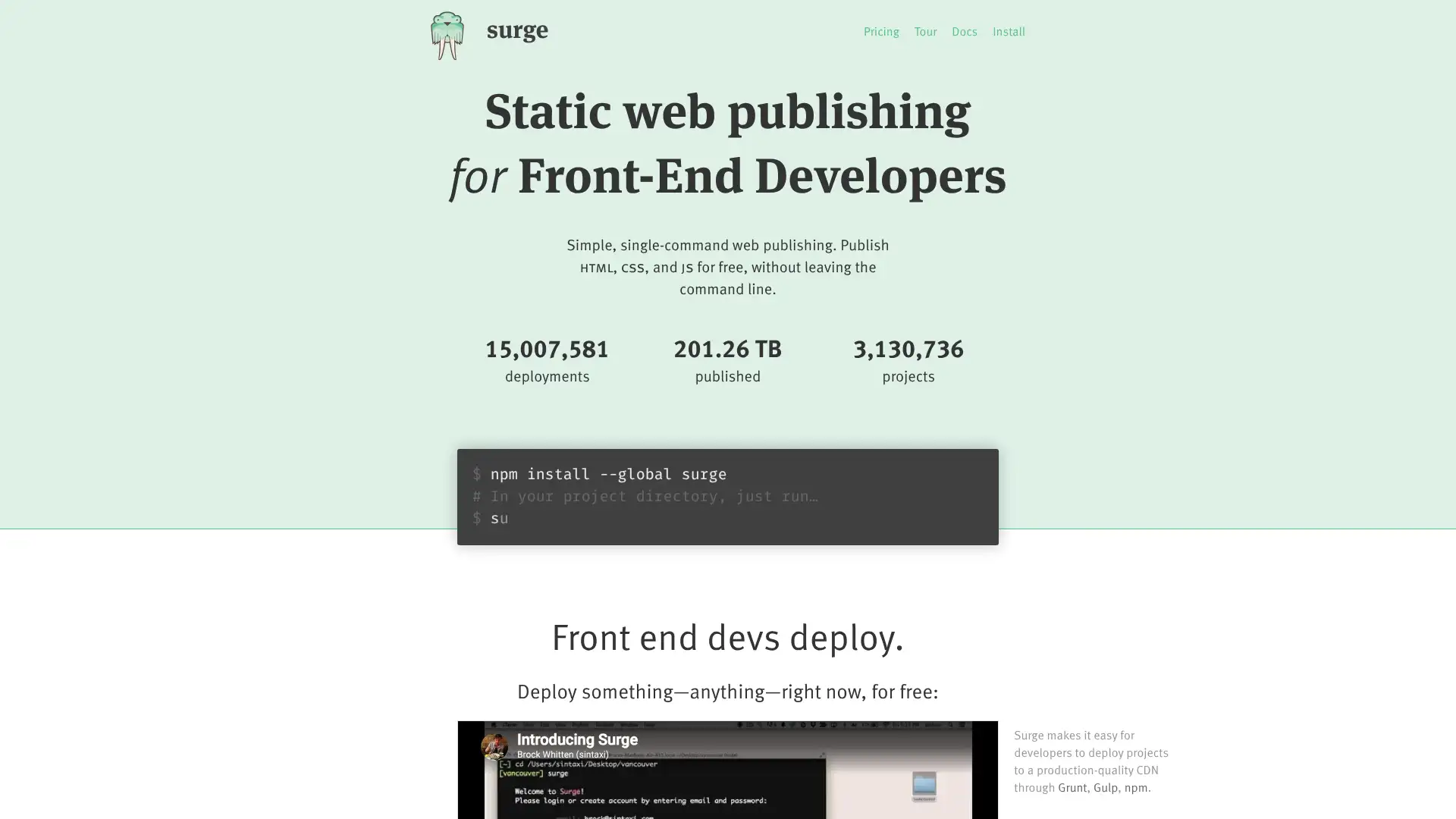
Surge is a minimalist static site hosting platform operated entirely from the command line. A single command (surge dist/) deploys any folder of static files to a surge.sh subdomain with automatic HTTPS. There is no dashboard, no Git integration, and no build pipeline: Surge deploys whatever files the developer provides directly. The CLI workflow is the simplest possible: install globally via npm, run surge in the build output directory, and the site is live. Custom domains are free on the free plan. The paid Surge Plus plan adds file compression and custom 404 pages.
- • Single command deploy: surge dist/ deploys any folder of static files without configuration
- • Custom domains free: connect any domain to a Surge site without paying
- • HTTPS automatic: free SSL certificates provisioned automatically for all Surge sites
- • Global CDN delivery: files served from CDN edge nodes without any configuration
- • npm-installable: global CLI install via npm install -g surge, no other dependencies
Surge.sh is the best choice for developers who want the absolute simplest deployment workflow from the terminal. Perfect for quick demos, prototyping, and situations where Git integration overhead is unnecessary. For production sites that need CI/CD on every push, Cloudflare Pages or Netlify provide automated pipelines.
Tiiny.host
Tiiny.host is the most accessible static hosting platform for non-developers: upload a ZIP file, HTML file, or PDF via drag-and-drop and receive a live HTTPS URL within seconds, no account required initially. Password protection, QR codes, basic analytics, and a built-in HTML/PDF editor are included. The platform is backed by AWS infrastructure with 99.99% uptime. Free tier sites remain live indefinitely as long as the user logs in every 3 months. There are multiple mixed reviews about the free tier enforcement and forced upgrades. Paid plans start at $5/month.

- • Drag-and-drop deployment: upload ZIP or HTML file, live URL generated in seconds without account setup
- • Password protection: protect client preview sites with a password in one click
- • Built-in HTML and PDF editor: make small edits directly in the dashboard without re-uploading
- • QR code generation: automatic QR code for each site for physical or digital sharing
- • Email-gated content: gate PDF or page downloads behind email capture without a third-party form tool
Tiiny.host is the right choice for designers, marketers, and agencies who need to share client previews, prototypes, or PDFs online without any DevOps knowledge. The password protection and PDF editing are practical differentiators. For developer workflows with CI/CD, Surge.sh or Netlify are more appropriate.
GitHub Pages
GitHub Pages provides free static hosting for any public GitHub repository. It natively builds Jekyll sites automatically, requiring only a repository push to trigger a build and deployment. For non-Jekyll sites, GitHub Actions can run any build process and deploy the output to the Pages environment. Custom domains are supported at no cost. Storage limits (1 GB repository, 1 GB per site) and bandwidth limits (100 GB/month) are enforced but rarely hit for typical sites. GitHub Pages is the natural default for open-source projects, developer portfolios, and any project already hosted on GitHub.

- • Native Jekyll builds: push Markdown files and Jekyll builds and deploys automatically
- • GitHub Actions integration: custom build pipelines for any SSG (Hugo, Astro, Eleventy, etc.)
- • Custom domain support: free custom domain with automatic HTTPS via Let's Encrypt
- • Version control integration: every page change is tracked in Git with full rollback capability
- • Free for public repositories: no cost for open-source projects and developer portfolios
GitHub Pages is the default recommendation for open-source projects, developer portfolios, and any site where the source code is already on GitHub. The native Jekyll integration and free custom domain make it the simplest starting point.
GitLab Pages
GitLab Pages provides free static hosting for GitLab repositories, integrated directly with GitLab CI/CD pipelines. Unlike GitHub Pages, GitLab Pages is framework-agnostic from day one: any SSG output can be deployed via a .gitlab-ci.yml pipeline definition. It supports both public and private repositories on GitLab.com with the same free static hosting. Custom domains and HTTPS are included. GitLab Pages is particularly strong for teams already using GitLab for source control and CI/CD who want to minimise the number of external services.

- • Framework-agnostic CI/CD: any SSG build runs via .gitlab-ci.yml without platform-specific adapters
- • Private repository Pages free: no upgrade required for private repository static hosting
- • Integrated with GitLab DevOps platform: merge requests, CI/CD, registry, and Pages in one system
- • GitLab CI/CD pipelines: full CI/CD for testing, building, and deploying static sites in one pipeline definition
- • Custom domains and HTTPS free on all plans with automatic Let's Encrypt certificate provisioning
GitLab Pages is the natural choice for teams standardised on GitLab for source control and DevOps. Private repository Pages at no cost is a meaningful advantage over GitHub Pages. For teams not already on GitLab, GitHub Pages or Cloudflare Pages provide simpler onboarding.

AWS Amplify
AWS Amplify is Amazon's fully managed frontend and full-stack hosting platform, built on top of AWS infrastructure (CloudFront CDN, S3, Lambda). It provides CI/CD pipelines, pull request previews, authentication (Cognito), GraphQL APIs (AppSync), and integration with the entire AWS service ecosystem. Amplify is best for teams already using AWS who need compliance, enterprise SLAs, and deep backend integration. The 12-month free tier covers $0.01 per build minute; after that, pay-as-you-go pricing applies. Pricing complexity (separate charges for build minutes, data storage, and data transfer) makes cost estimation harder than flat-rate platforms.
- • 450+ AWS CloudFront edge locations: global CDN with one of the largest infrastructure footprints
- • AWS authentication integration: Amplify Auth using Cognito for user login without separate auth setup
- • Pull request previews: automated preview deployments for every open pull request
- • Amplify Studio: visual interface for configuring backend services without writing CloudFormation
- • IAM and compliance: enterprise-grade access controls, audit logging, and compliance certifications (SOC 2, ISO 27001, etc.)
AWS Amplify is the right choice for enterprise teams already standardised on AWS who need compliance certifications, deep AWS service integration, and enterprise SLAs. For teams without AWS infrastructure requirements, Cloudflare Pages provides better price transparency and performance for most use cases.
Firebase Hosting
Firebase Hosting is Google's static web hosting platform, integrated with the Firebase backend-as-a-service ecosystem (Firestore database, Authentication, Cloud Functions, Storage). It is optimised for single-page applications and progressive web apps that use Firebase services as their backend. Firebase CLI deploys to a global CDN in one command. Preview channels generate temporary shareable URLs for different development branches. Hosting is free up to 1 GB storage and 10 GB/month transfer; beyond that, pay-as-you-go Blaze plan pricing applies.
- • Firebase CLI: deploy to Firebase Hosting in one command with no manual configuration
- • Preview Channels: temporary shareable URLs for different development branches and test environments
- • Firestore and Auth integration: connect to Firebase backend services without CORS configuration
- • Cloud Functions on Blaze: trigger serverless functions from hosting events for dynamic functionality
- • Google Cloud infrastructure: hosting backed by Google's global CDN with fast static file delivery
Firebase Hosting is the natural choice for developers already using Firebase Authentication, Firestore, or Cloud Functions who want the simplest integration between frontend hosting and Firebase backend. For teams without Firebase backend dependencies, Cloudflare Pages provides unlimited bandwidth at no cost.
DigitalOcean App Platform
DigitalOcean App Platform is a fully managed PaaS providing free static hosting alongside scalable web services, background workers, and managed databases. Its pricing model is modular and predictable: static sites are always free, web services start at $3/month per container, and databases start at $7/month. App Platform automatically builds from GitHub, GitLab, or Docker and handles infrastructure management. The platform integrates with DigitalOcean's other services (Droplets, Managed Databases, Spaces) under a unified account and billing.
- • Free static hosting permanently: no expiry, no credit card for static sites with 1 GiB transfer allowance
- • GitHub and GitLab auto-deploy: connect repository and App Platform builds and deploys on every push
- • Horizontal and vertical scaling: adjust instance size or add instances without downtime
- • Internal networking: static frontend and backend services communicate via private network
- • Gradient AI Platform integration: AI inference and GPU workloads alongside standard web services
DigitalOcean App Platform is the right managed platform for teams already using DigitalOcean infrastructure who want to add static or full-stack app hosting without switching vendors. The Starter tier is free for static sites with 3 free static sites included.
Fly.io
Fly.io runs applications in Firecracker micro-VMs distributed across 30+ global regions, placing application logic close to users for low-latency server-rendered applications. It is distinct from static site platforms: Fly.io runs long-lived server processes rather than serverless functions. As of 2026, Fly.io operates on a usage-based model with a trial credit rather than a permanently free tier. It is particularly used for globally distributed databases (LiteFS, Tigris), Phoenix Elixir applications, and any workload needing geographic proximity to users.
- • Firecracker micro-VMs: faster cold starts than traditional containers with stronger isolation
- • 30+ global regions: deploy application instances in specific regions close to user concentrations
- • LiteFS: distributed SQLite at the edge, replicating read replicas near users
- • Multi-region deployment: route users to the nearest instance automatically or with custom logic
- • Anycast networking: global IP routing to the nearest available instance
Fly.io is the right choice for applications that specifically need server-side logic running in specific geographic regions near users: real-time applications, globally distributed databases, and latency-sensitive APIs. For static site hosting, Cloudflare's 330+ edge locations deliver better global distribution without requiring server management.
Railway
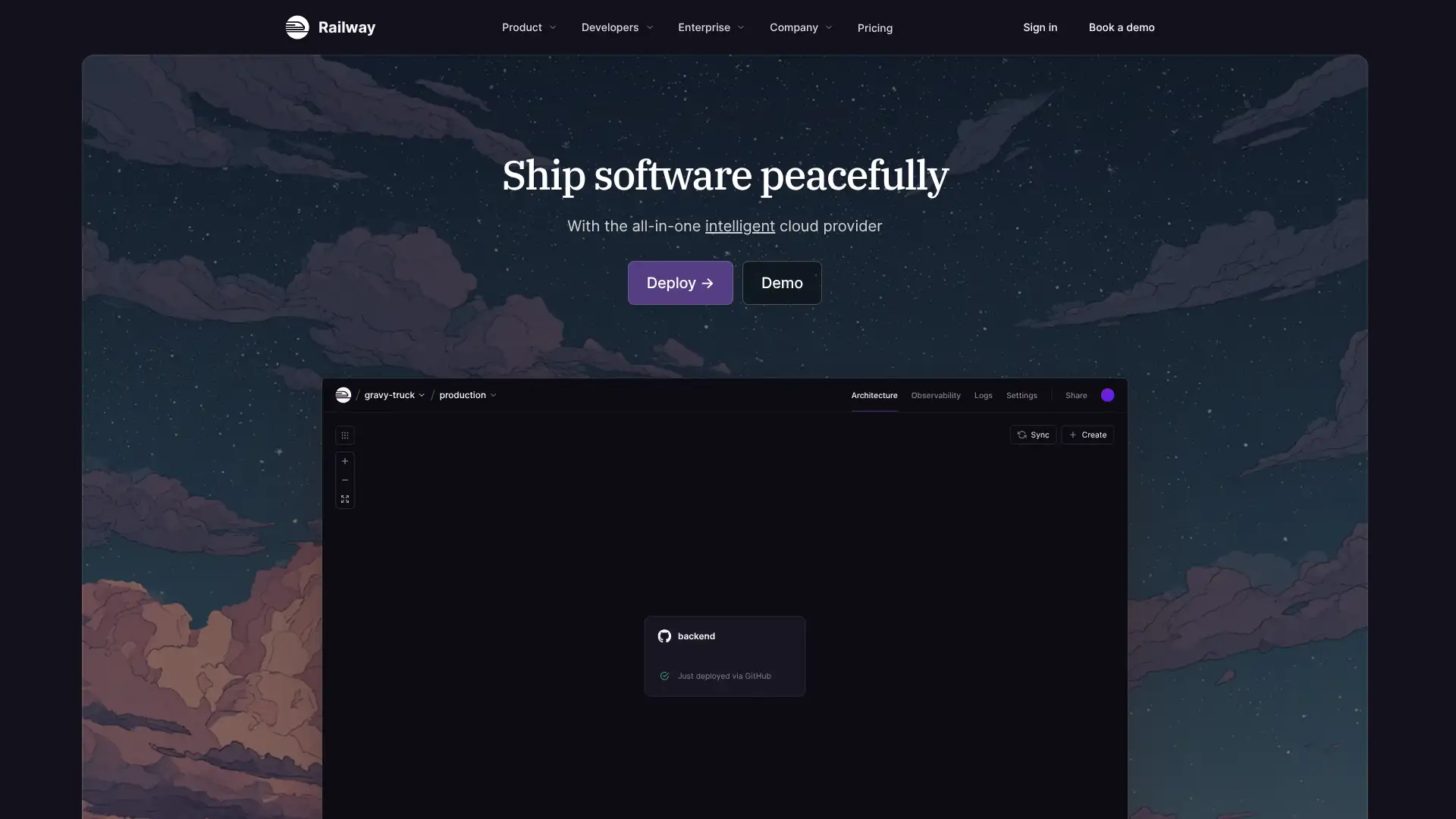
Railway is a developer-focused platform for deploying full-stack applications with one-click database provisioning (PostgreSQL, MySQL, MongoDB, Redis) and transparent usage-based pricing. It provides a visual dependency graph showing how services connect. GitHub integration triggers automatic deployments. Private networking connects services internally without exposing them publicly. As of 2026, Railway operates on a Hobby plan at $5/month (includes $5 usage credit) rather than a permanently free tier.
- • One-click database provisioning: deploy PostgreSQL, MySQL, MongoDB, or Redis in seconds alongside the application
- • Visual dependency graph: see how services connect, share environment variables, and communicate
- • Private networking: services communicate internally via Railway's private network without public exposure
- • Config as code: railway.toml defines deployment configuration in source control
- • GitHub integration: automatic deploys triggered by branch pushes with PR preview environments
Railway is the best choice for solo developers and small teams who want the simplest possible database provisioning alongside their full-stack application. The visual dependency graph and one-click databases reduce operational overhead significantly.
Statichunt.com
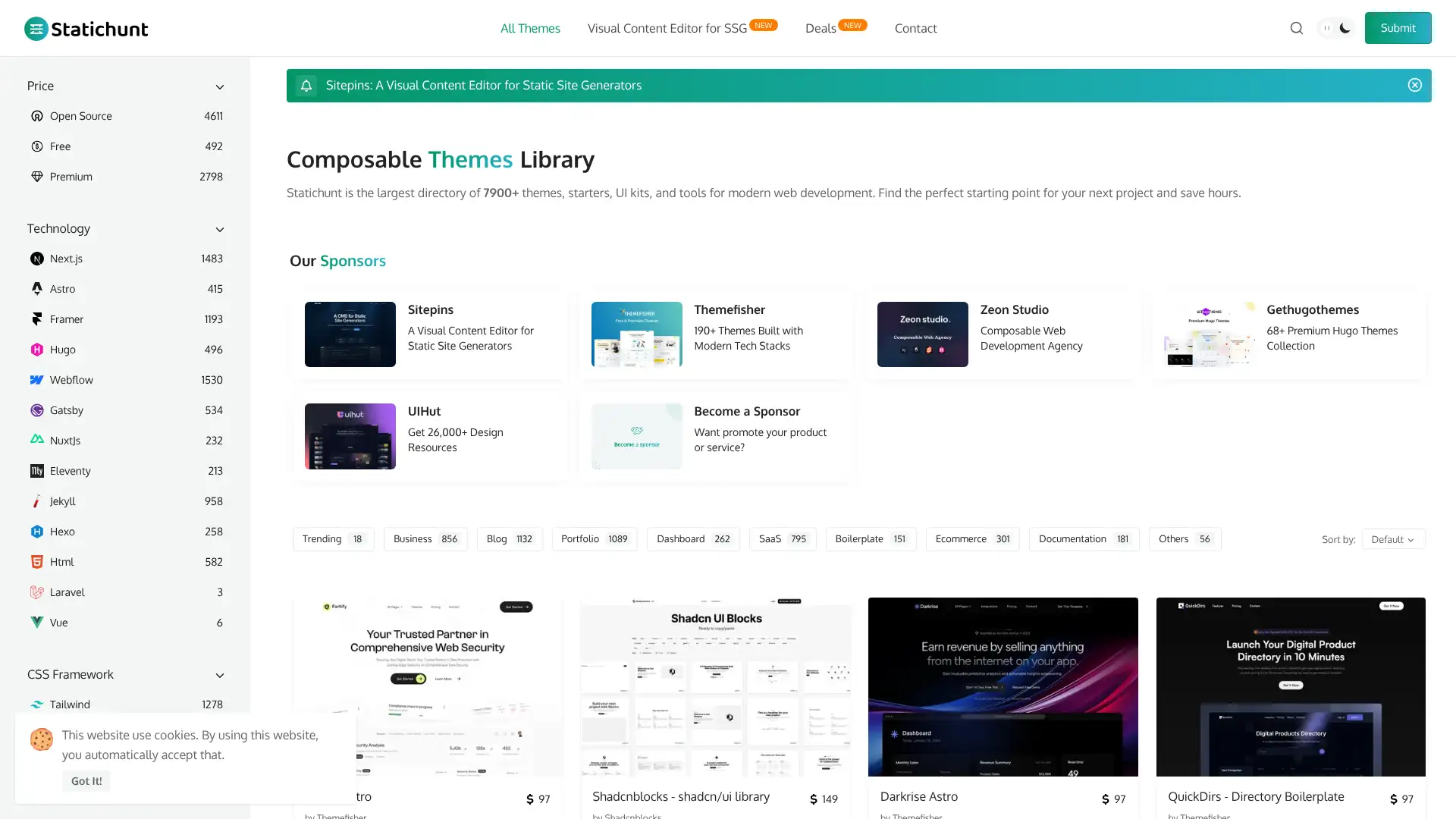
Statichunt is not a static site generator or hosting platform: it is a curated open-source directory of static site templates, themes, and starter kits for major SSGs (Hugo, Astro, Jekyll, Eleventy, Next.js, and others). It serves as a discovery platform for finding pre-built themes and starters that can be used as a foundation for new SSG projects. Free to use and browse. Statichunt is a useful research tool at the start of a new SSG project, not a generator or host itself.
- • Curated SSG template directory: browse hundreds of themes and starters across all major SSGs
- • Filter by SSG framework: find themes specifically for Hugo, Astro, Jekyll, Eleventy, or Next.js
- • Filter by category: filter templates by blog, portfolio, documentation, agency, and other site types
- • Open-source: all templates link directly to their GitHub repositories for fork-and-use access
- • Preview links: live demos for most templates before downloading or forking
Statichunt.com is a useful starting point for finding pre-built templates and starters for any major SSG. Use Statichunt to discover a template, fork it from GitHub, and then deploy using Cloudflare Pages, Netlify, or Vercel for hosting. Not a tool that builds or hosts anything itself.