31 Best POS Systems for Retail Stores and Restaurants in 2026
POS systems range from free mobile card readers to full enterprise platforms built for multi-location chains. This guide covers options for retail stores, restaurants, service businesses, and payment-focused merchants. Pricing was verified in March 2026 from each provider's official pricing pages.
Square POS
Square POS is used by over 4 million businesses and offers a genuinely free plan with unlimited items and basic sales tracking. Hardware starts with a free magstripe reader. In 2025, Square restructured its plan tiers and raised in-person rates slightly to 2.6% + 15¢ on the free plan. Paid plans (Plus at $49/mo, Premium at $149/mo) unlock lower processing rates and advanced tools. Square also offers industry-specific versions for restaurants, retail, and appointments, each with their own feature sets.
- • Free POS app: full sales, inventory, and reporting functionality at no monthly cost, available on iOS and Android
- • Integrated ecosystem: Square Payroll ($29/mo + $5/employee), Square Loyalty ($25/mo), and Square Marketing ($15/mo) all link directly to POS data
- • Square for Restaurants (Plus): floor plan management, auto-gratuity, split checks, and kitchen display system at $20/device/mo
- • Offline mode: processes sales without internet and syncs when reconnected, though card payments require reconnection to settle
- • Square AI (beta): chat-based business insights that surface sales trends and suggest relevant Square features

Square is the best starting point for any small business that wants a capable, zero-cost POS with room to grow. The free plan genuinely works for cafes, pop-ups, and solo retailers. High-volume businesses should compare the Plus plan's lower processing rates against competitors like Helcim, where interchange-plus pricing may be cheaper at scale.

Shopify POS
Shopify POS comes in two tiers: the free POS Lite (basic checkout bundled with every Shopify plan) and POS Pro at $89/mo per location. Shopify's ecommerce plans start at $39/mo (Basic) through $399/mo (Advanced), and POS Lite is included with all of them. POS Pro adds unlimited staff, buy-online-pick-up-in-store, smart inventory management, and advanced reporting. A separate Retail plan at $89/mo bundles POS Pro with the ecommerce platform. As of March 2026, Shopify has over 1.4 billion USD in subscription solution revenue and powers 170+ million merchants globally.
- • Unified inventory: stock counts update in real time across online store, POS, and all locations from one Shopify admin
- • Buy online, pick up in-store (BOPIS): available exclusively on POS Pro, integrates with online checkout seamlessly
- • Tap to Pay on iPhone: accept contactless payments using just an iPhone with no hardware purchase required
- • Smart grid: customizable POS interface showing best-selling items, recent customers, and open carts for faster checkout
- • Shopify Payments integration: eliminates third-party transaction fees (2% on Basic without it) and unlocks real-time payouts
Shopify POS is the clear choice for any retailer already running on Shopify's ecommerce platform. The unified inventory and omnichannel reporting alone justify the cost for multi-channel sellers. Pure brick-and-mortar businesses with no online presence will find the cost structure hard to justify — Square or Lightspeed will serve them better.
Lightspeed
Lightspeed is a Canadian company that has expanded through acquisitions to cover retail (X-Series, formerly Vend), restaurants (R-Series, including ex-ShopKeep and ex-Upserve), and golf. Retail plans start at $89/mo (Basic) through $289/mo (Plus), all billed annually. Restaurant plans start at $69/mo. All plans require a one-year contract and Lightspeed Payments integration is strongly pushed; using a third-party processor incurs a monthly fee of up to $400. Processing rates are 2.6% + $0.10 in-person. Lightspeed has faced significant user complaints about aggressive sales tactics, difficult cancellation, and surprise fees for external processors.
- • Preloaded product catalog with over 5 million items across common retail verticals, reducing data entry during setup
- • Multi-location inventory: centralized stock management with inter-location transfers, purchase orders, and reorder alerts across all stores
- • Restaurant floor management: drag-and-drop floor plan builder with real-time table status, coursing, and tableside ordering via iPad
- • Advanced analytics: 50+ built-in reports covering sales performance, inventory turnover, staff productivity, and customer lifetime value
- • Offline mode: both retail and restaurant versions continue taking orders when internet is down and sync on reconnection
Lightspeed is well-suited for established retail businesses with complex inventories across multiple locations, and full-service restaurants that need the best table and floor management available. Budget-conscious buyers or anyone who wants pricing flexibility on payment processing should look elsewhere — the lock-in and fees can be severe.
Toast POS
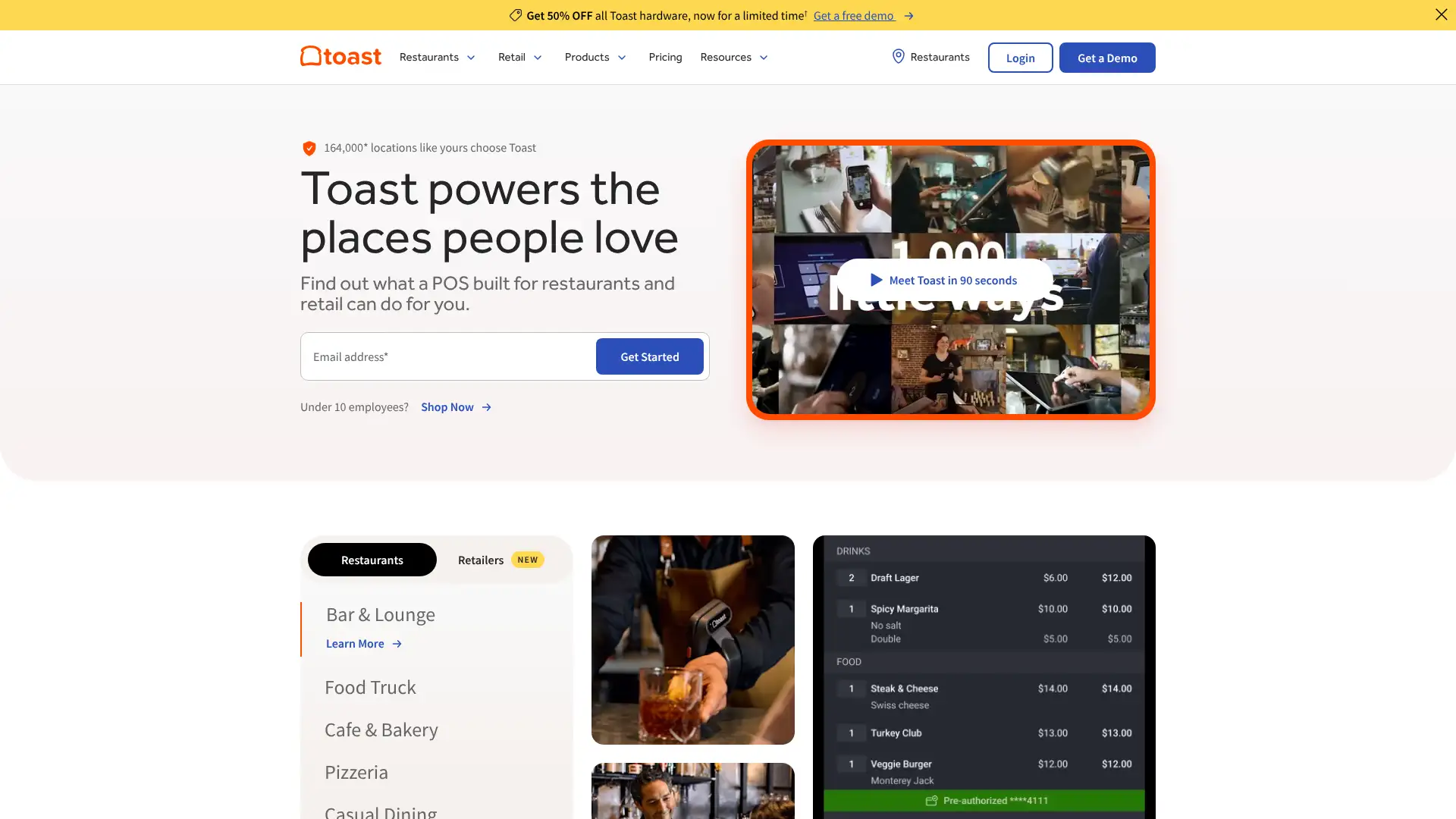
Toast is a restaurant-only POS used by over 112,000 businesses. It runs exclusively on Toast's own Android-based hardware, which is built to withstand spills, grease, and heat. The free Starter Kit plan has no monthly fee but charges 3.09% + 15¢ per in-person transaction. The Point of Sale plan at $69/mo drops processing to 2.49% + 15¢. Online orders cost 3.50% + 15¢ regardless of plan. Toast requires a two-year contract and you cannot use any other payment processor. Add-ons like online ordering, loyalty, and kitchen display systems typically cost $50-$165/mo each.
- • Restaurant-grade hardware: spill-resistant, heat-tolerant handheld and countertop terminals built specifically for food service environments
- • Kitchen Display System (KDS): color-coded order routing to individual kitchen stations with timing alerts; $20/device/mo
- • Toast Go 2: rugged handheld device for tableside ordering and payment, reducing ticket times and increasing table turns
- • Integrated payroll: Toast Payroll ($69/mo base + $9/employee) links directly to tip reporting, reducing payroll prep time
- • Online ordering: commission-free direct ordering page for takeout and delivery, integrating with third-party platforms like DoorDash and Grubhub
Toast is the right call for serious restaurant operators — particularly full-service, fast casual, and multi-location groups — who want hardware that survives a real kitchen and a fully integrated management suite. The locked-in processing and add-on cost structure means the total monthly bill for a mid-sized restaurant commonly runs $500-$1,500 before processing fees.
Clover POS
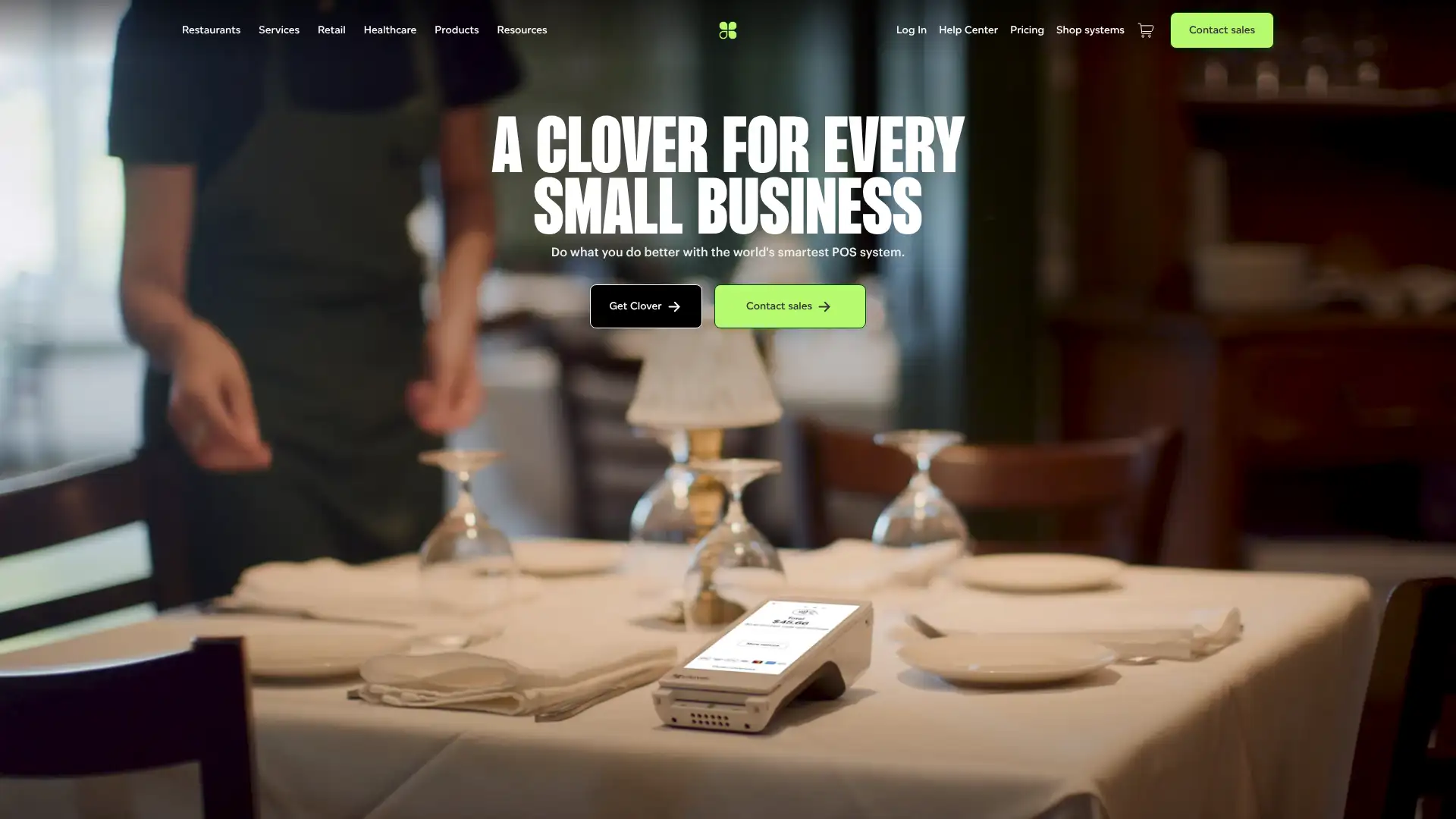
Clover is owned by Fiserv and offers distinct plan tiers for retail, restaurant, and service businesses. Plans are sold through Clover directly or via resellers (banks, ISOs), and pricing can vary significantly between channels. Retail software plans start at $14.95/mo (Payments only) through $84.95/mo (Growth). Quick-service restaurant plans start at $89.95/mo. Hardware is proprietary — you must use Clover-branded devices. Most promotional plans require a 36-month contract. Card-present rates start at 2.3% + $0.10 for restaurants and 2.6% + $0.10 for retail when buying directly.
- • Clover App Market: 300+ third-party apps for loyalty, scheduling, accounting, delivery, and specialized verticals, allowing deep customization
- • Hardware lineup: Clover Go ($199), Flex Pocket ($699), Mini ($849), Station Solo ($1,799), Station Duo ($1,899) — purpose-built touchscreens for every setup type
- • Multiple payment methods: EMV chip, NFC contactless, Apple Pay, Google Pay, QR code, gift cards, and ACH all supported natively
- • Employee management: role-based permissions, time tracking, shift scheduling, and tip management built into all non-Payments plans
- • Revenue center reporting: restaurants can break out sales by bar, dining room, patio, and other sections in custom F&B reports
Clover works well for businesses that want premium, polished hardware and are comfortable with a 3-year commitment through a reputable reseller. The key is buying directly from Clover or an ISO with transparent interchange-plus pricing — the worst Clover experiences almost always come from bank or big-box resellers that mark up rates heavily.
TouchBistro
TouchBistro is an iPad-based restaurant POS used by over 16,000 restaurants in 100+ countries. It operates as a hybrid system — local processing with cloud backup — so service continues even when the internet drops, unlike fully cloud-based competitors. The base POS starts at $69/mo (annual), though the website requires a demo call to see full plan pricing. Add-ons like reservations ($229/mo), inventory management ($195/mo), and online ordering ($50/mo) can push total costs significantly higher. TouchBistro Payments is powered by Chase and offers cost-plus pricing.
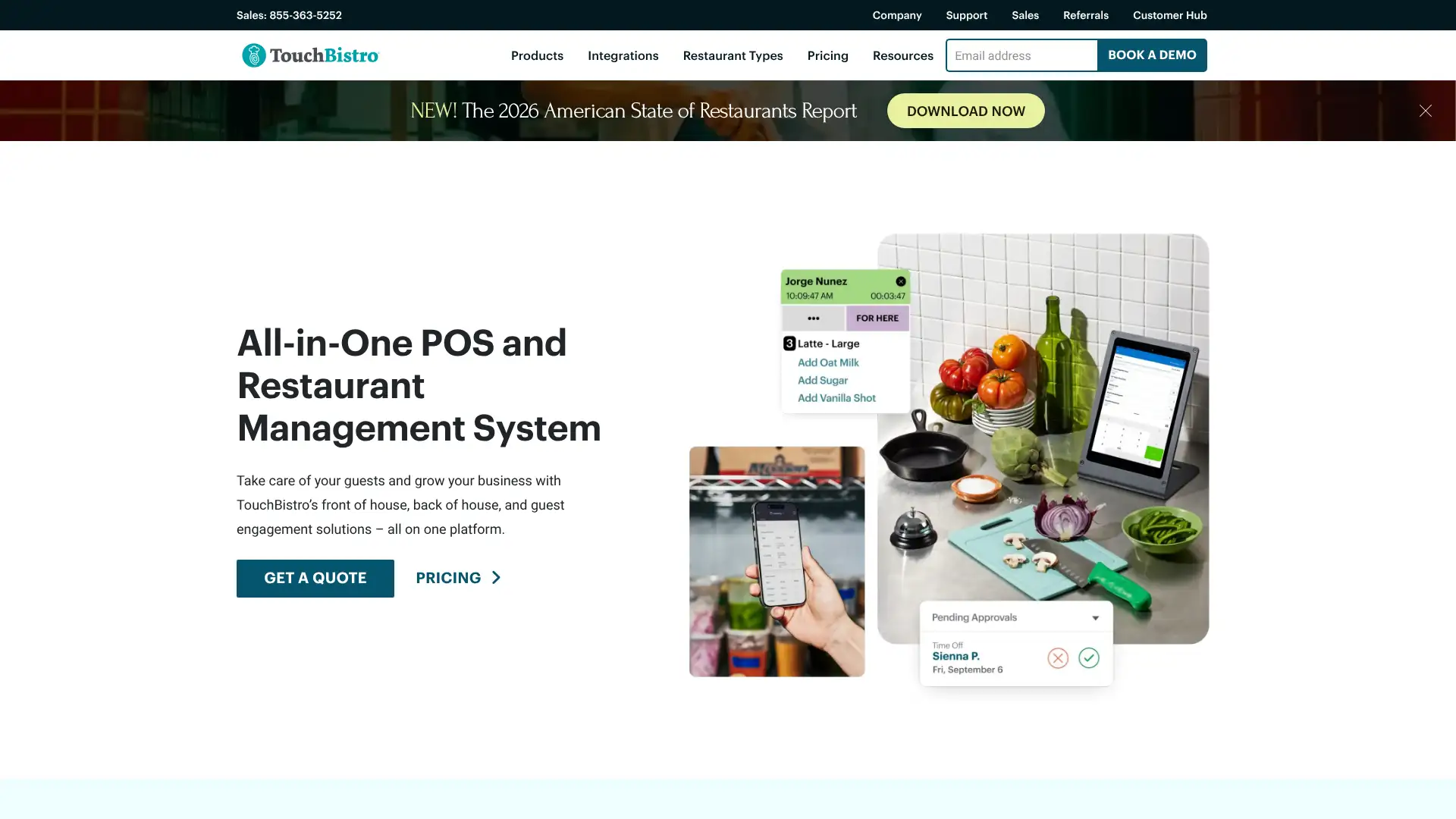
- • Hybrid local/cloud architecture: orders process locally on-site, eliminating the internet dependency that causes downtime at competing cloud-only systems
- • Table management: drag-and-drop floor plan with real-time table status, server section assignments, and course sequencing for full-service dining
- • Forced modifiers and upsell prompts: the system automatically prompts staff for cooking temperatures, add-ons, and upsells based on menu configuration
- • 50+ standard reports: sales by item, server performance, labor cost vs. sales, and end-of-day summaries accessible from any browser
- • TouchBistro Payments (Chase-powered): transparent cost-plus pricing with no surprise rate changes, integrated directly into the POS flow
TouchBistro is a strong fit for full-service restaurants and bars that need reliable offline operation, a clean tableside experience, and don't want to pay for features they won't use. The hybrid architecture is a real advantage in venues with unreliable internet. Just account for add-on costs upfront — the $69/mo base price rarely reflects the true monthly bill.
Heartland POS
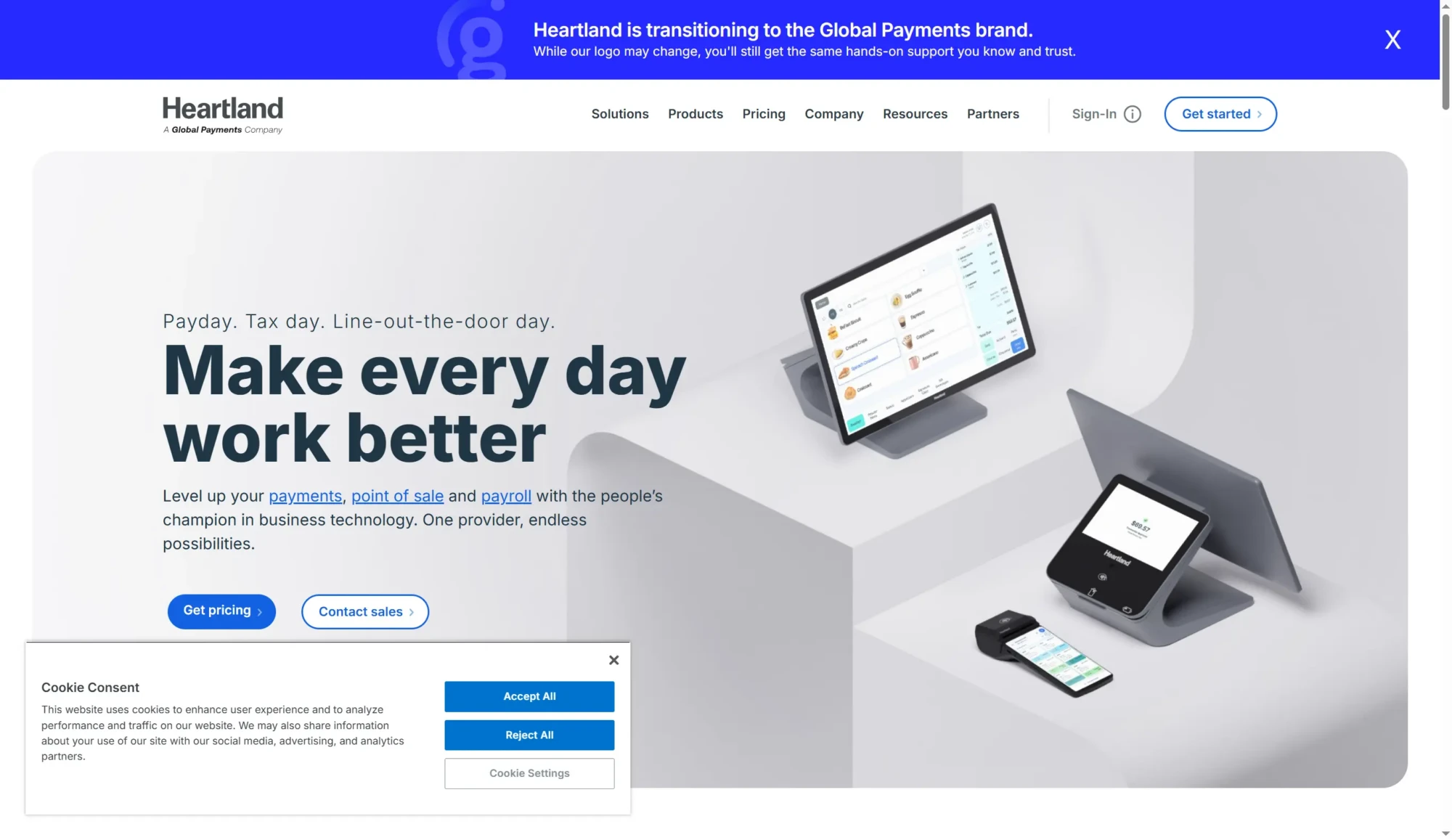
Heartland (now transitioning to Global Payments branding) offers a cloud-based POS for retail and restaurant businesses. The Retail POS (formerly Springboard) starts at $89/mo and offers two published plans: Essentials (single-location, basic features) and Complete (multi-location, 75+ integrations, ecommerce). Restaurant POS pricing is not publicly disclosed and requires a quote. Heartland Payments processes cards at interchange-plus rates and charges a $295 early termination fee per location. The company was acquired by Global Payments in 2016 for $4.3 billion.
- • Hardware agnostic retail: compatible with most standard POS hardware including iPad stands, cash drawers, barcode scanners, and receipt printers — not locked to proprietary devices
- • Real-time inventory across locations: multi-store stock visibility with transfer management and low-stock alerts across all sites on the Complete plan
- • 75+ integration partners: connects to QuickBooks, Mailchimp, RewardOps loyalty, Acuity Scheduling, and dozens of other small business tools
- • JavaScript API: developers can build browser-based apps that integrate with Heartland's backend for custom POS extensions
- • CRM with 360-degree customer view: purchase history, preferences, and contact data stored per customer to support personalized promotions
Heartland works well for established single-location retailers that want a solid cloud POS without proprietary hardware lock-in. The $89/mo Essentials plan is reasonably priced for what it includes. Larger multi-location retailers need to contact sales for pricing and should compare carefully against Lightspeed and Square, both of which offer more pricing transparency.
Epos Now
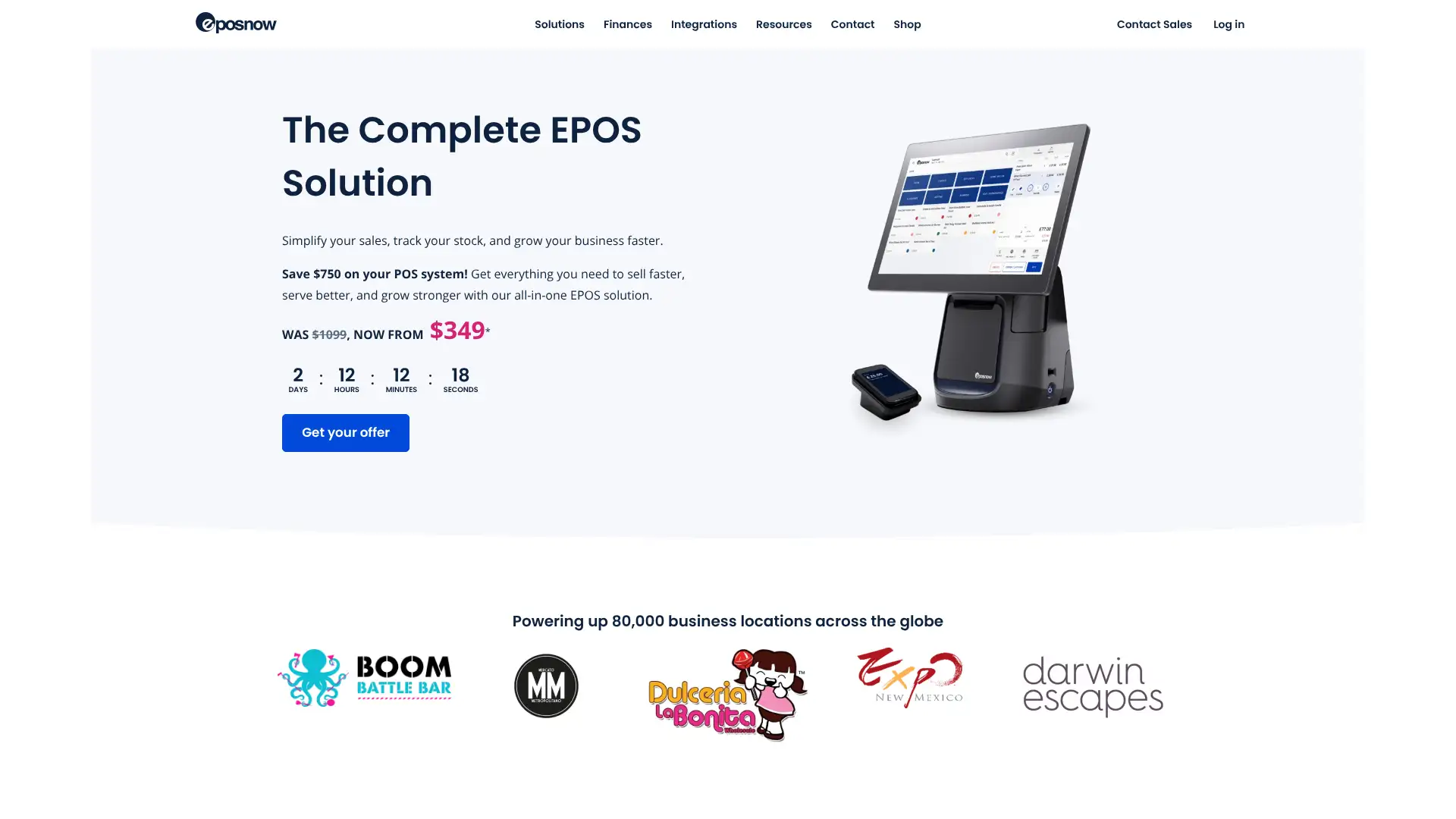
Epos Now is a UK-founded cloud POS used across 40,000+ businesses in 71 countries. The software runs on iPads, Android tablets, Windows PCs, and Mac, giving merchants device flexibility most competitors don't offer. Pricing is not fully transparent: promotional pricing lists the Complete System from $349 upfront + $39/mo (software only), while a full hardware bundle with support is closer to $349 upfront + $79/mo. Contracts of 3-5 years are standard. In-house payment processing via Epos Now Payments costs 2.6% + $0.10 per transaction. The AI pricing tool Sidekick helps merchants optimize item margins using market data.
- • Device freedom: runs natively on iPad, Android tablet, Windows PC, and Mac — no proprietary hardware required, meaning most existing equipment is compatible
- • Epos Now App Store: 130+ integrations including QuickBooks, Xero, Shopify, Mailchimp, and Loyalzoo loyalty, providing best-in-class connectivity for a POS at this price point
- • Sidekick AI: analyzes product margins against internal and external data to recommend optimal pricing adjustments for profitability
- • Stocktaking from any device: inventory counts can be performed on a smartphone camera as a barcode scanner, reducing the need for dedicated scanning hardware
- • Multi-channel sales: syncs in-store and online sales through Shopify integration or Epos Now's own online ordering module
Epos Now is best for businesses that want cross-platform hardware flexibility and a broad integration library without paying Lightspeed-tier prices. The 130+ integrations and AI pricing tool are genuine differentiators. Read the contract terms carefully before signing — the long-term commitment and support add-on structure can make the true monthly cost significantly higher than initially quoted.
Erply
Erply is an Estonian company founded in 2009 with offices in 7 countries, serving over 50,000 retail locations. It offers a comprehensive retail platform combining POS, WMS (warehouse management), ERP, loyalty, and BI into one system. Unlike most POS providers, Erply uses a per-feature pricing model across four bundles (Start, Grow, Expand, Enterprise). The base POS-only plan starts around $19/mo (older data; current pricing requires a quote), while the full inventory retail plan is approximately $69/mo. The platform works offline and supports 15+ languages. Month-to-month contracts are available, which is rare at this feature level.
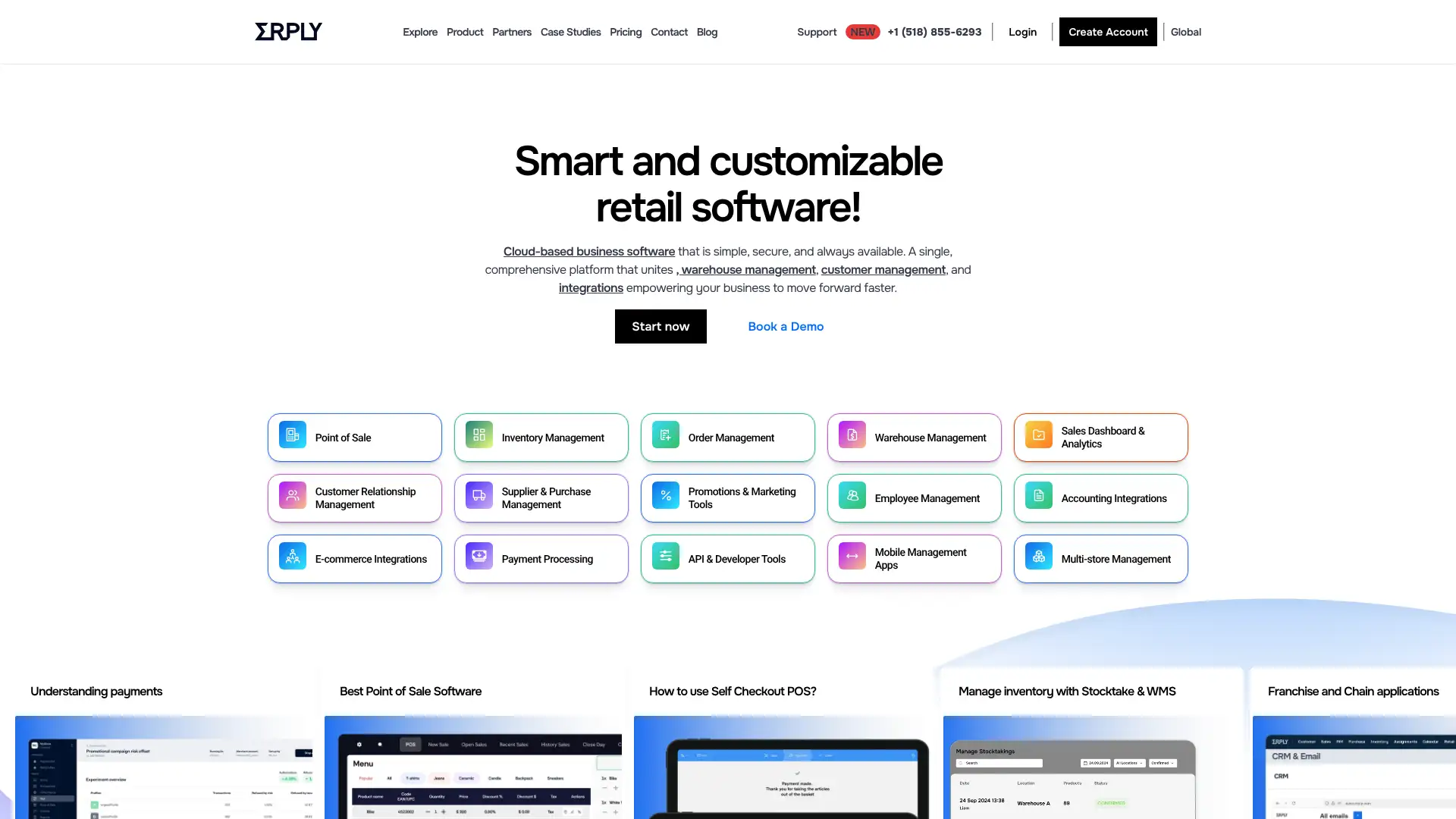
- • Comprehensive retail ERP: single platform covers POS, inventory, warehouse management, purchasing, CRM, loyalty, and business intelligence without requiring separate software
- • Self-checkout support: Erply includes built-in self-checkout module, a feature typically only found in dedicated enterprise retail platforms
- • Offline capability: the system continues processing sales and managing inventory without internet, syncing automatically when connectivity is restored
- • API with 4 quarterly updates free: cloud-based delivery means software improvements ship automatically with no upgrade fees or manual installation
- • Multi-language support: available in 15+ languages, making Erply one of the few POS platforms viable for international retail chains
Erply is a legitimate enterprise retail platform for chains and franchises that need a single system spanning POS, warehousing, and analytics. The month-to-month contract and per-feature pricing make it unusually accessible for an ERP-tier product. The dated interface and inconsistent support are real trade-offs; businesses with strong IT teams will get more value from it than those needing hand-holding.
Hike POS
Hike is an Australian cloud POS designed for retail, built specifically to work with any payment processor rather than forcing a proprietary gateway. Plans start at $59/mo for a single outlet with one register; additional registers cost $39/mo each. Multi-store packages with unlimited outlets start at $129/mo. There are no long-term contracts and no upfront hardware costs. Hike runs on iPad, PC, and Mac browsers, and integrates with Shopify, BigCommerce, WooCommerce, Xero, QuickBooks, and MYOB. It operates in 40+ countries and is available in 8 languages.
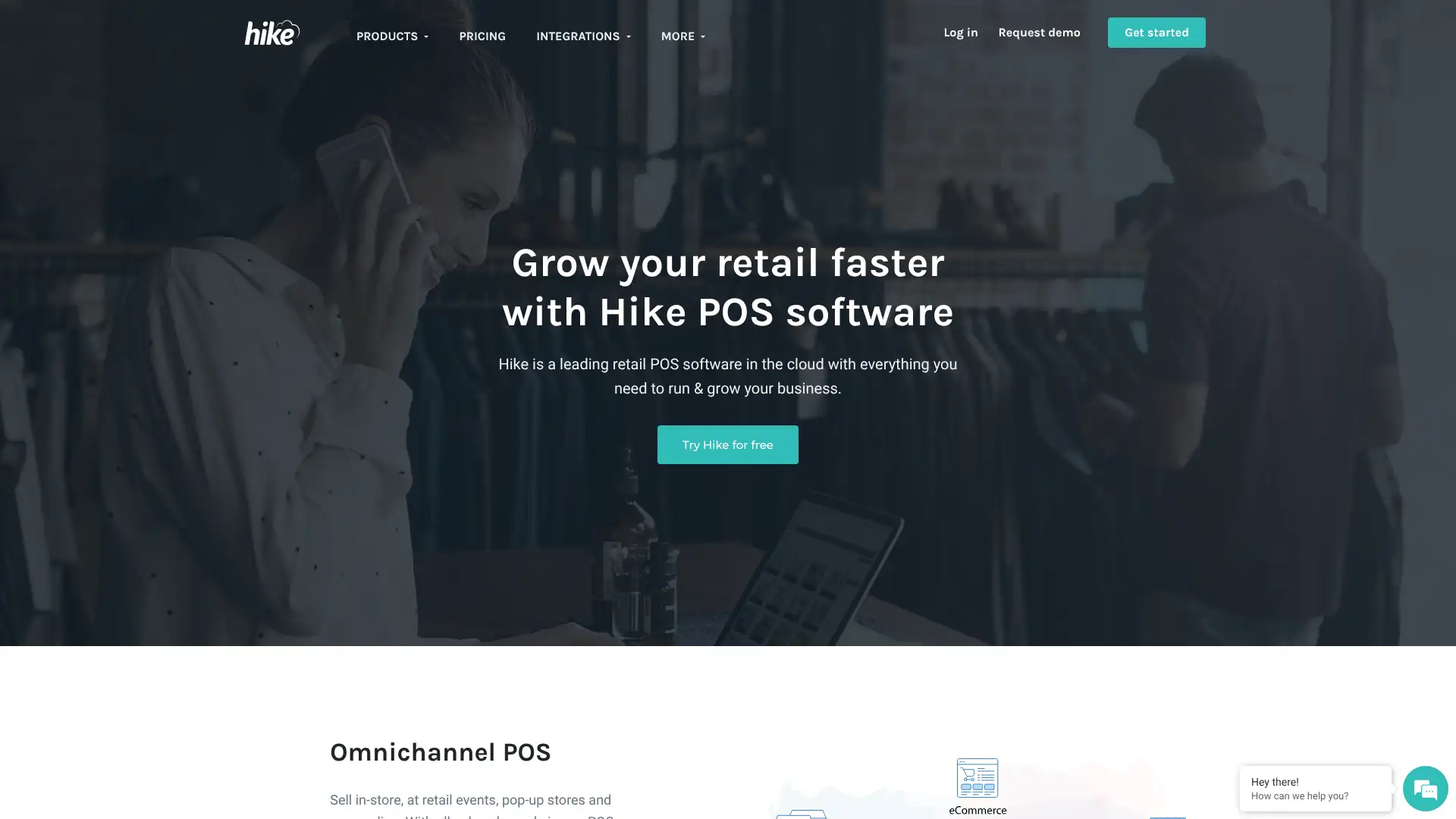
- • Payment agnostic: works with any payment processor globally — no forced gateway, no transaction fees beyond what your chosen processor charges
- • Works on any device: iPad native app plus full web-browser access on PC and Mac; Android app in development
- • Advanced discounting: built-in conditional discount rules (e.g., buy 2, get 50% off the third) that most POS systems require third-party apps to achieve
- • Offline mode: continues processing sales without internet; syncs automatically when connection is restored, with no data loss
- • Inventory scanner app: turns any iPhone, iPad, or Android camera into a barcode scanner for stocktakes without dedicated hardware
Hike is an excellent mid-market retail POS for businesses that want payment processor freedom without sacrificing features. The per-outlet pricing, no contracts, and advanced built-in discounting engine make it strong value for boutiques and specialty retailers. The absence of native Android support and a smaller integration ecosystem are the main limitations to evaluate.
Loyverse POS
Loyverse is a free cloud POS for iOS and Android used by over 200,000 merchants in 170+ countries. The core POS, inventory, sales reports, and CRM are genuinely free with no transaction fees from Loyverse itself. Paid add-ons are available for advanced inventory management ($29/mo per store) and employee management ($5/employee/mo). The system runs on smartphones and tablets with no dedicated hardware required. It integrates with SumUp and other payment processors. Loyverse is particularly popular in Southeast Asia, Latin America, and Africa where low-cost POS solutions are in high demand.
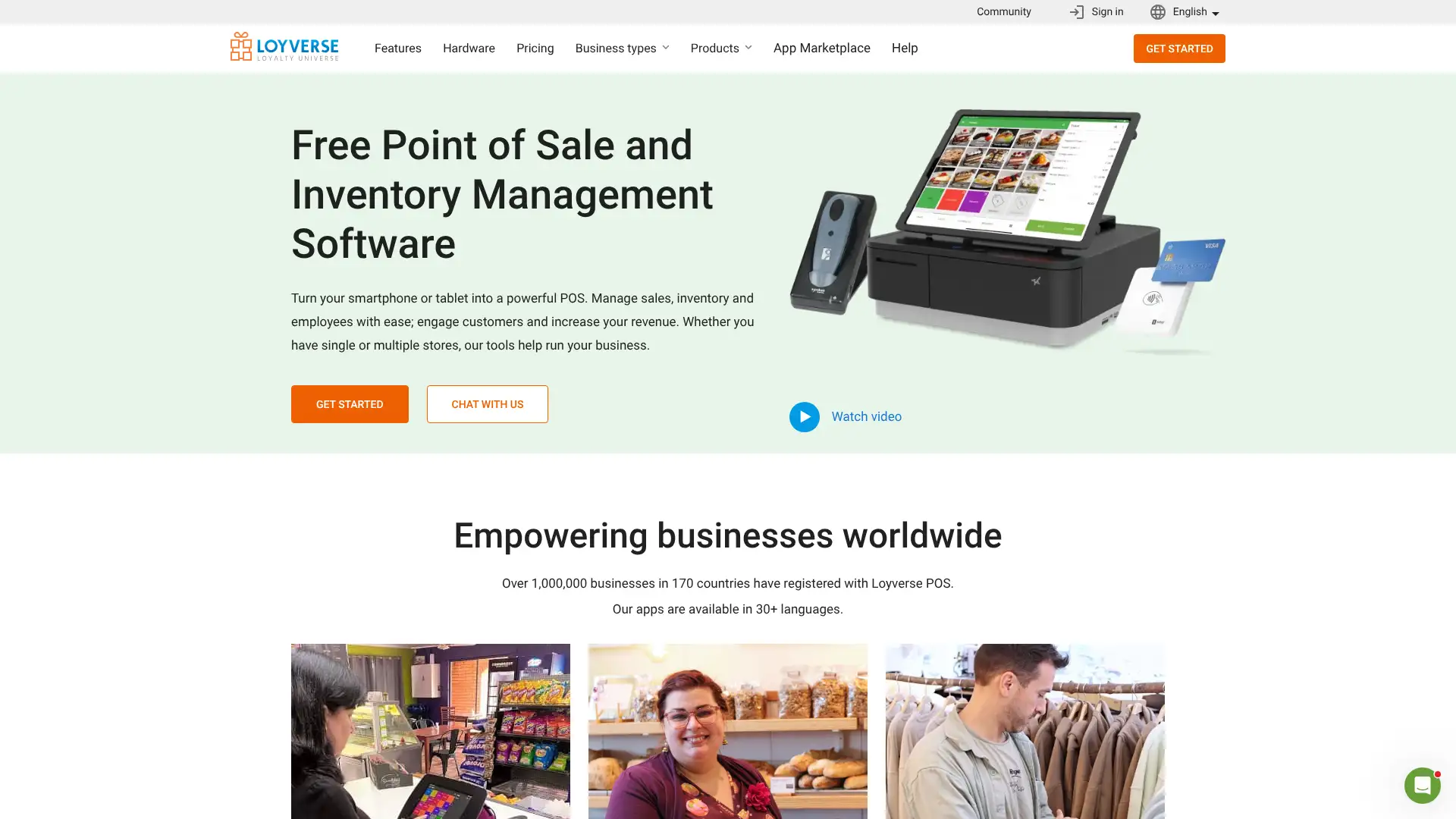
- • Free loyalty program: built-in points-based rewards system that customers can enroll in at checkout, with no add-on fee required
- • Kitchen display system: orders route directly to kitchen screens with the free plan, avoiding the $20/device/mo cost charged by Toast and Lightspeed
- • Works on smartphones: runs on any iOS or Android device including phones, eliminating the need for dedicated tablet hardware for very small operations
- • Multi-location support: manage multiple stores from one back-office account with separate inventory and reports per location
- • Offline mode: sales processing and inventory tracking continue without internet; syncs automatically when reconnected
Loyverse is the best free POS for small cafes, food stalls, market vendors, and boutique retailers that operate from smartphones or tablets. The free loyalty program and KDS alone would cost $50-$100/mo at competing platforms. Grow beyond a few locations or need desktop terminals, and Square or Lightspeed will serve you better.
Imonggo
Imonggo is a Philippines-based web POS that bills itself as the world's first free-forever POS. The free tier supports 1 user, 1 branch, 30 products, and 300 invoices per month. The paid plan at $30/mo per branch removes all limits and adds advanced features. Imonggo is fully browser-based, working on Windows, Mac, Linux, and mobile devices without a native app requirement. It integrates with Shopify and Xero. The platform is particularly useful for businesses needing a simple, low-overhead POS without hardware investment.
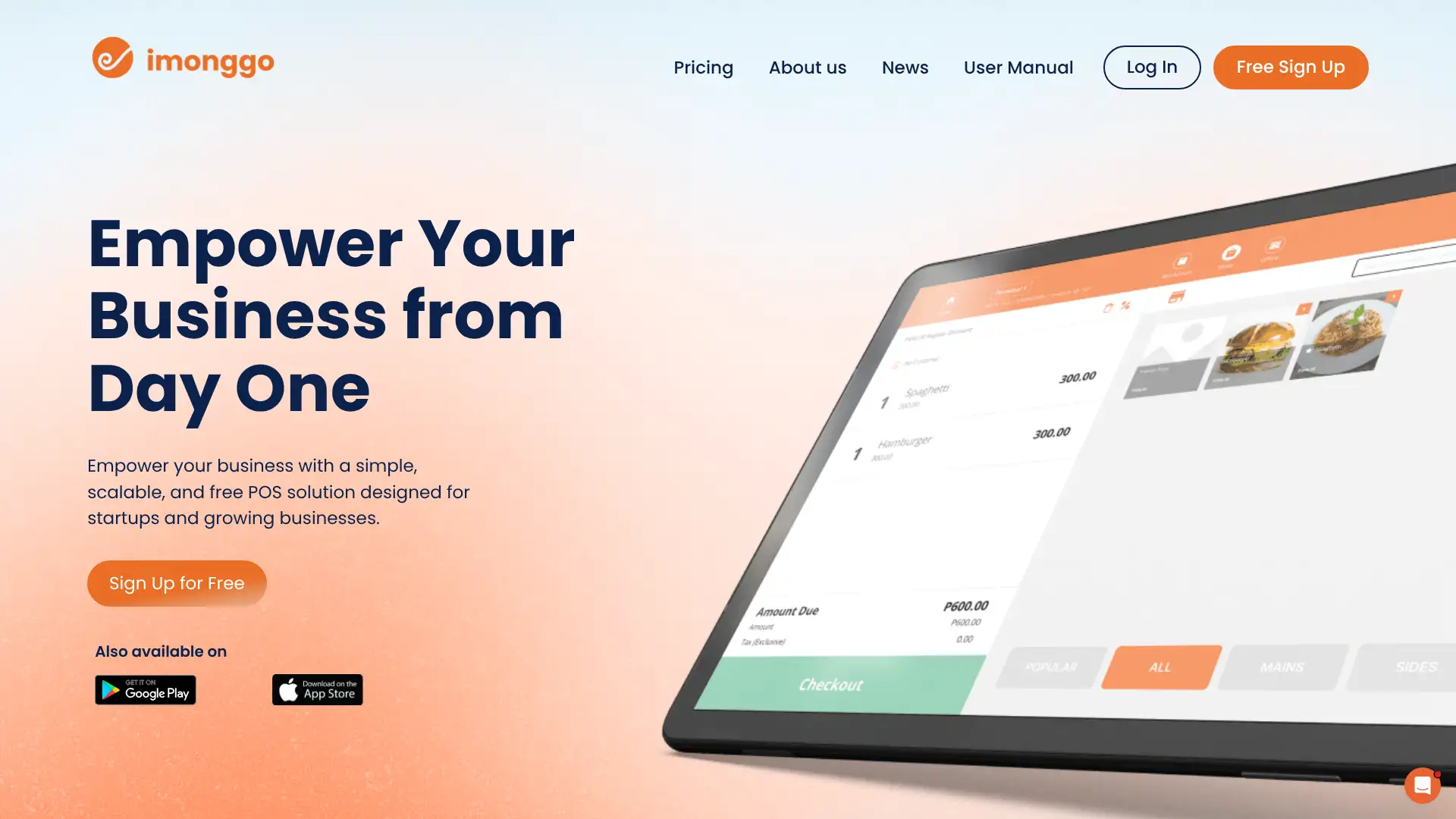
- • Universal web access: runs in any browser on Windows, Mac, Linux, iOS, or Android — no app install required, lowering setup friction to near zero
- • Offline sales processing: continues recording transactions without internet and syncs when back online
- • Layaway and split payment support: accepts deposits, partial payments, and multiple payment methods per transaction
- • Open-price items: supports manually entered prices at checkout for custom orders and variable-price goods
- • Email receipts: automatically emails receipts to customers, reducing thermal printer dependency for paperless operations
Imonggo is best for sole traders, pop-up shops, or very small retail operations that need to start immediately with no budget at all. The $30/mo paid plan is competitive for single-location retailers. For any business that processes more than 10 transactions a day, the free plan is too restrictive and Loyverse becomes the stronger free alternative.
Bindo POS
Bindo (now operating primarily as Bindo Labs) is an iPad POS originally founded in New York in 2010 that now operates primarily in Asia and the Middle East. The US-focused consumer POS has received heavily negative user reviews since 2020, with widespread reports of crashes, poor support, and billing issues. The product line has expanded to include F&B, retail, hospitality POS solutions, a payment gateway, self-service kiosks, and KDS. Pricing is not publicly disclosed and requires a demo request. Bindo's G2 profile has not been managed for over a year, indicating reduced US market focus.
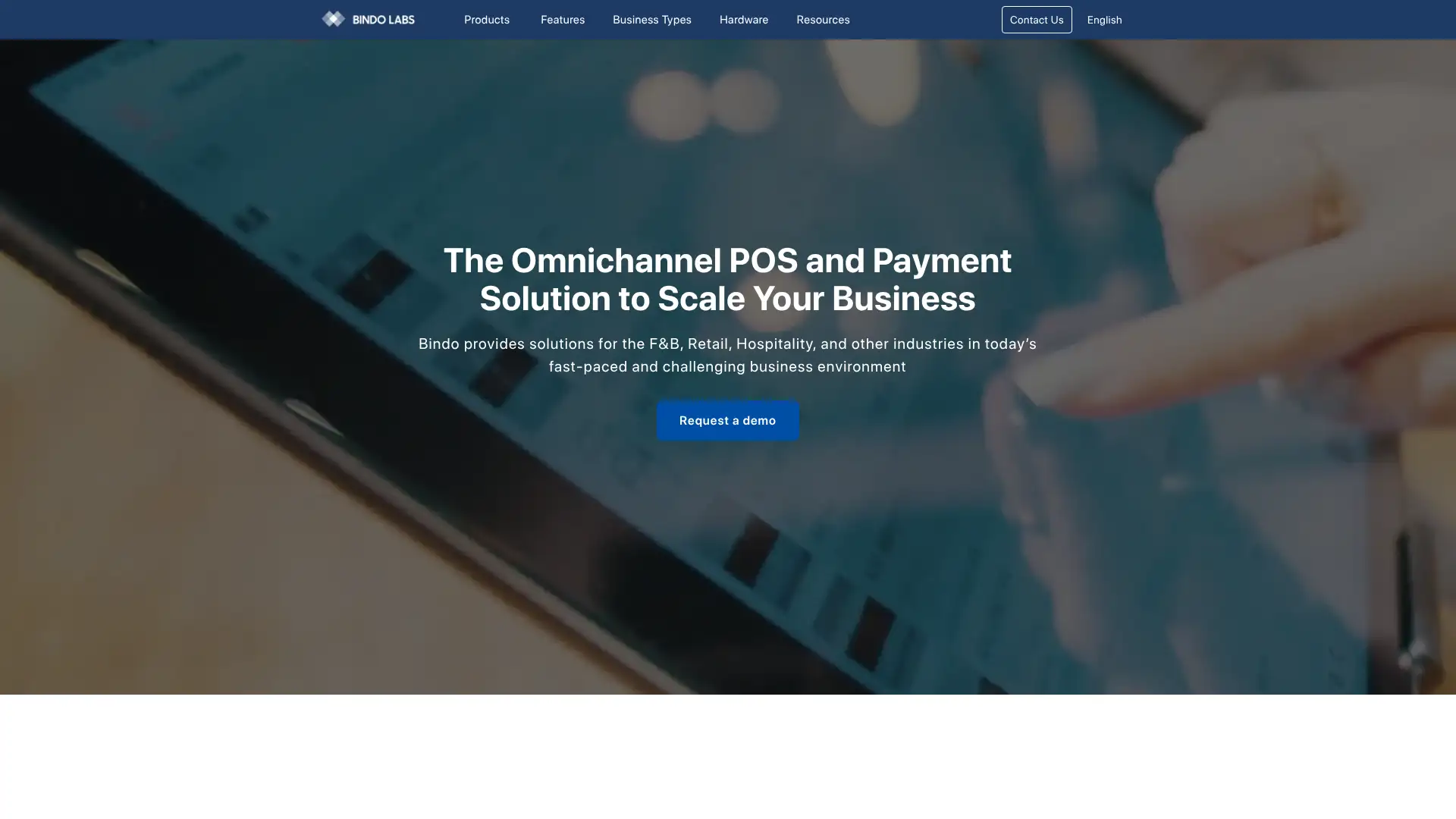
- • O2O (online to offline) platform: connects in-store inventory with online marketplace listings for simultaneous multi-channel selling
- • Smart Register: AI-powered upsell recommendations during checkout that surface relevant products based on the current cart and customer history
- • Ingredient tracking module: restaurant-specific feature that ties ingredient consumption to sales, supporting accurate food cost tracking and waste reduction
- • Self-ordering kiosk: customer-facing order screen that integrates directly with the POS and KDS for reduced labor at counter-service operations
- • 300+ features across retail, F&B, and hospitality modules including table management, queue management, and hotel PMS integration
Bindo should be avoided by US-based businesses based on the volume and consistency of negative user reviews since 2020, including reports of crashes, billing disputes, and inaccessible support. For businesses in MENA or Southeast Asia, Bindo Labs may be worth evaluating through a local reseller. Any US retailer or restaurant should choose a more actively supported platform.
Lavu POS
Lavu is an iPad-only restaurant POS that gained visibility through a feature on Gordon Ramsay's Kitchen Nightmares. Plans start at $59/mo with free hardware included, though the platform requires a 3-year contract. The 2025 addition of Marty AI scans 50,000 daily data signals overnight and delivers a 'Morning Deposit' report identifying recoverable revenue opportunities from labor waste, menu pricing, and slow hours. Lavu Pay is the integrated payment processor, though rates are not publicly disclosed. Users report a $230/year legacy hosting fee billed on top of the subscription, and total annual costs around $1,000 for basic setup.
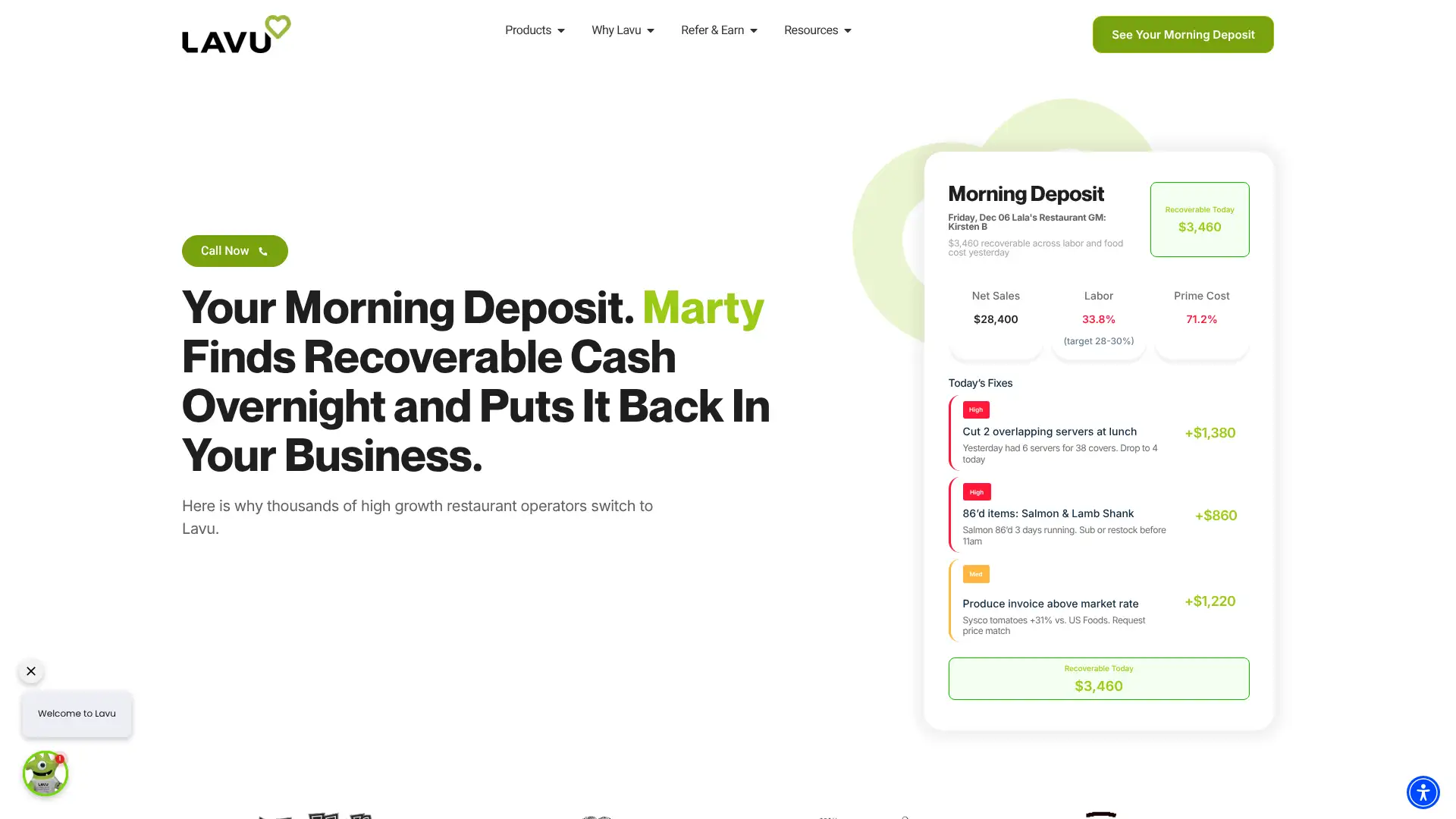
- • Marty AI: overnight analysis of 50,000+ data signals delivers a 'Morning Deposit' report before opening, identifying specific revenue recovery opportunities in staffing, pricing, and menu gaps
- • iOS-only operation: runs exclusively on iPad, iPhone, and MacBook devices with a native app built for Apple hardware performance
- • Online ordering via MenuDrive: commission-free digital ordering page that integrates directly with the POS and kitchen workflow
- • Dual pricing (cash discounting): built-in support for displaying different cash and card prices, offsetting credit card processing fees
- • Loyalty and gift programs: integrated Lavu Loyalty and Gift Card apps with customer engagement tools for repeat business building
Lavu is appealing for restaurants that want smart AI-driven insights at an accessible entry price. The Marty AI morning report is a real differentiator for operators who act on data. The 3-year contract and lack of offline card processing are significant drawbacks — read the contract carefully before signing, and verify all fees including legacy hosting charges.
Talech POS
Talech was acquired by U.S. Bank in 2019 and is now fully operated under Elavon, U.S. Bank's payments subsidiary. The talech.com domain now redirects to Elavon's POS offerings. Three published plan tiers exist: Mobile (free, card processing fees only), Starter ($29/mo), Standard ($69/mo), and Premium ($99/mo). The platform serves retail, restaurant, and service businesses on iPad. Users can access 24/7 support, though reviews note inconsistent quality. Processing fees are not publicly disclosed and are tied to the Elavon merchant account.
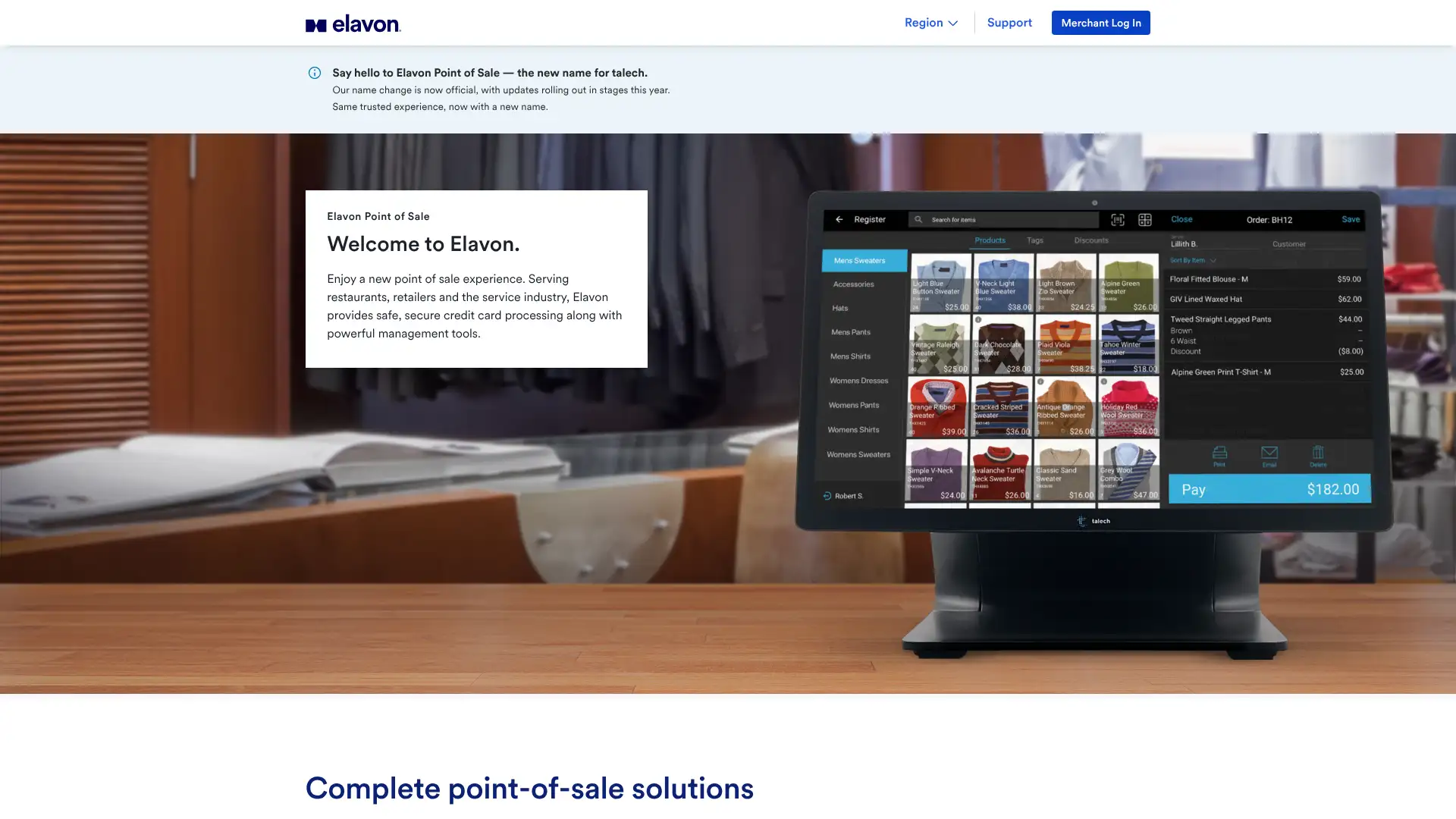
- • Industry-specific versions: distinct interfaces for retail (inventory-focused), restaurant (table/order management), and service (appointment scheduling) within one platform
- • Appointment scheduling: customer-facing booking website with timed services and staff profiles — included in Premium with no separate add-on cost
- • Email marketing: built-in campaign tools for customer communications directly from the POS dashboard
- • Integrated time clock: employees clock in/out at the POS with automatic timesheet generation and overtime calculations
- • Daily summary reports: end-of-day auto-generated summaries of transactions, top items, and employee performance delivered to the owner's inbox
Talech is best evaluated as part of a U.S. Bank or Elavon merchant services relationship rather than as a standalone POS choice. If you're already banking with U.S. Bank, the integration simplifies reconciliation. As a standalone POS selection, Square or Clover offer more transparent pricing, more reliable software, and broader hardware options at comparable cost.
Aloha by NCR Voyix
NCR Aloha is the restaurant industry's longest-running POS platform, used by major chains including Chipotle, Firehouse Subs, and international hotel F&B operations. In October 2023, NCR split into NCR Voyix (restaurants, retail) and NCR Atleos (ATMs). Two products are offered: Aloha Cloud (Android, cloud-native, starts at ~$175/terminal/mo for the Pro package) and Aloha Essentials (Windows-based, on-premise hybrid, custom pricing). Hardware runs approximately $1,000/terminal. In April 2025 NCR Voyix raised processing fees including a 0.25% discount fee increase and up to $0.07/authorization increase for existing customers.
- • Industry-standard POS: more restaurant staff have been trained on Aloha than any other system, reducing training time and turnover friction when hiring experienced staff
- • Delivery marketplace integration: Aloha Cloud consolidates third-party delivery orders (DoorDash, Uber Eats) directly into the POS, eliminating counter tablets
- • True offline availability: Aloha Essentials maintains full functionality during internet outages through local server redundancy — not just 'limited offline mode'
- • Enterprise menu management: centrally update prices, ingredients, nutritional info, and promotions across hundreds of locations simultaneously
- • PMS integration: deep integration with hotel property management systems for F&B departments in hotels and resorts
Aloha is the right choice for mid-size to enterprise restaurant chains and hotel F&B operations where staff familiarity with the system is a real operational asset. Aloha Cloud's $0 upfront offer makes it accessible to smaller restaurants that want an enterprise-grade platform. Independent restaurants not needing the enterprise features will find better value and simpler pricing with Toast or Square.
Oracle MICROS (Simphony)
Oracle Simphony (formerly MICROS, acquired by Oracle in 2014) is the enterprise standard for global hospitality, powering venues from local cafes to Wendy's, Taco Bell, and international hotel chains across 180 countries. The cloud POS processes billions of transactions annually. As of 2025/2026, Simphony Essentials starts at $55/mo for small restaurants and Simphony Plus at $75/mo for multi-location operations. Hardware is available for $1/device when switching from another POS. Processing rates are custom and not publicly disclosed. Oracle uses proprietary hardware exclusively — no BYOD.
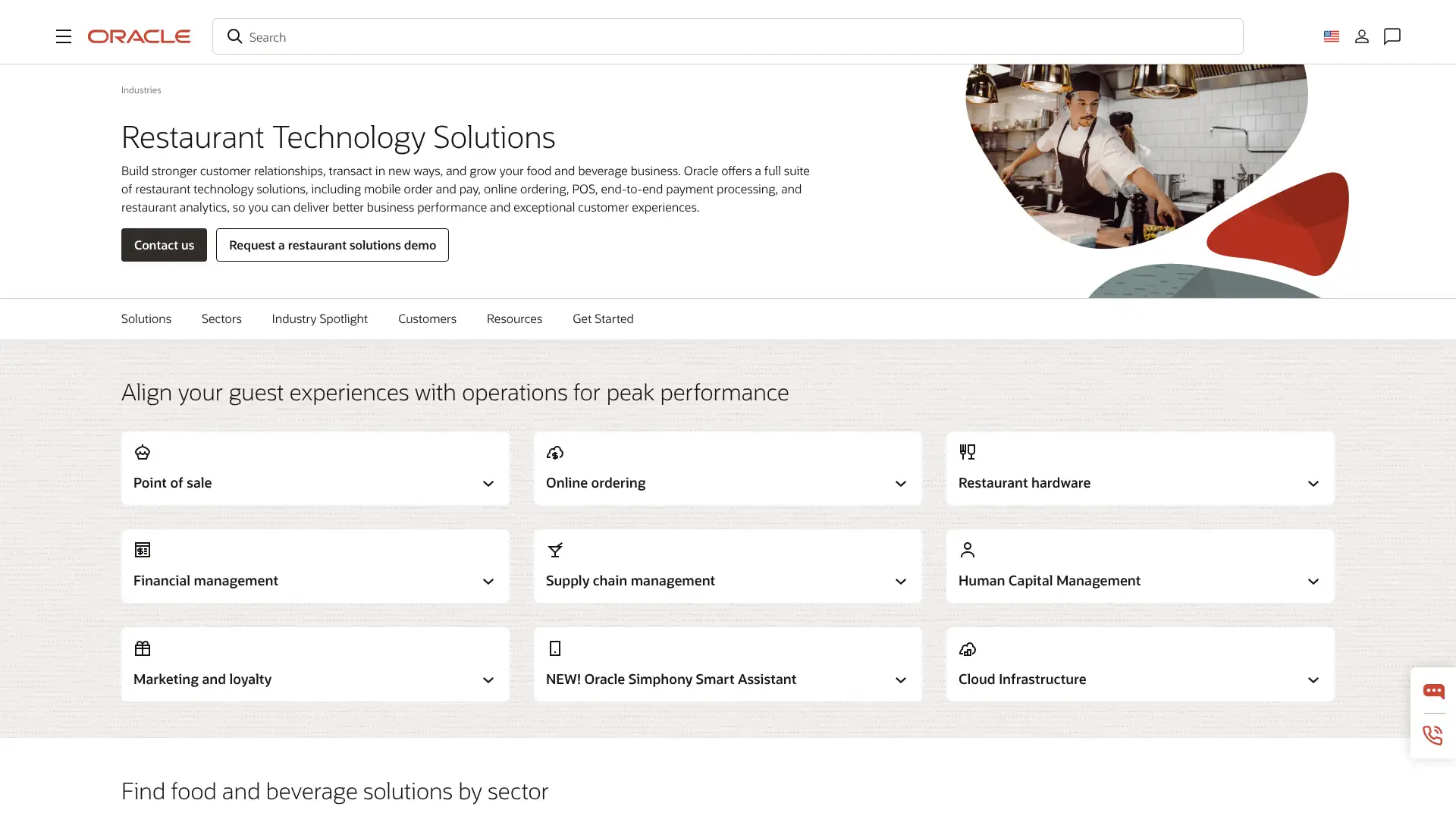
- • 200+ Oracle Cloud Marketplace integrations including GloriaFood, Olo, ChowNow, and direct connections to hotel PMS systems like Oracle OPERA
- • Kitchen Display System: color-coded order routing with bump bars and remote views; works across in-house waitstaff, kiosks, drive-thru, online, and delivery channels simultaneously
- • Self-service kiosks: Oracle Simphony powers both Oracle-branded and third-party kiosks with centralized menu and pricing management across all self-service touchpoints
- • Multi-concept management: manage completely separate restaurant brands, menus, pricing, and tax structures within a single enterprise dashboard
- • Enterprise reporting: 250+ report types including labor cost vs. sales, menu engineering analysis, and multi-location performance comparisons
Oracle Simphony is the correct platform for hotel F&B departments, global restaurant chains, and stadium/venue food service that require deep OPERA PMS integration and serious enterprise analytics. The $55-$75/mo published tiers make it approachable for smaller restaurants that need the platform's 200+ integrations. Independent restaurants should compare total cost carefully including hardware — the lack of BYOD adds to long-term expense.
PayPal POS (formerly Zettle)
PayPal acquired Zettle (formerly iZettle) in 2018 and fully rebranded it as PayPal POS in 2024. The zettle.com domain now redirects to paypal.com. The platform charges no monthly fee — you only pay per transaction: 2.29% + $0.09 for card-present sales, 3.49% + $0.09 for manually entered cards. The first card reader costs $29; additional readers are $79. A standalone terminal with a built-in barcode scanner is $239. The system accepts PayPal, Venmo, Apple Pay, Google Pay, and all major card networks. There is no offline mode, which limits viability for outdoor or connectivity-challenged environments.
- • PayPal and Venmo acceptance: native integration with PayPal's ecosystem enables QR code payments — customers pay from their PayPal or Venmo app without needing a card
- • Inventory management: built-in product catalog with variant tracking, low-stock notifications, and category management at no additional cost
- • Sales analytics: real-time reporting on top-selling items, payment types, staff performance, and daily trends accessible from the mobile app
- • Tap to Pay on iPhone: accept contactless payments with no hardware — just an iPhone and the PayPal POS app
- • Multi-location management: single account covers multiple store locations, each with separate product catalogs and sales reports
PayPal POS is the right choice for sellers who already live in the PayPal ecosystem and want the lowest-friction way to accept in-person card payments with no monthly overhead. The 2.29% + $0.09 in-person rate is compelling. For any business needing offline processing, loyalty tools, or advanced reporting, Square offers more for the same no-monthly-fee model.
SumUp POS
SumUp is a Berlin-based fintech founded in 2012 and now serving 4+ million merchants in 36 countries. In the US, combined POS plans start at $99/mo (POS with Connect Lite). Card-only plans have no monthly fee. In-person processing is 2.6% + $0.10. In the UK, the pay-as-you-go rate is 1.69% per transaction (among the lowest in the UK market) and the Payments Plus plan at £19/mo drops it to 0.99%. SumUp refreshed its hardware lineup in 2026, discontinuing the original Air and introducing new Terminal models with built-in POS software and receipt printers from $135/unit (UK).
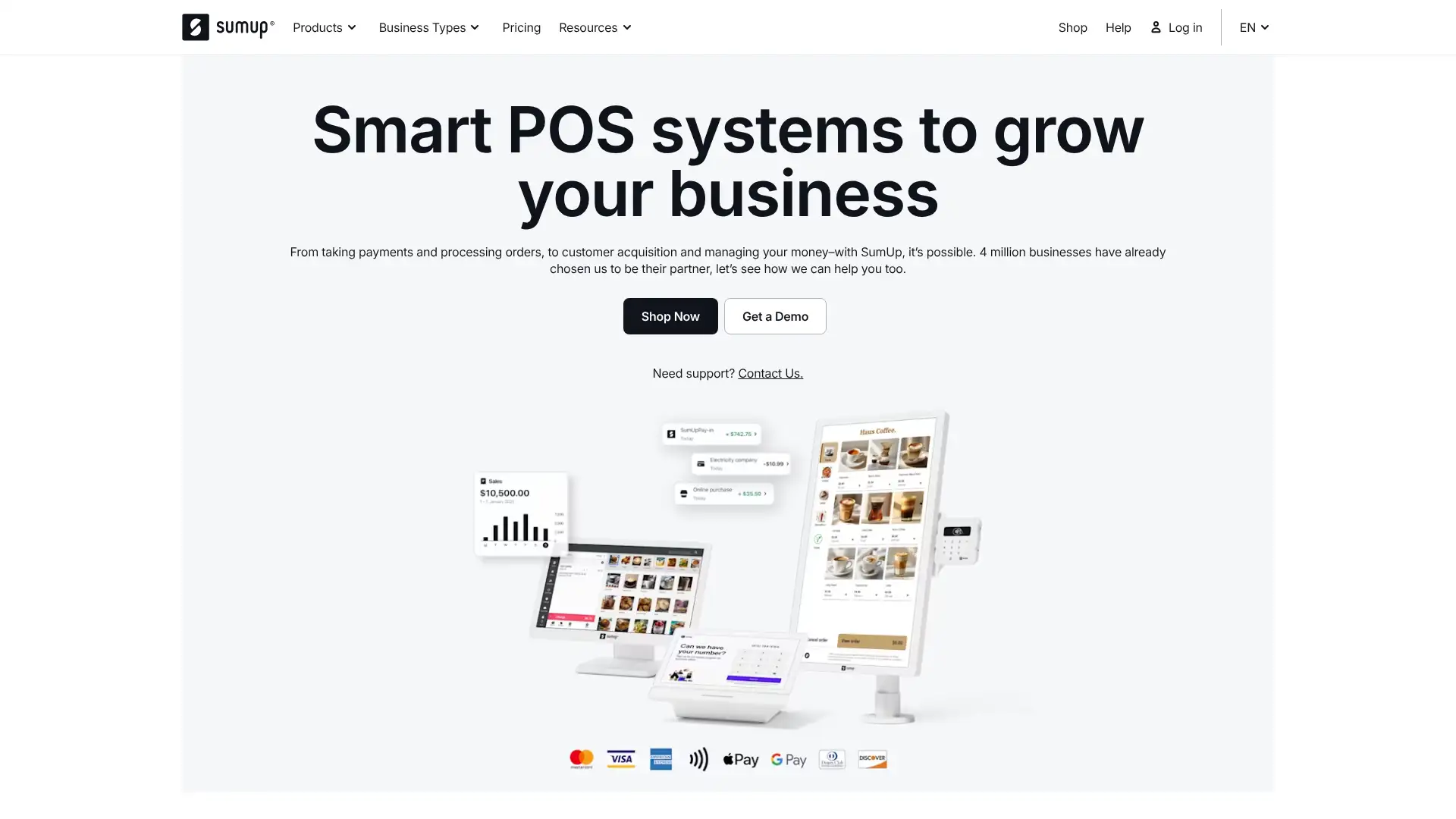
- • Hardware flexibility: Solo card reader works standalone without a phone; Terminal Handheld includes built-in printer and POS software in one device for table service
- • No monthly fee card reading: pay-as-you-go card acceptance is available with no subscription, making SumUp accessible to seasonal and low-volume businesses
- • Connect platform: paid plans unlock automated loyalty campaigns, acquisition marketing, and customer retention tools that activate without requiring POS staff time
- • MTD-ready (UK): SumUp is compliant with Making Tax Digital for Income Tax through a Sage partnership, preparing UK merchants for the April 2026 MTD mandate
- • Quick payouts: funds available within 1-2 business days with no cutoff windows on any day of the year
SumUp is excellent for European and UK small businesses where the 1.69% rate and clean hardware make it highly competitive. In the US market, the $99/mo Connect plans are harder to justify when Square's $49/mo Plus plan covers similar features. The no-contract model and 2026 hardware refresh make it worth evaluating for mobile sellers on both sides of the Atlantic.
Helcim
Helcim is a Canadian payment processor and POS platform founded in 2006 that has built a reputation for transparency by publishing exact interchange-plus rates and offering volume discounts automatically without negotiation. POS software is free with every account — you only pay for hardware ($99 card reader or $329 Smart Terminal) and transactions. Rates start at interchange + 0.40% + $0.08 for in-person, with the average effective rate of 1.93% + $0.08 being materially lower than Square's 2.6% + 15¢. In January 2026, Helcim launched Payment Extension, a browser plugin for processing payments within QuickBooks Online, Xero, and WooCommerce.

- • Automatic volume discounts: processing rates decrease automatically in 5 tiers as monthly volume grows — no negotiation required, unusual in the industry
- • Payment Extension (2026): browser plugin lets merchants process Helcim payments within QuickBooks Online, Xero, and WooCommerce without switching apps
- • Free online store: full hosted ecommerce storefront included with every account, with SSL, product catalog, and shopping cart
- • Level 2/3 B2B optimization: automatically enriches corporate card transactions with line-item data to qualify for lower interchange rates without manual entry
- • Merchant Buyout Program: covers up to $500 in early termination fees from your previous processor when switching to Helcim
Helcim is the best value credit card processor for retail, service, and ecommerce businesses processing at least $10,000/mo. The combination of no monthly fees, automatic volume discounts, and a rate-lock guarantee is unmatched. Businesses needing industry-specific POS features (restaurant table management, appointment booking) should combine Helcim for processing with a specialized POS that supports Helcim integration.
Stax
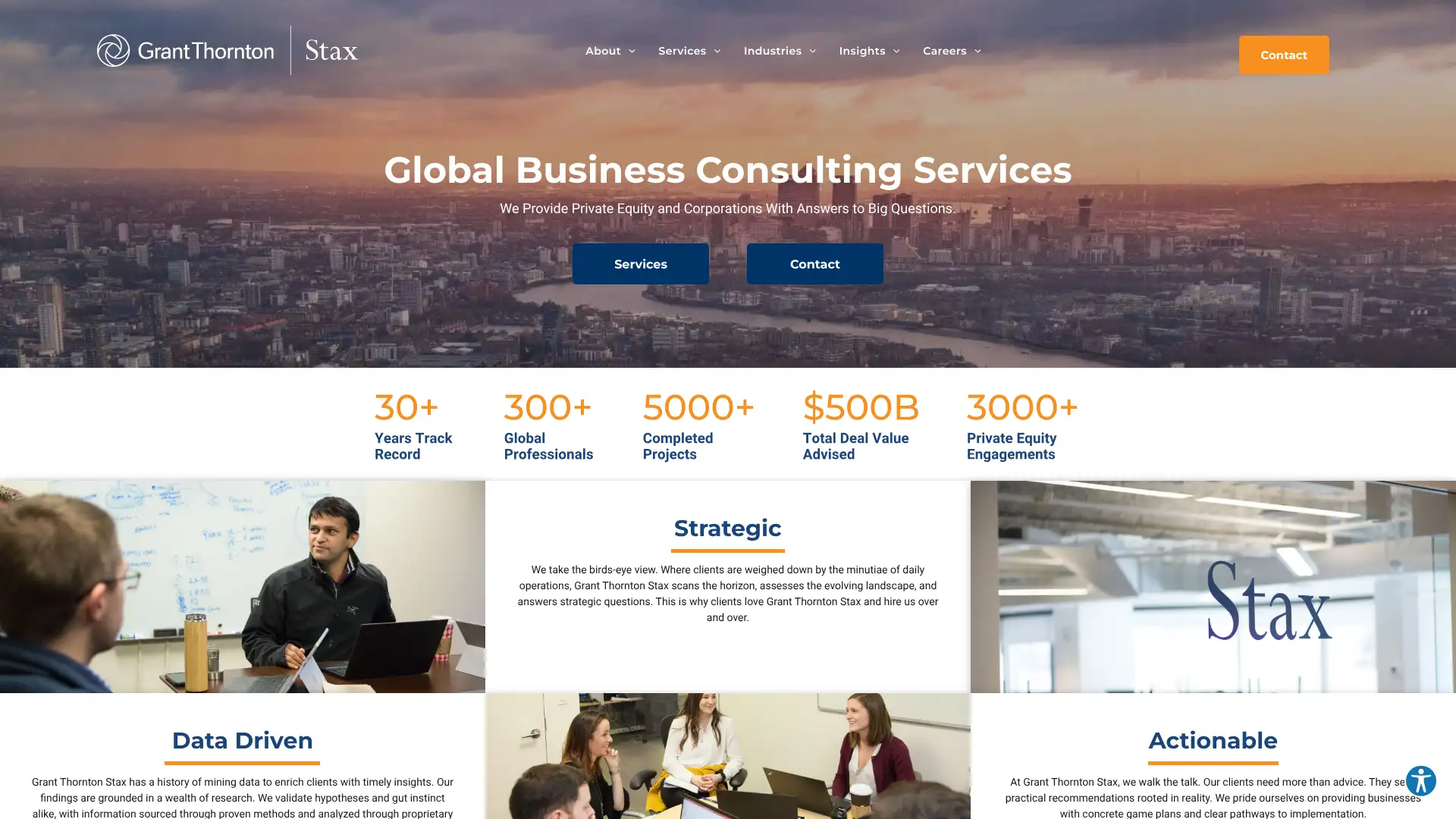
Stax (formerly Fattmerchant, founded in 2014 in Orlando) pioneered the subscription-based payment processing model in the US. Instead of percentage markups, Stax charges a flat monthly fee ($99-$199+/mo) and passes through interchange at the direct wholesale rate plus a small per-transaction fee ($0.07-$0.15). Over 30,000 businesses process $30+ billion through Stax annually. The company owns CardX (compliant surcharging), Payment Depot (interchange-plus reseller), and operates the Stax Connect platform for SaaS companies embedding payments. Stax does not manufacture hardware but works with 90%+ of compatible terminals.
- • Zero percentage markup: the subscription covers Stax's profit — you only pay the actual interchange fee set by Visa/Mastercard/Amex plus a small fixed cents-per-transaction fee
- • Stax Connect: white-label embedded payments for SaaS platforms and ISVs, enabling software companies to monetize payment processing within their products
- • CardX integration: compliant credit card surcharging solution that passes processing fees to customers who pay with credit cards, reducing net processing costs to near zero
- • 200+ pre-built integrations including QuickBooks, Salesforce, Keap, and NetSuite, plus thousands more via Zapier
- • Text-to-Pay and Payment Link: mobile invoice and payment link features included in Pro and above for service businesses collecting remote payments
Stax makes strong financial sense for businesses processing over $20,000/mo who want a predictable processing cost structure without a percentage markup eating into revenue. The subscription model is cleanest for high-average-ticket B2B sales. For volume below $10,000/mo, the monthly fee makes Stax more expensive than Helcim or Square on a per-transaction basis.
Payment Depot
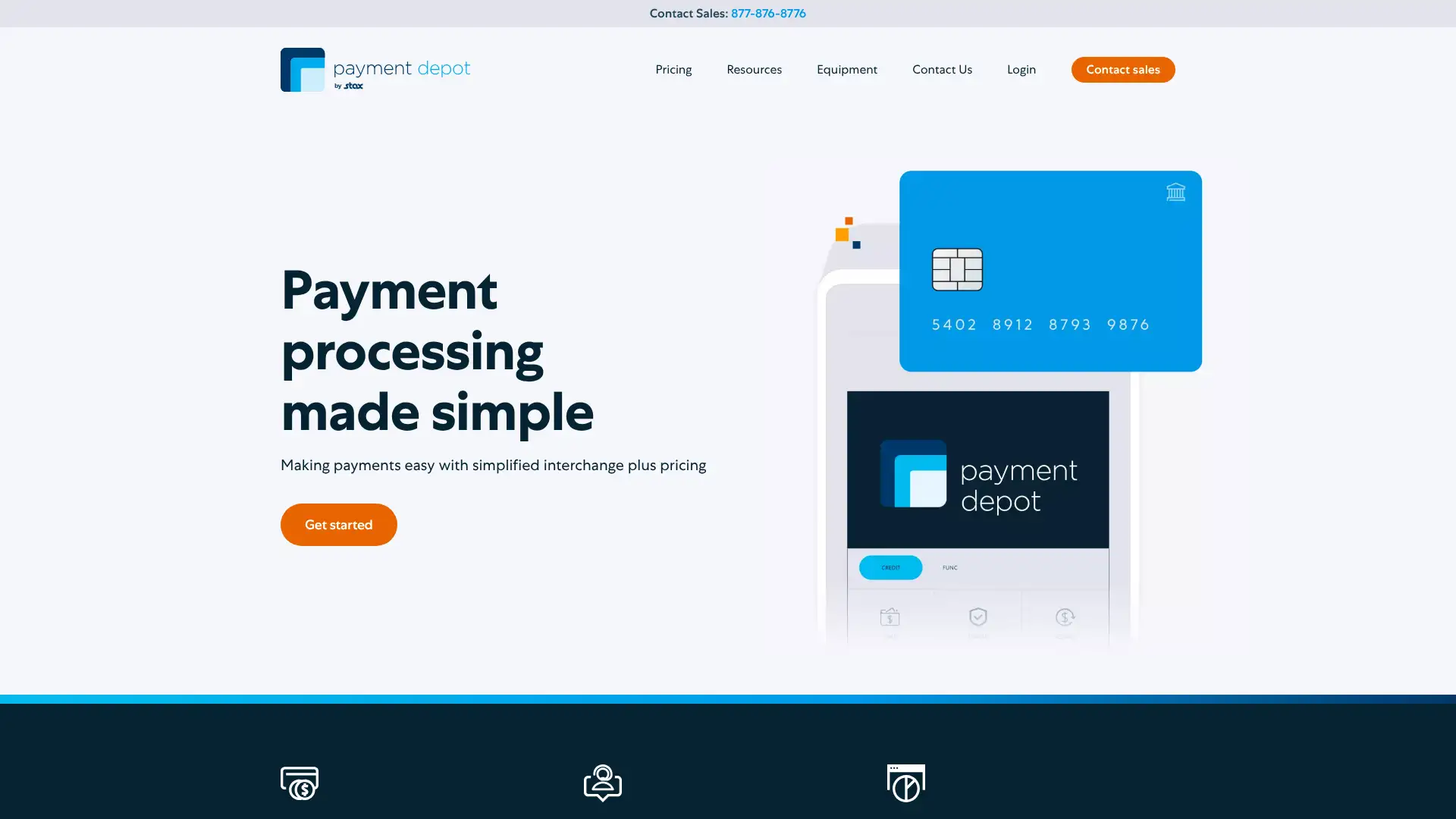
Payment Depot, acquired by Stax in 2021, operates as an independent brand under Stax's parent company. It popularized the 'Costco of credit card processing' positioning — pay a monthly membership fee and access near-wholesale interchange rates plus a small per-transaction fee ($0.05-$0.15) rather than a percentage markup. Plans are indexed at 0.2%-1.95% above interchange depending on the plan tier. Payment Depot partners with Clover for POS hardware, Fiserv for enterprise processing, and SwipeSimple for mobile. No monthly minimum and no early termination fee (unless a 'free' terminal was included with signup).
- • Membership interchange pricing: pays the actual wholesale interchange rate to card networks and charges only a fixed cents-per-transaction fee rather than a percentage markup
- • Clover POS integration: authorized Clover reseller offering Mini ($849), Flex ($749), and Station ($1,799) hardware as authorized add-ons to any Payment Depot plan
- • Virtual terminal included: free web-based terminal on all plans for keyed-in phone orders without additional software fees
- • SwipeSimple mobile app: compatible mobile payment app for on-the-go card acceptance paired with a $99 Bluetooth reader
- • Merchant Buyout: will cover up to $500 in cancellation fees from your previous processor when switching to Payment Depot
Payment Depot is a dependable, transparent payment processing choice for established retail, restaurant, and service businesses processing $25,000-$500,000/mo annually. The Clover hardware partnership means you can consolidate POS and processing through one vendor. Avoid the 'free terminal' bundles unless you're prepared for the three-year contract commitment.
National Processing
National Processing is a Utah-based merchant services provider with 17+ years in the industry. It offers three core plans for retail, online, and restaurant businesses at published flat rates plus interchange. The company is known for a price-match guarantee: if you find a lower rate from a comparable processor, National Processing will either beat it or send a $500 gift card. It partners with PAX, Clover, and SwipeSimple for hardware. Processing rates are fully transparent on the website. The company has an A+ BBB rating with only 13 complaints in three years and generally positive customer reviews around support quality.
- • Price-match guarantee with $500 payment: if any comparable processor offers lower all-in rates for your business, National Processing beats it or pays you $500
- • Free POS reprogramming: if you're switching from another processor and have compatible hardware, National Processing reprograms it at no charge rather than requiring new equipment purchases
- • NP POS system: proprietary tablet-based POS with inventory management, table service interface, online ordering, and staff management built in
- • Next-day funding available: funds deposited within 24 hours on most transactions through the Premium plan
- • High-risk acceptance: unlike many processors, National Processing works with certain high-risk business categories that are often declined by Square and Stripe
National Processing is a legitimate, well-regarded choice for businesses that process at least $10,000/mo and want low interchange-plus rates backed by a price-match guarantee. The $9.95/mo plans with sub-0.2% markups are among the best published rates available. Read the full contract before accepting any free hardware offer — the three-year commitment can be costly to exit.
Dharma Merchant Services
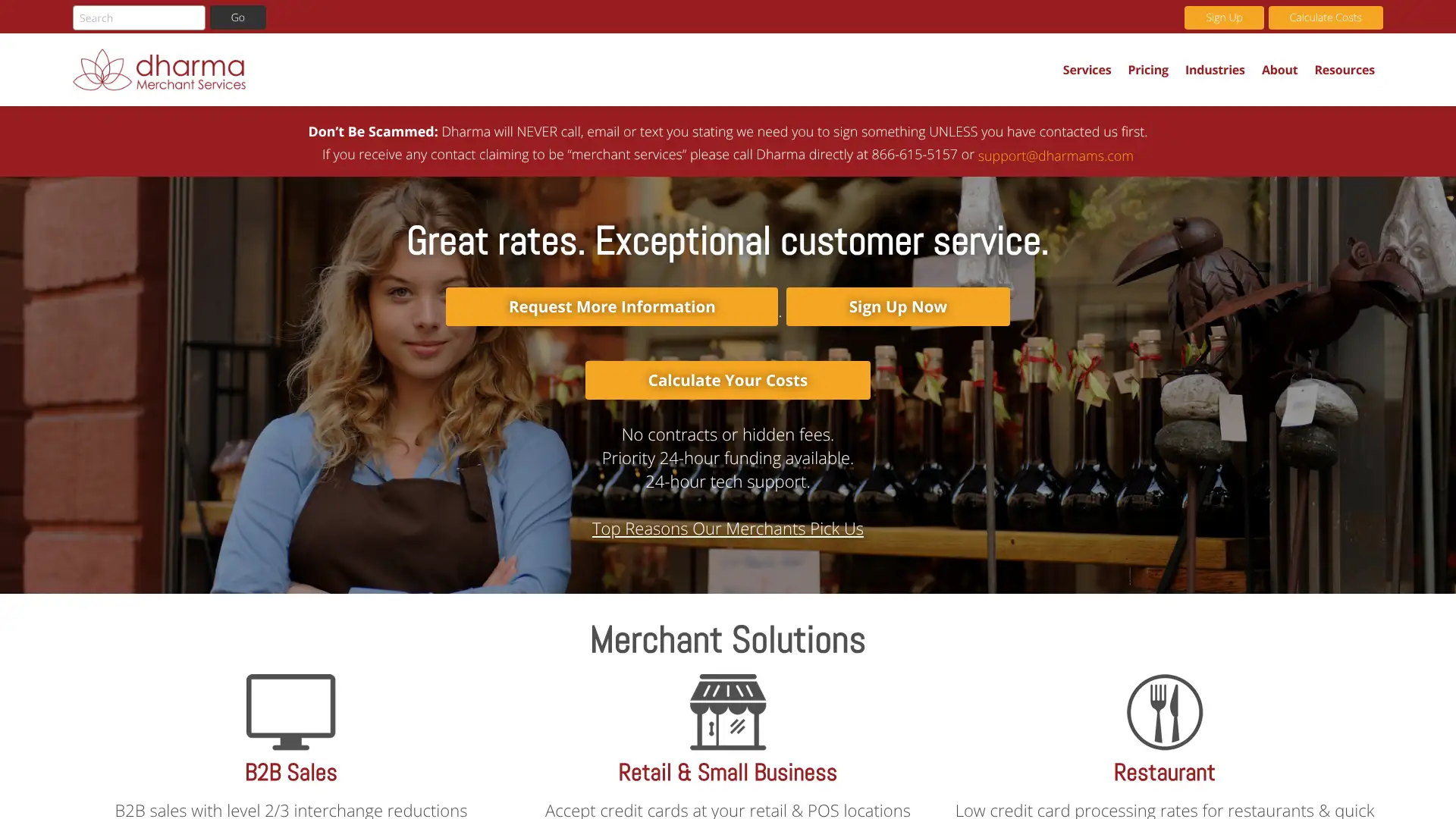
Dharma Merchant Services is a B Corp-certified payment processor founded in San Francisco in 2007, operated with a stated mission of social responsibility and fairness in payments. It offers interchange-plus pricing at 0.15% + $0.08 for retail and 0.20% + $0.11 for ecommerce, with no long-term contracts, no setup fees, no annual fees, and no monthly minimums. A $25/mo merchant account fee applies. The company donates 50% of net profits to nonprofit organizations annually and is consistently rated 4.8+ stars on Trustpilot. POS hardware is sourced from Clover, and MX Merchant is the included payment gateway.
- • MX Merchant included: web-based virtual terminal, mobile app, customer database, and reporting dashboard included at no additional cost on all plans
- • B2B Level 2/3 optimization: MX B2B app ($20/mo add-on) automatically enriches corporate card transactions to access the lowest interchange tiers on B2B sales
- • MX Insights ($10/mo): advanced customer analytics using a database of 95 billion transactions to provide demographic behavior data including age, income, and competitor insights
- • Next-day funding: card-present merchants receive funds within one business day without cutoff windows
- • Non-profit donation: Dharma donates 50% of net profits to charities annually, making it one of the few processors where choosing them has a direct social benefit
Dharma is the top choice for mission-driven businesses, nonprofits, and any merchant who prioritizes genuine transparency and social impact from their payment processor. The 4.8-star Trustpilot rating and $0 hidden-fee structure are the clearest demonstrations of what processing should look like. Businesses processing under $10,000/mo will find better economics with Helcim's no-monthly-fee model.
ShopKeep (now Lightspeed)
ShopKeep was acquired by Lightspeed in November 2020 for $440 million and fully rebranded as Lightspeed Retail S-Series. The shopkeep.com domain and all ShopKeep branding now redirect to lightspeedhq.com. Existing ShopKeep merchants were migrated to the Lightspeed ecosystem, and new customers are onboarded directly as Lightspeed Retail customers. The S-Series product line retains some ShopKeep DNA in its interface but is now fully managed and priced under Lightspeed's standard retail plans (Basic $89/mo, Core $149/mo, Plus $289/mo). ShopKeep no longer exists as an independent product.
- • Lightspeed S-Series interface: retains the simpler, more intuitive layout that ShopKeep merchants were familiar with, now powered by Lightspeed's backend infrastructure
- • Cloud-based inventory: real-time stock management with purchase orders, supplier tracking, and low-stock alerts across single or multi-location setups
- • Employee management: time clock, shift reporting, and individual sales performance tracking built into the POS
- • Customer profiles: tracks purchase history and contact information for targeted promotions and repeat-customer rewards
- • Payments by Lightspeed: integrated payment processing at 2.6% + $0.10 with next-day funding, replacing ShopKeep's previous payment partnerships
ShopKeep no longer exists as an independent product. If you are an existing ShopKeep user, you are now on Lightspeed S-Series. If you were evaluating ShopKeep as a new customer, evaluate Lightspeed Retail directly — the product quality is the same, and you'll be getting current pricing rather than legacy plan information.
QuickBooks POS
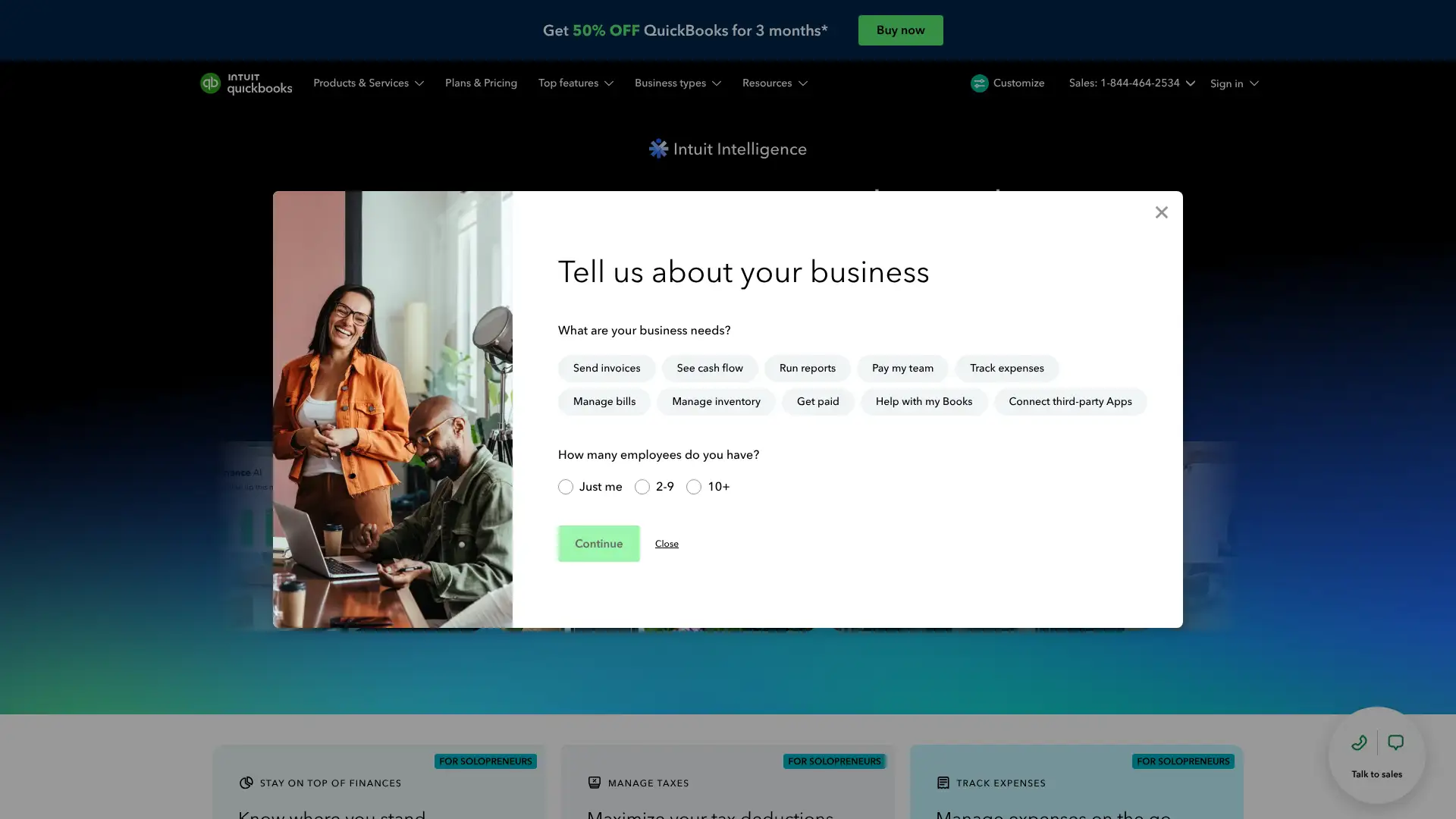
QuickBooks Desktop Point of Sale was discontinued by Intuit on October 3, 2023, after 20+ years in market. All connected services including payment processing, gift cards, mobile app sync, and store exchange were shut off on the same date. The final version was 19.0. Intuit has directed former customers to Shopify POS and Lightspeed as alternatives. No future versions of QuickBooks POS will be released. Existing installations of version 19.0 continue to function as local software without cloud services but receive no security patches, making continued use a PCI compliance and cybersecurity risk.
- • Sales and inventory tracking: the local QuickBooks POS software can still manage products and record sales in offline mode with no internet services
- • QuickBooks accounting sync: the financial exchange feature (syncing POS sales to QuickBooks Desktop) was disconnected on October 3, 2023, and is no longer functional
- • Gift card service: discontinued October 3, 2023 — existing physical gift cards cannot be redeemed through the QuickBooks system
- • Barcode printing and receiving: still functions locally in version 19.0 for businesses still using the software offline without cloud services
- • Employee time tracking: timecard module continues to work locally but can no longer sync to payroll integrations
QuickBooks POS is discontinued and must not be used for any business that processes payment cards. Continued use represents a PCI non-compliance risk and leaves customer payment data unprotected. Migrate immediately to Shopify POS (Intuit's recommended migration partner), Square, or Lightspeed — all three integrate with QuickBooks accounting software and preserve most of the functionality.
Sapaad
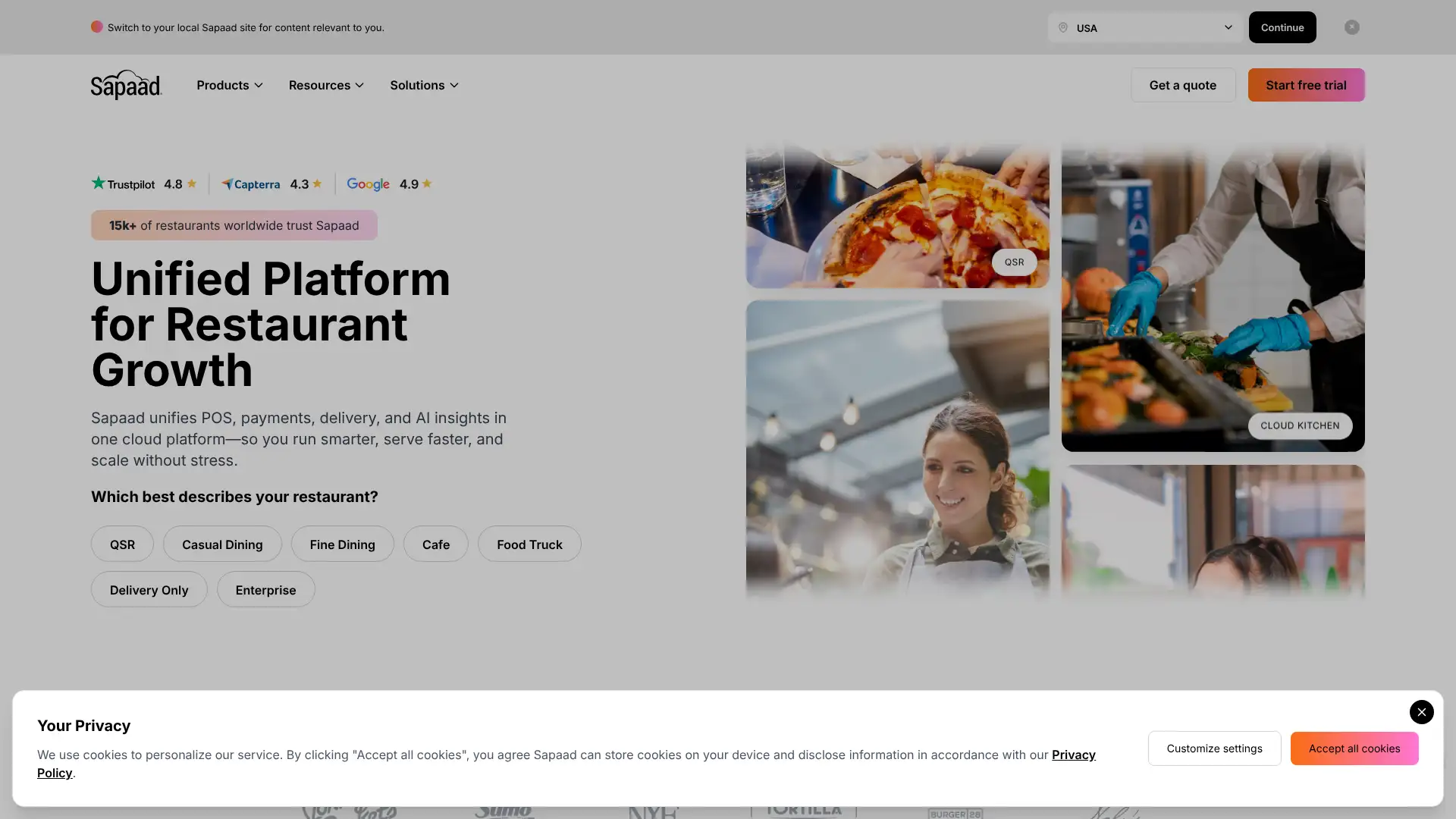
Sapaad is a Dubai-based restaurant cloud POS founded in 2012 and used by over 1,000 restaurant chains and cloud kitchen operators across 30+ countries. It excels at integrating with regional delivery aggregators including Deliveroo, Zomato, Foodpanda, GrabFood, Talabat, and others — a major advantage in MENA and Southeast Asia. The base monthly subscription starts at $59.99/mo for a single outlet. Annual subscribers pay $49.99/mo with 3 free months added, and 2-year subscribers pay $39.99/mo with 12 free months. Add-ons include inventory management, online ordering, loyalty, QR ordering, and the Sapaad Vantage BI platform (400+ reports).
- • Delivery aggregator integration via Sapaad Connect: consolidates orders from Deliveroo, Zomato, Foodpanda, GrabFood, Talabat, and 15+ platforms into one POS view
- • Sapaad Vantage: advanced BI dashboard with 400+ report types covering sales, margins, customer behavior, menu engineering, and operational performance powered by AI
- • QR code ordering (Sapaad Direct): customers scan a QR code to view the menu, place orders, and pay directly from their phone with no app download required
- • Device agnostic: runs on Android, iPad, and any web browser, meaning businesses can use affordable Android tablets alongside existing hardware
- • Multi-location management: centralize menu updates, pricing changes, and reporting across dozens of outlets with franchise-grade consistency controls
Sapaad is the strongest cloud POS option for restaurant chains and cloud kitchens operating in the Middle East, South Asia, and Southeast Asia. The delivery aggregator integrations, competitive pricing, and Vantage BI platform make it a genuine enterprise solution at a mid-market price. US-based restaurants should look at Toast or Lightspeed instead, as Sapaad's North American integration coverage is significantly thinner.
Upserve (now Lightspeed)
Upserve was a restaurant management platform from Providence, Rhode Island that was acquired by Lightspeed in December 2020 and rebranded as Lightspeed Restaurant U-Series. The upserve.com domain now redirects to Lightspeed. Known for its predictive intelligence features and offline reliability, Upserve's technology was integrated into Lightspeed's restaurant product. Lightspeed Restaurant now inherits Upserve's server-side data science capabilities. Current pricing follows Lightspeed Restaurant's standard plans: Starter at $69/mo, Essential at $189/mo, and Premium at $399/mo (all annual).
- • Server-side intelligence: inherited from Upserve, analyzes server performance, menu item profitability, and guest behavior to surface actionable operational insights
- • Lightspeed Restaurant reporting: real-time visibility into food cost, labor cost as a percentage of sales, and menu engineering data across all restaurant locations
- • Offline reliability: continues processing orders and payments during internet outages through local data caching, a strength Upserve built its reputation on
- • Table management: digital floor plan with real-time course tracking, seat assignments, and server section controls for full-service restaurants
- • Integration with delivery platforms: DoorDash, Uber Eats, and other delivery aggregators sync directly with the POS without requiring separate tablets
Upserve no longer exists as a standalone product. Customers seeking Upserve's restaurant intelligence capabilities should evaluate Lightspeed Restaurant directly, where those features have been absorbed. For new restaurant customers, Lightspeed Restaurant is a strong full-service option; Toast will serve operators who want Android-based hardware and tighter kitchen integration.
Vend (now Lightspeed)
Vend POS was a New Zealand-founded cloud retail POS that was acquired by Lightspeed in May 2021. The Vend brand was fully retired and the vend.com domain now redirects to lightspeedhq.com. Former Vend customers have been migrated to Lightspeed Retail X-Series. The X-Series retains Vend's DNA — strong multi-location inventory management, ecommerce integration, and a clean iPad interface — now enhanced with Lightspeed's resources. Pricing follows Lightspeed Retail: Basic at $89/mo, Core at $149/mo, and Plus at $289/mo, all annually.
- • 5+ million item product catalog: Lightspeed X-Series includes a preloaded supplier catalog that speeds product creation for electronics, sporting goods, apparel, and other retail verticals
- • Multi-location stock management: real-time inventory visibility across all stores with inter-location transfers, purchase orders from suppliers, and automatic reorder alerts
- • eCommerce integration: sells through Lightspeed eCom or third-party platforms with inventory synced across online and in-store channels simultaneously
- • Loyalty and customer profiles: purchase history, custom fields, and a points-based loyalty program accessible at the POS and online
- • Wholesale connector: NuORDER integration on the Plus plan allows retailers to browse and order directly from wholesale suppliers within the POS workflow
Vend no longer exists independently — it is now Lightspeed Retail X-Series. The platform quality for multi-location retail inventory management remains excellent. New customers should evaluate Lightspeed Retail directly rather than searching for Vend. The Core plan ($149/mo) is the minimum viable option for retailers needing both in-store POS and ecommerce integration.
Talech (via Elavon)
Talech was acquired by U.S. Bank in September 2019 and is now fully operated under Elavon, U.S. Bank's payments subsidiary. The talech.com domain redirects to Elavon's POS landing page. The iPad-based POS serves retail, restaurant, and service businesses with plans from $0/mo (Mobile, processing fees only) through $99/mo (Premium). Processing rates are tied to the Elavon merchant account and are not publicly disclosed before account signup. The platform serves over 8,000 businesses across the US. Users get 24/7 support and the system integrates with Xero for accounting.
- • Multi-vertical design: distinct modes for retail, restaurant, and service (beauty/salon) businesses within the same platform, avoiding separate software purchases for different departments
- • Appointment scheduling (Premium): customer-facing booking website with staff profiles and timed service slots included in Premium at no extra add-on cost
- • Integrated timesheet: employees clock in and out directly at the POS with automatic overtime calculations and timesheet reports for payroll processing
- • Loyalty and gift cards: built-in loyalty points and gift card programs; gift card module costs $49/mo as a separate add-on
- • Email marketing: basic campaign builder for customer re-engagement emails integrated directly with POS customer data
Talech/Elavon makes most sense for businesses already using U.S. Bank merchant services who want a POS that simplifies reconciliation. As a standalone POS choice, Square or Clover offer more transparent pricing, more reliable software, and broader hardware options. Review all fees including the $49/mo gift card add-on before committing to a plan.
Sapaad (Enterprise)
Beyond its standard single-outlet plans, Sapaad offers a dedicated enterprise tier designed for restaurant groups managing multiple brands, franchises, and cloud kitchens at scale. Sapaad Vantage is the enterprise BI layer providing 400+ report types, AI-driven insights, and cross-outlet performance benchmarking. Enterprise pricing is custom and requires a sales consultation. The platform serves major regional chains including Zen (10,000+ customers), Wingsters, Sumo Sushi, and Kebab Bistro. Device-agnostic architecture supports iPad, Android tablets, and any web browser, allowing operators to standardize on low-cost hardware across franchise locations.
- • Sapaad Vantage enterprise BI: 400+ report types with drag-and-drop custom report builder, covering sales, inventory, labor, and guest behavior across all outlets in real time
- • Multi-brand franchise management: standardize menus, pricing, promotions, and operational rules from a central HQ dashboard with outlet-level override controls
- • Sapaad Connect (enterprise): manages orders from 15+ delivery aggregators across all outlets simultaneously, routing directly to individual kitchens without staff intervention
- • Self-ordering kiosk integration: Sapaad Kiosk supports customizable branded self-order flows with upsells, modifiers, and payment, integrated directly with KDS and inventory
- • Central kitchen management: production module supports cloud kitchen and central kitchen operations, tracking stock consumption across all outlets from one manufacturing point
Sapaad Enterprise is the leading platform for restaurant groups across MENA, South Asia, and Southeast Asia needing centralized multi-brand management at a competitive price. The Vantage BI layer and delivery aggregator breadth are genuine enterprise advantages. North American restaurant chains should evaluate Oracle Simphony or Toast alongside Sapaad to ensure payment processing and hardware support aligns with US operational requirements.