30 Best Order Management Software in 2026
Order management software (OMS) centralizes the full lifecycle of a customer order - from capture through fulfillment, inventory sync, and returns - across every channel you sell on. This guide covers dedicated OMS platforms, multichannel inventory tools, warehouse management systems with OMS capabilities, and enterprise-grade order orchestration suites. Pricing has been verified against each vendor's public pages and recent third-party sources as of March 2026.

Shopify (Plus OMS)
Shopify's built-in order management is included across all plans, from Basic at $29/month through to Shopify Plus starting at $2,300/month on a 3-year term. The platform handles order routing, real-time inventory across up to 1,000 locations, returns, and basic fulfillment automation natively. Shopify Plus adds distributed order management (DOM), advanced checkout customization via Shopify Functions, B2B wholesale features, and up to 10x API rate limits for complex integrations. As of April 2026, Shopify expanded foundational B2B features - company profiles, custom catalogs, and volume discounts - to Basic, Grow, and Advanced plan merchants at no extra cost, narrowing the gap with Plus for smaller wholesale sellers.

- • Distributed order management: automatically routes orders to the nearest or most-stocked fulfillment location based on configurable rules (Plus plan).
- • Real-time inventory sync across up to 1,000 locations including stores, warehouses, and 3PLs, with automatic channel updates on every sale.
- • Returns and exchanges managed natively with auto-restocking and instant availability update as soon as a return is approved.
- • Shopify Flow automation builder (Plus) lets teams trigger order actions - routing, tagging, holds, notifications - without code.
- • 400+ Shopify App Store OMS and fulfillment integrations including ShipBob, ShipStation, Extensiv, and Brightpearl for advanced workflows.
Shopify's OMS is the strongest choice for brands whose primary storefront is Shopify and who want to avoid the cost and complexity of a separate OMS. At Plus, the platform is genuinely competitive with mid-market standalone systems. Brands running significant sales volume on Amazon, eBay, Walmart, or B2B wholesale channels alongside Shopify will eventually hit the limits of native routing and benefit from layering in a dedicated multichannel OMS.
Ordoro
Ordoro is an Austin-based ecommerce operations platform offering three independently purchasable apps: Shipping (free), Inventory (from $349/month), and Dropshipping (from $299/month). The Shipping app provides unlimited labels, multi-carrier rate comparison, and channel integrations with Shopify, Amazon, and Walmart at no monthly charge, making it one of the most accessible entry points for growing sellers. Inventory management covers real-time multi-warehouse stock sync, automated purchase orders, and kitting. Bundled pricing is available on request. Ordoro's support team is entirely in-house in Austin, with an average of 5+ years per rep.
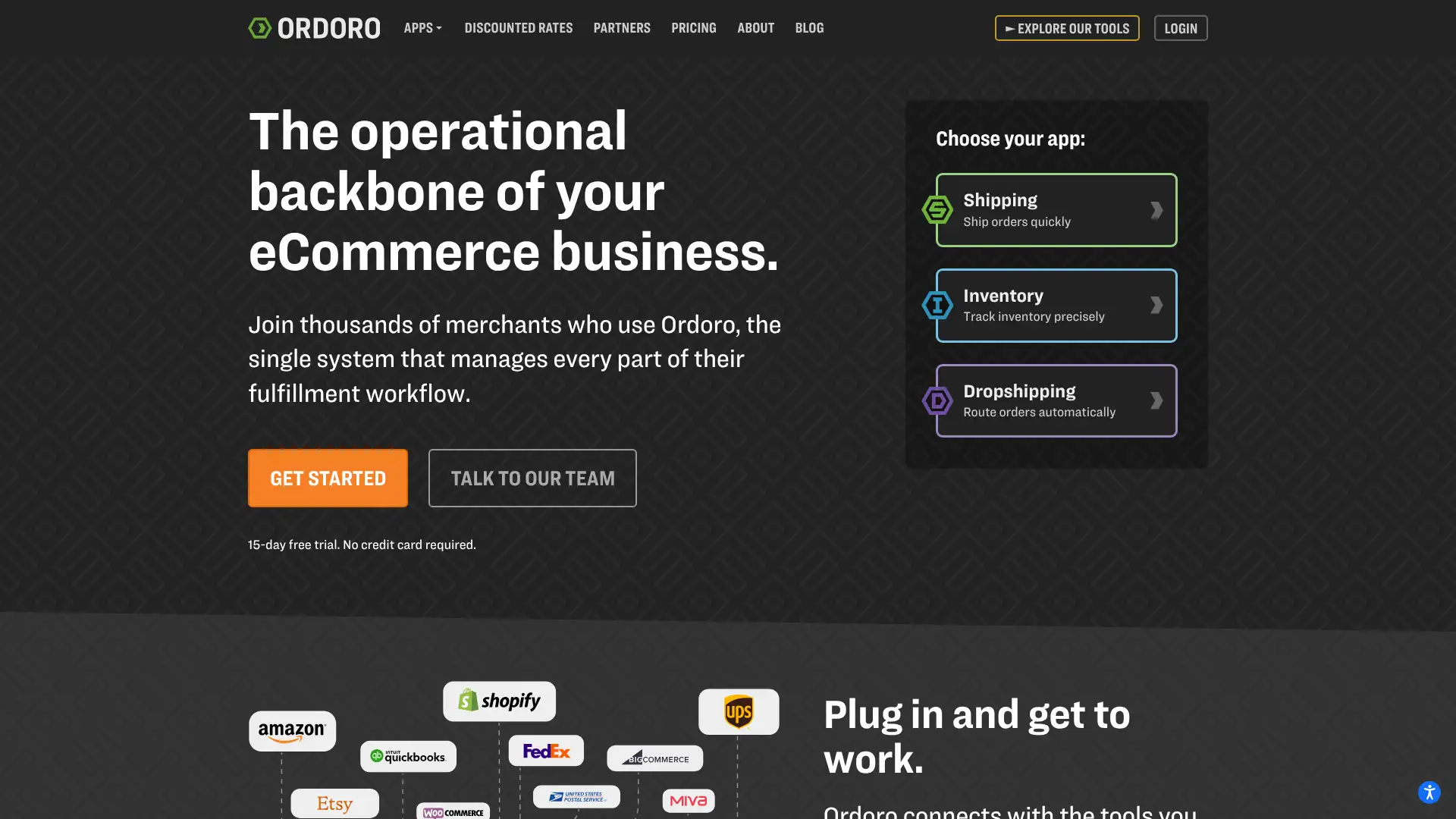
- • Free Shipping app includes unlimited label printing across USPS, UPS, FedEx, and DHL with discounted carrier rates and batch processing for up to 100 orders at once.
- • Multi-warehouse inventory tracking with real-time writeback to Shopify, BigCommerce, WooCommerce, Amazon, and eBay to prevent overselling.
- • Automated purchase order creation triggered by reorder thresholds with supplier management and goods receipt tracking.
- • Dropshipping app auto-routes orders to designated suppliers with tracking sync back to the sales channel.
- • 15-day free trial with no credit card required across all three apps.
Ordoro is the right pick for small to mid-size sellers who want a free shipping foundation they can grow into over time. The modular pricing prevents paying for features you do not need yet. Brands processing over 5,000 orders per month with complex multi-warehouse or forecasting needs will likely find Linnworks or Extensiv a better fit.
Brightpearl by Sage
Brightpearl, acquired by Sage in 2022 for $340 million, is a retail operating system (ROS) designed specifically for multichannel ecommerce brands and wholesalers. It combines order and inventory management, financial management, CRM, warehouse logistics, and an Automation Engine in one platform. Over 1,200 businesses across 26 countries use Brightpearl, processing more than 10 million transactions annually. Pricing is not publicly listed and requires a custom quote; third-party research indicates starting costs around $1,000/month, scaling to $3,000–$5,000/month for high-volume merchants. Brightpearl integrates natively with Shopify, BigCommerce, Magento, Amazon, and eBay.
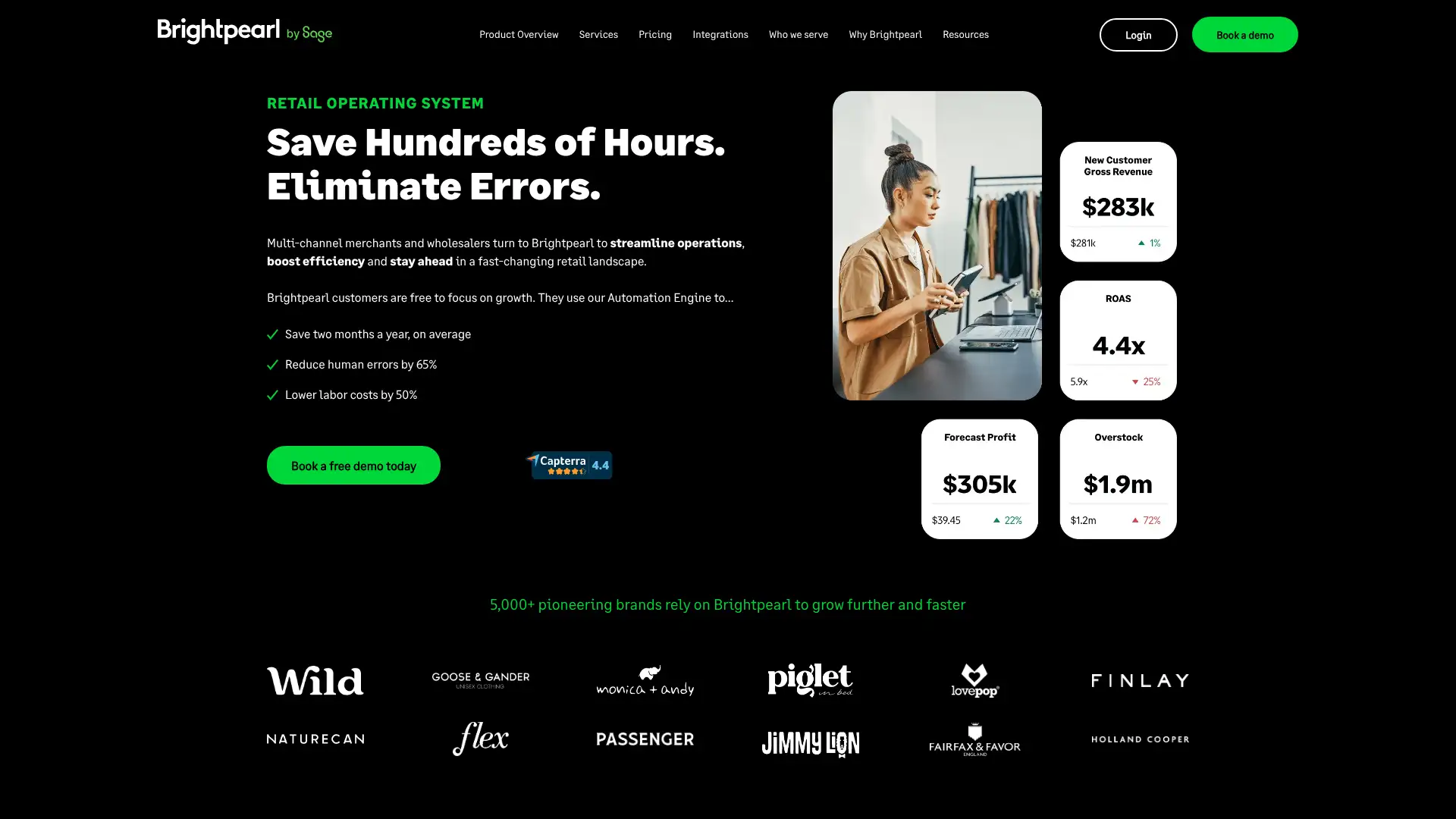
- • Automation Engine processes rules-based order workflows - routing, allocation, invoicing, purchasing - without code, handling thousands of orders per hour.
- • Real-time inventory sync across Shopify, Amazon, eBay, BigCommerce, and wholesale channels with a single source of truth for stock availability.
- • Built-in financial management module includes a general ledger, AP, AR, and bank reconciliation, reducing dependency on a separate accounting tool.
- • Demand forecasting based on historical sales data with AI-driven replenishment recommendations to reduce stockouts by 30–40% according to Brightpearl.
- • Plug-and-play connector library with hundreds of pre-built integrations across carriers, marketplaces, POS systems, and Sage Intacct for enterprise finance.
Brightpearl is the strongest choice for established multichannel retailers and wholesalers in the $1M–$50M revenue range who need automation-heavy back-office operations without a full ERP. Brands under $1M or those needing manufacturing capabilities should evaluate Cin7 Core or Unleashed as more cost-appropriate alternatives.
Cin7 Omni
Cin7 Omni is the flagship product of Cin7, a New Zealand-founded inventory and order management platform now serving over 8,000 businesses in 25+ countries. Following its acquisitions of DEAR Systems and Orderhive in 2021, Cin7 consolidated its product lineup in January 2023 into three branded offerings: Cin7 Omni (the original Cin7), Cin7 Core (formerly DEAR), and Cin7 Orderhive. Cin7 Omni is built for businesses that sell through wholesale, retail, and ecommerce simultaneously, with native EDI support connecting to 700+ retail trading partners. Pricing starts at $349/month on the Standard plan and scales to custom enterprise pricing.
- • Native EDI integration with 700+ retail trading partners including Walmart, Target, and Costco, enabling brands to manage retail compliance without third-party middleware.
- • Multichannel inventory sync across Shopify, WooCommerce, Amazon, eBay, and 700+ ecommerce integrations via the Cin7 Integration Manager.
- • Built-in B2B portal lets wholesale customers self-serve orders, view pricing, and check stock availability without requiring additional software.
- • Automated purchase order generation based on reorder points and lead times, with supplier management and goods receipt workflows.
- • Warehouse management features include bin locations, pick-and-pack workflows, and batch picking for self-managed warehouse operations.
Cin7 Omni is the best fit for product sellers managing complex wholesale, retail, and ecommerce operations simultaneously - particularly those needing native EDI. Businesses that only sell DTC or through two to three digital channels will find Linnworks or Ordoro more appropriately scoped and less expensive.
Extensiv Order Manager
Extensiv Order Manager (formerly Skubana, rebranded after Skubana's acquisition by 3PL Central and the combined company's rebrand to Extensiv in 2022) is an enterprise-grade order and inventory management platform for DTC brands and omnichannel sellers. The platform unifies orders, inventory, purchasing, and shipping from a single cloud dashboard, with one-click integrations to Shopify, Amazon, BigCommerce, eBay, Walmart, and all major carriers. A standout feature is SKU-level profitability reporting that factors in channel fees, FIFO costs, and overhead to give merchants a true unit economics view. Pricing is custom and quote-based; the platform is positioned at mid-market and enterprise sellers.
- • SKU-level profitability reporting accounts for Amazon settlement fees, FIFO inventory values, and overhead costs - a level of P&L granularity that most OMS platforms do not provide natively.
- • Algorithmic order routing engine directs each order to the optimal warehouse, 3PL, or dropshipping vendor based on cost, proximity, and stock availability rules.
- • No limits on users, warehouses, or sales channels - the platform scales without per-seat fees or integration surcharges.
- • Fully automated purchase order generation based on sales velocity, lead times, and seasonality per SKU, reducing manual replenishment planning.
- • 3PL and dropship vendor network management allows brands to route orders to partner fulfillment centers directly from the same dashboard as self-managed warehouses.
Extensiv Order Manager is a strong pick for high-volume omnichannel brands that need rigorous SKU-level cost accounting alongside multi-warehouse routing. The no-limits user and channel model is genuinely valuable as businesses scale. Smaller sellers or those with tight budgets should request pricing carefully, as the platform is positioned well above entry-level OMS tools.
Linnworks
Linnworks, founded in 2002 and headquartered in London with US operations, is a cloud-based order and inventory management platform used by over 4,000 multichannel retailers globally. The platform handles order import, inventory sync, shipping automation, and listing management across 100+ marketplace and carrier integrations. Linnworks was acquired by Veras Retail in 2021. Pricing is based on order volume rather than user count or revenue percentage, starting around $449/month. In 2022 Linnworks acquired SkuVault, adding a more structured warehouse management tier.
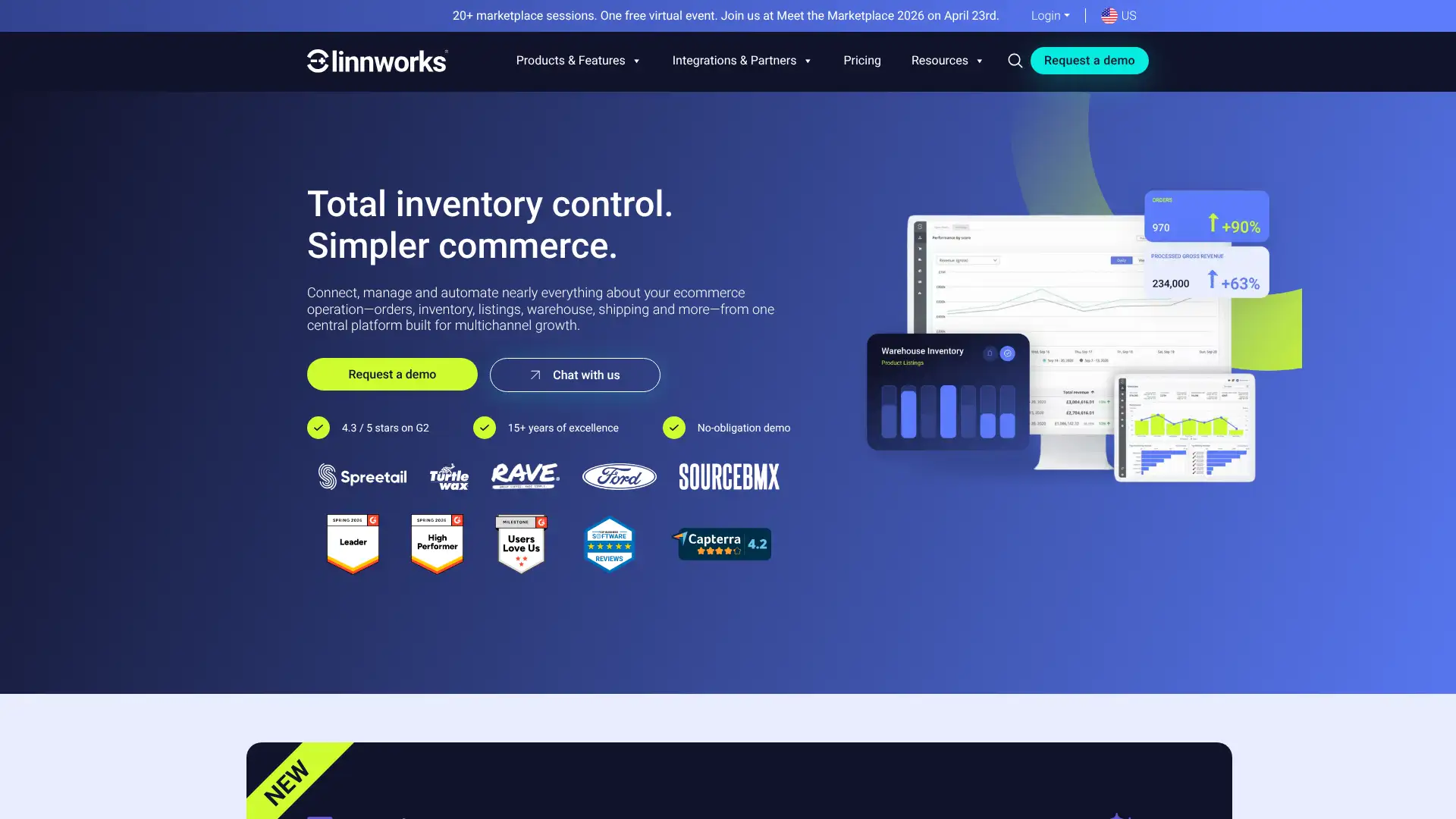
- • Rules-based order automation engine routes, merges, splits, and tags orders across 100+ marketplaces and carriers without manual intervention.
- • Real-time inventory sync across Amazon, eBay, Shopify, Walmart, TikTok Shop, and 100+ other channels prevents overselling and updates all channels simultaneously on each sale.
- • Listing management module (add-on) lets sellers create, edit, and bulk-update product listings directly from Linnworks across multiple marketplaces.
- • Wave and batch picking workflows with WMS add-on guide warehouse staff through bin-level pick operations with mobile scanning support.
- • Connected CommerceOps model integrates analytics, forecasting, and purchasing into one dashboard for a full operational view.
Linnworks is the go-to platform for multichannel sellers whose primary complexity is managing orders and inventory across 5+ marketplaces simultaneously. The broad connector library and volume-based pricing model make it well-suited for mid-market ecommerce operators. Brands with heavy warehouse operations or weight-based inventory should evaluate ShipHero or Brightpearl alongside Linnworks.
Sellbrite
Sellbrite, acquired by GoDaddy in 2019, is a multichannel inventory and order management platform targeted at small to medium-sized ecommerce businesses. The platform connects Amazon, eBay, Walmart, Etsy, Shopify, BigCommerce, and WooCommerce into a single dashboard, with inventory syncing every 15 minutes. A free Forever plan supports up to 30 orders per month, making it one of the most accessible entry points for multichannel selling. Shopify users access a discounted pricing tier starting at $19/month. GoDaddy integration adds domain, website, and payment tooling for sellers building their brand presence.
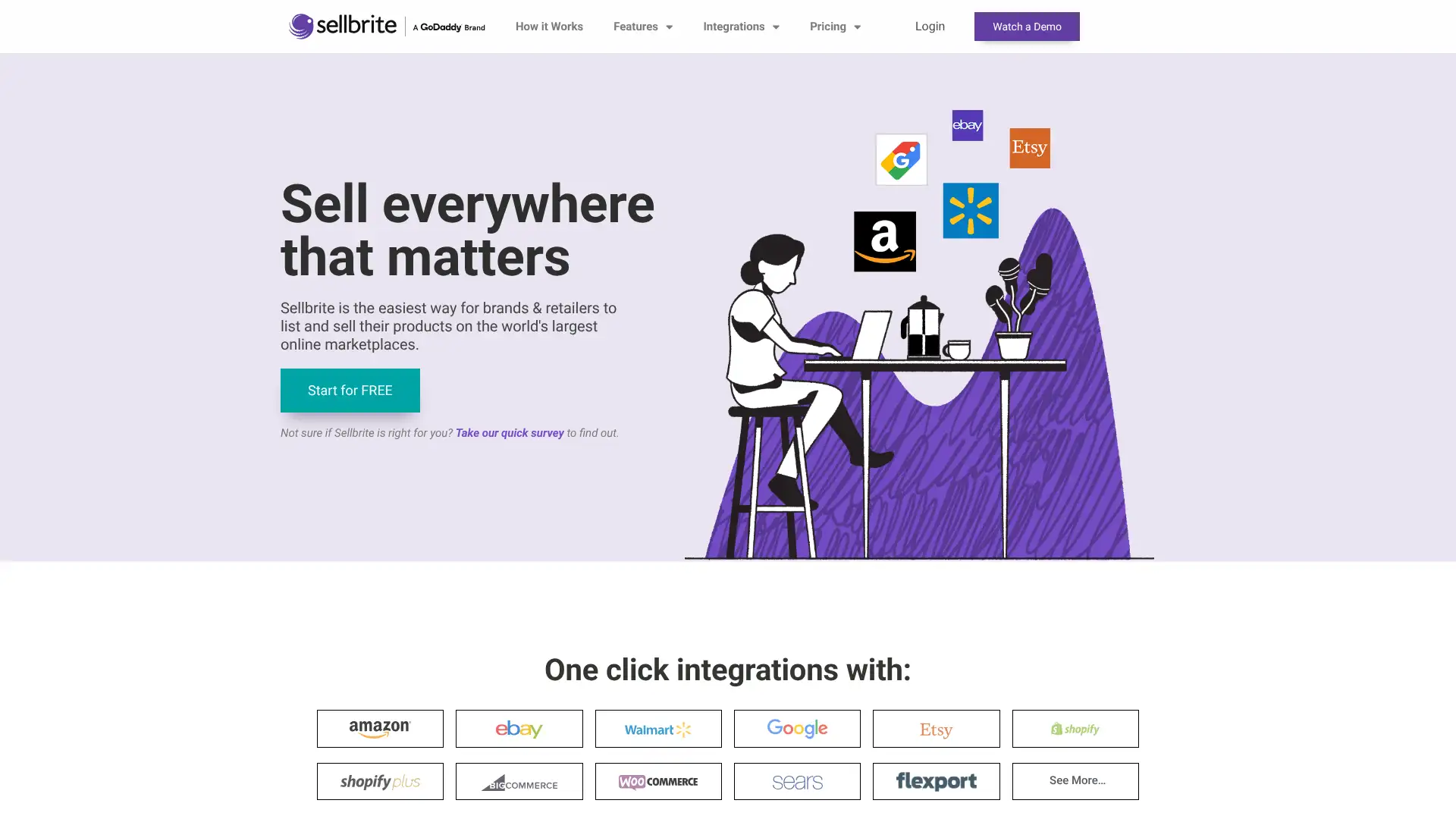
- • Real-time inventory sync across all connected channels updated approximately every 15 minutes, reducing overselling risk across Amazon, eBay, Walmart, and Shopify simultaneously.
- • Bulk listing creation with channel-specific templates lets sellers publish products to multiple marketplaces from a single product form.
- • Amazon FBA integration imports FBA inventory quantities into Sellbrite and auto-routes multi-channel fulfillment orders to Amazon's warehouse network.
- • Order consolidation dashboard pulls all marketplace orders into a single queue with filtering, tagging, and batch fulfillment tools.
- • Forever Free plan with all channel connections included requires no credit card and has no time limit - unusual for the SaaS industry.
Sellbrite is the right tool for small sellers taking their first steps into multichannel selling who want a zero-cost way to connect Amazon, eBay, Walmart, and Shopify. As order volume pushes past 500/month and shipping label needs become pressing, pairing Sellbrite with Ordoro's free Shipping app or upgrading to Linnworks becomes the natural next step.
Rithum (formerly ChannelAdvisor)
Rithum was formed in December 2023 when CommerceHub - which had acquired ChannelAdvisor in November 2022 for $660 million - rebranded the combined entity. The platform now processes over $50 billion in annual GMV across 40,000+ customers and 420+ marketplace and retail channels globally. Rithum's core strengths are marketplace listing management, drop-ship program orchestration, and retail media advertising. It is not an inventory management system - Rithum requires external inventory data to be fed in. In September 2025, Rithum launched RithumIQ, an AI engine for automated operational recommendations. Pricing is enterprise-only with no published tiers; customers report costs of $1,000–$5,000+/month with revenue-share components at higher volumes.
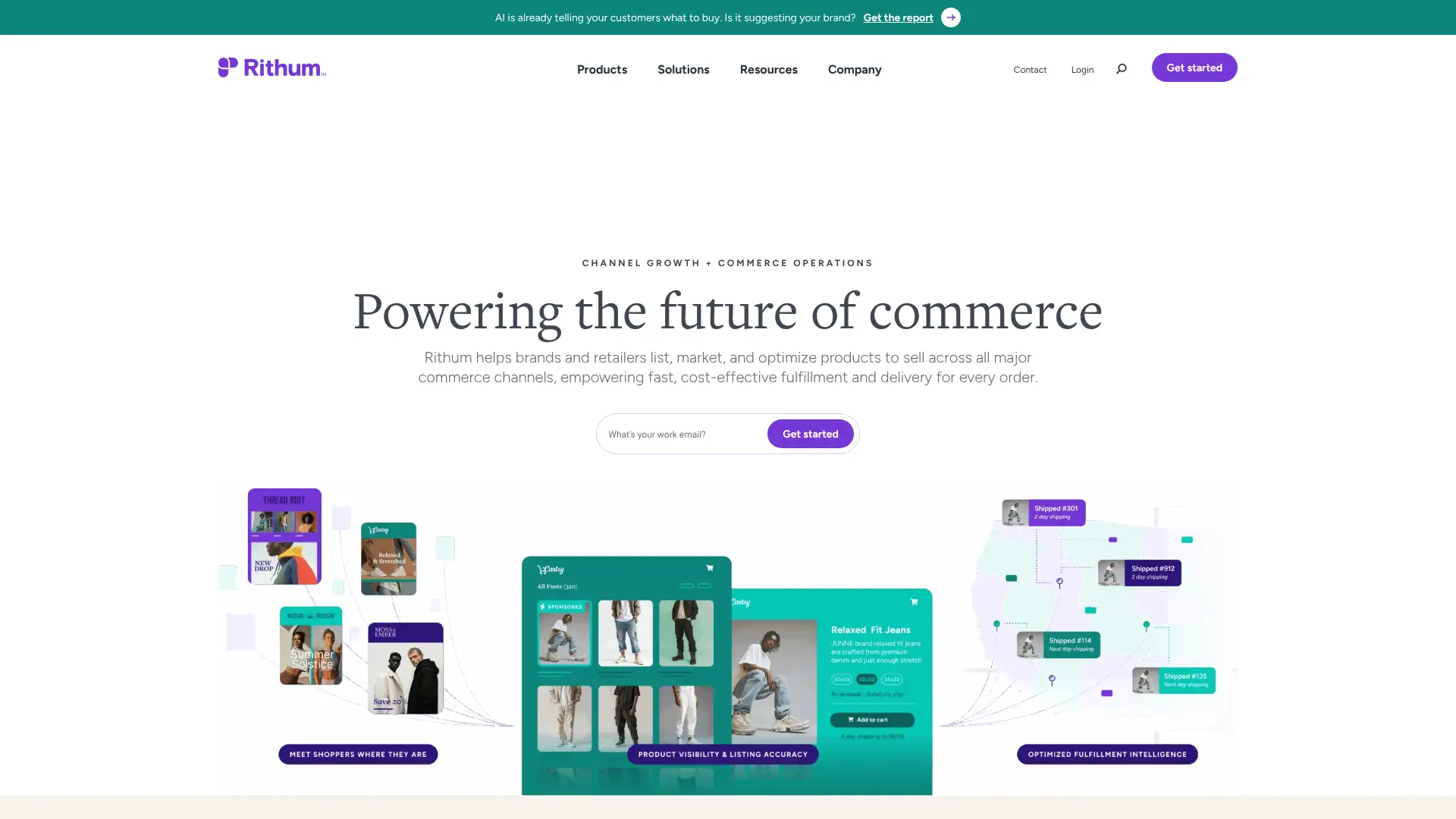
- • Marketplace Listings: distribute and manage product content, pricing, and availability across 420+ marketplaces and retail sites from a single catalog.
- • Drop-ship orchestration connects brands to retailer drop-ship programs (Walmart, Target, Best Buy) with automated PO receipt, routing, and acknowledgment.
- • Retail media management integrates Amazon Advertising, Walmart Connect, and other retail media networks for coordinated paid channel management.
- • RithumIQ (launched September 2025) provides AI-driven operational recommendations including listing optimization, channel expansion suggestions, and fulfillment insights.
- • EDI connectivity supports first-party retail programs with retailers that require electronic data interchange for purchase orders and advance shipping notices.
Rithum is the right tool for large enterprise brands and retailers running drop-ship programs or managing product listings across hundreds of channels simultaneously - particularly those with existing ChannelAdvisor contracts. Mid-market sellers should carefully evaluate the price increase risk post-contract renewal and consider whether Channable or Sellercloud delivers comparable listing management at a significantly lower cost.
Sellercloud
Sellercloud (now Descartes Sellercloud following its acquisition by Descartes Systems Group in October 2024) is a configurable omnichannel ecommerce operations platform serving multichannel retailers, wholesalers, and brands. The platform centralizes catalog, inventory, orders, warehouse management, shipping, purchasing, and accounting in one system with 350+ pre-built integrations including Amazon, Walmart, eBay, Shopify, and major carriers. Pricing is usage-based at a monthly minimum of $1,199 covering per-order charges - all features are included in every subscription, with no tiered feature gates. Advanced warehouse management adds $10/user/month. Dedicated server hosting starts at $1,199/month as an add-on.
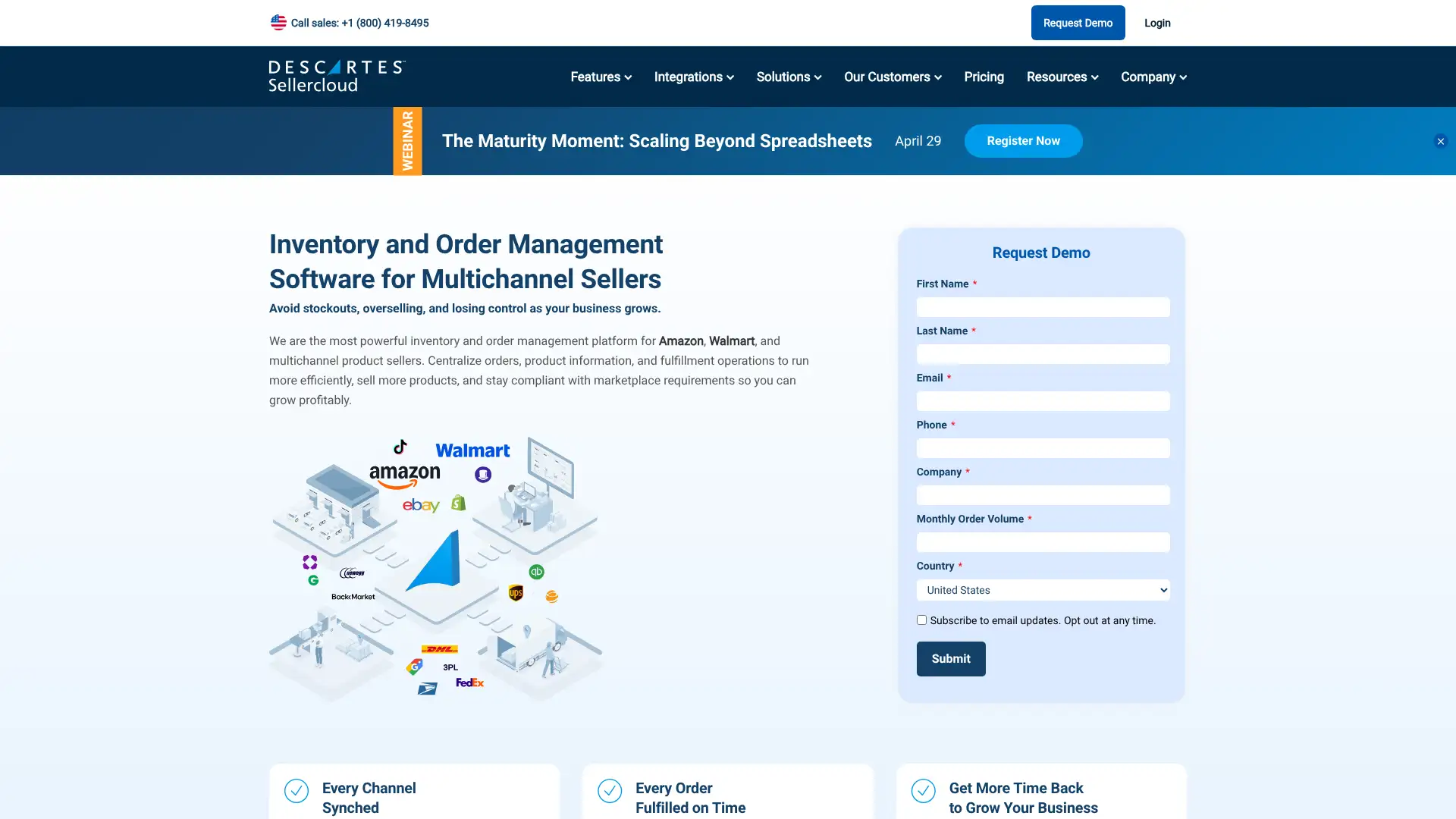
- • All-features-included pricing model means every subscriber accesses the full platform - no feature gates or module upgrades required to unlock functionality.
- • Real-time inventory sync across 350+ channels including Amazon, Walmart, eBay, Shopify, BigCommerce, and Etsy with bin-level warehouse tracking.
- • Predictive purchasing module recommends reorder quantities based on sales velocity history, preventing stockouts without manual forecasting.
- • Shipping automation with carrier rate shopping across USPS, UPS, FedEx, and DHL - rules route each order to the cheapest qualifying carrier automatically.
- • Role-based access controls and 2FA allow teams to restrict employee visibility to specific warehouse zones, channels, or order types.
Sellercloud suits mid-market sellers who want a single platform covering catalog, inventory, warehouse, and shipping without paying per feature unlock. The $1,199 floor makes it a poor fit for early-stage brands. The Descartes acquisition positions the platform well for brands that anticipate supply chain complexity growth over the next 3–5 years.
Ecomdash
Ecomdash is a multichannel ecommerce management platform acquired by Endurance International Group (now Newfold Digital) in 2019. The platform covers inventory management, order management, product listing, and shipping label creation for sellers on Amazon, eBay, Etsy, Shopify, WooCommerce, and Walmart. Ecomdash operates as a smaller, more affordable alternative to enterprise OMS tools, targeting small businesses managing under 10,000 orders per month. The platform has remained active under Newfold Digital's ownership, with support still operating as of early 2025. Pricing details are not prominently displayed and require direct contact.
- • Centralized order dashboard aggregates orders from Amazon, eBay, Etsy, Shopify, WooCommerce, Walmart, and other channels into a single interface.
- • Inventory sync updates stock levels across all connected channels when an item sells, reducing manual quantity adjustments.
- • Shipping label printing integrates with USPS, UPS, and FedEx directly within the platform without a separate shipping tool subscription.
- • Product listing management supports creating and updating listings across multiple marketplaces from one catalog.
- • Purchase order management tracks supplier orders and updates inventory upon goods receipt.
Ecomdash works for small sellers already using it who value the all-in-one workflow, but new buyers should consider that the platform has seen limited development since 2019. Sellbrite's free plan or Ordoro's modular approach offer more actively developed alternatives at comparable or lower cost.
ShipStation
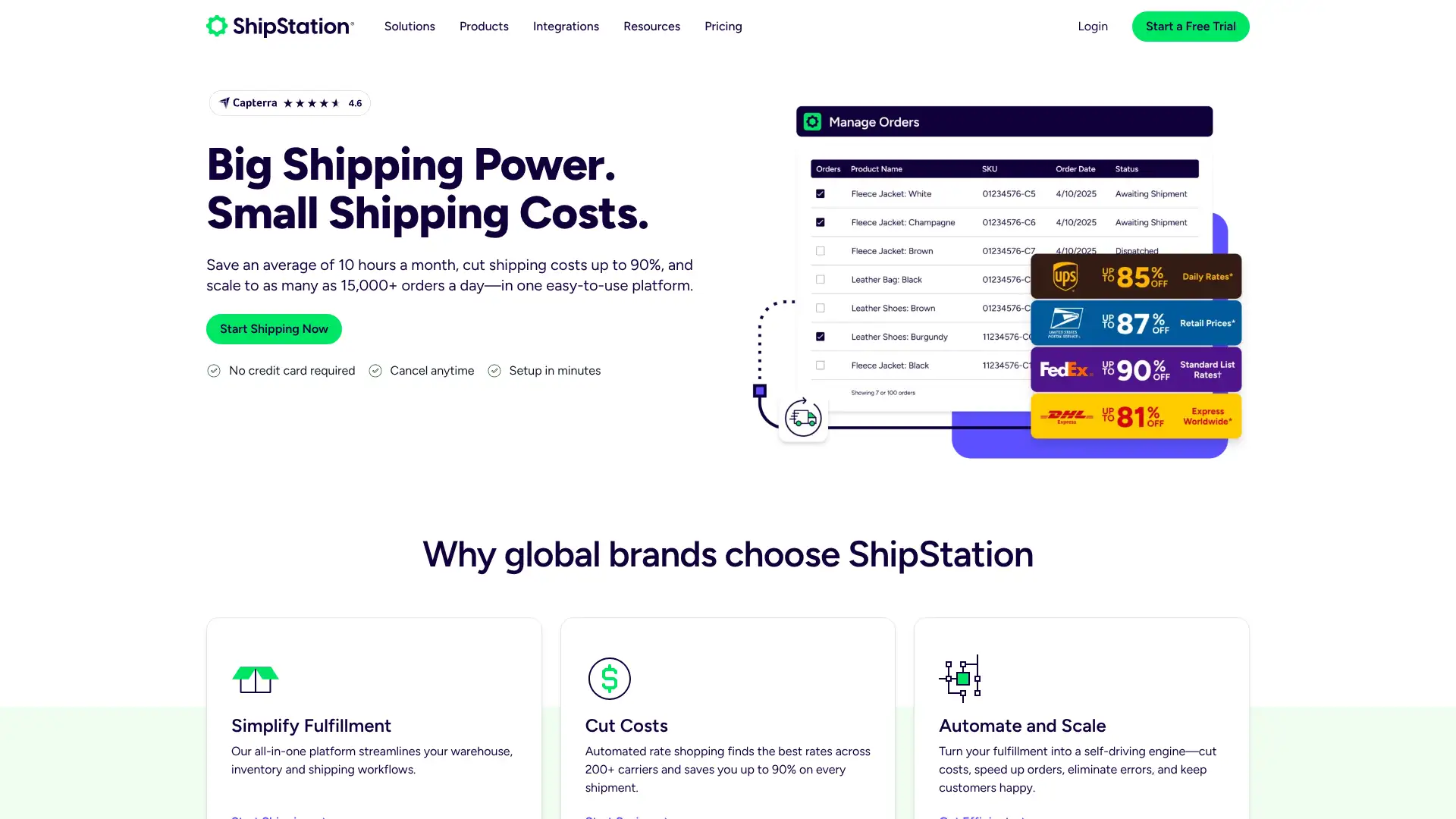
ShipStation is one of the most widely used shipping and order management platforms for ecommerce, processing millions of shipments monthly for brands ranging from Shopify sellers to enterprise retailers. Owned by Auctane (which also owns Stamps.com and ShipEngine), ShipStation connects to 100+ sales channels and 40+ carriers, providing multi-carrier rate shopping, batch label printing, and branded tracking. Plans start at $9.99/month for 50 shipments and scale to $229.99/month for 10,000 shipments, with enterprise pricing above that. ShipStation is primarily a shipping tool with order management features, not a full inventory management system.
- • Multi-carrier rate shopping compares live rates from USPS, UPS, FedEx, DHL, and regional carriers at the time of shipment to minimize postage spend.
- • Batch label printing processes up to hundreds of orders simultaneously with pre-configured shipping rules to eliminate per-order manual decisions.
- • Automation rules engine assigns carriers, service levels, package dimensions, and custom tags based on order weight, destination, channel, or SKU.
- • Branded tracking pages and customized packing slips with company logo and promotional messaging improve post-purchase customer experience.
- • 100+ integrations include Shopify, WooCommerce, Amazon, eBay, Walmart, Etsy, BigCommerce, and most major ecommerce platforms.
ShipStation is the right choice for sellers who need multi-carrier shipping automation and already have inventory managed elsewhere. It is not a replacement for an OMS with inventory sync - brands that need both shipping and inventory management should evaluate Linnworks or Ordoro as a more integrated alternative.
ShipHero
ShipHero is a cloud-based warehouse management system (WMS) built specifically for DTC ecommerce brands running their own warehouse and third-party logistics (3PL) providers. The platform handles order management, inventory tracking, mobile pick-and-pack workflows, carrier rate shopping, and returns from a single system. ShipHero's AI picking optimization reduces picker walking time by 20–30% and claims 99.9% barcode scanning accuracy rates. Pricing starts at approximately $1,995/month for the Standard WMS plan and $2,145/month for the 3PL WMS plan, each including 5 user seats with additional users at $150/seat.
- • AI picking path optimization reduces warehouse travel time by 20–30%, increasing daily pick density without additional staffing according to ShipHero's internal data.
- • Mobile barcode scanning for pick-and-pack workflows achieves 99.9% order accuracy, virtually eliminating mis-picks versus manual paper-based processes.
- • Real-time carrier rate shopping compares USPS, UPS, FedEx, and DHL at the time of shipment packing to minimize label costs on every order.
- • 3PL client portal gives each warehouse client real-time visibility into their inventory levels, order statuses, and billing - a fully white-labeled dashboard.
- • Pack-to-Light technology (via hardware integration) guides packers using LED signals, claimed to boost throughput by up to 450% in high-SKU environments.
ShipHero is the best purpose-built WMS for ecommerce brands running their own fulfillment center or 3PLs servicing DTC brands at volume. The AI picking and scan-accuracy capabilities deliver measurable ROI for operations processing 500+ orders per day. Smaller sellers or those without a physical warehouse should look at ShipStation or Ordoro instead.
Cin7 Core (formerly DEAR Systems)
Cin7 Core (previously DEAR Systems until the January 2023 rebrand following Cin7's 2021 acquisition) is a cloud ERP with inventory, order management, manufacturing, and accounting integration designed for SMBs and manufacturers. Over 8,000 businesses in 75+ countries use the platform. Cin7 Core starts at $349/month for the Standard plan and includes a 14-day free trial. The platform is particularly strong for businesses that need manufacturing execution (bills of materials, work orders) alongside inventory - a capability not available in most standalone OMS tools. Some legacy DEAR customers have reported price increases of 2–3x following the Cin7 acquisition.
- • Manufacturing execution system (MES) manages bills of materials, work orders, and production runs - enabling manufacturers to track raw materials through to finished goods in the same platform as sales order management.
- • Deep Xero and QuickBooks Online integration synchronizes invoices, bills, payments, and journals in real time, eliminating manual accounting reconciliation.
- • B2B portal allows wholesale customers to self-serve orders with company-specific pricing and stock availability without requiring seller staff intervention.
- • Multi-location inventory tracking with serial and batch number support for industries requiring lot traceability (food, pharma, electronics).
- • Ecommerce integrations connect to Shopify, WooCommerce, Magento, and marketplaces including Amazon and eBay with real-time inventory sync.
Cin7 Core is the strongest choice for SMBs that manufacture or assemble products and need tight accounting integration with Xero or QuickBooks - a combination that very few tools under $1,000/month offer. The price volatility following the DEAR acquisition is a genuine risk for budget-sensitive teams; evaluate Unleashed or Katana as alternatives if pricing stability is a priority.
Unleashed Software
Unleashed Software, founded in New Zealand in 2009, is a cloud-based inventory management and B2B sales platform used by manufacturers, distributors, and wholesalers in over 80 countries. The platform connects to Shopify, WooCommerce, Magento, Amazon, and key accounting platforms including Xero and QuickBooks Online. Unleashed is positioned as a more affordable alternative to full ERPs, with pricing starting at $349/month for the Small Business plan. It does not offer native warehouse management or manufacturing execution - it focuses on inventory control, purchasing, and sales order management.
- • B2B Sales Portal gives wholesale customers a branded self-service interface to browse products, check availability, place orders, and view order history without seller staff involvement.
- • Real-time inventory sync across Shopify, WooCommerce, and Amazon updates stock levels on every transaction, preventing overselling across DTC and wholesale channels.
- • Batch and serial number tracking supports lot traceability for food, beverage, pharmaceutical, and electronics businesses with compliance requirements.
- • Demand forecasting reports analyze sales velocity and seasonality to recommend reorder quantities and optimal safety stock levels.
- • Xero and QuickBooks Online two-way sync reconciles invoices, payments, and stock adjustments without manual accounting entry.
Unleashed is the best fit for distributors, wholesalers, and product businesses that prioritize inventory accuracy, B2B order management, and clean accounting integration over warehouse operations and manufacturing. Brands with physical warehouses or light manufacturing needs should consider Cin7 Core or Katana to avoid supplementing Unleashed with additional tools.
Katana
Katana is a cloud-based manufacturing resource planning (MRP) and inventory management platform designed for small to mid-size manufacturers. Founded in Estonia in 2017, Katana serves over 1,500 manufacturers in 60+ countries across industries including food, apparel, electronics, and cosmetics. The platform provides real-time production scheduling, bill of materials management, shop floor control, purchase order automation, and direct Shopify and WooCommerce integration. Pricing starts at $179/month on the Starter plan, making it one of the most affordable MRP tools for sub-100-employee manufacturers. A 14-day free trial is available.
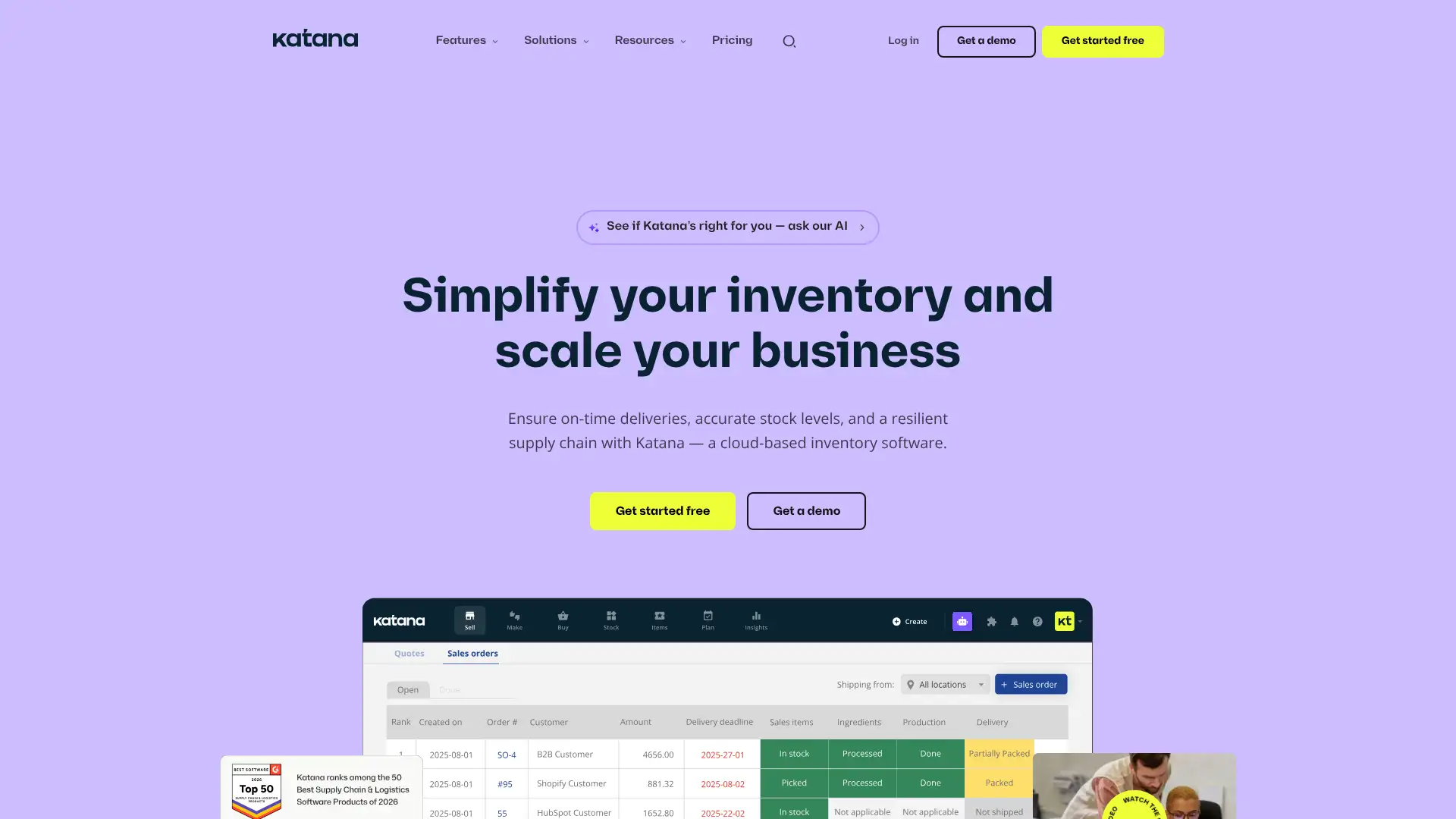
- • Visual production scheduling board gives shop floor managers a real-time drag-and-drop view of all active manufacturing orders, material availability, and capacity constraints.
- • Multi-level BOM (bill of materials) management supports complex product structures with sub-assemblies, variants, and by-products across all manufacturing workflows.
- • Real-time material availability checks block production orders when raw materials are insufficient, preventing commitment to orders the factory cannot fulfill.
- • Direct Shopify and WooCommerce integration auto-creates manufacturing orders when a sales order is placed, linking DTC sales directly to production without manual entry.
- • Shop floor app gives production workers a mobile interface to log operations, report completion, and track time against work orders without accessing the main admin.
Katana is the strongest choice for small manufacturers selling DTC on Shopify who need MRP and production scheduling without the cost or complexity of a full ERP. The visual interface and low starting price make it the most accessible manufacturing management tool in its category. Businesses with multi-location production, strict lot traceability requirements, or complex financial management should evaluate Cin7 Core instead.
Fishbowl
Fishbowl is an inventory management and manufacturing software platform that integrates tightly with QuickBooks Desktop - the only dedicated inventory system recommended by Intuit for QuickBooks users. Founded in 2001 and headquartered in Orem, Utah, Fishbowl serves over 40,000 businesses. The platform offers two products: Fishbowl Manufacturing (for production businesses) and Fishbowl Warehouse (for distribution and 3PL). Pricing is based on a perpetual license model with an annual maintenance fee, rather than a monthly SaaS subscription, which differs from most modern OMS tools. Starting licenses begin around $4,395 with annual support costs.
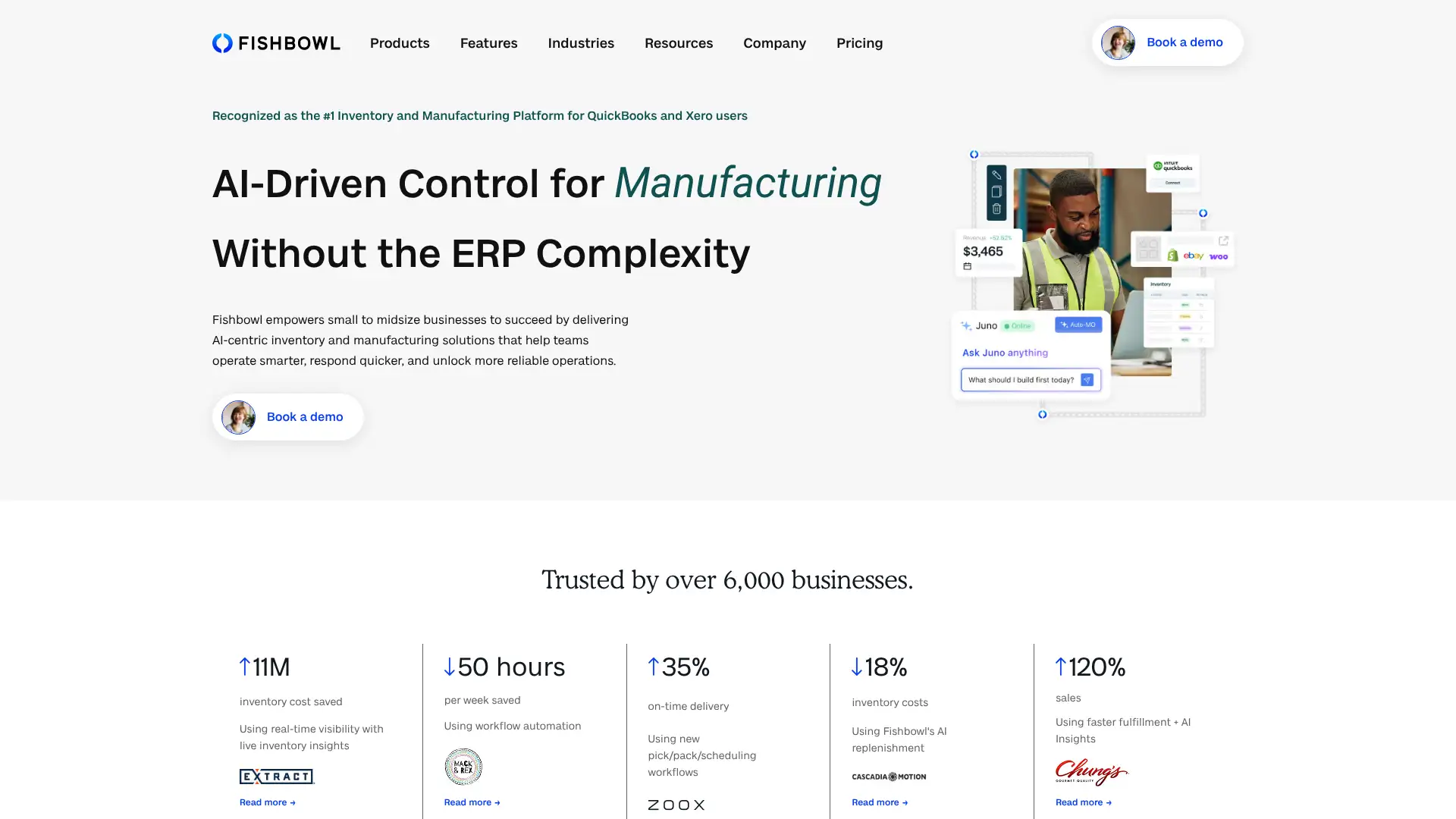
- • QuickBooks Desktop integration is the deepest of any inventory tool - Fishbowl passes purchase orders, work orders, invoices, and inventory adjustments bi-directionally without manual reconciliation.
- • Manufacturing module includes BOMs, work orders, MRP, and labor tracking for small to mid-size manufacturers producing physical goods.
- • Warehouse management features cover bin-level tracking, barcode scanning, multi-location inventory, cycle counting, and receiving workflows.
- • 40+ shipping carrier integrations with automated label printing and tracking sync across FedEx, UPS, USPS, and DHL.
- • Fishbowl Go cloud edition (launched 2024) provides a SaaS alternative starting at $329/month for businesses unwilling to make the perpetual license investment.
Fishbowl is the right choice for US manufacturers and distributors who are deeply embedded in QuickBooks Desktop and need inventory and manufacturing capabilities that QuickBooks cannot provide natively. For businesses on QuickBooks Online or cloud accounting platforms, a purpose-built cloud OMS like Cin7 Core or Unleashed provides a more modern and compatible alternative.
NetSuite (Order Management)
Oracle NetSuite is a cloud ERP that includes a full order management suite as one of its core modules. Over 41,000 organizations in more than 219 countries use NetSuite for financials, inventory, order management, CRM, manufacturing, and ecommerce. NetSuite OMS handles multi-channel order capture, intelligent order routing, real-time inventory visibility, fulfillment automation, and returns management. Pricing is based on a per-user, per-module model with a platform license base fee - it is not published and must be quoted through Oracle sales. Third-party analysts estimate annual costs starting around $30,000–$50,000 for a basic NetSuite implementation.
- • Multi-channel order capture consolidates orders from Shopify, EDI, B2B portals, call centers, and in-store POS into a single order queue with unified inventory.
- • Intelligent order routing applies configurable rules to allocate orders to the optimal fulfillment location - owned warehouse, 3PL, drop-ship, or store - in real time.
- • Financial management integration means every order, invoice, revenue recognition event, and return automatically posts to the NetSuite general ledger without a separate accounting integration.
- • SuiteCommerce B2C and B2B storefronts built natively on NetSuite, eliminating the data sync complexity of connecting a separate ecommerce platform.
- • Demand planning and MRP modules within the same system allow procurement and order management teams to work from a unified real-time data model.
NetSuite OMS is the right choice for mid-market and enterprise companies that need a single source of truth across finance, inventory, orders, and ecommerce and have the budget and internal resources to support a major implementation. SMBs under $5M in revenue should look at Cin7, Brightpearl, or Unleashed first - the NetSuite investment is rarely justifiable below that threshold.
SAP (Order Management)
SAP offers order management as part of its SAP S/4HANA ERP and as a standalone SAP Order Management Foundation (OMF) cloud service. SAP S/4HANA is used by over 25,000 companies globally including most of the Fortune 500. SAP OMF, introduced for composable commerce deployments, allows enterprises to integrate SAP's order orchestration logic into non-SAP tech stacks using APIs. Pricing for SAP is entirely custom and enterprise-contract-based, typically structured around user licenses, module subscriptions, and infrastructure costs - annual deals commonly range from $500,000 to several million dollars for large deployments.
- • SAP Order Management Foundation (OMF) provides cloud-native order orchestration via API, enabling composable commerce architectures that connect SAP order logic to non-SAP storefronts and ERPs.
- • Global availability management (GAM) shows real-time promising inventory across the entire supply network for customer service teams to make accurate delivery commitments.
- • Distributed order management handles complex fulfillment rules across manufacturing plants, regional distribution centers, third-party suppliers, and retail stores.
- • SAP Business Network integration connects directly with thousands of suppliers and trading partners for real-time PO, ASN, and invoice exchange.
- • Embedded analytics and SAP Analytics Cloud integration provide executive-level dashboards across order cycle time, fill rate, and demand vs. supply variance.
SAP Order Management is the right choice for large enterprises that run SAP as their core ERP and need order orchestration to match the complexity of their global supply chains. Organizations below $100M in revenue, or those without existing SAP investments, will find the cost and implementation timeline unjustifiable compared to mid-market alternatives like NetSuite or Brightpearl.
Oracle (Order Management Cloud)
Oracle Order Management Cloud is part of the Oracle Supply Chain Management (SCM) Cloud suite, which is used by thousands of large enterprises globally. The platform provides order capture, promising, routing, fulfillment, and returns management across channels including DTC, B2B, marketplace, and wholesale. Oracle OMS integrates natively with Oracle ERP Cloud, Oracle Commerce, and Oracle Fusion, making it the natural OMS choice for Oracle-ecosystem organizations. Pricing is enterprise contract-only with no public tiers - typical annual deals run from $500,000 into the millions for large organizations.
- • Orchestration Engine applies configurable fulfillment rules that automatically split, route, and allocate orders across owned warehouses, drop-ship vendors, and third-party logistics partners.
- • Global Available-to-Promise (GATP) checks real-time inventory across the entire supply network to provide accurate delivery date commitments at order entry.
- • Returns and reverse logistics management handles multi-step return workflows including inspection, restocking, refunds, and exchange order creation.
- • Oracle Configurator integration supports make-to-order products with complex configurations, pricing rules, and validation - valuable for manufacturing and high-tech industries.
- • Pre-built Oracle Fusion integration eliminates middleware costs for organizations running Oracle ERP Cloud as their financial system of record.
Oracle Order Management Cloud is the correct investment for large enterprises already running Oracle ERP Cloud or Oracle Fusion who need native, high-scale order orchestration. Organizations on non-Oracle ERP platforms should carefully evaluate whether the integration investment is justified versus Manhattan Associates, Blue Yonder, or Fluent Commerce as independent OMS alternatives.
IBM Sterling Order Management
IBM Sterling Order Management is one of the longest-standing enterprise OMS platforms in the market, with roots going back to the Sterling Commerce acquisition by IBM in 2010. Sterling OMS is used by major global retailers including Walmart Canada, Crate & Barrel, and Gap, particularly for complex omnichannel fulfillment scenarios including BOPIS, ship-from-store, endless aisle, and cross-channel returns. IBM Sterling is deployed on IBM Cloud or hybrid cloud environments. Pricing is enterprise-contract-only with no public list; implementations typically cost $500,000–$5,000,000 in the first year including licensing and services.
- • Distributed order management engine handles BOPIS, ship-from-store, endless aisle, curbside pickup, and cross-channel returns from a single orchestration layer.
- • Real-time inventory visibility across stores, warehouses, suppliers, and 3PLs with configurable sourcing rules that account for proximity, cost, and availability.
- • AI-powered order promising and capacity management optimizes fulfillment promises based on demand signals, supplier lead times, and store-level capacity constraints.
- • Store Engagement features give store associates a purpose-built interface for managing online order fulfillment tasks alongside in-store operations.
- • Supply chain event management monitors order exceptions, delays, and sourcing failures and triggers automated alerts and re-routing workflows.
IBM Sterling Order Management is the right choice for global retailers with existing IBM infrastructure, complex omnichannel networks including hundreds of physical store nodes, and the organizational resources to manage a multi-year implementation. Retailers under $500M in revenue should evaluate Manhattan Associates, Fluent Commerce, or Kibo as more right-sized alternatives.
Manhattan Associates (OMS)
Manhattan Associates is one of the most recognized names in enterprise supply chain technology, with its Order Management System consistently rated as a leader in Gartner Magic Quadrant evaluations. Manhattan Active Omni combines order management, inventory management, customer engagement, and store fulfillment in a single cloud-native platform. Customers include major global retailers such as Levi's, Lululemon, and Restoration Hardware. Pricing is enterprise-contract-only and not publicly listed - annual deal sizes commonly range from $500,000 to several million dollars for full omni deployments.
- • Manhattan Active Omni unifies OMS, inventory optimization, customer order management, and store fulfillment on a single continuously updated cloud platform with no version upgrades required.
- • Enterprise inventory management with global ATP and real-time promising across thousands of network nodes including DC, store, supplier, and third-party fulfillment points.
- • Store fulfillment capabilities include BOPIS management, ship-from-store workflows, curbside pickup, and in-store returns processing with a purpose-built store associate mobile app.
- • Intelligent sourcing engine evaluates cost, proximity, capacity, and carbon footprint simultaneously to select the optimal fulfillment node for each order.
- • Microservices architecture allows retailers to deploy individual OMS capabilities (promising, routing, returns) without replacing the entire tech stack.
Manhattan Associates OMS is the benchmark choice for large enterprise retailers that need best-in-class omnichannel order orchestration backed by 25+ years of retail supply chain expertise. Organizations below $100M in revenue should consider Fluent Commerce or fabric OMS, which offer enterprise-grade capabilities with faster and more affordable implementations.
Blue Yonder (Order Management)
Blue Yonder (formerly JDA Software, acquired by Panasonic in 2021) provides an AI-powered supply chain and order management platform used by over 3,000 companies including Walmart, Amazon, and Microsoft. Blue Yonder's OMS is part of a broader integrated suite covering demand planning, supply planning, warehouse management, and transportation management. The platform's Luminate Platform uses AI and machine learning to optimize order promising, inventory positioning, and fulfillment routing in real time. Pricing is enterprise-contract-only with no published rates - annual engagements typically start at $500,000.
- • Luminate Platform's AI engine continuously optimizes order promising and fulfillment routing based on real-time supply network conditions, reducing split shipments and expedited shipping costs.
- • Demand sensing integrates external signals including weather, social trends, and economic data with internal sales history to improve short-term demand forecasts.
- • Distributed order management connects orders across retail, DTC, B2B, and marketplace channels with configurable routing rules applied to every order in real time.
- • Unified supply chain visibility spans order management, warehouse operations, and transportation from a single data model, enabling cross-functional optimization.
- • Composable microservices architecture allows enterprises to deploy Blue Yonder's OMS capabilities alongside existing ERP and WMS tools without a full platform replacement.
Blue Yonder is the right choice for large enterprises that want AI-driven supply chain optimization spanning demand, supply, and fulfillment in a unified model - particularly in grocery, automotive, and manufacturing verticals. Retailers focused primarily on multichannel order routing without complex supply planning needs will find Manhattan Associates or Fluent Commerce more narrowly focused and potentially faster to implement.
fabric (OMS)
fabric is a San Francisco-based headless commerce platform founded in 2017 by former Amazon executives. It raised $297 million over 5 rounds and reached a $1.5 billion valuation in 2022. At NRF 2024, fabric launched its native Order Management System (OMS) as the first OMS built inside a composable commerce platform, combining order orchestration with dropshipping, PIM, promotions, and storefront management. fabric OMS uses AI-driven distributed order management and integrates natively with Shopify via a plug-in connector. Pricing starts at $4,500/month for the AI DOM plan with an AI Omni add-on at $3,000/month.
- • Native OMS inside a composable commerce platform means order orchestration, product data, promotions, and storefront are on the same data model - eliminating OMS-to-commerce sync latency.
- • AI-driven distributed order management routes each order to the optimal fulfillment node in real time based on cost, proximity, inventory, and configurable business rules.
- • Dropshipping network integration expands product assortment by enabling vendors to fulfill orders directly without the retailer holding inventory.
- • Shopify integration via plug-in connector syncs order and inventory data bidirectionally without ongoing middleware maintenance.
- • Retailers migrating from legacy platforms to fabric reported a 20% increase in conversion rates during Black Friday and Cyber Monday peak periods according to fabric case studies.
fabric OMS is the right choice for mid-market and enterprise retailers who are building a composable commerce architecture and want OMS as a native module rather than a third-party integration. The fast implementation claim and AI routing differentiate it from legacy enterprise platforms. Brands needing a proven 10+ year track record should evaluate Manhattan Associates or IBM Sterling first.
Kibo Commerce
Kibo Commerce is a composable commerce platform built for mid-market and enterprise retailers, combining ecommerce, order management, subscriptions, and AI-personalization in a unified cloud suite. Kibo OMS provides real-time inventory visibility, distributed order management, BOPIS, ship-from-store, and returns orchestration. Customers include Patagonia, Crate & Barrel, and Tempur-Pedic. Kibo was formed through the merger of Mozu, Certona, and Monetate in 2019. Pricing is enterprise-contract-based with no published tiers - typical engagements start around $100,000–$500,000 annually depending on order volume and modules.
- • Unified OMS and commerce platform processes orders from Kibo's own storefront or external ecommerce platforms (Shopify, Salesforce, BigCommerce) via API connections.
- • Distributed order management routes orders across warehouses, stores, and drop-ship vendors with configurable sourcing rules and real-time ATP.
- • BOPIS and curbside pickup fulfillment workflows include store associate apps for order acknowledgment, picking, and customer notification.
- • AI-powered personalization engine (from the Certona acquisition) delivers product recommendations and search results tailored to individual shopper behavior.
- • Subscription management supports recurring order models for consumable products with pause, skip, and frequency modification capabilities.
Kibo Commerce suits mid-market retailers that want unified commerce and OMS in a composable architecture without the enterprise price tag of IBM Sterling or Manhattan Associates. Brands with heavy subscription commerce needs should evaluate Kibo's built-in subscription capabilities as a strong differentiator. For pure OMS without the broader commerce platform, Fluent Commerce or fabric provide more focused alternatives.
Fluent Commerce
Fluent Commerce is an Australian-founded cloud-native distributed order management platform used by global retailers including Superdry, The Iconic, and PSA Group. Fluent OMS is designed as a headless, API-first system that plugs into any ecommerce platform, ERP, or WMS without requiring a full stack replacement. It specializes in global inventory visibility, intelligent order routing, BOPIS, ship-from-store, returns, and real-time availability. Fluent is backed by Tiger Global and Salesforce Ventures and raised $37.5 million in its Series B. Pricing is enterprise-contract-based; typical annual engagements start at $100,000.
- • Headless API-first architecture integrates with any existing ecommerce platform (Shopify, Salesforce Commerce, Magento, SAP) as an independent OMS without requiring replatforming.
- • Global inventory management provides real-time network-wide inventory visibility across warehouses, stores, suppliers, and third-party logistics nodes.
- • Intelligent order routing applies complex business rules including cost optimization, carbon footprint, proximity, and node capacity to select the best fulfillment source.
- • BOPIS, curbside pickup, and ship-from-store workflows include a mobile store associate app for picking, packing, and customer handoff management.
- • Fluent Order API allows brands to expose order management services directly to customers, store associates, and third-party developers via RESTful endpoints.
Fluent Commerce is the strongest choice for mid-to-large retailers that want a modern, headless OMS that deploys alongside existing infrastructure without a full replatform. The API-first design and fast implementation timelines are compelling differentiators against legacy enterprise platforms. US-based brands should verify partner availability before committing, as the North American implementation ecosystem is smaller than for Manhattan Associates or IBM Sterling.
Veeqo
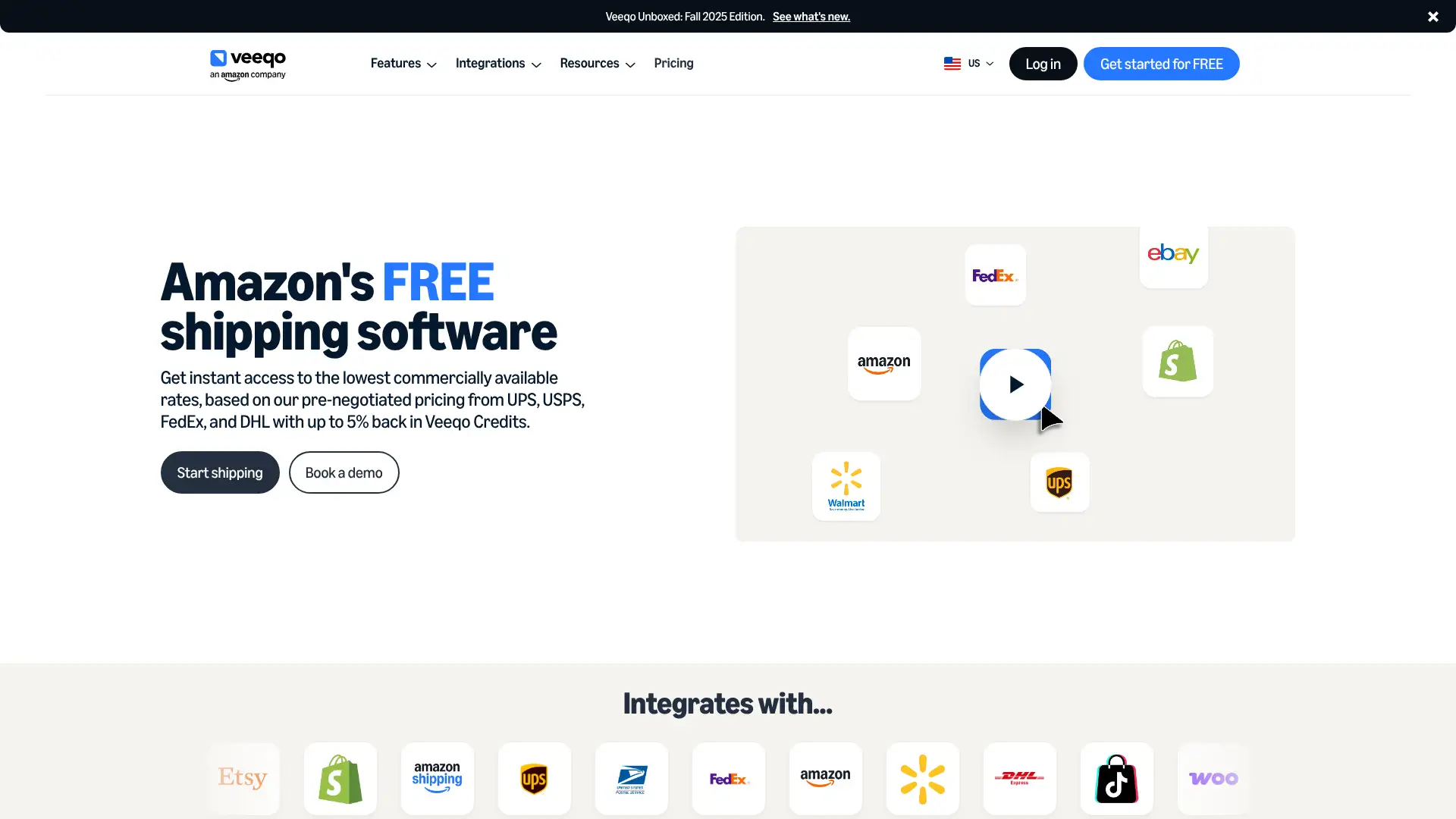
Veeqo is a multichannel inventory and order management platform acquired by Amazon in 2021 and made completely free for sellers in 2022. The platform connects Amazon, Shopify, eBay, Walmart, Etsy, WooCommerce, and other channels, providing real-time inventory sync, order management, and shipping label printing at no monthly charge. Veeqo is funded by Amazon and earns revenue when sellers use Amazon-negotiated carrier rates - which are often 5% below carrier-direct pricing. As of 2025, Veeqo offers access to Amazon's deeply discounted USPS, UPS, and FedEx rates to all sellers regardless of shipping volume.
- • Completely free platform with no order limits, user caps, or feature gates - Amazon subsidizes the platform in exchange for sellers using Amazon-discounted carrier rates.
- • Access to Amazon-negotiated carrier rates for USPS, UPS, FedEx, and DHL - available to all Veeqo users regardless of individual shipping volume.
- • Real-time inventory sync across Amazon, Shopify, eBay, Walmart, Etsy, and WooCommerce from a single dashboard.
- • Multichannel order management imports and processes orders from all connected channels with batch label printing and automated carrier selection.
- • Amazon Warehousing and Distribution (AWD) and FBA inventory visibility is included, allowing sellers to manage both FBA and self-fulfilled inventory from one view.
Veeqo is the best starting point for any seller who wants professional multichannel order management, inventory sync, and carrier rate shopping at zero cost. The platform's Amazon ownership and deeply discounted carrier rates make it a genuinely strong choice even compared to paid tools for sellers who are comfortable with the Amazon ecosystem alignment. When analytics, forecasting, or B2B capabilities become priorities, Linnworks or Extensiv should be evaluated.
Zentail
Zentail is a multichannel commerce operations platform specializing in product listing syndication, catalog management, and order management across Amazon, Walmart, Target Plus, eBay, Google Shopping, and more. Founded in 2015 and headquartered in Washington DC, Zentail serves brands and distributors managing thousands of SKUs across multiple retail channels. The platform's SMART Types technology normalizes product data into channel-specific listing formats automatically, reducing the manual attribute mapping work typical of listing management. Pricing is custom and enterprise-quoted; starting costs are typically in the $1,000–$3,000/month range.
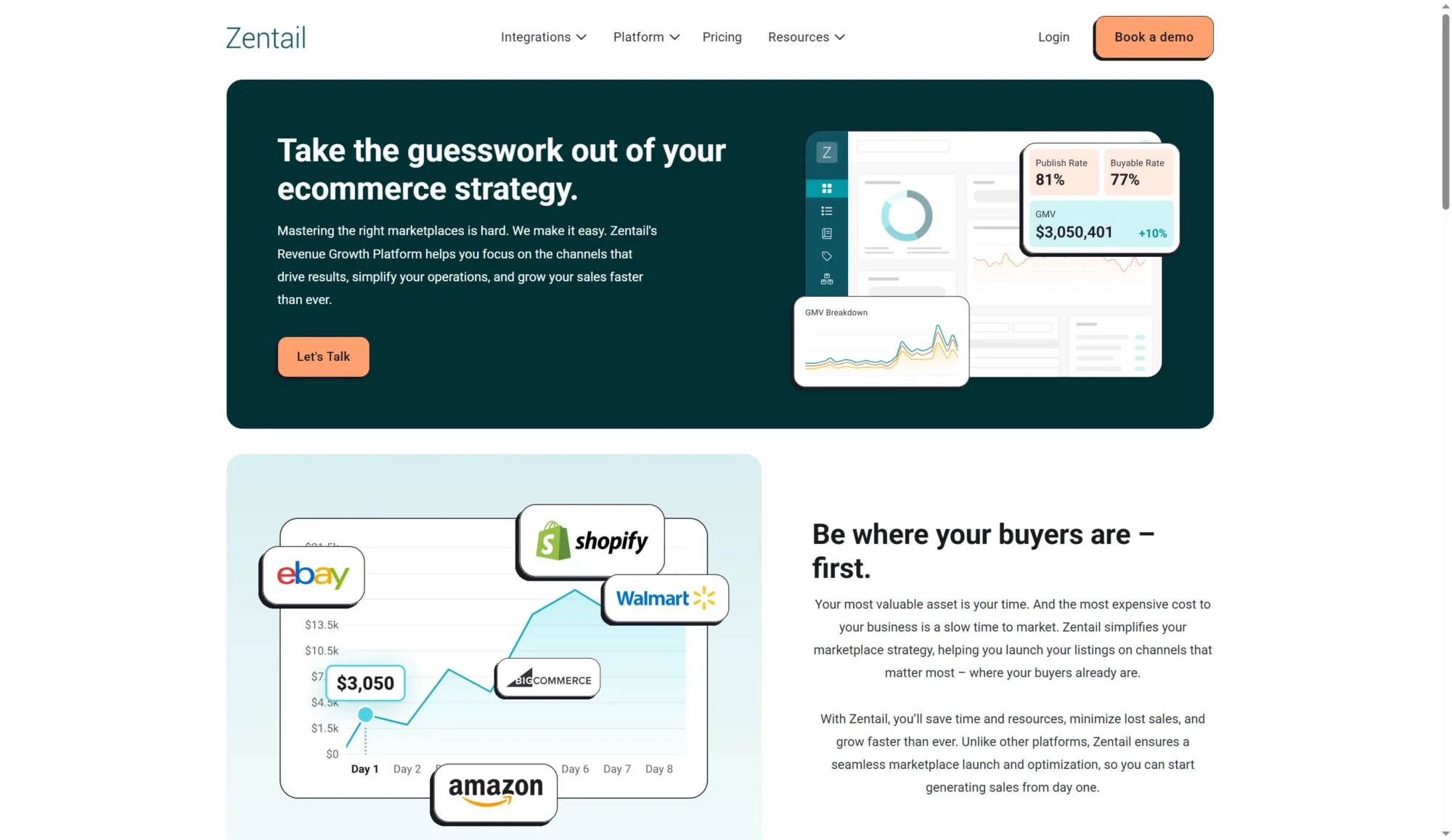
- • SMART Types automatically maps product catalog data to channel-specific listing requirements, reducing the attribute mapping work required when expanding to a new marketplace.
- • Listing error management proactively identifies and surfaces Amazon, Walmart, and Target listing suppression errors with guided resolution workflows.
- • Real-time inventory sync prevents overselling across all connected channels with immediate quantity updates on every order.
- • Multichannel order management consolidates orders from Amazon, Walmart, Target Plus, eBay, and website orders into a single fulfillment dashboard.
- • Analytics dashboard provides channel-level sales performance, buy box percentage, and listing health metrics across all connected marketplaces.
Zentail is the right choice for brands with large catalogs selling through Amazon, Walmart, and Target who need intelligent listing automation and error management to protect marketplace revenue. Sellers primarily focused on inventory and order routing rather than listing syndication will find Linnworks or Extensiv a better primary OMS and can use Zentail as a specialized listing layer on top.
Listing Mirror
Listing Mirror is a multichannel listing, inventory, and order management platform based in the US, serving ecommerce sellers who need to manage product listings across Amazon, eBay, Walmart, Shopify, Etsy, and other channels from a single interface. The platform is positioned as an affordable mid-market alternative to enterprise listing tools like Zentail or Rithum. Listing Mirror supports listing creation, bulk editing, inventory sync, and order routing. Pricing starts at $129/month for the Starter plan covering up to 5 sales channels and 1,000 products.
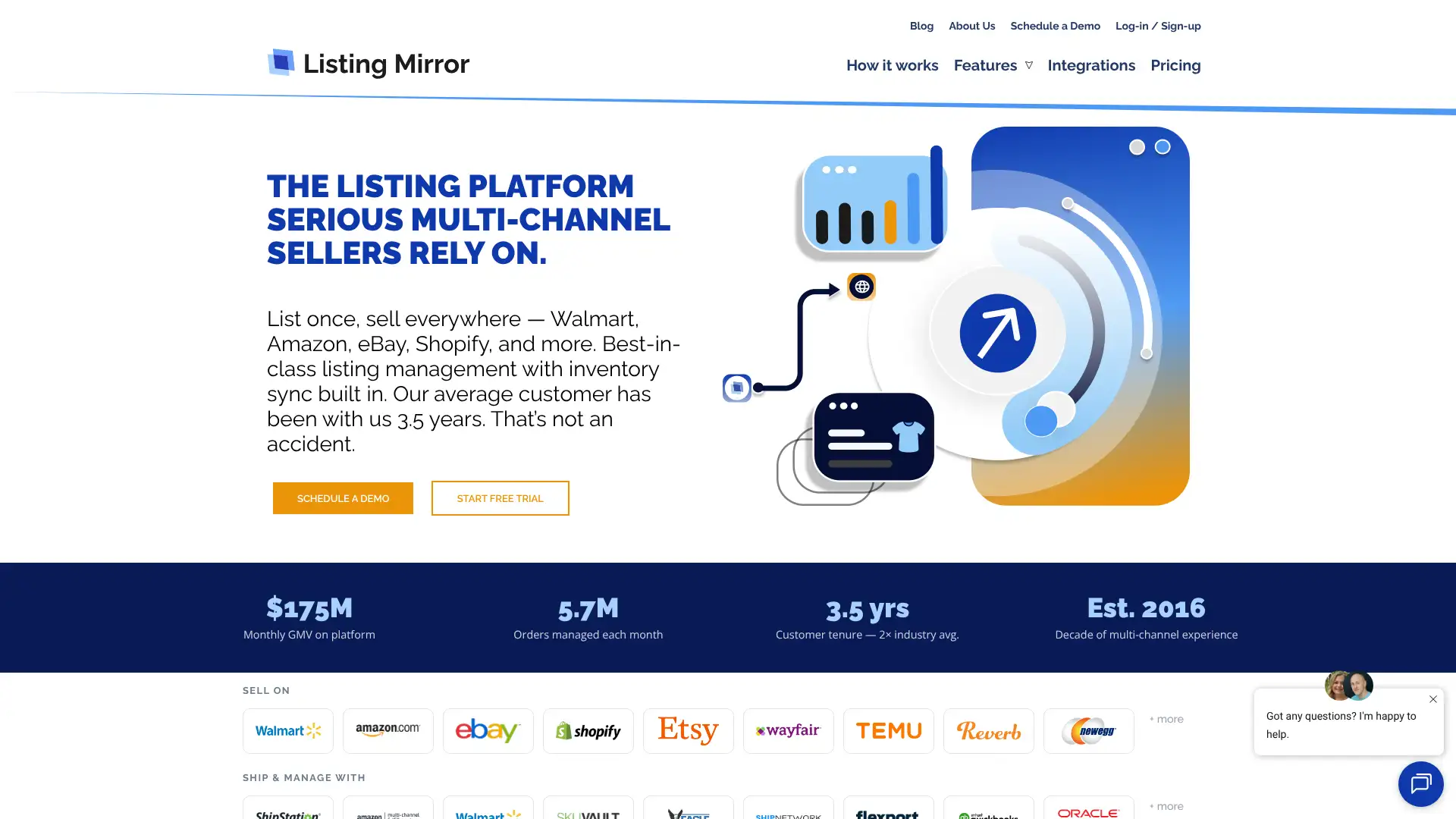
- • Multi-channel listing creation and editing across Amazon, eBay, Walmart, Shopify, Etsy, and 30+ other channels from a single product catalog.
- • Real-time inventory sync prevents overselling across all connected channels with automatic quantity adjustments on each sale.
- • Order management consolidates orders from all channels into a unified queue with batch fulfillment and tracking sync back to each marketplace.
- • Listing mirroring technology replicates product changes made on one channel across all connected channels automatically, reducing duplicate data entry.
- • Variation management handles product variants (size, color, style) with channel-specific mapping to each marketplace's variant taxonomy.
Listing Mirror is a solid choice for growing multichannel sellers who need affordable listing syndication and inventory sync without paying enterprise OMS prices. At $299/month for the Professional plan, it covers the core multichannel needs of most mid-size sellers. Brands that prioritize analytics, warehouse management, or demand forecasting alongside listing management will quickly find Listing Mirror's capabilities limiting.
Channable
Channable is a Dutch-founded product feed management and multichannel automation platform used by over 7,500 businesses in 100+ countries, including agencies managing feeds for large retail clients. The platform specializes in creating, transforming, and syncing product data feeds to 2,500+ shopping channels, marketplaces, and advertising platforms including Google Shopping, Amazon, Facebook Catalog, Bol.com, and Zalando. Channable also includes an order management module that consolidates marketplace orders and syncs them back to ecommerce platforms or ERP systems. Pricing starts at $39/month for basic plans with channel-based scaling.
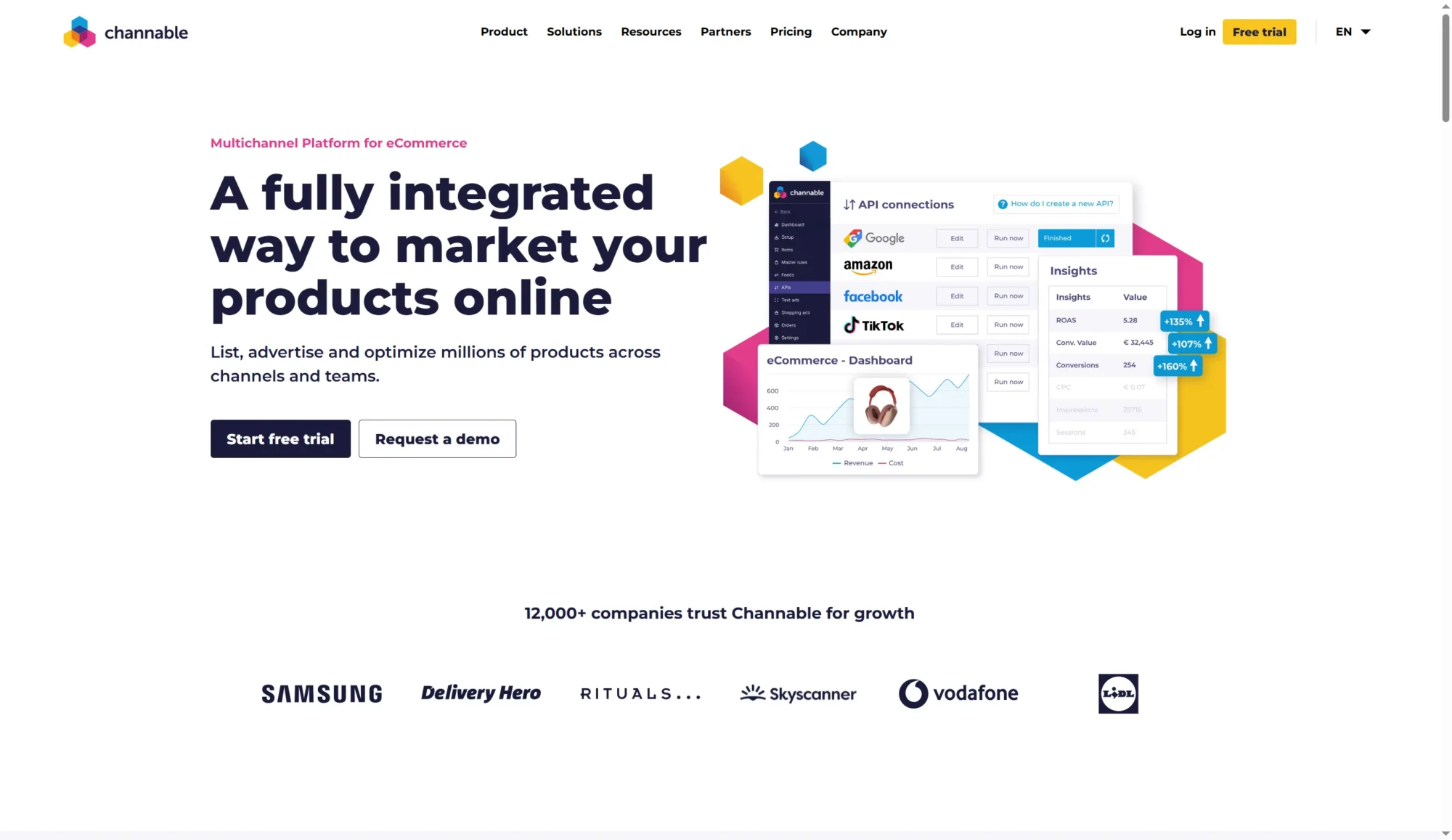
- • Rule-based feed transformation engine applies pricing rules, category mapping, title optimization, and exclusion filters to product data without coding.
- • 2,500+ channel connections cover shopping ads (Google, Microsoft, Facebook), marketplaces (Amazon, eBay, Zalando, Bol.com), and affiliate networks from a single feed platform.
- • Order import module consolidates marketplace orders into Channable and syncs them back to Shopify, WooCommerce, Magento, or ERP platforms.
- • Dynamic pricing rules adjust product prices on specific channels based on competitor prices, margins, or inventory levels.
- • Agency multi-project management allows digital marketing agencies to manage product feeds for multiple retail clients from a single Channable account.
Channable is the best tool for ecommerce businesses and agencies whose primary need is product feed management for Google Shopping, Amazon Sponsored Products, and European marketplaces. Its OMS capabilities are useful for feed-driven order sync but are not a replacement for a dedicated multichannel inventory and order management system. Sellers needing real inventory management alongside listing distribution should pair Channable with Linnworks or Ordoro.
Shopiroller
Shopiroller is a no-code headless ecommerce platform that includes built-in order management, multichannel selling, and inventory control. It allows businesses to launch a web store, mobile app, and marketplace listings from a single platform without technical expertise. Shopiroller integrates with Amazon, eBay, Google Shopping, Facebook, and Instagram and syncs inventory and orders across all channels from a centralized dashboard. The platform is designed for SMBs and entrepreneurs who want an ecommerce and order management solution bundled together rather than separate tools. Pricing and plan details are available on shopiroller.com with free plan and paid tier options.
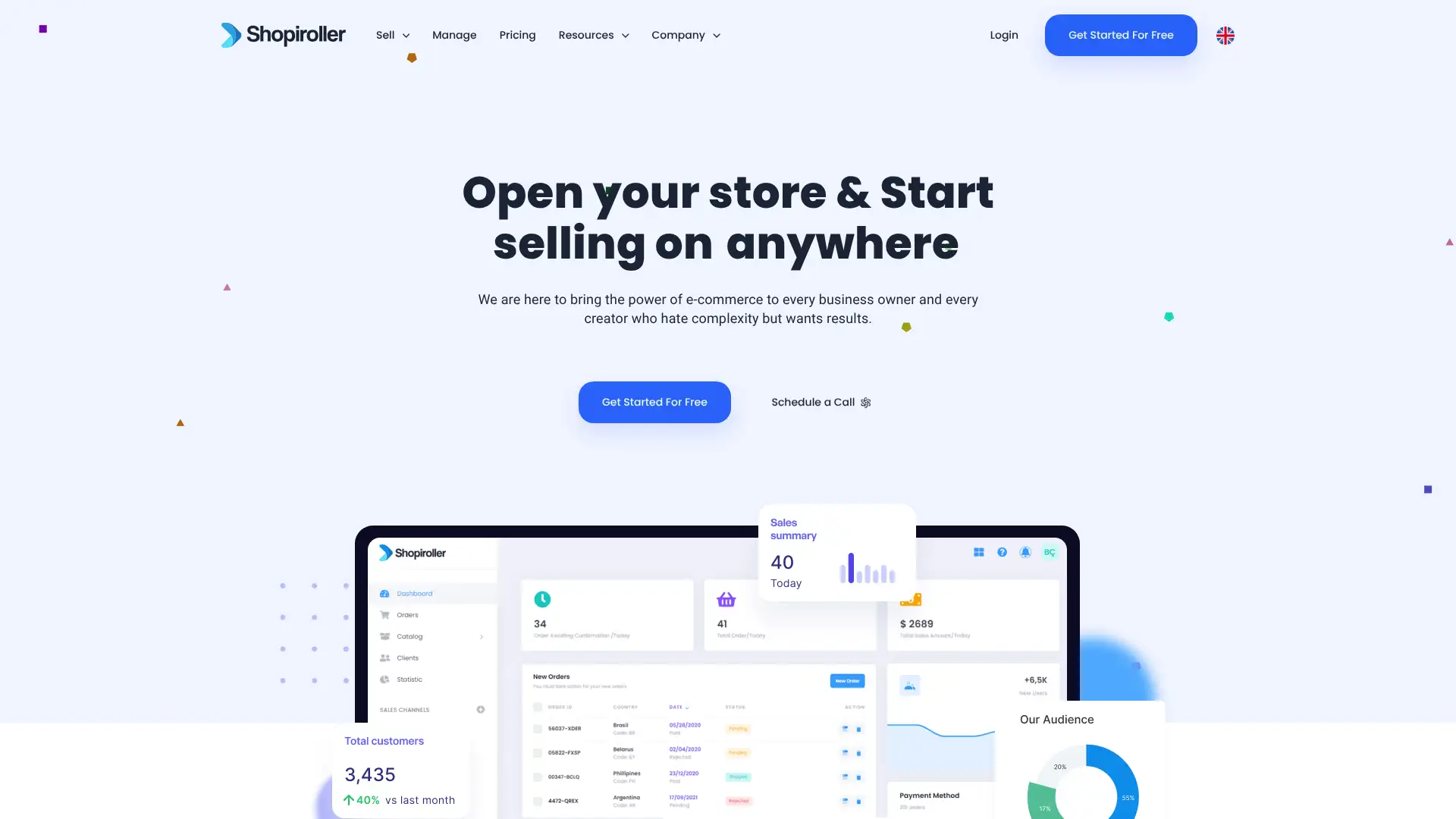
- • No-code storefront builder lets businesses launch a branded ecommerce web store and mobile app without developer resources.
- • Centralized inventory and order management keeps stock levels and order status synchronized across web, mobile, Amazon, eBay, and social commerce channels.
- • Google Shopping and Google Ads integration automatically syncs product catalog and creates Google Shopping campaigns directly from the Shopiroller dashboard.
- • Amazon and eBay multichannel selling connects product listings and inventory to marketplace channels from the same admin used to manage the core store.
- • Mobile-first design delivers an ecommerce mobile app experience for customers alongside the web store without additional development.
Shopiroller is appropriate for very early-stage businesses that want to launch a no-code web store, mobile app, and multichannel presence simultaneously without a developer. As order volume, channel complexity, or fulfillment requirements grow, migrating to Shopify plus a dedicated OMS like Ordoro or Linnworks will provide the scalability and integration depth that Shopiroller cannot match.