24 Best Inventory Management Software in 2026
Inventory management software helps businesses track stock levels, automate reordering, sync inventory across sales channels, and streamline warehouse operations. This guide covers platforms built for ecommerce sellers, manufacturers, wholesalers, distributors, and facilities teams. Pricing data was verified in March 2026.
Cin7
Cin7 is a cloud-based inventory management platform serving over 8,000 businesses across retail, wholesale, and manufacturing. It offers two products: Cin7 Core for SMBs and Cin7 Omni for larger operations with EDI and 3PL needs. Core plans start at $349/mo for 5 users with 2 ecommerce integrations, scaling to $999/mo for the Advanced plan. Cin7 ForesightAI, added in 2024, delivers AI-powered demand forecasting and automated reordering. DEAR Systems, formerly a standalone product, was absorbed into Cin7 Core. With 700+ integrations including Shopify, Amazon, Xero, and QuickBooks, Cin7 is one of the broadest-featured options below $1,000/mo.
- • Multi-location inventory: real-time stock visibility across warehouses, retail stores, and FBA with automatic stock adjustments on every sale or purchase.
- • Built-in EDI: native connections to major retailers and 3PLs on Cin7 Omni, avoiding third-party EDI translation costs for most standard documents.
- • ForesightAI forecasting: AI-driven demand predictions that account for seasonality and lead times, available as an add-on to any Core or Omni plan.
- • 700+ integrations: connects Shopify, WooCommerce, Amazon, Xero, QuickBooks, ShipStation, and most major shipping and accounting platforms out of the box.
- • Manufacturing module: bill of materials (BOM) tracking, work orders, and production cost calculations included from the Pro plan upward.
Cin7 is the strongest all-in-one choice for product businesses between $1M and $30M in revenue that need inventory, order management, and warehouse operations in a single subscription. The $349 starting price is reasonable for what you get, but teams that need serious WMS or EDI features will find themselves at $999/mo or above. For lean teams on tight budgets, Zoho Inventory at a fraction of the cost is worth trialing first.
Fishbowl
Fishbowl is a long-standing inventory and warehouse management platform primarily used by small and mid-sized manufacturers and wholesalers who run QuickBooks or Xero for accounting. It offers two cloud editions: Fishbowl Drive starting at $349/mo for 2 users, and Fishbowl Advanced starting at $399/mo for 2 users, which adds manufacturing and complex BOM support. Fishbowl requires a mandatory implementation package as part of every purchase. The platform integrates natively with QuickBooks Online and Desktop, and connects with Shopify, Amazon, and ShipStation. It is used by companies including Rocket Lab USA and Terex Corporation for high-volume manufacturing workflows.
- • QuickBooks and Xero integration: bidirectional sync of inventory value, COGS, income, and payments keeps accounting and inventory reconciled in real time.
- • Bill of materials (BOM): multi-level BOM management with component tracking, waste management, and work order creation for assembly and manufacturing operations.
- • Barcode scanning: mobile barcode scanning for receiving, picking, cycle counts, and shipping across all warehouse locations with automatic inventory updates.
- • Multi-location inventory: track stock across unlimited warehouses, retail locations, and virtual locations with transfer orders and real-time quantity visibility.
- • Reorder points: set minimum stock thresholds per SKU per location and generate purchase orders automatically when levels drop below the configured threshold.
Fishbowl is the go-to choice for manufacturers and wholesalers who consider QuickBooks their accounting backbone and need warehouse management without jumping to a full ERP. The mandatory implementation cost is a real hurdle for small teams, but once live, the QuickBooks sync and BOM capabilities justify the investment for companies running physical production. Teams primarily focused on ecommerce channel management should look at Cin7 or Linnworks instead.
Zoho Inventory
Zoho Inventory is a cloud-based inventory and order management solution from Zoho Corporation, designed for small and mid-sized businesses selling across multiple channels. It offers a genuine free plan capped at 50 orders/month, with paid plans ranging from $29/mo (Standard, annual) to $249/mo (Enterprise, annual). The platform connects with Amazon, eBay, Shopify, Etsy, Walmart, Xero, QuickBooks, and all major shipping carriers. Businesses already using Zoho Books, Zoho CRM, or Zoho Analytics get the most value, as inventory data flows automatically across the Zoho suite. Software Advice named Zoho Inventory the best free warehouse management solution of 2025.
- • Multichannel order management: pull orders from Amazon, eBay, Shopify, Etsy, and Walmart into a unified dashboard with automatic inventory decrement on each sale.
- • Batch and serial number tracking: trace individual items or production batches through the full lifecycle including expiry date management for perishable goods.
- • Automated reorder points: set minimum stock levels per warehouse and have purchase orders generated and sent to suppliers automatically when thresholds are crossed.
- • Zoho ecosystem integration: native two-way sync with Zoho Books, Zoho CRM, and Zoho Analytics, giving finance and sales teams real-time inventory visibility.
- • Barcode and QR scanning: generate barcodes directly in Zoho Inventory and scan items in and out using the iOS or Android mobile app.
Zoho Inventory is the best-value inventory management option for small businesses, especially those already using or open to the Zoho ecosystem. The free plan is genuinely functional, and the $29-$79/mo paid tiers undercut most competitors significantly. The per-organization pricing structure becomes a limitation as teams grow past 5-7 people, at which point Cin7 Core or inFlow Inventory offer better per-user economics.
Sortly
Sortly is a visual inventory tracking app built for businesses that manage physical items, tools, materials, and equipment rather than ecommerce SKUs. It's widely used in construction, healthcare, interior design, education, and retail. Plans range from a free tier to $299/mo (Premium), with the Advanced plan at $49/mo supporting 2 users and 2,000 unique items. A key differentiator is offline mobile access and folder-based organization with custom photo tags. Sortly raised pricing significantly for legacy users in 2024-2025, drawing negative reviews from long-term customers. It does not offer native accounting integrations or ecommerce channel sync.
- • Visual inventory: attach high-resolution photos to every item so anyone on the team can identify stock without knowing part numbers or SKUs.
- • Custom QR and barcode labels: generate and print your own labels for any item; scan with a phone camera to instantly pull up full item details and history.
- • Offline access: scan items and update quantities even without an internet connection, syncing automatically when connectivity is restored.
- • Folder-based organization: group items by location, category, project, or any hierarchy you define, with drag-and-drop movement between folders.
- • Low stock alerts: set minimum quantity thresholds per item and receive email or push notification alerts before stockouts occur.
Sortly is the right fit for operations teams, field crews, and small businesses that need to track where physical items are, who has them, and when they need replenishing, without the complexity of a full inventory management system. It is not suitable for ecommerce sellers or any business that needs accounting integration. The pricing increase history is a red flag worth weighing before signing an annual contract.
inFlow Inventory
inFlow Inventory is a cloud-based inventory and order management system by Archon Systems, serving over 940,000 users across wholesale, distribution, manufacturing, and ecommerce. Plans are order-volume based and range from $110/mo (Entrepreneur, 100 orders/mo) to $1,319/mo (Enterprise, 10,000 orders/mo). Every plan includes a dedicated Customer Success Manager, a built-in B2B Showroom portal for wholesale buyers, and full pick/pack/ship support. inFlow's manufacturing add-on supports BOM and assemblies. It integrates with Shopify, WooCommerce, Amazon, Xero, and QuickBooks Online. SOC 2 compliance is included on all plans.
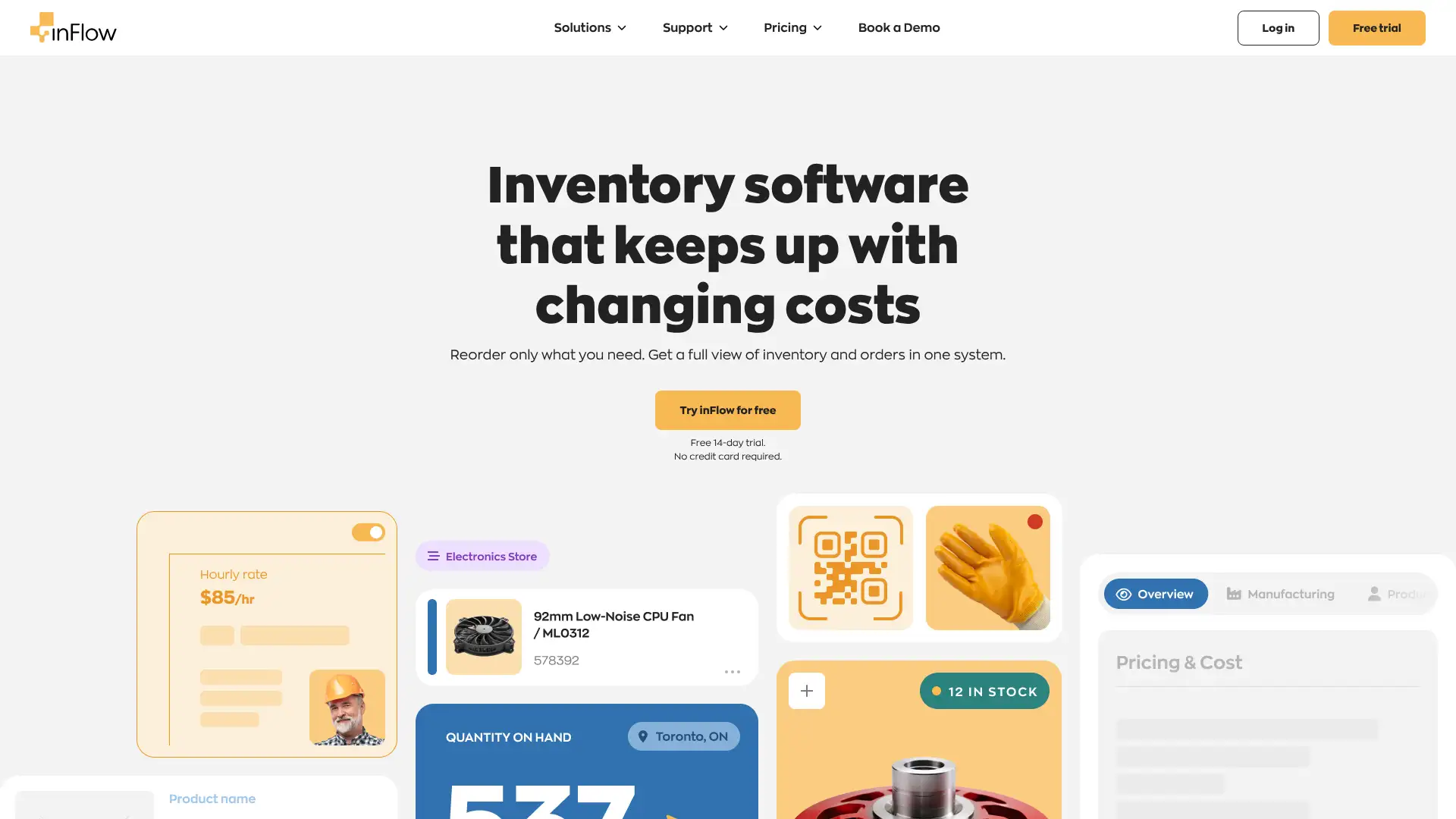
- • B2B Showroom: a branded self-service portal where wholesale customers can browse your catalog, see their custom pricing, and place orders directly, reducing manual order entry.
- • Pick/pack/ship: structured fulfillment workflows with printable pick lists, packing slips, and shipping label generation inside inFlow without switching to a separate app.
- • Bill of materials and assemblies: track component-level inventory for kitting and manufacturing with precise cost rollups and automatic quantity adjustments on production.
- • Barcode generation and scanning: create barcodes for any product directly in inFlow and scan via the iOS/Android app to receive inventory, pick orders, or conduct cycle counts.
- • Built-in B2B pricing: set different price lists per customer or customer group, with automatic application at checkout in the Showroom or when staff creates a manual order.
inFlow Inventory is the best-fit choice for wholesale distributors and businesses with a B2B sales channel that need an affordable portal for buyer self-service. The per-order pricing model is predictable for businesses with steady order volumes but can become expensive for high-volume, low-margin ecommerce operations. Teams that primarily need shipping automation rather than B2B order management will find Ordoro or Linnworks a better match.
Ordoro
Ordoro is a cloud-based order management and shipping platform built for ecommerce businesses handling multiple sales channels. Inventory management starts at $349/mo and the full all-in-one plan with purchase orders and BOM is $499/mo. Ordoro is known for its modular approach: businesses choose the apps they need from shipping, inventory, and dropshipping. It supports unlimited users, warehouses, and sales channels on all plans. Ordoro connects with Shopify, Amazon, eBay, WooCommerce, Etsy, Walmart, USPS, FedEx, UPS, and QuickBooks. It is not suitable for asset tracking, rental management, or businesses that primarily need B2B wholesale features.
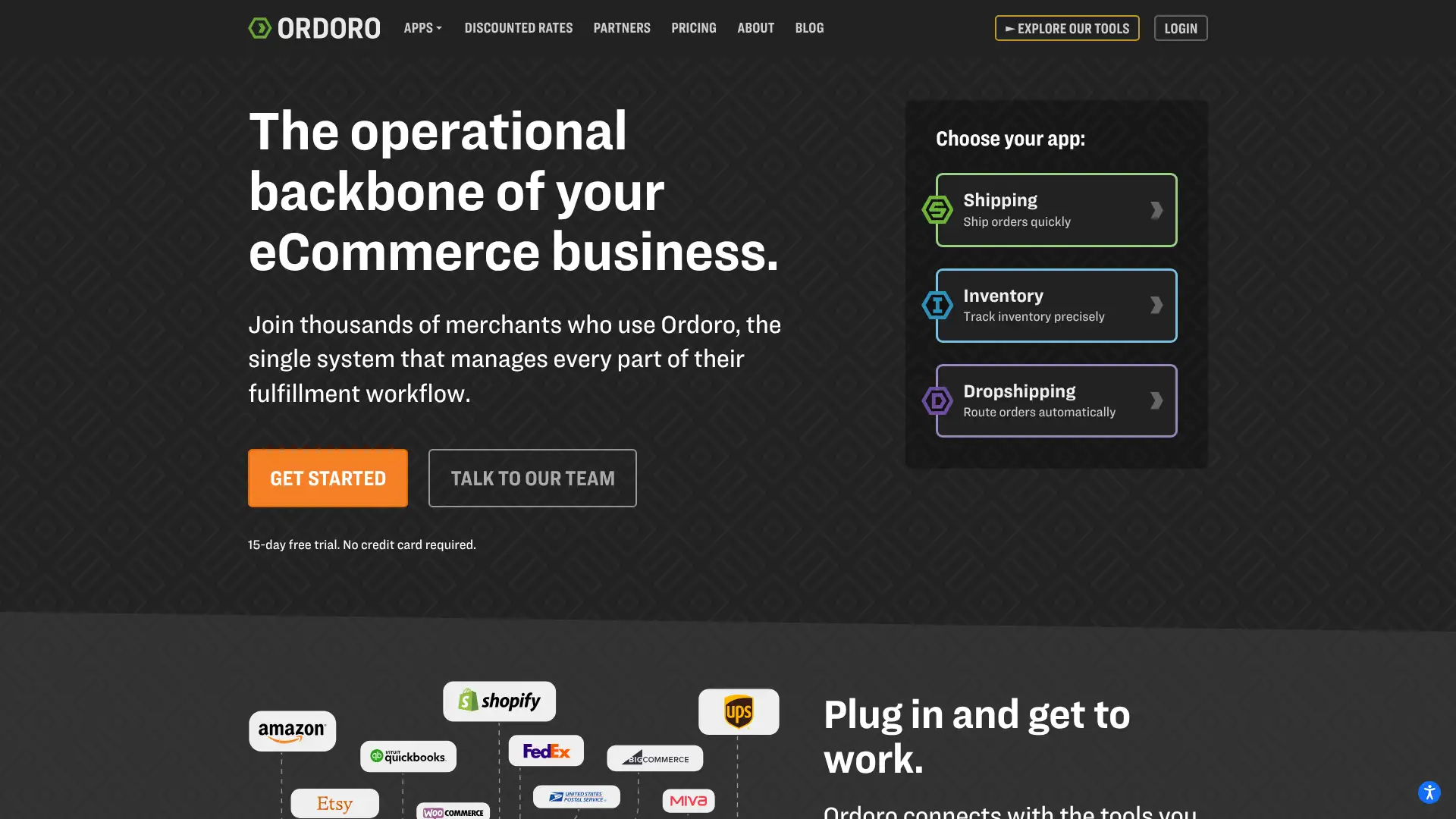
- • Multichannel order consolidation: pulls orders from every connected channel into a single queue with tagging, filtering, and bulk processing for high-volume shipping days.
- • Dropship automation: splits orders automatically to the correct supplier, sends supplier notifications, and consolidates tracking back to the originating channel without manual steps.
- • Kitting and bundling: define kits that automatically decrement individual component inventory when a kit is sold, keeping component-level accuracy across channels.
- • QuickBooks integration: syncs order data, COGS, and inventory value to QuickBooks Online for real-time financial visibility without manual journal entries.
- • Vendor portals: give suppliers direct access to their order queue so they can update fulfillment status and tracking without staff needing to relay information manually.
Ordoro is the strongest platform for ecommerce businesses whose primary operational challenge is shipping efficiency and dropship coordination rather than complex inventory valuation or B2B order management. The unlimited-everything plan structure is genuinely rare and eliminates growth-related cost surprises. Teams that need demand forecasting, a mobile warehouse app, or advanced inventory analytics should look elsewhere.
Brightpearl
Brightpearl, acquired by Sage in 2022, is a Retail Operating System (ROS) designed for retailers and wholesalers managing high order volumes across multiple channels. It handles order management, inventory, warehouse management, returns, accounting, and CRM in one platform. Pricing is fully bespoke with no published rates; user reviews suggest starting costs around $15,000/year for basic functionality. Brightpearl includes unlimited users on all plans. Over 1,000 merchants use it, processing collectively significant GMV. Its Automation Engine is a standout feature, capable of handling complex fulfillment rules that would require engineering resources on other platforms.
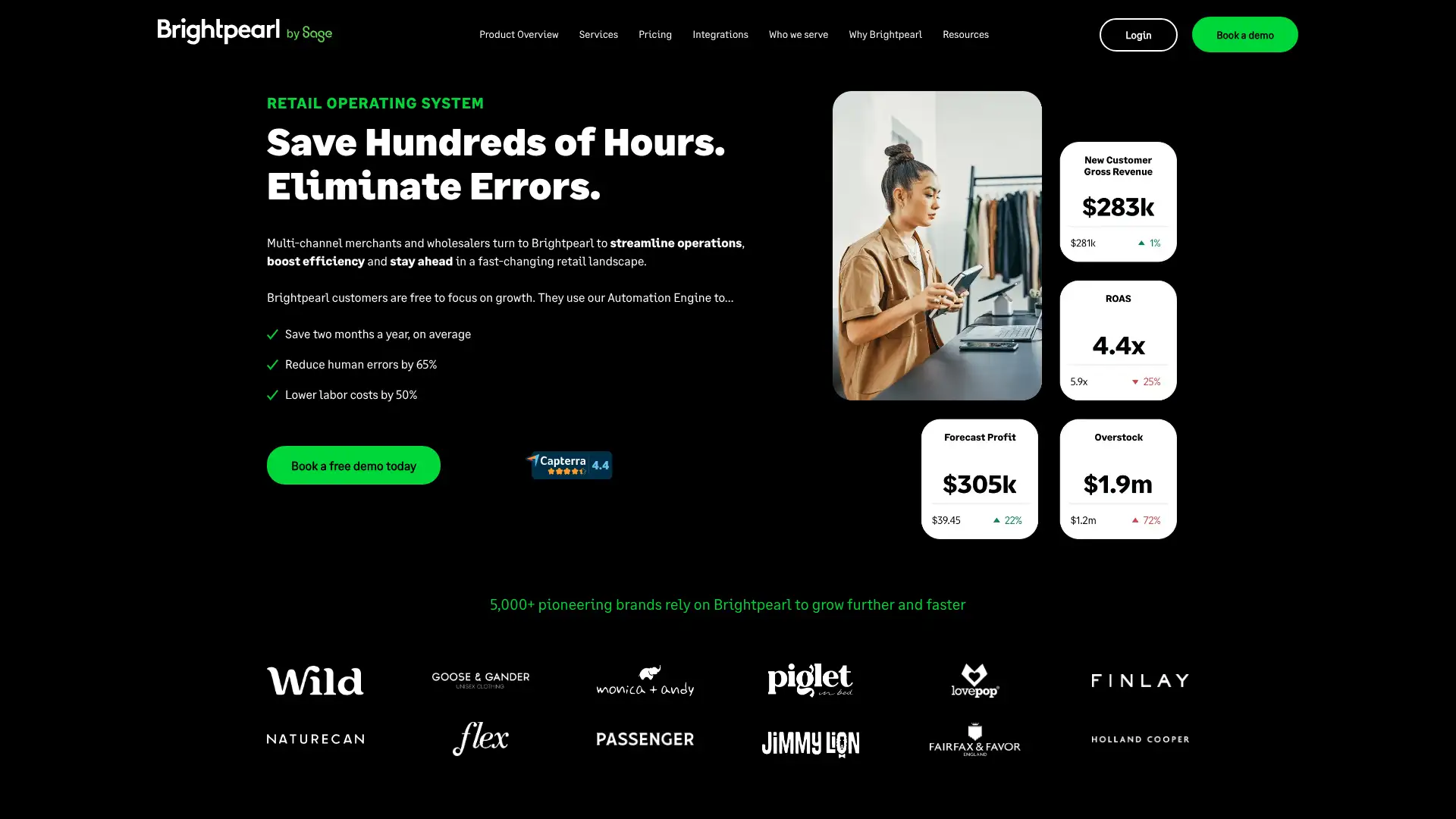
- • Automation Engine: build rule-based workflows that trigger on order events, inventory changes, or customer actions without writing code, reportedly saving an average of two months of staff time annually.
- • Inventory Planner (add-on): AI-powered demand forecasting that accounts for seasonality, promotions, and lead times, with automated purchase order creation from recommendations.
- • Plug-and-play integrations: 100+ pre-built connectors for Shopify, Shopify Plus, BigCommerce, Magento, Amazon, eBay, and major shipping providers that typically activate in minutes.
- • Retail analytics: 360-degree reporting across channels, products, customers, suppliers, and marketing campaigns with KPIs surfaced in a single dashboard.
- • Returns management: structured returns and credit workflows including RMA creation, restocking rules, and customer credit issuance across all connected sales channels.
Brightpearl is best suited for retailers and wholesalers hitting the operational ceiling of simpler tools around $2-5M in revenue, where automation savings start justifying a $15,000+/year commitment. Its unlimited-user model and Automation Engine provide real ROI at scale. Smaller businesses should start with Cin7 or Linnworks and graduate to Brightpearl when operational complexity demands it.
Extensiv Order Manager
Extensiv Order Manager (formerly Skubana, rebranded after the Extensiv acquisition) is an enterprise-grade order management and inventory platform built for high-volume multichannel ecommerce brands. It supports selling on Amazon (all international properties and FBA), Shopify, BigCommerce, Walmart, eBay, Wayfair, and more, with 100+ marketplace integrations. Pricing is custom and contact-based; the platform is generally positioned for brands processing at least $1M in annual GMV. Extensiv does not charge per user and sets no limits on warehouses or channels. Its Orderbot automation engine lets teams build complex order manipulation rules without engineering resources.
- • Orderbot automation: create rule-based order handling logic that triggers on SKU, channel, weight, value, or custom criteria to route, split, tag, or modify orders automatically.
- • Multi-warehouse inventory allocation: see all inventory across your own warehouses, FBA, and 3PL partners in one view and auto-route orders to the most efficient fulfillment location.
- • 100+ marketplace integrations: connect every major marketplace and ecommerce platform with pre-built integrations including Amazon FBA and MCF, Walmart, eBay, and Shopify.
- • SKU-level analytics: per-SKU profitability reporting incorporating all channel fees, FBA fees, COGS, and shipping costs so teams can identify which products actually make money.
- • Demand forecasting: generate purchase orders based on historical sales velocity, lead times, and configurable safety stock rules to reduce both stockouts and overstock.
Extensiv Order Manager is built for brands that have outgrown simpler platforms and are processing hundreds of thousands of orders annually across multiple channels and warehouses. The Orderbot automation and multi-3PL inventory management are genuinely best-in-class. Smaller or mid-market businesses will find the cost and implementation burden harder to justify; Linnworks or Cin7 Omni are more proportionate options at that scale.
Linnworks
Linnworks is a UK-headquartered inventory, order, and listing management platform serving over 4,000 ecommerce retailers globally, including brands on Amazon, eBay, TikTok Shop, Shopify, and 100+ other channels. It recently acquired SkuVault to add warehouse management capabilities under the SkuVault Core product line. Pricing is custom and requires a quote; third-party sources estimate starting costs around $150/user/month. Linnworks's Rules Engine lets teams automate order routing, carrier selection, and fulfillment assignment based on complex conditional logic. Its Spotlight AI launched in 2024 adds natural language inventory and sales queries.
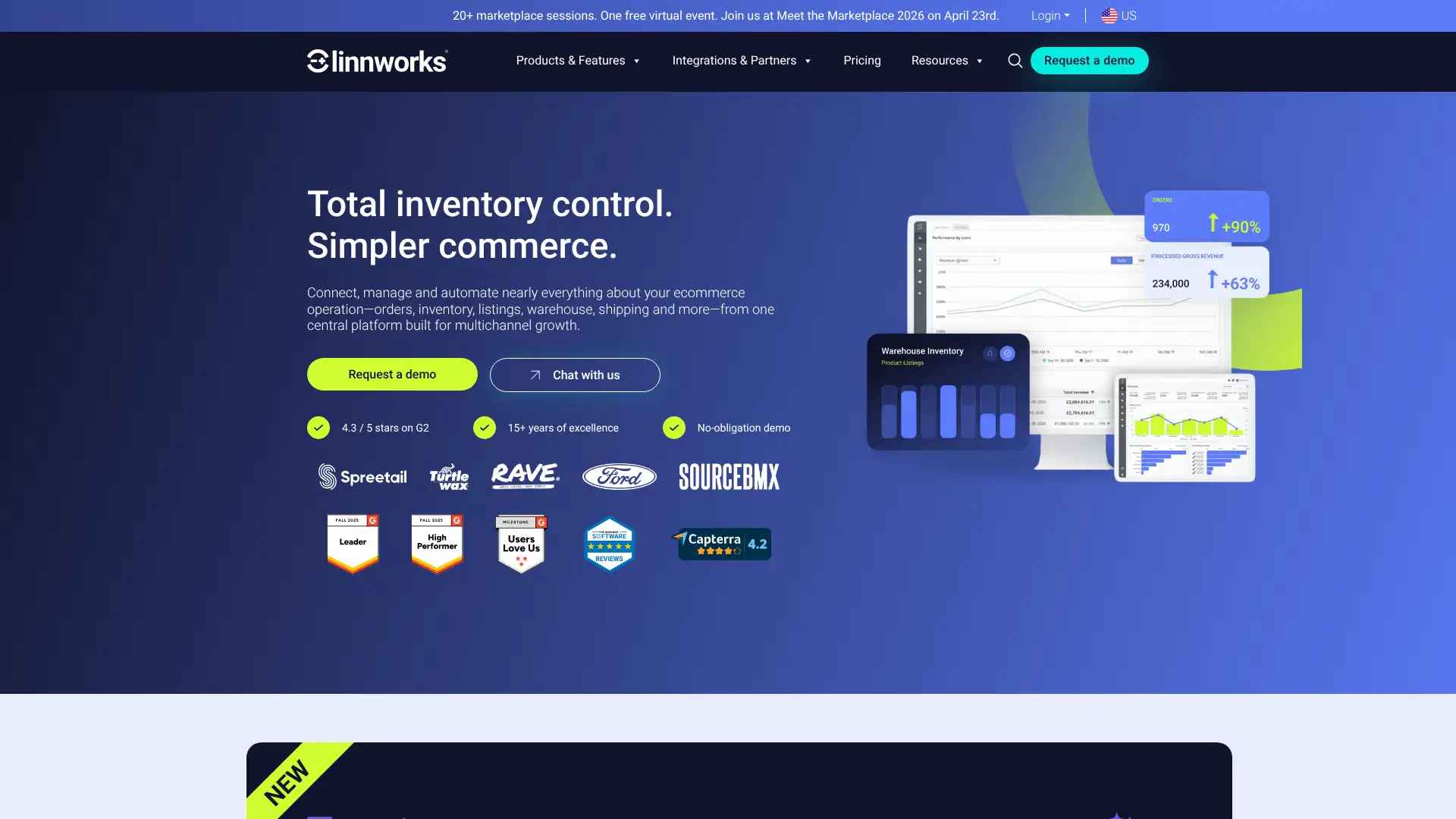
- • Real-time inventory sync: stock levels update across 100+ connected channels within seconds of a sale, preventing overselling even during high-traffic promotional periods.
- • Rules Engine: build conditional order routing logic based on SKU, carrier, destination, channel, or custom tags to automate fulfillment center assignment and packaging decisions.
- • Multichannel listing management: create, update, and publish listings to Amazon, eBay, TikTok Shop, and other marketplaces in bulk from a single product catalog.
- • Spotlight AI: ask natural language questions about inventory, sales trends, and order performance without building custom reports or using SQL queries.
- • 100+ native integrations: unlimited free integrations with marketplaces, D2C platforms, shipping providers, 3PLs, and analytics tools including ShipStation and Inventory Planner.
Linnworks is among the most capable multichannel inventory and listing platforms for brands processing thousands of orders daily across 5+ channels. Its unlimited integrations, mature Rules Engine, and 20+ years of ecommerce expertise make it a strong long-term platform. Teams with under $2M GMV or fewer than 3 channels will likely find the cost and complexity of Linnworks disproportionate and should start with Sellbrite or Cin7 Core.
Unleashed Software
Unleashed Software is a cloud-based inventory management platform built specifically for manufacturers, wholesalers, and distributors across 100+ countries. Three plans are available: Medium at $410/mo (3 users), Large at $785/mo (7 users), and Large Plus at $1,188/mo (20 users), with additional users at $109/mo each on Medium and lower rates on higher tiers. Unleashed's standout features are perpetual inventory tracking, batch and serial number traceability, detailed landed cost calculations, and production management with digital BOMs. It integrates with Xero, QuickBooks Online, Shopify, and Prospect CRM. Unleashed served Vendella International through 35% year-on-year growth for six consecutive years.
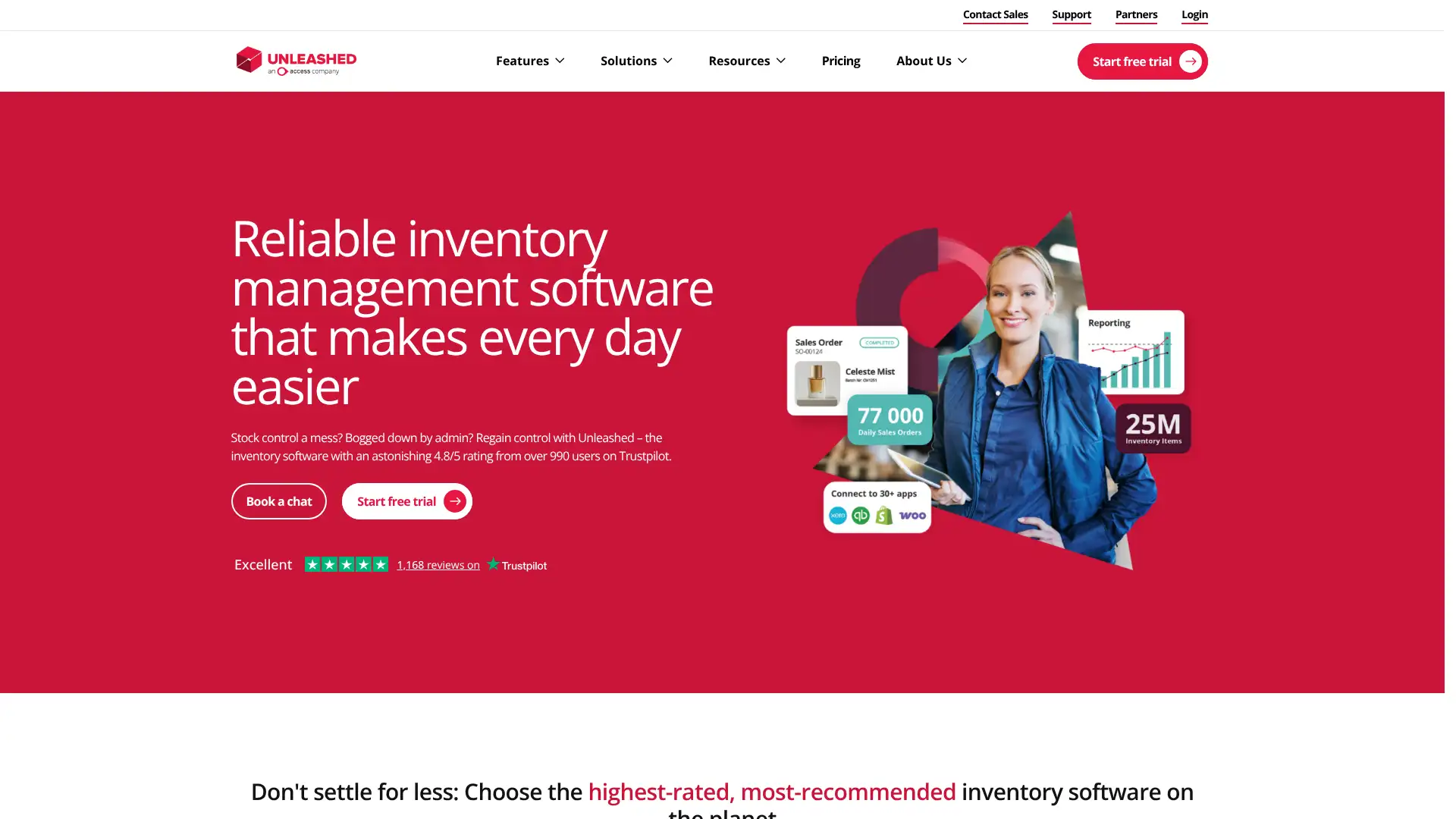
- • Perpetual inventory tracking: every transaction updates stock levels in real time across all warehouses, eliminating the periodic-count discrepancies common in manual systems.
- • Batch and serial number traceability: assign lot numbers at purchase, track through production and warehouse stages, and trace any batch forward or backward in the supply chain for recall or compliance purposes.
- • Landed cost management: calculate the true cost of goods including freight, customs, and duty by allocating all procurement costs to individual product units at time of receipt.
- • Production and BOM management: digital bills of materials with multi-level nesting support assembly operations, sub-assembly tracking, and labor cost inclusion in product costing.
- • B2B eCommerce portal (add-on): branded self-service ordering portal for wholesale buyers with custom pricing, product availability, and order history access.
Unleashed Software is the right choice for manufacturers, food producers, and pharmaceutical distributors who require certified batch traceability, precise landed cost accounting, and deep production BOM support. It is more expensive than most SMB alternatives, but the costing accuracy and compliance-grade traceability justify the premium for regulated industries. Teams that primarily need ecommerce channel sync should look at Cin7 Core or Linnworks instead.
Megaventory
Megaventory is a web-based inventory management and order fulfillment platform founded in 2010, serving small and medium businesses across retail, wholesale, manufacturing, and franchises. The single Pro plan is $150/mo (billed monthly) or $135/mo (annual), covering 5 users, up to 50,000 transactions per month, 20 warehouse locations, 20,000 products, and 5 integrations. Additional users cost $50/mo each and extra transaction blocks cost $50/mo per 10,000. Enterprise pricing is available on request. Megaventory integrates with Shopify, WooCommerce, Magento, QuickBooks Online, ShipStation, Zapier, and SPS Commerce. Companies including De'Longhi and Yantra use it in their supply chain operations.
- • Multi-location inventory: track stock across up to 20 physical warehouses, stores, or franchise locations with internal transfer documents and real-time quantity visibility.
- • Manufacturing support: multi-level bills of materials, work orders, and production tracking from raw material receipts through finished goods with cost calculations at each stage.
- • Barcode and serial number tracking: assign barcodes to items, scan them during receiving and shipping, and track serialized items through their full warehouse lifecycle.
- • Consignment and dropshipping: manage vendor-held stock, consignment inventory at customer locations, and drop-ship orders with automatic document flow between parties.
- • API and integrations: a full REST API is included in the Pro plan alongside native connectors for Shopify, WooCommerce, QuickBooks Online, ShipStation, and Zapier.
Megaventory is a solid mid-market choice for businesses that need multi-location inventory, manufacturing BOMs, and invoicing in a single platform without paying $400-$600/mo. The flat $150/mo Pro pricing with all features included is genuinely rare. The platform starts to show limitations when order volume is high or when regulatory-grade batch traceability is required.
Asset Panda
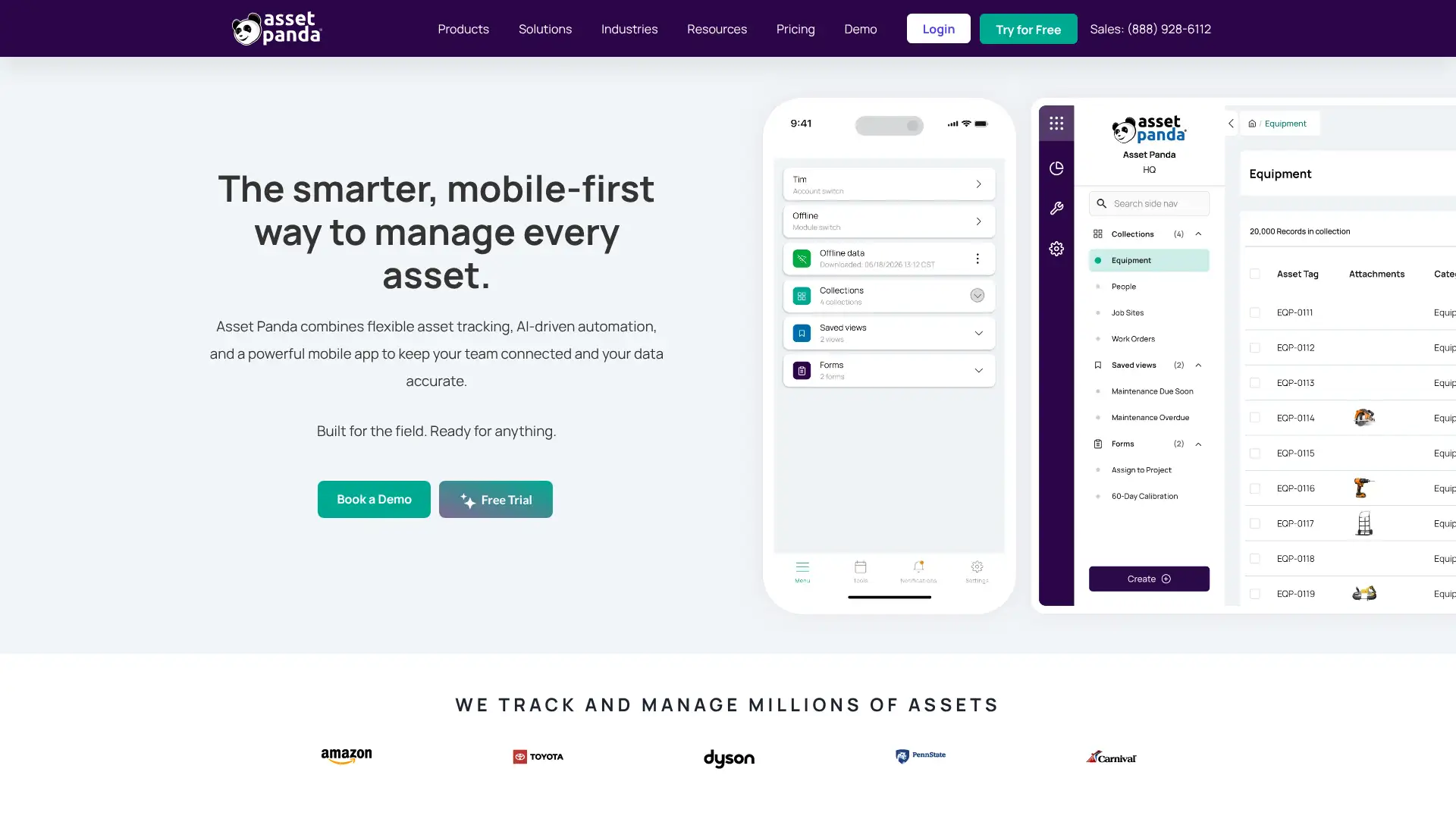
Asset Panda is a cloud-based asset tracking and management platform used by organizations in construction, healthcare, education, IT, and manufacturing across more than 140 industries and 60 countries. It tracks millions of assets for clients including large enterprises. Pricing starts at $3,000/year for the Starter plan, with Business+ at $7,500/year and Enterprise at custom pricing. Plans are based on asset count and user seats rather than a per-user subscription. Asset Panda connects with Azure Active Directory, Jamf Pro, Google Workspace, Microsoft Intune, and other ITAM and enterprise tools. It includes a free iOS and Android mobile app with barcode/QR scanning, offline mode, and custom action workflows.
- • Unlimited users on all plans: any number of staff can log in to view or update asset records without adding to the annual cost, unlike per-seat competitors.
- • Customizable workflows and fields: build asset records, check-in/out forms, maintenance schedules, and audit trails tailored to your specific equipment or IT asset categories.
- • Mobile barcode and QR scanning: staff can scan asset tags from any iOS or Android device to instantly retrieve full asset history, location, warranties, and attached documentation.
- • Asset lifecycle tracking: record acquisition cost, depreciation schedules, maintenance history, and disposal, giving finance and operations a single source of truth for fixed assets.
- • Enterprise integrations: bidirectional sync with Jamf Pro, Azure Active Directory, and Google Workspace keeps asset records current without manual data entry from IT systems.
Asset Panda is the right choice for IT, facilities, and operations teams that need to track equipment and fixed assets across multiple departments or locations without paying per user. The $3,000/year starting cost requires justification, but the unlimited user model and enterprise integrations make it cost-effective at 50+ users. It is not an inventory management tool for ecommerce or product businesses.
UpKeep
UpKeep is a mobile-first Computerized Maintenance Management System (CMMS) built for maintenance technicians and operations managers in manufacturing, facilities, hospitality, and property management. It offers four pricing tiers: Lite at $20/user/mo, Starter at $45/user/mo, Professional at $75/user/mo, and Business+ at $120/user/mo. UpKeep includes parts and inventory management from the Starter plan upward, making it relevant to operations teams that track spare parts and consumables alongside work orders. It has received Series B funding of $36M from Insight Partners, Emergence Capital, Battery Ventures, and Y Combinator. UpKeep serves over 3,000 companies worldwide.
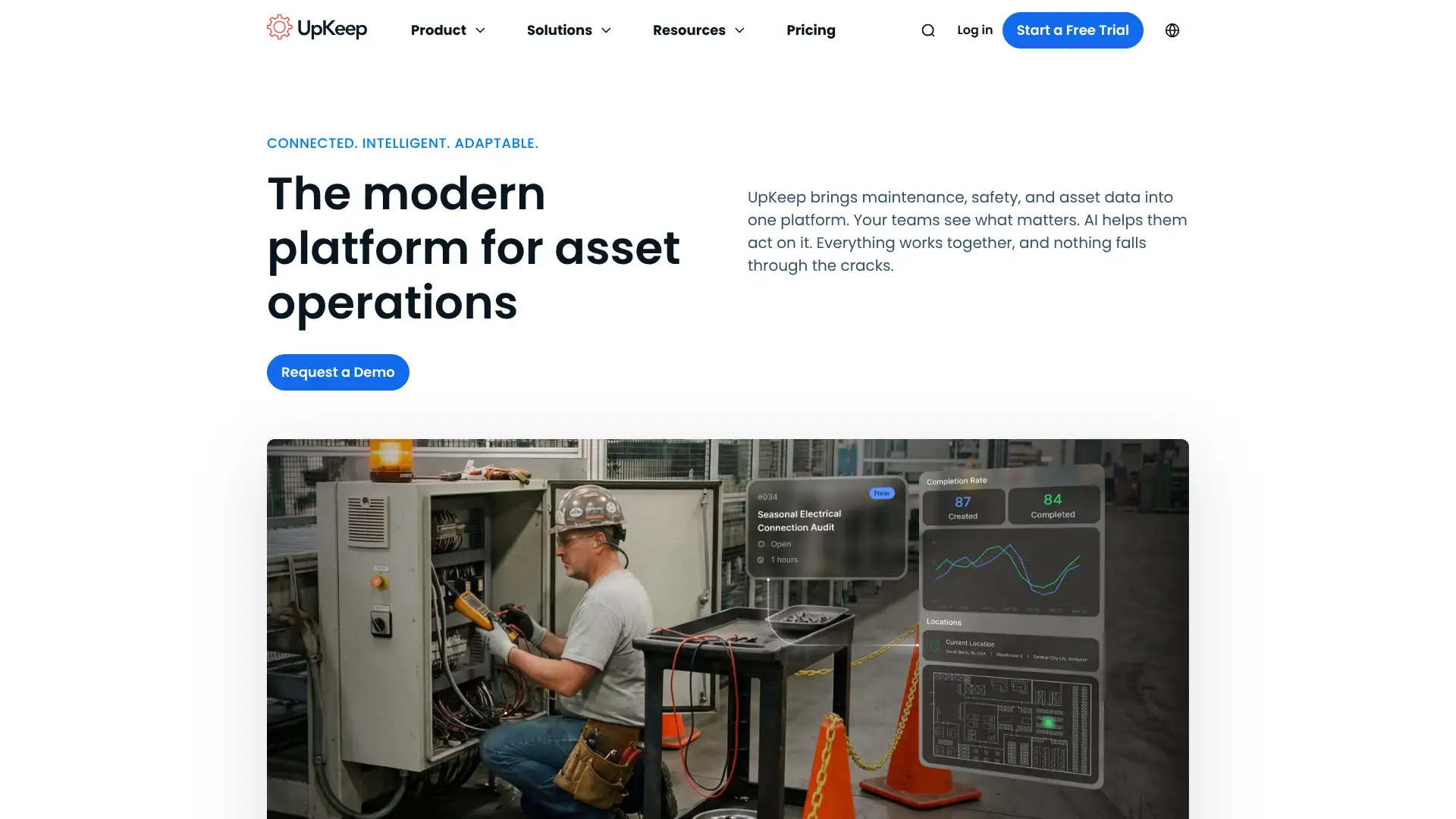
- • Work order management: create, assign, prioritize, and track corrective and preventive maintenance work orders from any mobile device with real-time status updates.
- • Parts and inventory tracking: log spare parts quantities, set reorder points, and connect parts consumption to specific work orders for accurate maintenance cost tracking.
- • Preventive maintenance scheduling: build recurring PM schedules by calendar frequency, meter readings, or condition triggers, with automatic work order creation and technician notification.
- • Asset lifecycle tracking: maintain full service history, warranty status, and maintenance costs for each piece of equipment in a searchable asset register.
- • AI-powered insights: Business+ plan includes AI analysis of work order patterns, equipment downtime, and maintenance costs to surface predictive recommendations.
UpKeep is best suited for mobile maintenance teams in facilities, manufacturing, and hospitality who want a modern CMMS that technicians will actually use in the field. The $45 Starter plan is the minimum viable tier for real maintenance operations. Teams that need deeper AI analytics or enterprise compliance features should look at Fiix or eMaint, which offer more capability at a similar per-user price.
Limble CMMS
Limble CMMS is a cloud-based maintenance management platform consistently rated among the top CMMS solutions by G2, Capterra, and Software Advice. It offers a free plan and three paid tiers: Standard at $28/user/mo (annual), Premium+ at $69/user/mo, and Enterprise at custom pricing. Limble includes implementation, online training, and support in every paid plan with no hidden onboarding fees. Its parts and inventory module with multi-location support is available from the Premium+ plan. Limble serves pharmaceutical, food and beverage, manufacturing, and facilities management teams and is awarded 99% user satisfaction on Capterra.
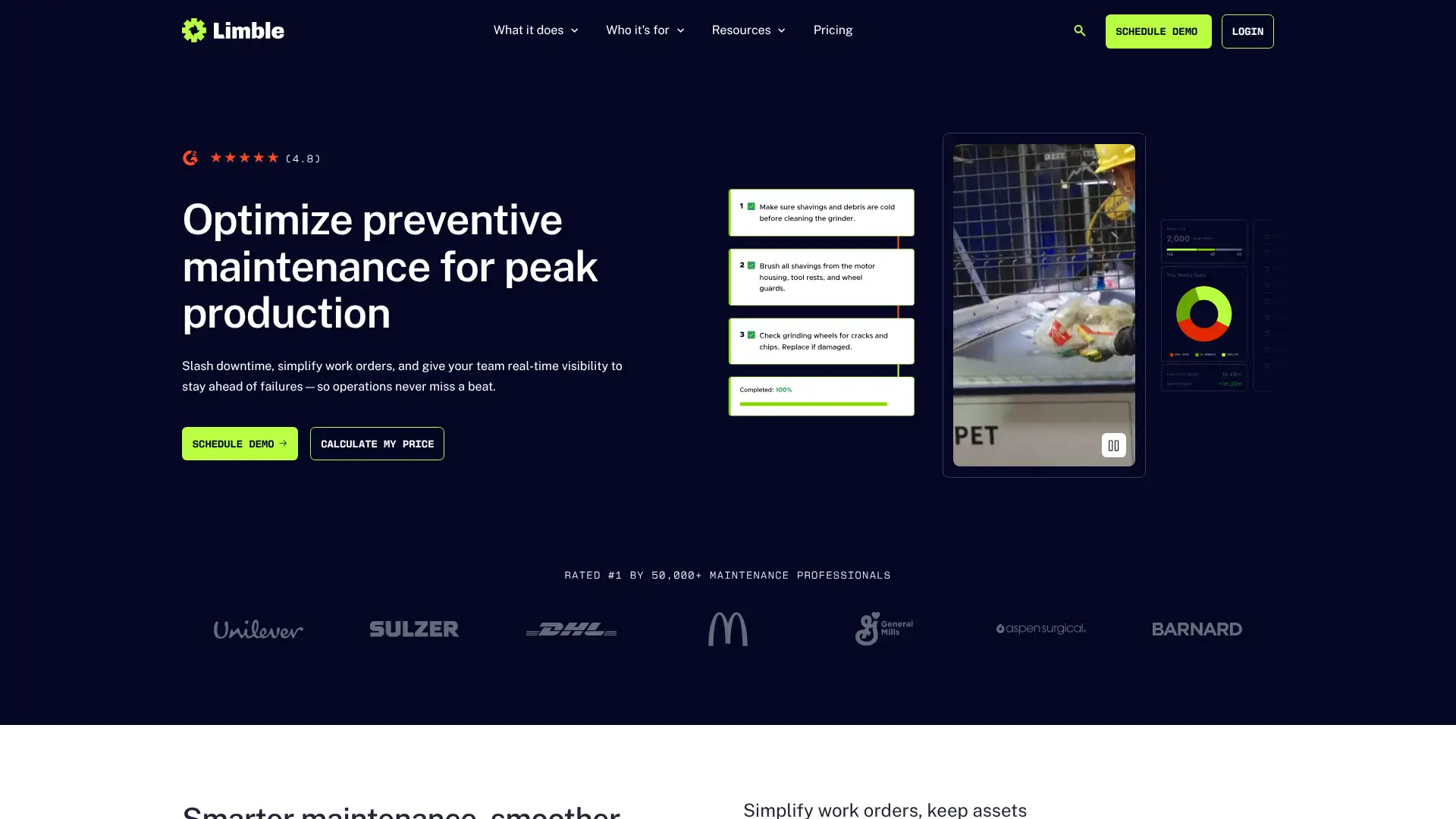
- • Customizable dashboards: drag-and-drop KPI widgets let maintenance managers build real-time views of work order completion rates, open PMs, downtime hours, and maintenance costs per asset.
- • Work order and PM automation: set recurring preventive maintenance by calendar, meter, or condition trigger with automatic assignment and email or SMS notification to assigned technicians.
- • Parts inventory management: track spare parts quantities across multiple storage locations, set reorder points, and attach parts usage to completed work orders for accurate cost reporting.
- • QR code and barcode scanning: print QR codes for any asset or location and let technicians scan to submit requests or view asset history from their phone camera.
- • Unlimited read-only users: requesters and supervisors can view work order status and asset data without consuming paid licenses, keeping per-user costs lower.
Limble is the top-rated CMMS for mid-sized maintenance teams that value ease of use, customizable dashboards, and responsive support. The Premium+ plan at $69/user/mo unlocks the inventory and multi-location features that most serious operations need. Teams that primarily need spare parts management in a distributed warehouse context should look beyond CMMS platforms to purpose-built inventory tools like inFlow or Zoho Inventory.
Fiix
Fiix is a cloud-based CMMS acquired by Rockwell Automation in 2021, serving manufacturing, food and beverage, oil and gas, and utilities industries. It offers a free tier for basic maintenance tracking, with paid plans at $45/user/mo (Basic) and $75/user/mo (Professional), plus Enterprise at custom pricing. Fiix differentiates on AI-driven maintenance insights, predictive scheduling, and deep integration with enterprise systems including SAP, Oracle, and other ERPs. It serves over 3,000 organizations including major industrial brands. The platform has a 4.5-star Capterra rating from 628 reviews.
- • AI-driven maintenance scheduling: the platform analyzes work order history and equipment condition data to recommend PM intervals that reduce unplanned downtime.
- • Predictive maintenance (Professional): connect IoT sensor data to Fiix and trigger work orders automatically when equipment readings cross threshold conditions.
- • Asset hierarchy management: organize equipment into parent-child relationships so work orders, costs, and downtime roll up from components to machines to production lines.
- • ERP and enterprise integrations (Enterprise): bidirectional data sync with SAP, Oracle, and other ERPs keeps maintenance and procurement records aligned without manual export/import.
- • Unlimited phone and email support on all paid plans: Fiix includes support on Basic and above at no additional charge, a contrast to competitors who reserve phone support for higher tiers.
Fiix is the best CMMS for industrial manufacturers and facilities teams that need AI-powered maintenance scheduling and a credible path to IoT-driven predictive maintenance. Rockwell Automation's backing makes it a safe enterprise choice. Teams without complex analytics needs or ERP integration requirements will find Limble or UpKeep adequate at a similar or lower cost.
eMaint CMMS
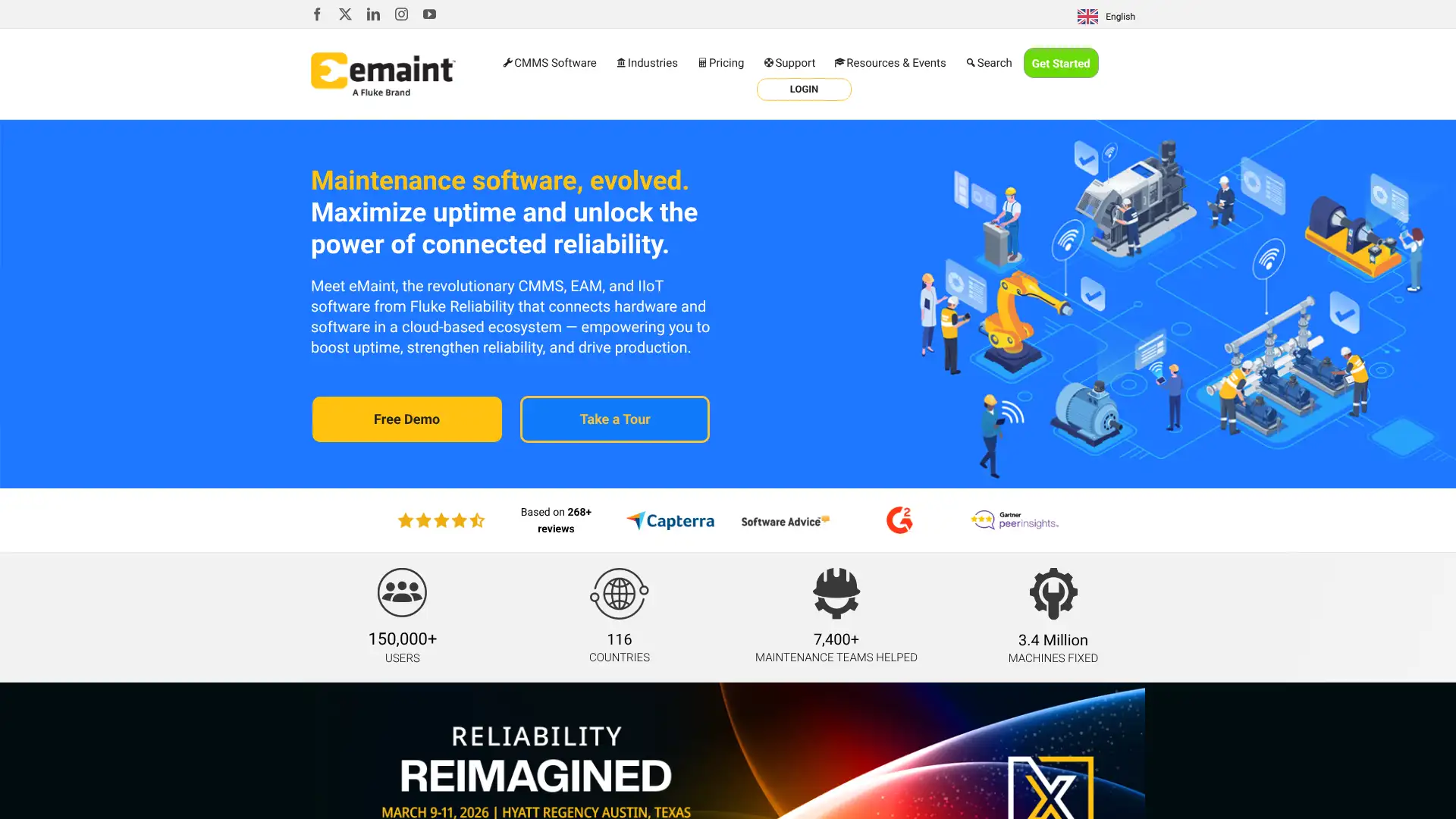
eMaint is a cloud-based CMMS from Fluke Reliability, part of Fortive Corporation, positioned for mid-sized to large enterprises in manufacturing, utilities, food and beverage, and government sectors. It offers three plans: Team at $69/user/mo (maximum 3 users), Professional at $85/user/mo (minimum 3 users), and Enterprise at custom pricing (minimum 5 users). eMaint is known for detailed audit trails, configurable compliance reporting, and enterprise-grade asset hierarchy management. It serves 50,000+ users across more than 150 countries. The platform integrates with SAP, Oracle, and major ERP systems, and is Fortive-owned, ensuring product continuity and ongoing investment.
- • Audit trails: every data entry, work order update, and inventory adjustment is logged with user, timestamp, and before/after values for regulatory compliance and internal accountability.
- • Asset hierarchy management: build multi-level equipment hierarchies that roll up maintenance costs, downtime, and PM compliance from components to systems to facilities.
- • Interactive image mapping: overlay equipment on facility floor plans or equipment diagrams so technicians can click to view asset details and open work requests in context.
- • Purchasing and requisitioning: manage spare parts purchase orders, vendor catalog pricing, and stock replenishment requests from within the CMMS without a separate procurement tool.
- • Condition monitoring: connect sensor or meter data to asset records and trigger PM work orders automatically when readings exceed configured thresholds.
eMaint is the right platform for multi-site enterprise operations in regulated industries where audit trail completeness and compliance reporting are non-negotiable. The Team plan's 3-user cap makes it unsuitable for real operations unless used only for trial purposes. For most mid-sized maintenance teams without enterprise compliance requirements, Limble or UpKeep offer better value at a lower per-user cost.
MPulse
MPulse is a CMMS software provider serving 2,500+ customers across 24 countries, with clients including General Dynamics, Fender Guitars, Siemens, and IKEA. It is awarded by Capterra Shortlist and Software Advice FrontRunners in 2026. Plans are concurrent-user based: Professional at $49/concurrent user/mo, Advanced at $99/concurrent user/mo, and Enterprise at custom pricing. MPulse is available as both cloud-based SaaS and on-premise, an important differentiator for organizations with data residency requirements. The platform covers work order management, PM scheduling, asset lifecycle tracking, inventory management, and vendor management.
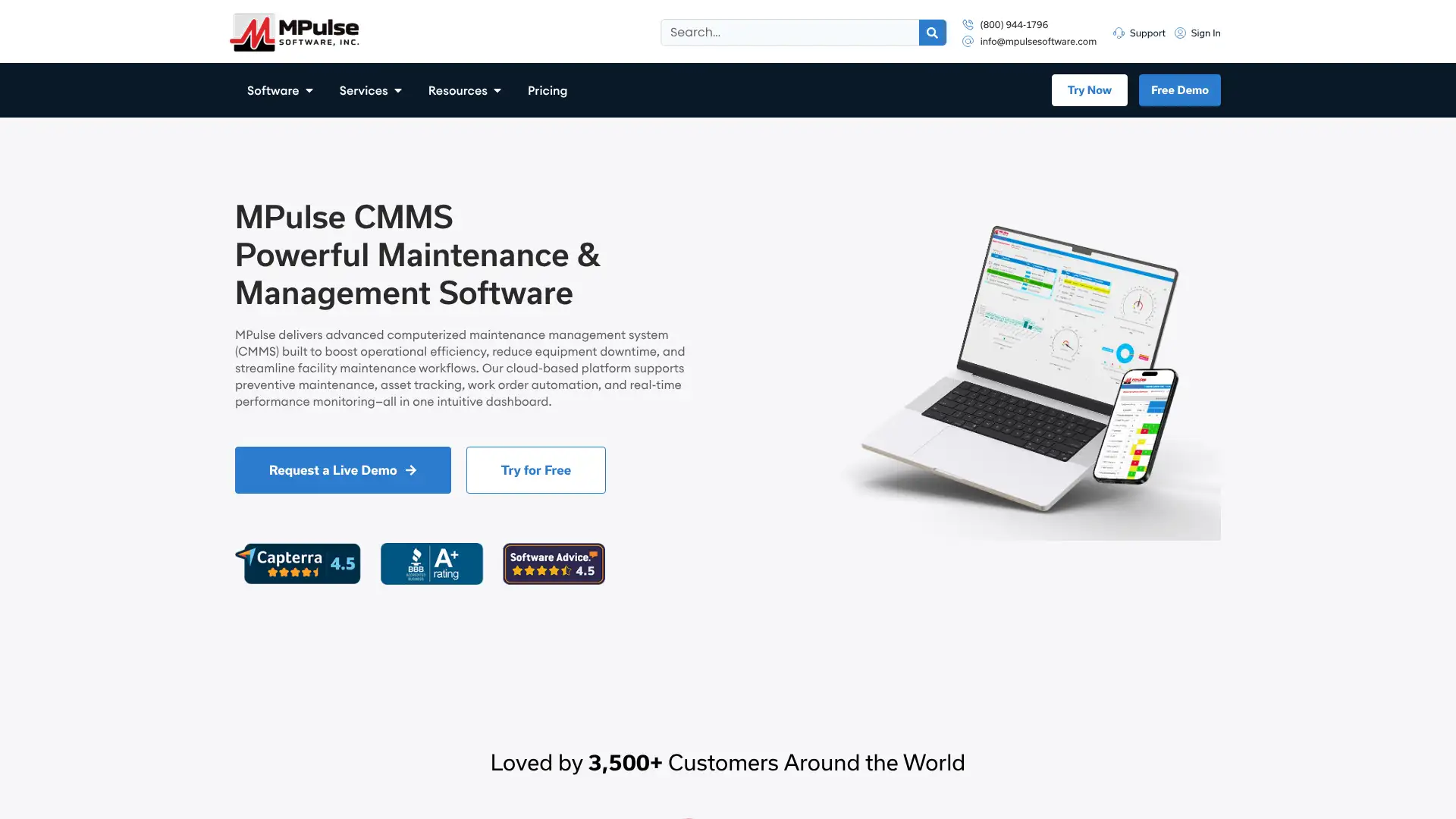
- • Concurrent user licensing: pay only for users logged in at the same time rather than all named users, which can reduce costs significantly for organizations with shift-based operations.
- • Preventive maintenance scheduling: set PM triggers by calendar date, equipment runtime hours, or meter readings with automatic work order generation and technician notification.
- • Parts and inventory management: track spare parts quantities with an inventory shopping cart interface, purchase requisitions, and automatic reorder point alerts.
- • Asset lifecycle tracking: log acquisition cost, depreciation, warranty status, and full maintenance history for every asset with drill-down reporting by asset, location, or cost center.
- • On-premise deployment: available for organizations with strict data residency, security, or compliance requirements that prohibit cloud-only hosting.
MPulse is a solid, established CMMS for operations that need either concurrent-user pricing economics or on-premise deployment options that cloud-only competitors cannot provide. At $49/concurrent user/mo it can undercut named-user platforms significantly. Teams that prioritize a modern mobile-first interface and active vendor support may prefer Limble or Fiix, which invest more heavily in product marketing and UI iteration.
InventoryLab
InventoryLab is now part of Seller 365, a suite of 10 Amazon seller tools by Threecolts, available for $69/mo (single user) and higher tiers for teams. The Stratify app within InventoryLab handles FBA shipment creation, inventory tracking, expense management, and profitability reporting at the SKU level. The companion Scoutify 2 mobile app assists sourcing decisions in the field by displaying buy cost, Amazon fees, estimated profit, and historical sales data instantly. Used by thousands of Amazon sellers globally, it is especially popular with retail arbitrage and wholesale FBA businesses that need precise cost-of-goods tracking alongside their FBA workflow.
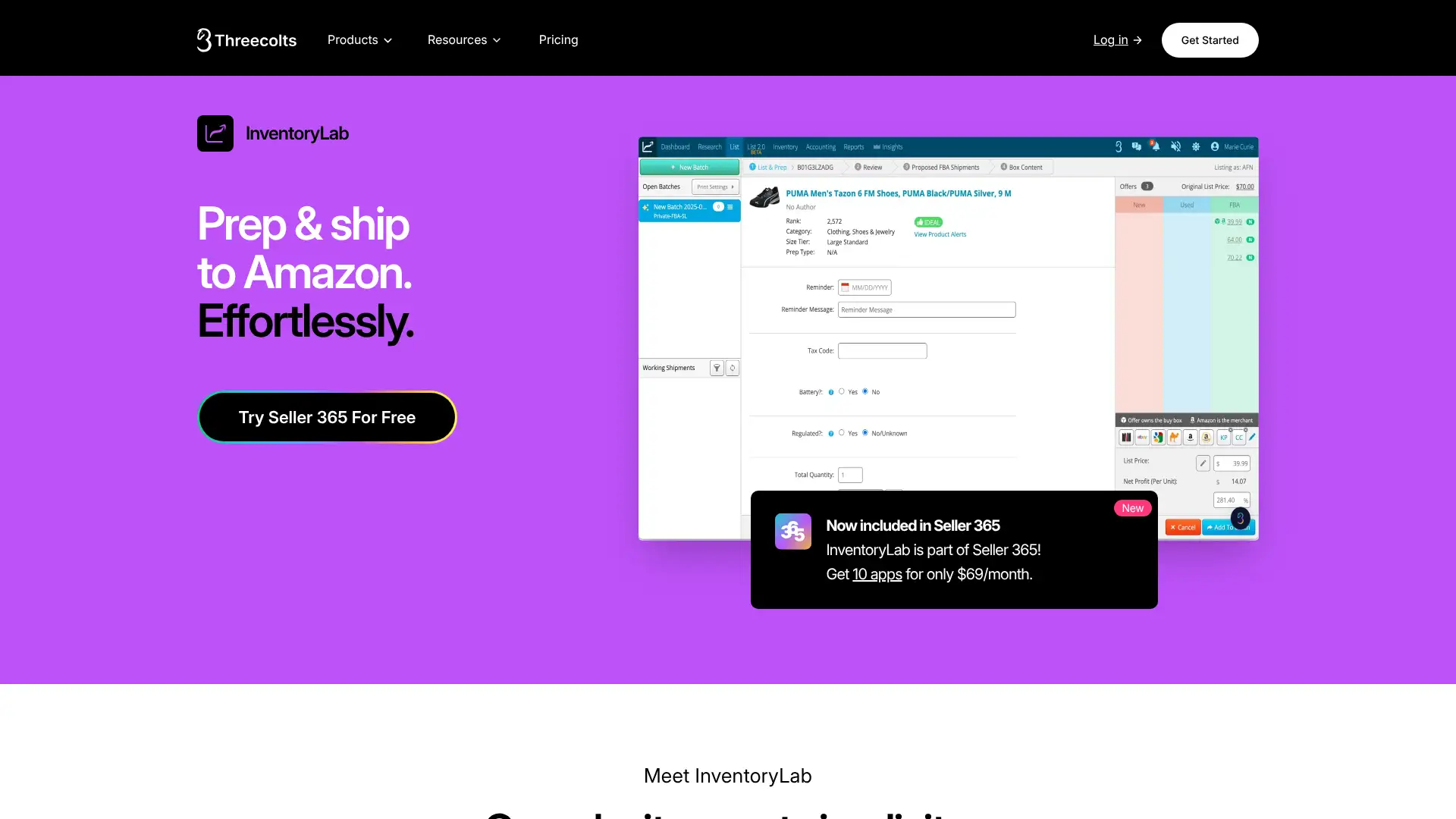
- • FBA shipment creation: build and submit Amazon FBA inbound shipments directly from InventoryLab with automatic box content generation and label printing to Amazon specifications.
- • SKU-level profitability tracking: automatically calculates net profit per ASIN by incorporating sale price, all Amazon fees, COGS, and shipping costs in real time without manual spreadsheet work.
- • Scoutify 2 sourcing app: scan products in stores or at liquidation auctions to instantly see estimated net profit, sales rank, historical price data, and competition levels.
- • Expense tracking: log business overhead including mileage, sourcing trips, software subscriptions, and prep costs and attribute them to appropriate ASINs or categories for tax purposes.
- • Accounting integration: sync income and expense data with QuickBooks or export structured reports for accountants at tax time, reducing bookkeeping time for FBA-heavy businesses.
InventoryLab is the best all-in-one profitability and FBA management tool for retail arbitrage, online arbitrage, and wholesale Amazon sellers. The Seller 365 bundle at $69/mo is excellent value when you consider the 10 tools included. Sellers operating beyond Amazon or needing inventory management across multiple fulfillment channels will outgrow it quickly and should look at Sellbrite or Linnworks instead.
SellerCloud
SellerCloud, now operating under Descartes Systems Group, is an omnichannel ecommerce operations platform with over 350 pre-built integrations covering Amazon, Walmart, eBay, Shopify, and major ERPs. Pricing is order-volume-based with no per-user fees; detailed pricing requires a sales conversation, but third-party analysis suggests starting costs around $500-$1,000/mo for small businesses scaling to $5,000+/mo for enterprise operations. SellerCloud centralizes inventory, product catalog management, order routing, warehouse management, and shipping in one system, making it one of the most comprehensive platforms available for complex ecommerce operations. It excels at multi-warehouse fulfillment and channel-specific listing customization.
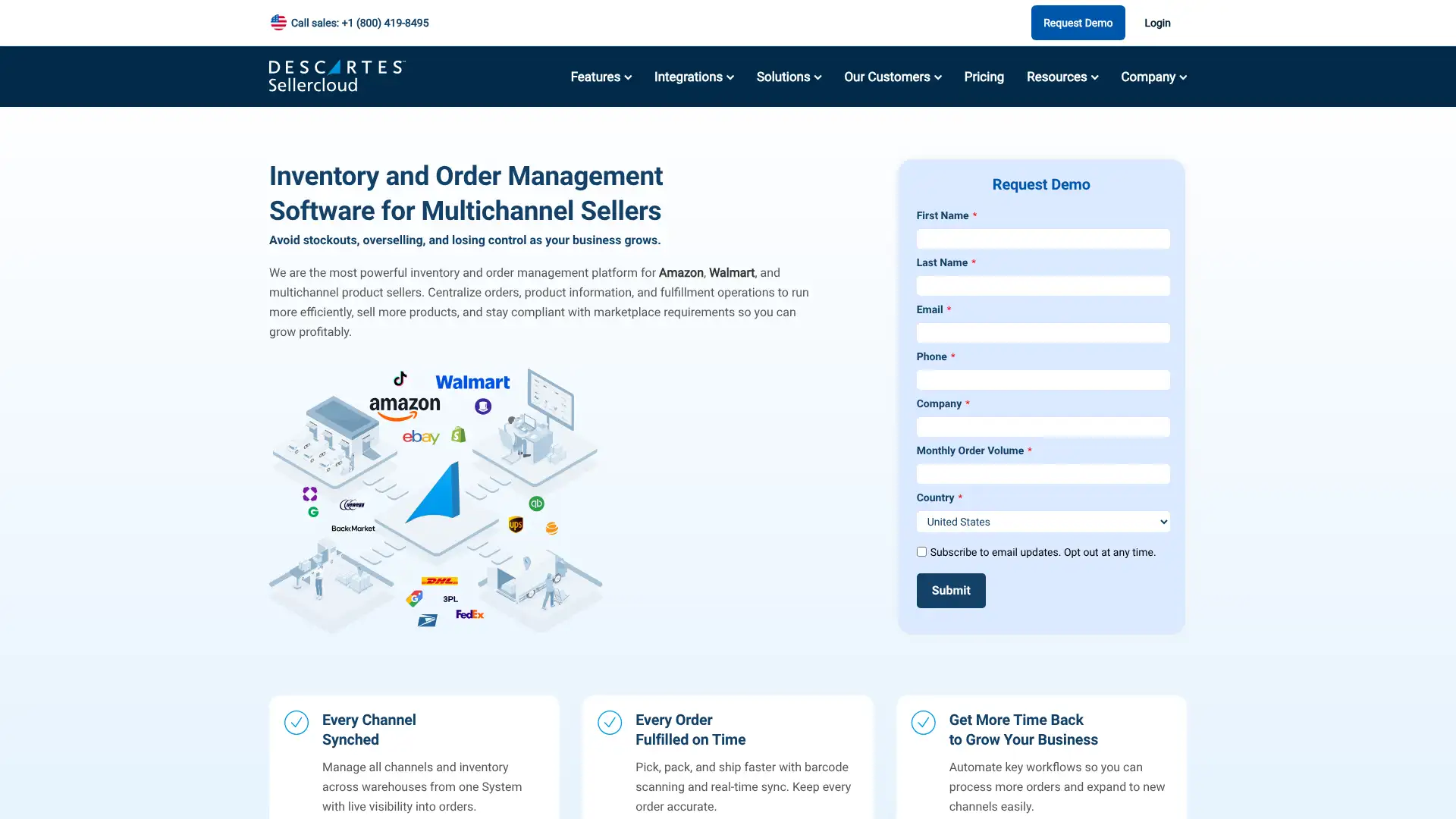
- • 350+ pre-built integrations: covers every major marketplace, ecommerce platform, shipping carrier, ERP, and 3PL with pre-built connectors that eliminate custom integration work.
- • Multi-warehouse inventory: track stock at the bin level across owned warehouses, virtual warehouses, FBA, and 3PL partners with automated order routing to the optimal fulfillment location.
- • Channel-specific listing management: customize product titles, descriptions, attributes, and pricing per marketplace independently while maintaining a single master catalog.
- • Intelligent order routing: configure complex business rules that route orders based on inventory location, carrier availability, customer SLA, or custom logic without IT involvement.
- • Demand forecasting and purchase orders: generate reorder recommendations based on sales velocity and lead times, then create and track purchase orders from within the same platform.
SellerCloud is best suited for high-SKU, high-volume ecommerce businesses that sell across 10+ channels and need catalog management, order routing, and inventory all under one roof. Teams willing to invest in setup and staff training report that SellerCloud can handle complexity that simpler platforms cannot. Businesses prioritizing ease of use or a modern UI should look at Linnworks or Extensiv instead.
Rithum (ChannelAdvisor)
ChannelAdvisor, rebranded as Rithum following its acquisition by CommerceHub in 2022 (a $663M deal), is an enterprise multichannel commerce platform connecting brands and retailers to 420+ channels. Rithum handles product feed management, marketplace listings, digital marketing (Google Shopping, Meta), EDI retail vendor connections, dropship management, and supply chain analytics. Pricing is enterprise-tier: industry sources cite starting costs of $33,000+/year, often with a percentage-of-GMV fee model in addition. It is used by global brands running tens of millions in annual online GMV. Post-merger support quality has drawn some negative reviews from former ChannelAdvisor customers.
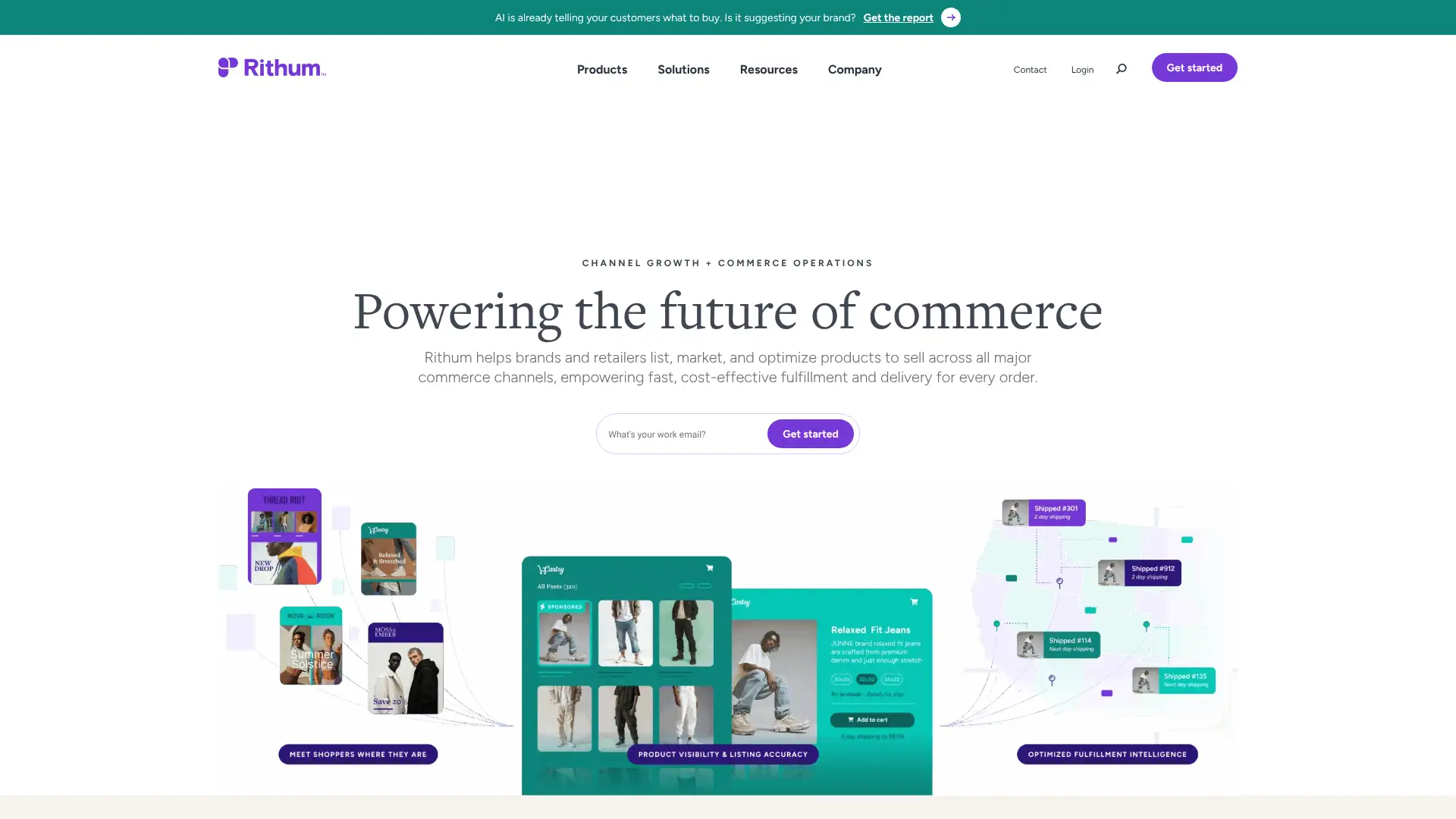
- • 420+ channel connections: manage product listings, inventory, and orders across Amazon, Walmart, eBay, and hundreds of regional and international marketplaces from a single feed.
- • Digital marketing integration: sync product data to Google Shopping, Meta Catalog, and retail media networks with automated feed optimization and bid management.
- • Retail vendor (EDI) connections: automate purchase order management, advance ship notices, and invoices with Walmart, Target, Home Depot, and other major retailers via EDI.
- • Dropship and 3P marketplace management: give retail partners access to your product catalog and automate dropship order flow, tracking, and invoice reconciliation.
- • Supply chain and inventory analytics: demand forecasting, safety stock recommendations, and out-of-stock risk scoring across all channels to inform purchasing decisions.
Rithum makes sense exclusively for large brands managing digital marketing, retail vendor EDI, and marketplace selling simultaneously across global channels at meaningful GMV. At $33,000+/year, the ROI calculation requires multi-millions in managed sales volume. For most growing brands, Linnworks or SellerCloud cover the same multichannel needs at 10-50% of the cost.
Listing Mirror
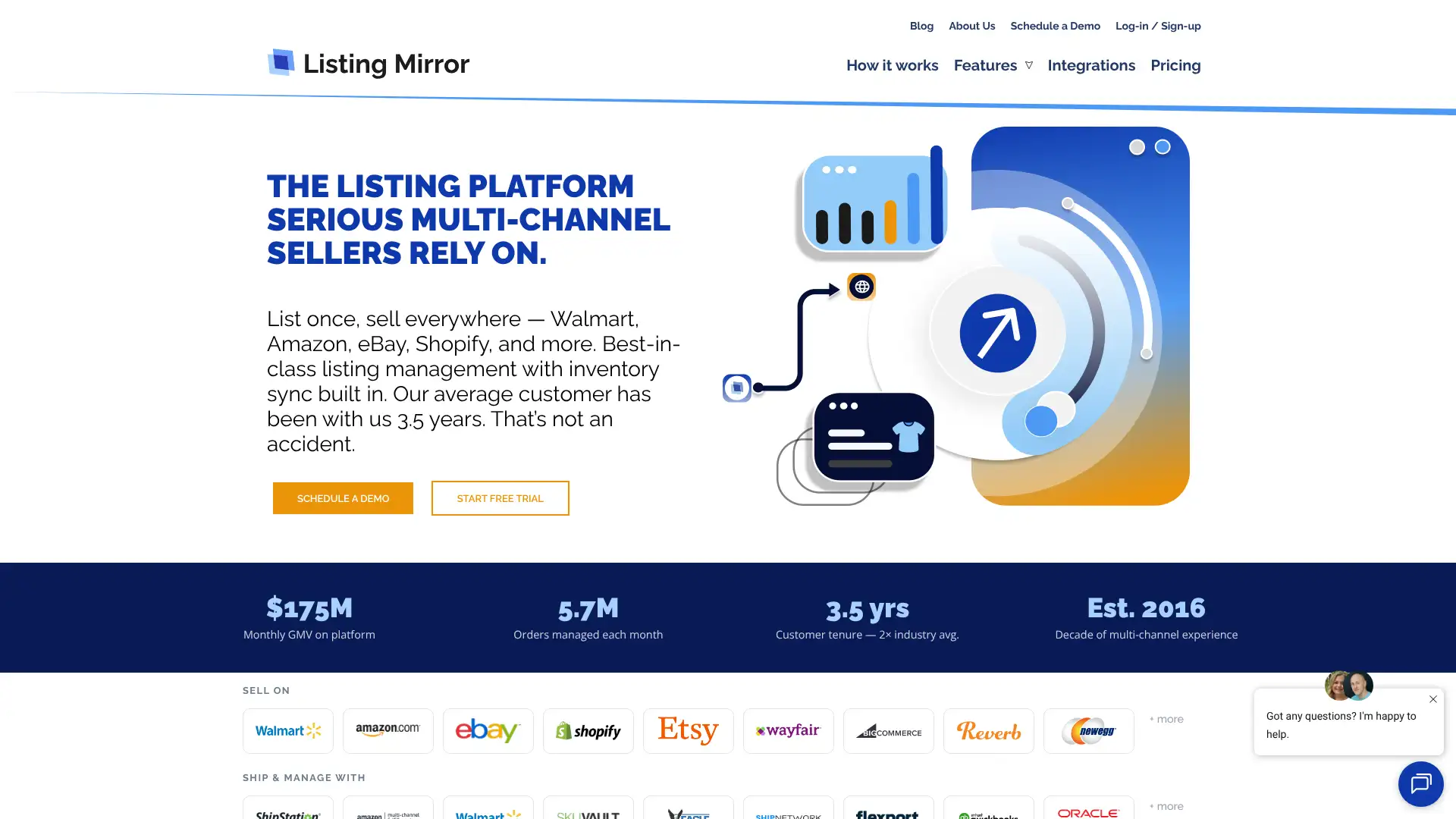
Listing Mirror is a multichannel listing and inventory management platform headquartered in the US, focused on helping ecommerce sellers sync listings, inventory, and orders across Amazon, Walmart, eBay, Etsy, Shopify, and other channels. It offers three transparent plan tiers: Basic at $99/mo (3 channels, 500 orders), Listings Plan at $159/mo, and Full Plan at $249/mo. Listing Mirror charges no transaction fees and no per-order fees, which is a meaningful advantage for high-volume sellers. It integrates with ShipStation for label printing and supports Amazon MCF for off-Amazon fulfillment. A 30-day free trial covering up to 10 products is available.
- • Multichannel listing sync: push product listings from a central catalog to Amazon, Walmart, eBay, Etsy, and Shopify simultaneously with channel-specific field mapping.
- • Inventory sync across channels: stock levels update across all connected channels within minutes of a sale to prevent overselling on high-traffic days.
- • Amazon MCF integration: route non-Amazon orders to Amazon Multi-Channel Fulfillment automatically, with tracking numbers synced back to the originating channel.
- • Inventory forecasting: analyze sales velocity and generate purchase order recommendations so you reorder before stockouts occur on your fastest-moving SKUs.
- • ShipStation integration: push orders to ShipStation for bulk label printing and carrier rate shopping without managing two separate shipping workflows.
Listing Mirror is a strong choice for multichannel sellers in the $500K-$5M GMV range who want transparent pricing, no transaction fees, and solid listing and inventory sync without the complexity of enterprise platforms. The Amazon-cannot-be-managed-through-Listing-Mirror limitation is a real operational consideration that should be verified during the free trial before committing. Teams growing beyond 10 channels or requiring advanced analytics will eventually outgrow it.
Sellbery
Sellbery is a cloud-based multichannel product listing and inventory synchronization platform designed to help ecommerce merchants manage listings, orders, and stock levels across Amazon, eBay, Etsy, Shopify, WooCommerce, and other marketplaces. Pricing starts at $19-21/mo for the entry plan covering a limited SKU count, scaling with catalog size. Sellbery supports operations in 55+ countries with multi-currency handling and inventory feed automation. It has a Shopify App Store listing and is used by smaller ecommerce operations that need a cost-effective way to push listings across channels without manual re-entry. The platform is relatively lean in marketing presence but remains operationally active as of 2025.
- • Multichannel product sync: push product listings including titles, descriptions, prices, and images from one source to Amazon, eBay, Etsy, Shopify, WooCommerce, and other channels.
- • Inventory feed automation: automatically update stock quantities across connected channels as orders arrive, preventing overselling without manual quantity adjustments.
- • Price and promotion sync: manage price changes and promotional pricing across channels from a central price feed, including start and end dates for time-limited offers.
- • Order management dashboard: view and track order statuses across all connected channels from a single interface with export options for fulfillment processing.
- • 55-country support: manage listings, currencies, and marketplace-specific requirements across regional Amazon properties and international marketplaces.
Sellbery can work for very small sellers who need basic multichannel listing sync at minimal cost and are comfortable with a lean support experience. For most sellers, Sellbrite at $29/mo offers meaningfully better support, documentation, and reliability for only $10/mo more. Sellers expecting to grow should start with a more established platform rather than migrating later.
RestockPro by eComEngine
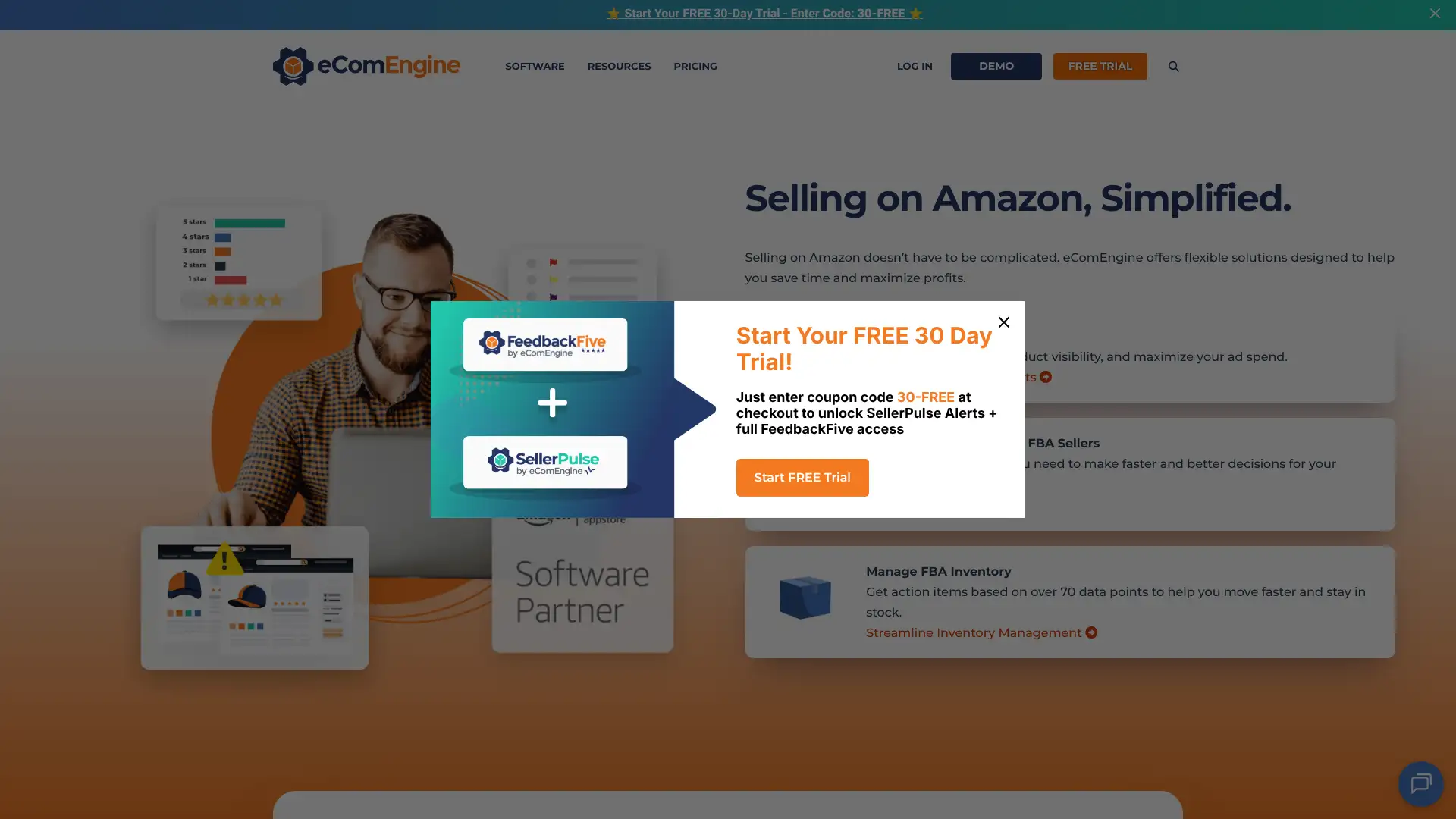
RestockPro is an Amazon FBA inventory forecasting and management tool by eComEngine, serving thousands of Amazon sellers across 100+ countries since 2007. Plans are based on monthly FBA order volume: $49/mo for up to 1,000 FBA orders, scaling to $249/mo for 35,000+ FBA orders. Annual plans provide 12 months for the price of 10. All features are available on every plan tier, including restock suggestions, purchase order management, supplier tracking, kit profitability analysis, and SKU-level margin calculations. RestockPro integrates with Aura repricer for free to keep restocking and pricing tools aligned. A 21-day free trial requires no credit card.
- • Intelligent restock suggestions: analyzes 70+ data points per SKU including sales velocity, lead times, and historical days of supply to generate precise reorder quantities and timing.
- • Low inventory fee avoidance: surfaces SKUs at risk of Amazon's low-inventory-level fee (introduced in 2024) by tracking the 28-day supply threshold Amazon uses to assess the charge.
- • Supplier management: store vendor contact details, lead times, minimum order quantities, and preferred shipping methods per supplier so purchase orders pre-populate correctly.
- • Purchase order creation and tracking: build, send, and track POs from within RestockPro with status visibility from order placement through Amazon inbound receiving.
- • Kit profitability tracking: automatically calculate margin for Amazon kits by pulling in all component costs, FBA fees, and sale prices without manual spreadsheet work.
RestockPro is the best dedicated FBA restocking tool for Amazon-focused sellers who want to eliminate spreadsheet-based reorder decisions and avoid Amazon's 2024 low-inventory fees. The all-features-on-every-plan pricing model and 21-day free trial make it easy to evaluate. Multichannel sellers or brands managing both FBA and their own warehouse fulfillment should look at tools that cover the full inventory picture.
Katana
Katana is a cloud-based manufacturing ERP designed for small to mid-sized manufacturers, DTC brands, and make-to-order businesses. It offers a free plan limited to 30 SKUs and a configurable Core Plan starting at $299/mo (annual) with unlimited SKUs and users. Add-ons include Full Traceability ($199/mo), Planning and Forecasting ($199/mo), Advanced Manufacturing ($449/mo), and Warehouse Management ($99/mo). Katana integrates with Shopify, WooCommerce, Xero, QuickBooks Online, and other ecommerce and accounting platforms. It is notable for its visual production planning board and real-time inventory visibility across materials and finished goods. However, multiple long-term customers have reported significant and unexpected price increases mid-subscription in recent years.
- • Visual production planning board: drag-and-drop manufacturing schedule with real-time status tracking showing what is in progress, blocked, or completed across all production runs.
- • Live inventory tracking: raw materials and finished goods inventory updates in real time as production consumes materials and sales orders fulfill stock across all channels.
- • Bill of materials management: multi-level BOMs with component substitution support, waste tracking, and cost rollup from materials through finished goods.
- • Shop floor app: assign operator tasks, record quantities produced and materials consumed directly on the factory floor via mobile device with barcode scanning support.
- • Ecommerce sync: two-way integration with Shopify and WooCommerce keeps sales orders and inventory levels synchronized between your store and manufacturing workflow.
Katana's production planning board and ecommerce integration make it genuinely attractive for small make-to-order manufacturers. However, the history of unexpected pricing model changes is a material risk for businesses entering multi-year operational dependency on the platform. Teams with complex traceability or multi-location needs will find the cumulative add-on costs approach or exceed full-ERP pricing. Try the free plan to validate fit before signing an annual contract.