34 Best Helpdesk Software in 2026
This guide covers five categories of customer support software in 2026: Full-service help desks (Zendesk, Freshdesk, Intercom, HubSpot, Salesforce, Help Scout, Zoho Desk) for omnichannel ticketing and support operations; Specialised commercial platforms (Kayako, HappyFox, Jitbit, DeskPRO, LiveAgent) for specific workflow and compliance needs; Open-source options (osTicket, UVdesk, Zammad, FreeScout) for budget-conscious self-hosted deployments; Live chat and messaging (LiveChat, Tidio, Crisp, Drift) for real-time customer engagement; and Niche and specialist platforms (Gorgias, Re:amaze, Front, Groove, Hiver, Missive, Helpwise, Dixa, Kustomer, Gladly, Helpjuice, Document360, ClickDesk, SupportBee, Teamwork Desk) for e-commerce, collaborative inbox, knowledge management, and premium customer relationship use cases.
Zendesk
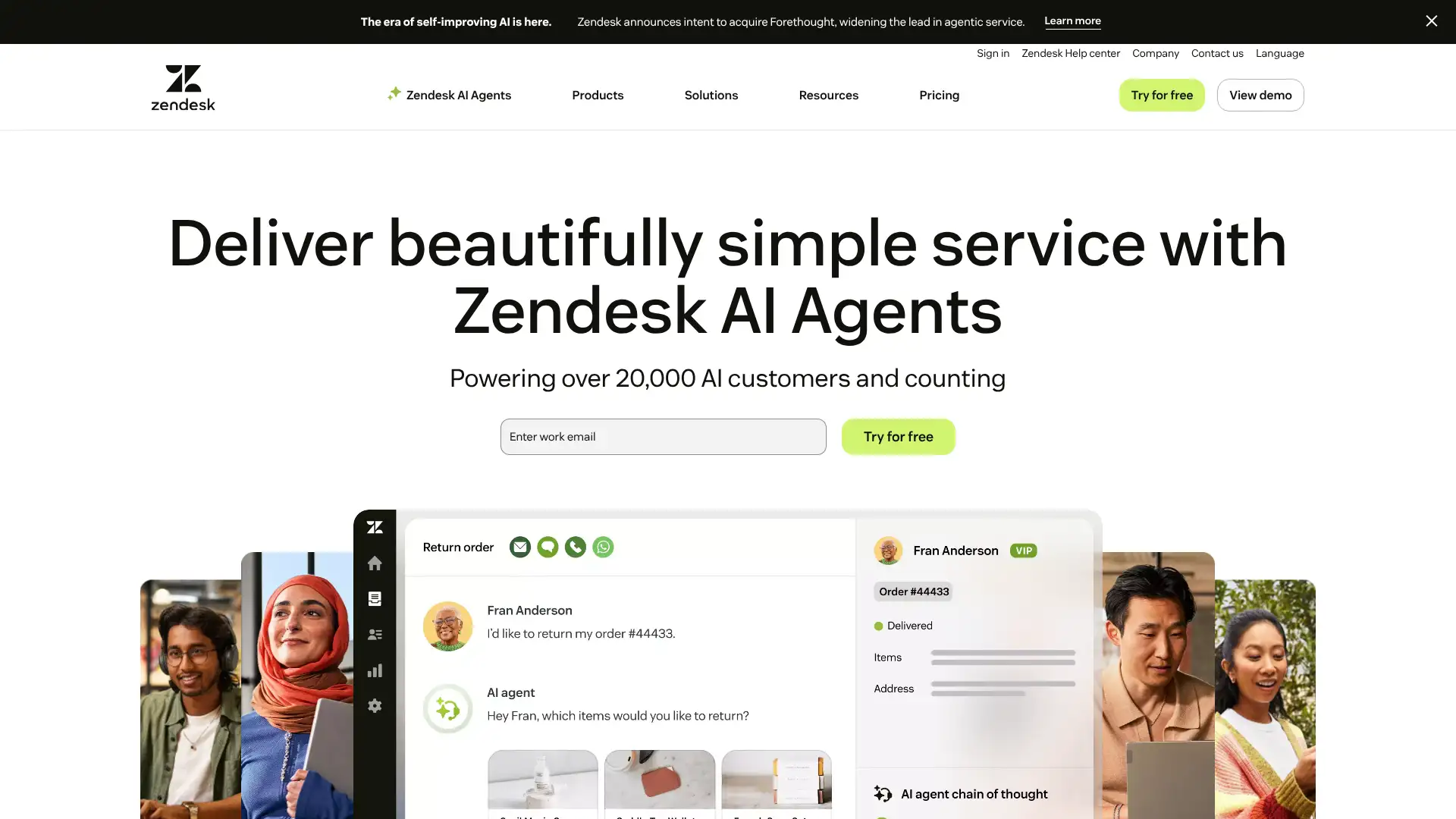
Zendesk is the most widely deployed enterprise help desk platform, holding a dominant position in the customer support software market. It provides a comprehensive omnichannel suite covering email, live chat, phone, social media, community forums, and self-service knowledge base. Zendesk's deepest advantage is its integration ecosystem: nearly 2,000 integrations versus Freshdesk's approximately 700. No free tier exists. Plans start at $55/agent/month for Suite Team. The actual total cost of ownership is commonly higher than the listed price: the Advanced AI add-on costs $50/agent/month extra, and a Data Privacy add-on adds another $50/agent/month. A 10-agent team can reach $2,150/month versus the advertised $1,150. Forrester Consulting reported customers see payback in two months on average.
- • Nearly 2,000 integrations: the largest app marketplace in the help desk category
- • Advanced AI add-on: AI agent for automated resolution, intelligent triage, and intent detection
- • Skills-based routing: route tickets to the right agent based on skills, language, and workload
- • Multi-brand help centres: support multiple products with separate knowledge bases on Suite Professional
- • SLA management: configurable SLA policies with breach alerts and reporting on Growth+
Zendesk is the right choice for organisations handling hundreds or thousands of daily tickets across multiple channels who need sophisticated routing, reporting, and multi-brand support. Hidden add-on costs make it expensive for smaller teams.
Freshdesk (Freshworks)
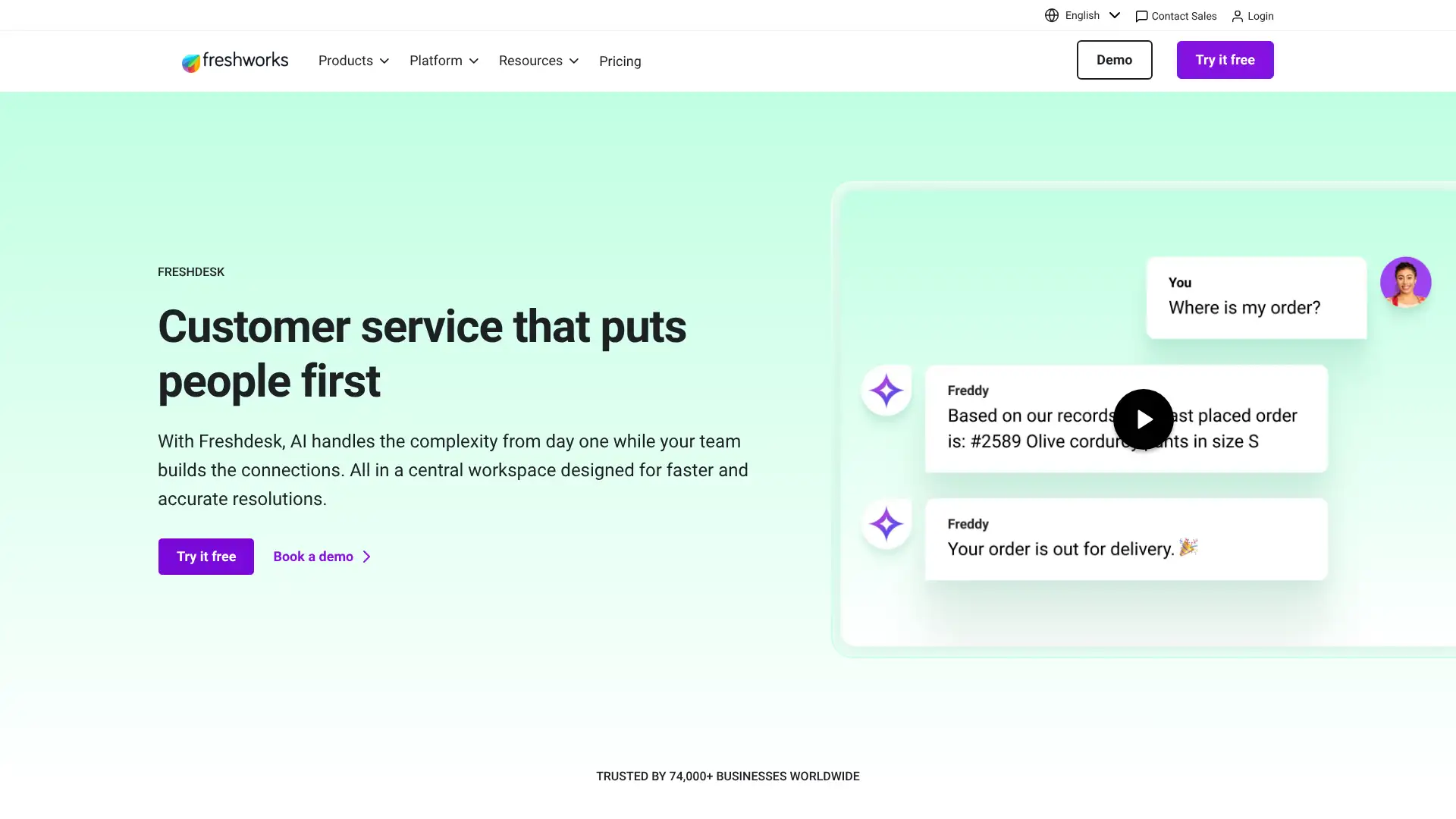
Freshdesk is Freshworks' customer support platform, widely regarded as the value champion in the help desk category: it provides approximately 80% of Zendesk's features at about 50% of the cost. A genuine free tier exists (up to 10 agents, 6 months) which is one of the most useful free plans in the market. The Growth plan at $15/agent/month covers automation, reporting, and collision detection. The Pro plan at $49/agent/month adds advanced analytics and multilingual support. Freshdesk Omni is the consolidated omnichannel product covering email, chat, phone, social, and WhatsApp starting at $29/agent/month. Freddy AI assists with response drafting and ticket summaries. Freshdesk operates data centres in Frankfurt for GDPR compliance, an important differentiator for European customers.
- • Free tier for up to 10 agents: one of the most genuinely useful free plans in the category
- • Freddy AI: AI-powered response suggestions, ticket summaries, and article recommendations
- • 700+ integrations: the second-largest marketplace after Zendesk
- • GDPR-compliant Frankfurt data centres: EU data residency option for European businesses
- • Freshdesk Omni: consolidated omnichannel including WhatsApp native support
Freshdesk is the best commercial help desk for budget-conscious SMBs and growing teams who want Zendesk-level features without Zendesk prices. The genuine free tier and GDPR-compliant Frankfurt data centres make it particularly strong for European businesses. For enterprise teams needing the deepest customisation, Zendesk remains the standard.
Intercom
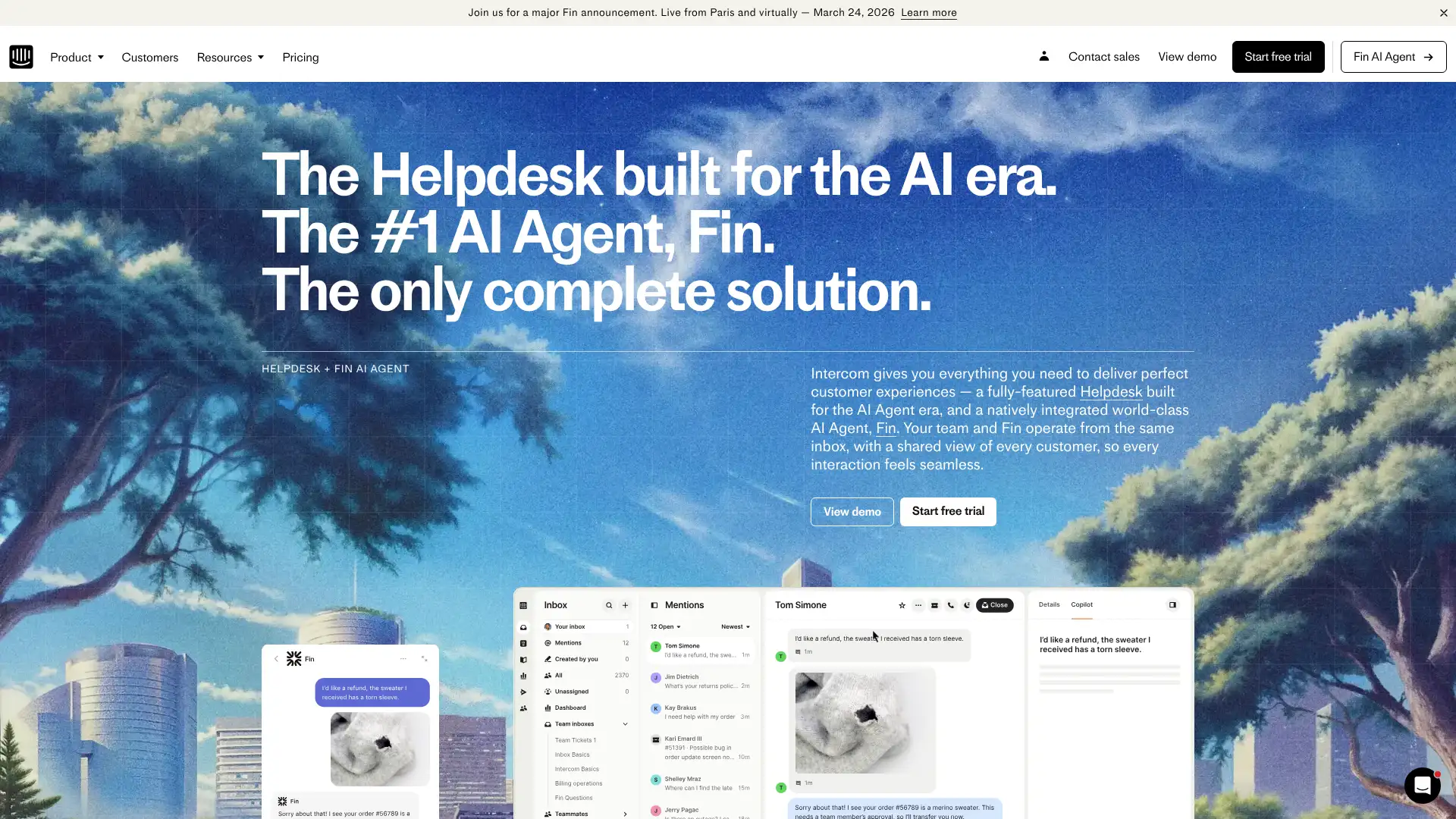
Intercom is a conversational support platform founded in 2011 and positioned as AI-first: its Fin AI Agent automatically resolves customer queries using help centre content, reducing the volume of tickets requiring human attention. Unlike Zendesk and Freshdesk which are ticket-centric, Intercom is conversation-centric, with real-time messaging, proactive outreach, in-app product tours, and customer segmentation built in. This makes it the natural choice for product-led SaaS companies where support is also a sales and retention channel. Base plans start at approximately $39/seat/month. AI resolutions are priced at $0.99 per resolution (lower than Zendesk's AI resolution pricing). For high-volume support, AI costs can reach $5,000+/month. Intercom was acquired by a private equity firm in 2023 but continues independent operations.
- • Fin AI Agent: automatically resolves customer queries from help centre content with no human involvement
- • In-app messaging and product tours: contextual support and onboarding directly inside your product
- • Proactive outbound messaging: send targeted messages to user segments based on behaviour
- • Customer data platform: user profiles with event history, attributes, and segment logic built in
- • WhatsApp native: WhatsApp Business integration included on Essential plan
Intercom is the best support platform for product-led SaaS companies where support, sales, and product onboarding overlap. The Fin AI Agent genuinely reduces ticket volume. For traditional ticket-based support teams without a product-led motion, Freshdesk or Help Scout provide better value.
HubSpot Service Hub
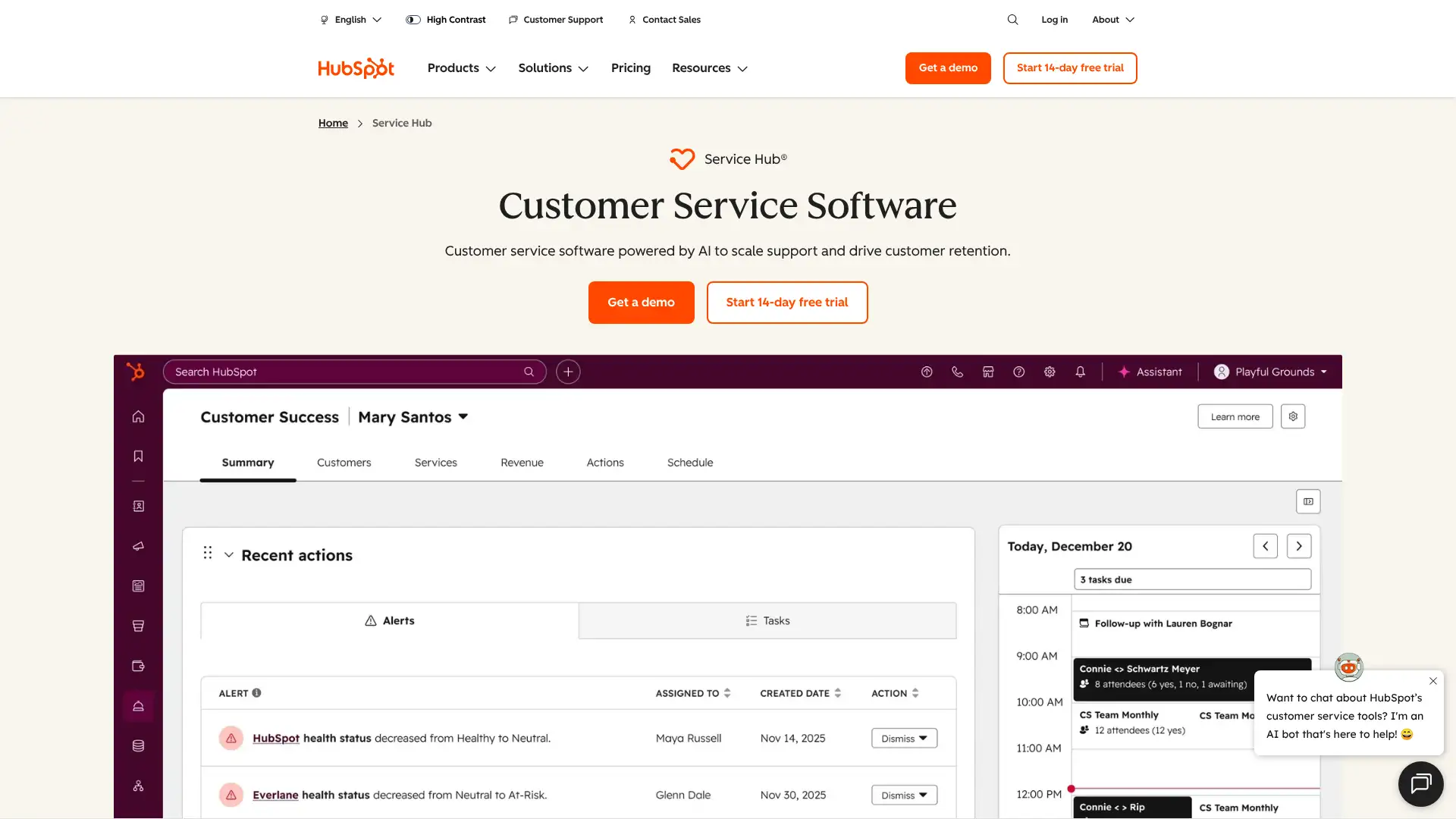
HubSpot Service Hub is HubSpot's customer support product, built natively on the same CRM as HubSpot Marketing and Sales Hub. The key advantage is zero data silos: support tickets, contact history, deal data, and marketing interactions all live in the same database, giving support agents full customer context without integration. A genuinely useful free tier exists covering ticketing, live chat, email templates, and calling. The Service Hub Starter plan costs $15/seat/month. The Professional plan at $90/seat/month adds automation, SLAs, CSAT, and a knowledge base. For teams already using HubSpot for marketing or sales, Service Hub is the natural extension without additional per-seat licence costs for CRM data access.
- • Native CRM integration: tickets, contacts, deals, and marketing all in one HubSpot database
- • Knowledge base: public and private articles with SEO optimisation on Professional+
- • Customer portal: self-service ticket status tracking and case management for customers
- • SLA management and CSAT: response time SLAs and satisfaction surveys on Professional plan
- • Conversation intelligence: call recording, transcription, and coaching on Enterprise
HubSpot Service Hub is the right choice for companies already using HubSpot Marketing or Sales Hub who want support data in the same CRM without a separate integration. The free tier is one of the best in the category.
Salesforce Service Cloud
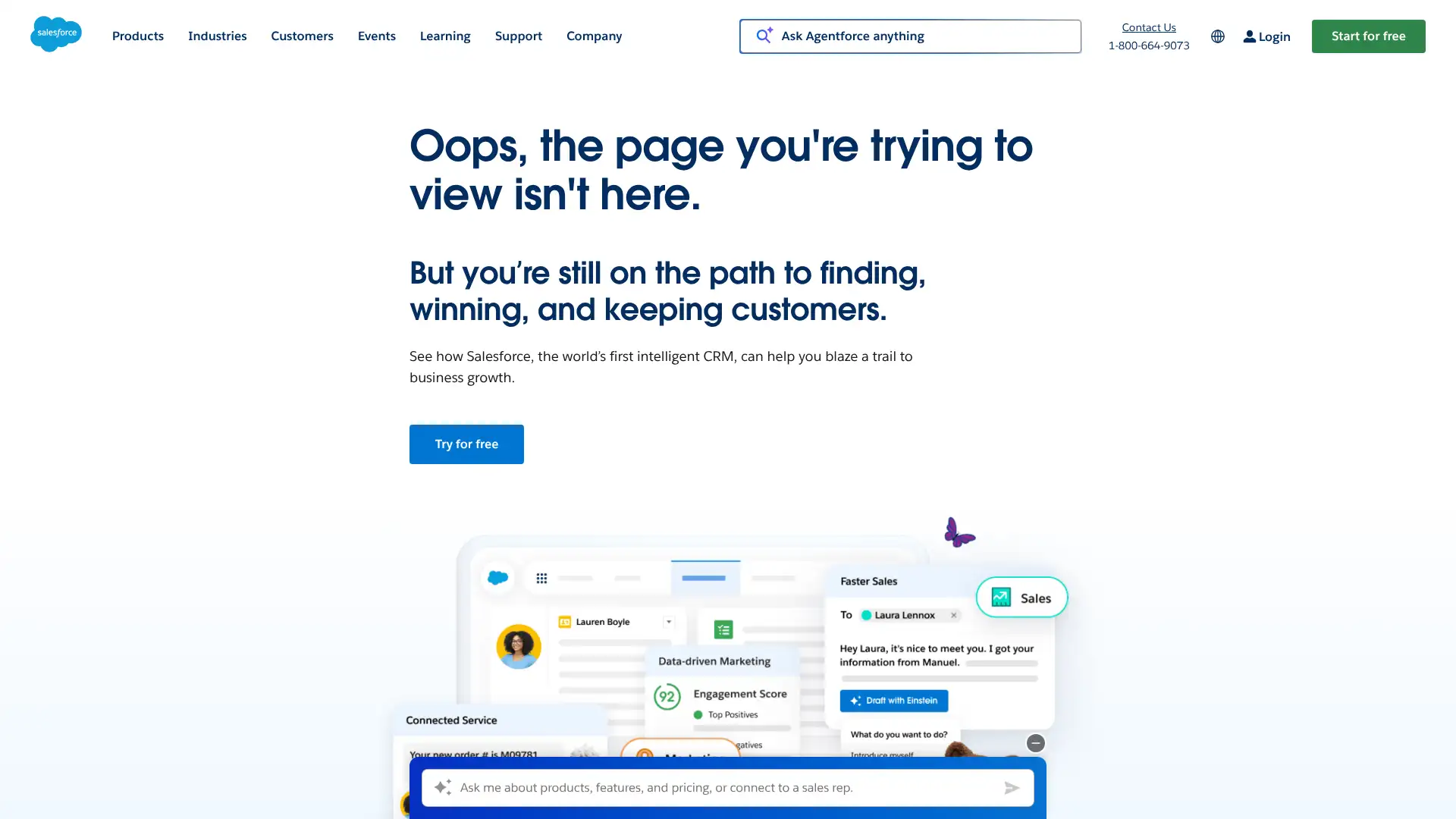
Salesforce Service Cloud is the enterprise customer service platform built on the Salesforce CRM platform, used by the majority of Fortune 500 companies that run Salesforce. It provides case management, omnichannel routing, knowledge management, field service, AI-powered Einstein, and deep analytics through Tableau. Like HubSpot Service Hub, its primary advantage is native CRM integration: service cases are first-class objects alongside sales opportunities. Pricing starts at approximately $25/user/month for Starter, $75 for Professional, $150 for Enterprise, and $300 for Unlimited. Implementation typically requires Salesforce-certified consultants and can take months. It is the most powerful enterprise support platform reviewed but also the most expensive.
- • Einstein AI: AI-powered case classification, routing, and response suggestions across all plans
- • Salesforce CRM native: cases, contacts, accounts, and opportunities share one database
- • Omni-Channel routing: route work across email, phone, chat, social, and messaging by agent skill
- • Field Service Lightning: manage field technician dispatch and mobile workforce for service businesses
- • Tableau Analytics: enterprise BI embedded in Service Cloud for customer service insights
Salesforce Service Cloud is the right choice for large enterprises already running Salesforce Sales Cloud who need customer service data in the same platform as their CRM, ERP, and sales operations. For organisations not already on Salesforce, Zendesk or HubSpot Service Hub provide comparable enterprise support at lower implementation
Help Scout
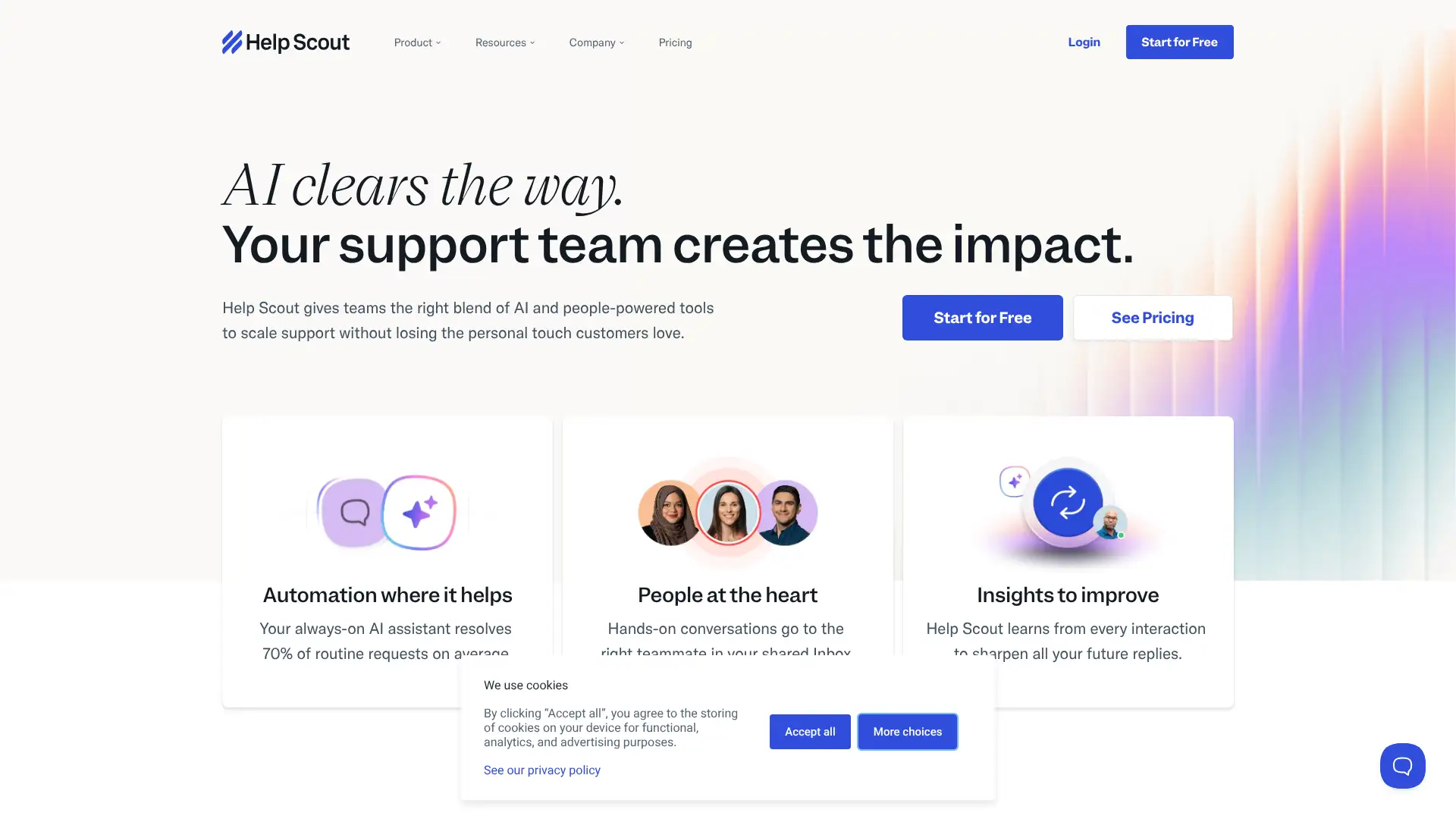
Help Scout is an email-centric help desk platform designed around the belief that support should feel human rather than transactional. Conversations look like normal emails to customers rather than ticket numbers, and the interface is clean enough that non-technical support agents can use it with minimal training. Plans start at $25/user/month for Standard, $50 for Plus, and $65 for Pro. Unlike Intercom (AI-first) or Zendesk (ticket-centric), Help Scout's philosophy is putting humans first and using AI as a productivity layer. Beacon (the live chat widget) and Docs (the knowledge base) are included in all paid plans. Help Scout AI ($0.75/resolution) is cheaper than Intercom's equivalent. The free plan allows up to 5 users for an unlimited time, the most generous permanent free tier reviewed.
- • Conversation model: support looks like normal email to customers, no ticket numbers in subject lines
- • Beacon live chat widget: proactive chat with self-service suggestions before connecting to an agent
- • Docs knowledge base: built-in knowledge base included on all paid plans, no extra charge
- • AI summaries and drafts: AI-generated reply drafts at $0.75/resolution, lower than Intercom
- • HIPAA compliance: available on Pro plan, important for healthcare and regulated industries
The best help desk for small-to-medium teams (5-50 agents) where support quality and human connection matter more than ticket throughput. The permanent free tier for 5 users is genuinely useful. For enterprise-scale omnichannel with phone, Zendesk or Freshdesk are more appropriate.
Zoho Desk
Zoho Desk is one of the most cost-effective commercial help desks on the market, with a free plan for up to 3 agents and paid plans starting at $14/agent/month. It covers email, live chat, phone, social media, and WhatsApp, making it an omnichannel platform at a fraction of Zendesk's price. Zoho Desk's primary advantage is its integration with the broader Zoho ecosystem: CRM, campaigns, analytics, and finance all connect natively. The Zia AI assistant provides response suggestions and ticket sentiment analysis. Zoho Desk's highest plan costs less per user than Zendesk's lowest plan. It is particularly popular in Asia, Europe, and with organisations already using other Zoho products.
- • Zia AI: sentiment analysis, tag suggestions, anomaly alerts on Enterprise plan
- • Zoho CRM native integration: tickets, contacts, and deals connected without a third-party integration
- • Multi-brand support: separate help centres for multiple products on Enterprise plan
- • Community forums: built-in forums for customer-to-customer support on Professional+
- • ASAP self-service widget: embedded help widget with AI-powered search and ticket submission
Zoho Desk is the best commercial help desk for small businesses on tight budgets or teams already using Zoho CRM, Books, or other Zoho products. The omnichannel feature set at $40/agent/month is exceptional value.
Kayako
Kayako is a customer support platform founded in 2001 that focuses on providing agents with a unified view of the full customer journey across all support channels. Rather than showing discrete tickets, Kayako shows agents the complete conversation history from email, chat, social, and help centre in one timeline view per customer. This is conceptually similar to Gladly and Kustomer's customer-centric model rather than the ticket-centric model of Zendesk. Kayako InFusion (on-premise version) and Kayako Classic are legacy products; the current SaaS product targets SMBs and growing teams. Pricing starts at approximately $15/agent/month for Inbox and $30/agent/month for Growth.
- • SingleView timeline: complete customer history across email, chat, and self-service in one view
- • Kayako Messenger: live chat widget with co-browsing and visitor monitoring
- • Knowledge base: public and private articles with SEO settings and multilingual support
- • Collaboration: internal notes, @mentions, and agent collision detection
- • Automation: rule-based routing, auto-tagging, and time-based SLA triggers
Kayako's customer-centric conversation timeline is a genuinely differentiated data model that shows every interaction a customer has ever had in chronological order, regardless of channel, which is more useful than a ticket list for high-value B2C relationships. The problem is product velocity: Freshdesk, Intercom, and.
HappyFox
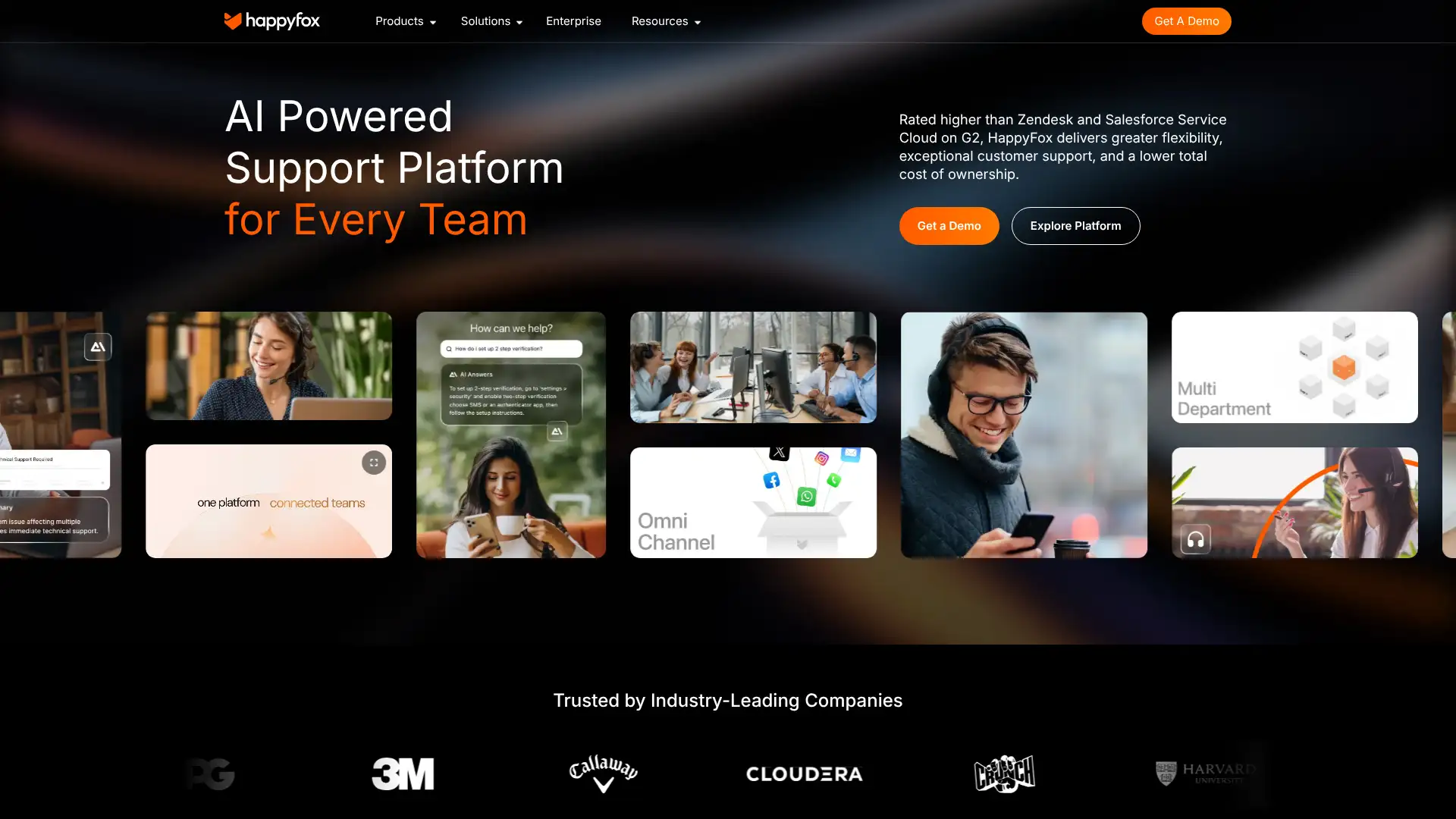
HappyFox is a help desk platform targeting mid-market companies (50-500 employees) that need structured ticketing with strong SLA management, multi-department support, and compliance features. It supports email, live chat, phone, social media, and a self-service portal. HappyFox differentiates with a very clear SLA policy engine, agent-facing queues with visual SLA timers, and a built-in asset management module. Pricing starts at approximately $9/agent/month for Basic and goes up to $49/agent/month for Enterprise, with unlimited agents on higher plans. A dedicated Chatbot product is available as a separate subscription.
- • Unlimited agents on Pro and Enterprise: predictable cost regardless of team size growth
- • Visual SLA timers: agents see breach risk in real time on the ticket queue view
- • Asset management: track IT assets alongside support tickets without a separate tool
- • Multi-department queues: IT, HR, and customer support can use separate queues in one platform
- • HappyFox Chat: separate live chat product that integrates with the help desk
HappyFox is the best help desk for mid-market companies that need structured SLA management across multiple departments (IT, HR, and customer support) and want unlimited-agent pricing on higher tiers. For companies primarily using the platform for customer support without internal IT help desk requirements, Freshdesk provides a
Jitbit
Jitbit is a straightforward email-to-ticket help desk with one of the most transparent flat-rate pricing structures in the category. Unlike Zendesk or Freshdesk which charge per agent, Jitbit charges per company: $29/month for up to 10 agents (Freelancer), $69/month for 25 agents (Startup), $129/month for unlimited agents (Company), and $249/month for unlimited agents with more storage (Enterprise). A self-hosted version is available as a one-time purchase at approximately $1,799. Jitbit targets small-to-medium support teams that want email ticketing, knowledge base, and basic automation without the complexity of enterprise platforms.
- • Flat-rate company pricing: cost does not increase as you add agents within the tier limits
- • Self-hosted option: one-time purchase for data-sovereignty-conscious organisations
- • Email-to-ticket pipeline: converts all inbound emails to tickets with auto-assignment rules
- • Knowledge base: built-in KB with public and private articles and full-text search
- • Mobile apps: iOS and Android apps for agent responses on the go
Jitbit is the best commercial help desk for small-to-medium teams (under 50 agents) that want flat-rate company-level pricing rather than per-agent billing. The self-hosted option is a genuine differentiator for organisations with data sovereignty requirements. For omnichannel support, Freshdesk is more complete at a similar price point.
osTicket
osTicket is one of the oldest and most widely deployed open-source help desk systems, with its first GitHub release in 2013. It is built in PHP and MySQL, completely free under the GNU GPL licence for self-hosted deployment. A cloud-hosted managed version is available at $12/agent/month. osTicket handles the core help desk workflow well: email-to-ticket conversion, departments, ticket routing, custom forms, auto-responders, and SLA policies. The interface is functional but dated compared to modern SaaS alternatives. There are no official mobile apps (third-party only). osTicket is often called the reliable workhorse option: not flashy, but it handles the basics dependably for budget-conscious IT departments and small businesses.
- • Email-to-ticket conversion: automatically converts inbound emails to tickets with routing rules
- • Custom forms: configurable intake forms per help topic for structured data collection
- • Departments and agents: role-based access with department-specific ticket queues
- • SLA policies: configurable SLA levels with escalation alerts
- • Auto-responders: automatic acknowledgement emails and status notifications to submitters
osTicket is the right open-source help desk for IT departments, schools, and budget-conscious organisations that need reliable email ticketing with no licence cost and are comfortable managing their own server. For a more modern open-source alternative, Zammad provides a cleaner interface.
UVdesk
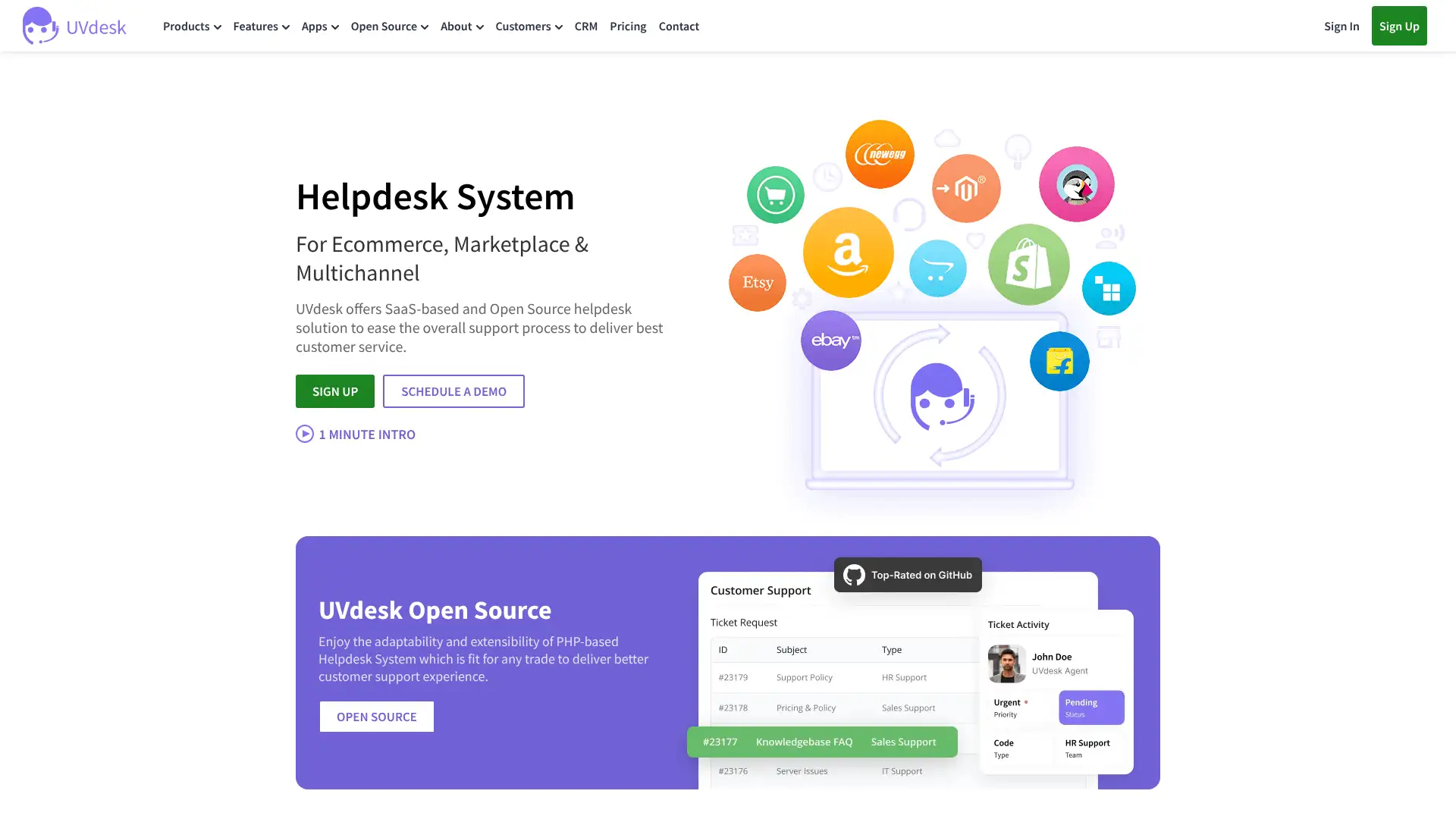
UVdesk is an open-source help desk built on the Symfony PHP framework, available for free self-hosting or as a cloud SaaS starting at $22/month. Its standout feature is e-commerce platform integration: native connectors for Shopify, Magento, WooCommerce, PrestaShop, and Amazon bring order history and customer data directly into the support ticket view, enabling agents to process refunds and check order status without leaving the help desk. This positions UVdesk as the open-source alternative to Gorgias for e-commerce support teams. The platform supports multi-channel ticket capture from email, web forms, social media, and marketplace queries.
- • E-commerce platform integrations: Shopify, Magento, WooCommerce, PrestaShop, Amazon out of the box
- • Order data in tickets: agents see order history, status, and customer details alongside tickets
- • Multi-channel capture: email, web forms, social media, and marketplace queries all converted to tickets
- • Workflow automation: rule-based ticket routing, auto-replies, and escalation policies
- • Custom knowledge base: branded FAQ and knowledge base builder
UVdesk is the best open-source help desk for e-commerce businesses that need order data from Shopify, Magento, or WooCommerce visible inside support tickets. The Gorgias-equivalent functionality at zero licence cost is the core value proposition.
Zammad
Zammad is a modern open-source help desk built in Ruby, designed from the ground up with a contemporary interface that is closest to Zendesk among all open-source alternatives. It handles email, phone, social media (Twitter/X, Facebook), and web forms in one unified inbox. Audit-proof ticket historisation tracks every change to every ticket, making it particularly valuable for banks, healthcare, and regulated industries. Self-hosted Zammad is free under the AGPL licence. Cloud pricing ranges from EUR 5 to EUR 24/agent/month, and annual support plans for self-hosted deployments range from EUR 2,999 to EUR 10,000.
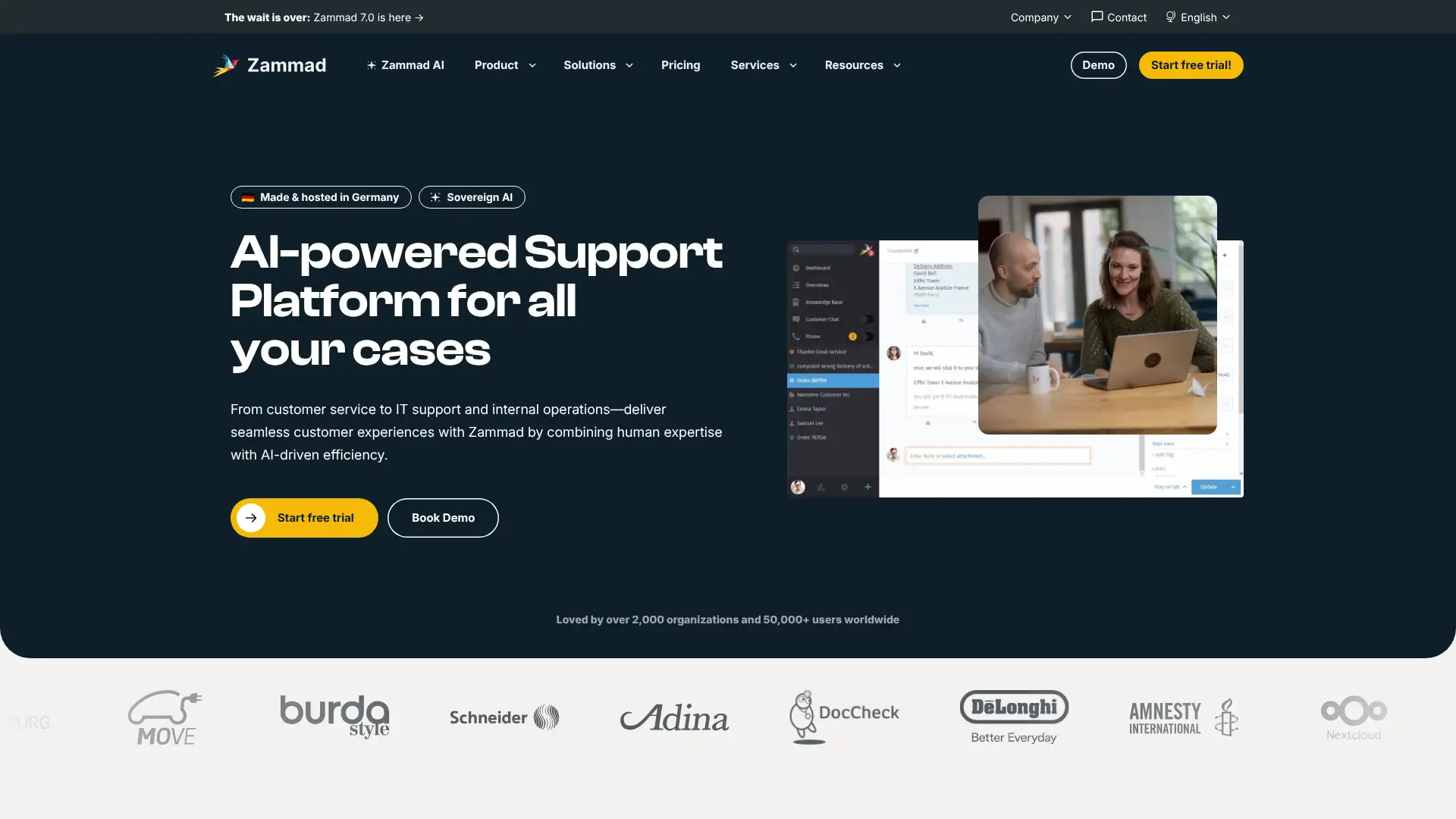
- • Modern interface: the closest to Zendesk look-and-feel of any open-source help desk reviewed
- • Audit-proof historisation: every change to every ticket is logged and tamper-proof
- • Full omnichannel: email, phone, Twitter/X, Facebook, and web forms unified in one inbox
- • REST API: comprehensive API for custom integrations and automated workflows
- • Migration importers: built-in importers from Zendesk, OTRS, and Freshdesk for switching
Zammad is the best open-source help desk for technical teams that want a modern interface, audit-proof records for compliance, and true omnichannel support. The Elasticsearch and Redis requirement means self-hosting needs more server resources than osTicket or FreeScout.
FreeScout
FreeScout is a free open-source help desk explicitly modelled on Help Scout, providing a Gmail-like shared inbox experience for teams that want clean email support management without per-agent licensing costs. It is built in PHP and Laravel, runs on shared hosting, and supports unlimited agents, tickets, and mailboxes. The core platform is free; optional functionality like SLA tracking, Slack notifications, auto-assignment, and WhatsApp integration are available as paid one-time module purchases (typically $2-$19 each). FreeScout requires no Elasticsearch or Redis, making it the lightest self-hosted option reviewed. A mobile app for Android and iOS is available.
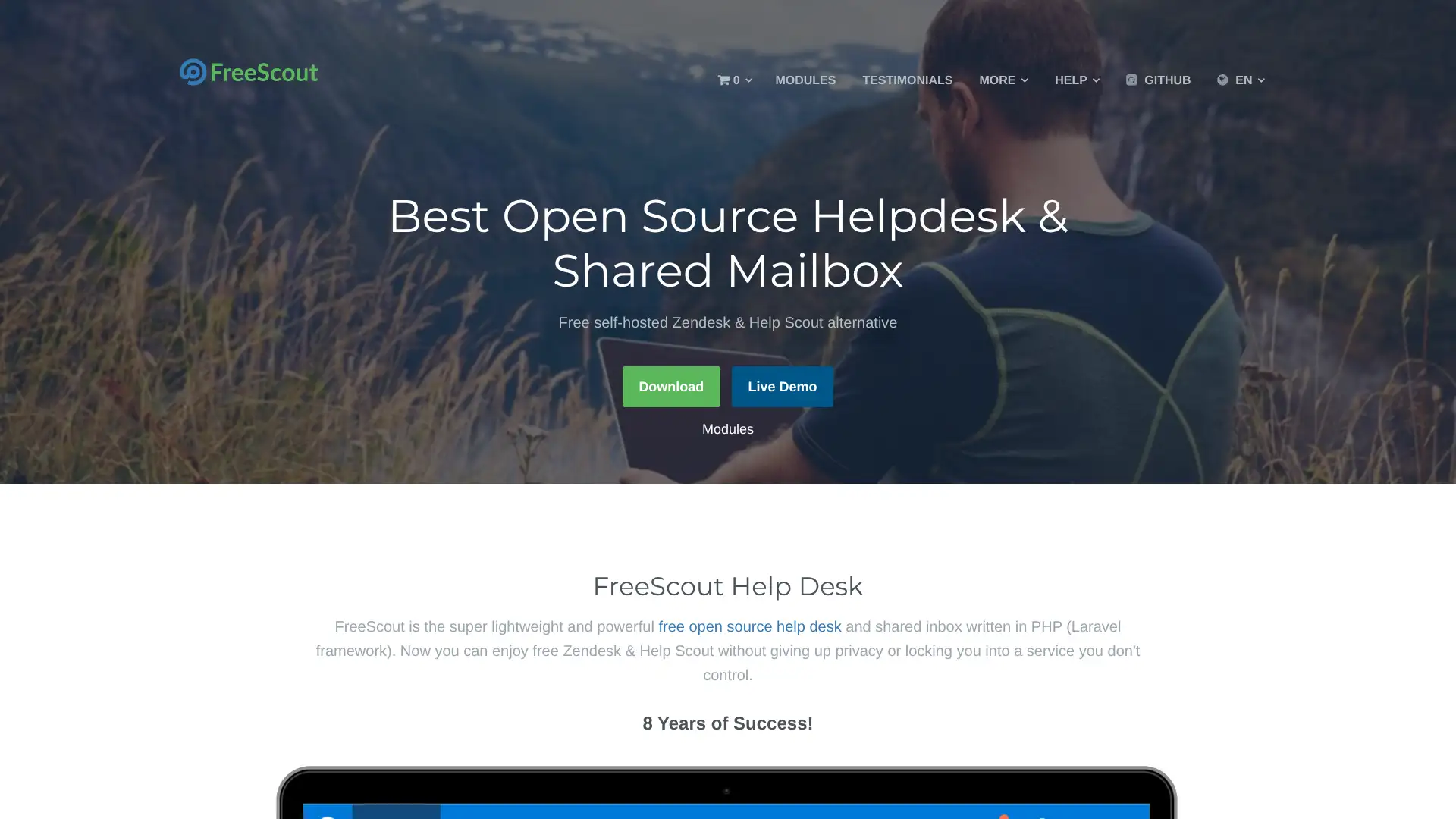
- • Gmail-like interface: the most approachable UI of any open-source help desk reviewed
- • Unlimited agents and mailboxes: no per-agent licensing regardless of team size
- • Module system: add only the functionality you need without a bloated full install
- • Collision detection: prevents two agents from working on the same ticket simultaneously
- • GDPR readiness: data stored on your own server with full admin control
FreeScout is the best starting point for small teams and startups that want a Help Scout-style shared inbox experience with zero licence cost and minimal server requirements. The module system means you only pay for what you actually need.
DeskPRO
DeskPRO is a comprehensive help desk platform available as both cloud SaaS and a fully licensed on-premise installation, making it one of the few commercial help desks that still offers on-premise deployment for organisations with strict data residency requirements. It covers email, live chat, phone, social media, and a self-service community portal. The asset management module tracks hardware and software assets alongside support tickets. DeskPRO includes CRM functionality, user segmentation, and a community forum. Pricing starts at approximately $29/agent/month. The on-premise licence removes the recurring SaaS fee after the initial purchase.
- • On-premise deployment: rare in 2026 commercial help desks; critical for regulated and air-gapped environments
- • Asset management: track IT hardware and software assets alongside support tickets
- • Community forums: integrated customer community for peer-to-peer support and feature requests
- • CRM functionality: contact and company management alongside ticketing
- • Multiple deployment regions: EU, US, and Australia-hosted cloud options for data residency
DeskPRO is the right commercial help desk for organisations that need on-premise deployment for data sovereignty, compliance, or air-gapped environment requirements. For cloud-only organisations without on-premise requirements, Freshdesk or Zendesk provide more polished interfaces with larger ecosystems.
LiveChat
LiveChat (by Text.com) is a dedicated live chat platform founded in 2002 and used by over 200,000 support representatives. It is built specifically for real-time website chat with agent efficiency tools: canned responses, chat routing, transfer, co-browsing, and rich analytics including agent performance reports. Unlike Tidio or Crisp which bundle chat with ticketing, LiveChat focuses on live chat excellence and integrates with separate products (HelpDesk and ChatBot by the same parent company) for ticketing and chatbot functionality. Pricing starts at $20/agent/month for Starter, $41 for Team, $59 for Business, and $69 for Enterprise.
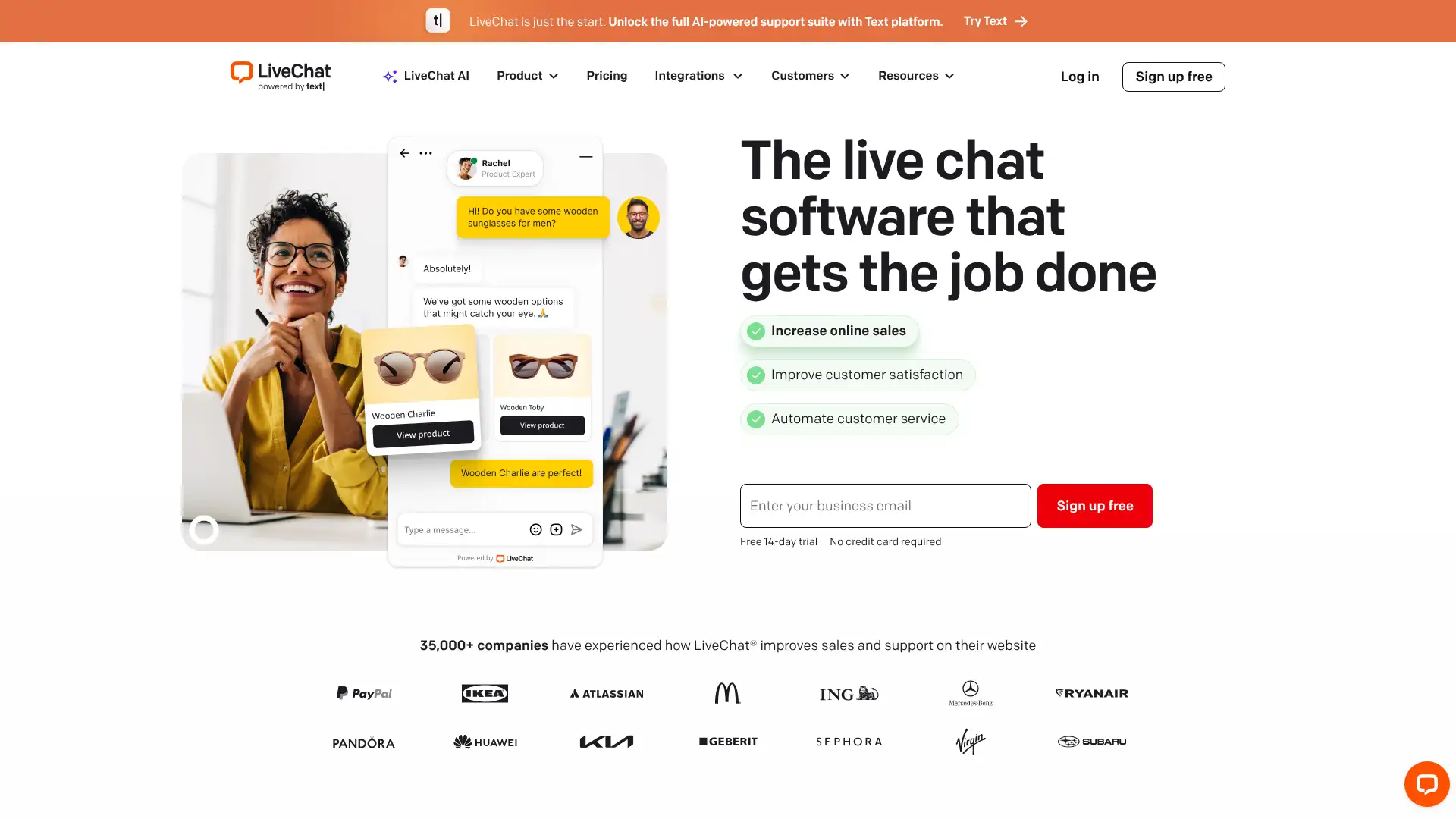
- • Best canned response library: the most organised and efficient canned response system reviewed
- • Staffing prediction: analytics showing when to schedule agents based on chat volume patterns
- • Co-browsing: guide customers through your website in real time from the chat window
- • Chat transfer with full context: pass chats between agents with the complete conversation visible
- • 200+ integrations: connects with CRM, e-commerce, and helpdesk tools
LiveChat is the best live chat platform for customer-facing teams where real-time chat efficiency and agent performance analytics are the primary requirement. For teams that also need ticketing and chatbot in one product, Tidio or Crisp bundle more functionality at lower cost.
Tidio
Tidio is an AI-driven live chat and customer service platform targeting small-to-medium businesses. Its key differentiator is Lyro, a conversational AI agent trained on your support content that handles up to 70% of repetitive queries automatically. Tidio connects to website chat, email, WhatsApp, Instagram, Facebook Messenger, and integrates natively with Shopify, Wix, Magento, and BigCommerce. Plans start at approximately $24/month (based on agent count) with a free plan available. Lyro AI conversations are billed separately at approximately $0.50 per conversation. Tidio also integrates with major CRM and help desk tools including Zendesk, HubSpot, and Salesforce.
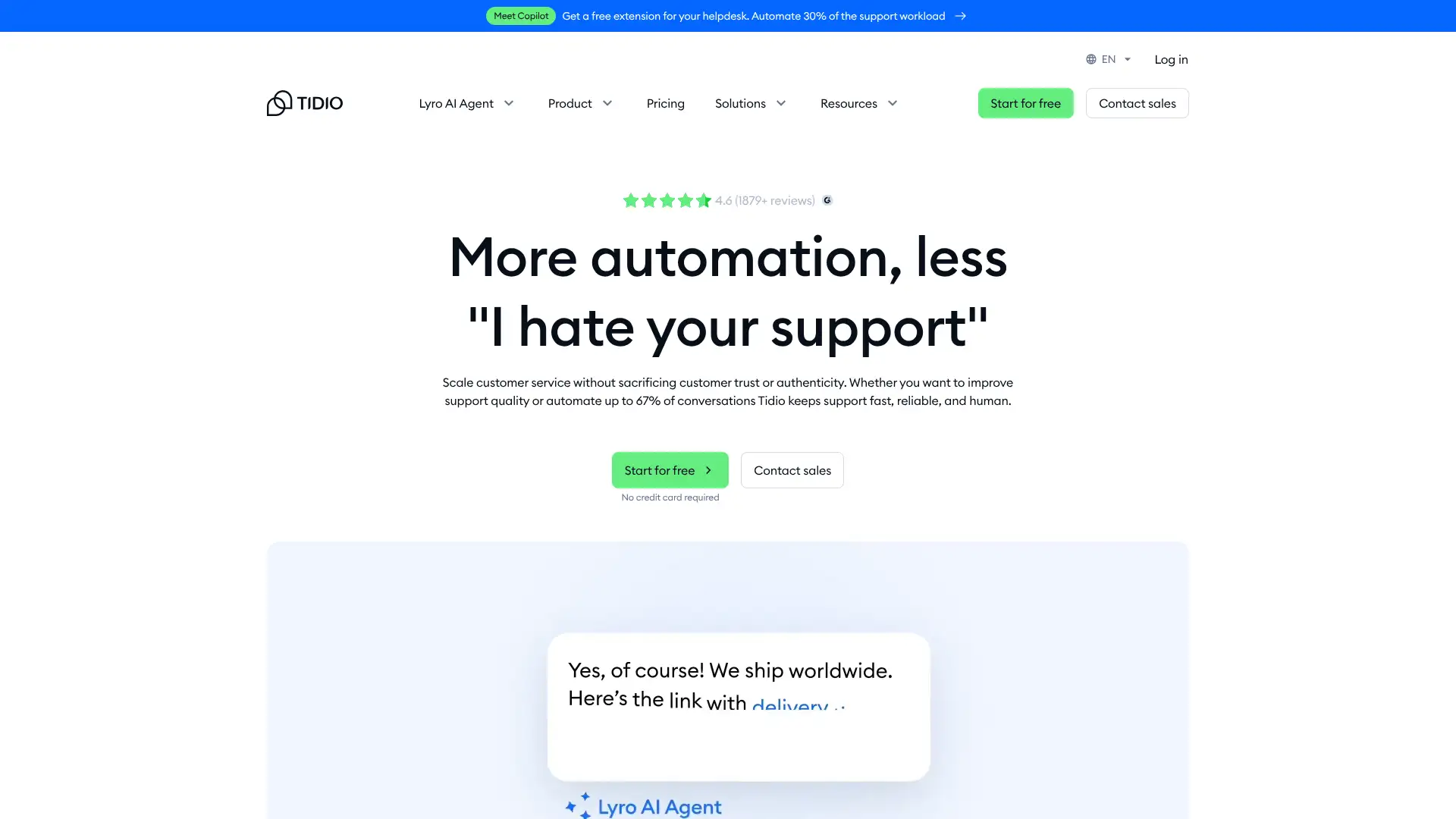
- • Lyro AI agent: conversational AI that handles up to 70% of repetitive queries from support content
- • E-commerce native: Shopify, Wix, BigCommerce, and Magento integrations out of the box
- • Visual chatbot builder: drag-and-drop flow builder for custom automation without coding
- • WhatsApp and Instagram: social messaging channels alongside website chat in one inbox
- • Multi-channel inbox: email, chat, and social managed from one shared agent view
Tidio is the best live chat and AI deflection platform for small e-commerce businesses that want to automate repetitive queries through Lyro AI while maintaining human agent backup. For dedicated e-commerce help desk with Shopify order management, Gorgias is more complete.
Crisp
Crisp is a customer messaging platform that charges per company workspace rather than per agent, making it particularly cost-effective for rapidly growing teams. The free plan supports 2 agents; the Mini plan at EUR 45/month adds canned responses and unlimited history; Essentials at EUR 95/month adds the chatbot builder, knowledge base, analytics, and routing; Plus at EUR 295/month adds ticketing, 100+ integrations, and white-labelling. Crisp AI (called MagicReply) generates instant reply suggestions, summarises conversations, and handles multilingual support. MagicBrowse provides co-browsing without a plugin. Crisp particularly appeals to SaaS startups as a more affordable alternative to Intercom.
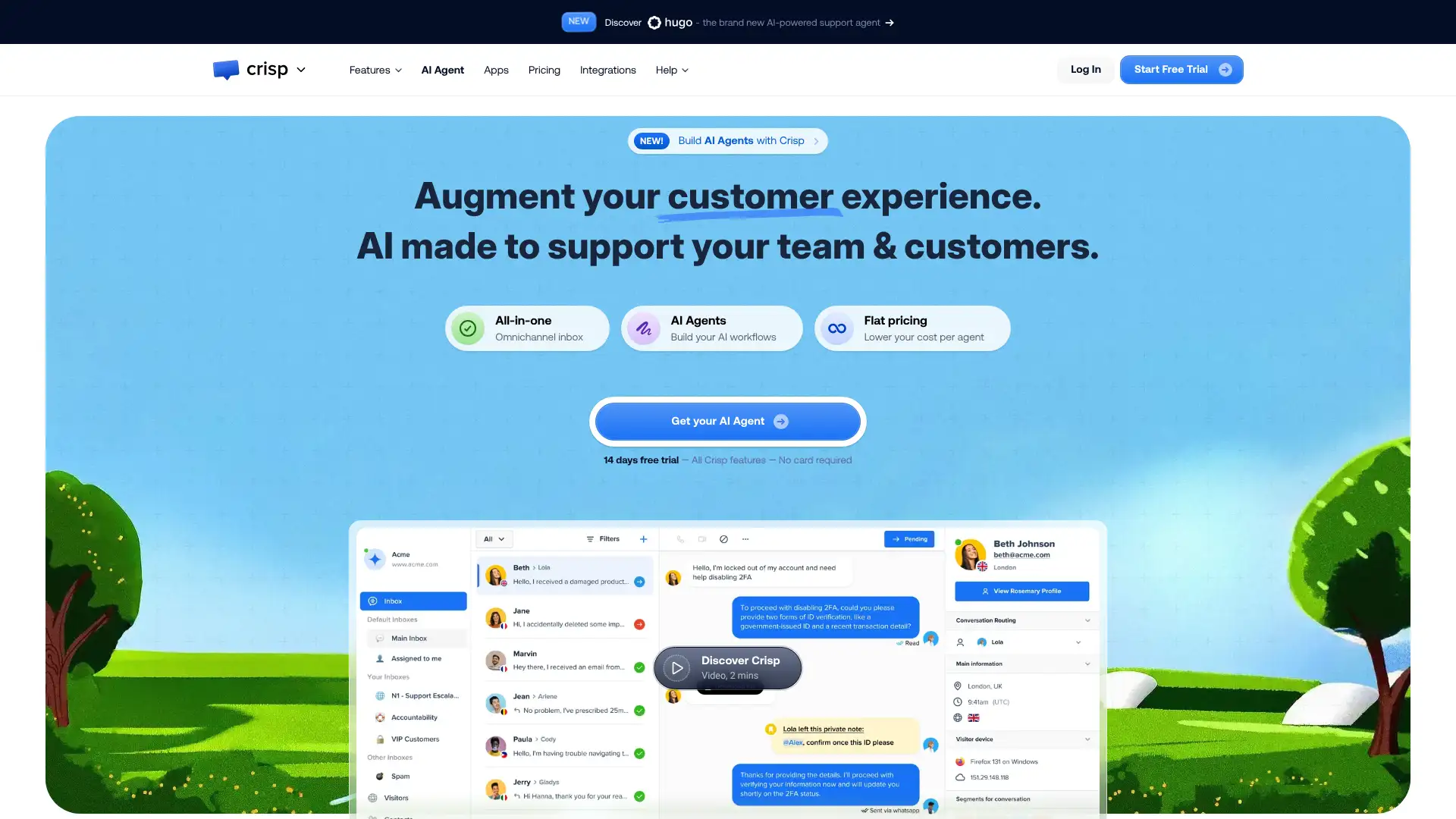
- • Workspace-based pricing: cost stays flat regardless of how many agents you add
- • MagicReply AI: instant reply suggestions, conversation summaries, and multilingual support
- • MagicBrowse co-browsing: view and guide customers through their screen without a plugin install
- • Omnichannel: email, WhatsApp, Messenger, Instagram, Telegram, LINE in one inbox
- • 14-day free trial: no credit card required to evaluate all paid features
Crisp is the best value conversational support platform for startups and small SaaS companies that want Intercom-style chat at a fraction of the cost. The per-workspace pricing model means adding agents does not increase costs.
Drift (now Salesloft)
Drift was founded in 2015 as a conversational marketing platform for B2B sales and was acquired by Salesloft, the revenue orchestration platform, in 2023. It remains one of the most recognised names in live chat for B2B sales-oriented businesses, with features for booking meetings, qualifying leads through chat, and personalising conversations based on visitor intent and CRM data. Pricing starts at approximately $2,500/month (annual contracts) for meaningful B2B functionality, making it inaccessible to most small businesses. Post-acquisition, Drift's roadmap is increasingly oriented toward Salesloft's revenue intelligence and sales engagement platform, which may affect standalone positioning over time.
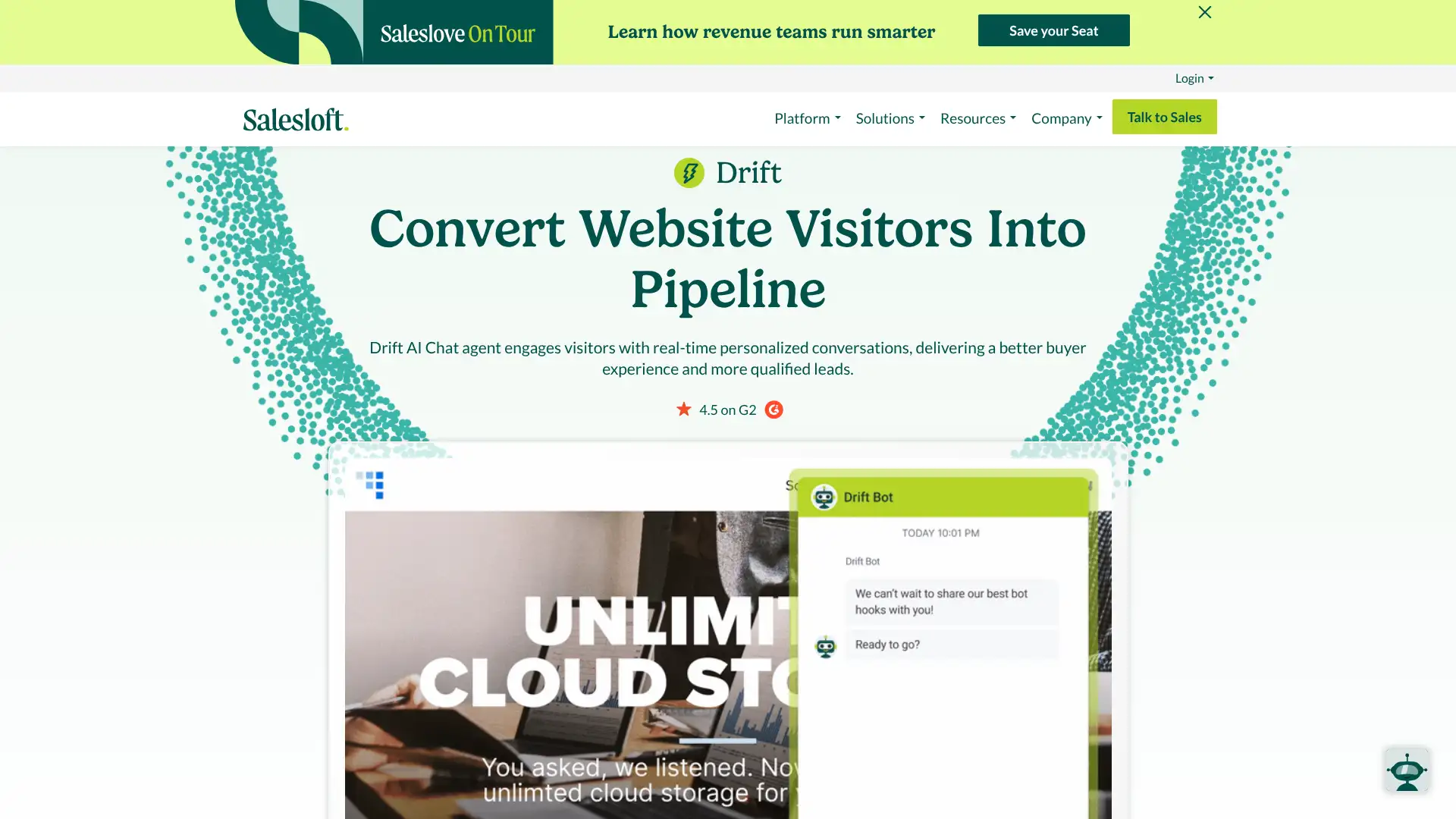
- • Conversational marketing: qualify leads through chat based on visitor intent, company data, and CRM attributes
- • Meeting booking: book demos and sales calls directly from the chat window without leaving the site
- • ABM targeting: personalise chat based on account and visitor data from CRM and intent tools
- • Revenue insights: track pipeline influenced by chat conversations
- • Salesloft integration: native connection to the revenue orchestration platform post-acquisition
Drift is the right choice for enterprise B2B companies with dedicated SDR teams where chat is a revenue channel for qualified-lead capture and meeting booking. At $2,500+/month, most businesses are better served by Intercom's proactive messaging or Crisp's affordable omnichannel at a fraction of the cost.
Gorgias
Gorgias is a customer support platform built specifically for e-commerce, dominating the Shopify help desk market. Its Shopify integration is the deepest in the industry: agents can view order history, process refunds, cancel orders, edit shipping details, and apply discounts directly from the Gorgias inbox without opening Shopify. It also integrates with WooCommerce, Magento, and BigCommerce. Pricing is ticket-based rather than per-agent: Starter at $10/month for 50 tickets, Basic at $60/month for 300 tickets, Pro at $360/month for 2,000 tickets, and Advanced at $900/month for 5,000 tickets, with unlimited agent seats. The ticket-based model means costs scale with business volume, not team size. AI Agent conversations are double-billed at $0.90-$1.00/conversation.
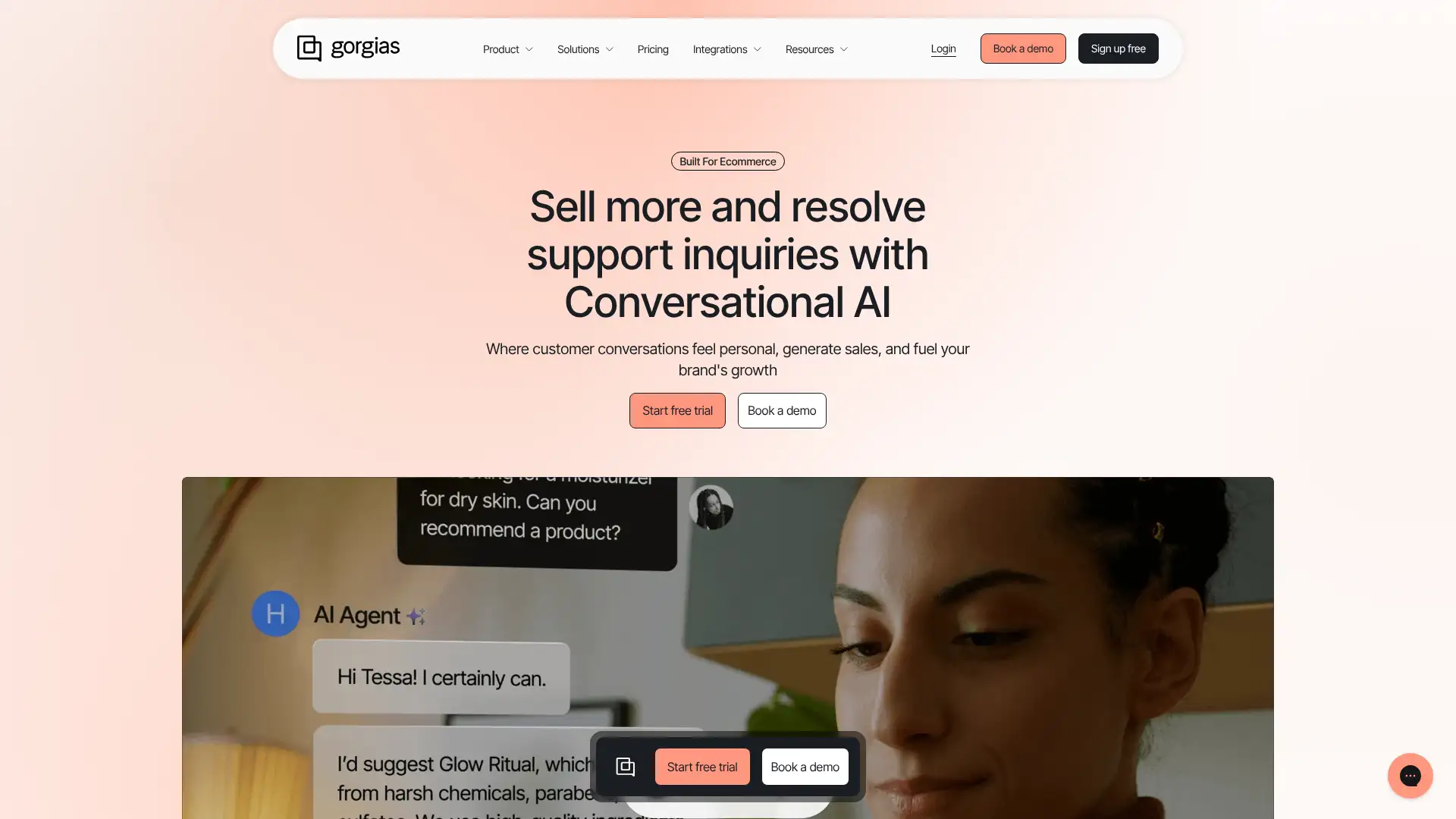
- • Tightest Shopify integration: refunds, cancellations, and order editing directly from the inbox
- • Revenue attribution: track how support interactions influence sales and prevent cancellations
- • AI Agent: automatic handling of WISMO and return queries based on Shopify order data
- • Unlimited agents on all plans: costs scale with ticket volume, not team size
- • Multi-store management: manage multiple Shopify stores from one Gorgias account
Gorgias is the best customer support platform for Shopify-first e-commerce businesses where order management from the inbox is a daily operational need. The revenue attribution feature is unique in the market.
Re:amaze
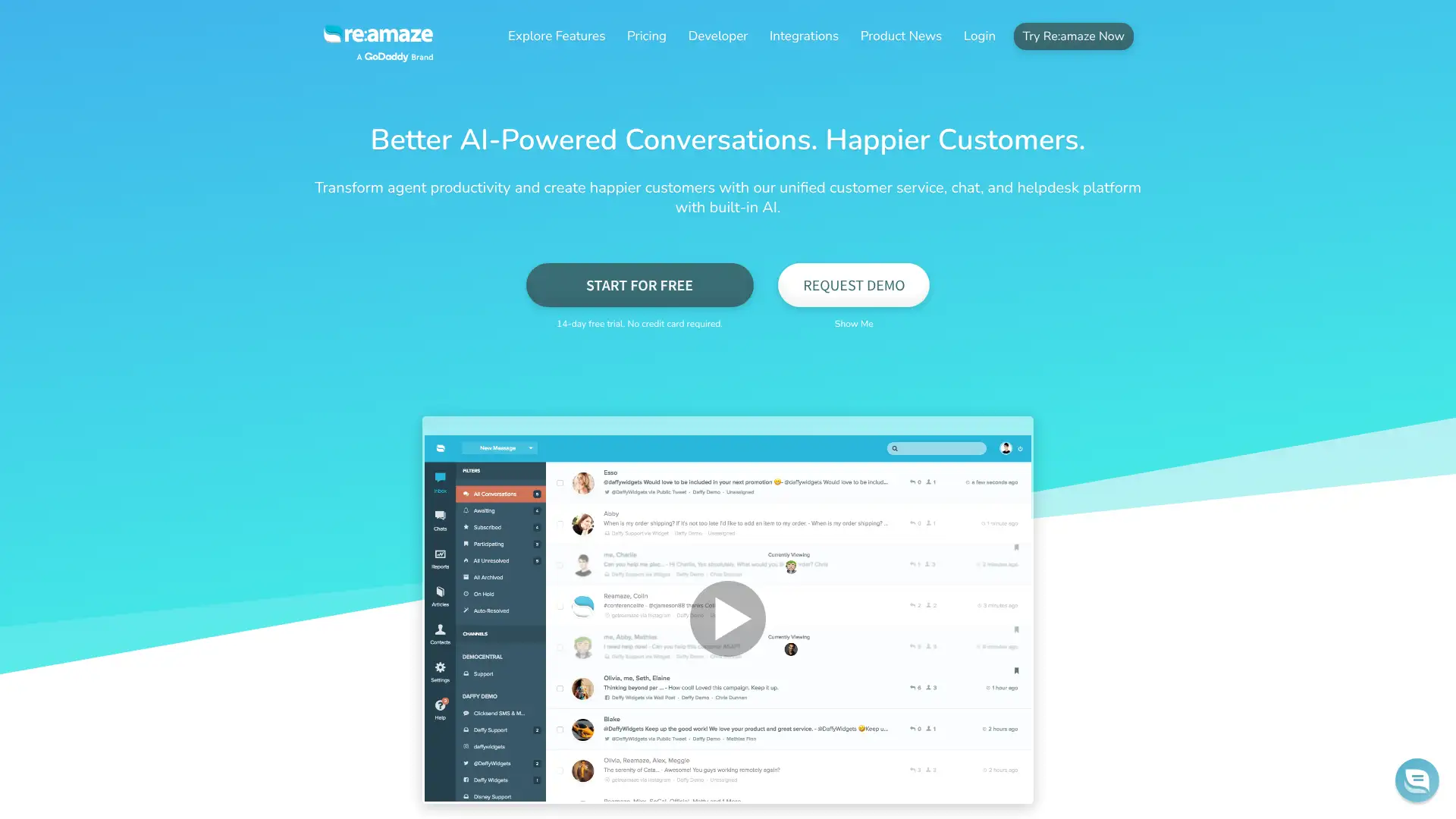
Re:amaze is a customer support platform designed for e-commerce and SaaS companies, offering a shared inbox, live chat, chatbot, status pages, push notifications, and knowledge base at a flat per-agent monthly price. Unlike Gorgias's ticket-based model, Re:amaze charges per agent, making it more predictable for high-volume support teams. Plans start at $29/agent/month for Basic. Re:amaze integrates with Shopify, BigCommerce, WooCommerce, Stripe, and Slack. It also includes a Status Page feature for communicating system incidents to customers, a differentiator uncommon in help desks at this price. Re:amaze is particularly popular as a Gorgias alternative for teams that prefer per-agent pricing.
- • Per-agent flat pricing: predictable cost regardless of ticket volume
- • Status page: built-in system status communication, unusual in help desks at this price point
- • Push notifications: send proactive customer notifications from within the help desk
- • Multi-brand support: manage multiple storefronts or brands from one account
- • Co-browsing on Plus: guide customers through their screen in real time
Re:amaze is the best alternative to Gorgias for e-commerce support teams that prefer predictable per-agent pricing over variable ticket-based billing. The built-in status page is a genuine differentiator. For teams with primarily Shopify workflows where order editing depth matters, Gorgias still leads.
Front
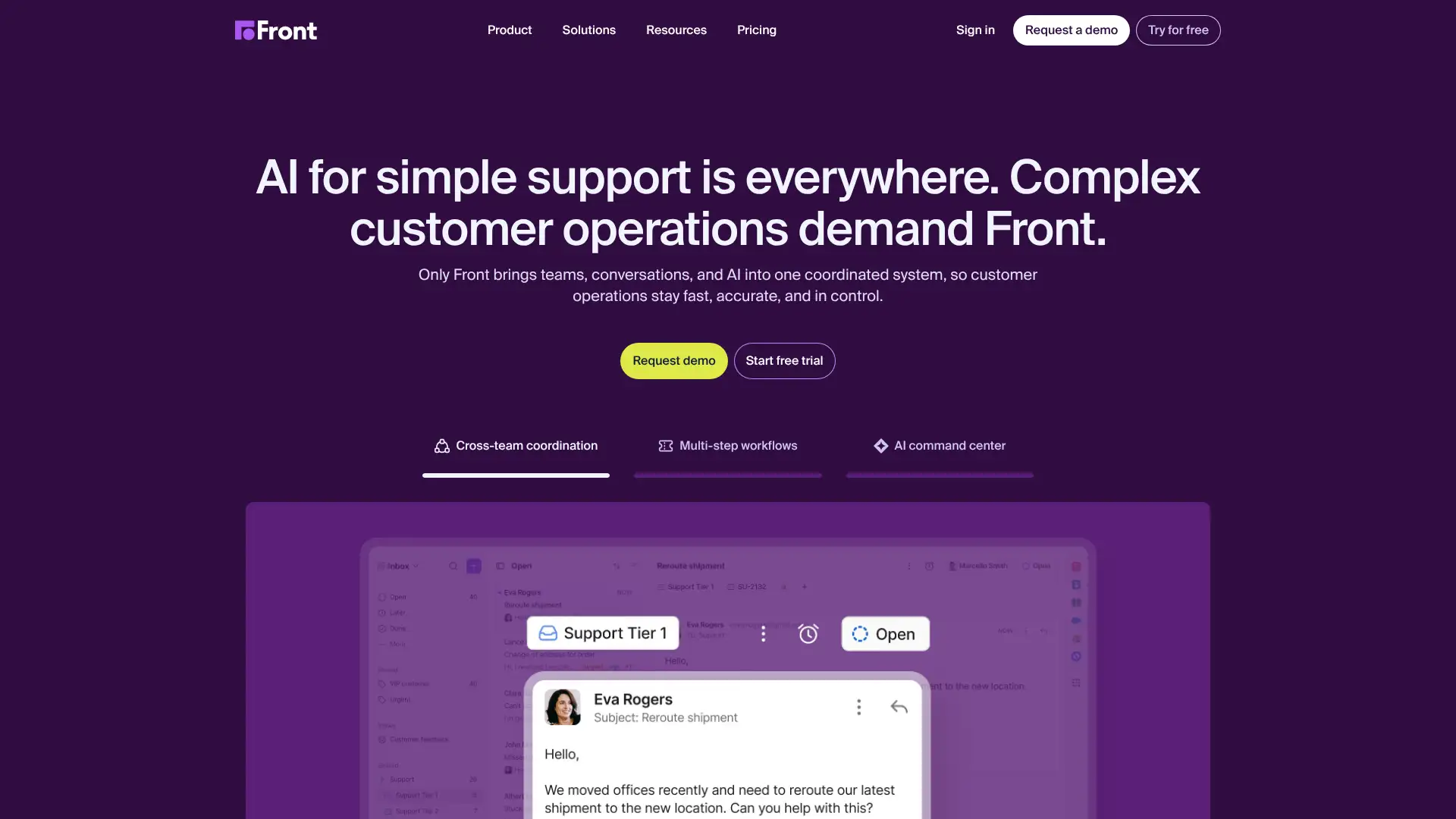
Front is a collaborative inbox platform that turns customer-facing email into a team workspace, combining shared inbox, email collaboration, and basic CRM functionality. It is used by sales, operations, and support teams that manage external emails collaboratively and need internal commenting, assignment, and thread ownership alongside customer conversations. Pricing starts at $19/seat/month for Starter, $59 for Growth, and $99 for Scale. Front differs from traditional help desks by keeping email feeling like email rather than converting conversations to ticket numbers. It is particularly popular with logistics, finance, and operations teams managing external relationships rather than high-volume customer support.
- • Collaborative email threading: internal comments and @mentions visible only to teammates in the conversation
- • Thread ownership: assign email threads to specific team members with transfer and escalation
- • Analytics: response time, SLA tracking, and team workload reports
- • CRM integrations: Salesforce, HubSpot, Copper, and Pipedrive sync contact data alongside emails
- • Approval workflows: multi-step approval before sending certain types of messages
Front is the best collaborative inbox for operations, logistics, and account management teams where external email is a team responsibility requiring transparency and ownership. For dedicated customer support ticketing with knowledge base and SLA management, Help Scout or Freshdesk provide more appropriate tooling at lower cost.
Helpjuice
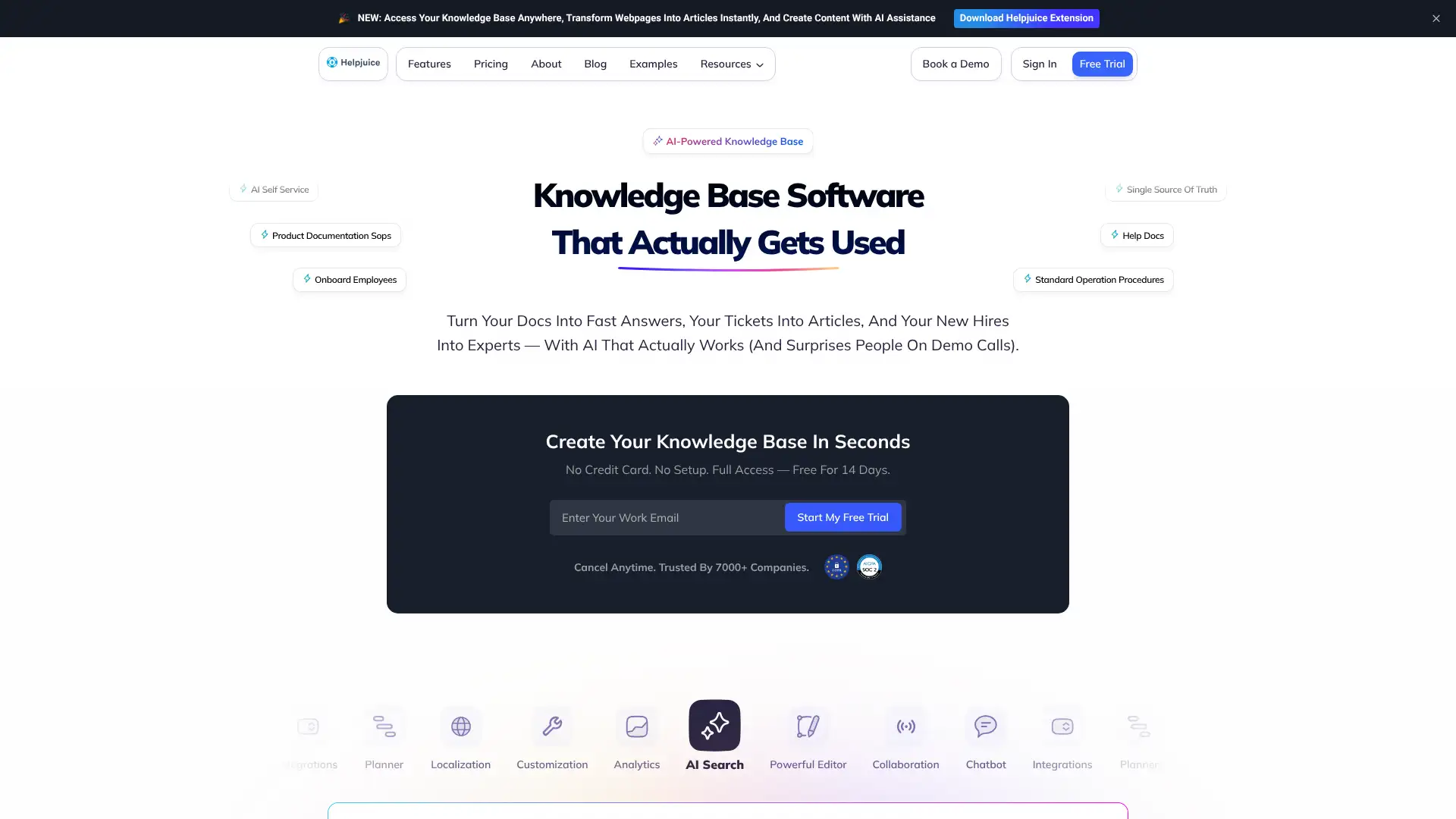
Helpjuice is a dedicated knowledge base platform, not a help desk. It is designed for companies that want to build a comprehensive self-service knowledge base for customers and internal teams without coupling it to a ticketing system. Features include powerful full-text search with analytics showing what customers searched for and could not find, custom branding and domain, multiple knowledge bases, article versioning, and Google Analytics integration. Pricing starts at $120/month for up to 4 users, $200/month for up to 16 users, $289/month for up to 60 users, and $369/month for unlimited users.
- • Search analytics: see exactly what customers searched for and failed to find
- • Multiple knowledge bases: separate public, private, and internal KBs in one platform
- • Article versioning: track all edits to articles with restore functionality
- • Customisable widget: embed the knowledge base as a search widget on any page
- • Multilingual support: publish articles in multiple languages from one content repository
Helpjuice is the best dedicated knowledge base for companies that want deep self-service analytics and multiple knowledge bases without coupling them to a specific help desk. For companies wanting a knowledge base bundled with ticketing, Freshdesk and Help Scout both include knowledge bases in their plans.
Document360
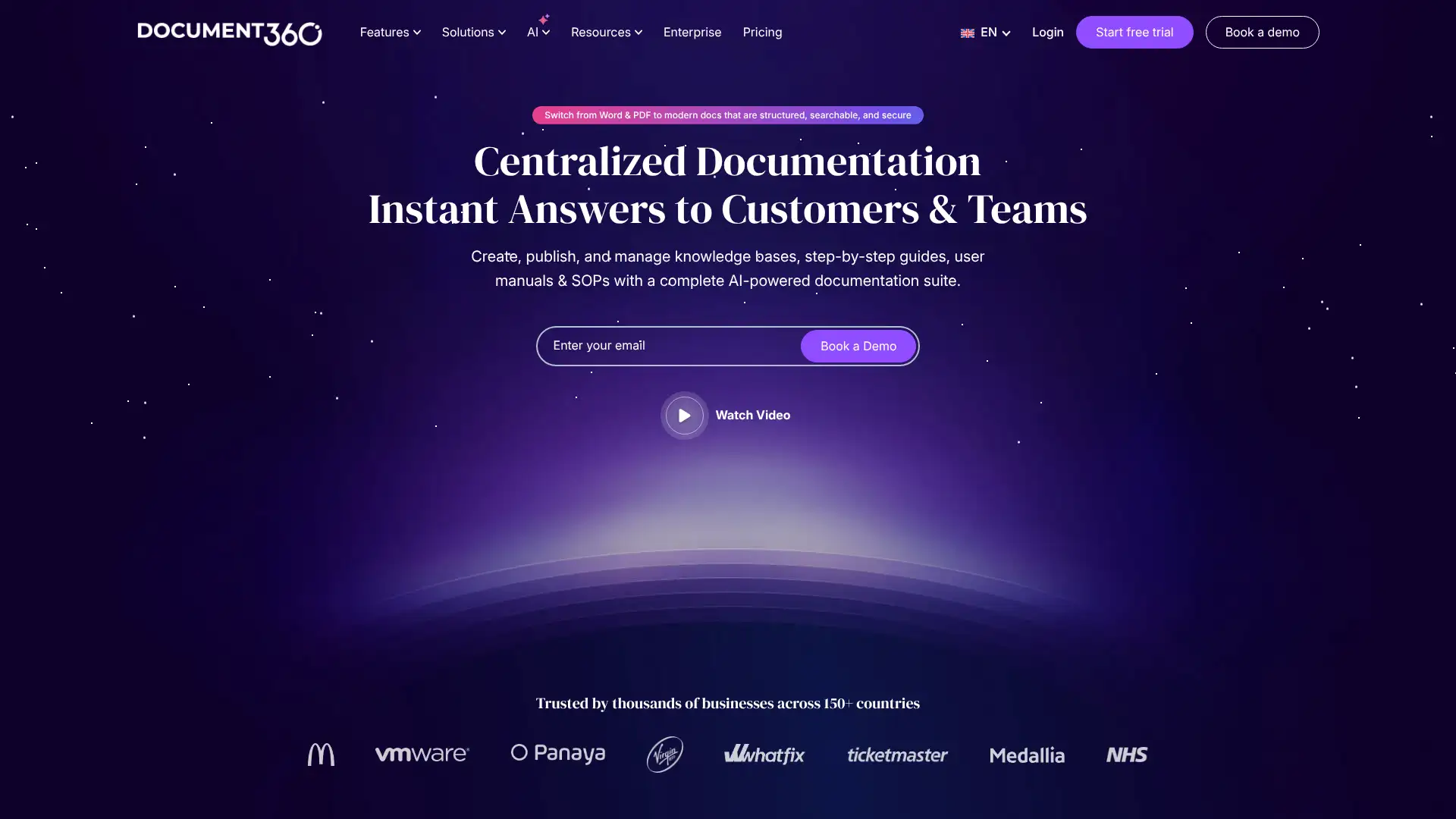
Document360 is a dedicated knowledge base platform built for technical teams creating structured product documentation, API references, and SOPs. It uses an AI-powered editor with Markdown and WYSIWYG modes, supports version control per article, and provides an embeddable widget for in-app self-service. The AI assistant (called Eddy) answers customer questions from the knowledge base and suggests articles to agents. Document360 is commonly used for developer documentation, software release notes, and internal company wikis. Pricing starts at $149/month for Professional, $299 for Business, and $399 for Enterprise.
- • AI editor and Eddy AI: AI-powered writing assistance and Q&A from knowledge base content
- • Version control per article: track all changes with restore capability
- • API documentation templates: structured templates for developer-facing technical docs
- • In-app widget: embeddable self-service search for product-led apps
- • Multiple knowledge bases: separate workspaces for customer, internal, and partner documentation
Document360 is the best knowledge base platform for software companies and technical teams creating structured product documentation, API references, and release notes. The AI Eddy feature and version control make it the most appropriate choice for developer-facing content.
ClickDesk
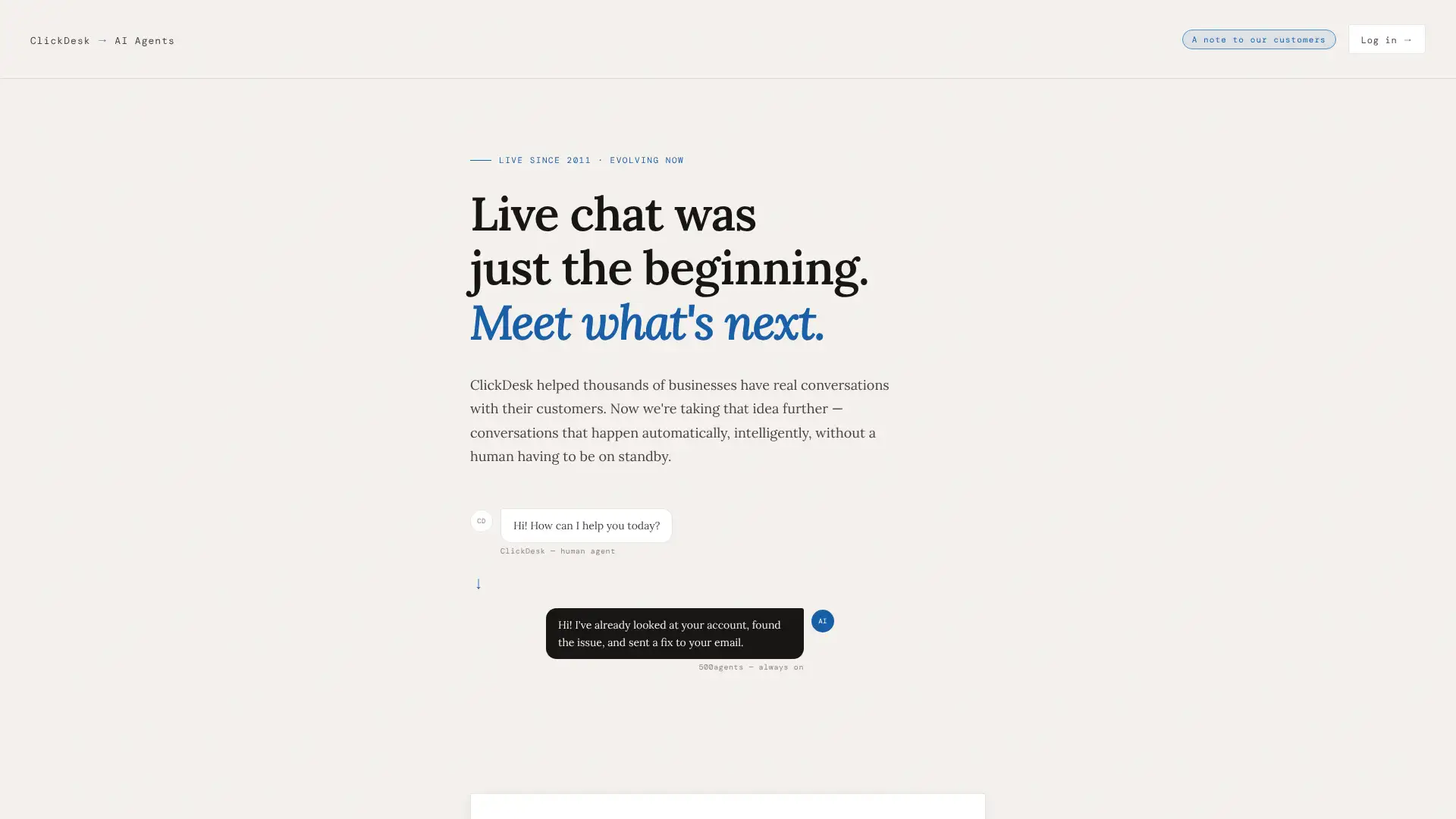
ClickDesk is a live chat and help desk platform that differentiates by including VoIP voice calling directly from the chat widget: website visitors can start a voice or video call from the chat bubble without a phone number. This is a rare feature at the $29/month price point. ClickDesk covers live chat, email ticketing, a help desk, social toolbar for Twitter and Facebook, and the click-to-call VoIP feature. Pricing starts at a free plan for 10 users (30 chats/month), $14.99/month for Lite, $24.99 for Pro, and $39.99 for Enterprise.
- • Click-to-call VoIP: website visitors can start voice calls directly from the chat bubble
- • Video chat: video calling from the chat widget included on Pro and Enterprise
- • Social toolbar: Twitter and Facebook integration alongside live chat
- • Email helpdesk: basic ticketing system alongside the live chat product
- • Free plan: 10 users with 30 chats/month at no cost
ClickDesk is the best live chat option for small businesses that specifically need click-to-call voice capability from the website chat widget at under $30/month. For teams that primarily need chat without voice, LiveChat or Tidio provide better overall live chat experiences.
LiveAgent
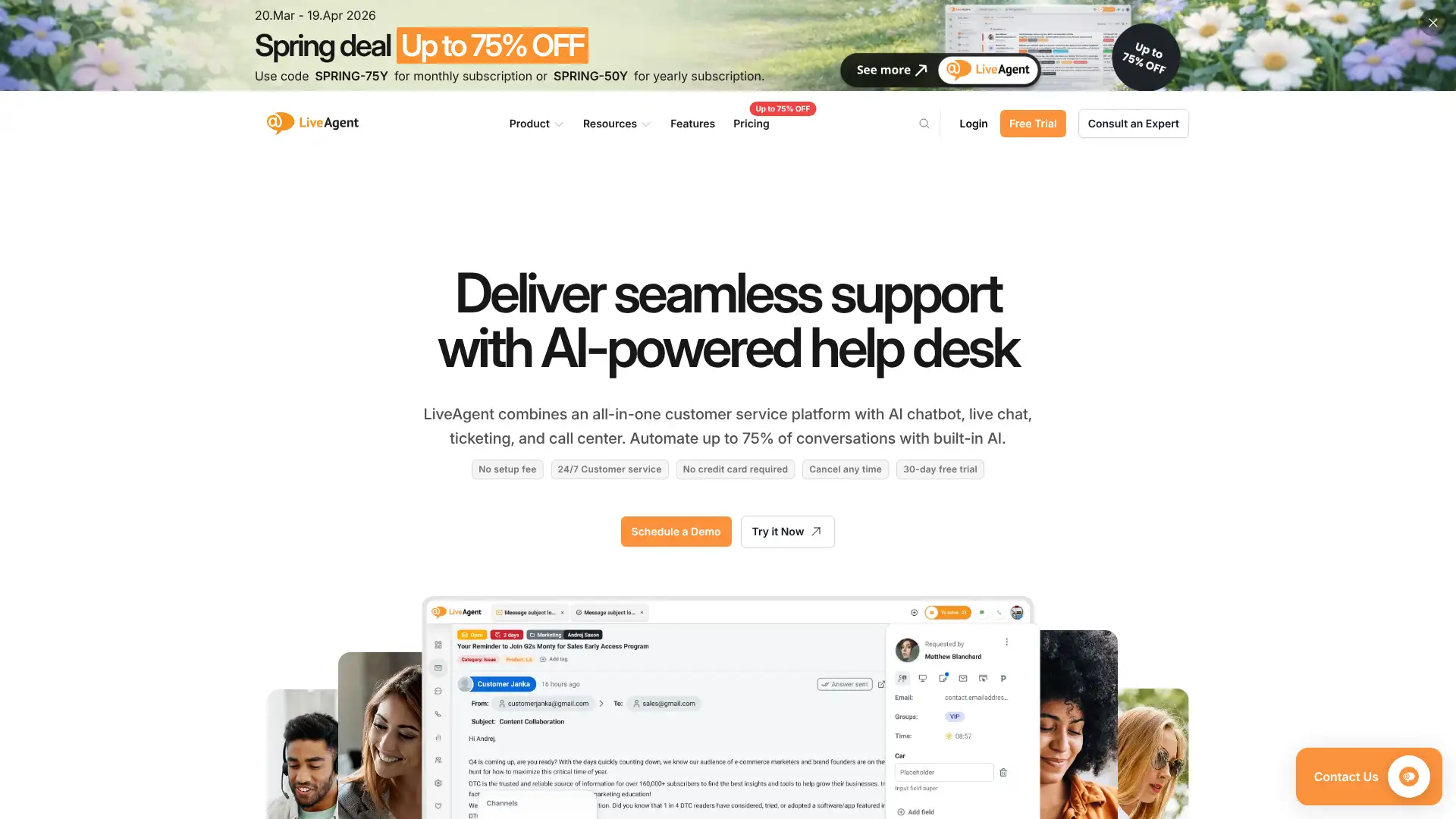
LiveAgent is a comprehensive help desk platform offering email, live chat, phone (native call centre), social media, and a customer portal in one product. It has one of the most complete feature sets of any mid-market help desk: over 170 features including gamification, time tracking, built-in call centre with call recording, customer forums, and a knowledge base. A free plan exists for up to 1 agent. Paid plans start at $15/agent/month for Small Business, $35 for Medium Business, $59 for Large Business, and $85 for Enterprise. LiveAgent is particularly strong for teams that need native voice calling without a Twilio or Aircall integration.
- • Native call centre: built-in voice calling with call recording, IVR, and call queuing included
- • 170+ features: the most comprehensive feature set of any mid-market help desk reviewed
- • Gamification: leaderboards, badges, and level system for agent performance motivation
- • Social media integration: Facebook, Twitter/X, Instagram, and WhatsApp in the shared inbox
- • Customer portal: self-service portal with ticket status tracking and knowledge base
LiveAgent is the best mid-market help desk for teams that need a native call centre with call recording and IVR without paying separately for Twilio or Aircall integration. The 170+ features make it the most complete out-of-the-box help desk at its price point.
SupportBee
SupportBee is a simple, email-focused customer support platform targeting small businesses and startups that want shared inbox management without the complexity of a full help desk. It converts customer emails into tickets and provides assignment, internal notes, labels, and a basic knowledge base. There is no live chat, no phone, and no social integration. Pricing is straightforward at $13/agent/month for Startup and $17/agent/month for Enterprise. SupportBee's primary selling point is its simplicity: teams are productive within minutes without training. An annual billing discount reduces the cost to approximately $10/agent/month.
- • Email-to-ticket: converts all customer emails to trackable tickets with assignment and status
- • Internal notes: private agent discussion threads on tickets invisible to customers
- • Knowledge base: basic article creation for customer self-service
- • Label-based organisation: flexible tagging for ticket categorisation
- • Simple setup: teams are operational in under an hour without training
SupportBee is the right choice for small teams (under 20 agents) that need nothing more than shared email management with assignment and internal notes. For teams that need live chat, automation, or SLA management, Help Scout or Groove provide comparable simplicity with more capability at a small
Teamwork Desk
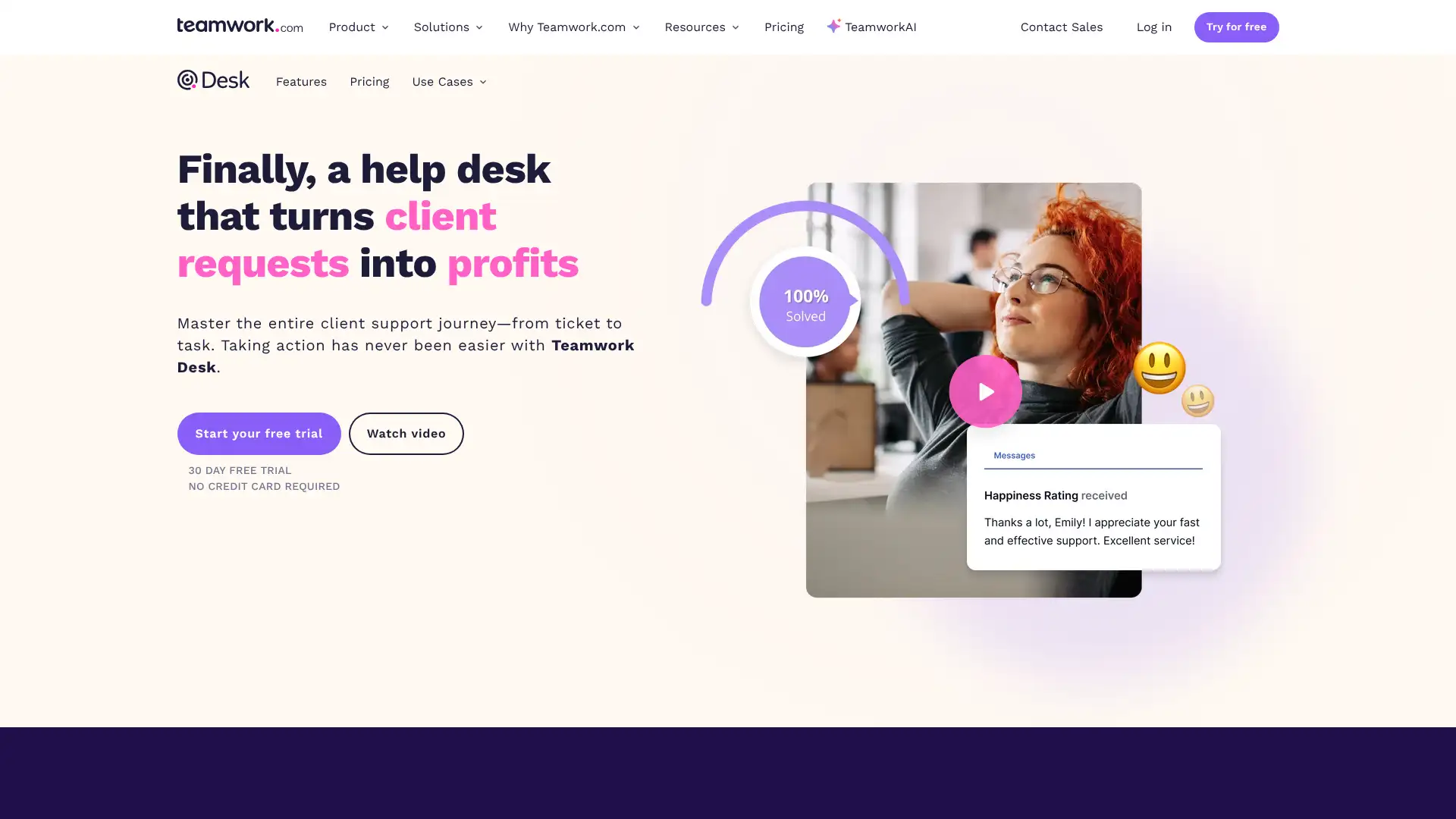
Teamwork Desk is a help desk product from Teamwork.com, the project management company particularly popular with agencies and professional services firms. Its primary differentiator is native integration with Teamwork Projects and Teamwork CRM, allowing support tickets to be converted to project tasks and linked to client accounts without any integration work. This makes it the natural help desk choice for agencies already using Teamwork for project management. Pricing starts at $8.50/agent/month for Starter, $13.50 for Pro, and $19.50 for Premium. A free plan exists for 2 users.
- • Teamwork Projects native integration: convert support tickets to project tasks with one click
- • CRM integration: link tickets to client accounts in Teamwork CRM for account-level context
- • Collision detection: prevents two agents from working on the same ticket simultaneously
- • CSAT surveys: customer satisfaction ratings on resolved tickets
- • HIPAA compliance on Premium: healthcare agency support
Teamwork Desk is the right choice for agencies and professional services companies already using Teamwork Projects and Teamwork CRM who want support tickets natively linked to client projects. For companies not in the Teamwork ecosystem, the primary differentiator disappears and Help Scout or Groove provide better standalone help
Hiver
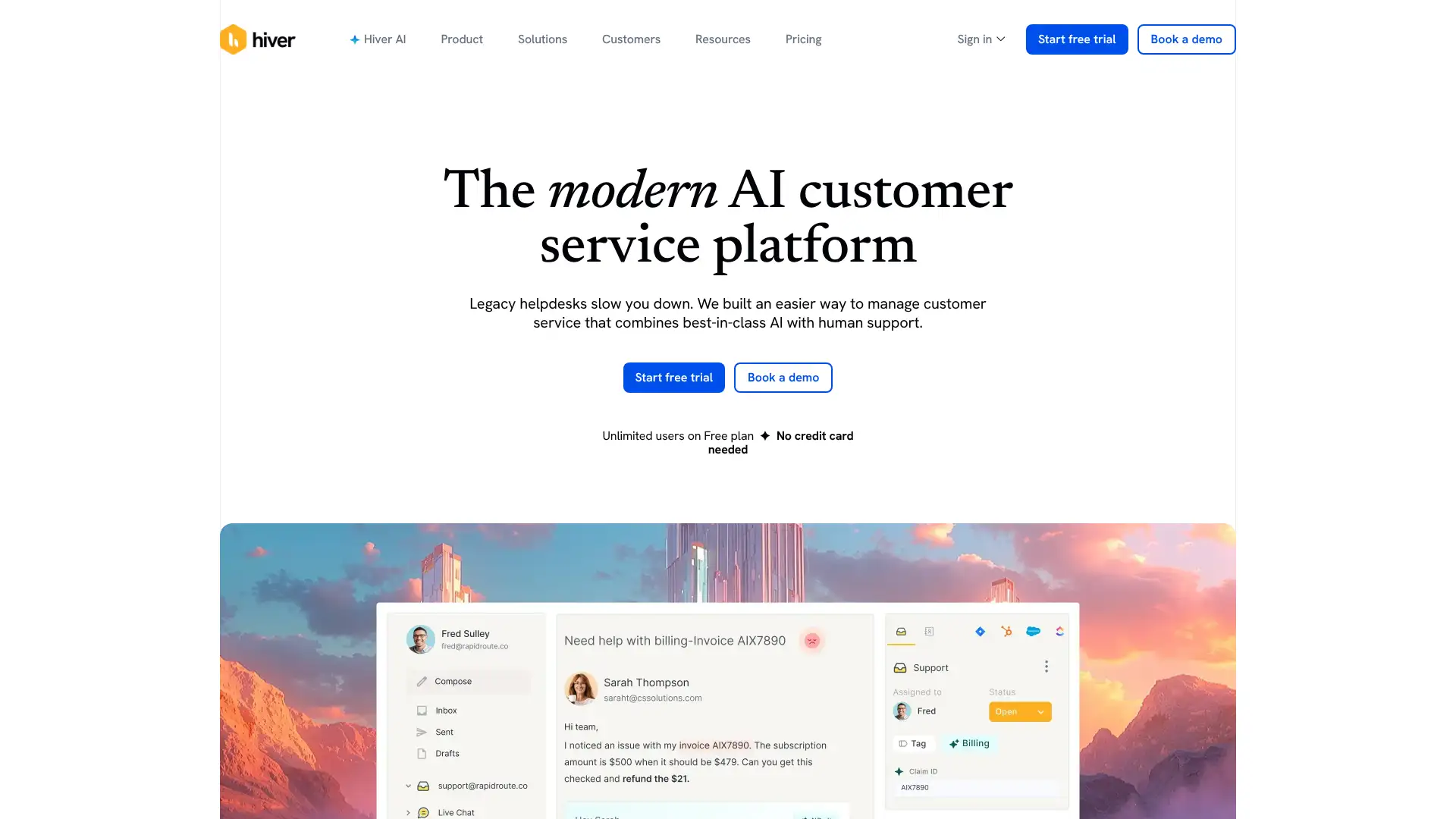
Hiver is a help desk that lives entirely inside Gmail, turning Google Workspace email into a shared support inbox with assignment, collision detection, SLA tracking, and notes. Unlike all other platforms reviewed which require switching to a separate application, Hiver extends Gmail with shared inbox functionality. This makes it the natural choice for teams already living in Google Workspace who want to avoid context-switching. Plans start at $15/user/month for Lite, $25 for Growth, $50 for Pro, and $100 for Elite. A free plan for up to 3 users is available.
- • Gmail-native: agents never leave Google Workspace to manage support
- • Collision detection: see when a teammate is already viewing or replying to an email
- • SLA management: configure response time SLAs with breach alerts inside Gmail
- • Live chat and WhatsApp on Pro: omnichannel support without leaving Gmail
- • AI email summaries and drafts: AI-assisted responses from within the Gmail interface
Hiver is the best help desk for teams that live in Google Workspace and do not want to adopt a separate support application. The Gmail-native approach eliminates context-switching entirely.
Missive
Missive is a team email and chat platform that merges personal email, shared team inboxes, and internal chat into one application. It supports Gmail, Microsoft Exchange, IMAP, and Office 365, making it compatible with both Google Workspace and Microsoft 365 teams, unlike Hiver (Gmail only). Missive is used by support, sales, and operations teams that want one place for internal communication and external customer emails. Rules and workflows automate routing and assignment. Pricing starts at $14/user/month for Starter, $18 for Productive, and $26 for Business.

- • Multi-provider email: works with Gmail, Outlook, Exchange, and any IMAP account
- • Combined personal and shared inboxes: personal email and team inboxes in one application
- • Internal team chat: real-time chat alongside email without switching to Slack
- • Rules and workflows: conditional routing, assignment, and notification automation
- • Snooze and scheduling: schedule email sends and snooze threads for follow-up
Missive is the best team email client for small teams (under 50 users) that want personal email, shared team inboxes, and internal chat in one application without adopting a dedicated help desk. Unlike Hiver, it works with both Gmail and Outlook.
Helpwise
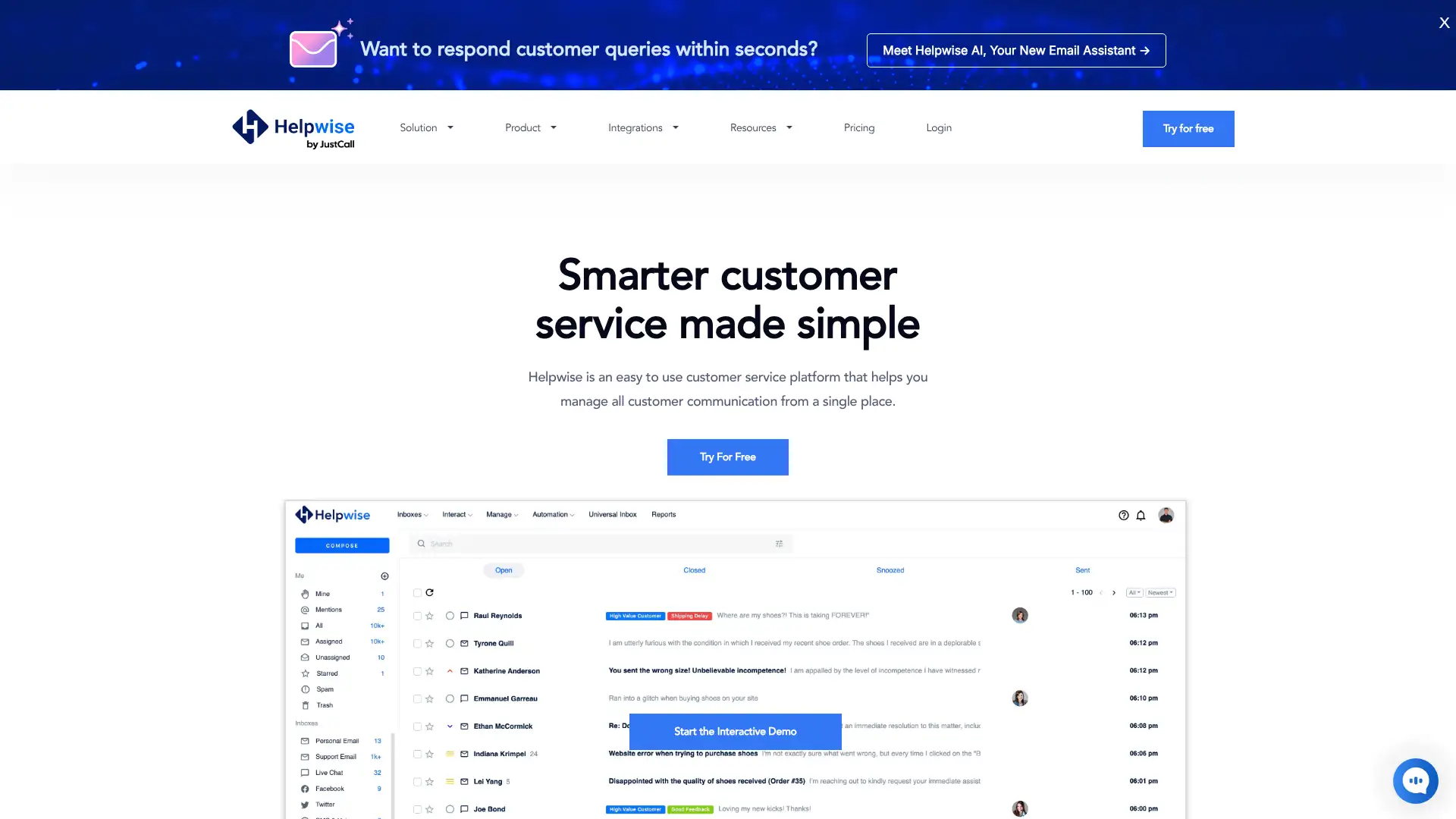
Helpwise is a shared inbox platform supporting email, WhatsApp, Facebook, Instagram, Twitter/X, SMS, and live chat in one inbox, targeting small teams that need omnichannel support at a lower price than Intercom or Zendesk. Pricing starts at $15/user/month for the Basic plan. Helpwise integrates with HubSpot, Pipedrive, Shopify, and Zapier. The platform includes collision detection, assignment, internal notes, canned responses, and basic automation. It is commonly compared to Front and Help Scout as a simpler, more affordable alternative.
- • WhatsApp Business inbox: manage WhatsApp customer conversations in the shared inbox
- • Social media channels: Facebook, Instagram, and Twitter/X messages in one inbox
- • Collision detection: prevent duplicate replies from multiple agents
- • Shopify integration: basic order data alongside support conversations
- • Zapier automation: connect with 1,000+ tools through Zapier
Helpwise is the best affordable shared inbox for small teams (under 20 users) that specifically need WhatsApp Business, Facebook, and Instagram in addition to email without paying Intercom or Zendesk prices. For teams where WhatsApp is not a required channel, Help Scout or Groove provide more polished
Dixa
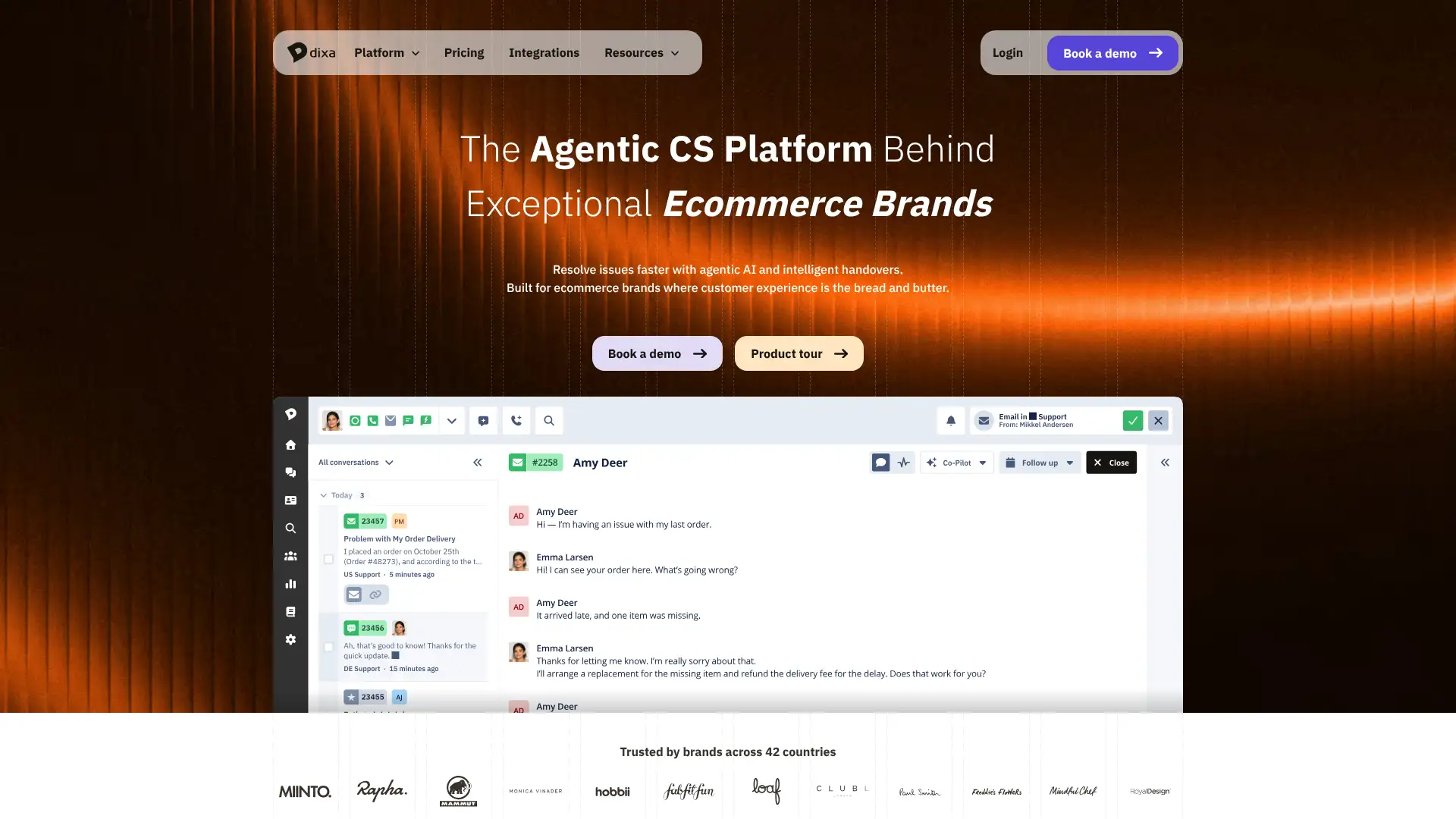
Dixa is a conversational customer service platform founded in Denmark in 2015, targeting mid-market companies (50-500 agents) with intelligent routing, skill-based assignment, and a unified conversation timeline across email, phone, chat, and social. Pricing is straightforward: Essential at $39/agent/month, Growth at $89, Ultimate at $139, and Custom. Dixa differentiates with its conversation routing intelligence: the platform uses dynamic data from CRM integrations to route conversations to the best available agent based on skill, language, priority, and customer tier in real time. A knowledge base module (Dixa Enlighten) is available as an add-on.
- • Intelligent routing: route conversations using dynamic CRM data and real-time agent skills
- • Unified conversation timeline: single view of all customer interactions across all channels
- • Callback scheduling: customers can schedule a callback rather than waiting in a phone queue
- • Co-browsing: agents can view and guide customers through their screen
- • Dixa Enlighten KB: knowledge base add-on with AI search and agent-facing article suggestions
Dixa is the best mid-market help desk for companies where sophisticated real-time conversation routing based on agent skills and customer CRM data is a genuine operational requirement. For teams where intelligent routing is less critical, Freshdesk Pro provides omnichannel at half the cost.
Kustomer
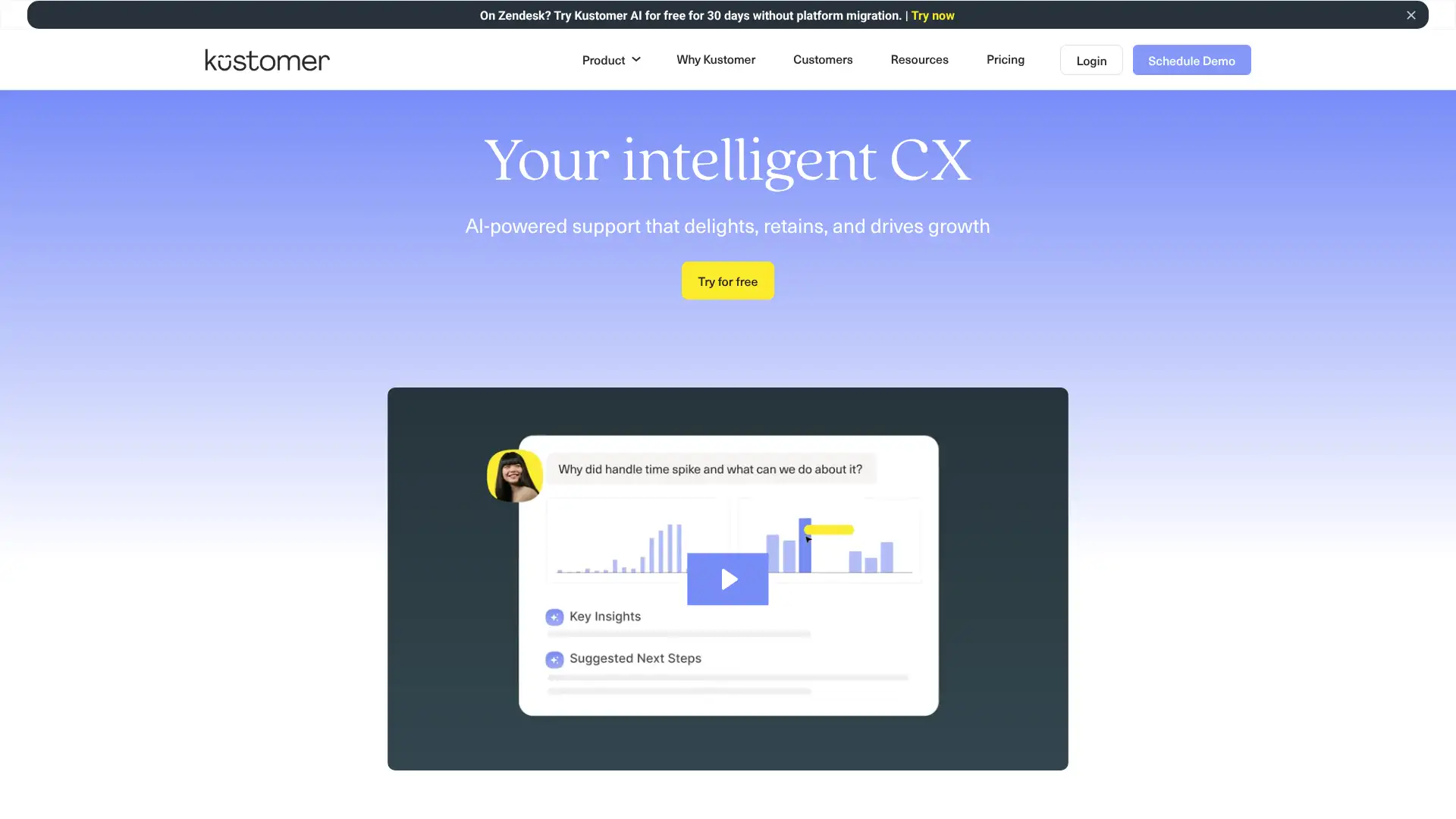
Kustomer is a customer service CRM platform acquired by Meta (Facebook) in February 2022 and subsequently resold to a private equity firm, now operating independently. Unlike Zendesk and Freshdesk which are ticket-centric, Kustomer organises interactions around the customer: all emails, chats, social messages, calls, and order history are unified in a single customer timeline rather than separate tickets. This is the same model as Gladly. Kustomer is positioned for mid-market B2C companies handling high volumes (1,000+ conversations/day) and competes directly with Gladly and Zendesk Suite. It integrates natively with Shopify, Magento, Salesforce, and major social platforms.
- • Customer-centric timeline: all interactions across email, chat, social, and phone in one view per customer
- • AI-powered workflows: intelligent routing, suggested replies, and sentiment-based escalation
- • CRM data model: custom objects ('Klasses') for importing business-specific data alongside support
- • Native social integrations: Facebook, Instagram, Twitter/X, and WhatsApp in one timeline
- • Shopify and Magento integration: order and product data alongside the customer timeline
Kustomer is the best customer-centric CRM help desk for mid-market B2C companies handling high-volume omnichannel support where a unified customer timeline is more valuable than discrete ticket management. For most organisations at this scale, Zendesk Suite provides comparable capability at a more established track record and with
Gladly
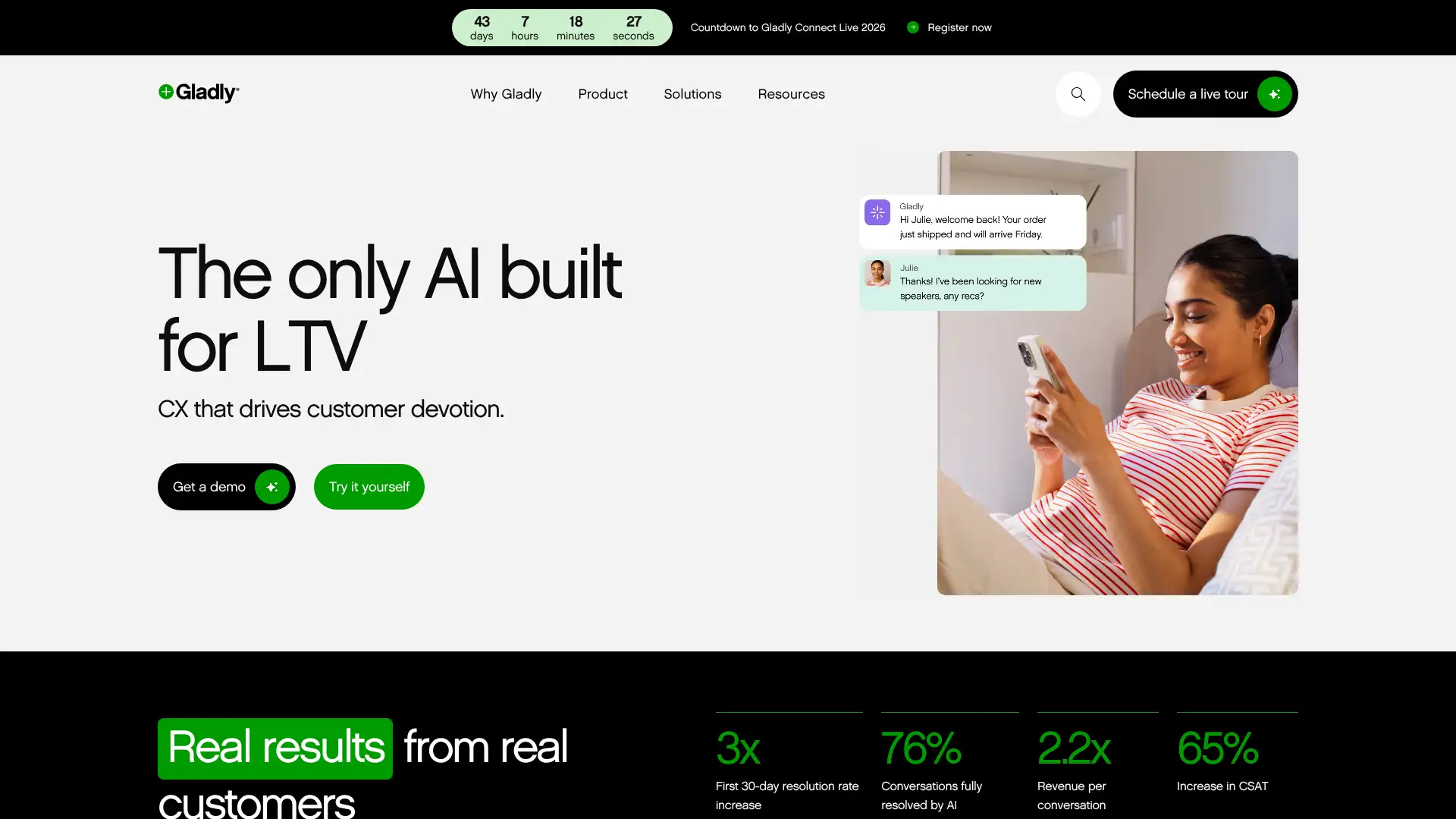
Gladly is a customer service platform that treats support as a relationship, not a transaction: it creates one continuous conversation per customer across all channels (email, chat, SMS, voice, and social) rather than discrete tickets. Every agent sees the complete conversation history in a single timeline regardless of which channel the customer used. Gladly is used by Nordstrom, Crate and Barrel, Ulta Beauty, TUMI, Allbirds, and Breeze Airways. Pricing is approximately $180-$210/user/month on annual contracts with minimum seat requirements: a 10-person team costs approximately $21,600/year before any AI, voice, or SMS charges. Gladly has powered over 300 million conversations.
- • Continuous conversation model: one thread per customer across all channels, forever
- • Sidekick AI: AI agent for product recommendations, order lookup, and autonomous query resolution
- • People match: route customers to the agent they have spoken to before for relationship continuity
- • Voice and messaging channels: native phone, SMS, email, chat, and social all in one timeline
- • Customer profiles: customer preferences, lifetime value, and history accessible to every agent
Gladly is the right choice for premium retail, hospitality, and B2C brands where treating support as a relationship is a differentiated customer experience strategy and the $180/user/month cost is justified by customer lifetime value. For most organisations at enterprise scale, Zendesk or Kustomer provide comparable omnichannel capability