28 Best ERP Software in 2026
From hyperscale enterprise platforms to open-source self-hosted solutions and niche manufacturing MRP tools. Pricing verified March 2026. Implementation costs vary significantly and should be negotiated with vendors directly.
SAP S/4HANA
SAP S/4HANA is the flagship ERP for large enterprises running multi-country, multi-currency, and multi-entity operations. The Public Cloud edition starts at $180/user/mo with quarterly auto-upgrades. The Private Cloud and on-premise editions allow deeper ABAP customisation but carry significantly higher TCO. Over 5 years, a 100-user deployment can cost $1.5M to $3M in total, including implementation.
- • In-memory HANA database enabling real-time analytics without data warehousing
- • 300+ pre-configured best-practice business scenarios across finance, procurement, and manufacturing
- • Deepest multi-currency, multi-language, and multi-tax compliance of any ERP
- • SAP BTP (Business Technology Platform) for side-by-side AI and integration extensions
- • Quarterly automatic upgrades on Public Cloud; customer-controlled on Private Cloud
The definitive ERP for large enterprises operating across multiple countries and legal entities. The Public Cloud edition at $180/user/mo is the lowest-TCO entry into the SAP ecosystem. Do not deploy without an experienced certified implementation partner.
Oracle ERP Cloud (Fusion)
Oracle ERP Cloud (Fusion) is the enterprise-tier cloud ERP from Oracle, positioned above NetSuite for organizations with Fortune 500-scale complexity. It excels in financial management, procurement, risk, and project billing. Pricing benchmarks at $400 to $625/user/mo for core finance and procurement modules. Implementation typically requires 6 to 18 months and costs several hundred thousand dollars.
- • AI-driven financial insights: anomaly detection, intelligent transaction matching, predictive close
- • Strong in public sector, financial services, and US federal government compliance
- • Native integration with Oracle Database, Middleware, and Oracle Autonomous Data Warehouse
- • Multi-GAAP accounting: simultaneous IFRS and US GAAP books with full consolidation
- • Oracle Analytics Cloud natively embedded for real-time operational dashboards
A premium choice for large enterprises with complex multi-entity financials, strong Oracle technology dependencies, or US public sector compliance requirements. For organizations below Fortune 1000 scale, NetSuite or Dynamics 365 deliver comparable functionality at 30 to 60% lower total cost.
Oracle NetSuite
NetSuite is one of the first cloud ERPs, launched in 1998 and acquired by Oracle in 2016. It serves 37,000+ organizations across manufacturing, wholesale distribution, retail, services, and software. Pricing is modular and negotiated: base platform from $999/mo, user licenses $99 to $199/user/mo, with modules for manufacturing, warehouse, ecommerce, and revenue recognition priced separately. First-year total cost typically $65K to $250K.
- • True multi-tenant cloud with two automatic upgrades per year included in subscription
- • NetSuite OneWorld handles multi-subsidiary consolidation and multi-currency in one account
- • AI embedded in 2026 for predictive analytics, anomaly detection, and intelligent coding
- • SuiteCommerce B2B/B2C ecommerce natively integrated with ERP inventory and orders
- • 20 to 40% list price discounts common at Oracle end-of-quarter (March, June, September, December)
The leading cloud ERP for companies in the $5M to $500M revenue range that have outgrown QuickBooks. Always negotiate at Oracle's end-of-quarter for 20 to 40% discounts. Engage an independent ERP advisor before committing to scope and pricing.
Microsoft Dynamics 365
Microsoft Dynamics 365 is a modular suite of business applications covering ERP, CRM, finance, supply chain, field service, and HR. Business Central (mid-market ERP) starts at $70/user/mo. Finance and Supply Chain Management for enterprise starts higher. The strong pull is deep Microsoft 365 integration: Teams, Excel, Power BI, Copilot AI, SharePoint, and Azure all connect natively.
- • Business Central: full ERP for SMBs with finance, supply chain, manufacturing, and project management
- • Native Power BI integration for real-time dashboards without separate BI licensing
- • Copilot AI for finance: automated summaries, draft emails, and anomaly alerts in Dynamics 365
- • Modular: buy only Finance, only SCM, only Field Service, or bundle with Microsoft 365
- • Azure cloud; FedRAMP, HIPAA, ISO 27001, and GDPR compliance available
The top ERP choice for organizations already standardized on Microsoft 365. Business Central at $70/user/mo is the best-value genuine ERP in the mid-market. The modular structure means you only buy what you need, but enterprise-scale implementations still require significant partner investment.
Workday
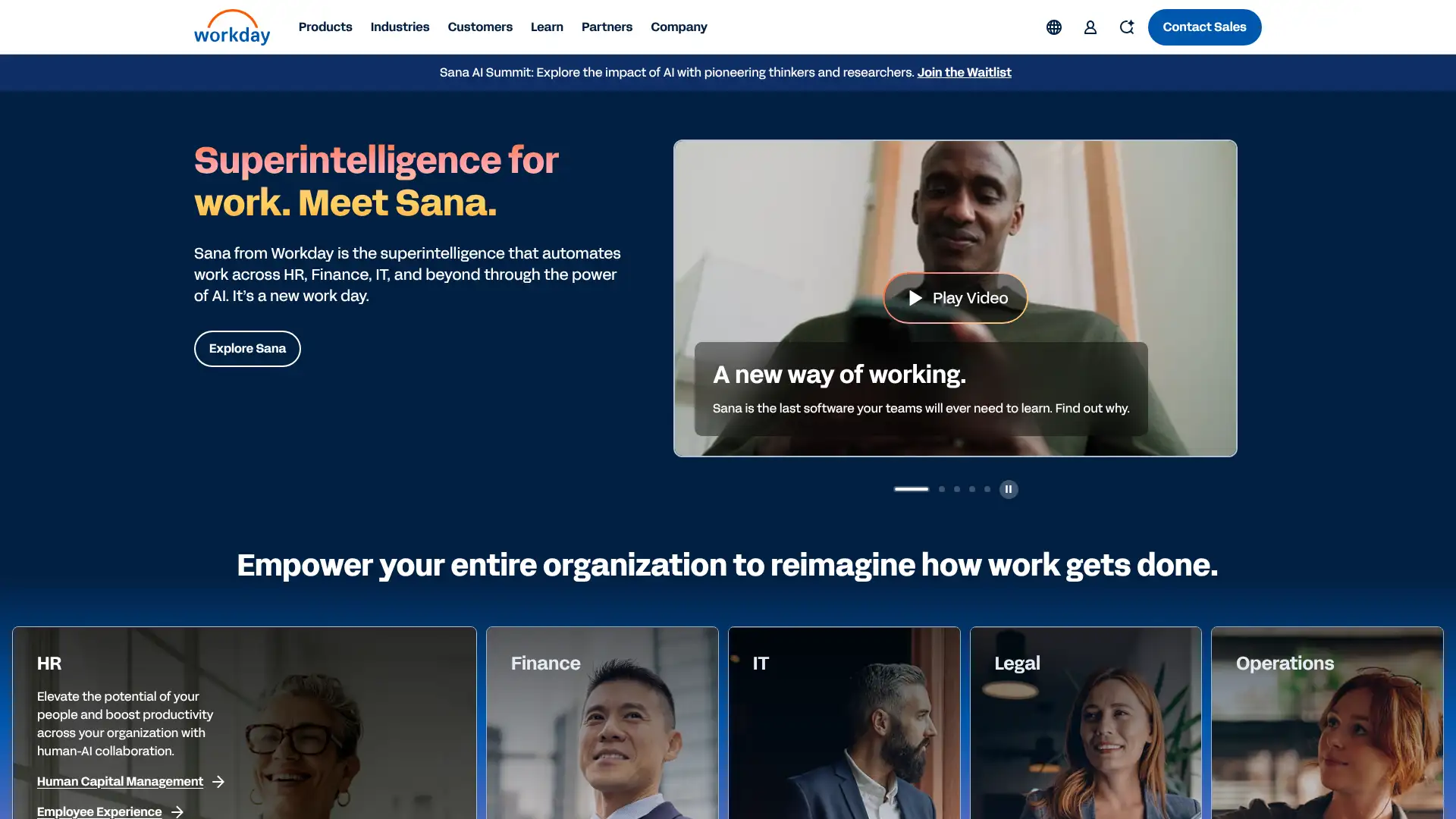
Workday is a cloud-native ERP purpose-built for finance and human capital management, launched in 2005. It is uniquely strong for professional services, financial services, healthcare, education, and technology companies where headcount-driven cost management and project-based revenue recognition are the core operational challenge. Pricing is subscription-based, typically $34 to $100/employee/mo for mid-market; enterprise is negotiated. Workday does not publish list prices.
- • Single object model for Finance and HR eliminates reconciliation between separate systems
- • Workday Adaptive Planning embedded for FP&A budgeting and scenario modeling
- • Real-time audit trails: every transaction timestamped with the who, what, and when
- • Workday AI for headcount forecasting, attrition prediction, and skills gap analysis
- • 6 to 18 month implementation timeline; no shortcuts for enterprise deployments
The go-to ERP for large professional services, financial services, and technology organizations where people costs are the primary operational lever. If you need manufacturing, distribution, or inventory ERP, Workday is the wrong tool. For services-led businesses, it is the best combined Finance and HR platform available.
Infor CloudSuite
Infor offers a portfolio of industry-specific cloud ERP suites: CloudSuite Industrial (SyteLine) for manufacturing, CloudSuite Distribution, CloudSuite Healthcare, CloudSuite Food and Beverage, and more. Koch Industries acquired Infor in 2020, providing deep capital backing. Infor's differentiation is the depth of out-of-box industry functionality that reduces customization cost versus horizontal ERPs like SAP or Oracle. Pricing is typically $100 to $250/user/mo depending on edition and modules; implementation timelines are 6 to 18 months.
- • Industry-specific pre-built processes: food traceability, aerospace compliance, healthcare, distribution
- • Infor Coleman AI for predictive maintenance, demand forecasting, and intelligent routing
- • Multi-site manufacturing management with real-time production visibility across facilities
- • Built on AWS; ISO 27001, SOC 2 Type II, and GDPR compliant
- • Infor Birst embedded BI for analytics without separate data warehouse infrastructure
The right choice for mid-to-large manufacturers and distributors in industries where Infor has a dedicated suite: food, aerospace, industrial, healthcare. The pre-built industry processes can reduce implementation cost and timeline versus horizontal ERPs. Not suitable for SMBs or services-led businesses.
Sage X3
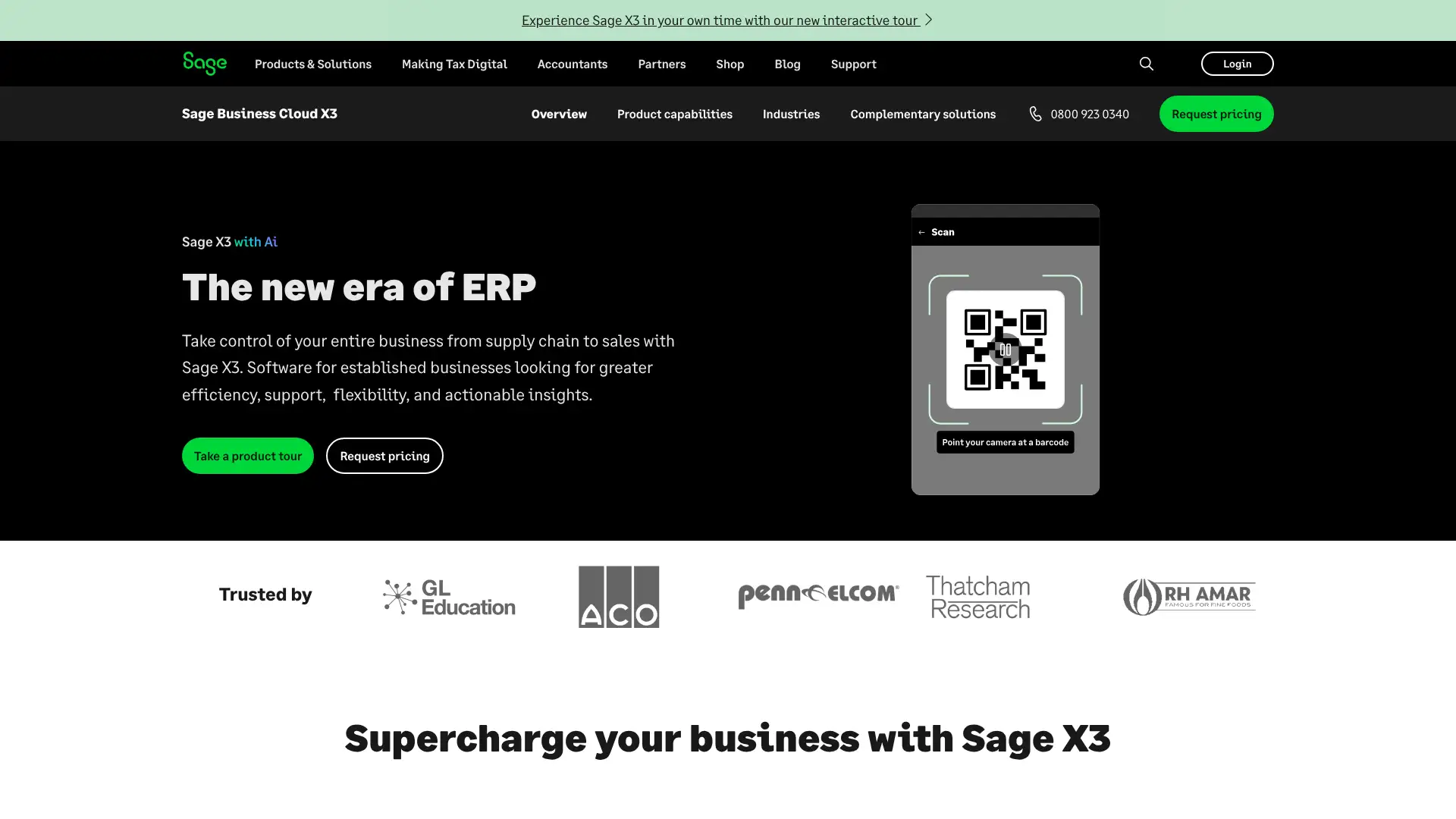
Sage X3 is a web-based ERP designed for mid-market manufacturers with international operations (50 to 500 employees). It covers financial management, supply chain, manufacturing, and sales with strong multi-currency, multi-language, and multi-legislation support. Starting at approximately $100/user/mo, it sits between SAP Business One and SAP S/4HANA in the Sage product family. Sage also offers Intacct (cloud financials for services) and Sage 100/300 for smaller organizations.
- • Multi-currency, multi-language, and multi-legislation support for 50+ countries out of box
- • Manufacturing module covers discrete, process, and project manufacturing modes
- • Mobile-responsive web interface accessible from any browser without thick client
- • Customizable workflows and approval rules without code using Sage's visual configurator
- • Strong in food and beverage, chemical, pharmaceutical, and industrial manufacturing in Europe
The best ERP in the Sage portfolio for mid-market manufacturers needing multi-country operations. Sage X3 occupies a useful mid-market niche between entry-level accounting software and full SAP or Oracle enterprise deployments. Particularly strong in Europe and for food, chemical, and industrial manufacturing.
Epicor Kinetic
Epicor Kinetic (formerly Epicor ERP 10) is a manufacturing-focused ERP for discrete, mixed-mode, and job shop manufacturers. Cloud subscription runs $1,500 to $2,500/mo base plus $100 to $200/user/mo. On-premise perpetual licenses also available. Implementation for a 25 to 100 user manufacturer typically costs $100K to $400K and takes 6 to 18 months. Exclusively targets manufacturing, distribution, and retail verticals.
- • Modern web-based UI rebuilt for cloud; same underlying ERP as Epicor ERP 10
- • MRP and advanced scheduling for discrete, job shop, and configure-to-order manufacturing
- • Epicor Advanced MES (Manufacturing Execution System) for shop floor control and real-time monitoring
- • Quality management with inspection plans and supplier quality scoring
- • Epicor Kinetic supports both cloud and on-premise with a smooth migration path between them
A top-tier manufacturing ERP for job shops, configure-to-order, and discrete manufacturers in the 50 to 1,000 employee range. The MES add-on is a strong differentiator for shop floor visibility. Not a good fit for service businesses or companies needing a generalist ERP.
IFS Cloud
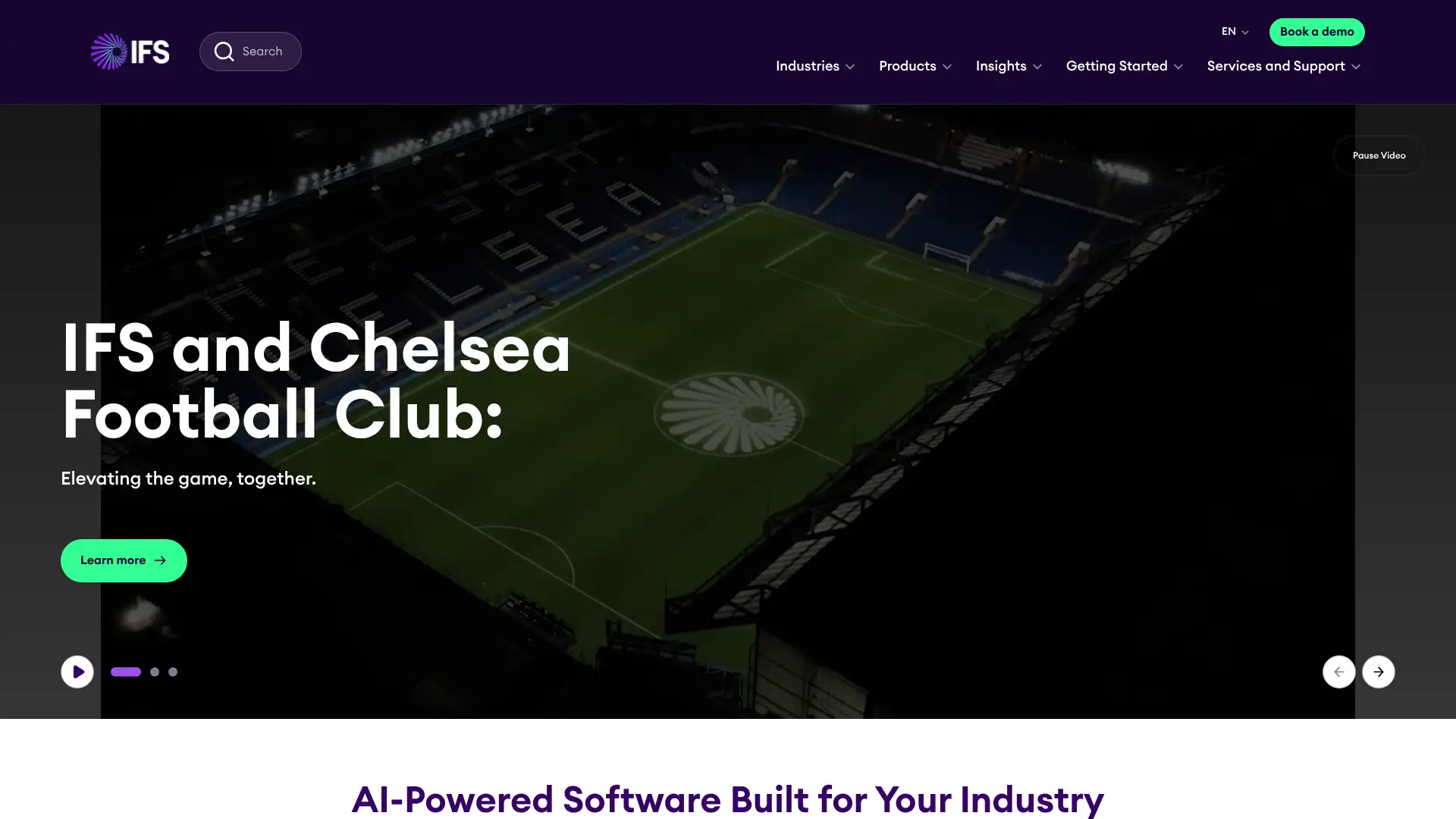
IFS Cloud is the ERP of choice for asset-intensive industries: aerospace and defense, energy, utilities, construction and engineering, and manufacturing with complex field service. IFS markets itself as the "Industrial AI" ERP vendor. IFS Ultimo (enterprise asset management) is tightly integrated. Pricing is $150 to $300/user/mo for enterprise; IFS is typically deployed for 200 to 5,000 users. Implementations run 9 to 24 months.
- • Best-in-class field service management: work orders, scheduling, mobile workforce, and IoT integration
- • Enterprise Asset Management (EAM) with full lifecycle tracking from commissioning to decommission
- • Aerospace and defense regulatory compliance: AS9100, ITAR, MRO (Maintenance, Repair, Overhaul)
- • IFS Industrial AI: predictive maintenance, failure probability scoring, and AI-driven scheduling
- • Cloud, on-premise, or hybrid deployment; AWS and Azure hosting available
The strongest ERP for aerospace and defense, utilities, energy, and any organization where field service and enterprise asset management are central to operations. Outside these specific verticals, the cost and complexity are hard to justify vs. more generalist alternatives.
Acumatica Cloud ERP
Acumatica is a cloud ERP with a distinctive pricing model: instead of per-user fees, it charges based on computing resources and modules (transaction volume and business capacity). This means unlimited users can access the system without per-seat cost increases. Annual subscription ranges from $7,500 to $150,000 depending on modules and transaction volume. Editions include Manufacturing, Distribution, Construction, Retail, and Field Service.
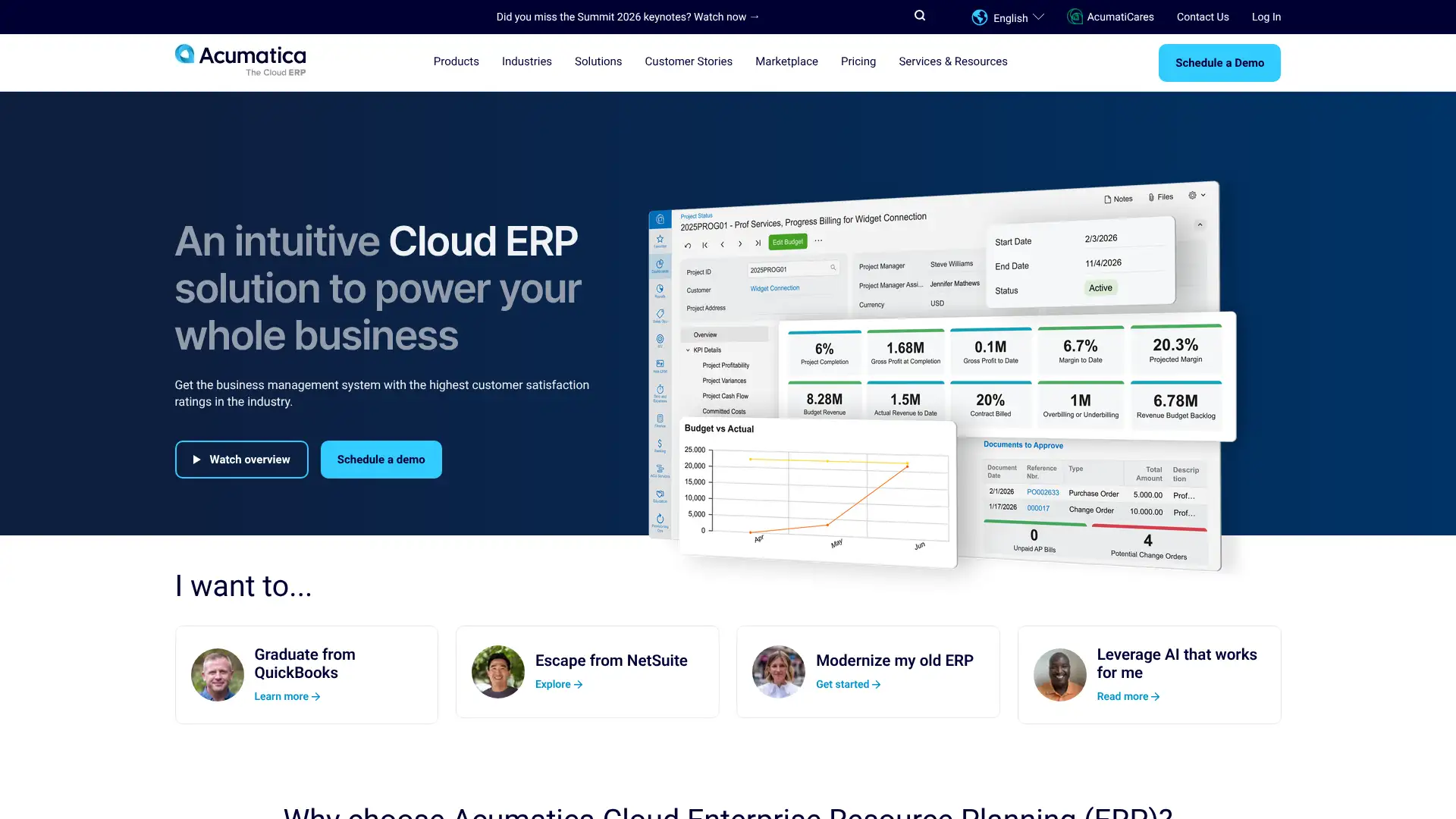
- • Consumption-based pricing: unlimited users without per-seat cost increases
- • True cloud-native built with open APIs; accessible from any browser or mobile device
- • Industry editions: Manufacturing, Distribution, Construction, Retail Commerce, Field Service
- • Deep developer framework with native integration marketplace and customization tools
- • Consistently rated highest in customer satisfaction in mid-market ERP surveys
The most user-friendly mid-market cloud ERP with the strongest customer satisfaction track record. The unlimited-user pricing model is a genuine differentiator for growing companies. Always benchmark against NetSuite on total transaction volume cost before committing.
Odoo
Odoo is the world's most popular open-source ERP. The Community edition is free to self-host under LGPL. The Enterprise edition at $24.90/user/mo (annual) adds cloud hosting, premium modules, and official support. Odoo covers 50+ integrated apps: CRM, sales, purchase, inventory, manufacturing, accounting, HR, website, ecommerce, and more. Over 40,000 apps in the Odoo marketplace. 5-year TCO as low as $300K to $800K vs. SAP's $1.5M to $3M.
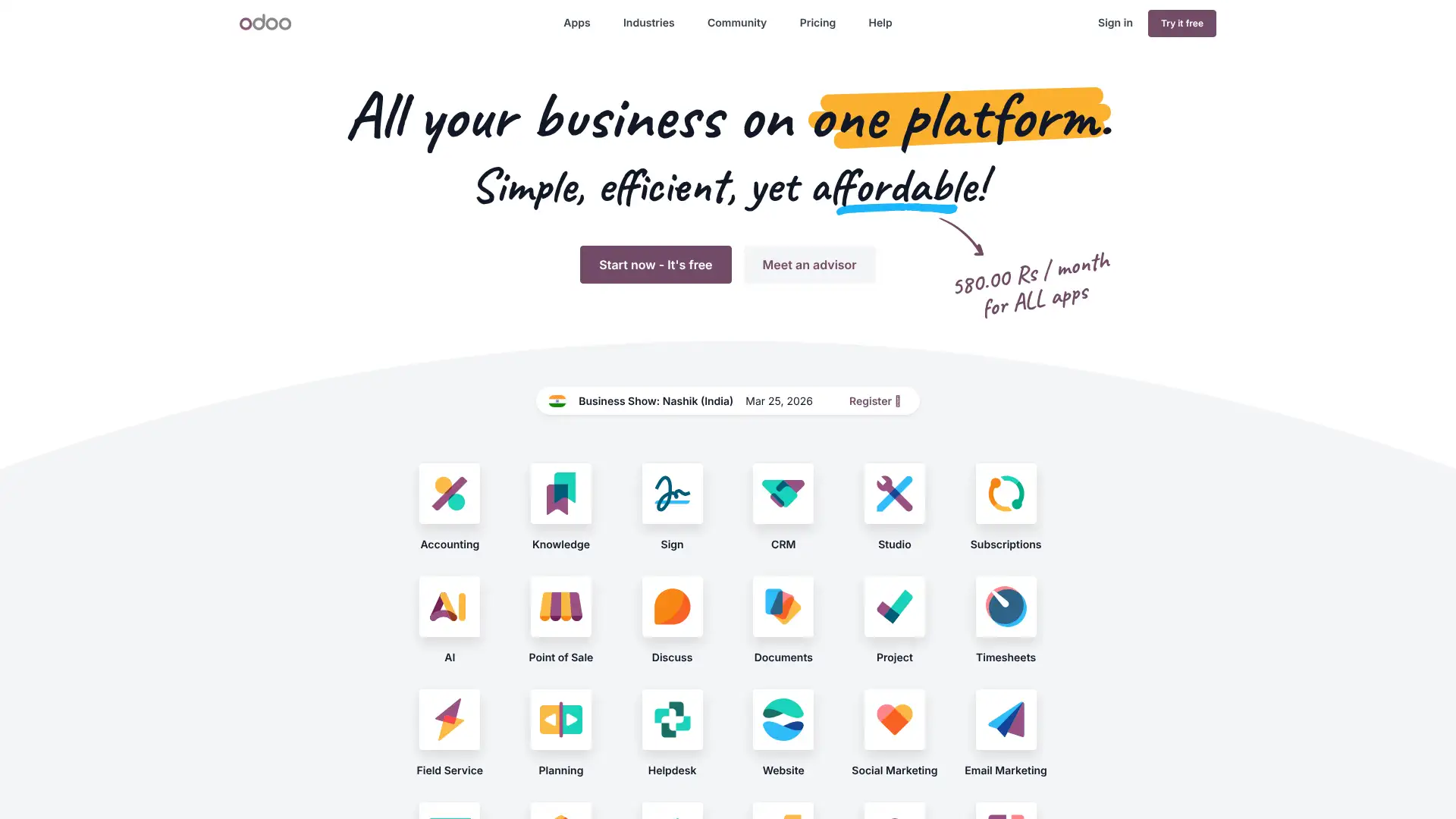
- • 50+ natively integrated apps with a shared database; no third-party middleware required
- • Community edition free to self-host; Enterprise adds cloud, support, and premium apps
- • 40,000+ marketplace apps for vertical extensions; active developer community
- • Manufacturing module includes BOM, work orders, MRP, quality, and maintenance
- • Odoo.sh PaaS or Odoo Online for managed hosting without server management
The strongest value proposition in ERP for SMBs growing beyond basic accounting software. Enterprise edition at $24.90/user/mo is remarkably affordable for a fully integrated suite. Partner selection is the most important decision; good Odoo partners dramatically outperform mediocre ones.
ERPNext (Frappe)
ERPNext is a fully open-source ERP built on the Frappe framework, released under GPL 3. Originally created to replace expensive proprietary ERP, it now covers accounting, inventory, manufacturing, CRM, HR, projects, and even education and healthcare verticals. Cloud hosted plans are significantly cheaper than Odoo. Self-hosted is completely free. Over 3,000 companies globally use ERPNext as their primary ERP.
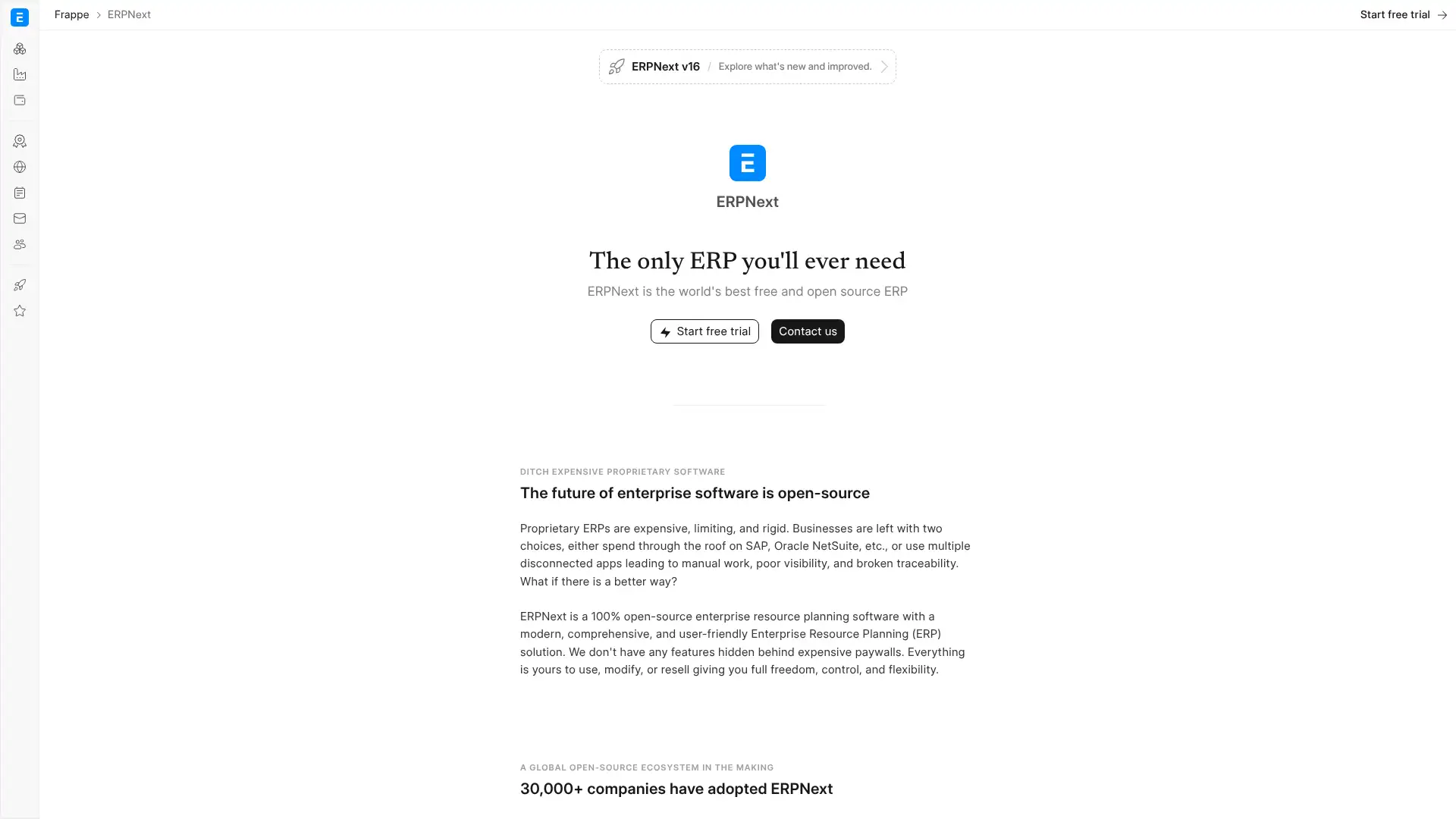
- • Modules: accounting, stock, manufacturing, CRM, projects, HR, payroll, education, healthcare
- • Form-driven UI: fill fields and let the application handle the logic; low learning curve
- • Frappe framework allows custom app development alongside ERPNext without forking
- • Active community on discuss.frappe.io; 3,000+ global deployers sharing modules
- • Native mobile app for stock management and field tasks on iOS and Android
The top free open-source ERP for small businesses, NGOs, and educational institutions that have basic IT capacity. The Frappe hosting plans at $10 to $25/user/mo are among the cheapest managed ERP options available. For businesses needing commercial support and a larger partner network, Odoo Enterprise is the better choice.
SYSPRO
SYSPRO is a 45-year-old manufacturing and distribution ERP, built from the ground up by one vendor rather than assembled through acquisitions. This gives it unusually consistent data models and deep integration across modules. It serves 17,000+ customers in 60+ countries, with 60% in North America. Subscription pricing starts at $199/user/mo; perpetual licenses $3,000 to $5,000/concurrent user. Primarily targets companies with 20 to 500 employees.
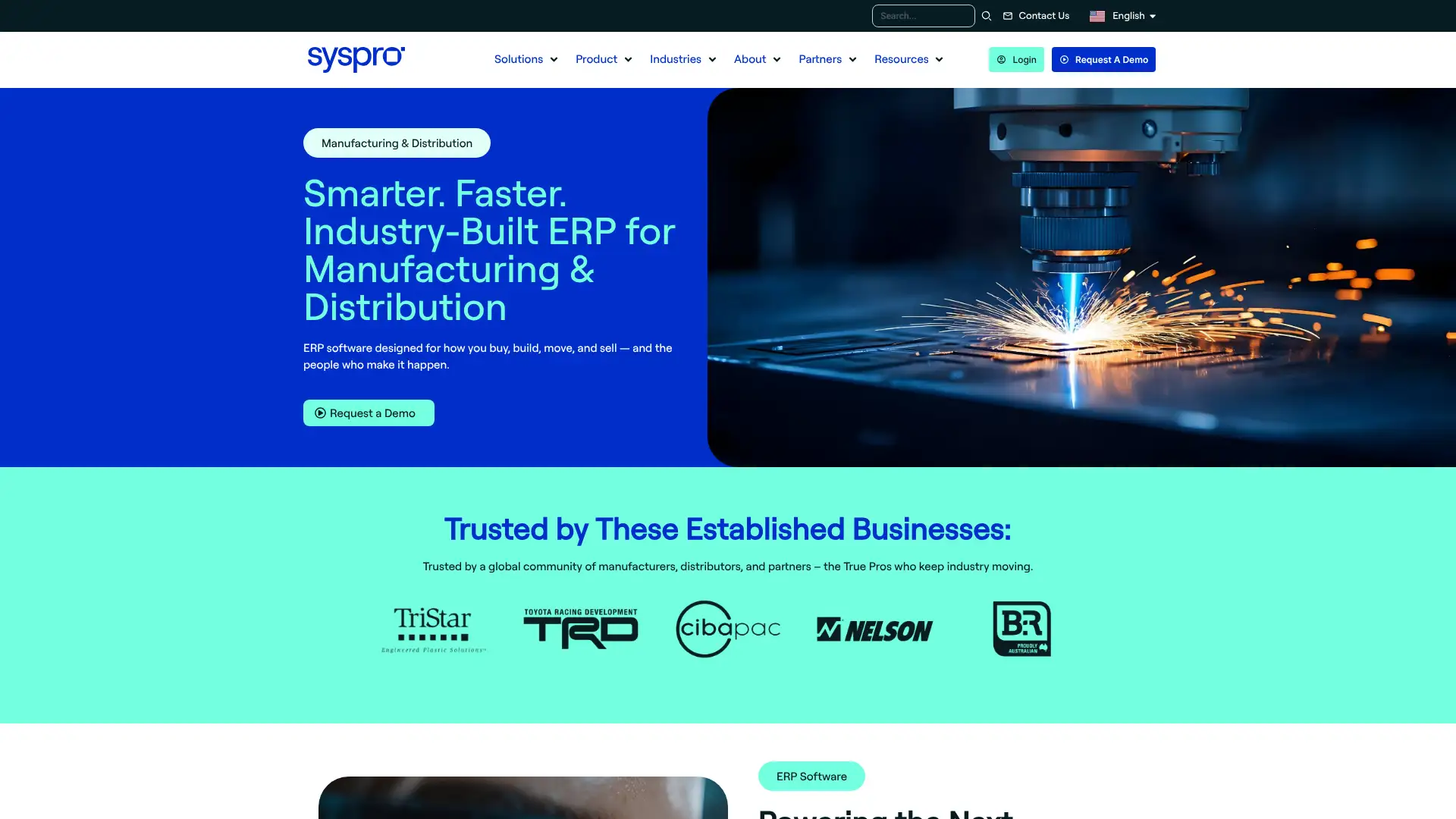
- • Single-vendor codebase since 1978: consistent UX and data model across all modules
- • Lot traceability and serial tracking from raw material to customer delivery
- • Product configurator for engineer-to-order and configure-to-order manufacturers
- • SYSPRO Avanti: mobile-responsive web UI for shop floor and warehouse staff
- • SYSPRO Risk and Compliance module for SOX, FDA 21 CFR Part 11, and ISO audits
One of the most reliable manufacturing ERPs in the mid-market, backed by 45 years of single-vendor development. The upgrade-safe customisation model is genuinely rare in ERP. Ideal for manufacturers that want deep MRP, lot traceability, and product configuration without paying SAP or Oracle prices.
Priority Software
Priority Software is an Israeli-founded mid-market ERP covering manufacturing, distribution, professional services, and retail. It is notable for its built-in low-code development environment that allows business users to modify forms, reports, and workflows without engaging external developers. Strong in Israel, the UK, and growing presence in Europe and North America. Pricing starts at approximately $60 to $120/user/mo depending on modules.
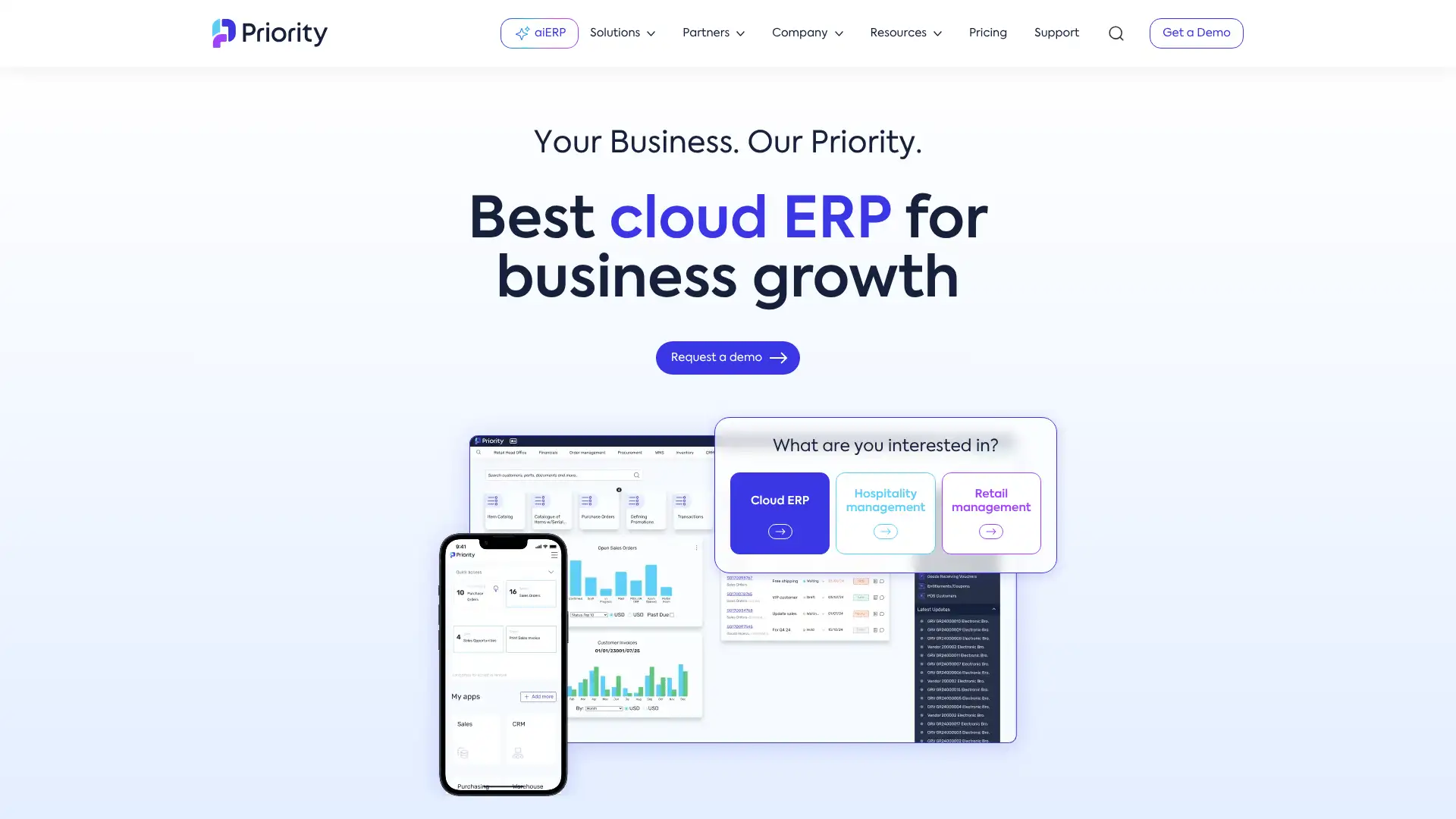
- • Built-in low-code environment: modify screens, reports, and workflows without external developers
- • Covers manufacturing, distribution, professional services, and retail in one unified platform
- • Multi-company and multi-currency with real-time consolidation
- • Priority API for REST integration with third-party systems
- • Mobile app for field teams, warehouse staff, and managers
A strong mid-market ERP underrated outside of Israel and the UK. The built-in low-code customization tool is a genuine time and cost saver for organizations that need frequent process adjustments. Worth evaluating seriously alongside Acumatica and Dynamics 365 Business Central.
Rootstock Cloud ERP
Rootstock is a cloud manufacturing ERP built natively on the Salesforce platform. This means it runs inside Salesforce, sharing the same database, security model, and user interface as your CRM. For manufacturers already deeply invested in Salesforce, Rootstock eliminates the integration overhead between CRM and ERP entirely. Pricing is approximately $75 to $175/user/mo depending on modules, plus Salesforce platform licensing.
- • Runs natively on Salesforce: same login, security, and data model as your CRM
- • Quote-to-cash in one system: Salesforce CPQ connects directly to Rootstock manufacturing
- • No integration middleware required between CRM and ERP; single source of truth
- • Covers MRP, work orders, BOM, inventory, purchasing, and shop floor control
- • Benefits from Salesforce's SOC 2 Type II, ISO 27001, and HIPAA compliance infrastructure
The right choice if and only if your organization is already deeply invested in Salesforce CRM and wants to eliminate the perennial ERP-to-CRM integration overhead. For everyone else, the added Salesforce licensing cost makes Acumatica or NetSuite more straightforward.
Cetec ERP
Cetec ERP is a cloud manufacturing ERP designed for small to mid-size contract manufacturers, electronics manufacturers, and job shops. It aims to be faster to implement than Epicor or SYSPRO, with a typical go-live timeline of 4 to 8 weeks. Pricing starts at $40/user/mo, making it one of the most affordable purpose-built manufacturing ERPs on this list. Strong for make-to-order and configure-to-order environments.
- • Full manufacturing suite: quoting, BOM, work orders, shop scheduling, and invoicing
- • Quick implementation: 4 to 8 weeks go-live vs. months for Epicor or SYSPRO
- • Lot traceability and serialization for electronics and regulated manufacturers
- • RMA management for customer returns and warranty tracking
- • QuickBooks and Xero integration for companies not ready to move accounting to the ERP
An excellent entry point for small contract manufacturers and job shops that need a real manufacturing ERP without a 6-month implementation project. The 4 to 8 week go-live and $40/user/mo pricing are genuinely compelling for teams of 5 to 50 users.
Katana Cloud Inventory
Katana is a cloud inventory and manufacturing management platform aimed at small product businesses selling on Shopify, WooCommerce, or Amazon. It handles bill of materials, production orders, real-time inventory, and sales order management with a clean modern interface. However, Katana has received significant negative reviews in 2024 to 2025 over unannounced pricing model changes (from flat to GMV-based), with some customers seeing their monthly bill jump from $199 to $899+ without warning. Verify current pricing before committing.
- • Visual production planner with drag-and-drop scheduling on a live floor view
- • Native Shopify, WooCommerce, Xero, QuickBooks Online, and Amazon integrations
- • Real-time raw material and finished goods inventory with automatic reorder alerts
- • Multi-location inventory support across warehouses and sales channels
- • Barcode scanning for stock movements, production tracking, and fulfillment
Katana has a genuinely excellent UI and strong ecommerce integrations, but the pricing model changes documented in G2 and Capterra reviews are a significant concern. Read recent reviews carefully and get pricing confirmed in writing before committing. MRPeasy is the safer alternative at a comparable price point.
MRPeasy
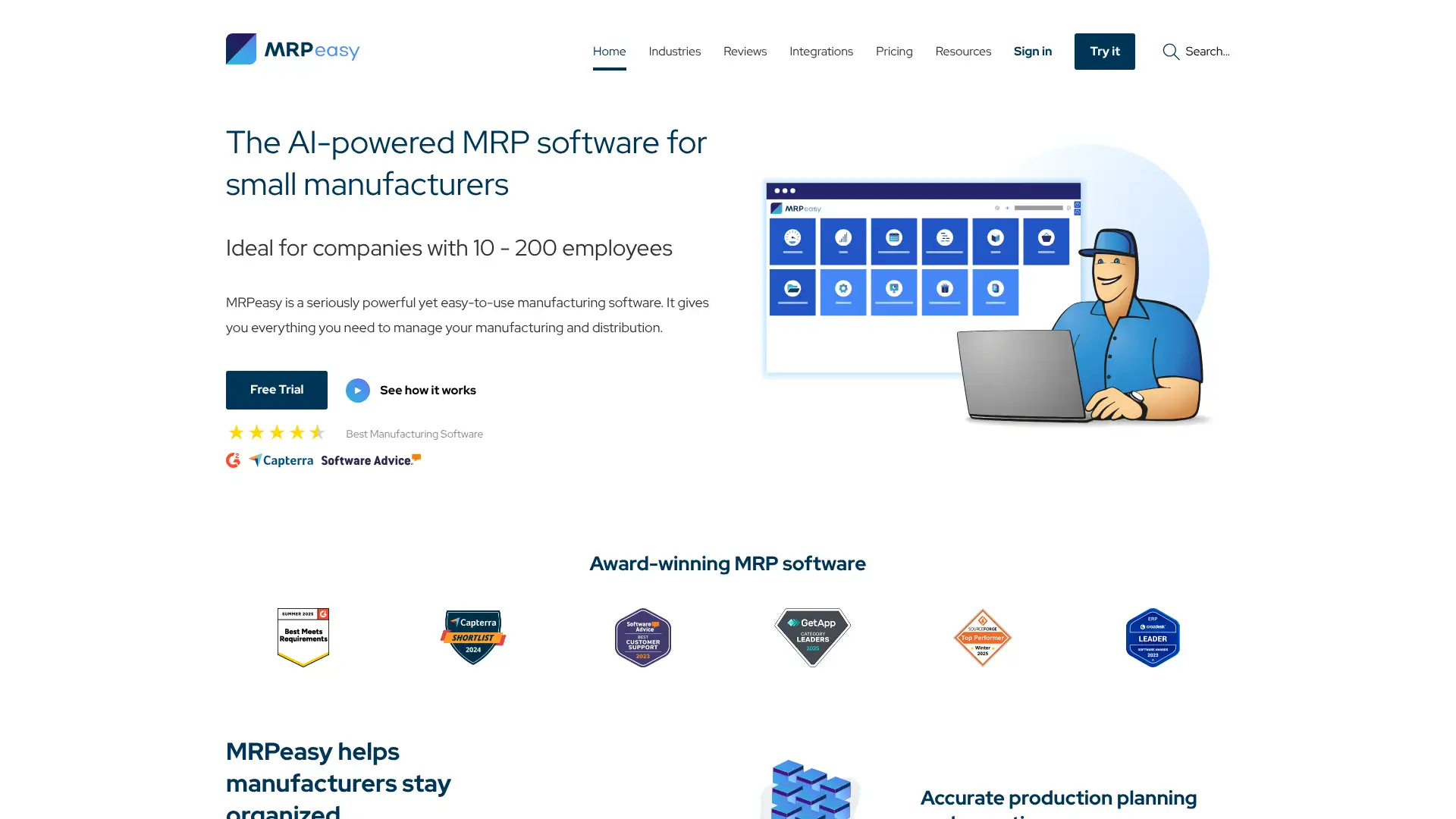
MRPeasy is a cloud MRP/ERP system built for small manufacturers with 10 to 200 employees. It covers production planning, inventory management, purchasing, shop floor reporting, and basic accounting. Four plans from €39/user/mo, with transparent published pricing. Frequently cited by users leaving Katana as the more reliable and affordable alternative. 15-day free trial available.
- • MRP planning: explodes BOMs, calculates materials needed, and creates purchase orders automatically
- • Shop floor reporting: workers log time and materials against work orders from mobile or desktop
- • Inventory management with lot/serial tracking and multi-warehouse support
- • Integrates with Shopify, WooCommerce, QuickBooks, Xero, and major e-commerce platforms
- • 15-day free trial with no credit card; transparent published pricing unlike most ERPs
The most reliable affordable MRP/ERP for small manufacturers who want predictable published pricing and solid production planning. Frequently recommended by former Katana users as the more trustworthy alternative. Excellent 4.6/5 G2 rating reflects genuine customer satisfaction at this price tier.
Megaventory
Megaventory is a cloud inventory management and order fulfillment system with light manufacturing capabilities. Aimed at SMBs managing inventory across multiple locations, warehouses, or sales channels. Priced from $150/mo for up to 5 users, it is one of the most affordable options for multi-location stock management. Integrates with WooCommerce, Shopify, QuickBooks, and Magento.
- • Multi-location stock management: track inventory across warehouses, stores, and consignment locations
- • Purchase orders, sales orders, and supplier management in one dashboard
- • Basic assembly/disassembly manufacturing for kits and bundles
- • Barcode scanning support for receiving, shipping, and stock counts
- • REST API for custom integrations; Zapier supported for no-code connections
A solid affordable solution for small businesses managing inventory across multiple locations without complex manufacturing needs. Not a full ERP, but for inventory-and-orders-first businesses the flat team pricing at $150/mo is hard to beat. Upgrade to Cin7 when multi-channel retail complexity increases.
Brightpearl (Sage)
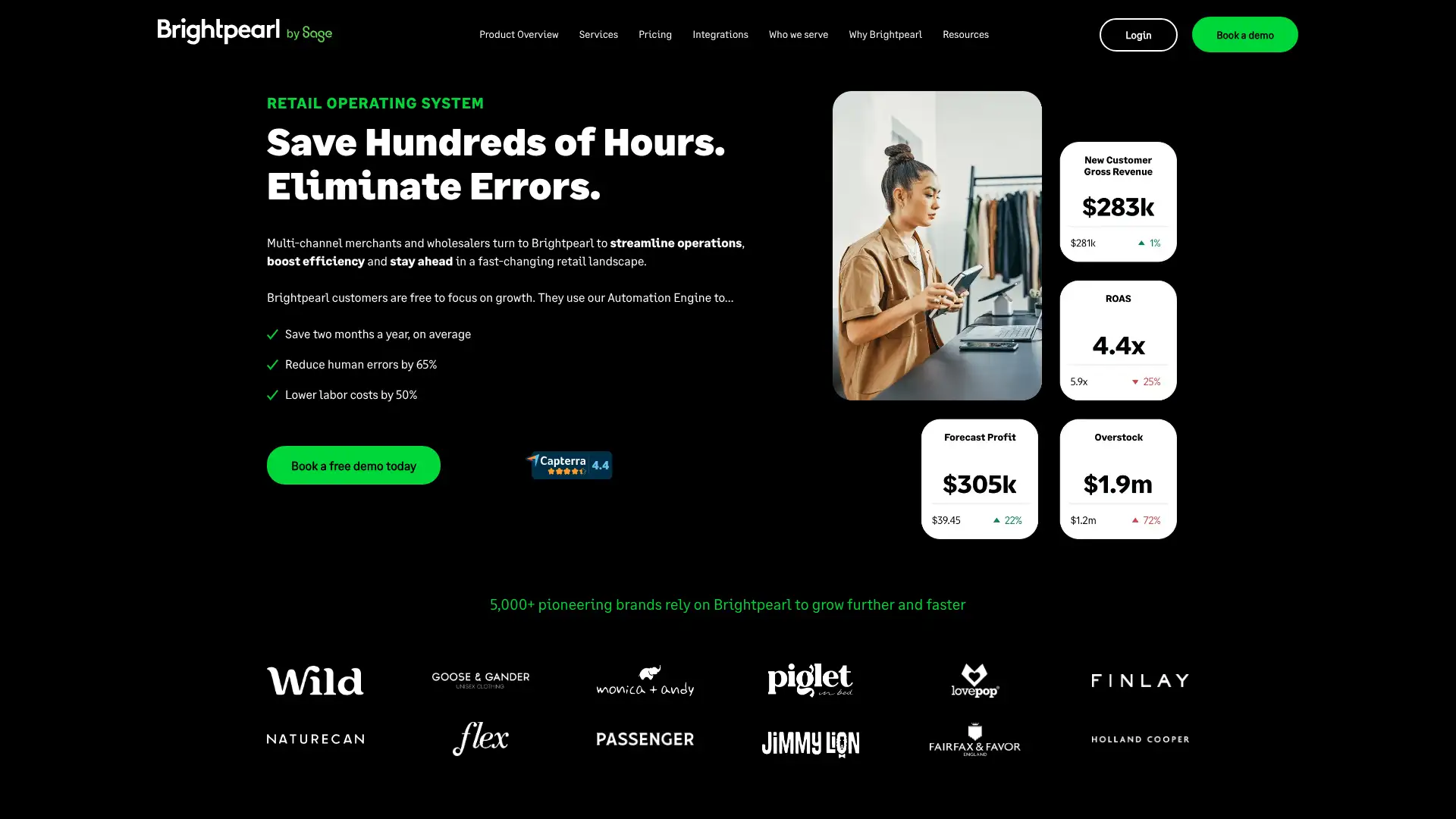
Brightpearl (acquired by Sage) is a retail operations platform designed for omnichannel retailers selling on Shopify, Amazon, eBay, and through physical stores. It automates inventory, order management, warehouse, purchasing, and accounting across all channels. Brightpearl's Automation Engine can automate 90%+ of post-purchase operations without manual intervention. Custom pricing; typical entry from $375/mo.
- • Automation Engine: automate order routing, fulfilment, returns, and stock allocation rules
- • Native Shopify Plus, BigCommerce, Magento, Amazon, eBay, and Walmart integrations
- • Real-time inventory sync across all channels, warehouses, and retail stores
- • Demand planning and open-to-buy forecasting for seasonal retail buyers
- • Built-in accounting and reporting purpose-built for retail P&L and margin management
The best omnichannel retail operations platform for businesses selling across Shopify, Amazon, and physical stores simultaneously. The Automation Engine genuinely reduces manual post-purchase work. Not suitable for manufacturers; for retail-first businesses it is a strong alternative to generic ERPs.
Cin7
Cin7 (including Cin7 Core, formerly DEAR Systems) is a cloud inventory management and order management platform with built-in point of sale, B2B portal, and light manufacturing. It is designed for small to mid-size wholesalers, distributors, and product companies selling across multiple channels. Plans start at $349/mo; advanced plans at $599 and $999/mo for higher order volumes and more automation.
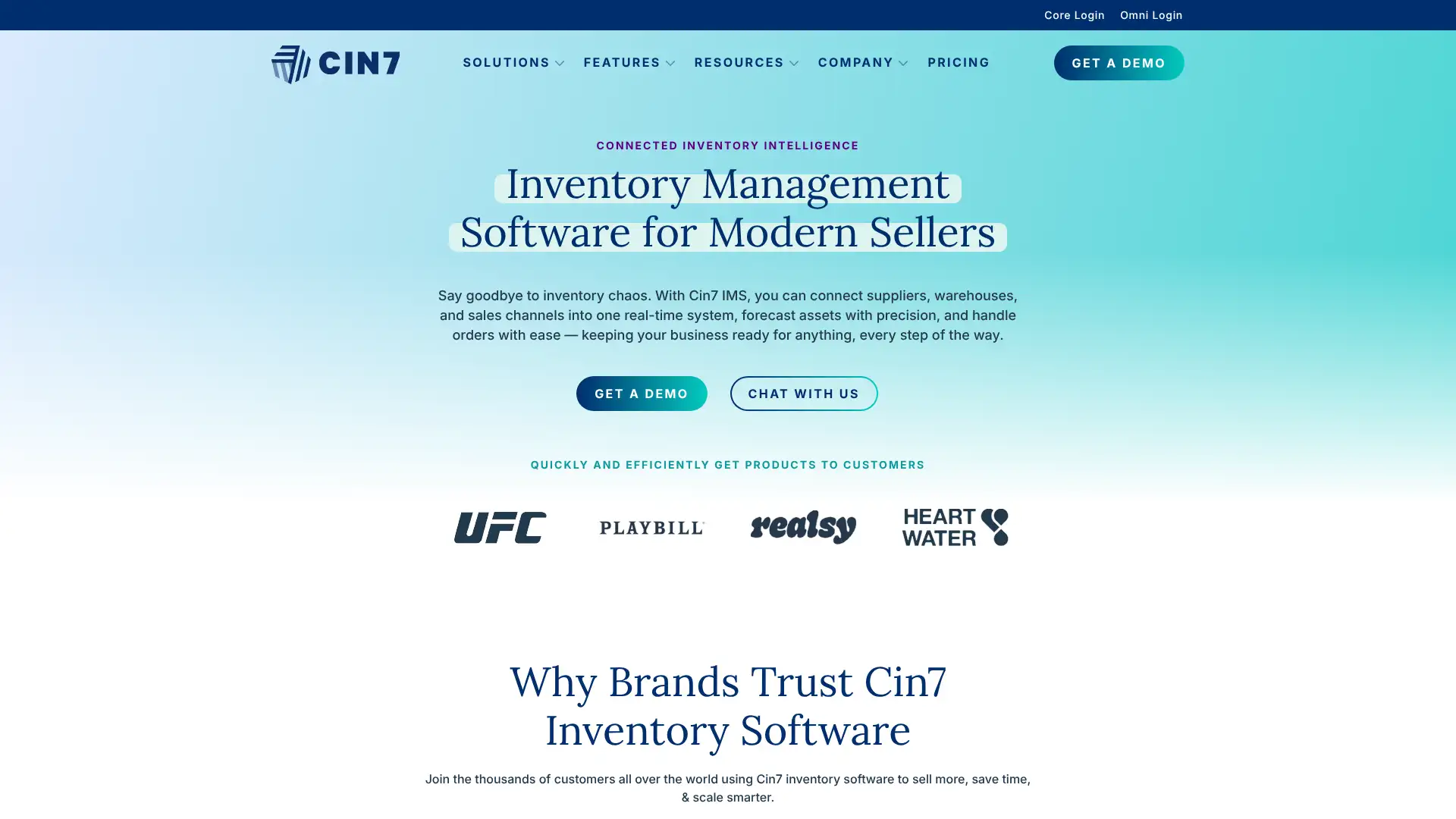
- • Multi-channel inventory: Shopify, Amazon, eBay, Walmart, physical POS, and B2B portal unified
- • Batch and serial number tracking for compliance, lot management, and expiry date control
- • B2B portal allows wholesale customers to self-serve orders with custom pricing
- • 700+ integrations including Xero, QuickBooks, Shopify, Magento, and 3PL providers
- • Light manufacturing: BOM assembly, disassembly, and simple production orders
The go-to platform for SMB wholesalers and distributors managing inventory across multiple sales channels. The 700+ integration library and B2B wholesale portal are genuine differentiators. For complex manufacturing, pair with a dedicated MRP tool or consider a full ERP upgrade.
Fishbowl Inventory
Fishbowl is the most popular inventory management and manufacturing add-on for QuickBooks, with deep two-way sync. It extends QuickBooks with multi-location inventory, barcoding, manufacturing work orders, and warehouse management, without requiring a full ERP migration. Available as on-premise software with annual licensing, and as Fishbowl Drive (cloud). Preferred by US small businesses that want to keep QuickBooks for accounting while adding operational capability.
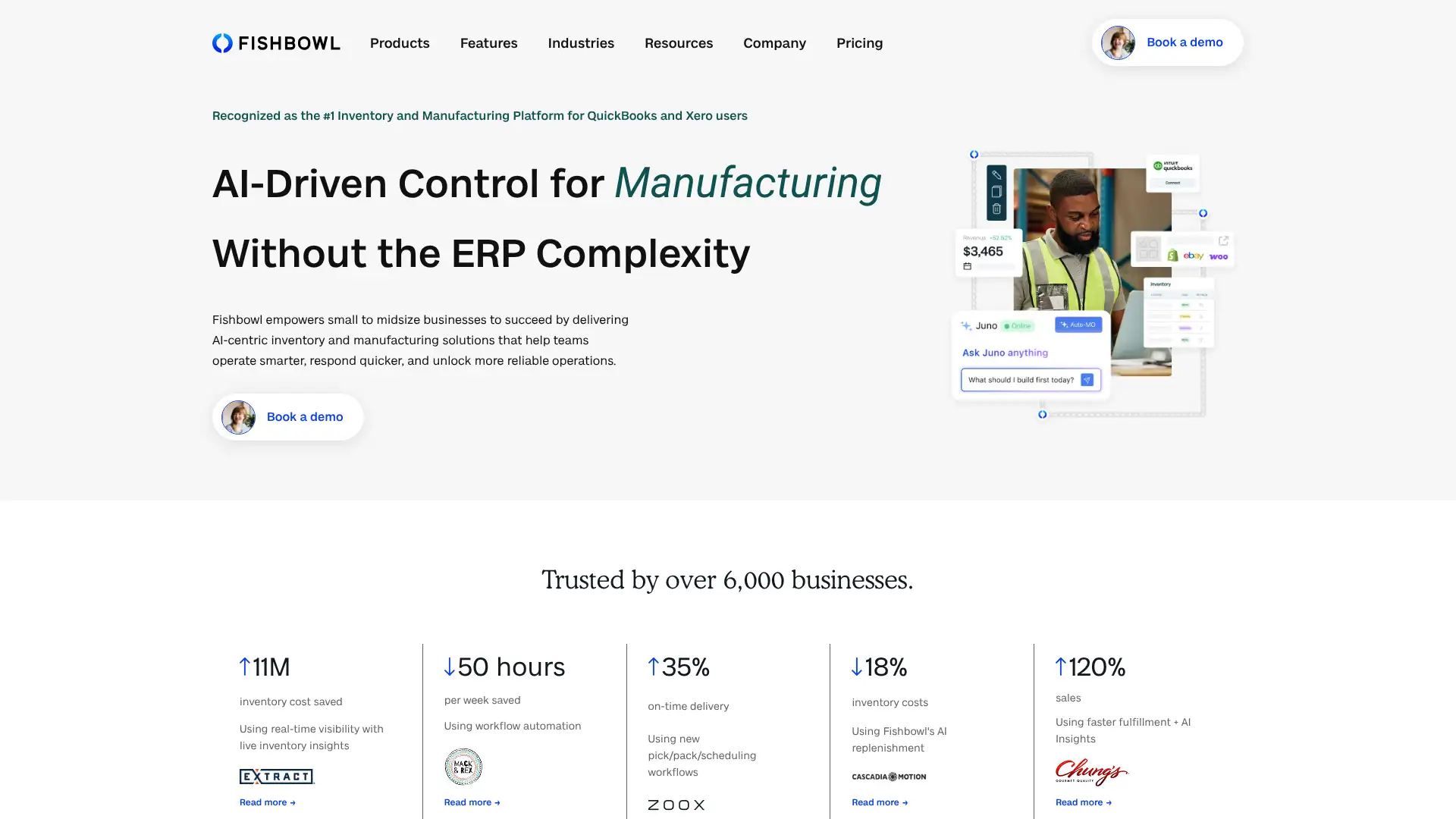
- • Deep QuickBooks integration: inventory costs, orders, and payments sync automatically
- • Multi-location inventory with barcode scanning, bin locations, and cycle counts
- • Manufacturing work orders, BOM management, and job costing
- • Purchasing automation: reorder points, vendor management, and PO generation
- • Integrates with Shopify, Amazon, Xero, and 50+ additional platforms
The most practical solution for small US manufacturers and warehouses that want to extend QuickBooks without a full ERP migration. The integration depth with QuickBooks is unmatched. When your business outgrows QuickBooks itself, the natural step is Acumatica or NetSuite.
abas ERP
abas ERP is a German-developed ERP for mid-size manufacturers, distributors, and retailers with 50 to 5,000 employees. It is known for its flexibility: the abas programming language (FO) allows deep customisation without changing the core product, preserving upgrade paths. Strong in Germany, Austria, Switzerland, and neighboring markets. Custom pricing; implementation-heavy and partner-sold. Part of the Asseco Group since 2017.
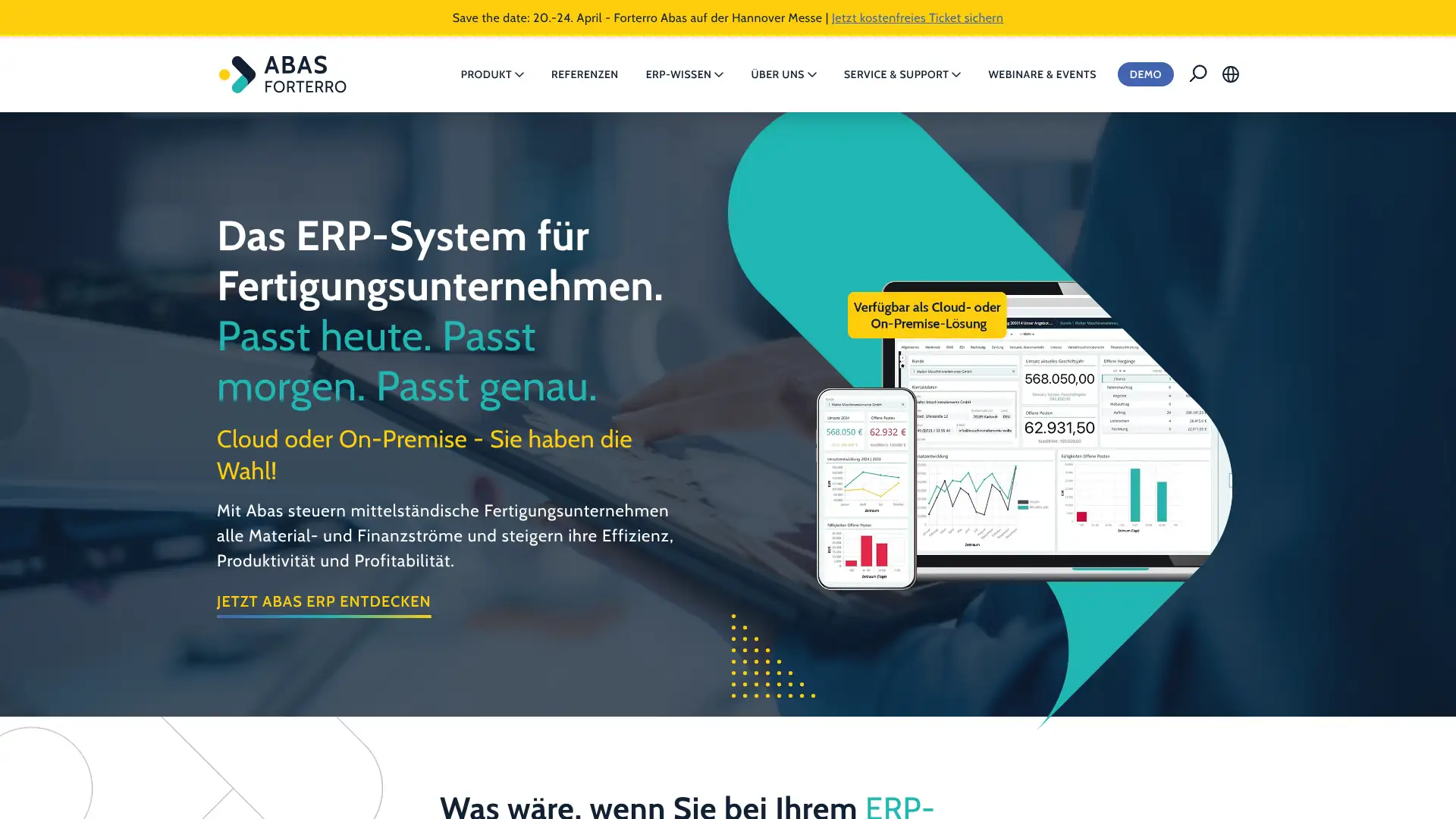
- • FO programming language for deep customisation without forking the core product
- • Manufacturing: discrete, make-to-order, configure-to-order, and project manufacturing
- • Multi-site manufacturing with cross-site MRP and inventory visibility
- • DACH-market compliance: German trade law, GoBD digital accounting requirements, VAT
- • abas DMS (Document Management System) integrated for digital document workflows
The strongest choice for mid-size German-speaking manufacturers needing deep DACH compliance and flexible customisation. Less compelling outside the DACH region where Epicor, SYSPRO, or Sage X3 have stronger partner networks and international presence.
metasfresh
metasfresh is a Java-based open-source ERP rebuilt from the ADempiere codebase for modern scalability and performance. It is free to self-host under GPL 2, with commercial cloud plans available. Unlike Dolibarr, metasfresh is designed for more complex operations: multi-company, production planning, materials management, procurement, and advanced accounting. Popular in DACH region and increasingly adopted globally. Cloud plans are free for 1 user.
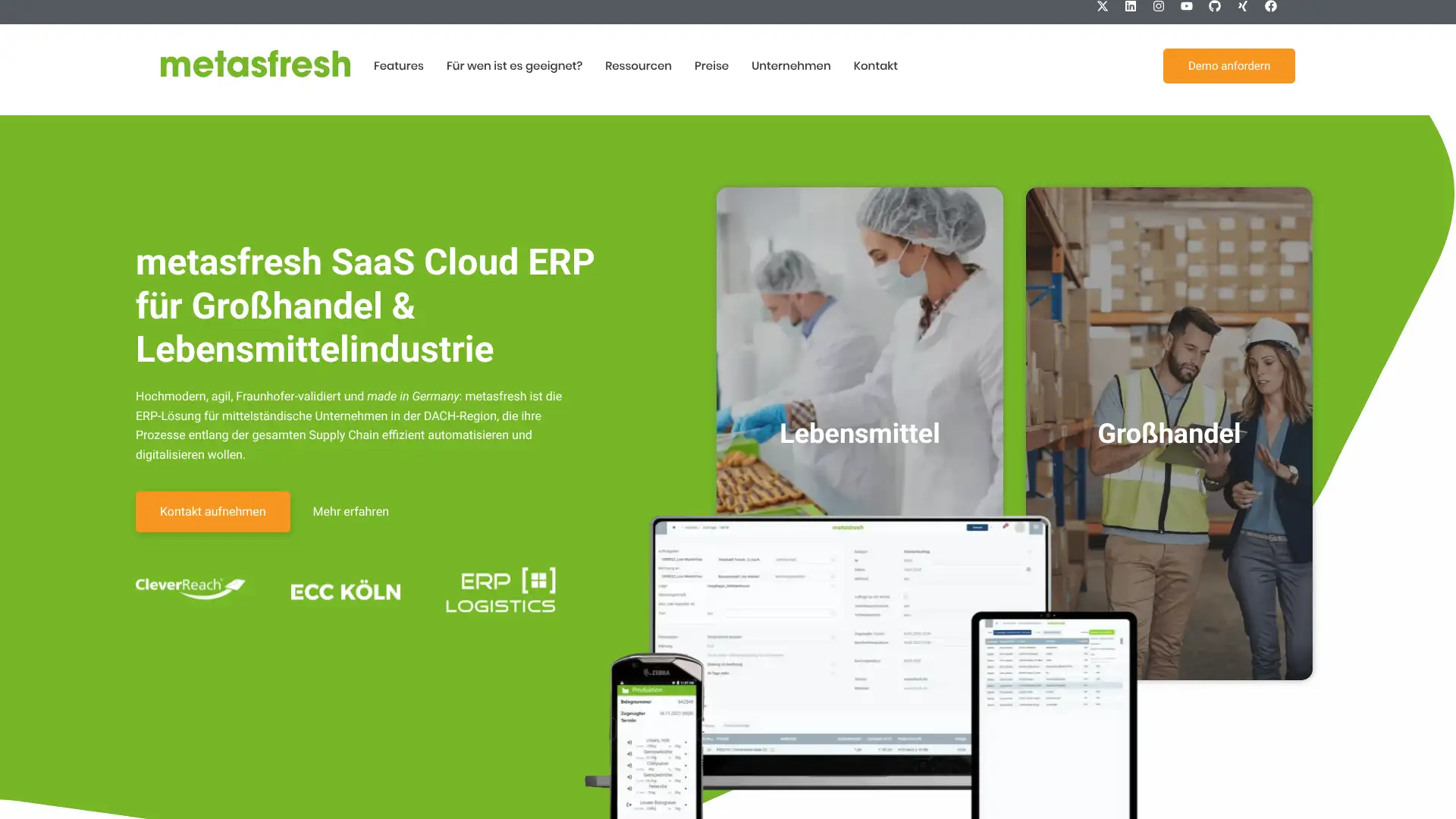
- • Java-based architecture designed for enterprise-scale transaction volumes
- • Production planning with MRP, BOM, routing, and materials management
- • Multi-company, multi-currency, and multi-language in a single instance
- • Advanced procurement: purchase contracts, rebates, and vendor pricing management
- • REST API and service-oriented architecture for clean third-party integration
A serious open-source ERP for mid-size manufacturers willing to invest in Java deployment and administration. Stronger manufacturing depth than most free alternatives. Best suited for DACH-region companies or organizations with in-house Java development capabilities.
Tryton
Tryton is a Python-based open-source ERP framework with a three-tier architecture: Tryton Server (backend), Tryton Client (desktop/web), and PostgreSQL database. It originated as a fork of OpenERP (now Odoo) but diverged to prioritize clean architecture, modularity, and long-term maintainability over rapid feature growth. Completely free under LGPL 3. Hosted services and commercial support available from the Tryton Foundation and community partners.
- • Clean three-tier Python architecture: server, client, and database fully separable
- • Modules: accounting, stock, production, sales, purchase, invoicing, and party management
- • Multi-company, multi-currency, and multi-language with horizontal scaling support
- • Strong emphasis on data integrity; all changes are revision-tracked and auditable
- • LGPL 3 license; commercially usable; modules can be proprietary without GPL obligations
The right choice for developers or organizations with Python capabilities who want a clean, maintainable ERP foundation to extend over time. The LGPL 3 license is more permissive than GPL for building proprietary extensions. Not suitable for non-technical teams needing a configured out-of-box ERP.
iDempiere
iDempiere evolved from Compiere and ADempiere, implementing the ERP/CRM/SCM stack on an OSGi (Open Services Gateway Initiative) plugin architecture. It won InfoWorld's Best Open Source Software award in 2015 and 2016. The OSGi architecture means modules are hot-swappable plugins, enabling deep extensibility without forking. Completely free under GPL 2. Strong for organizations needing Java-based enterprise ERP with deep workflow customisation.
- • OSGi plugin architecture: add, remove, and update modules without restarting the server
- • Deep ERP coverage: invoicing, warehouse management, MRP, CRM, and supply chain
- • Multi-organization support: run multiple companies in one iDempiere instance
- • Advanced workflow engine for complex approval chains and business rules
- • Configurable reporting with standard web browser interface; no thick client required
A powerful free ERP for organizations with Java development expertise and complex multi-organization requirements. The OSGi plugin architecture is genuinely unique in open-source ERP. Not recommended for teams without dedicated Java developers to maintain the deployment.
Compiere
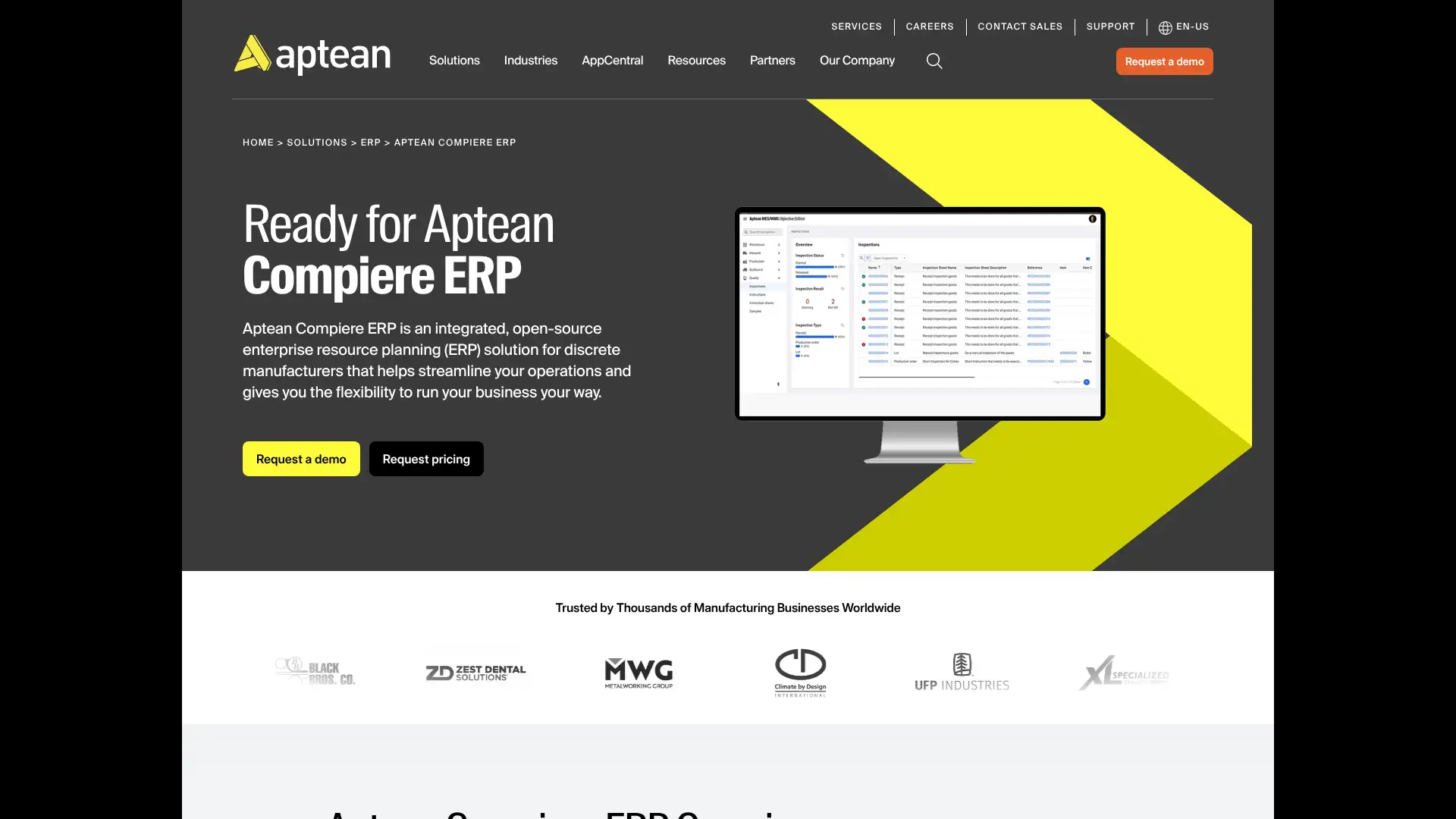
Compiere was one of the first major open-source ERPs when it launched in 1999, covering ERP, CRM, and SCM for small to mid-size businesses. It spawned two major forks: ADempiere (2006) and Openbravo. Compiere Inc. was acquired by Aptean in 2012, and the open-source community project largely stalled. The codebase lives on through its forks, most notably iDempiere (which runs on OSGi) and metasfresh. Active new deployments on Compiere itself are rare in 2026.
- • Pioneer open-source ERP: one of the first Java-based open ERP platforms (1999)
- • Spawned the major Java open-source ERP ecosystem: ADempiere, iDempiere, metasfresh
- • Core modules: accounting, inventory, MRP, CRM, order management
- • Acquired by Aptean 2012; community open-source branch has limited active development
- • Legacy deployments still running in distribution and retail in some markets
Do not start new deployments on the Compiere community branch in 2026. The open-source community is effectively inactive. Organizations on legacy Compiere deployments should evaluate migration to iDempiere, metasfresh, Odoo, or ERPNext. The Compiere story matters historically but the product itself has been superseded.
Aptean / GlobalShop
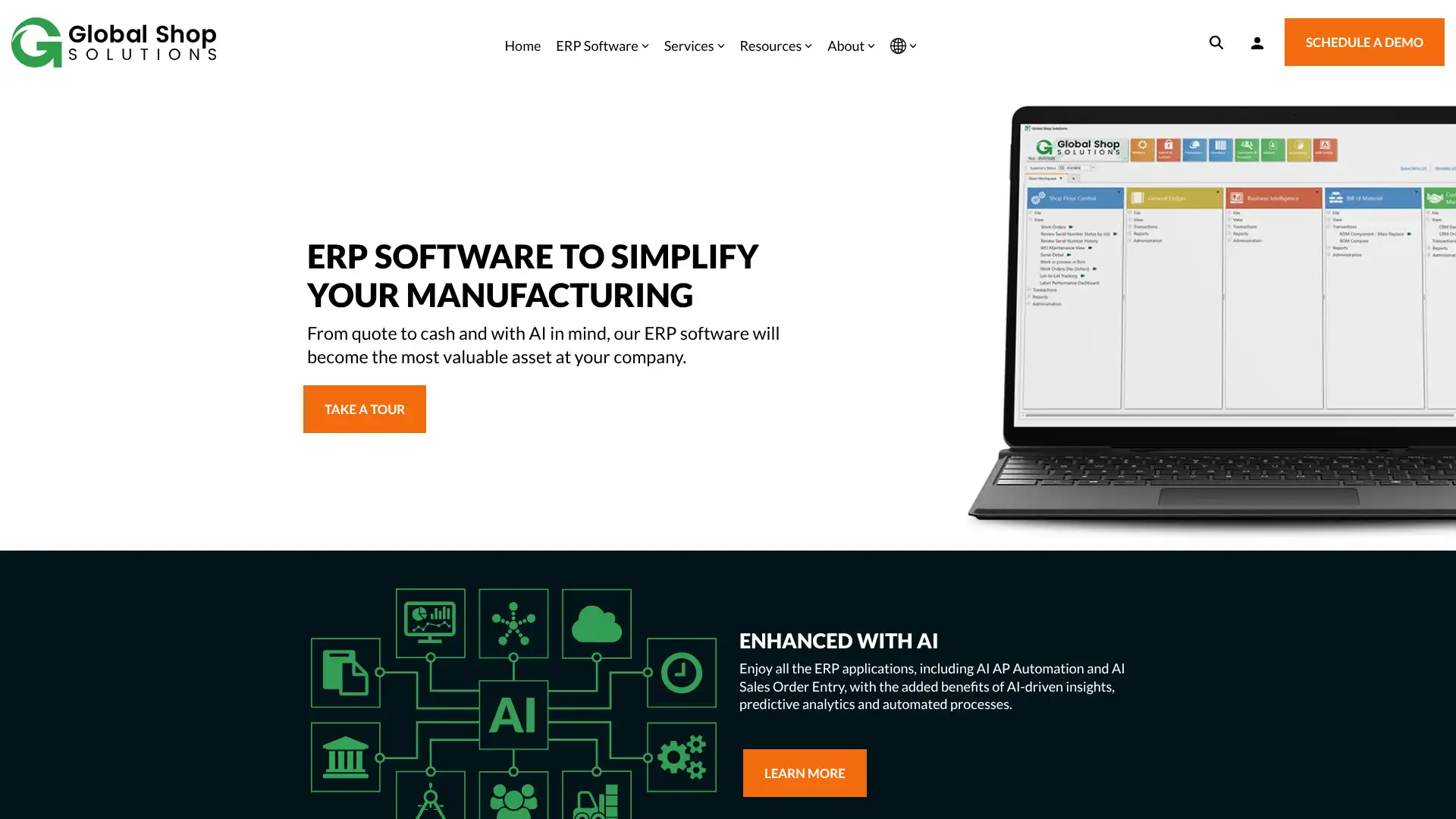
GlobalShop is a job shop and custom manufacturing ERP now owned by Aptean (the same company that acquired Compiere). It is designed for make-to-order and engineer-to-order job shops with complex quoting, job costing, shop scheduling, and material tracking needs. Aptean acquired GlobalShop Solutions and rebranded it as part of the Aptean Industrial Manufacturing ERP portfolio. Pricing is custom and implementation-led. Targeted at US and North American job shops with 10 to 300 employees.
- • Quote-to-cash for custom manufacturing: estimating, quoting, job creation, and invoicing in one flow
- • Job costing: track actual vs. estimated labor, material, and overhead by job
- • Shop floor scheduling: visual Gantt charts for capacity planning and work centre scheduling
- • Material requirements based on job specifics; not standard MRP for repetitive manufacturing
- • Aptean's portfolio includes 30+ industry-specific ERP products; upgrade paths available
A focused solution for North American job shops and custom manufacturers that need dedicated quote-to-cash, job costing, and visual shop scheduling. Aptean's portfolio approach adds long-term upgrade paths. For organizations needing both job shop and distribution ERP in one system, SYSPRO or Epicor are better starting points.