27 Best Database Management Tools in 2026
Covers managed Postgres hosting, serverless databases, distributed SQL, NoSQL, graph databases, time-series, edge databases, and GUI client tools. Pricing verified March 2026. Two entries (ElephantSQL, bit.io) are documented as discontinued.
Supabase
Supabase is a Postgres-centred backend-as-a-service platform that bundles the database with authentication, auto-generated REST and GraphQL APIs, real-time subscriptions, file storage, and edge functions. The free tier includes 500 MB storage, 1 GB file storage, and 5 GB bandwidth across up to 2 projects. Free projects pause after one week of inactivity. Pro plan at $25/mo covers most startups through their first 100,000 users. Multigres (2025) brings horizontal sharding to Postgres. HIPAA compliant on Enterprise.
- • Auto-generated PostgREST and GraphQL APIs from your schema with zero configuration
- • Row Level Security (RLS) for multi-tenant access control enforced at the database layer
- • Real-time subscriptions over WebSockets to database change events
- • Database branching integrated with GitHub/GitLab for preview environments per commit
- • pgvector, PostGIS, and 40+ Postgres extensions available with one SQL command
The best starting point for developers building full-stack web applications who want Postgres, auth, and real-time in one place. Supabase consistently outperforms Firebase for SQL-first teams and delivers strong value at $25/mo. Start here unless you specifically need a pure database with no extra services bundled.
Neon
Neon separates Postgres compute from storage using a copy-on-write page server, enabling instant database branching regardless of size and scale-to-zero when idle. In May 2025, Databricks announced acquisition of Neon, reflecting its strong alignment with agentic AI workloads. The free tier includes up to 10 projects, 0.5 GB storage per project, and 191.5 compute-unit hours/month. Cold start after scale-to-zero is approximately 150ms. Open source under Apache 2.0.
- • Copy-on-write branching: create a full database clone in milliseconds regardless of DB size
- • Scale-to-zero compute; spin up in ~150ms when a connection arrives
- • Point-in-time restore: branch from any timestamp for debugging production incidents
- • HTTP driver for edge runtimes (Cloudflare Workers, Vercel Edge Functions)
- • Open source codebase under Apache 2.0; self-hostable for data sovereignty
The best pure serverless Postgres for bursty, variable, or ephemeral workloads. Instant branching and scale-to-zero make it ideal for preview environments and AI agent databases. The 2025 outage history is a concern for mission-critical production; consider Supabase or PlanetScale for higher uptime requirements.
PlanetScale
PlanetScale is built on Vitess, the MySQL clustering system originally created at YouTube. It added Postgres support in September 2025, though the Postgres implementation also runs on Vitess, which introduces differences from native Postgres. PlanetScale removed its free tier in late 2024 and repositioned as a premium product for scale-focused teams. Plans start from $5/mo for Postgres and from $39/mo for higher tiers. The developer workflow centers on git-like schema branching with non-blocking schema changes.
- • Vitess horizontal sharding enables YouTube-scale MySQL without application changes
- • Schema branching: deploy schema changes without locking tables or causing downtime
- • Lowest tail latency of the serverless database platforms in head-to-head benchmarks
- • Postgres added September 2025; runs on Vitess with some behavioral differences from native Postgres
- • Database Threads: visual query analysis tool for identifying slow queries
The best choice for teams with deep MySQL expertise who need horizontal sharding and schema branching at scale. The removal of the free tier signals a clear pivot toward enterprise customers. For new Postgres-first projects, Neon or Supabase are more accessible starting points.
Aiven
Aiven runs managed open-source databases across AWS, GCP, Azure, DigitalOcean, and UpCloud, covering Postgres, MySQL, Redis, Kafka, OpenSearch, ClickHouse, Cassandra, and more. The multi-cloud flexibility is its core differentiator: deploy your database on whichever provider your application runs on, or migrate between providers without re-platforming. VPC peering, PrivateLink, RBAC, and Prometheus/Grafana integrations are available. Partnered with ElephantSQL as the recommended migration target after ElephantSQL's shutdown in January 2025.
- • 6+ cloud providers supported: AWS, GCP, Azure, DigitalOcean, UpCloud, and more
- • Multi-cloud failover: database can span multiple cloud providers for maximum resilience
- • VPC peering, PrivateLink, and RBAC for enterprise network and access control
- • Observability integrations: Prometheus, Grafana, and Datadog out of the box
- • Supports 10+ open-source databases: Postgres, MySQL, Kafka, Redis, ClickHouse, Cassandra
The top choice for infrastructure teams managing databases across multiple cloud providers who need compliance controls, VPC peering, and observability integrations. Aiven abstracts operational complexity away from databases you already know. Not a developer-first product; it is an operations-first one.
Timescale
Timescale is a PostgreSQL extension (TimescaleDB) that optimises Postgres for time-series data: IoT sensor readings, application metrics, financial tick data, and monitoring. The TimescaleDB extension is open source (Apache 2.0 for single-node; Timescale License for clustering). Timescale Cloud is the managed hosted service. It also added columnar storage, continuous aggregates for real-time rollups, and a vector database layer (pgvectorscale) for AI applications. Usage-based pricing from $0.023/vCPU-hour.
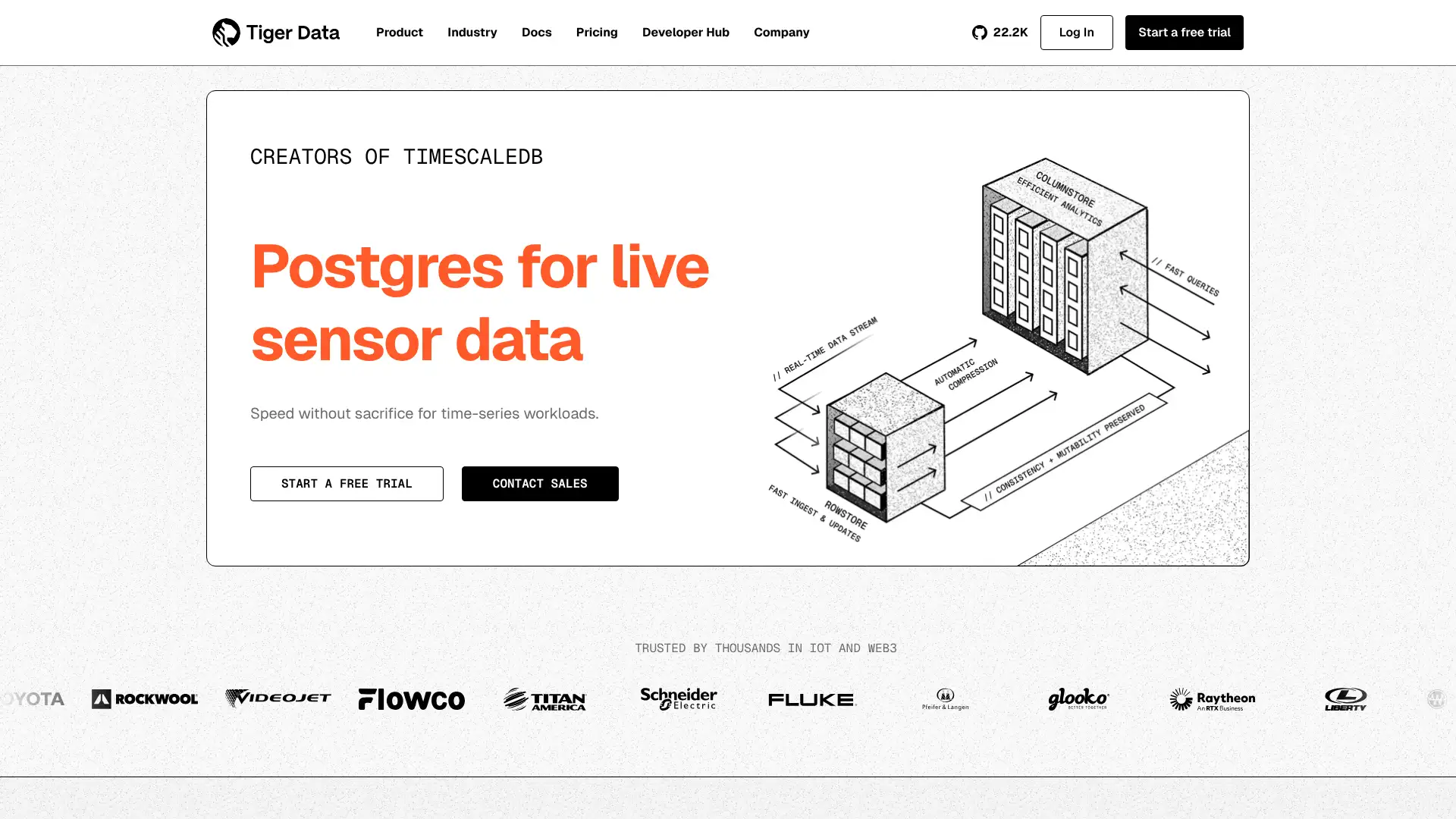
- • Hypertables: automatic time-based partitioning for efficient time-series insert and query performance
- • Continuous aggregates: precomputed rollups that refresh automatically in real time
- • Data retention policies: automatic expiry and compression of older time-series data
- • pgvectorscale: vector similarity search optimised for high-cardinality AI embedding workloads
- • Full SQL compatibility: use standard Postgres tools, ORMs, and extensions alongside time-series features
The definitive choice for teams storing IoT sensor data, application metrics, financial tick data, or any time-indexed workload on Postgres. The open-source extension is free and production-ready for single-node deployments. If you need Postgres and time-series in the same database, TimescaleDB is the answer.
CockroachDB
CockroachDB is a distributed SQL database inspired by Google Spanner, supporting the Postgres wire protocol and most Postgres SQL syntax. It provides automatic horizontal sharding, multi-region ACID transactions, and automatic failover with no data loss. Pricing is usage-based on the serverless tier; dedicated clusters require contacting sales. Buyers with competitive evaluations against YugabyteDB typically achieve 15 to 25% below list pricing. Strong for financial platforms, booking systems, and global SaaS.
- • Automatic horizontal sharding with no application code changes required
- • Multi-region ACID transactions: strong consistency across geographically distributed nodes
- • Geo-partitioning for data residency: pin specific rows to specific regions for GDPR compliance
- • PostgreSQL wire protocol compatible; psql, standard ORMs, and tools work without modification
- • Survive any single availability zone or entire region failure with zero data loss
The right database for organizations building financial platforms, global booking systems, or enterprise SaaS that genuinely needs multi-region active-active deployments. Do not use CockroachDB for single-region applications; the operational complexity is not justified. When you reach this scale, present YugabyteDB as a competitive alternative to negotiate better pricing.
YugabyteDB
YugabyteDB is a fully open-source (Apache 2.0) distributed SQL database that reuses PostgreSQL's query layer code rather than reimplementing it from scratch. This gives it a PostgreSQL compatibility score of 85.08% vs CockroachDB's 53.66% per independent benchmarks. The free tier provides 2 vCPU, 4 GB RAM, and 10 GB storage. YugabyteDB Managed is the cloud service. Supports Postgres, Cassandra, and Redis APIs in a single system. Strong migration path from Oracle via YugabyteDB Voyager.
- • Reuses PostgreSQL query layer: stored procedures, triggers, and native read-committed isolation all work
- • Multi-API support: PostgreSQL (YSQL), Cassandra-compatible (YCQL), and Redis-compatible (YEDIS)
- • YugabyteDB Voyager: live migration from Oracle, PostgreSQL, MySQL, and legacy systems
- • Fully open source under Apache 2.0; no proprietary license for enterprise features
- • Multi-region active-active with tunable consistency levels and data residency controls
The better distributed SQL choice for teams migrating from PostgreSQL or Oracle who need the highest compatibility with existing SQL patterns. The fully open-source Apache 2.0 license removes licensing risk. Use YugabyteDB's price as leverage when negotiating CockroachDB, as both vendors will sharpen commercial terms when facing head-to-head evaluation.
MongoDB Atlas
MongoDB Atlas is the managed cloud service for MongoDB, the world's most popular document database. It runs on AWS, GCP, and Azure across 100+ regions and includes Atlas Search (Lucene-powered), Atlas Vector Search for AI embeddings, and Atlas Data Lake for analytics. The free tier (M0) provides a permanent shared cluster with 512 MB storage. Paid clusters start from $9/mo for M2. MongoDB uses BSON documents with flexible schemas. Used in MEAN/MERN stacks and applications with frequently changing data structures.
- • Flexible BSON document model: nest arrays and objects without schema migrations
- • Atlas Search: Lucene full-text search fully integrated with your MongoDB data
- • Atlas Vector Search: semantic similarity search for AI embeddings stored alongside documents
- • Multi-cloud clusters: split your cluster across AWS, GCP, and Azure for resilience
- • Change Streams: real-time event stream of document changes for reactive architectures
The default choice for JavaScript-heavy stacks (MERN/MEAN) and applications with highly variable document structures. Atlas Search eliminates a common reason to add Elasticsearch. In 2026, Postgres with JSONB covers most MongoDB use cases for new SQL-comfortable teams; MongoDB remains stronger for document-first design patterns and its larger ecosystem.
Redis / Redis Cloud
Redis is an in-memory data structure store used as a cache, message broker, session store, and real-time leaderboard. Redis Ltd. offers Redis Cloud (managed) and Redis Stack (with JSON, search, time-series, and probabilistic modules). Redis changed its license from BSD to the Server Side Public License (SSPL) in 2024, prompting an open-source fork called Valkey. Redis Cloud free tier: 30 MB. Paid managed clusters from $7/mo. For serverless Redis, Upstash is the most popular alternative.
- • Sub-millisecond read/write latency for hot data: sessions, rate limiting, and caching layers
- • Pub/Sub and Streams for real-time messaging and event-driven architecture
- • Redis Stack modules: JSON documents, full-text search, time-series, and probabilistic data structures
- • Redis Cluster for automatic partitioning and horizontal scaling beyond single-node limits
- • Valkey: BSD-licensed fork maintained by the Linux Foundation as the open-source alternative post-SSPL
Redis remains the industry standard caching and pub/sub layer. For managed serverless Redis with no idle cost, Upstash is the cleaner choice for most applications. The SSPL license change creates uncertainty for self-hosted deployments; teams with licensing concerns should evaluate Valkey as the drop-in open-source alternative.
Upstash
Upstash provides serverless Redis and Kafka, accessed over HTTP with a REST API that works in edge runtimes (Cloudflare Workers, Vercel Edge Functions, Deno Deploy). There is no server to manage and you pay only for commands executed; idle databases cost nothing. The free tier is generous for experimentation. Upstash QStash provides a serverless message queue for background jobs. Upstash Vector adds a serverless vector database for AI similarity search.
- • HTTP/REST Redis API: works in edge runtimes without TCP connection overhead
- • Pay per command: no idle cost; databases cost nothing when not in use
- • Upstash Kafka: serverless Kafka with no cluster management or minimum throughput cost
- • QStash: serverless message queue for scheduling and delivering background jobs via HTTP
- • Upstash Vector: serverless vector database for AI embedding similarity search
The best serverless Redis for applications built on edge runtimes or serverless functions where TCP connections are restricted. The zero-idle-cost model makes it ideal for dev and staging environments. For high-frequency, low-latency production caching, Redis Cloud with a TCP connection remains faster.
Neo4j
Neo4j is the world's leading graph database, storing data as nodes and relationships rather than tables or documents. It uses the Cypher query language, which reads naturally for relationship traversal queries that would require complex multi-join SQL. Neo4j AuraDB is the managed cloud service; the Community edition is free and open source. Used heavily for fraud detection, recommendation engines, social networks, and knowledge graphs powering AI applications. AuraDB Free provides a permanent hosted graph database.
- • Native graph storage: relationships are first-class citizens stored with constant-time traversal
- • Cypher query language: pattern matching that reads like drawing what you want to find
- • Graph Data Science library: 65+ algorithms including PageRank, community detection, and path finding
- • Vector search via Neo4j Vector Index for AI embedding similarity alongside graph traversal
- • Bloom visualization tool for exploring graph data without writing queries
The definitive choice when your data model is fundamentally relational in a graph sense: fraud detection networks, recommendation systems, knowledge graphs, and social networks. If you are adding graph features to a primarily relational application, evaluate Apache AGE for Postgres before adopting a separate graph database.
Dgraph
Dgraph is an open-source distributed graph database with native GraphQL support. You define your schema in GraphQL SDL and Dgraph automatically generates a CRUD API, custom queries, and mutations. It is written in Go and uses a custom storage engine. Slash GraphQL (now Dgraph Cloud) is the managed service. Dgraph is open source under the Apache 2.0 license. Best suited for applications that expose a GraphQL API over graph data.
- • GraphQL-native: define your schema in GraphQL SDL and get a full CRUD API automatically
- • DQL (Dgraph Query Language) for complex graph traversal beyond standard GraphQL
- • Distributed by design: horizontal sharding of graph data across nodes
- • Full-text search and geo-spatial queries built into the graph engine
- • Open source Apache 2.0: self-hostable on Kubernetes or Docker
The best choice for GraphQL-native teams who need graph data with an automatically generated API. The schema-to-API workflow significantly speeds up development. For production graph analytics and fraud detection at enterprise scale, Neo4j's richer tooling ecosystem and stronger community support are more reliable.
SurrealDB
SurrealDB is a multi-model NewSQL database combining document, relational, and graph capabilities in a single storage engine, accessed via SurrealQL. It supports real-time queries, runs embedded (single binary), in cloud, or on-premise, and separates compute and storage. Suitable for serverless applications, single-page apps, and jamstack. SurrealDB Cloud is the managed service; the open-source version is licensed under the Business Source License (BSL). Launched in 2022 and growing in community traction.
- • Multi-model: store documents, use relational JOINs, and traverse graph edges in one query
- • SurrealQL: SQL-like syntax extended with graph traversal and document nesting
- • Real-time live queries: LIVE SELECT subscribes to changes matching a query filter
- • Permissions at the record level: enforce access control in the database layer
- • Separates compute and storage; scale-to-zero and stateless deployment supported
An ambitious and technically impressive multi-model database. Worth experimenting with for new projects where you want to avoid separate graph, document, and relational databases. Not yet recommended as a primary database for production workloads that require mature ecosystem support and proven operational reliability.
Turso
Turso takes SQLite global using libSQL, an open-source Rust fork of SQLite. It distributes your database to edge locations worldwide for read-heavy applications where data needs to be close to the user. The free tier includes 5 GB storage, 100 databases, and 500 million row reads/month. Turso added concurrent writes in 2025, partially addressing SQLite's historical single-writer limitation. Perfect for read-heavy apps, mobile sync, edge computing, and per-tenant databases at scale (one database per user/organization).
- • libSQL: open-source Rust SQLite fork with remote access, replication, and concurrent writes
- • Edge replicas: deploy read replicas to 30+ edge locations for sub-10ms reads globally
- • Database-per-tenant architecture: thousands of isolated SQLite databases at no extra per-database cost
- • Embedded SQLite sync: sync a local SQLite file with a remote Turso database for offline-first apps
- • Scales to thousands of databases on the free tier; ideal for multi-tenant SaaS architectures
The go-to database for read-heavy edge applications and multi-tenant SaaS architectures where one database per tenant eliminates cross-tenant query complexity. The database-per-tenant model on the free tier is a genuine unlock for multi-tenant product design. Not a replacement for Postgres on write-heavy or complex relational workloads.
Xata
Xata combines PostgreSQL with OpenSearch in a single managed service, providing full-text search, vector embeddings, and database branching without managing separate infrastructure. The CEO Monica Sarbu previously led engineering at Elastic. No free tier; a 14-day trial with $100 credit is available. Xata targets applications where search is central to the user experience: marketplaces, directories, and content platforms that would otherwise need to sync data between Postgres and Elasticsearch.
- • Postgres plus OpenSearch in one managed service: full-text search without a separate Elasticsearch cluster
- • Database branching: create isolated database branches for development and preview environments
- • Built-in vector search for AI embeddings stored alongside relational data
- • Spreadsheet-like UI for non-technical team members to manage data without SQL
- • Standard Postgres wire protocol: psql, Prisma, Drizzle, and standard ORMs all connect
Worth evaluating for applications where search is a core feature (not an afterthought) and you want to avoid maintaining a separate search cluster. If your search needs are basic, pg_tsvector in standard Postgres is cheaper. If your search is complex with faceting and relevance tuning, Elasticsearch managed separately may offer more control.
Railway
Railway is an application deployment platform that treats databases as services alongside your apps. Add a Postgres, MySQL, Redis, or MongoDB service to your project and it provisions alongside your application with shared networking. Pricing is usage-based with a $5/mo free credit. The Hobby plan costs $5/mo and includes $5 of usage credits. Railway's visual canvas for connecting services makes it intuitive for full-stack deployments. Often compared to Heroku's original developer experience but cheaper and faster.
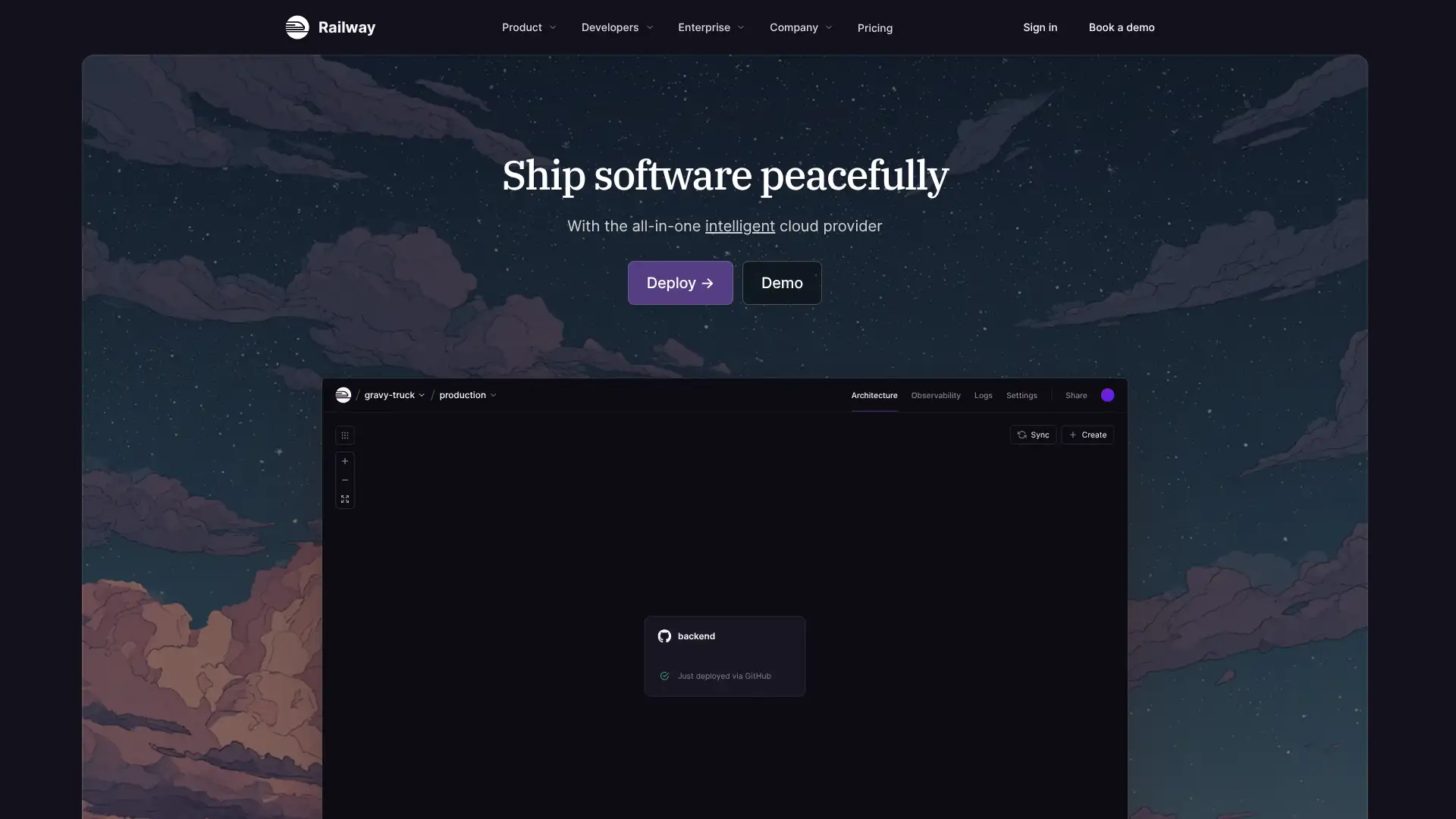
- • Visual canvas: connect app services, databases, and workers with drag-and-drop topology
- • Deploy Postgres, MySQL, Redis, and MongoDB as first-class services alongside your app
- • GitHub deploy: push to main and Railway auto-deploys your application
- • Usage-based pricing: pay for actual RAM, CPU, and network consumed
- • Private networking: services within a project communicate over internal network without public exposure
The best developer experience for deploying a full-stack application with a database in one place. Railway recreates the simplicity of early Heroku with lower prices and better tooling. When you need specialist database features like branching, connection pooling, or compliance controls, migrate to a dedicated database service.
Tembo
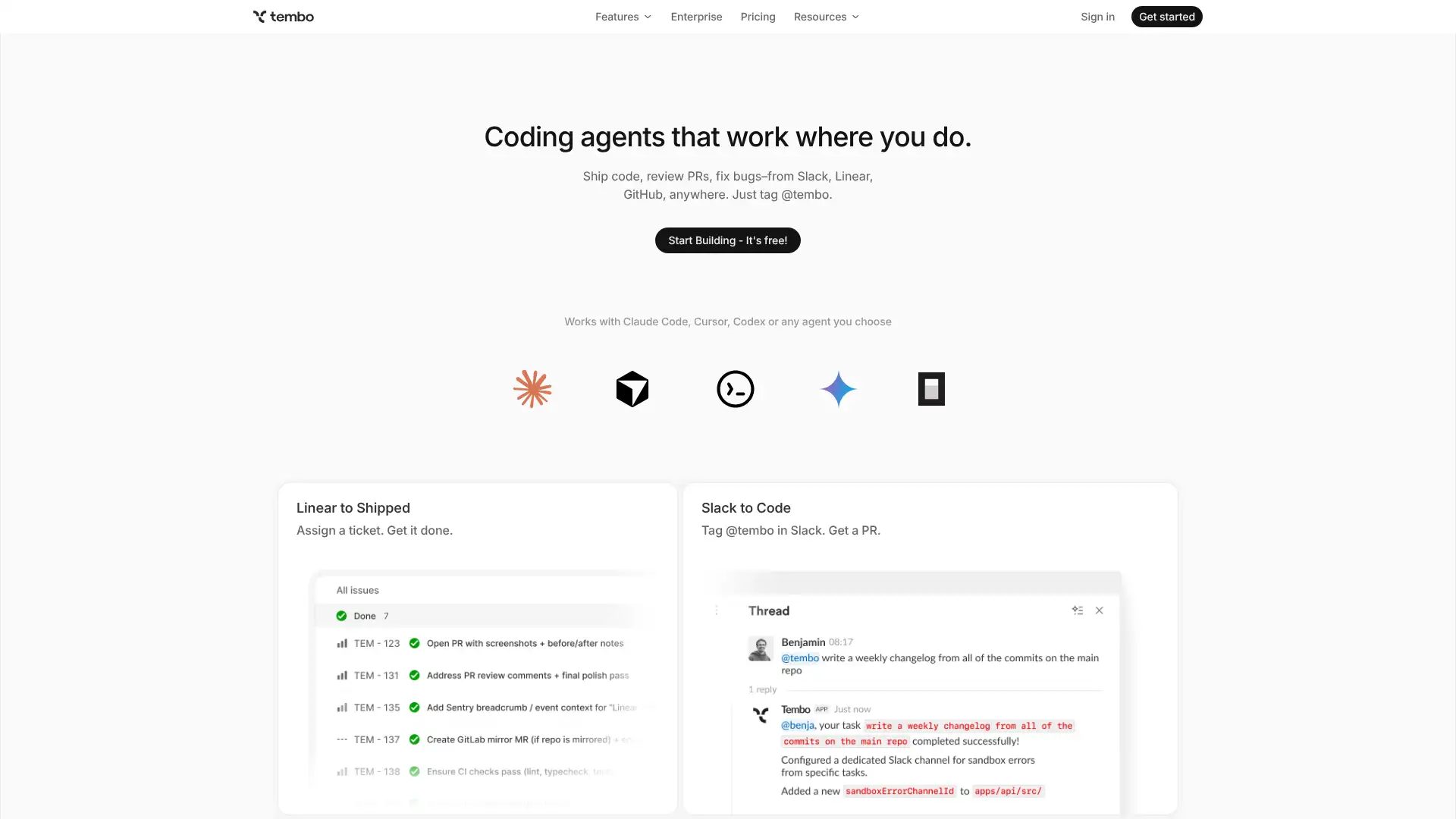
Tembo pre-configures Postgres with extension stacks optimized for specific workloads: an AI stack (pgvector, pg_analytics), a message queue stack (pg_partman, pgmq), a time-series stack (TimescaleDB), a search stack, and a OLAP stack. Instead of manually installing and tuning extensions, Tembo provides a ready-to-use Postgres instance for each workload. Self-hostable via the open-source Tembo Operator on Kubernetes. Cloud plans available with a free tier.
- • Pre-configured workload stacks: AI, OLAP, message queue, time-series, search, and more
- • pgvector and pg_analytics pre-installed and tuned for the AI stack
- • Postgres Message Queue (pgmq): replace external message queues with Postgres-native queuing
- • Self-hostable via the open-source Tembo Operator for Kubernetes; own your deployment
- • Standard Postgres wire protocol; all existing Postgres tooling works without modification
A compelling choice for Postgres power users who want workload-optimized extension stacks without manual configuration. The pgmq message queue extension alone can replace a Redis or Kafka service for many applications. The self-hostable Kubernetes operator is a genuine differentiator for compliance-sensitive organizations.
Crunchy Data
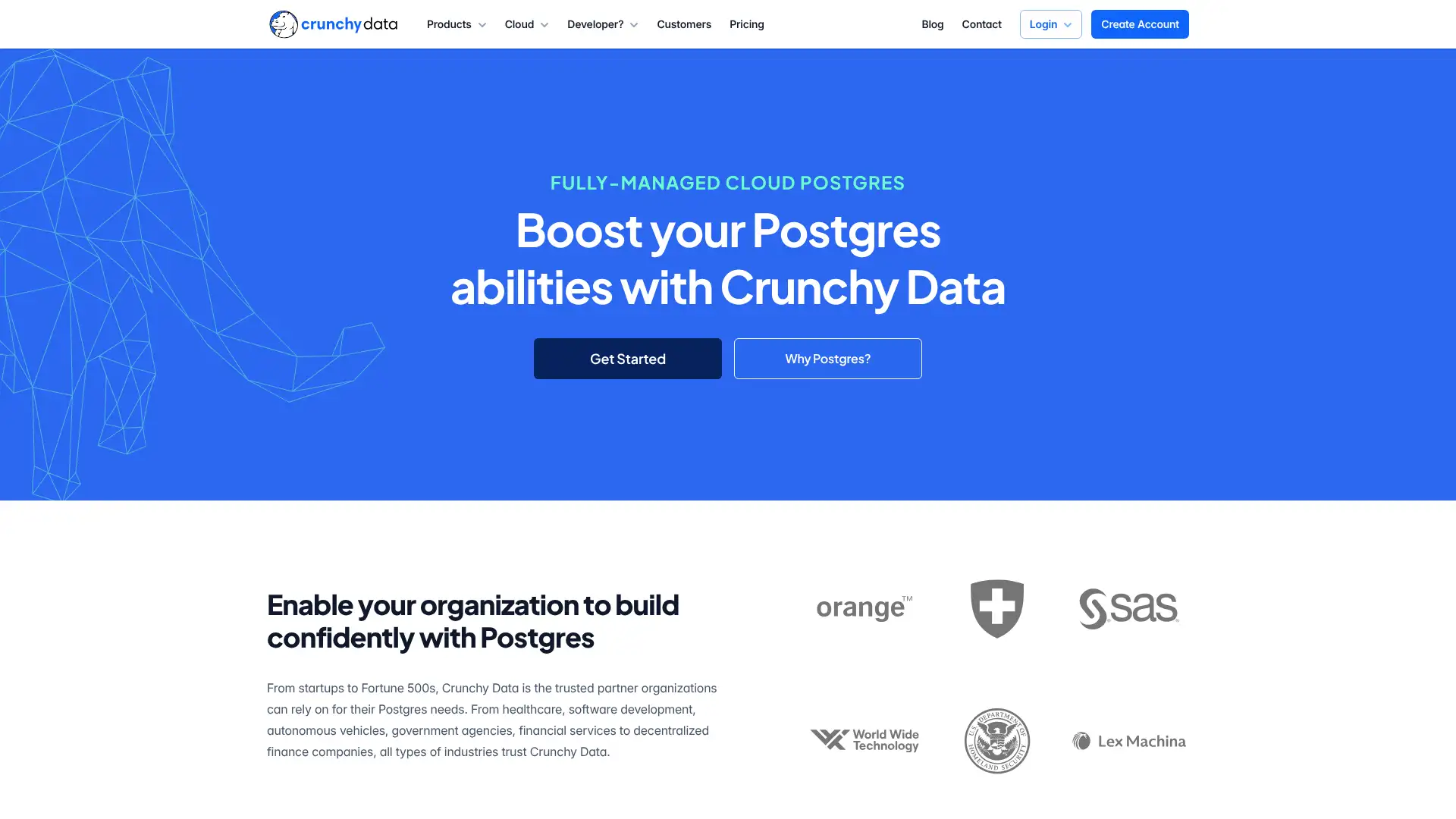
Crunchy Data specializes in enterprise and government PostgreSQL deployments with an emphasis on security, compliance (FedRAMP, HIPAA, DISA STIG, DoD), and support. Crunchy Bridge is the managed cloud Postgres service. Crunchy Postgres for Kubernetes is the open-source operator. The team contributes heavily to PostgreSQL core development and the PostgreSQL extension ecosystem. Crunchy Data is the enterprise alternative for organizations that cannot use consumer-grade managed Postgres platforms.
- • FedRAMP, HIPAA, DISA STIG, and DoD compliance certifications for government workloads
- • Active contributors to PostgreSQL core development and the extension ecosystem
- • Crunchy Postgres Operator: mature Kubernetes-native Postgres operator with HA and backup
- • Enterprise support with guaranteed SLAs and dedicated database engineers
- • Crunchy Bridge: managed Postgres on AWS and Azure with dedicated compute (not shared)
The top choice for US government agencies, defense contractors, and highly regulated enterprises that need FedRAMP-authorized or HIPAA-compliant managed Postgres with genuine enterprise support. Commercial companies with standard compliance needs are better served by Aiven, Supabase Enterprise, or Percona at significantly lower cost.
Percona
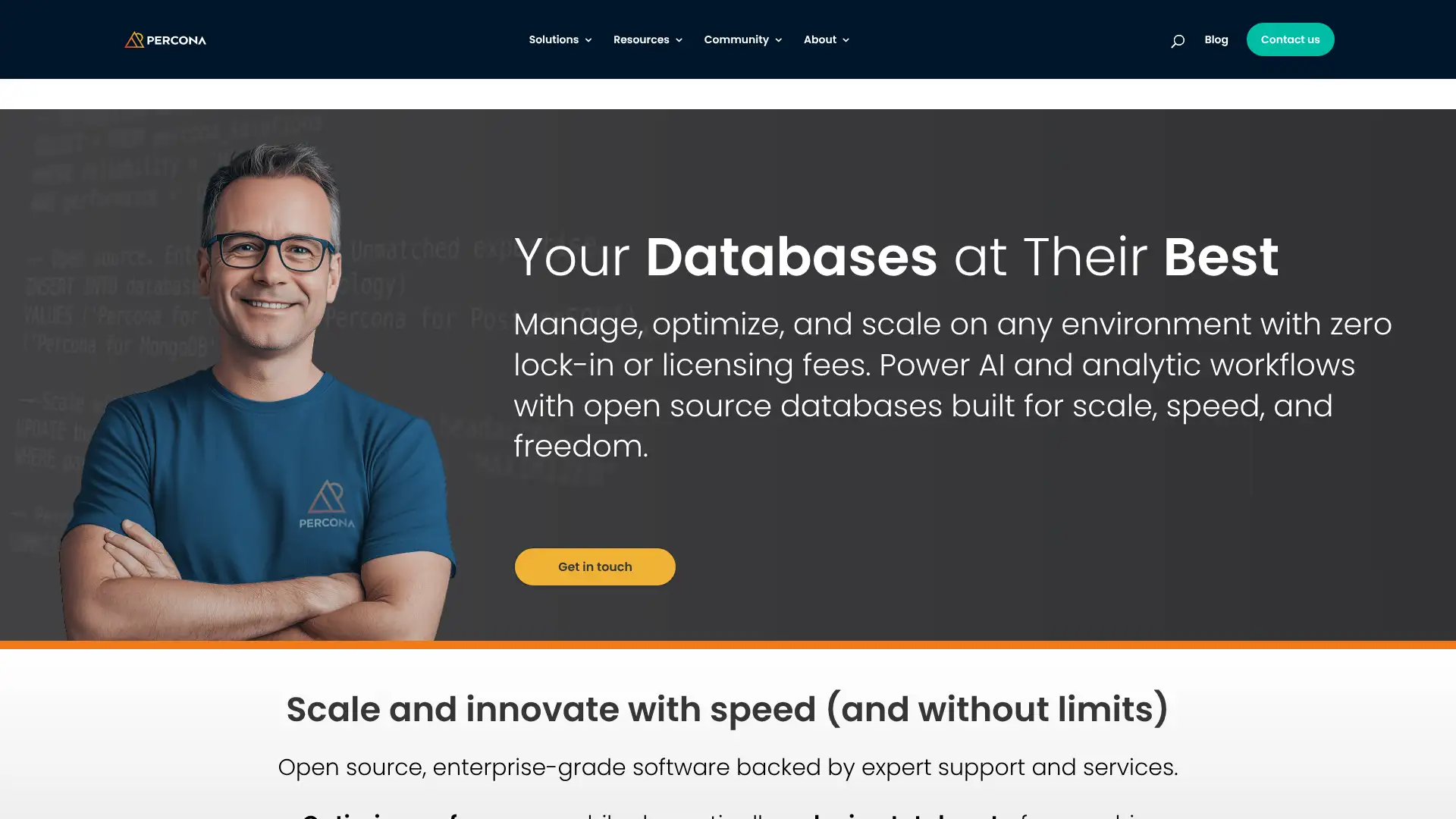
Percona is the leading open-source database support and services company, providing enterprise-grade distributions, tools, and managed services for MySQL (Percona Server), PostgreSQL (Percona Distribution for PostgreSQL), and MongoDB (Percona Server for MongoDB). Percona XtraBackup is the standard MySQL hot backup tool. Percona Monitoring and Management (PMM) is a free open-source database monitoring tool. Percona Everest is a Kubernetes-native managed database platform. Commercial support contracts available from Percona.
- • Percona Server for MySQL: enhanced MySQL with query response time plugin and XtraDB storage engine
- • XtraBackup: industry-standard hot backup for MySQL without table locks
- • Percona Monitoring and Management (PMM): free open-source database performance monitoring
- • Percona Everest: Kubernetes-native database platform for self-managed PostgreSQL, MySQL, and MongoDB
- • Enterprise support contracts with 24/7 database engineer access and SLA commitments
The definitive tooling vendor for teams self-hosting MySQL, Postgres, or MongoDB who need enterprise-grade backup tools, monitoring, and support. PMM is free and should be running on any production MySQL or Postgres database. Percona Server is the preferred MySQL alternative for teams concerned about Oracle dependency.
MariaDB
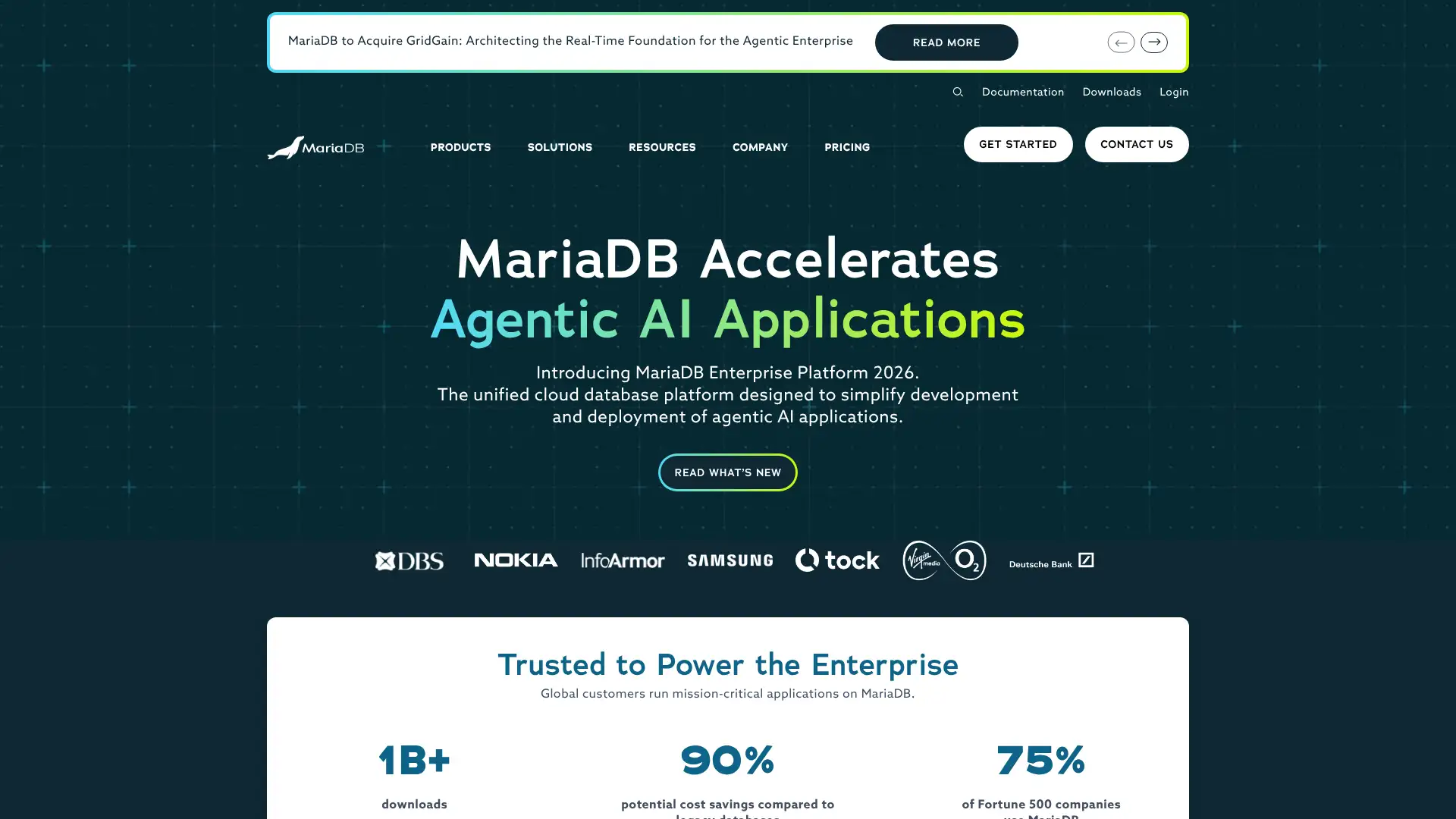
MariaDB is a community-developed MySQL-compatible relational database, created in 2009 by the original MySQL founders after Oracle acquired MySQL. It remains drop-in compatible with MySQL while adding storage engines (Aria, ColumnStore, Spider), temporal data tables, and features Oracle has not backported to MySQL. MariaDB Foundation maintains the open-source project under GPL. MariaDB SkySQL is the managed cloud service. Used by Wikipedia, WordPress, and many large-scale web applications.
- • Drop-in MySQL compatible: most MySQL applications run on MariaDB without modification
- • Aria storage engine: crash-safe alternative to MyISAM for internal tables
- • ColumnStore: columnar storage for analytics queries on large datasets
- • Temporal tables: track historical data changes with built-in versioning
- • Community governance: no single corporate owner; foundation model reduces vendor risk
MariaDB remains a solid MySQL-compatible option for PHP/WordPress ecosystems and teams that specifically need MySQL without Oracle dependency. The 2023 bankruptcy and K1 acquisition create organizational uncertainty. For new relational database projects in 2026, Postgres is the stronger long-term choice.
MySQL
MySQL is the world's most popular open-source relational database, maintained by Oracle since the Sun Microsystems acquisition. It powers WordPress, Drupal, and the LAMP/LEMP stack. Available as Community Edition (GPL) for free. MySQL HeatWave is Oracle's managed MySQL cloud service with ML capabilities. MySQL Cluster provides distributed in-memory storage. Despite Postgres's growth in new development, MySQL remains dominant in deployed production systems, particularly in the CMS and PHP ecosystem.
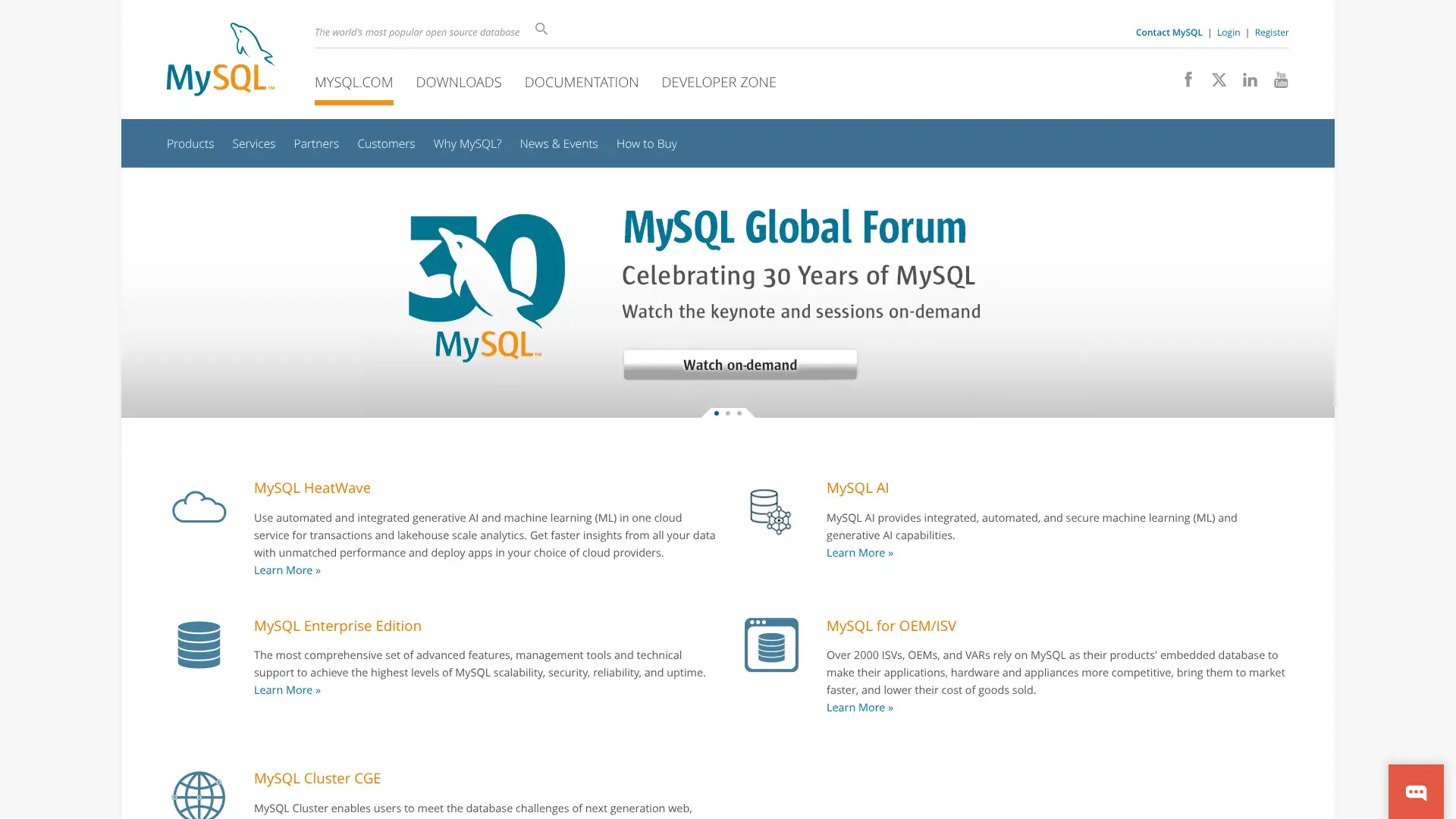
- • Most widely deployed RDBMS in the world; powers WordPress, Drupal, and LAMP stack applications
- • InnoDB storage engine with ACID transactions, foreign keys, and crash recovery
- • MySQL Replication: primary-replica setup for read scaling and high availability
- • MySQL HeatWave: in-database machine learning on Oracle Cloud
- • Widest hosting provider support: available on almost every shared and managed host
MySQL remains the database of the PHP and WordPress ecosystem and will be in production for decades. For new application development in 2026, Postgres is the recommended choice. For existing MySQL applications, PlanetScale handles scaling, and Percona handles operations. Oracle's ownership remains a long-term consideration for enterprise buyers.
DBeaver
DBeaver Community is a free, open-source, cross-platform database GUI supporting 80+ database engines via JDBC drivers: MySQL, Postgres, MariaDB, SQLite, Oracle, SQL Server, DB2, and more. The Enterprise edition adds NoSQL support (MongoDB, Cassandra, Redis) and cloud database connections. Built on the Eclipse platform in Java. DBeaver is the most popular free database management tool among developers. Community Edition is free; Lite is $99/yr; Enterprise is $250/yr.
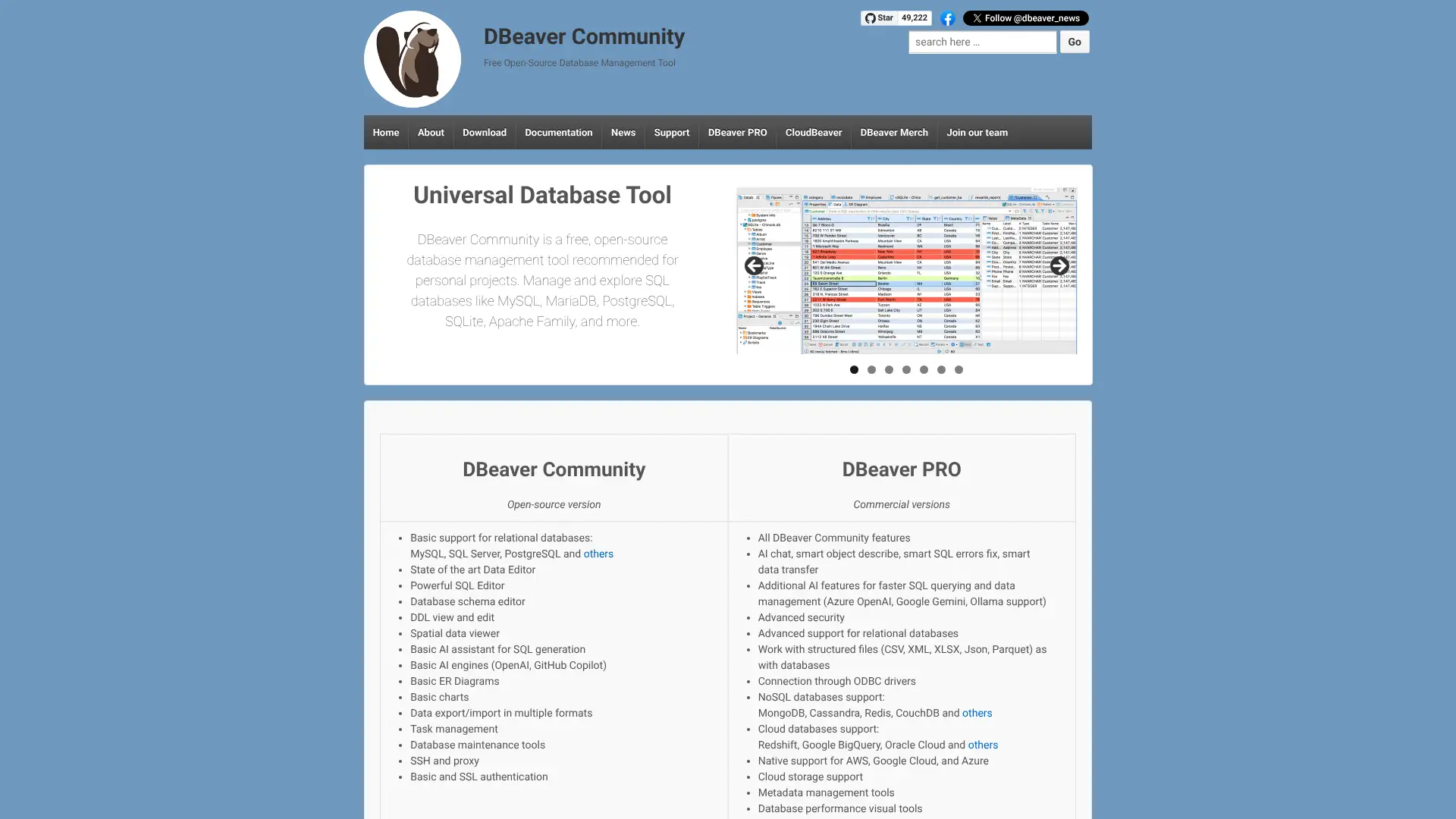
- • 80+ databases via JDBC: universal tool for all SQL databases in one consistent interface
- • SQL editor with autocomplete, syntax highlighting, explain plan, and visual query builder
- • ER diagram visualization: auto-generate entity-relationship diagrams from existing schemas
- • Data import/export: CSV, Excel, JSON, SQL dump, and more across databases
- • Cross-platform: Windows, macOS, and Linux on the Eclipse framework
The best free database GUI for developers who work with multiple database types and need a single tool that covers everything. The Eclipse/Java overhead is noticeable but the breadth of database support and zero cost make DBeaver the default recommendation for budget-conscious developers. Upgrade to TablePlus or DataGrip for better performance and UI.
TablePlus
TablePlus is a native database GUI for macOS, Windows, and Linux (Linux support ongoing). It offers a clean, minimal interface focused on speed and simplicity, prioritizing the most common tasks: query, view data, and edit rows. Supports Postgres, MySQL, MariaDB, SQLite, SQL Server, Oracle, Redis, and more. No free tier; starts at $99 for a one-time license. Popular among macOS developers who find DBeaver too heavy and DataGrip too expensive.
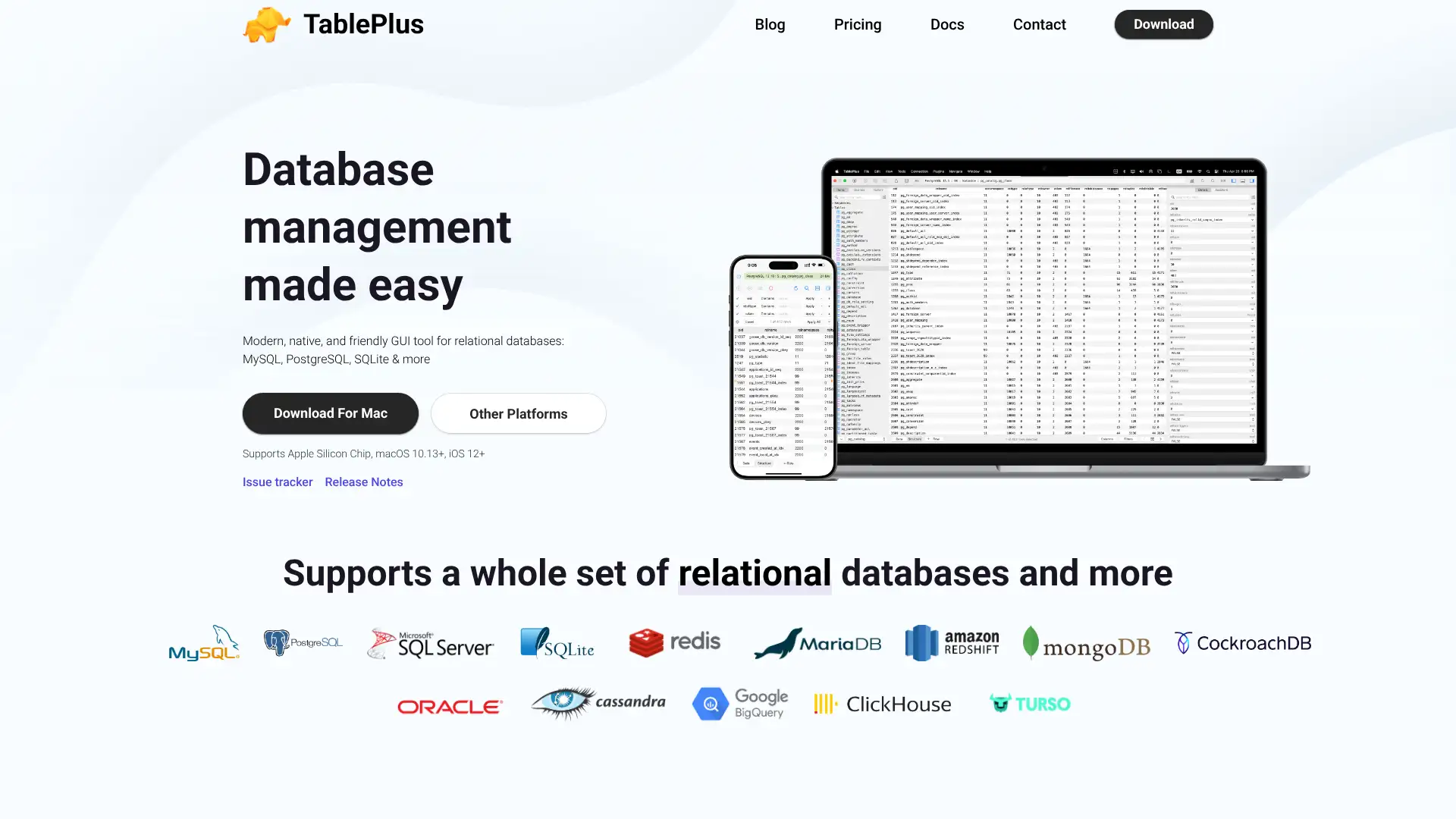
- • Native macOS application: fast startup, low RAM, and system font rendering quality
- • Spreadsheet-style data view: inline editing, filtering, and sort without writing SQL
- • Syntax highlighting and autocomplete in the SQL editor
- • Multiple tab system: work across many databases and queries simultaneously
- • One-time license: no subscription required for the base $99 tier
The best-designed database GUI on the market. If you are a macOS developer who wants a fast, beautiful tool for everyday database work without paying an annual subscription, TablePlus at $99 one-time is excellent value. Not suitable for teams needing advanced admin tooling or developers who primarily need IDE-grade SQL editing.
Adminer
Adminer is a single PHP file (~470 KB) that you drop into your web server to get a full database management interface. It replaced phpMyAdmin as the more lightweight and versatile alternative, supporting MySQL, Postgres, SQLite, SQL Server, Oracle, and MongoDB from one file. No installation required beyond copying the file. Completely free under Apache 2.0. Available as official Docker images. Popular for quick dev environment database access.
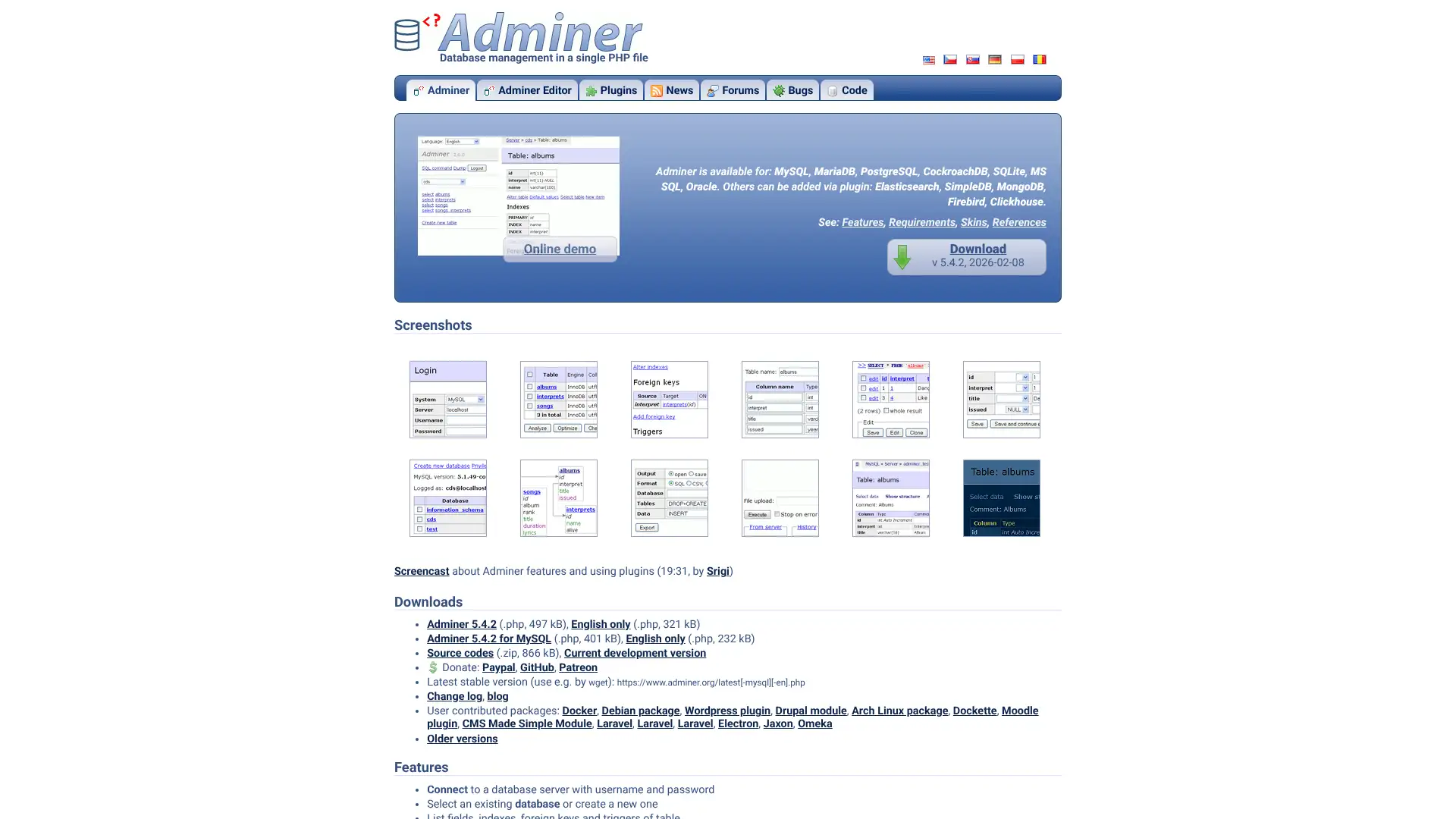
- • Single PHP file (~470 KB): drop into any PHP-capable web server for instant database access
- • Supports MySQL, Postgres, SQLite, SQL Server, Oracle, and MongoDB from one file
- • SQL query editor, table browsing, data editing, and schema management all included
- • Plugins system for extending functionality including themes, authentication, and custom designs
- • Works on any shared hosting with PHP support; no composer or dependencies required
The most practical tool for quick database access in development or staging environments when you need something that works immediately with no installation. The single-file deployment in Docker-compose is a common dev environment pattern. Never expose Adminer to the public internet without authentication and IP restrictions.
phpMyAdmin
phpMyAdmin is the most widely deployed web-based MySQL management interface, in production since 1998. It is pre-installed on most shared hosting control panels (cPanel, Plesk) and is the standard tool for WordPress database management on shared hosts. Written in PHP, completely free under GPL 2. Supports MySQL and MariaDB. Despite its age and dated UI, phpMyAdmin remains the most universally available database GUI in the world.
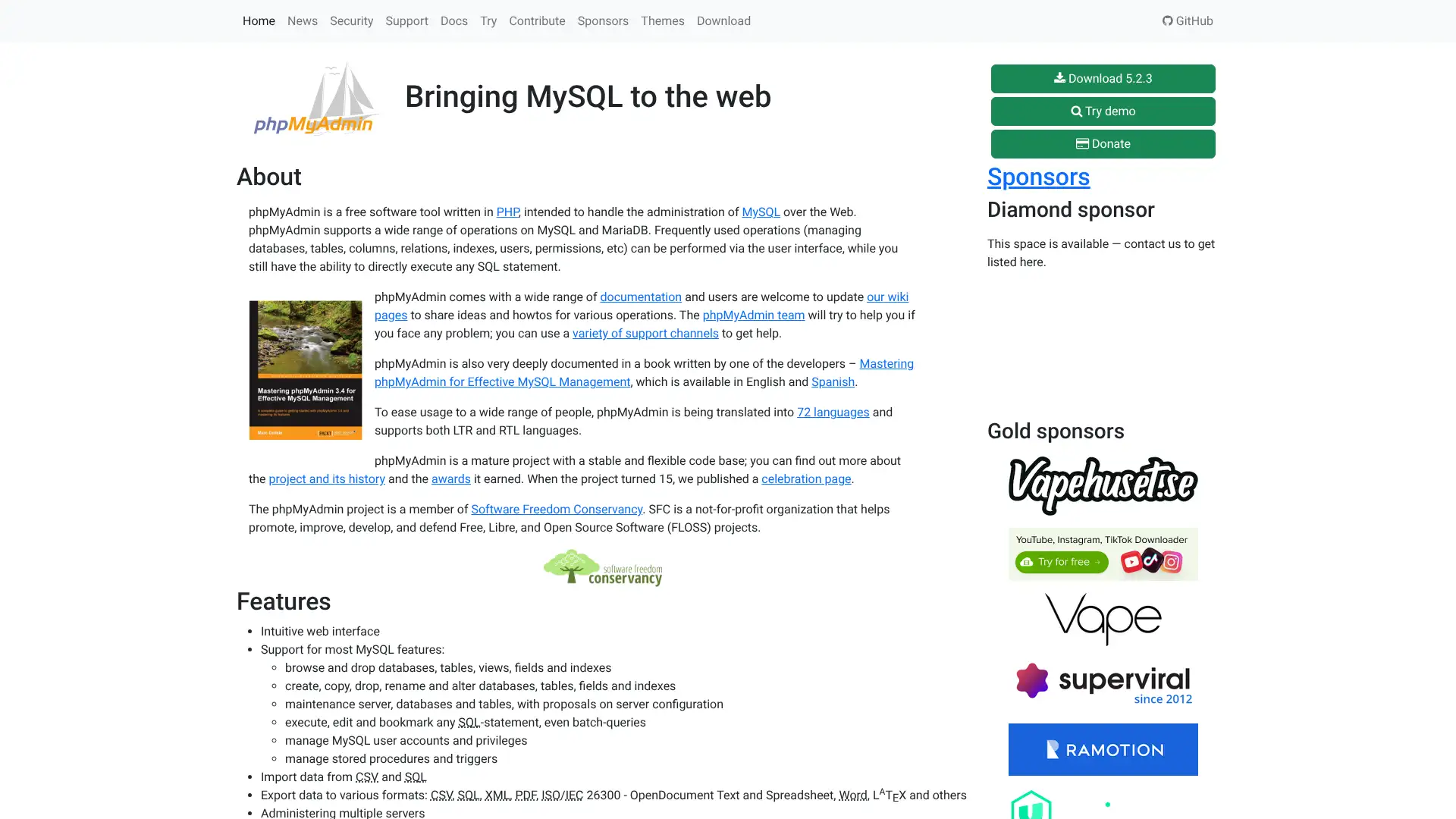
- • Pre-installed on virtually all shared web hosting (cPanel, Plesk, DirectAdmin)
- • Complete MySQL management: tables, queries, indexes, users, and privileges
- • SQL editor with query history and basic syntax highlighting
- • Import/export: mysqldump SQL, CSV, Excel, XML, and more
- • Available as official Docker image for development environment deployment
The default database GUI for WordPress and shared hosting because it is already installed on your host. For active development, switch to DBeaver (free desktop) or Adminer (lightweight web interface). phpMyAdmin's primary value in 2026 is its pre-installation on shared hosting; it is not the tool you should choose if given a choice.
pgAdmin 4
pgAdmin 4 is the official open-source administration and development platform for PostgreSQL, built in Python and JavaScript. It can run as a desktop application or a web application shared with a team. It provides comprehensive PostgreSQL-specific tooling: schema browser with property editors for all object types, grant wizard for permissions management, visual EXPLAIN plan visualizer, backup and restore workflows, and schema diff tools. Completely free and actively maintained in step with Postgres releases.
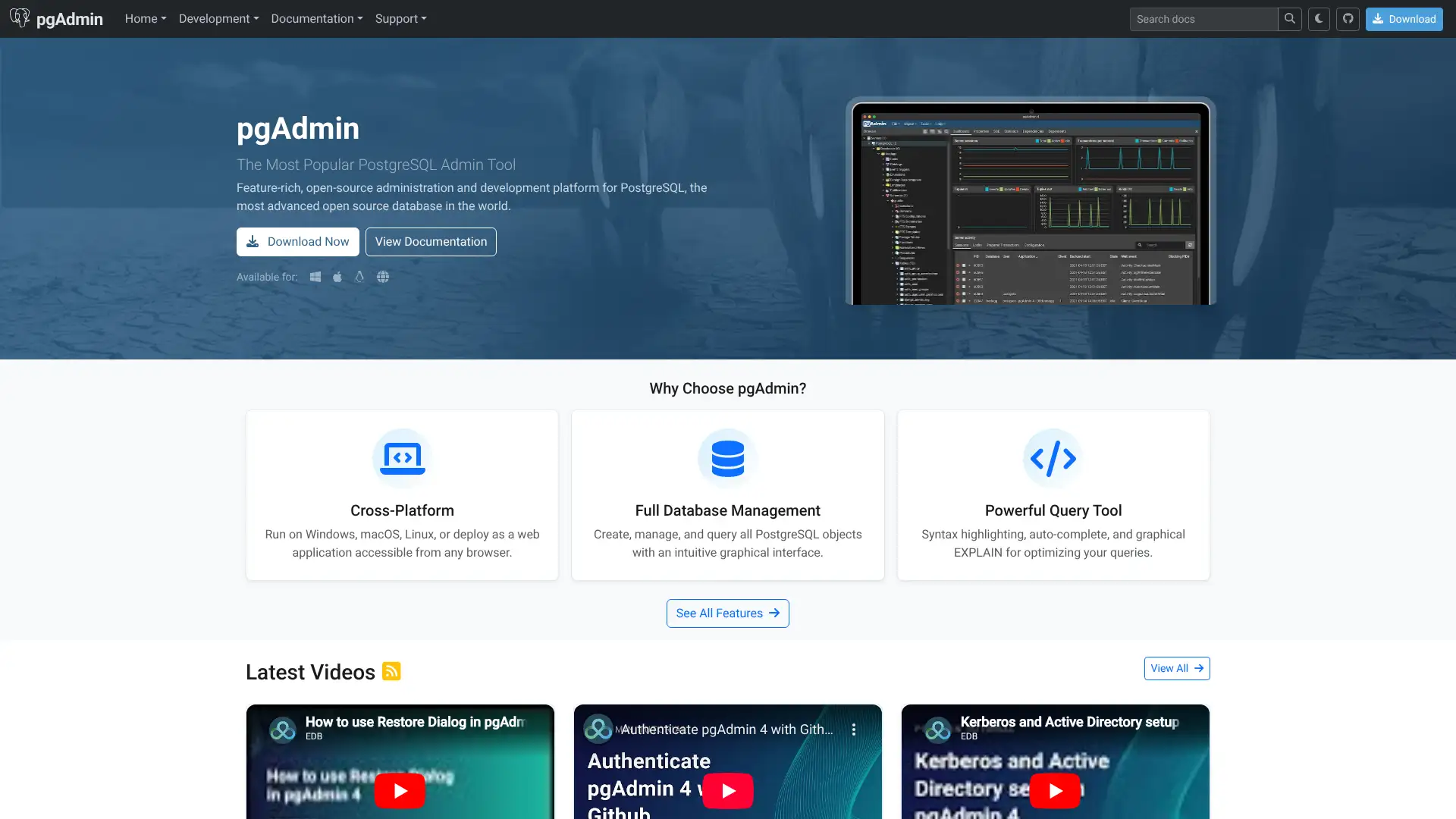
- • Comprehensive Postgres schema browser: tables, views, functions, triggers, roles, and extensions
- • Visual EXPLAIN plan: tree view of query execution plans with cost annotations
- • Grant wizard: manage complex permission trees without writing GRANT statements
- • Schema diff: compare two databases or schemas and generate ALTER scripts
- • pgAgent: built-in job scheduler for recurring maintenance tasks
The best free Postgres administration tool for DBAs who need deep PostgreSQL-specific operations: role management, backup workflows, schema diff, and EXPLAIN visualization. For developers who primarily write queries, DBeaver or TablePlus provide a better daily-use experience. pgAdmin and a second lighter tool (Beekeeper Studio or TablePlus) is the common two-tool setup for Postgres teams.
DbGate
DbGate is a free, open-source database manager that offers both a web interface and a desktop application from the same codebase. It supports Postgres, MySQL, SQL Server, SQLite, MongoDB, Redis, and more. The web interface makes it ideal for self-hosting as a shared team database tool accessible from any browser. A paid Premium edition adds advanced features. Available as Docker image for web deployment and as desktop apps for Windows, macOS, and Linux.
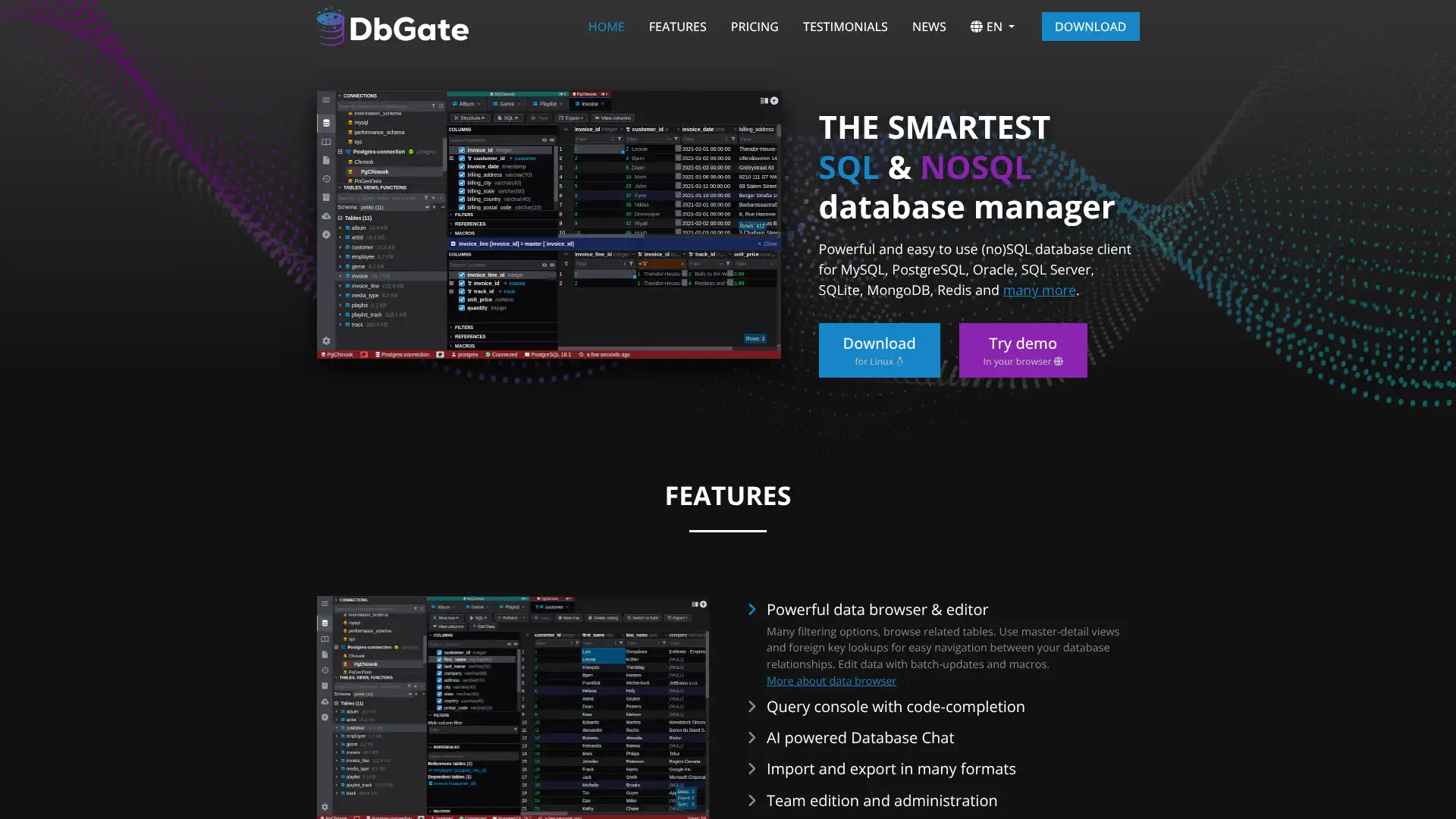
- • Dual deployment: same codebase runs as a desktop app or self-hosted web application
- • Supports Postgres, MySQL, MariaDB, SQL Server, SQLite, MongoDB, and Redis
- • SQL editor with autocomplete, syntax highlighting, and query history
- • Table data editing, import/export, and schema management in the browser
- • Open source under MIT/Apache; Docker image available for self-hosted team deployments
The best free option when you want to self-host a shared web database GUI for your team. The Docker deployment is straightforward and gives everyone browser-based database access without installing anything. For Postgres administration depth, pgAdmin still wins; for multi-database team access via the web, DbGate is the cleanest free solution.