40 Best Cryptocurrency Exchanges and Trading Platforms in 2026
Cryptocurrency exchanges range from regulated fiat-to-crypto on-ramps for beginners to high-throughput derivatives platforms and fully decentralized AMMs running on-chain. This directory covers centralized exchanges (CEXs), decentralized exchanges (DEXs), DEX aggregators, and hybrid platforms. Fees and features are verified as of March 2026.
Binance
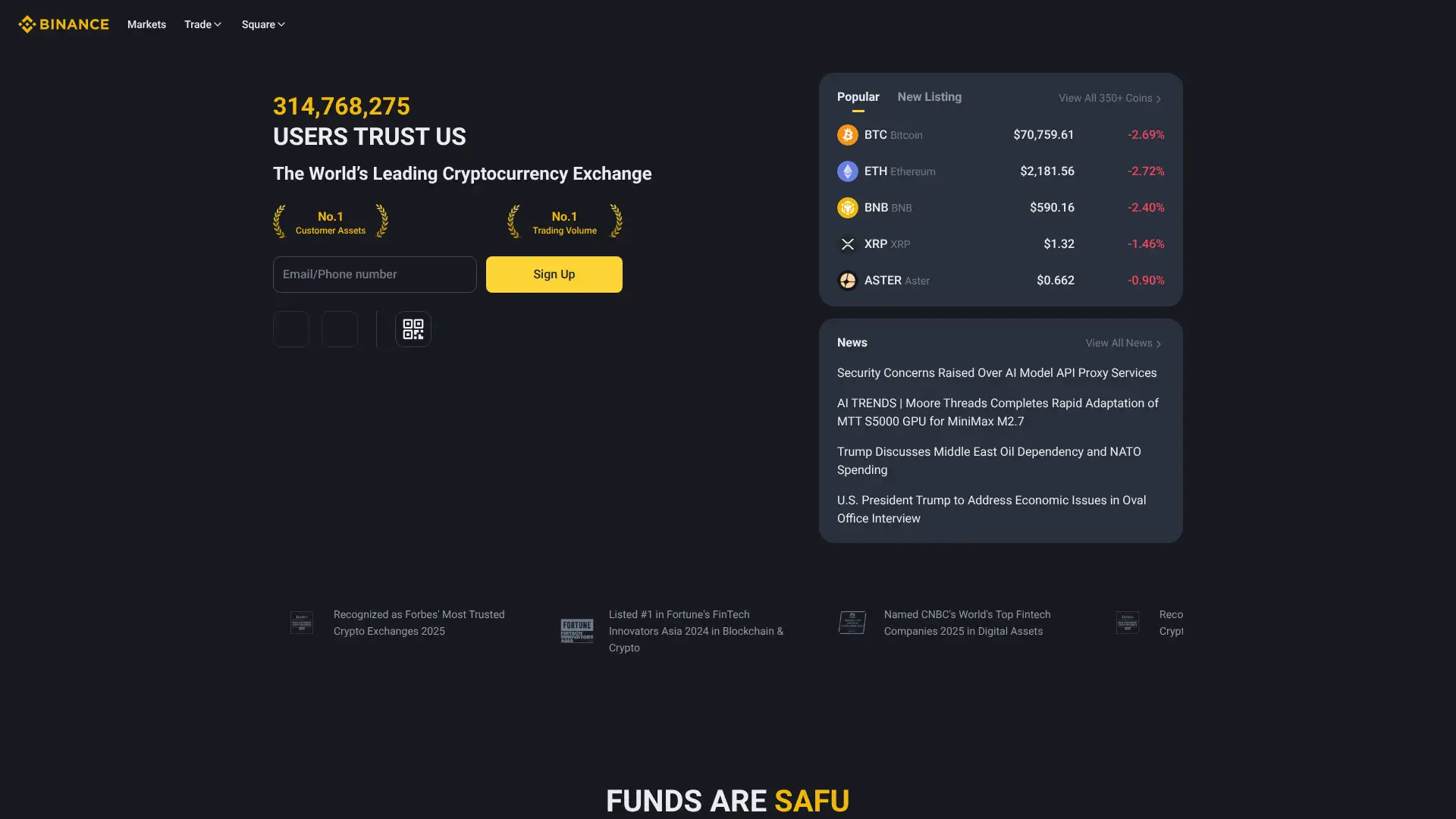
Binance is the world's largest crypto exchange by trading volume, serving over 297 million users as of late 2025. It offers spot trading, futures, margin, staking, a Web3 wallet, and an NFT marketplace in one ecosystem. Spot trading fees start at 0.10% maker and 0.10% taker, with a 25% discount available when paying with BNB. Futures fees start at 0.02% maker and 0.05% taker. Binance is restricted for US residents, who must use the separate Binance.US platform, which offers 0% maker and 0.01% taker fees.
- • Spot trading: 500+ trading pairs across crypto-to-crypto and fiat markets with some of the tightest spreads in the industry
- • BNB fee discount: holding BNB in your account activates a flat 25% fee reduction, saving $25 per $100,000 in monthly spot volume at standard rates
- • Futures and perpetuals: up to 125x leverage on BTC/USDT perpetuals with maker fees as low as 0.00825% at top VIP tiers
- • Binance Earn: staking, flexible savings, and auto-invest products supporting BTC, ETH, BNB, and 100+ assets
- • BNB Chain ecosystem: native Layer-1 blockchain with DeFi and dApp integrations accessible directly from a Binance account
Binance remains the default choice for international active traders who want the widest selection of pairs, deepest liquidity, and lowest blended fees when paying with BNB. US residents must use Binance.US or switch entirely to Coinbase or Kraken. Traders prioritizing regulatory clarity in Europe or the UK may find OKX or Kraken a better fit given Binance's ongoing compliance rebuilding.
Coinbase
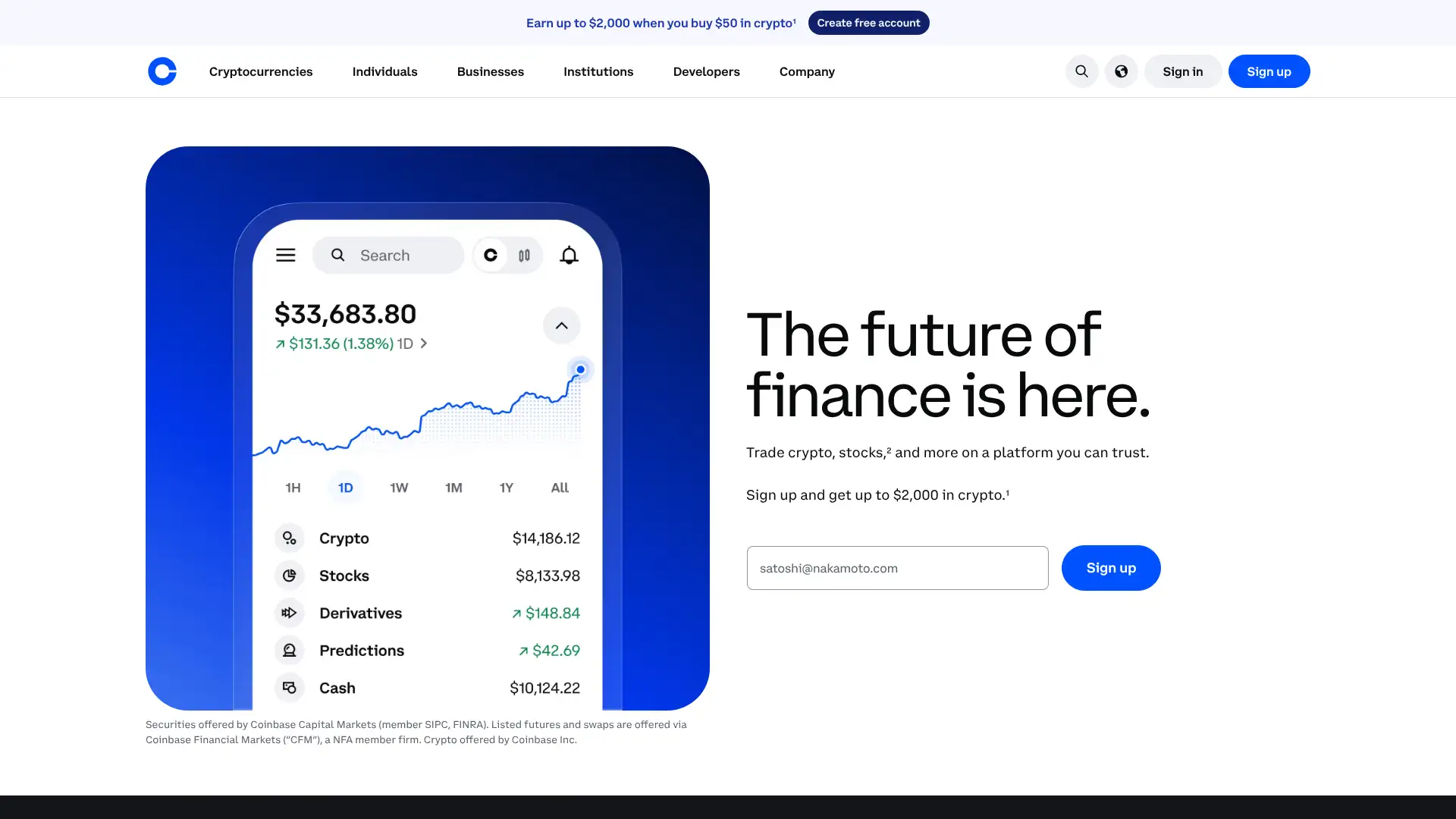
Coinbase is the largest US-regulated crypto exchange, publicly listed on Nasdaq (COIN) and serving over 100 million verified users globally. The platform runs two tiers: the simple consumer interface and Coinbase Advanced Trade, formerly Coinbase Pro. Simple trades use a spread of roughly 0.50% plus a flat fee ($0.99 to $2.99 for orders under $200); Advanced Trade starts at 0.60% maker and 0.80% taker for under $10,000 monthly volume. A Coinbase One subscription (Basic $4.99/mo, Preferred $29.99/mo, Premium $299.99/mo) waives simple-trade fees up to monthly volume caps.
- • Regulatory compliance: fully licensed under New York BitLicense, FINCEN MSB registration, and listed on Nasdaq — among the strongest US compliance profiles of any exchange
- • Coinbase Advanced Trade: professional order book with maker-taker fees, stop-limit orders, and volume-based tier discounts reaching 0.00% maker at $100M+ monthly volume
- • Coinbase One: subscription that eliminates simple-trade fees and provides account takeover insurance up to $250,000 on the Premium tier
- • Staking: earn rewards on ETH, SOL, ADA, ATOM, and more with a 35% commission retained by Coinbase; Coinbase One reduces this commission
- • FDIC insurance: USD cash balances held through Coinbase's banking partners carry FDIC pass-through coverage up to $250,000
Coinbase is the right starting point for US investors who prioritize regulatory safety over low fees, and Coinbase One Preferred is worth it for anyone making more than roughly $800 in simple trades per month. Frequent traders should migrate to Advanced Trade or switch to Kraken or OKX for meaningful fee savings.
Kraken
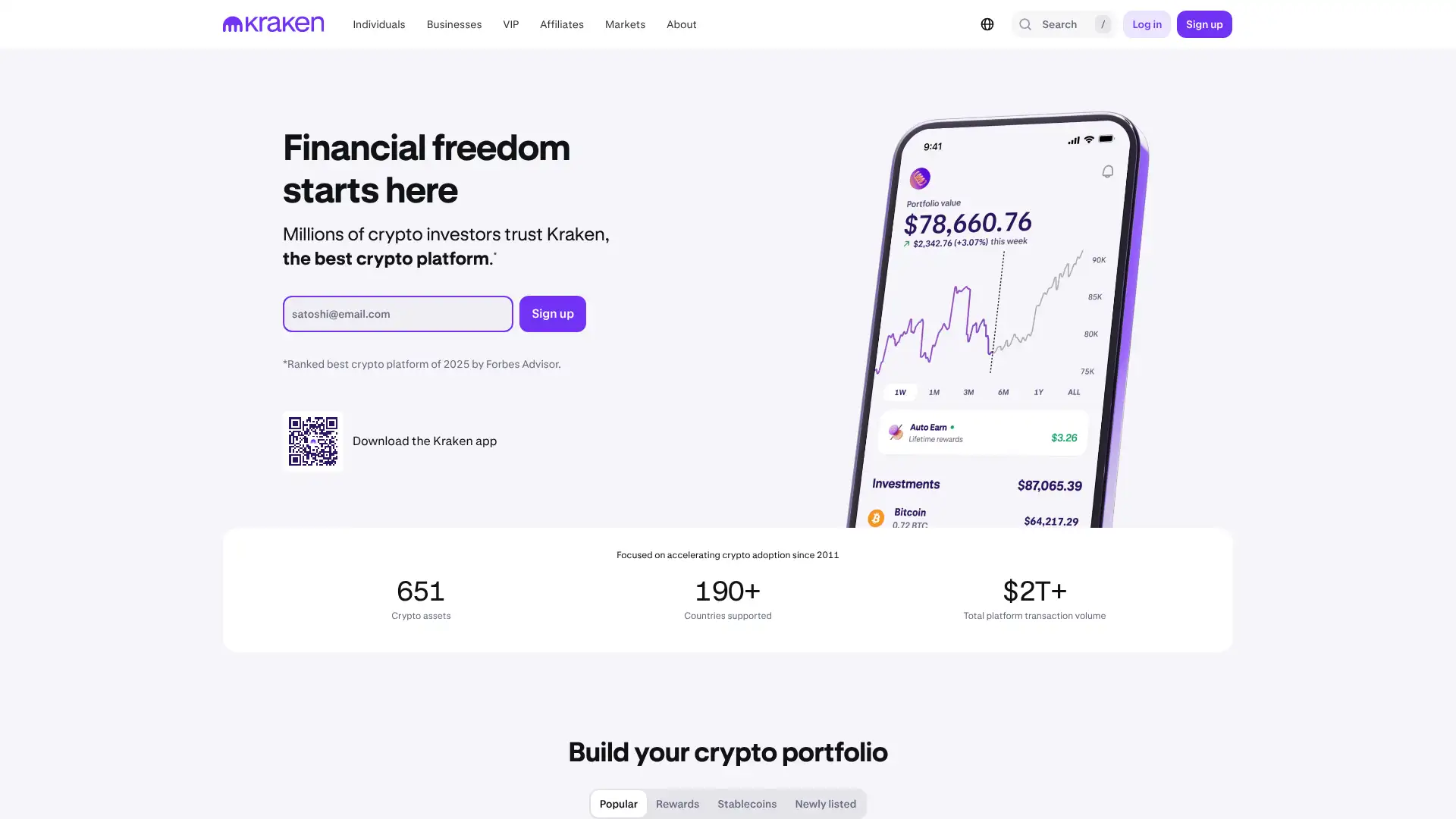
Kraken was founded in 2011 and has processed over 2.5 billion trades with 99.9% uptime. It supports 500+ cryptocurrencies across 190+ countries and operates a clean security record with no major hacks. Base spot fees on Kraken Pro start at 0.25% maker and 0.40% taker, falling to 0.00% maker and 0.05% taker at the highest public volume tier. The standard Kraken app charges a flat 1% fee. Kraken Plus (now Kraken+) waives trading fees on up to $10,000/month in simple trades while spreads still apply. Kraken also recently launched commission-free US stock and ETF trading.
- • Kraken Pro: full order-book interface with TradingView charts, stop-limit orders, and volume-based maker-taker discounts across 500+ spot pairs
- • Kraken Futures: perpetual contracts on BTC, ETH, and major alts with leverage and institutional API support available globally
- • US stocks and ETFs: commission-free trading for US clients on xStocks tokenized securities — a differentiating product not offered by most crypto-only exchanges
- • Proof-of-reserves: Kraken publishes cryptographic proof-of-reserves with dated snapshots (most recently September 30, 2025) verifiable by users
- • Security: over 13 years of operation with no major hack; supports hardware security keys, mandatory 2FA, and withdrawal address whitelists
Kraken is the strongest all-around regulated exchange for US traders who want real Pro-tier fees without relying on a native token discount. The addition of US stock trading makes it a genuine multi-asset account. Active traders elsewhere should weigh the April 2026 UK/EEA withdrawal before committing.
OKX
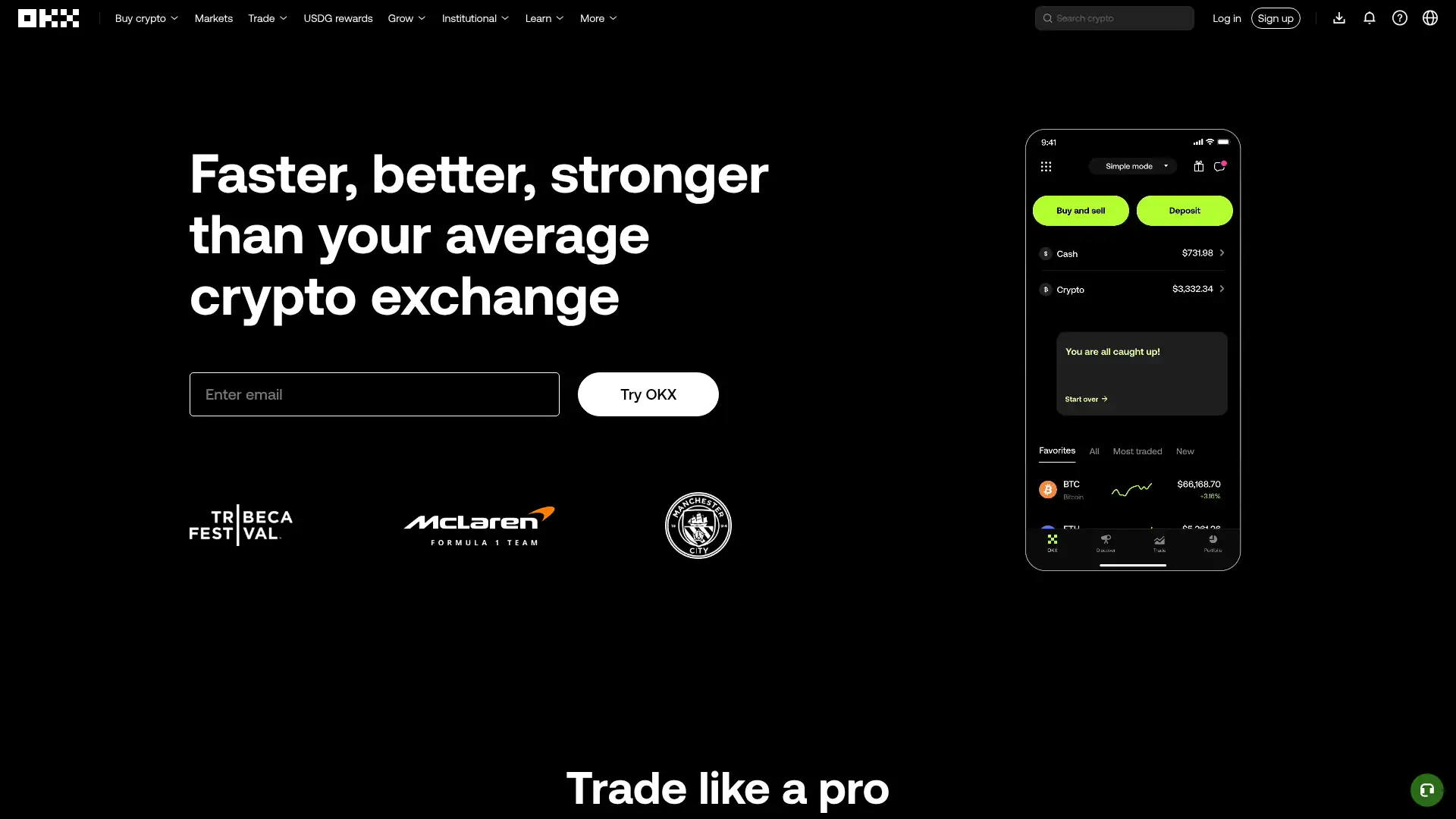
OKX is a major global exchange listing 296+ cryptocurrencies across 702 spot pairs, and is consistently recognized for some of the lowest base spot fees in the industry: 0.08% maker and 0.10% taker at the regular (non-VIP) tier. Holding OKB tokens reduces spot fees further — 1,000 OKB drops the maker rate to 0.06%. Perpetual futures fees start at 0.02% maker and 0.05% taker. OKX also operates a non-custodial Web3 Wallet covering 70+ blockchains, making it one of few CEXs with a native DeFi gateway. EEA users face a different fee schedule starting at 0.20% maker and 0.35% taker following an October 2025 update.
- • Spot fees: 0.08% maker / 0.10% taker globally at the regular tier — lower than Binance (0.10%) without needing OKB, beating most tier-1 exchanges at entry level
- • OKX Web3 Wallet: non-custodial wallet supporting 70+ blockchains with integrated DEX access, NFT marketplaces, and 1,000+ dApps directly from the OKX app
- • Perpetual contracts: base futures fees at 0.02%/0.05% maker/taker with maker rebates available at high VIP tiers — attractive for institutional flow
- • OKB token utility: holding OKB reduces spot fees, qualifies users for VIP tiers, and grants access to Jumpstart token launch allocations
- • Proof-of-reserves: OKX publishes monthly proof-of-reserves with a public wallet view and a verifiable user liabilities tree — among the most transparent in the sector
OKX is the best choice for global active traders who want the lowest transparent base spot fees without needing to hold a native token for discounts. The integrated Web3 Wallet sets it apart from pure CEX competitors. EEA-based traders should re-check the updated regional fee schedule before assuming they get the globally advertised rates.
Bybit
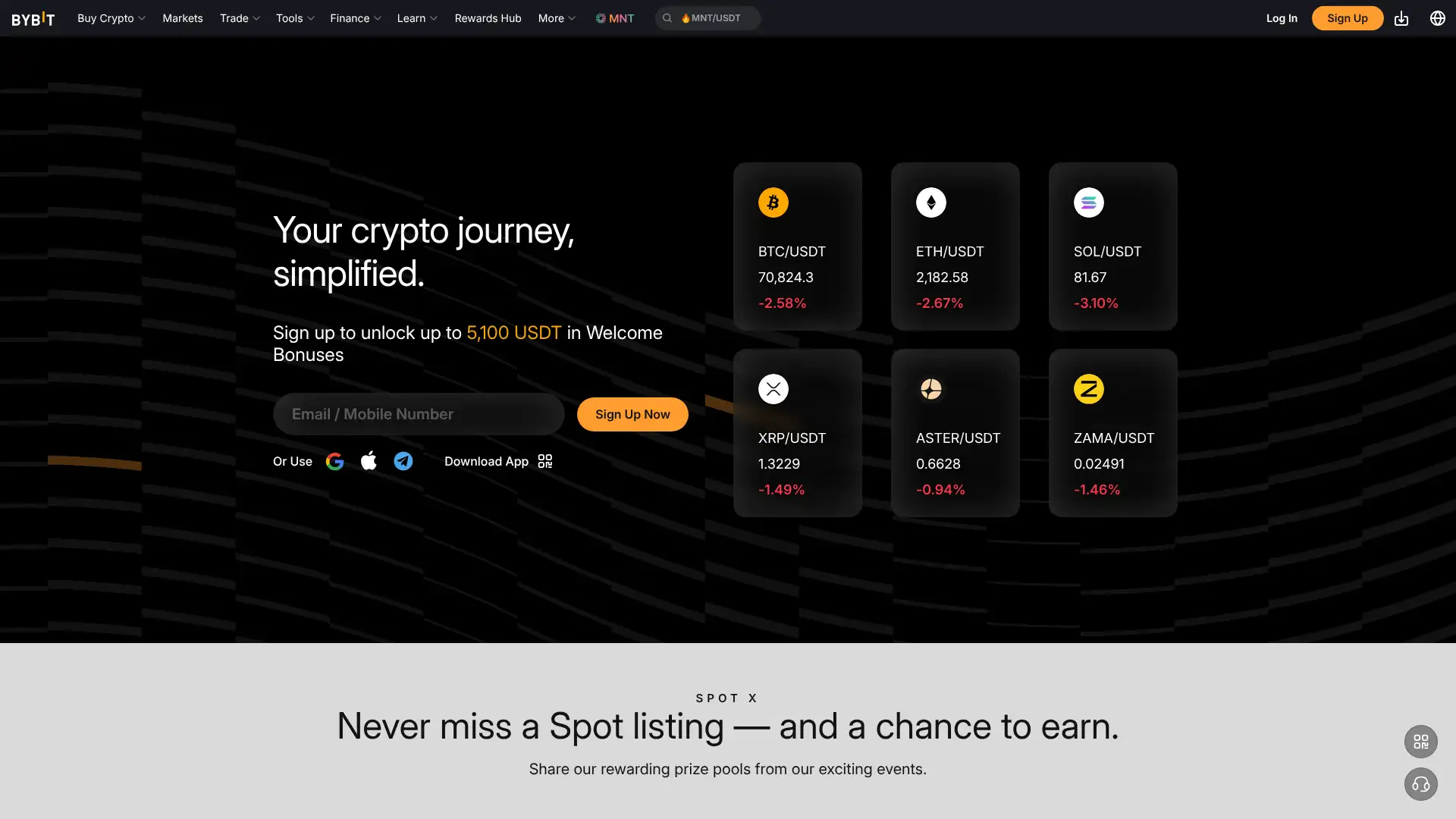
Bybit launched in 2018 and has grown into a top-5 global exchange by derivatives volume, supporting 650+ spot assets and 2,500+ trading pairs including perpetuals, options, and leveraged tokens. Spot trading fees are 0.10% maker and 0.10% taker, with zero fees on select spot pairs. Perpetual futures fees start at 0.01% maker and 0.06% taker. The exchange is not available to US residents. Bybit processes up to 100,000 transactions per second and is widely used by algorithmic traders through its robust API.
- • Perpetual contracts: 200+ perpetual pairs with leverage up to 100x on BTC and ETH, with a market-leading matching engine handling 100,000 TPS
- • Copy trading: built-in copy trading module allowing users to automatically replicate the positions of vetted strategy providers
- • Trading bots: native grid, DCA, and arbitrage bots accessible with no third-party integration required, available to all account tiers
- • Testnet: full paper trading environment mirroring live markets — one of the few major exchanges offering a complete testnet for both spot and futures
- • VARA licensing: Bybit holds a Virtual Asset Service Provider license from Dubai's VARA regulator, one of the most prestigious crypto regulatory approvals in the Middle East
Bybit is the top pick for non-US active derivatives traders who want a fast, feature-rich platform with competitive perpetuals fees and native automation tools. It is not a viable option for US residents and falls slightly short of OKX on base spot fees when trading non-zero-fee pairs.
Bitget
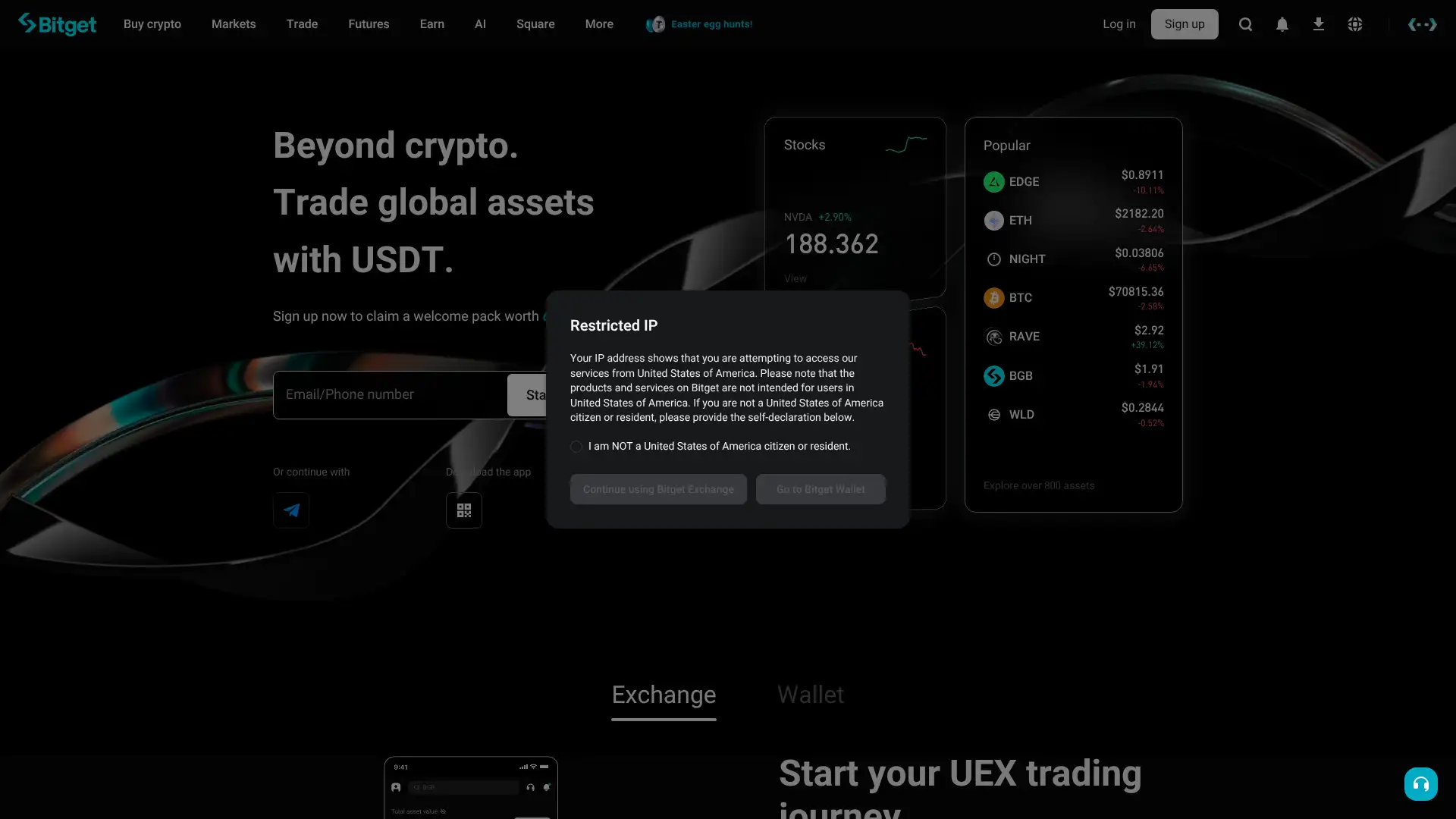
Bitget launched in 2018 and is now recognized as the world's largest crypto copy trading platform, with over 110,000 copy traders available. It supports 1,300+ coins and offers one of the lowest base spot fees in the industry at 0.10% maker and 0.10% taker — reducible by 20% when paying with BGB, the platform's native token. Futures fees start at 0.02% maker and 0.06% taker. Bitget maintains a $500M+ User Protection Fund as of early 2026, and holds regulatory registrations in Australia (AUSTRAC), Italy, Poland, and several other jurisdictions.
- • Copy trading: largest ecosystem with 110,000+ active strategy providers, public P&L history, ROI, and AUM all visible before copying
- • BGB token: holding BGB reduces spot and futures fees by up to 20%, with additional VIP tier benefits for high-volume holders
- • $500M+ User Protection Fund: self-funded and publicly disclosed insurance pool separate from operational capital, designed to cover extraordinary loss events
- • 1,300+ listed coins: among the broadest altcoin selections of any tier-1 exchange, frequently listing projects before Binance or OKX
- • TradFi integration: Bitget is expanding into tokenized stocks and TradFi-Crypto bridge products as a differentiating feature in 2025-2026
Bitget is the best exchange for copy trading and a strong contender for altcoin-heavy spot trading. The $500M Protection Fund is a genuine differentiator in a sector where insurance is rarely formalized. For non-US active traders who want a set-and-copy strategy or need access to 1,300+ coins, Bitget edges out KuCoin on protection and Bybit on altcoin breadth.
KuCoin
KuCoin launched in 2017 and now serves over 39 million users across 200+ countries, listing 1,100+ altcoins including many small-cap projects not yet available on Binance or Coinbase. Spot fees start at 0.10% maker and 0.10% taker, with a 20% discount when paying fees in KCS (KuCoin Token). Futures fees are 0.02% maker and 0.06% taker. The KuCoin Spotlight launchpad has a track record of listing high-return projects early. The exchange also offers a free, comprehensive suite of trading bots.
- • Altcoin depth: 1,100+ listed assets including many low-cap and newly launched tokens not available on larger exchanges
- • KCS token: paying fees in KCS gives a flat 20% discount; additional staking in KCS Pool unlocks Spotlight allocation rights
- • Trading bots: grid, DCA, futures, and smart rebalancing bots are free with no setup fee — one of the most complete free bot suites in the industry
- • KuCoin Spotlight: launchpad for new projects allowing KCS stakers to buy tokens at pre-public prices, historically delivering significant early gains
- • KuCoin Earn: staking, flexible savings, and lending products covering BTC, ETH, USDT, and 100+ other assets
KuCoin is the go-to exchange for traders who want early altcoin access with free automation tools. Its Spotlight launchpad has a genuine track record. The 2023 hack requires users to weigh platform risk, but KuCoin's reimbursement and security upgrades have maintained user trust for most. US residents must look elsewhere.
Gate.io
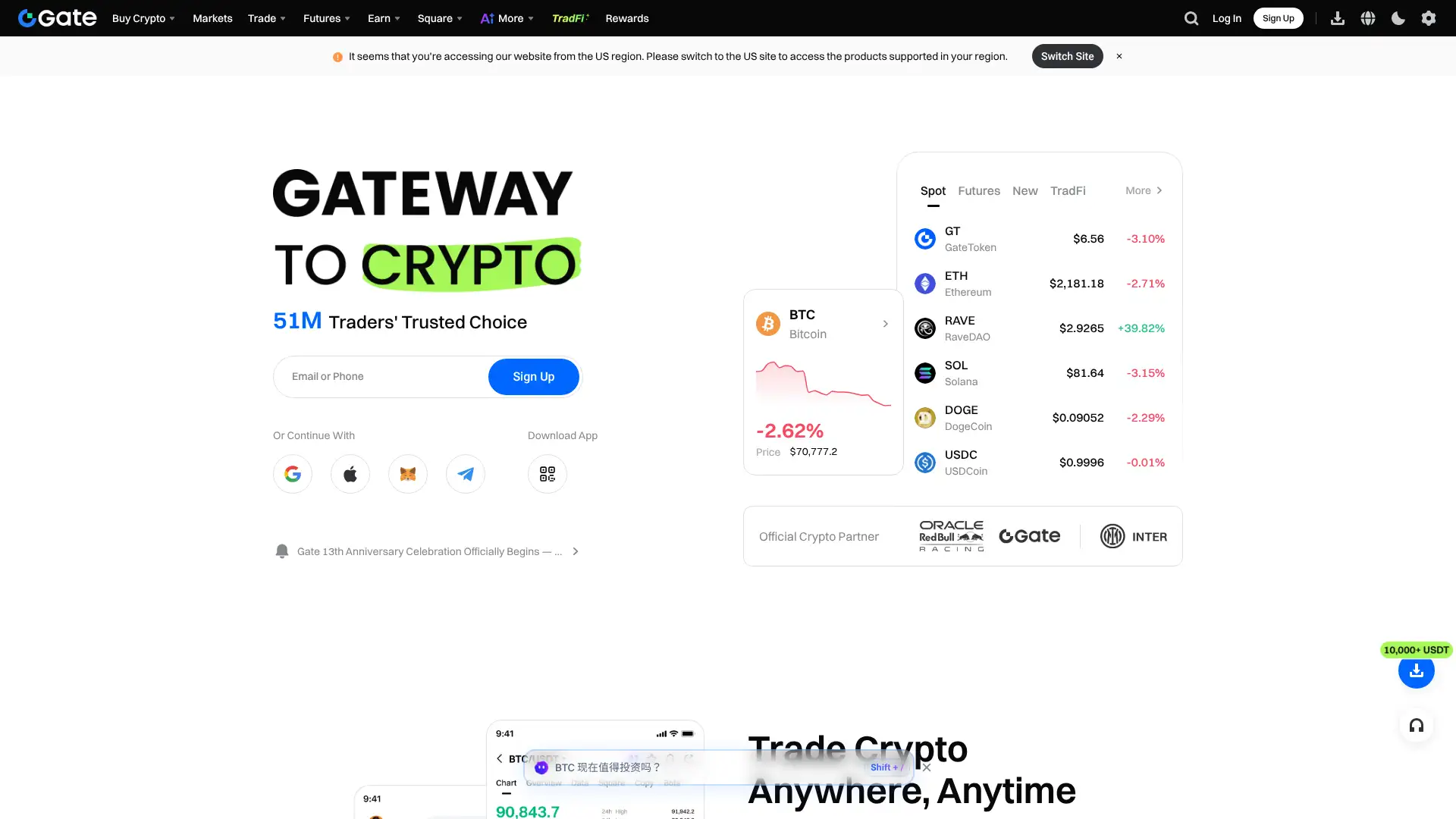
Gate.io (also known as Gate) has operated since 2013 and lists over 3,600 assets — among the highest token counts of any centralized exchange globally. Spot trading fees are flat at 0.10% for both makers and takers, with a 20% discount available when paying with GT (Gate Token). Futures fees start at 0.02% maker and 0.05% taker. Gate.io is not available in the US, Canada, or China. The platform also offers a copy trading feature, margin trading up to 10x on spot, and a Startup launchpad for new token offerings.
- • Token breadth: 3,600+ listed assets makes Gate.io the exchange with the largest cryptocurrency selection of any major platform globally
- • GT token discount: paying fees in GT provides a 20% reduction, equivalent to KuCoin's KCS model and BGB on Bitget
- • Startup launchpad: early-stage token subscription events available to GT holders, mirroring Binance Launchpad in structure
- • Copy trading: integrated social trading feature allowing users to follow and mirror top traders' strategies automatically
- • Proof-of-reserves: Gate.io maintains a publicly verifiable 100%+ reserves disclosure, one of the earliest exchanges to adopt this after FTX
Gate.io wins on sheer token selection — no other major exchange lists 3,600+ assets. It suits dedicated altcoin traders willing to manage the higher scam risk that comes with aggressive listing policies. The proof-of-reserves posture is reassuring, but high BTC withdrawal fees and regional restrictions make it a complement to a primary exchange rather than a standalone choice.
HTX
HTX (formerly Huobi, rebranded in 2023) is one of the longest-running crypto exchanges, founded in 2013. It supports 500+ trading pairs and offers spot, futures, options, and margin trading. Spot trading fees start at 0.20% maker and 0.20% taker, reducing with 30-day volume tiers. The platform operates the TRON ecosystem heavily following Justin Sun's involvement as HTX Global Advisor. HTX also offers a cloud mining product and an integrated DeFi hub. It is not available in the US, Japan, or China.
- • Established since 2013: one of the longest-operating exchanges in Asia with a decade-plus track record in crypto markets
- • HT token: holding the Huobi Token (HT) reduces trading fees and grants access to launchpad allocations on PrimePool
- • TRON ecosystem integration: heavy exposure to TRON-based DeFi and staking products as a result of Justin Sun's advisory role
- • DeFi hub: gateway to DeFi protocols accessible within the HTX interface, similar to OKX's Web3 Wallet model
- • Derivatives depth: futures and options trading across BTC, ETH, and major altcoins with institutional-grade matching engine
HTX suits traders already embedded in the Huobi or TRON ecosystems who value the platform's long operating history. For new users choosing an exchange in 2026, OKX or Binance offer better fees, broader reach, and less regulatory uncertainty than HTX.
Bitfinex
Bitfinex is one of crypto's oldest exchanges, founded in 2012. In a landmark move on December 17, 2025, Bitfinex eliminated all trading fees for both makers and takers across spot, margin, derivatives, OTC, and securities markets — a zero-fee model covering every product type. Previously, spot fees started at 0.10% maker and 0.20% taker. Holders of Unus Sed LEO still receive discounts on margin funding and borrow fees, but trading fees are now $0 regardless of LEO holdings or volume. Bitfinex has deep BTC/USD and ETH/USD order books and strong institutional-grade API access.
- • Zero trading fees across all products since December 17, 2025 — no maker fee, no taker fee, no volume minimum required
- • Deep BTC/USD liquidity: Bitfinex remains one of the deepest spot order books for large BTC and ETH trades with minimal slippage
- • LEO token utility: holding Unus Sed LEO reduces margin funding and borrow rates even under the zero-trading-fee model
- • OTC desk: institutional-grade block trade execution with dedicated relationship managers
- • Advanced API: WebSocket and REST APIs supporting algorithmic and high-frequency trading with low-latency order routing
Bitfinex's December 2025 shift to zero trading fees is a genuine differentiator — it is now the only major exchange where large traders pay absolutely no commission on any product. For non-US professional traders focused on BTC, ETH, and major pairs, this makes Bitfinex worth serious evaluation despite its regulatory history. US traders must look elsewhere.
Gemini
Gemini was founded in 2014 by Cameron and Tyler Winklevoss and operates as a New York limited-purpose trust company regulated by the NYDFS — the strictest crypto regulatory framework in the US. It supports approximately 76 cryptocurrencies and is the only major exchange authorized to operate in New York under the BitLicense's successor framework. Gemini's standard interface charges a spread plus a variable fee; the ActiveTrader interface uses a maker-taker schedule starting at 0.60% maker and 1.20% taker at the entry tier. Note that Gemini is closing retail accounts in the UK, EEA, and Australia effective April 6, 2026.
- • NYDFS trust company: Gemini is structured as a fiduciary under New York law, legally required to prioritize client interests and maintain strict capital reserves
- • SOC certifications: Gemini achieved SOC 1 Type 2 and SOC 2 Type 2 certifications — the same internal control standards expected of traditional banks
- • GUSD: Gemini issues the Gemini Dollar (GUSD), a fully regulated USD-backed stablecoin used as a settlement asset within the exchange
- • Derivatives: up to 100x leverage on perpetual contracts where permitted by jurisdiction, offered separately from spot trading
- • Gemini Credit Card: earns crypto rewards on everyday spending, a unique product among crypto-exchange-issued cards
Gemini is the best exchange for traders in New York or those who specifically need NYDFS-fiduciary-grade custody. For everyone else in the US, Kraken matches compliance quality at a fraction of the ActiveTrader fee. The April 2026 UK and EEA closures mean non-US users should not rely on Gemini as a long-term primary exchange.
Crypto.com
Crypto.com is a Singapore-based exchange founded in 2016, serving users in 90+ countries with 400+ cryptocurrencies. It is best known for its mobile app and the Crypto.com Visa card, which offers up to 5% cashback in CRO when sufficient CRO is staked. Spot trading fees range from 0.07% maker and 0.07% taker (for CRO Supercharger users) down to 0.04% at high VIP tiers. Basic accounts without CRO staking see fees starting around 0.10%/0.10%. The exchange is available to US residents through Crypto.com Exchange (though derivatives are restricted). ATM withdrawal via card carries up to 2% in fees.
- • Visa card: up to 5% CRO cashback on all everyday purchases, airport lounge access (Obsidian tier), and no annual fee — one of the most feature-rich crypto debit cards available
- • CRO token utility: staking CRO unlocks lower trading fees, higher card cashback rates, and Crypto.com Earn yield boosts
- • Crypto.com Earn: flexible and fixed-term staking products earning up to 14% on stablecoins and 5%+ on BTC when CRO is staked at higher tiers
- • 400+ cryptocurrencies with direct fiat on-ramp via bank transfer, debit card, and Apple/Google Pay in supported regions
- • NFT marketplace: integrated NFT trading and minting within the Crypto.com app, targeting mainstream and collector user segments
Crypto.com is the best exchange for people who want a feature-rich crypto debit card integrated with their trading account. The CRO staking model creates a sticky ecosystem but locks users into CRO price risk. For pure trading efficiency, Binance or OKX are cheaper; for card rewards, Crypto.com is the market leader.
Bitstamp
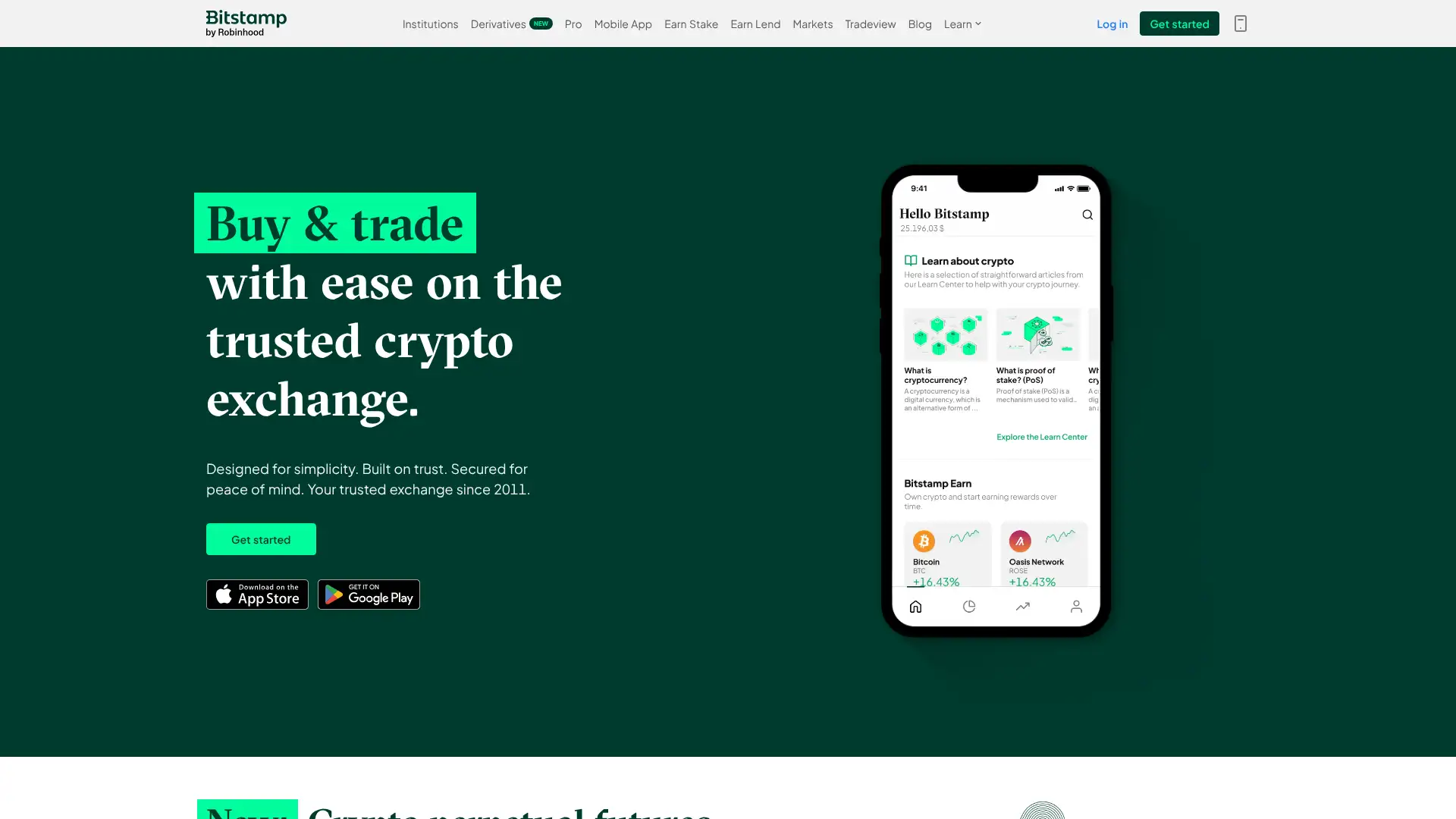
Bitstamp was founded in 2011 in Slovenia and is now owned by Robinhood following a June 2025 acquisition. It operates as one of the oldest exchanges in the world, licensed in Luxembourg (CSSF Payment Institution), New York (BitLicense), and multiple other jurisdictions. It supports approximately 107 coins and ~230 spot pairs, focusing on majors rather than altcoin breadth. Spot fees start at 0.30% maker and 0.40% taker for monthly volumes under $10,000, dropping to 0.00% maker and 0.03% taker above $1 billion. Card purchases carry a 4% instant service fee. SEPA bank transfers are free.
- • Regulatory breadth: licensed in Luxembourg (EU Payment Institution), New York (BitLicense), Singapore, and other key jurisdictions — one of the most regulated CEXs globally
- • Fiat infrastructure: SEPA, ACH, Faster Payments, bank wire, card, Apple Pay, Google Pay, and PayPal supported across USD, EUR, and GBP accounts
- • Pro trading interface: TradingView-integrated order book with market, limit, and stop-limit orders; stop-market orders removed in April 2025 (check strategies)
- • Bitstamp Earn: staking for ETH and ADA where available, with no lock-up period on some products
- • OTC and institutional: RFQ desk for large block trades, FIX connectivity, and sub-accounts with key segregation for institutions
Bitstamp suits institutional clients and long-term holders who need a regulated fiat gateway with deep major-pair liquidity and no frills. For retail traders comparing fees, the 0.30%/0.40% base rate is hard to justify against Kraken Pro at 0.25%/0.40% or OKX at 0.08%/0.10%. Use Bitstamp Pro mode and bank transfers — avoid the 4% card fee at all costs.
MEXC
MEXC is one of the fastest-growing exchanges by token selection, listing over 3,100 cryptocurrencies as of 2026 and serving more than 40 million traders globally. It offers an industry-leading 0% maker fee and 0.05% taker fee for spot trading, with futures maker fees also at 0% and taker fees at 0.03%. MX token holders can reduce fees further by up to 50%. MEXC is not available to US residents. The platform is known for listing new and early-stage tokens aggressively and often before other tier-1 exchanges.
- • 0% spot maker fee with no minimum volume — the only top-40-volume exchange offering zero-cost limit order execution at base tier without a subscription or token condition
- • 3,100+ listed assets: the largest cryptocurrency selection of any exchange, listing new tokens days or weeks before Binance, KuCoin, or Gate.io
- • 0%/0.03% futures fees: the lowest combined futures fee structure in the market for most user tiers
- • MX token: holding MX reduces taker fees by up to 50% and grants access to MEXC Launchpad allocations for new token offerings
- • 40M+ users: MEXC's rapid growth between 2022-2025 reflects its unique combination of ultra-low fees and aggressive early-listing policy
MEXC is the best exchange for fee-conscious non-US traders who want zero maker fees and access to 3,100+ tokens including the earliest new listings. The risk is that the broadest token selection comes with the broadest scam risk — always verify contract addresses when trading newly listed assets.
LBank
LBank was founded in 2015 and is headquartered in the British Virgin Islands. It lists 500+ cryptocurrencies and targets emerging market users across Asia, Africa, and Latin America. Spot trading fees start at 0.10% maker and 0.10% taker. The platform offers futures with up to 125x leverage. LBank is not available to US residents. It is known for listing small and micro-cap tokens early and running a copy trading service. LBank launched a launchpad in 2021 for early-stage token offerings.
- • Early altcoin listings: LBank lists new projects from emerging ecosystems quickly, targeting traders who want early-entry positions before mainstream exchange listings
- • Copy trading: integrated social trading feature allowing users to mirror the positions of experienced traders
- • Futures: perpetual contracts with up to 125x leverage on BTC, ETH, and major altcoins
- • Fiat gateway: supports fiat on-ramps across multiple payment methods relevant to emerging markets, including local payment methods in select regions
- • LBank Launchpad: subscription-based token launch events where users stake LBK token to earn allocation rights
LBank is a functional option for emerging-market traders who cannot easily access Binance or KuCoin, or who want very early altcoin exposure. However, for anyone who can access tier-1 exchanges, MEXC or Gate.io offer better liquidity, lower fees, and a stronger security profile.
BitMart
BitMart was founded in 2017 and lists 1,500+ cryptocurrencies, positioning itself as a bridge for new DeFi and AI projects seeking centralized exchange exposure before graduating to Binance or KuCoin. It is available in 180+ countries. Spot fees are 0.25% maker and 0.25% taker, with a 25% discount when paying with BMX (BitMart Token). BitMart added futures trading in July 2024. The exchange suffered a $196 million hack in December 2021 and subsequently reimbursed affected users.
- • 1,500+ listed coins: broad altcoin selection including many micro-cap and DeFi-native tokens seeking their first CEX listing
- • BMX token: paying fees in BMX reduces the 0.25% base rate by 25%, lowering effective cost to ~0.19%
- • New project on-ramp: BitMart is frequently chosen as a second-wave CEX after MEXC or BingX for token launches needing broader retail distribution
- • Global availability: accessible in 180+ countries including many emerging markets with localized payment method support
- • Futures (added July 2024): expands the platform beyond pure spot trading for traders wanting leverage exposure on listed assets
BitMart works as a secondary exchange for traders chasing micro-cap listings not yet on KuCoin or MEXC. The 0.25% base fee is a real drawback for regular use, and the 2021 hack history means it should not be used for long-term fund storage. Limit use to short-term altcoin positions and withdraw to self-custody promptly.
BingX
BingX was founded in 2018 and operates as a global exchange offering spot trading, perpetual futures, copy trading, and grid bots. It serves 500+ cryptocurrencies and is regulated in Canada, the EU, and Australia. Spot trading fees are 0.10% maker and 0.10% taker. Futures fees start at 0.02% maker and 0.04% taker — the lowest futures taker rate among mid-tier exchanges. BingX's copy trading feature allows users to replicate top traders' positions automatically, with referral codes offering 10-15% fee rebates and up to $100 in bonus credits.
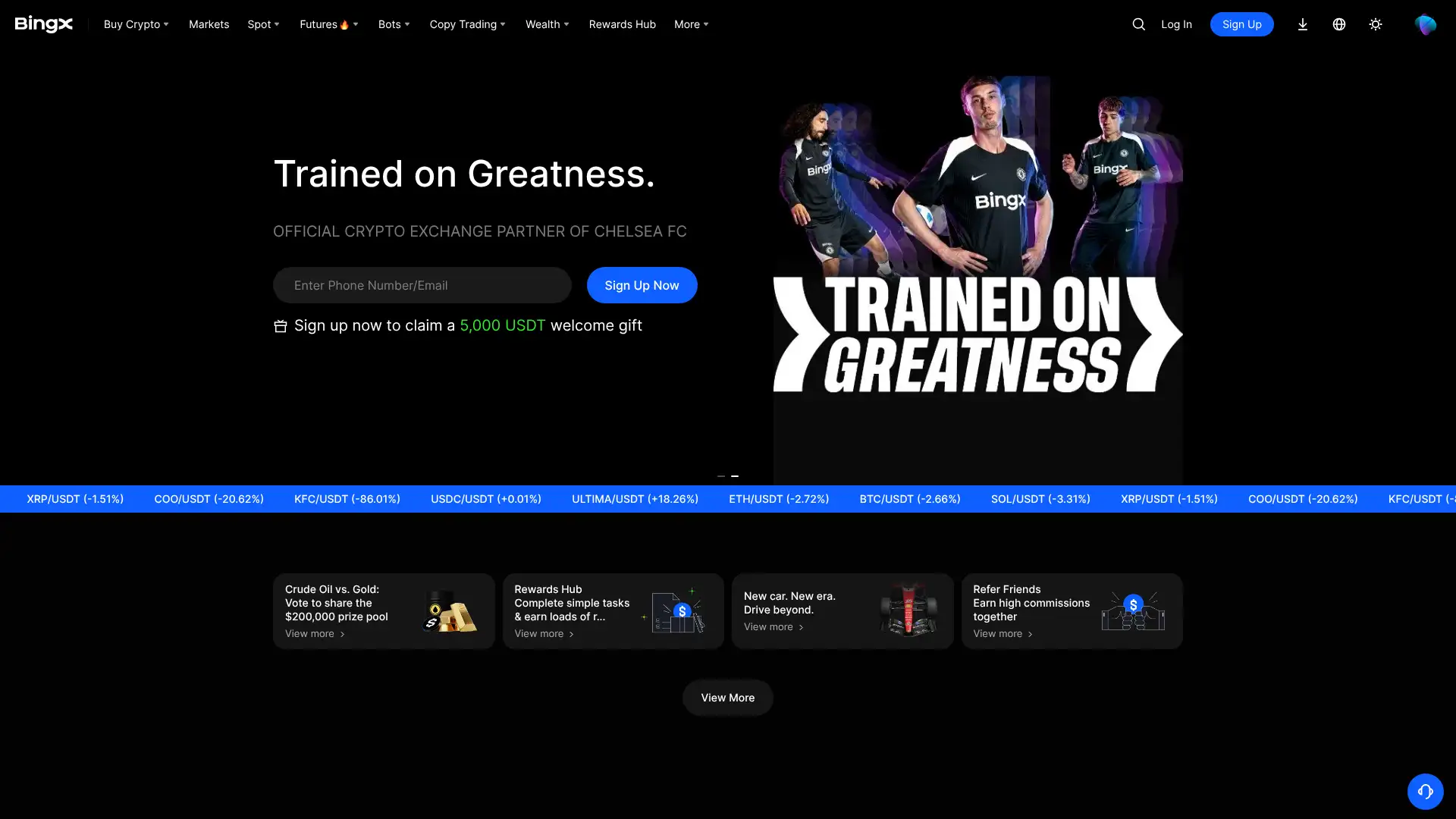
- • Copy trading: BingX's social trading ecosystem allows automated position mirroring across spot and futures markets with transparent trader performance metrics
- • Futures taker fee 0.04%: below Binance (0.05%) and Bybit (0.06%) at base tier, making BingX one of the more cost-efficient options for futures takers
- • 100% Proof of Reserves: BingX maintains a published proof-of-reserves system verifiable via the official PoR page
- • Regulatory coverage: licensed and registered in Canada, EU jurisdictions, and Australia — broader formal compliance than most exchanges at its size tier
- • Grid bots and automation: built-in grid trading bots for spot and futures that can be shared and copied within the BingX community
BingX is a solid mid-tier option for non-US traders who want futures with a lower taker fee than Binance and a decent copy trading ecosystem. The Canadian and EU licensing provides extra comfort. For more active altcoin trading, MEXC or KuCoin are stronger; for copy trading at scale, Bitget's 110,000+ provider pool is more compelling.
Phemex
Phemex launched in 2019 as a Singapore-based derivatives and spot exchange, processing up to 300,000 transactions per second. Spot fees start at 0.10% maker and 0.10% taker. Perpetual futures have a maker rebate of 0.01% and a taker fee of 0.06%. The exchange supports 200+ trading pairs and offers copy trading, grid bots, and a paper trading testnet. Phemex does not serve US residents. In early 2025 the platform experienced a security incident, which it disclosed and addressed publicly. Premium memberships via PT (Phemex Token) reduce spot fees.
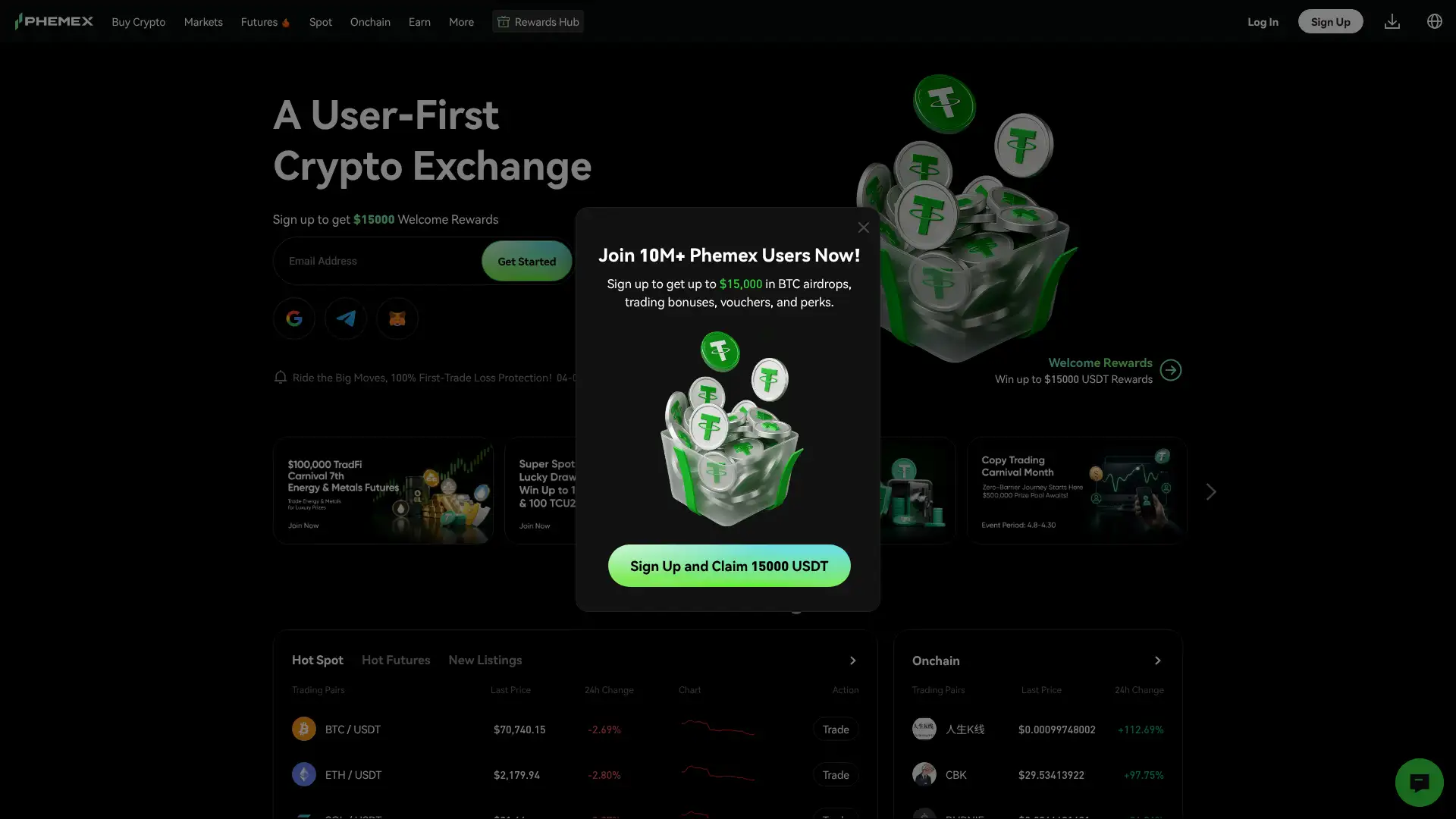
- • Perpetuals maker rebate: at base tier, limit-order (maker) perpetuals traders receive a 0.01% rebate on each fill — one of the few mid-tier exchanges offering maker rebates without a VIP requirement
- • 300,000 TPS matching engine: high-throughput order processing competitive with top-tier derivatives platforms for latency-sensitive strategies
- • Paper trading: full testnet environment mirroring live BTC, ETH, and major altcoin perpetual markets for strategy validation without risk
- • Copy trading: users can copy strategies from vetted Master Traders who take up to 20% profit share, with filtering by Total PnL, Monthly ROI, and AUM
- • 200+ trading pairs across spot and perpetuals with unified account margin for both products
Phemex suits algorithmic and derivatives traders who specifically want a maker rebate at entry level without climbing VIP tiers. The 300,000 TPS engine and paper trading testnet are genuine strengths. The 2025 security incident and limited trading pairs make it a better secondary platform than a primary exchange for large capital.
WhiteBIT
WhiteBIT is a Ukrainian-founded exchange launched in 2018, now serving 5 million+ users in 190+ countries. It supports 320+ cryptocurrencies with spot, futures, margin, staking, and copy trading. Base spot fees are 0.10% maker and 0.10% taker. WBT (WhiteBIT Token) holders can reduce maker fees to 0% and taker fees by up to 80%. Futures fees start at 0.02% maker and 0.05% taker. WhiteBIT holds EU regulatory registrations in Lithuania and Estonia and scored 9.3/10 in TradersUnion's 2026 exchange evaluation.
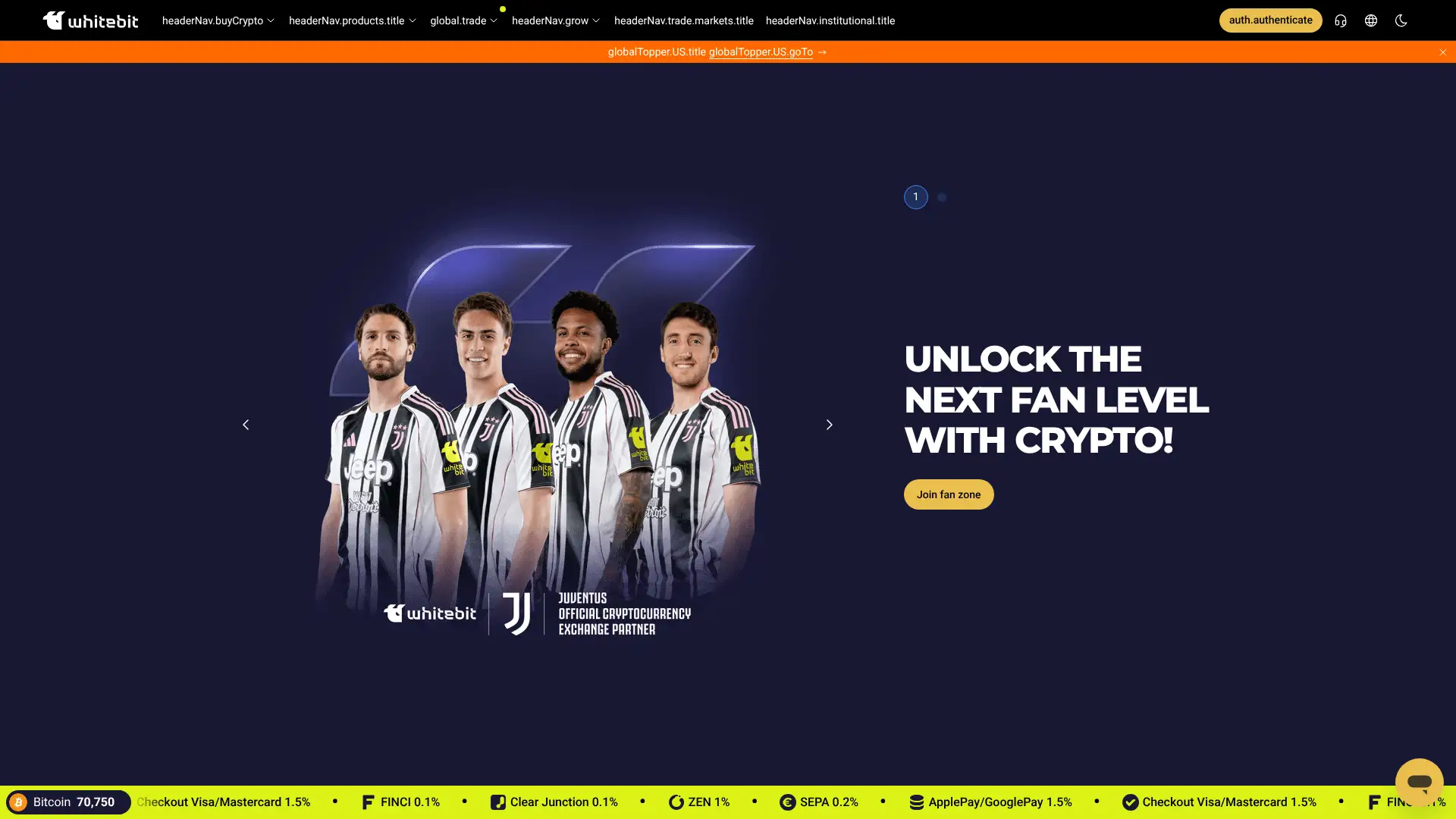
- • WBT token utility: holding WBT can eliminate maker fees entirely (0%) and reduce taker fees by up to 80% — the most aggressive token-based discount structure of any mid-tier exchange
- • EU regulatory registrations: Lithuania and Estonia financial authority registrations provide European users with a locally-compliant exchange option
- • Copy trading: built-in strategy copying with transparent P&L history for providers
- • P2P trading: peer-to-peer marketplace with 0% platform fee for both maker and taker, supporting 50+ fiat currencies
- • Futures: perpetual contract support with maker fees as low as 0.0005% at high 30-day volume tiers — among the lowest published rates in the industry
WhiteBIT is a viable choice for EU-based traders who want a locally registered exchange with aggressive WBT token discounts. The zero-maker-fee potential and 0% P2P fee make it cost-competitive with the best global options. For altcoin breadth or larger trading volumes, Binance or OKX remain superior.
Coinsquare
Coinsquare is Canada's oldest and largest cryptocurrency exchange, founded in 2014 and headquartered in Toronto. It is registered with FINTRAC as a Money Services Business and regulated by CIPF for non-crypto cash balances. The exchange offers approximately 50 cryptocurrencies with CAD, USD, EUR, GBP, and AUD trading pairs. Pro interface fees are 0.50% for both maker and taker (flat rate). Interac e-Transfer deposits are free, with no crypto deposit fee. Bank wire and direct bank deposit withdrawals carry a 1.5% fiat fee; Interac e-Transfer withdrawals are free up to $2,000.
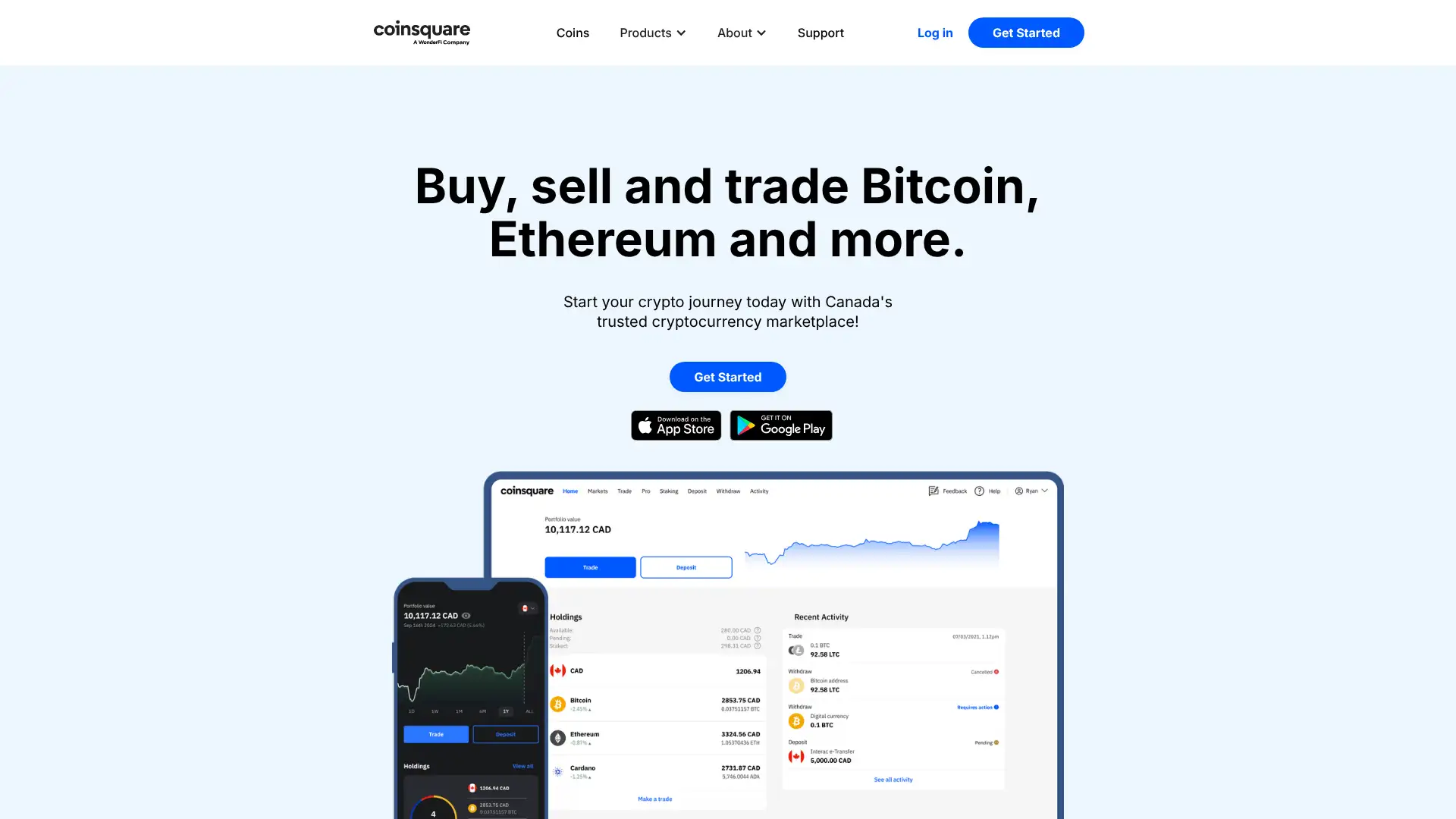
- • FINTRAC MSB registration: Coinsquare is formally registered as a Canadian Money Services Business and complies with AML and KYC requirements under Canadian law
- • CIPF protection: cash balances (not crypto) held in qualified accounts at Coinsquare Capital Markets Ltd. are eligible for CIPF investor protection
- • CAD trading pairs: one of the few exchanges where Canadians can directly buy BTC, ETH, and major altcoins in Canadian dollars without fiat conversion costs
- • Interac e-Transfer: free deposits via Interac, the dominant Canadian bank payment network — instant and familiar for Canadian residents
- • 50+ cryptocurrencies covering majors plus select altcoins, focused on quality and liquidity rather than speculative breadth
Coinsquare is the right starting point for Canadian residents who want a FINTRAC-registered exchange with free Interac deposits, but the flat 0.50% fee with no volume discount makes it expensive for active traders. Consider using Coinsquare as a CAD fiat on-ramp and then moving assets to Kraken or Binance for cheaper active trading.
Blockchain.com
Blockchain.com is one of the world's oldest crypto infrastructure companies, launched in 2011. It is best known for its non-custodial wallet with 100M+ wallets created, but also operates a centralized exchange. The exchange supports BTC, ETH, BTC-Lightning, and select major cryptocurrencies. Trading fees are baked into a spread of approximately 0.50% to 1.0% depending on the asset and order size — the platform does not publish a detailed maker-taker schedule. Blockchain.com also offers institutional services through Prime.
- • Non-custodial wallet: over 100 million wallets created since 2011, with the explorer and wallet product widely used independently of the exchange
- • Blockchain Explorer: one of the original and most-used BTC and ETH blockchain explorers, processing billions of lookups annually
- • Bitcoin Lightning support: Blockchain.com supports Lightning Network for low-fee, near-instant BTC payments within the ecosystem
- • Institutional Prime: OTC and custody services for institutions via Blockchain.com Prime, targeting funds and asset managers
- • DeFi wallet: non-custodial wallet supporting DeFi protocols and dApp interactions alongside the centralized exchange product
Blockchain.com is a heritage brand better known for its wallet and explorer than its exchange. As a trading platform, its limited coin selection and opaque spread-based pricing make it hard to recommend over Coinbase or Kraken for anyone beyond absolute beginners who trust the Blockchain.com brand from prior wallet use.
Uphold
Uphold is a multi-asset platform launched in 2015 that supports 250+ assets including cryptocurrencies, equities, precious metals, and national currencies. It uses a spread-based fee model — 0.80% to 1.20% spread for major crypto like BTC and ETH, 1.40% to 2.95% for altcoins, and approximately 0.25% for stablecoins. Small orders under $500 carry a $0.99 minimum fee. Card and digital wallet deposits cost 3.99%. ACH/SEPA bank transfers are free. Uphold serves approximately 10 million active users globally.
- • Multi-asset trading: trade BTC, ETH, and 250+ crypto alongside US equities, gold, silver, and 30+ fiat currencies in a single account without separate brokerage accounts
- • Transparent pricing: spread is shown in-app before each transaction, providing price clarity compared to exchanges that bury costs in the execution
- • Uphold Card: Elite card tier charges 0% foreign transaction fee; standard card charges 1.75% — crypto-funded spending card integrated with the account
- • Instant settlement: crypto-to-crypto and crypto-to-stock conversions settle in seconds within the Uphold account without withdrawal delays
- • 10M+ active users with global availability across the US, UK, and EU — one of the more accessible multi-asset platforms with few geographic restrictions
Uphold makes sense for investors who genuinely want to move fluidly between BTC, gold, and stocks without managing multiple accounts. For traders who focus primarily on crypto and care about fees, the 0.80%-2.95% spread model is far too expensive — Coinbase or Kraken are significantly cheaper for the same crypto exposure.
Robinhood Crypto
Robinhood is a US-based retail trading platform offering commission-free trading across crypto, stocks, options, and ETFs in a single mobile-first account. Crypto trading has no posted commission but uses payment for order flow (PFOF) — bid-ask spread costs are estimated at $3.50-$8.50 per $1,000 traded. Robinhood supports approximately 50 cryptocurrencies and added a Robinhood Legend desktop app in late 2025. US stocks and ETFs are genuinely commission-free. Perpetual futures are available to EU users only. No crypto-to-crypto trading; all crypto pairs denominated in USD.
- • Commission-free crypto: no explicit trading fee — but PFOF means Robinhood routes orders to market makers who profit from the spread, costing traders an estimated 0.35%-0.85% per trade
- • Integrated account: crypto, stocks, ETFs, and options in a single SIPC-protected account — the most seamless multi-asset US retail experience
- • Robinhood Legend: desktop app launched late 2025 with millisecond-precision data, customizable layouts, and Smart Exchange Routing for Gold subscribers
- • 50 cryptocurrencies: BTC, ETH, SOL, DOGE, and major assets — no DeFi tokens, no altcoin speculative plays, no crypto-to-crypto trading
- • No custody risk for stocks: SIPC covers up to $500,000 for securities; crypto is not SIPC-covered but held in segregated accounts
Robinhood is best for US equity investors who want to add BTC or ETH exposure without opening a new account. Gold subscribers who trade frequently get genuine value from Smart Exchange Routing. For dedicated crypto traders who need altcoin access, staking, or competitive maker-taker fees, Coinbase Advanced or Kraken are better choices.
eToro
eToro is a social trading platform founded in 2007 and serving millions of users globally with crypto, stocks, ETFs, and commodities in a single interface. Crypto trading carries a 1% spread fee on entry and 0.6%-1% on exit, totaling approximately 2% for a round trip. Transferring crypto to an external wallet costs an additional 2%. Stocks and ETFs are commission-free for non-leveraged buys. An inactivity fee of $10/month applies after 12 months without login. eToro's CopyTrader system allows mirroring of successful investor portfolios with a minimum of $200.
- • CopyTrader: automatically replicate the portfolio and trades of selected investors in real time — minimum $200 to copy; up to 100 traders simultaneously
- • Multi-asset: 100+ crypto, 3,000+ global stocks, 250+ ETFs, commodities, and forex in a single regulated account — the broadest asset class coverage of any platform in this directory
- • Smart Portfolios: pre-built thematic portfolios managed by eToro's investment committee covering AI, renewable energy, and crypto sectors
- • Social feed: community news feed showing trades and market commentary from followed traders, creating a real-time social investment layer
- • Regulated globally: CySEC (EU), FCA (UK via partners), ASIC (Australia), and FINRA/FinCEN (US) registrations provide multi-jurisdictional regulatory coverage
eToro is the best platform for investors who want to copy experienced traders across stocks and crypto simultaneously. For pure crypto trading, the 2% round-trip spread makes it 10-20x more expensive than dedicated exchanges. Use eToro for CopyTrader and multi-asset portfolios; use Coinbase or Kraken for actual crypto trading volume.
CoinEx
CoinEx launched in 2017 and supports 1,200+ cryptocurrencies across spot, futures, and margin markets. Base spot fees start at 0.20% maker and 0.20% taker — above average for a major exchange. Futures fees start at 0.03% maker and 0.05% taker. CET (CoinEx Token) holders receive fee discounts. A notable feature is the no-KYC policy for withdrawals up to $50,000 per day, making it attractive for privacy-focused traders. CoinEx is not available to US, Canadian, Chinese, or Hong Kong residents. In September 2023 the exchange suffered a $70 million hack and subsequently reimbursed all affected users.
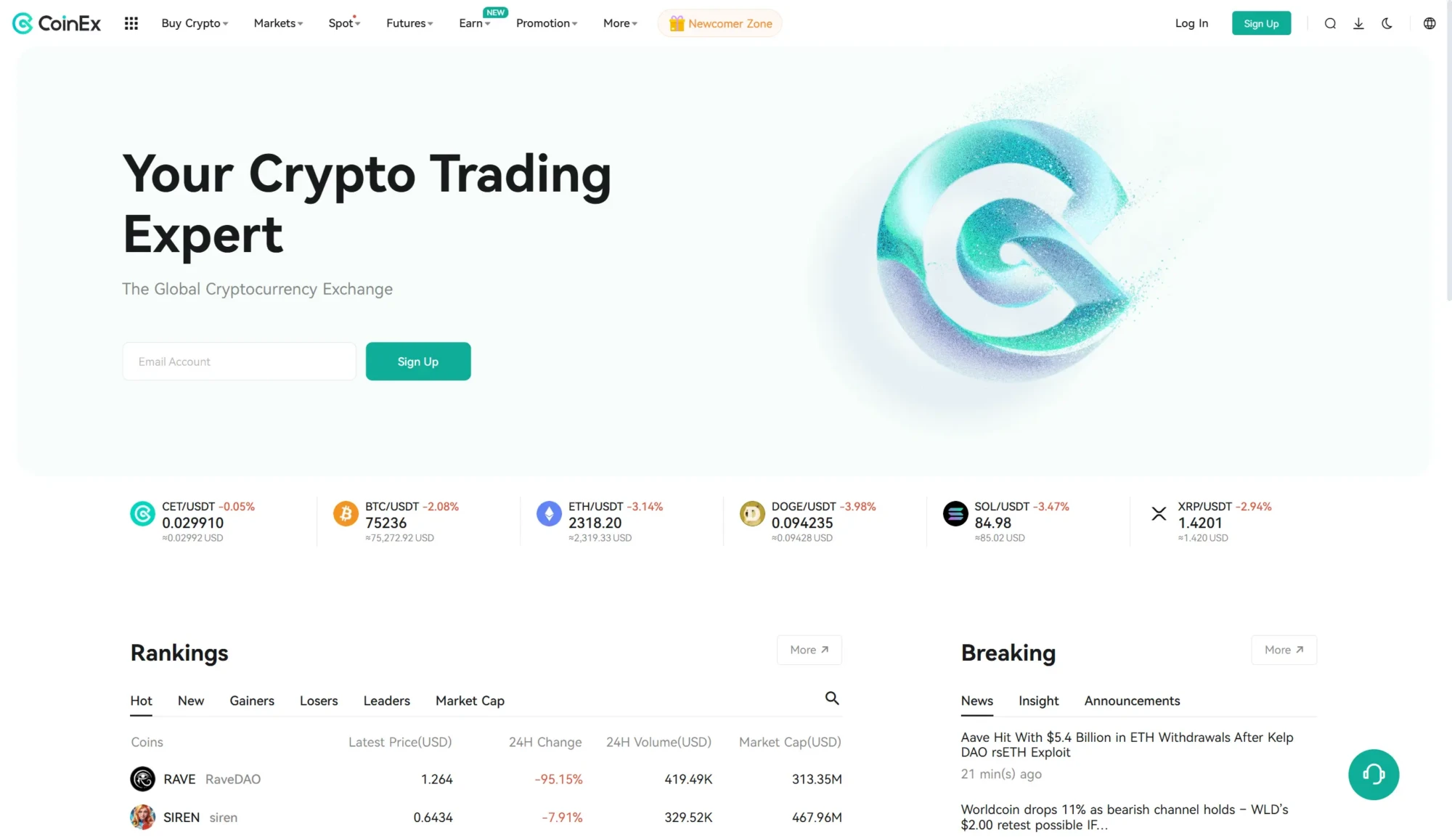
- • No-KYC up to $50,000/day: basic account access without identity verification for daily withdrawal amounts under $50,000 — unique among major 1,000+ coin exchanges
- • 1,200+ listed tokens: mid-tier breadth for altcoin access, though narrower than MEXC (3,100+) or Gate.io (3,600+)
- • CET token: discount token that reduces fees and provides staking rewards; can be burned for platform credits
- • Shield Fund: 10% of all trading fees is allocated to a protection fund for user assets — partially comparable to Bitget's larger $500M fund
- • Proof of Reserves: CoinEx publishes monthly proof-of-reserves disclosures with verifiable data
CoinEx suits privacy-conscious non-US traders willing to pay 0.20% spot fees in exchange for KYC-free access up to $50,000/day. For fee-sensitive traders, MEXC's 0%/0.05% structure is clearly better. The 2023 hack is a background risk that warrants keeping only working capital on the platform.
Poloniex
Poloniex is one of the oldest US-founded crypto exchanges, launched in 2014, and acquired by the Tron Foundation ecosystem (associated with Justin Sun) in 2019. It supports 400+ cryptocurrencies with a focus on TRON-based assets. Base spot fees are 0.145% maker and 0.155% taker, reducible by 30% when paying with TRX. Futures fees start at 0.01% maker and 0.075% taker. Poloniex offers P2P lending at 0% platform fee. The exchange has limited US availability due to historical regulatory issues.
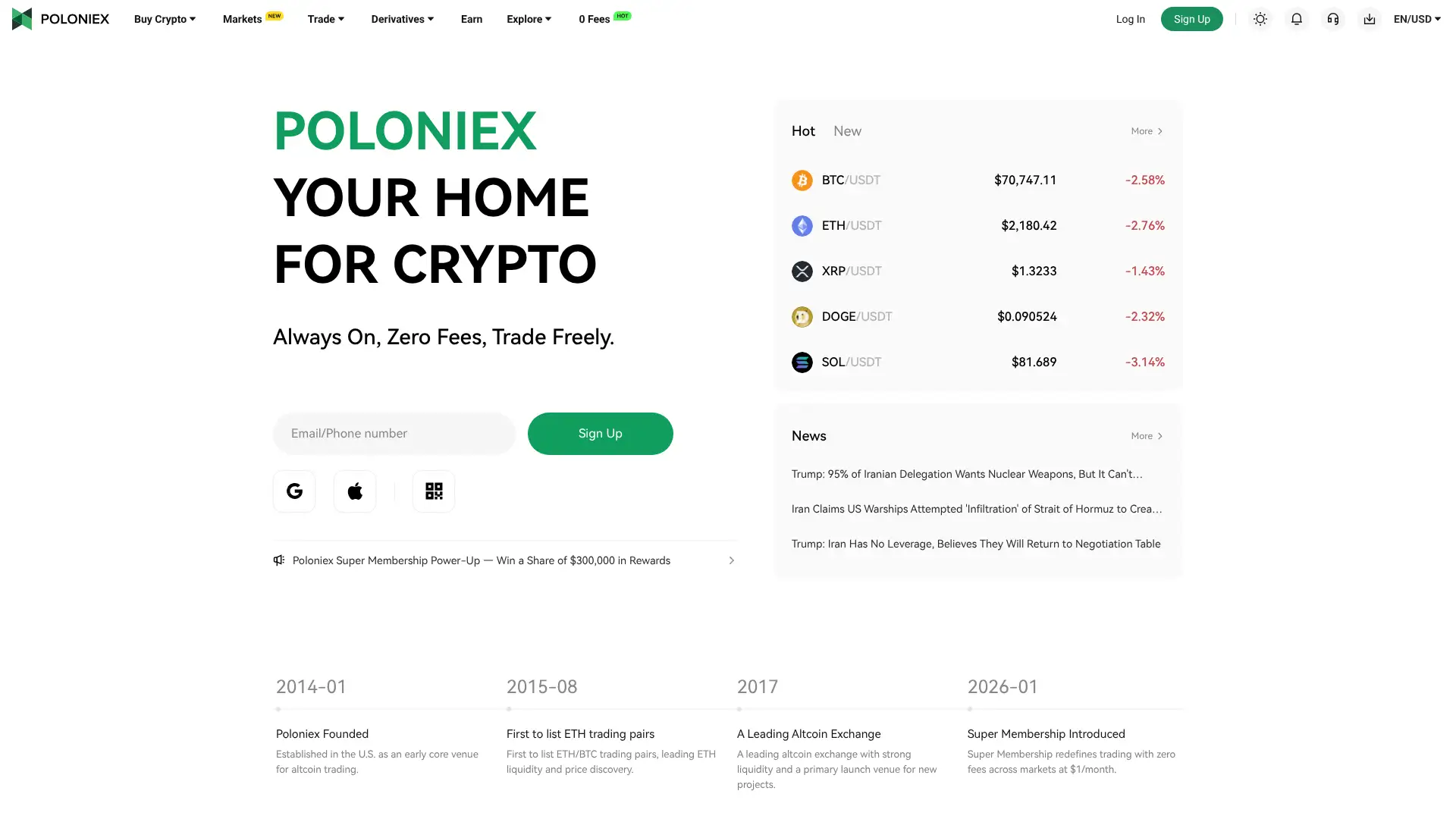
- • TRX discount: paying fees with TRX reduces spot trading costs by 30%, closely tying Poloniex to the Tron ecosystem
- • P2P lending: peer-to-peer margin funding at 0% platform fee — allows token holders to earn interest by lending to margin traders directly
- • 400+ cryptocurrencies with heavy Tron network integration, including TRC-20 USDT pairs and native TRC-20 token trading
- • Futures: perpetual contracts starting at 0.01%/0.075% maker/taker — maker fee is competitive but taker at 0.075% is higher than Binance (0.05%) or OKX (0.05%)
- • Long operating history since 2014, providing one of the longest track records in centralized crypto exchange operation
Poloniex is best suited for Tron ecosystem traders who hold TRX and want to reduce fees via native token discounts, or for users seeking the P2P margin lending product. For general altcoin trading or derivatives, KuCoin or Gate.io offer better pricing with a more diversified ecosystem.
Backpack Exchange
Backpack Exchange launched in 2023 and is built by the team behind the Backpack Wallet and Mad Lads NFT collection on Solana. It operates across 150 countries including 11 US states and is licensed in multiple jurisdictions including the British Virgin Islands. Spot fees start at 0.08% maker and 0.10% taker — below industry average. Perpetual futures fees start at 0.02% maker and 0.05% taker. All assets trade against USDC. The exchange reports that it does not have an internal market maker, meaning users are not frontrun by the exchange's own trading desk.
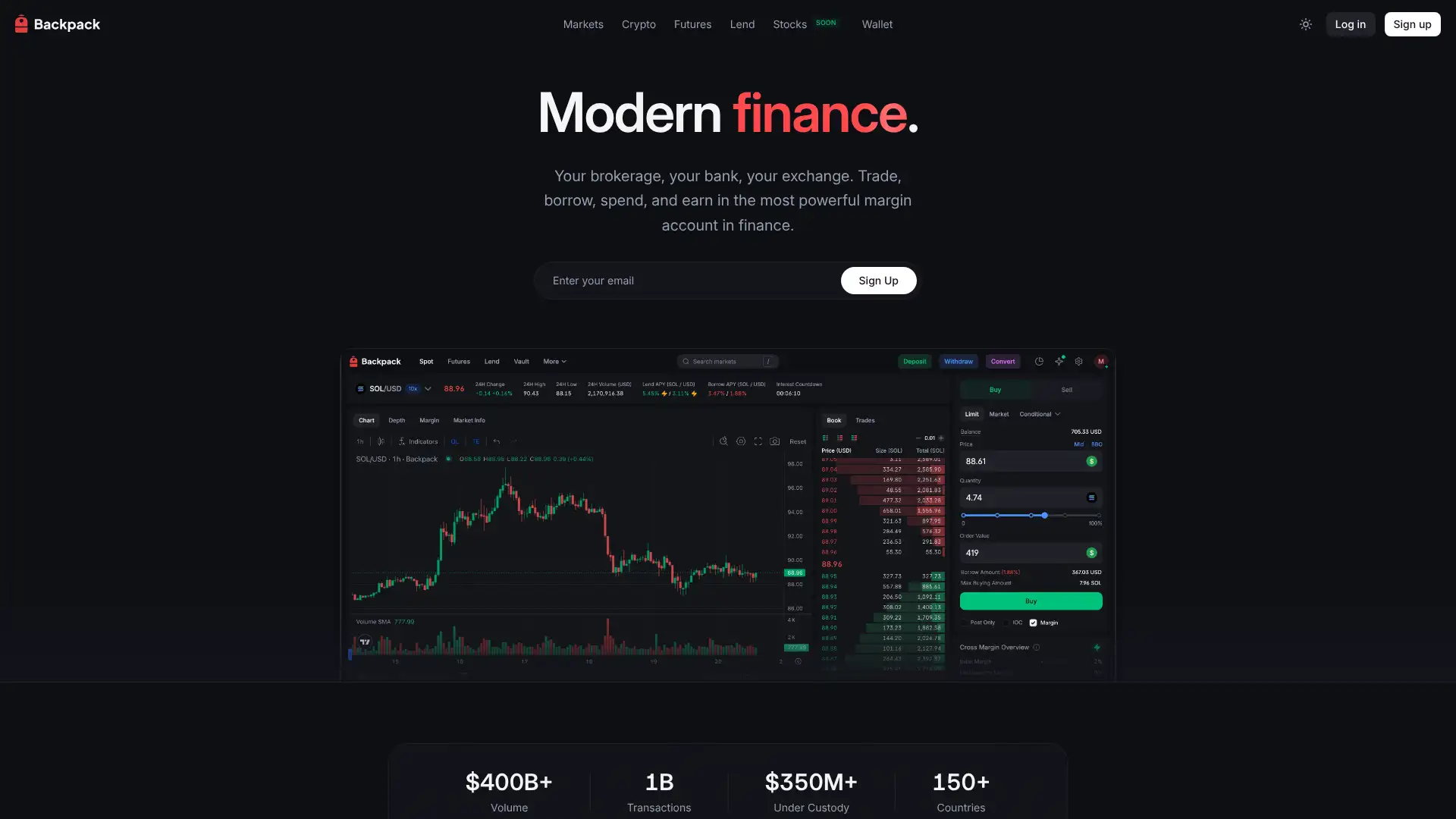
- • No internal market maker: Backpack explicitly states it does not operate an in-house MM desk, eliminating frontrunning risk that affects traders on many CEXs
- • USDC-only settlement: all spot pairs trade against USDC rather than USDT, providing stablecoin-specific settlement transparency
- • Unified account: a single balance covers spot, futures, margin, lending, and borrowing without internal transfers between sub-accounts
- • Crypto lending: users can lend USDC, ETH, SOL, and BTC with interest that can be earned simultaneously while holding open trading positions
- • Partial US availability: accessible in California, Colorado, Wisconsin, Wyoming, and 7 other US states — one of the few non-Coinbase exchanges with legal US state access
Backpack is an interesting exchange for Solana-ecosystem users and traders concerned about frontrunning, but 61 coins is far too limited for broad use. The no-internal-MM promise and competitive base fees are appealing for BTC/ETH/SOL spot trading. Use Backpack as a secondary venue for majors while relying on Kraken or OKX for full market access.
HashKey Global
HashKey Group launched in 2024 as a globally accessible arm of the Hong Kong-licensed HashKey Exchange. It holds licenses from Hong Kong's SFC (Type 1 and Type 7) for its HK entity and operates as a regulated alternative for institutional clients in Asia. HashKey Global lists 110+ major cryptocurrencies. Base spot fees are 0.029% maker and 0.029% taker — among the lowest of any regulated exchange. Holding HSK (HashKey Token) reduces fees by an additional 5%. Fiat withdrawals in HKD are available from as low as 5 HKD.
- • SFC licensing (Hong Kong): the Hong Kong entity holds Type 1 and Type 7 SFC licenses — among the most coveted crypto regulatory approvals in Asia, confirming institutional-grade operational standards
- • 0.029% base fee: lower than Binance (0.10%), OKX (0.08%), and Kraken (0.25%) at base level — the lowest published base spot fee of any regulated exchange in this directory
- • Real-World Asset (RWA) tokenization: HashKey leads in tokenizing traditional financial products like bonds and funds, targeting Hong Kong institutional investors in 2026
- • HSK token: fee discount token integrated with VIP tiering; holding HSK reduces spot fees and provides access to HashKey's institutional services
- • SOC 2 Type II custody: HashKey Custody offers SOC 2-certified storage for institutional clients, bridging traditional finance security standards and digital asset custody
HashKey is the best-regulated exchange in Asia for institutional clients who need SFC licensing and low base fees on major pairs. At 0.029% maker/taker, it undercuts every major competitor on headline rate. For retail traders or anyone needing altcoin breadth, the 110-coin selection is a hard constraint.
OSL
OSL is a Hong Kong-based digital asset platform operating under SFC regulation with Type 1 and Type 7 licenses, founded in 2018. It targets professional and institutional clients — hedge funds, family offices, banks, and exchanges — seeking regulated spot trading, OTC, lending, and custody in Asia. OSL does not publicly list retail spot fees; pricing is available via institutional negotiation. The platform is majority-owned by BC Technology Group (listed on HKEX).
- • SFC Type 1 and Type 7 licenses: same regulatory standing as HashKey — the highest institutional crypto licenses available in Hong Kong
- • HKEX-listed parent: OSL's majority owner BC Technology Group is publicly listed on the Hong Kong Stock Exchange, providing institutional-grade transparency and capital backing
- • Institutional custody: regulated custody solution meeting institutional risk requirements for fund administrators and corporate treasurers
- • OTC desk: deep liquidity for block trades in BTC, ETH, and major stablecoins with institutional-grade execution and price certainty
- • API access: institutional-grade REST and WebSocket APIs for systematic and algorithmic trading strategies
OSL is purpose-built for institutional capital in Asia-Pacific that requires SFC licensing, public parent company transparency, and regulated custody. It is not a retail exchange and should not be evaluated as one. For institutional fund managers operating in Hong Kong, OSL and HashKey are the two natural regulated choices.
dYdX
dYdX v4 (dYdX Unlimited) is a fully decentralized perpetuals DEX running on its own Cosmos SDK-based blockchain, launched in 2023. Unlike earlier dYdX versions on Ethereum Layer 2, v4 has negligible gas fees for internal transactions. Taker fees are volume-based starting at 0.05% and dropping with 30-day volume; maker fees are 0% at the base tier with rebates available at higher tiers. dYdX is not available to US residents. The fee schedule and parameters are set by community governance through the dYdX DAO, making changes possible without central authority.
- • Self-custody perpetuals: traders maintain custody of funds via wallet connection — no CEX account, no withdrawal risk, no counterparty custodial risk
- • Zero maker fee at base tier with potential rebates: the only major perpetuals venue offering zero cost for limit orders at the entry level without a token discount condition
- • Cosmos appchain architecture: dedicated blockchain provides CEX-comparable order book performance with on-chain settlement and no Ethereum gas spikes
- • DAO governance: fee schedule is community-controlled via DYDX governance proposals — no single entity can unilaterally raise fees
- • dYdX Unlimited (v4): supports perpetuals on BTC, ETH, SOL, and 40+ major assets with up to 20x leverage
dYdX is the best choice for non-US crypto-native traders who want to trade perpetuals with self-custody, zero maker fees, and governance-protected fee structures. The custodial risk elimination alone justifies the modest performance trade-offs versus CEXs. US residents cannot legally access it, and traders needing spot markets must use a separate platform.
Uniswap
Uniswap is the dominant decentralized exchange on Ethereum and its Layer 2 networks, processing $1-5 billion weekly across 10+ chains. It pioneered the automated market maker (AMM) model and introduced concentrated liquidity in v3 and dynamic pool fees in v4. Pool fees range from 0.01% to 1% depending on the pool tier (0.01%, 0.05%, 0.30%, 1.00% for v3 pools; flexible/dynamic for v4). Uniswap removed its interface fee in 2025. Since December 28, 2025, a portion of v2 and v3 pool fees is used to buy back and burn UNI via the UNIfication governance proposal.
- • Broadest ERC-20 token access: Uniswap lists any token by contract address with no permission required — the primary venue for newly launched tokens before CEX listing
- • Concentrated liquidity (v3): liquidity providers can target specific price ranges, improving capital efficiency by up to 4,000x versus v2 — reducing slippage on major pairs
- • v4 dynamic fees: pool creators can implement custom fee logic via hooks, enabling dynamic fees that adjust to market volatility — released for pools on all supported chains
- • 10+ chain support: Ethereum mainnet, Arbitrum, Optimism, Base, Polygon, Avalanche, BSC, zkSync, Linea, and Solana (limited liquidity on Solana vs Raydium/Orca)
- • UNI buyback (Dec 2025): the UNIfication governance proposal now directs 17% of collected fees to purchase and burn UNI tokens, creating a deflationary mechanism
Uniswap is indispensable for Ethereum ecosystem trading — there is no better venue for accessing newly launched ERC-20 tokens or providing liquidity on major ETH L2 pairs. Use Arbitrum, Base, or Optimism to avoid mainnet gas costs. For established coins also listed on CEXs, Binance or OKX will typically provide cheaper execution without MEV risk.
SushiSwap
SushiSwap launched in 2020 as a fork of Uniswap v2, famous for its 'vampire attack' that temporarily siphoned Uniswap liquidity. It has since evolved into a multi-chain DeFi suite covering 30+ chains with an AMM DEX (Sushi v3), a DEX aggregator, a cross-chain bridge (SushiXSwap), and lending (Kashi). Swap fees on standard pairs are 0.30%, with a portion allocated to xSUSHI stakers. Sushi v3 adopted concentrated liquidity in 2023, matching Uniswap's capital efficiency improvements.
- • 30+ chain deployment: SushiSwap runs on Ethereum, Arbitrum, Polygon, BNB Chain, Avalanche, Fantom, Gnosis, and many others — broader chain coverage than Uniswap
- • xSUSHI: staking SUSHI tokens earns 0.05% of every swap across all chains — a passive income layer on top of liquidity provision
- • SushiXSwap: native cross-chain bridge and swap routing, enabling single-transaction asset moves across supported chains without leaving the Sushi interface
- • Concentrated liquidity (v3): capital-efficient LP positions in specific price ranges, same model as Uniswap v3, giving LPs more control over capital deployment
- • Kashi lending: isolated margin lending markets for longing or shorting tokens, allowing leveraged exposure within the Sushi ecosystem
SushiSwap suits multi-chain DeFi users who want xSUSHI yield on top of LP income and a single interface spanning 30+ networks. For Ethereum mainnet token swaps, Uniswap v3/v4 typically has better liquidity. SushiSwap's value is in its breadth across smaller chains where Uniswap has thinner deployment.
Curve Finance
Curve Finance is a specialized AMM DEX designed for low-slippage swaps between assets that should hold similar value — stablecoins (USDC, USDT, DAI, FRAX), wrapped BTC pairs (WBTC/renBTC), and liquid staking derivatives (stETH/ETH). Pool fees typically range from 0.04% for stable pools, going up to 0.04%-0.40% for crypto pools. Curve also allows LPs to provide single-sided liquidity in some pools. The platform is deployed across Ethereum and 15+ L2/L1 networks. crvUSD is Curve's native overcollateralized stablecoin launched in 2023.
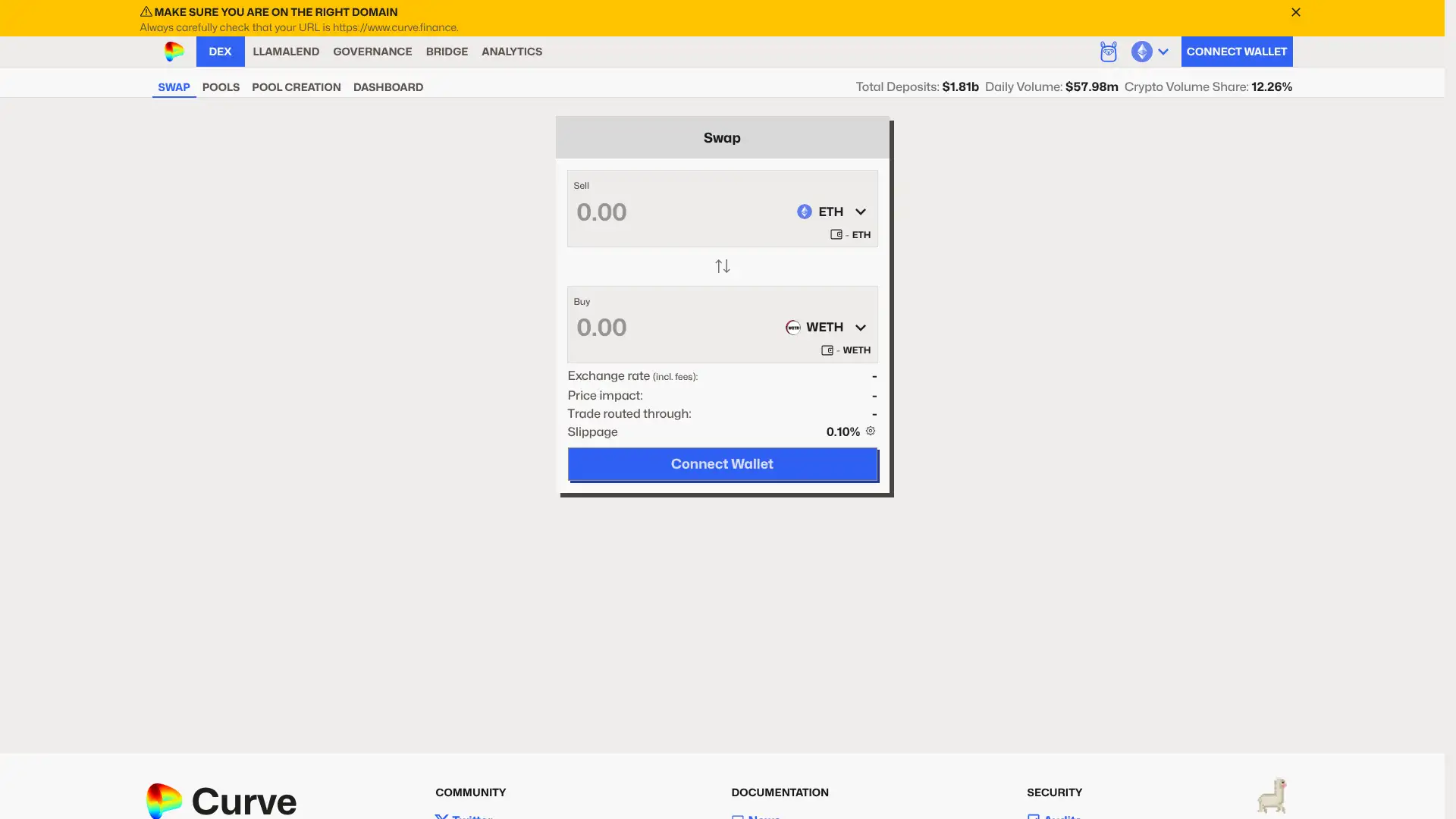
- • StableSwap algorithm: Curve's core innovation — a bonding curve optimized for correlated assets, delivering less than 0.05% slippage on million-dollar USDC/USDT swaps
- • crvUSD: Curve's native stablecoin backed by ETH-linked liquid staking assets, enabling borrow and lend within the Curve ecosystem without leaving the protocol
- • Gauge voting: CRV token holders vote on which liquidity pools receive CRV emission rewards — driving the 'Curve Wars' between DeFi protocols competing for Curve liquidity
- • Convex integration: most Curve LPs maximize returns via Convex Finance, which boosts CRV rewards and distributes cvxCRV — reducing the need for Curve's complex vote-locking directly
- • 15+ chain deployment: Ethereum, Arbitrum, Optimism, Polygon, Avalanche, Base, Fantom, and many others — Curve's pools are foundational DeFi infrastructure across all major chains
Curve is the go-to DEX for any swap involving stablecoins or correlated assets above $50,000 in size. Its StableSwap algorithm delivers slippage that no competitor can match at scale. For newcomers and small trades, the complexity doesn't justify using Curve directly — let 1inch route through it automatically when it finds the best rate.
1inch
1inch is a DEX aggregator and intent-based swap protocol operating across 13+ blockchain networks including Ethereum, Arbitrum, BNB Chain, Polygon, Avalanche, Base, Solana, and others. The 1inch Fusion+ system splits trades across multiple liquidity sources — Uniswap, Curve, SushiSwap, Balancer, and 300+ others — to minimize price impact and MEV exposure. There is no 1inch platform fee on aggregated swaps — users pay only the underlying pool fees and gas. The 1inch Wallet provides native swap access and supports hardware wallets.
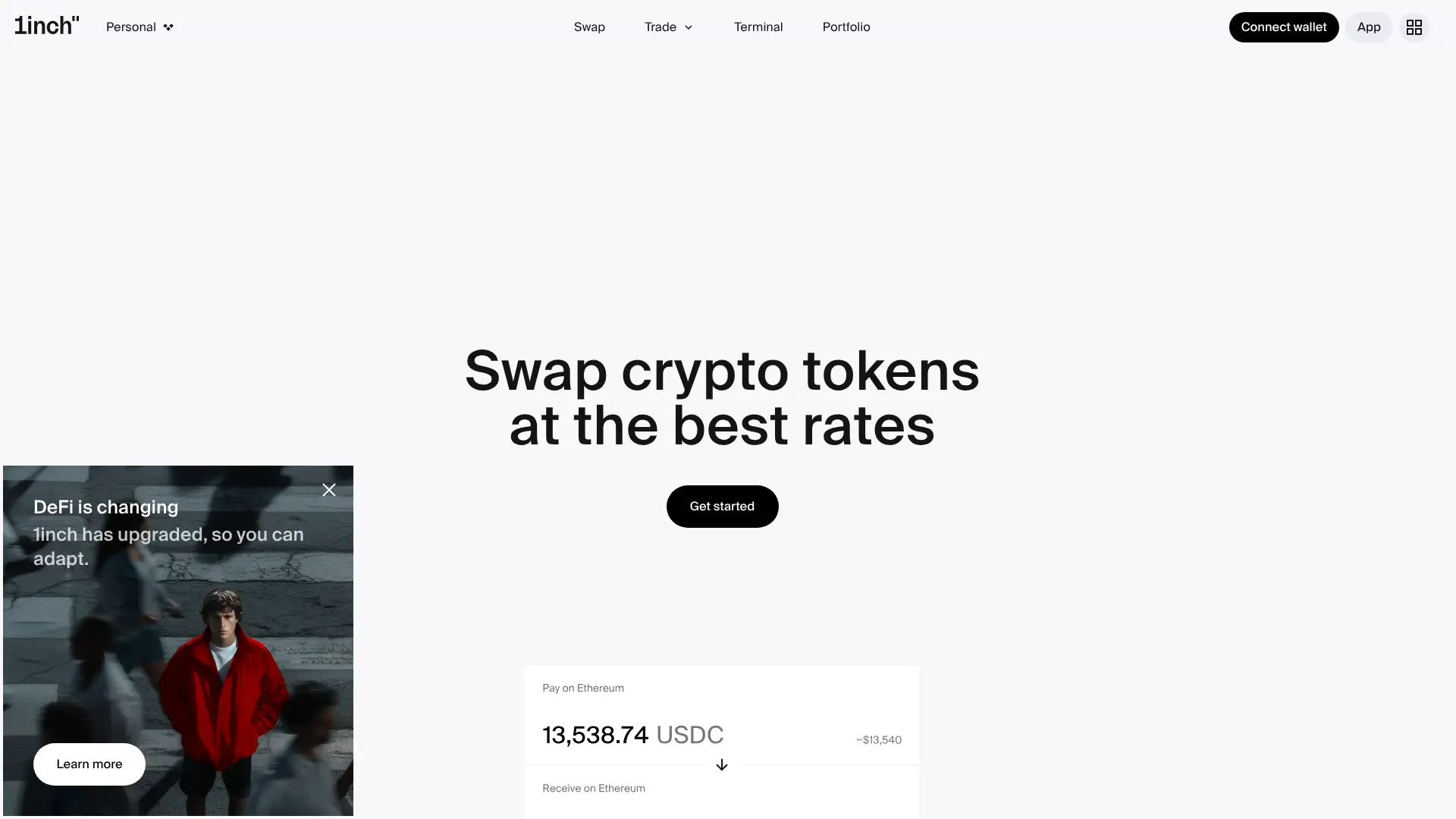
- • 300+ liquidity source routing: 1inch scans Uniswap v2/v3/v4, Curve, SushiSwap, Balancer, PancakeSwap, and 295+ others simultaneously for the best split-route execution
- • Fusion+ intent-based swaps: users submit swap intents signed off-chain; independent solvers compete to fill the order optimally — eliminating frontrunning MEV at the intent layer
- • 0% platform fee: 1inch charges no additional fee on top of the underlying DEX pool fees — pure routing value with no extraction from users
- • 13+ chain support: Ethereum, Arbitrum, Optimism, BNB Chain, Polygon, Gnosis, Avalanche, Fantom, Base, zkSync Era, Linea, Solana, and more
- • Limit orders: 1inch supports gasless limit orders via the Fusion mode, allowing traders to set target prices that solvers fill when market conditions are met
1inch should be the default starting point for any DeFi swap on Ethereum or its L2s. The zero platform fee and 300+ source routing consistently deliver better prices than going directly to Uniswap or SushiSwap. Fusion+ makes it the safest option against MEV on large trades. On Solana, use Jupiter instead.
PancakeSwap
PancakeSwap is the dominant DEX on BNB Chain with over $2.3 billion in TVL, and has expanded to 8 additional chains including Ethereum, Arbitrum, Base, zkSync, Linea, and Solana. Pool fees range from 0.01% to 0.25% depending on the pool tier, significantly below Uniswap's standard 0.30%. BNB Chain gas fees are typically under $0.05 per transaction. PancakeSwap also offers perpetual futures, prediction markets, crypto lotteries, and yield farms. CAKE is the native governance and reward token.
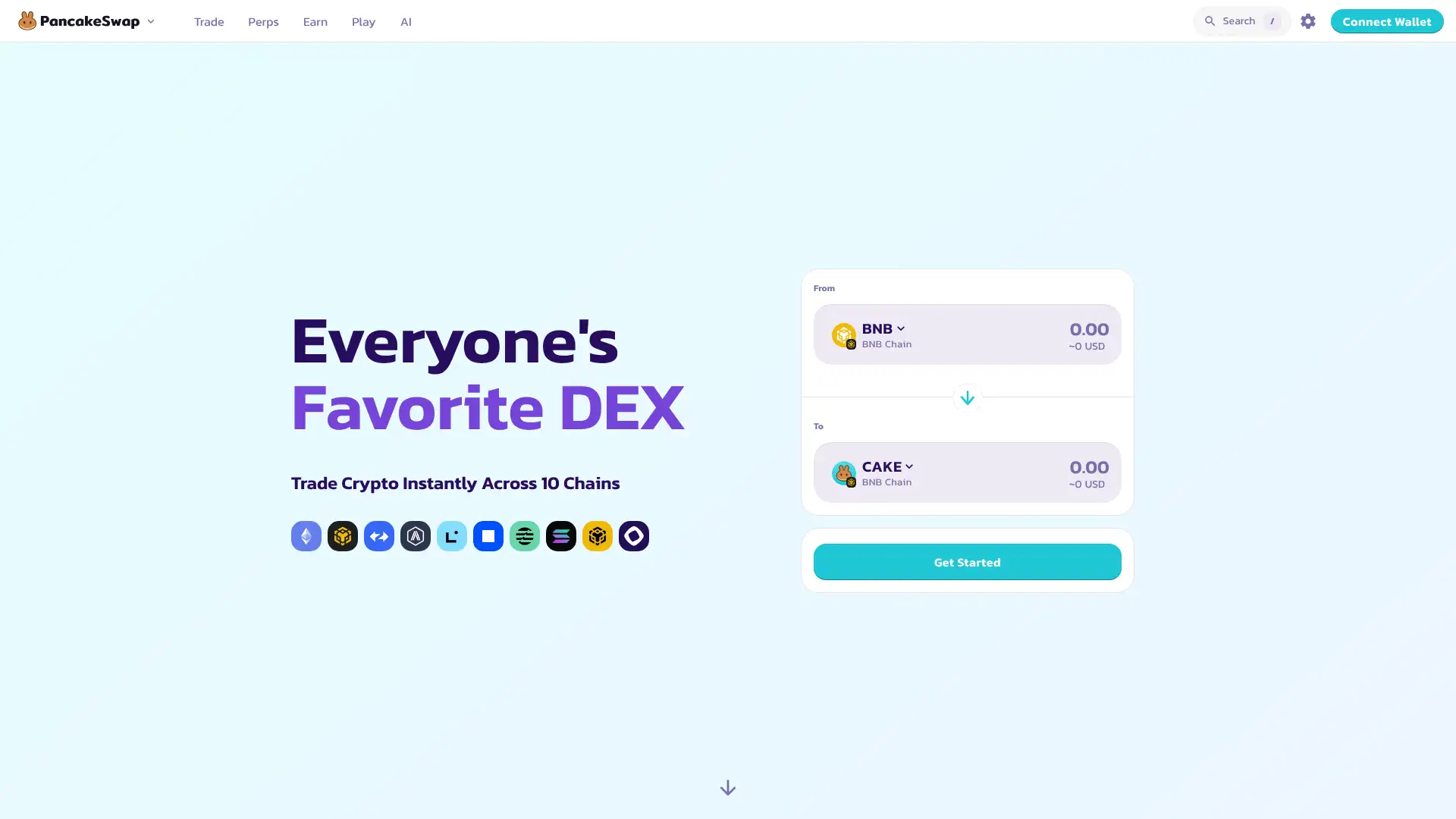
- • Lowest pool fees in the DEX market: PancakeSwap v3 caps standard pairs at 0.25%, versus Uniswap's 0.30% standard — saves 17% on the pool fee component vs Ethereum DEXs
- • Sub-$0.05 BNB Chain gas: transaction costs on BNB Chain are 100-200x cheaper than Ethereum mainnet — PancakeSwap is one of the most cost-effective DEXs for small trades
- • 8-chain deployment: Ethereum, BNB Chain, Arbitrum, Base, zkSync Era, Linea, Solana — increasingly multi-chain but BNB Chain remains the liquidity home
- • Perpetual futures: non-custodial perpetuals trading directly from your wallet, expanding PancakeSwap beyond pure spot swaps
- • CAKE token: used for governance voting, liquidity mining rewards, and pool boosting via veCAKE — the BNB Chain equivalent of Curve's veCRV model
PancakeSwap is the best DEX for BNB Chain trading — it offers lower fees than Uniswap's standard tier, sub-$0.05 gas, and deep BNB-native liquidity in one accessible interface. For Ethereum-native tokens, Uniswap or 1inch are better starting points. PancakeSwap's multi-chain expansion is growing but has not yet reached critical liquidity mass outside BSC.
Orca
Orca is a native Solana AMM DEX focused on simplicity and user experience, featuring a clean interface that makes concentrated liquidity (Whirlpools) accessible to non-experts. Orca is consistently one of the top 2 Solana DEXs by trading volume alongside Raydium. Pool fees range from 0.01% for stablecoin pairs to 1.00% for exotic pairs; most standard token pairs are 0.05%-0.30%. Solana transaction costs are under $0.01. Orca is regularly cited as the most user-friendly DEX on Solana for retail traders.
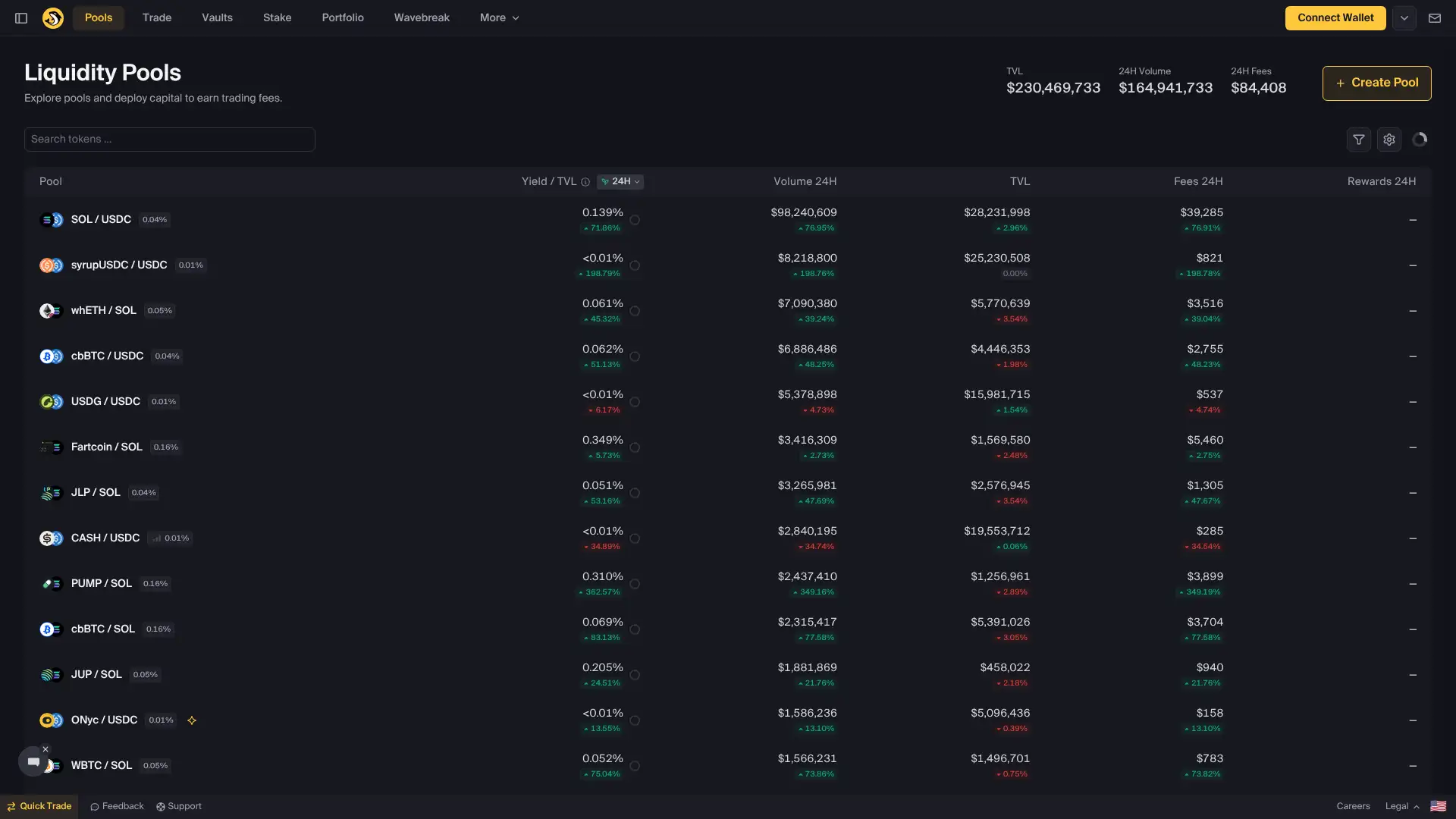
- • Whirlpools concentrated liquidity: Orca's implementation of concentrated LP positions (matching Uniswap v3) is presented in a significantly more accessible UI — LPs can set ranges without advanced DeFi knowledge
- • Sub-second confirmations: Solana block times under 400ms mean Orca swaps complete before most CEX interfaces have rendered a confirmation screen
- • Simple swap UX: Orca's interface strips away the complexity of pool management — just enter token amounts, review slippage, and confirm — ideal for Solana newcomers
- • Ecosystem depth: Orca has deep liquidity on SOL, USDC, USDT, and major Solana-native tokens, and is a primary liquidity venue for SPL token launches
- • ORCA token: governance token that earns a share of pool fees when staked — LP providers can additionally earn ORCA rewards on incentivized pools
Orca is the cleanest Solana DEX for straightforward swaps and LP management. Most users will find that starting with Jupiter automatically routes through Orca when it offers the best rate, making direct Orca use redundant for swapping. Orca's standalone value is in its LP management interface — if you want to provide concentrated liquidity on Solana without the complexity of Raydium's interface, Orca is the right tool.
Raydium
Raydium is a Solana-native AMM and liquidity hub that introduced hybrid order book and AMM liquidity in 2021. It is the primary venue for new Solana token launches, particularly meme coins and community tokens, as creating a Raydium pool requires minimal setup. Standard pool fees are 0.25%. Raydium's Concentrated Liquidity Market Maker (CLMM) pools offer variable fee tiers from 0.01% to 1.00%. RAY is the native governance token. PumpSwap (a Pump.fun product) has challenged Raydium's meme coin dominance in 2025, but Raydium retains significant launch volume.
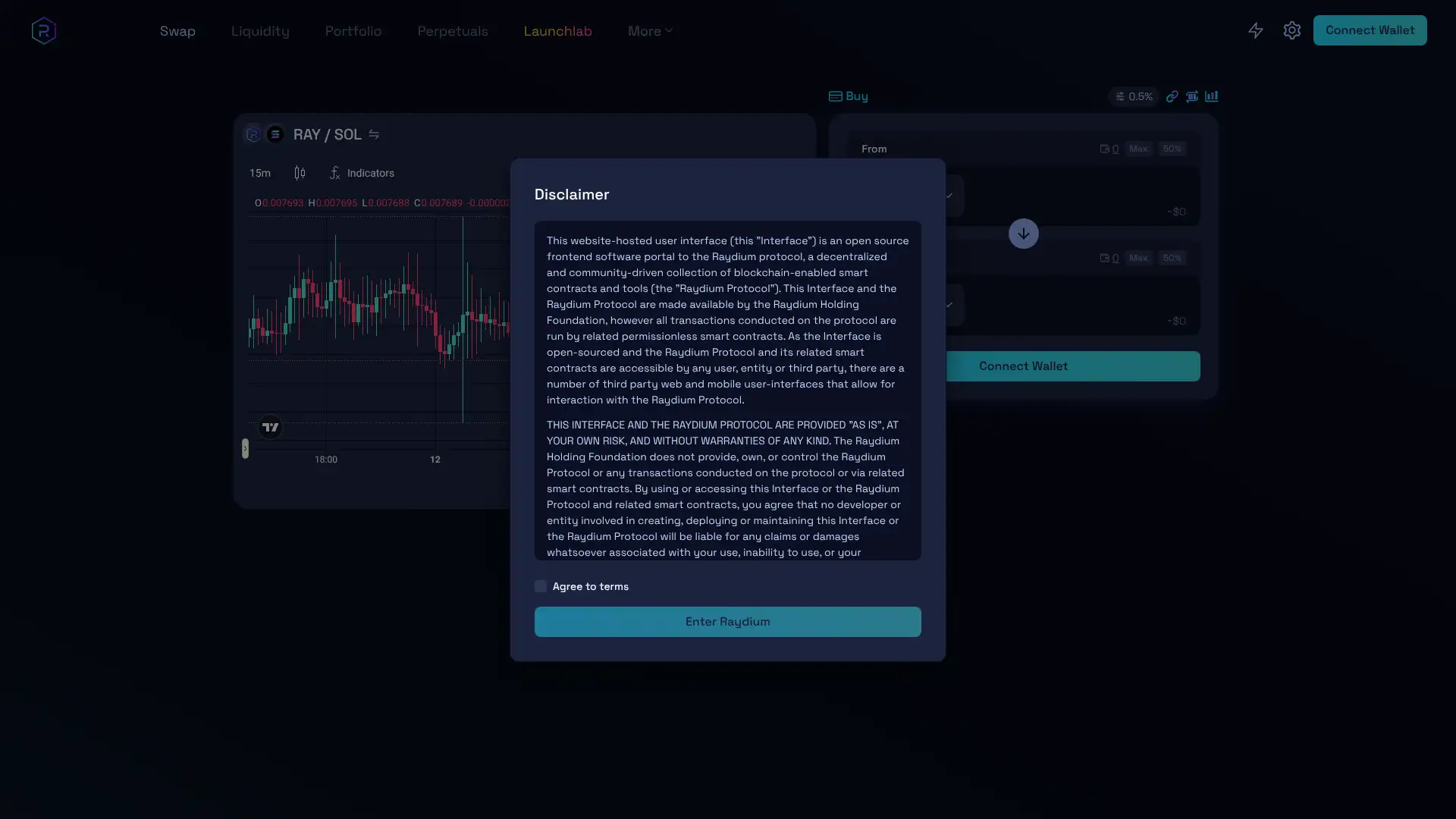
- • Meme coin launch liquidity: Raydium is the most common venue where new Solana tokens create their first liquidity pool — essential for traders who want exposure at or near launch
- • CLMM (Concentrated Liquidity): Raydium's v3-equivalent implementation allows LPs to earn more fees on active price ranges, compatible with Jupiter routing for optimal aggregation
- • RAY buyback: 0.03% of every AMM swap is used to buy back RAY from the open market — a deflationary mechanism integrated into the fee structure
- • Permissionless pool creation: any Solana token holder can create a Raydium pool immediately, making it the default for project teams launching new tokens on Solana
- • Jupiter integration: Raydium pools are a primary liquidity source for Jupiter's Metis router — Raydium and Orca together handle the majority of Jupiter's routing
Raydium is the essential Solana DEX for meme coin launch trading — if a new Solana token is trending, it likely appeared on Raydium first. For everything else, Jupiter automatically routes through Raydium when it offers the best price. The rug-pull risk is real: use a contract address verifier and trade small until a project proves itself.
Changelly
Changelly launched in 2015 and operates as a non-custodial instant swap platform aggregating rates from 20+ exchanges and DEXs to find the best crypto-to-crypto exchange rate. It supports 1,000+ assets across 185 blockchains. Changelly charges a fixed 0.25% exchange fee on every transaction, plus network fees. A fixed-rate option is available but includes a spread to lock the quoted price. US users are not accepted. Changelly Pro (a separate product) offers futures and margin trading with fees from 0.0% to 0.1% for professional traders.
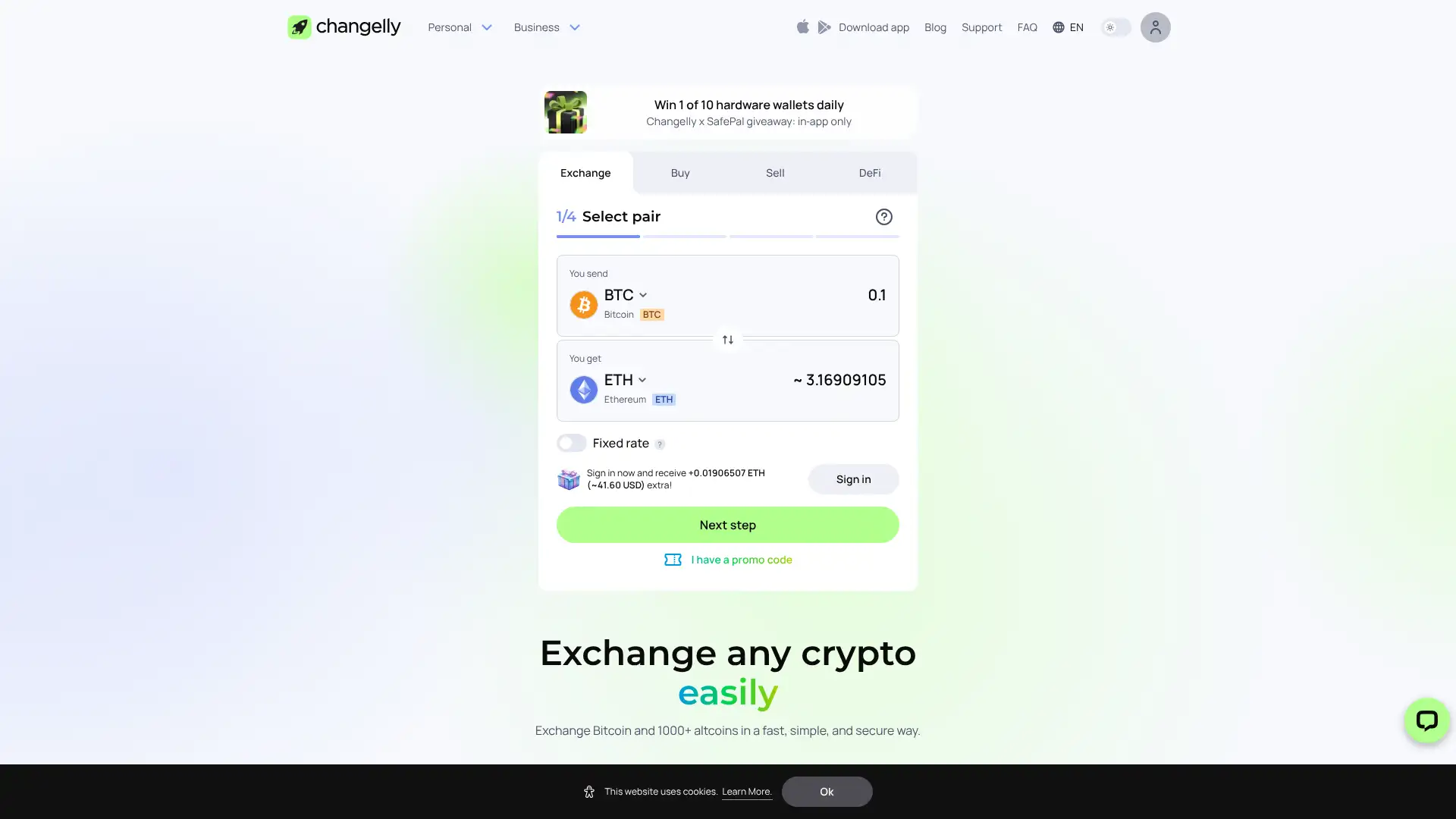
- • Non-custodial: users send crypto to Changelly's address and receive the swapped asset to their personal wallet — Changelly never holds user funds beyond the brief swap window
- • No mandatory KYC for standard swaps: basic swaps proceed without identity verification unless flagged by the risk system — one of the few compliant non-KYC swap platforms
- • 1,000+ asset support across 185 blockchains: covers tokens on chains that DEXs don't natively support, including Bitcoin pairs and cross-chain swaps
- • 350+ API partners: integrated with Exodus wallet, Ledger, Trezor, and Tonkeeper — Changelly powers the in-wallet swap functionality for many self-custody users
- • Fixed rate option: users can lock an exchange rate for the duration of the transaction — useful for large swaps where price slippage during processing is a concern
Changelly is genuinely useful for cross-chain swaps involving assets on chains with no native DEX liquidity (like Bitcoin-to-Solana), or for users who want to swap directly within their Ledger or Trezor wallet interface. For EVM chain token swaps, 1inch provides better rates at zero platform fee. Avoid Changelly for regular high-volume trading — the 0.25% flat fee adds up quickly.
SwissBorg
SwissBorg is a Swiss-engineered crypto wealth management app licensed in Estonia and France, serving users in 115+ countries (not US). It supports 50+ cryptocurrencies and aggregates liquidity from 10+ CEXs and DEXs via its Smart Engine to minimize spread on every trade. Standard account exchange fees are 0.99% (reduced from 1.49% in September 2025). Premium tiers tied to locked BORG tokens reduce fees further: Explorer (1,000 BORG) pays 1%, Community/Pioneer pays 0.75%, Generation pays 0.5%, Genesis pays 0.25%. A 'Paid to Trade' cashback system returns a portion of fees in BORG weekly, with Elite ranks capable of up to 99% cashback.
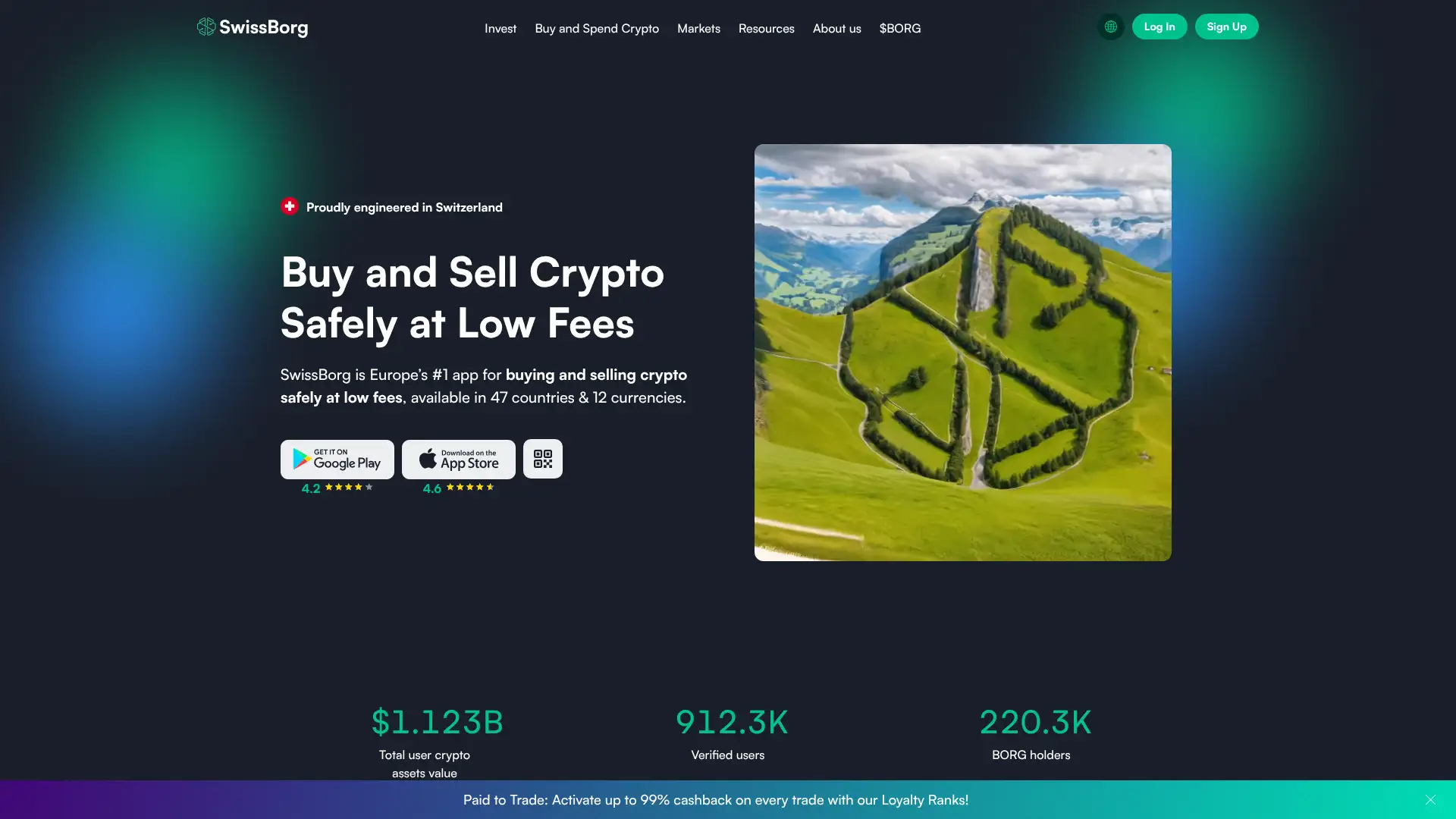
- • Smart Engine: aggregates liquidity from Binance, Kraken, Orca, and 8+ other venues simultaneously to find best execution price — no spread added on top of the exchange fee
- • Paid to Trade: cashback model returns a portion of exchange fees in BORG weekly, funded by a market buyback mechanism — up to 99% cashback for the highest Dynamic Elite Ranks
- • Crypto Earn: yield products on BTC, ETH, USDC, and 30+ assets with flexible and fixed terms; rates vary by asset and are distributed daily
- • BORG loyalty system: 14-day cooldown (not 12-month lock) for unlocking BORG — significantly more flexible than earlier locking mechanics
- • EU-licensed operation: Estonian and French financial authority licenses give SwissBorg one of the strongest regulatory footprints of any crypto wealth app serving the European market
SwissBorg is best suited for European investors who value regulatory compliance, automated best-price routing, and daily yield on idle crypto over low trading fees. The 0.99% base fee makes it unsuitable as a primary trading platform for anyone executing more than a few trades per month. Use SwissBorg for DCA purchases, Earn products, and portfolio management — use Kraken or Binance for active trading.
Nexo
Nexo was founded in 2018 and manages assets for over 7 million users across 150+ jurisdictions. It relaunched in the US on February 16, 2026 with a compliance-first structure under regulated US entity partnerships. The platform offers crypto-backed credit lines (2.9%-18.9% APR), savings with up to 12% on stablecoins and 5% on BTC, spot exchange via Nexo Pro, and a dual debit/credit Nexo Card. Spot trading fees on Nexo Pro start at 0.20% maker and 0.20% taker for monthly volume under $10,000. NEXO token holders receive benefits including lower borrow rates and fee reductions at higher loyalty tiers.
- • Crypto-backed credit line: borrow stablecoins or fiat starting at 2.9% APR using BTC, ETH, and 900+ crypto assets as collateral without selling your positions
- • Nexo Card: dual debit and credit mode — credit mode borrows against crypto collateral automatically; debit mode spends stablecoin balances with up to 2% cashback
- • Nexo Pro: full order-book trading terminal with TradingView charts, real-time news sentiment analysis, and on-chain whale activity alerts
- • Smart order router: automatically splits large exchange orders across multiple liquidity venues for best price execution, supporting swaps of up to $3 million
- • Nexo Private: institutional OTC desk for large-clip trades with a dedicated relationship manager and access to aggregated deep liquidity
Nexo is the strongest CeFi platform for crypto holders who want to borrow against their positions or earn yield without leaving centralized custody. The February 2026 US relaunch makes it accessible to American users for the first time in years. For pure trading, the 0.20% base spot fee is uncompetitive versus Binance or OKX — use Nexo for its lending and Earn products, and a separate exchange for active trading.