What is 2048?
2048 is a single-player sliding puzzle game played on a 4x4 grid where you swipe numbered tiles in four directions and merge matching pairs to double their value, with the goal of building one tile that displays the number 2048. After every move a new tile appears in a random empty spot so the board slowly fills up, and once it is full with no merges left the game is over. AIFreeForever includes an undo button because one bad swipe should not erase ten minutes of progress.
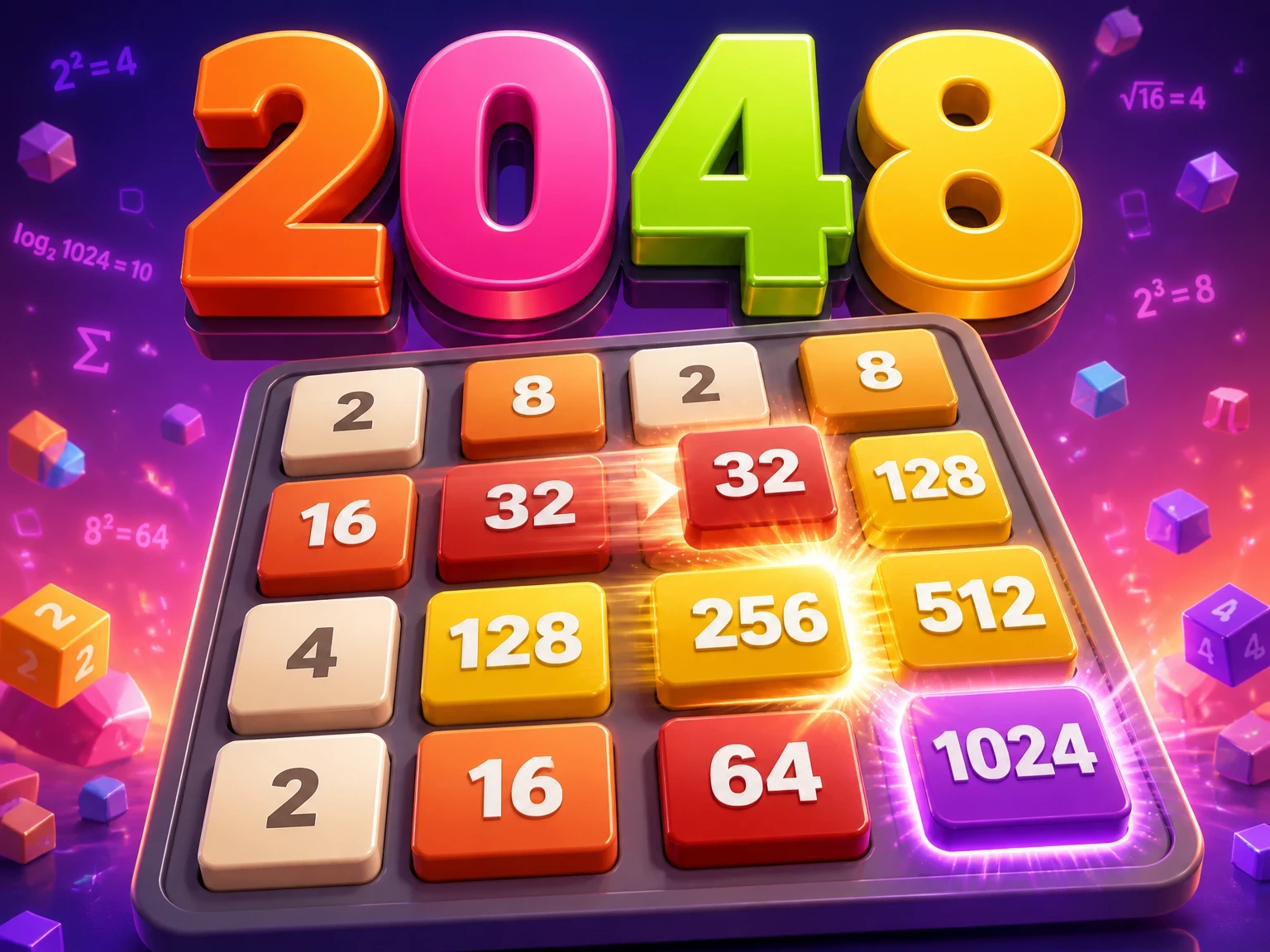
2048 by AIFreeForever
2048 by AIFreeForever is a free browser game you can play online without downloading anything. It features four game modes (Classic, Rush, Zen and Challenge), three grid sizes (4x4, 5x5 and 6x6), merge sound effects and a full game-style interface with settings and stats.
What AIFreeForever improved in 2048 is the variety, because most browser versions give you one grid and one mode while AIFreeForever offers three grid sizes and four modes so you can practice on a forgiving 6x6 board or race the clock in Rush without the core puzzle getting stale.
Starting Board: Two Tiles, Four Directions
When you start a new game of 2048 on AIFreeForever, you will see a 4x4 grid with two randomly placed tiles showing either a 2 or a 4, and from here you can swipe in any of the four directions to begin merging.
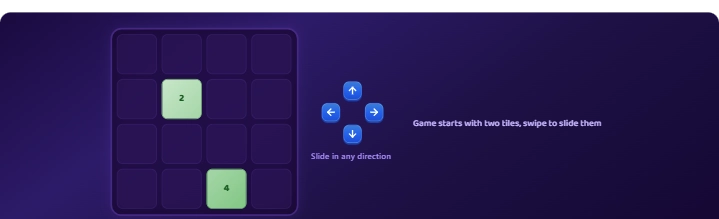
2048 Start Board screenshot on AIFreeForever
Beyond 2048: Chase Higher Tiles
Once you reach the 2048 tile, the game on AIFreeForever does not end because a Keep Going button lets you continue merging toward 4096, 8192 and beyond while your score keeps climbing.

2048 Goal Tile screenshot on AIFreeForever
How to Win the 2048 Game on AIFreeForever
In order to win the game of 2048, a player must merge tiles until one tile displays the number 2048, and since there is no timer or opponent the only real pressure comes from the board filling up with unmergeable tiles. On AIFreeForever a Keep Going button appears on the win screen so you can chase 4096 or higher without losing your board.
The Win Screen: What Victory Looks Like
If you see a glowing 2048 tile on the board with a You Win overlay, that means you have successfully merged your way through eleven doubling steps and the game considers you the winner.
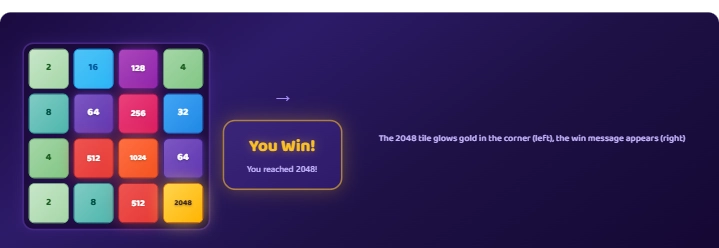
2048 Win Board screenshot on AIFreeForever
The most reliable path to victory is the corner strategy, where you pin your biggest tile in one corner, line up the next-biggest tiles along that edge like a descending staircase, and limit your swipes to two directions. AIFreeForever recommends this approach because it turns a chaotic puzzle into a methodical build, and following it consistently will get you to 2048 far more often than swiping at random.
How Merging Works: Same Numbers Combine
When you swipe and two tiles with the same number collide, they fuse into a single tile worth double the value, so two 2s become a 4, two 4s become an 8, and the chain continues all the way up to 2048 and beyond.
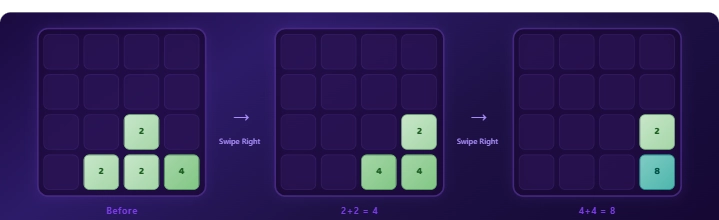
2048 Merging screenshot on AIFreeForever
Game Over: Full Board, No Matches Left
If every cell on the board is filled and no two adjacent tiles share the same number, the game ends because there are no possible merges left, which is the scenario the illustration below depicts with a full board and a Game Over message.
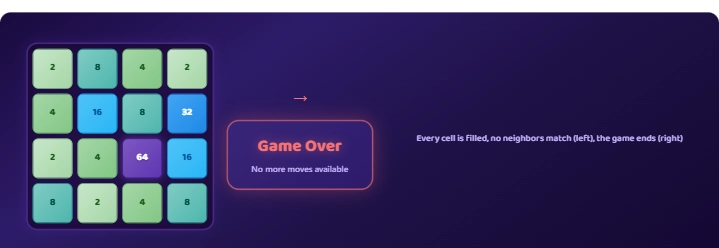
2048 Board Filling screenshot on AIFreeForever
The Corner Strategy: Keep Your Biggest Tile Locked
The illustration below shows the corner strategy in action, where the highest-value tile stays pinned in one corner while the next-biggest tiles line up along the edge in descending order, forming a staircase that lets you merge efficiently without displacing your largest tile.

2048 Corner Strategy screenshot on AIFreeForever
Where does the number 2048 come from and why is it the goal?
2048 is 2 to the power of 11. Each merge doubles the number: 2, 4, 8, 16, 32, 64, 128, 256, 512, 1024, 2048. The game is named after that 11th step in the chain.

2048 Doubling Chain screenshot on AIFreeForever
What do I actually see on screen when I win?
The 2048 tile appears in bold text and a You Win overlay pops up. You can keep playing for a higher score or start fresh.
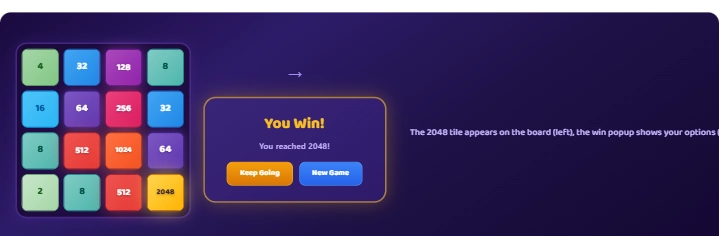
2048 Win Screen screenshot on AIFreeForever
Can I keep playing after reaching 2048?
Yes, you can hit Keep Going and chase 4096, 8192 or beyond, and your score keeps climbing as long as moves remain.
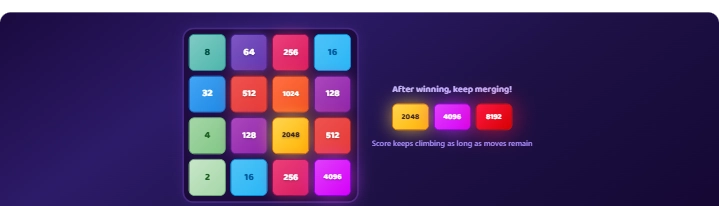
2048 Keep Going screenshot on AIFreeForever
Is it possible to run out of moves before reaching 2048?
Yes, if the board fills up with no adjacent matching tiles the game is over, which is why AIFreeForever includes an undo button to recover from a single bad swipe.
What is the corner strategy and why does everyone recommend it?
Pick one corner, keep your biggest tile there, and build a descending chain along the edge. It works because it stops your biggest tile from getting trapped in the middle.
Why do new tiles only show 2 or 4 and not bigger numbers?
New tiles appear as a 2 (90% chance) or a 4 (10% chance), which forces you to build up through merging because bigger random tiles would remove most of the challenge.
How many moves does it take to win on average?
It takes roughly 1,000 moves on average, though skilled players using the corner strategy can reach 2048 in fewer.
What happens if I swipe in a direction and nothing moves?
Nothing happens and no new tile spawns unless the board actually changes, which is by design so you are never penalized for an impossible swipe.
Is there a maximum possible tile beyond 2048?
The theoretical maximum on a 4x4 board is 131,072 (2 to the power of 17), though in practice anything beyond 8192 requires near-perfect play.
History of 2048
Gabriele Cirulli, a 19-year-old Italian developer, built 2048 over a single weekend in March 2014 as a programming exercise inspired by 1024 by Veewo Studio and Threes by Asher Vollmer, and he open-sourced it on GitHub immediately.
The game hit 100 million plays within its first week and spawned hundreds of clones and spin-offs, yet Cirulli never charged for it, and that open-source spirit is something AIFreeForever respects, which is why the AIFreeForever version is also completely free with no ads or paywalls.
Types of 2048
Classic 4x4
Classic 4x4 is the original version of 2048 played on a four-by-four grid where you slide numbered tiles in any direction, merge matching pairs to double their value, and try to reach the 2048 tile, and this is the version AIFreeForever built as the default mode with all four game modes available.
Standard 4×4 Grid Layout
The grid below shows a typical mid-game board on the classic 4x4 layout, where numbered tiles occupy some cells while empty cells remain available for new tiles to appear after each swipe.

Classic 4x4 2048 screenshot on AIFreeForever
5x5 and 6x6 Variants
With the 5x5 and 6x6 Variants the grid expands beyond the standard four-by-four layout, giving you more cells to work with and more breathing room to set up chain merges, and AIFreeForever built both sizes into the game because beginners often get stuck on the tight 4x4 board.
Bigger Boards, More Room to Merge
The illustration below compares the standard 4x4 grid with the larger 5x5 and 6x6 options available on AIFreeForever, showing how extra rows and columns give you more breathing room to plan merges.
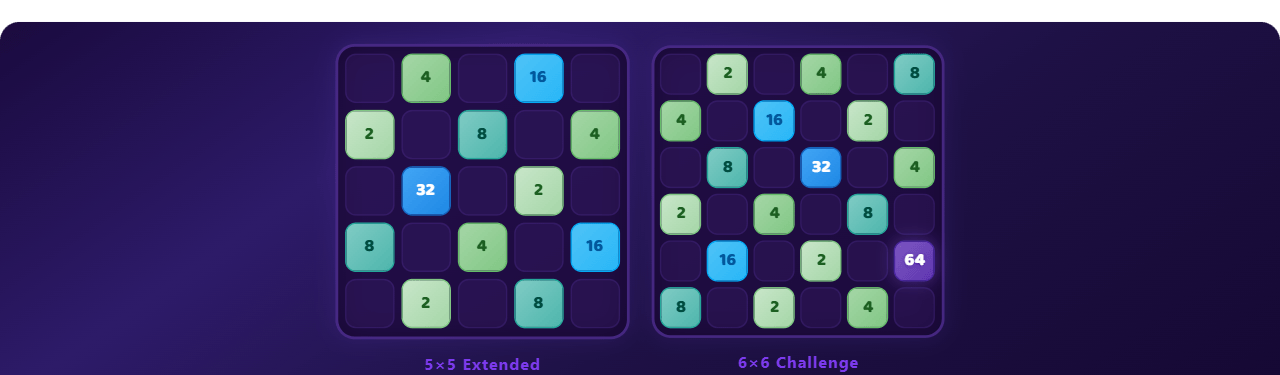
5x5 and 6x6 2048 screenshot on AIFreeForever
3D 2048
3D 2048 stacks the board into a cube where tiles slide along three axes instead of two, making every move decision far more complex than the flat version and not something most browser versions even attempt.
Stacked Layers in 3D Space
In the 3D variant shown below, multiple layers of grids are stacked on top of each other and tiles can slide along three axes instead of two, which dramatically increases the complexity of every move.

3D 2048 screenshot on AIFreeForever
2048 Fibonacci
In 2048 Fibonacci the tiles follow the Fibonacci sequence instead of powers of two, so the board displays numbers like 1, 1, 2, 3, 5, 8, 13 and adjacent Fibonacci numbers merge when they collide, which changes the strategy entirely.
Fibonacci Numbers Instead of Powers of 2
The Fibonacci variant shown below replaces the standard doubling sequence with the Fibonacci sequence, so tiles display numbers like 1, 1, 2, 3, 5, 8, 13 and adjacent Fibonacci numbers merge when they collide.

2048 Fibonacci screenshot on AIFreeForever
2048 Hexagonal
2048 Hexagonal swaps the square board for a honeycomb-shaped hex grid with six slide directions instead of four, and the extra axes create merge angles and chain possibilities that simply do not exist on a rectangular layout.
Hex Grid: Six Directions to Slide
The hexagonal variant shown below uses a honeycomb-shaped grid with six slide directions instead of four, which creates merge angles and chain possibilities that simply do not exist on a square board.

2048 Hexagonal screenshot on AIFreeForever
2048 Multiplayer
In 2048 Multiplayer two players race on separate boards or share one grid, and every swipe applies simultaneously, turning the normally solo puzzle into a head-to-head competition with real time pressure.
Two Players Race Side by Side
In the multiplayer variant shown below, two players each control their own board and every swipe applies to both grids simultaneously, turning the normally solo puzzle into a competitive race to reach 2048 first.

2048 Multiplayer screenshot on AIFreeForever
What Makes Our 2048 Game Fun?
Most 2048 clones give you one grid and nothing else, but AIFreeForever lets you pick your mode and grid size before each game, where Rush adds a countdown timer, Zen removes the game-over condition so you can relax, and Challenge sets a target score you need to hit.
Tiles blast with sound effects when they merge, and the whole interface has beveled buttons, glow effects and a dark purple game-style theme with stats, settings, undo and a home menu always one tap away.
How to Play 2048
Slide tiles
Use arrow keys or swipe to slide all tiles in one direction: up, down, left or right.
Merge matching tiles
When two tiles with the same number collide, they merge into one tile with double the value.
Plan ahead
After every move, a new tile (2 or 4) appears randomly. Plan your moves to avoid filling the board.
Reach 2048
Keep merging tiles to create bigger numbers. Reach the 2048 tile to win the game!
Tips & Strategy
Keep your highest tile in one corner and never move it away from that corner so it stays protected.
Prefer two directions, for example always slide down and right, and only go up or left when absolutely necessary.
Build a chain of descending values along one edge of the board so that tiles merge efficiently into each other.
Never place a small tile between two large tiles because it blocks merges and wastes valuable board space.
Focus on keeping the board as empty as possible since more empty cells means more room to maneuver.
When the board gets crowded, look for chain reactions where one merge sets up another to clear multiple tiles at once.
2048 Statistics & Numbers
| Statistic | Value |
|---|---|
| Grid size | 4 x 4 (16 cells) |
| Starting tiles | 2 tiles (value 2 or 4) |
| Target tile | 2048 (2^11) |
| Maximum possible tile | 131,072 (2^17) |
| Average moves to win | ~1,000 |
| Possible board states | ~10^20 |
| AI win rate (2048 tile) | > 99% |
| Year created | 2014 |
Fun Facts About 2048
The highest possible score in a standard 4x4 game is 3,932,156 points.
Stanford CS221 used 2048 as a final project where students built AI agents using expectimax search.
"Doge 2048" replaced numbers with Shiba Inu memes and hit the front page of Reddit, becoming a viral spin-off of the original.
New tiles have a 90% chance of being a 2 and only a 10% chance of being a 4.
freeCodeCamp and The Odin Project both include building a 2048 clone as a recommended JavaScript project for beginners.
2048 Online Game Strategy for Winning
If your big tile leaves its corner, the most important thing is to focus on getting it back immediately by merging everything around it toward the corner again, because the recovery matters more than the mistake and AIFreeForever added undo specifically for moments like this.
Keeping similar-value tiles next to each other is essential, since two 64s on opposite sides of the board are dead weight that block future merges, whereas maintaining a smooth gradient lets the merges chain naturally.
2048 Online Game in the Real World
Stanford CS221 used 2048 as a final project for AI agents, Robert Xiao at Carnegie Mellon proved the theoretical max tile is 131,072 as covered by Ars Technica, and Khan Academy used the doubling chain to teach exponential growth.
The game's open-source code on GitHub inspired spin-offs like Doge 2048 and 2048 Cupcakes, and AIFreeForever took inspiration from the same codebase but rebuilt the interface from scratch with game modes, sound effects and a settings screen that the original never had.
From the Developers
From the developers
Last Updated: October 1, 2026
We developed the 2048 game on AIFreeForever because the original open-source version only offers a single 4x4 grid with no modes, no undo, and no settings. We rebuilt the interface from scratch with four game modes (Classic, Rush, Zen and Challenge), three grid sizes, merge sound effects, an undo button, and a full settings screen so the experience feels like a polished app rather than a weekend coding exercise.
Connect with us for questions, feature requests, or improvements:
What Users Say
Rated 4.8 out of 5 based on 144+ verified user reviews
Linkon Patrick
US · Jun 14, 2026
This app is over good to use thanks
Mike Baker
US · Jun 12, 2026
Nice service, seems to be free to use, by watching a short ad. Seems to work as it should.
Neetu Parihar
IN · Jun 3, 2026
Awesome tool and great work by developers and the team. Salute to your hardwork and dedication dudes.
Artos Publishing
RS · May 22, 2026
The Aifreeforever is simple and easy to use. From the start I didn't have any problems. Especially, I like the opportunity to work with ChatGPT 5 with no limitations.
Curtis Baker
US · May 2, 2026
With all these ridiculous prices on the over hyped AI competitors. I can't thank you, Aifreeforever, enough! Thank you for looking out for "We The People!"
Mohsen
IR · Jun 10, 2026
it was best experience
Share Your Comments & Feedback
Enjoying 2048 on AIFreeForever? Have a high score to share or a suggestion for a new mode? We would love to hear from you.