Julian Date Converter
A Julian date converter transforms Julian date codes used in manufacturing, food packaging, and military applications into standard calendar dates and vice versa. Enter a Julian date code or calendar date in the panel to instantly see the conversion.
Today's Julian Date
What Is a Julian Date?
A Julian date is a compact numeric code that identifies a specific date by encoding the year and the day of the year (1 through 365 or 366) into a single number. Unlike standard calendar dates that express month and day separately, Julian date codes collapse the entire date into a short numeric string, making them efficient for stamping on physical products, batch records, and logistics labels where space is limited and machine readability is important.

The term "Julian date" in industrial and commercial contexts refers specifically to this manufacturing date code format and is distinct from the astronomical Julian Day Number, which is an entirely different system used in astronomy. When you see a five or seven digit code on a food package or product label, that is a manufacturing Julian date.
Julian Date in Manufacturing
In manufacturing, a Julian date code stamps a product with the exact date it was made or packaged. A code like 24156 means the product was produced on day 156 of the year 2024 — which is June 4, 2024. This compact format is used across food production, pharmaceutical manufacturing, military supply chains, and industrial parts manufacturing because it is shorter than a full date, sorts chronologically in numerical order, and is easy to print on small labels or directly stamp on packaging.
Julian Day Number (Astronomical)
The astronomical Julian Day Number is an unrelated system used by astronomers and scientists to express any date as a continuous count of days since January 1, 4713 BC (the Julian Period epoch). For example, January 1, 2000 corresponds to Julian Day Number 2,451,545. This system eliminates month and year complexity for calculating time intervals between events. When most people search for a Julian date converter, they are looking for the manufacturing code format — not the astronomical Julian Day Number.
How to Read Manufacturing Date Codes
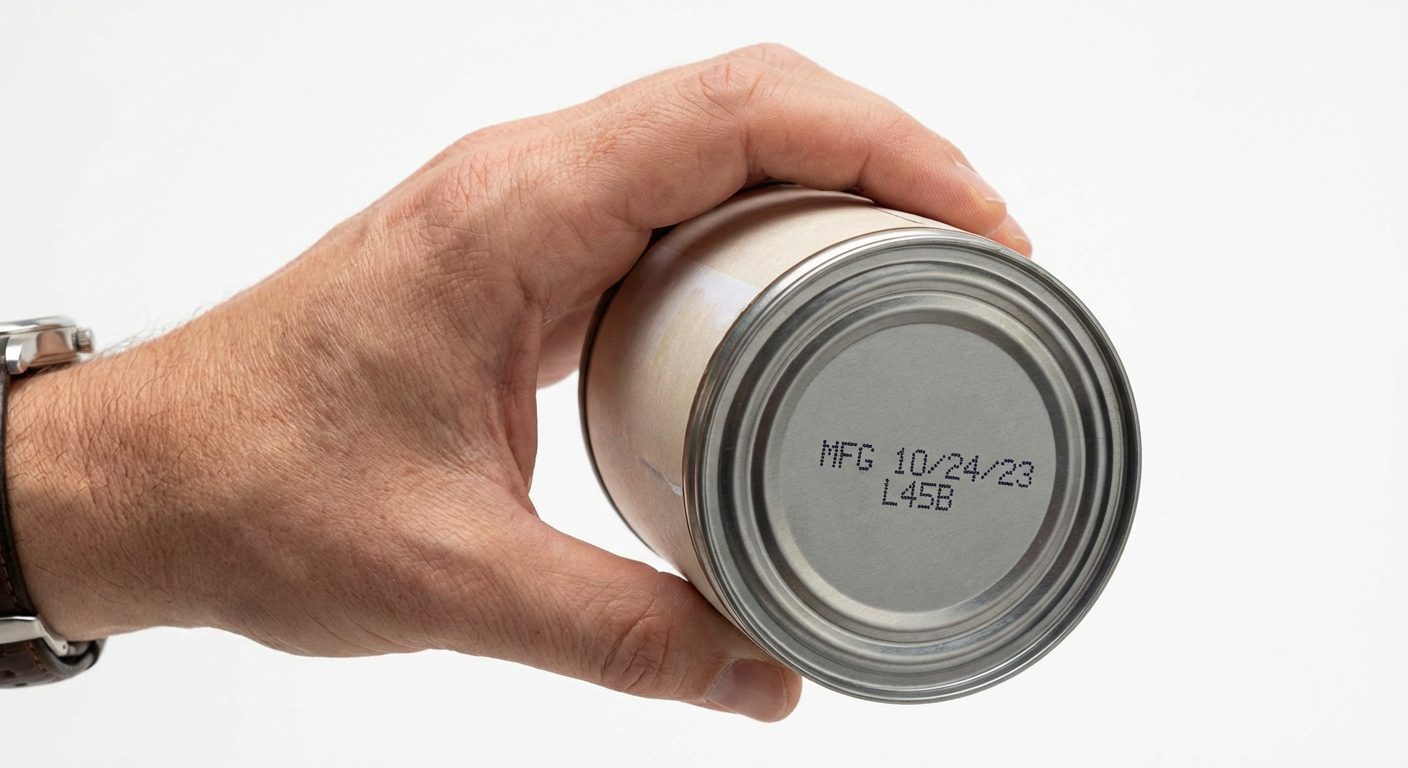
Manufacturing date codes appear in two main formats depending on the industry and country. Both encode the same information — the year and the day of the year — but differ in how many digits are used for the year component.
YYDDD Format Explained
YYDDD is a 5-digit Julian date code where the first two digits represent the last two digits of the year and the last three digits represent the day of the year. For example:
When using YYDDD codes, the two-digit year is interpreted with a century cutoff: years 00 through 50 are treated as 2000–2050, and years 51 through 99 are treated as 1951–1999. This is the most common format found on food packaging, canned goods, dry products, and consumer goods in the United States.
YYYYDDD Format
YYYYDDD is a 7-digit Julian date code where the first four digits are the full four-digit year and the last three digits are the day of the year. This format eliminates ambiguity for the year value and is used in pharmaceutical manufacturing, aerospace, defense, military supply chains, and regulated industries where records must be retained for decades.
Julian Date Chart
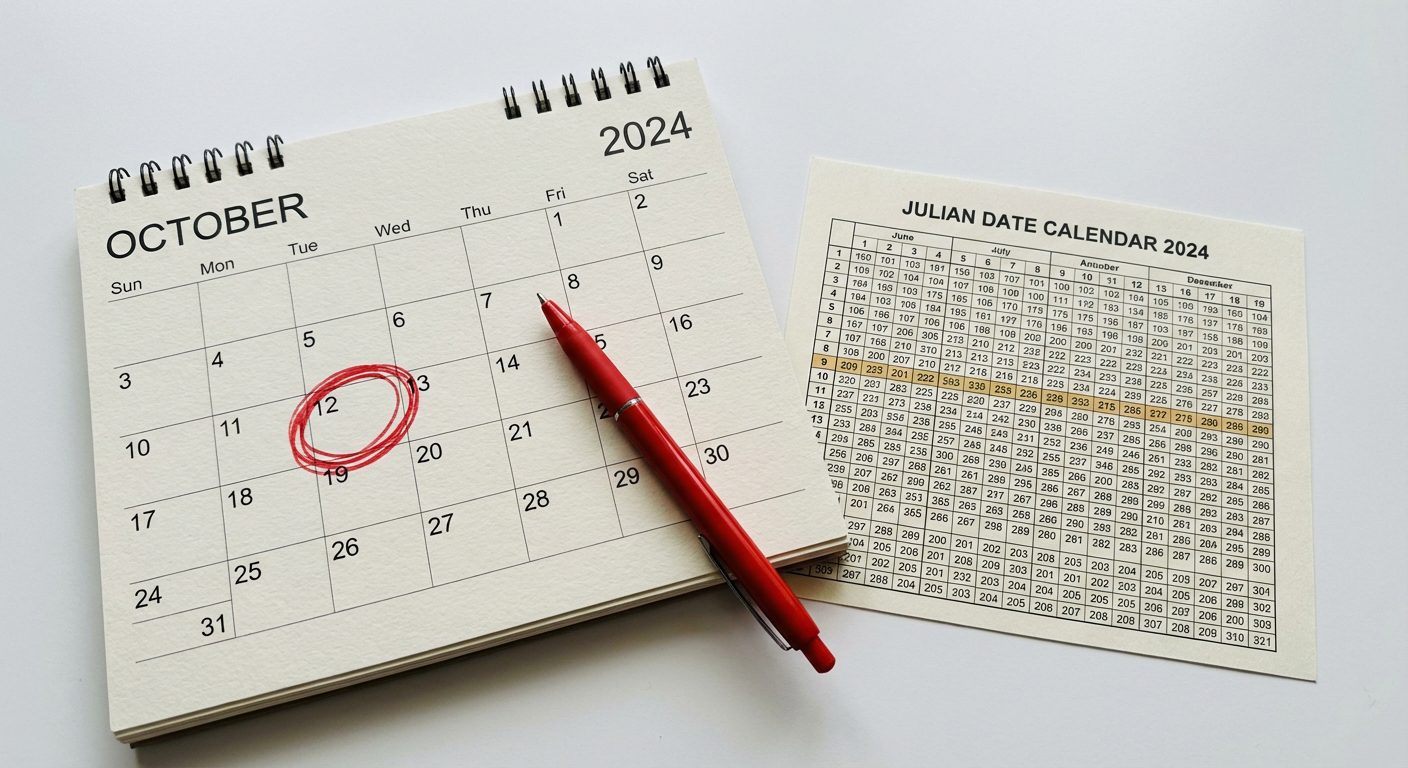
Use this reference chart to find the Julian day range for each month of a standard (non-leap) year. In a leap year, add 1 to all days after February 28 (starting from March 1 onward).
| Month | First Day (DDD) | Last Day (DDD) | Days in Month |
|---|---|---|---|
| January | 001 | 031 | 31 |
| February | 032 | 059 | 28 |
| March | 060 | 090 | 31 |
| April | 091 | 120 | 30 |
| May | 121 | 151 | 31 |
| June | 152 | 181 | 30 |
| July | 182 | 212 | 31 |
| August | 213 | 243 | 31 |
| September | 244 | 273 | 30 |
| October | 274 | 304 | 31 |
| November | 305 | 334 | 30 |
| December | 335 | 365 | 31 |
Leap year note: In a leap year (e.g. 2024), February has 29 days, so March 1 becomes day 061 and all subsequent month start days increase by 1. December 31 becomes day 366.
How to Convert Julian Date to Calendar Date
To convert a Julian date code to a calendar date manually, follow these steps:
- Identify the format. Count the digits. A 5-digit code uses YYDDD format. A 7-digit code uses YYYYDDD format.
- Extract the year. For YYDDD, take the first 2 digits and add 2000 (for 00–50) or 1900 (for 51–99). For YYYYDDD, the first 4 digits are the year directly.
- Extract the day of year. Take the last 3 digits. This is the day of the year, from 001 (January 1) to 365 (December 31) or 366 in a leap year.
- Convert the day of year to a calendar date. Count forward from January 1, subtracting the days in each month until you find the correct date. The Julian date chart above helps with this step. Alternatively, use the converter tool in the panel on the left.
- Check for leap years. If the year is a leap year (divisible by 4, except century years not divisible by 400), February has 29 days and the day ranges shift accordingly from March onward.
How to Convert Calendar Date to Julian Date
To manually convert a standard calendar date to a Julian date code:
- Determine the day of year. Add up the number of days from January 1 up to and including your target date. For example, March 5 = 31 (Jan) + 28 (Feb, non-leap) + 5 = 64, so it is day 064.
- Format the year. For YYDDD, use the last two digits of the year. For YYYYDDD, use the full four-digit year.
- Pad the day to three digits. Day 64 becomes 064. Day 5 becomes 005. Day 365 stays 365.
- Combine year and day. Concatenate the year digits with the padded day digits. Year 2024, day 064 in YYDDD format = 24064. In YYYYDDD format = 2024064.
Common Uses for Julian Dates
Food Expiration Codes
Many food manufacturers use Julian date codes on packaging to indicate the production date or expiration date. Canned goods, dried foods, snack packages, and beverages may print a Julian code alongside or instead of a conventional date. For example, a can of soup stamped 24300 was produced on day 300 of 2024 — October 26, 2024. Understanding how to read these codes helps consumers verify freshness, check lot numbers in recalls, and confirm shelf life. The FDA food date labeling guidance notes that manufacturers are responsible for determining the format of date stamps on their products.
Military Date Tracking
The United States military uses Julian date codes extensively for supply chain management, ammunition dating, ration stamping (MRE packages), parts tracking, and logistics documentation. Military Julian dates typically use the YYYYDDD 7-digit format to avoid century ambiguity. Every component of a military system — from food rations to aircraft parts — may carry a Julian production or expiration code that supply personnel must be able to read and verify. The compact format enables fast scanning of large inventories and integrates with barcode systems used across military depots and field operations.
Pharmaceutical Date Codes
Pharmaceutical manufacturers stamp Julian date codes on medication bottles, blister packs, and bulk shipments to track production batches with precision. Unlike the consumer-facing expiration dates printed on the front of packaging, Julian codes on pharmaceutical products identify the exact day of manufacture for quality control, batch recall, and regulatory compliance purposes. Pharmacists, hospital inventory managers, and regulatory inspectors use Julian date converters to translate these codes into human-readable dates during audits and recalls. The stringent traceability requirements in pharmaceutical manufacturing — governed by FDA 21 CFR Part 211 — make accurate date coding essential.
Julian Date Conversion Examples
Example 1 — Reading a Food Label Code
A bag of dried pasta is stamped 25032 on the bottom. Using YYDDD format: year = 25 → 2025, day = 032. Day 032 in a non-leap year falls on February 1, 2025. This means the product was manufactured or packed on February 1, 2025. If the manufacturer's stated shelf life is 24 months, the product should be used by approximately February 1, 2027. Use the Julian date converter tool in the panel to verify this instantly.
Example 2 — Military Parts Code
A military component is labeled 2024244. Using YYYYDDD format: year = 2024, day = 244. Day 244 in 2024 (a leap year) is September 1, 2024 (since day 244 in a leap year = August 31 in a non-leap year + 1 for the leap day). The converter handles leap year adjustments automatically. If inspection requires the part to be replaced after 18 months, the replacement date would be approximately March 1, 2026.
Frequently Asked Questions
What does Julian date 24001 mean?
Julian date 24001 in YYDDD format means year 2024 (from the '24') and day 001, which is January 1, 2024. The first two digits represent the last two digits of the year, and the last three digits represent the day of the year.
How do I read a date code on food?
Find the stamped code on the packaging — usually on the bottom or side. A 5-digit code is typically YYDDD format (e.g., 25090 = March 31, 2025). A 7-digit code is YYYYDDD format (e.g., 2025090 = March 31, 2025). Enter the code into the Julian date converter in the panel above to get the full calendar date instantly.
What Julian day is today?
Today's Julian date is shown in the interactive panel at the top of this page, automatically calculated from your device's current date. The converter tool also shows today's Julian code when you select 'Calendar to Julian' and use today's date.
What is the difference between Julian and Gregorian calendar dates?
The Gregorian calendar is the modern calendar system used worldwide, with months, weeks, and years as most people know them. The Julian date code used in manufacturing is not the same as the historical Julian calendar — it is a numeric encoding system that represents any Gregorian calendar date as a year plus a day-of-year number. The historical Julian calendar preceded the Gregorian and differs by about 13 days in the modern era.
How many Julian days are in a year?
A standard year has 365 Julian day codes (001 through 365). A leap year has 366 Julian day codes (001 through 366). Leap years occur every 4 years, except for century years that are not divisible by 400. For example, 2024 is a leap year (366 days) and 2025 is a standard year (365 days).