Clothing Size Converter
A clothing size converter translates garment sizes between US, UK, European, and international sizing systems for women's and men's clothing and shoes. Select your category and enter your size to instantly find the equivalent in another country's sizing system.
What Is a Clothing Size Converter?
A clothing size converter is a tool that translates garment sizes from one country's standard to another. Different countries and retail markets use different numbering and labeling systems for the same physical measurements, which creates confusion when shopping internationally, ordering from overseas retailers, or buying garments labeled under an unfamiliar system.
The US, UK, European, Australian, and Japanese systems all use different scales to represent the same range of body measurements. A US women's size 8, for example, is equivalent to a UK size 12, an EU size 40, an Australian size 12, and a Japanese size 13. The converter above handles these translations for women's tops, bottoms, dresses, and shoes, as well as men's shirts, pants, and shoes.
Women's Size Conversion Charts
Women's Tops and Dresses (US / UK / EU)
Women's tops and dresses share the same size scale across most systems. The table below covers the full range from XS to 3XL equivalent, showing the size label in each international system.

| US | UK | EU | AU | Japan | Approx. Label |
|---|---|---|---|---|---|
| 0 | 4 | 32 | 4 | 5 | XS |
| 2 | 6 | 34 | 6 | 7 | XS |
| 4 | 8 | 36 | 8 | 9 | S |
| 6 | 10 | 38 | 10 | 11 | S |
| 8 | 12 | 40 | 12 | 13 | M |
| 10 | 14 | 42 | 14 | 15 | M |
| 12 | 16 | 44 | 16 | 17 | L |
| 14 | 18 | 46 | 18 | 19 | XL |
| 16 | 20 | 48 | 20 | 21 | XXL |
| 18 | 22 | 50 | 22 | 23 | 3XL |
| 20 | 24 | 52 | 24 | 25 | 4XL |
Women's Bottoms / Pants
Women's bottom sizing follows the same scale as tops in the US, UK, EU, AU, and Japanese systems. The size number corresponds to a waist and hip measurement range rather than a single exact measurement.
| US | UK | EU | AU | Japan | Waist (approx.) |
|---|---|---|---|---|---|
| 0 | 4 | 32 | 4 | 5 | 24–25 in |
| 2 | 6 | 34 | 6 | 7 | 25–26 in |
| 4 | 8 | 36 | 8 | 9 | 26–27 in |
| 6 | 10 | 38 | 10 | 11 | 27–28 in |
| 8 | 12 | 40 | 12 | 13 | 28–29 in |
| 10 | 14 | 42 | 14 | 15 | 29–30 in |
| 12 | 16 | 44 | 16 | 17 | 30–31 in |
| 14 | 18 | 46 | 18 | 19 | 32–33 in |
| 16 | 20 | 48 | 20 | 21 | 34–35 in |
Women's Shoes
Women's shoe sizes vary significantly between countries. The US and UK systems use different numeric scales, EU uses a Paris Point system (roughly 2/3 of a centimeter), and Japan uses centimeter foot length.
| US | UK | EU | AU | Japan (cm) |
|---|---|---|---|---|
| 5 | 3 | 36 | 5 | 22 |
| 5.5 | 3.5 | 36.5 | 5.5 | 22 |
| 6 | 4 | 37 | 6 | 22.5 |
| 6.5 | 4.5 | 37.5 | 6.5 | 23 |
| 7 | 5 | 38 | 7 | 23.5 |
| 7.5 | 5.5 | 38.5 | 7.5 | 23.5 |
| 8 | 6 | 39 | 8 | 24 |
| 8.5 | 6.5 | 39.5 | 8.5 | 24 |
| 9 | 7 | 40 | 9 | 24.5 |
| 9.5 | 7.5 | 40.5 | 9.5 | 25 |
| 10 | 8 | 41 | 10 | 25.5 |
| 10.5 | 8.5 | 42 | 10.5 | 25.5 |
| 11 | 9 | 42.5 | 11 | 26 |
Men's Size Conversion Charts
Men's Shirts and Tops
Men's shirts and tops use letter-based sizes (S, M, L, XL) in the US, UK, and Australia, while Europe uses numeric chest measurements and Japan uses a modified letter system. EU sizes for men's tops represent chest circumference in centimeters.
| US / UK | EU | AU | Japan | Chest (approx.) |
|---|---|---|---|---|
| XS | 44 | XS | XS | 34–36 in |
| S | 46 | S | S | 36–38 in |
| M | 48 | M | M | 38–40 in |
| L | 50 | L | L | 40–42 in |
| XL | 52 | XL | LL | 42–44 in |
| XXL | 54 | XXL | 3L | 44–46 in |
| 3XL | 56 | 3XL | 4L | 46–48 in |
Men's Pants and Trousers
Men's pants in the US and UK use waist size in inches, while EU sizing uses a numeric scale that roughly corresponds to chest/waist measurement in centimeters. Japanese men's pants often use a letter scale or centimeter waist measurement.
| US / UK (waist in) | EU | AU | Japan | Waist (cm approx.) |
|---|---|---|---|---|
| 28 | 44 | 28 | S | 71 cm |
| 30 | 46 | 30 | M | 76 cm |
| 32 | 48 | 32 | L | 81 cm |
| 34 | 50 | 34 | XL | 86 cm |
| 36 | 52 | 36 | LL | 91 cm |
| 38 | 54 | 38 | 3L | 97 cm |
| 40 | 56 | 40 | 4L | 102 cm |
| 42 | 58 | 42 | 5L | 107 cm |
Men's Shoes
Men's shoe sizes differ substantially between the US and UK systems — a US men's 9.5 is a UK 9, not a direct match. EU shoe sizes use the Paris Point system (each size = 2/3 cm of foot length). Japan sizes in centimeters refer to actual foot length.
| US | UK | EU | AU | Japan (cm) |
|---|---|---|---|---|
| 7 | 6.5 | 40.5 | 7 | 25 |
| 7.5 | 7 | 41 | 7.5 | 25 |
| 8 | 7.5 | 42 | 8 | 26 |
| 8.5 | 8 | 42.5 | 8.5 | 26.5 |
| 9 | 8.5 | 43 | 9 | 27 |
| 9.5 | 9 | 44 | 9.5 | 27 |
| 10 | 9.5 | 44.5 | 10 | 27.5 |
| 10.5 | 10 | 45 | 10.5 | 28 |
| 11 | 10.5 | 46 | 11 | 28.5 |
| 11.5 | 11 | 46.5 | 11.5 | 29 |
| 12 | 11.5 | 47 | 12 | 29.5 |
| 13 | 12.5 | 48 | 13 | 30 |
How to Measure for Clothing Sizes
Bust, Waist, and Hip Measurements
To find your correct clothing size in any system, you need three key measurements: bust, waist, and hips. Measure the bust by wrapping a tape measure around the fullest part of your chest, keeping it parallel to the floor. Measure the waist at its narrowest point, usually about an inch above the navel. Measure the hips at the widest point, typically 7 to 9 inches below the natural waist.
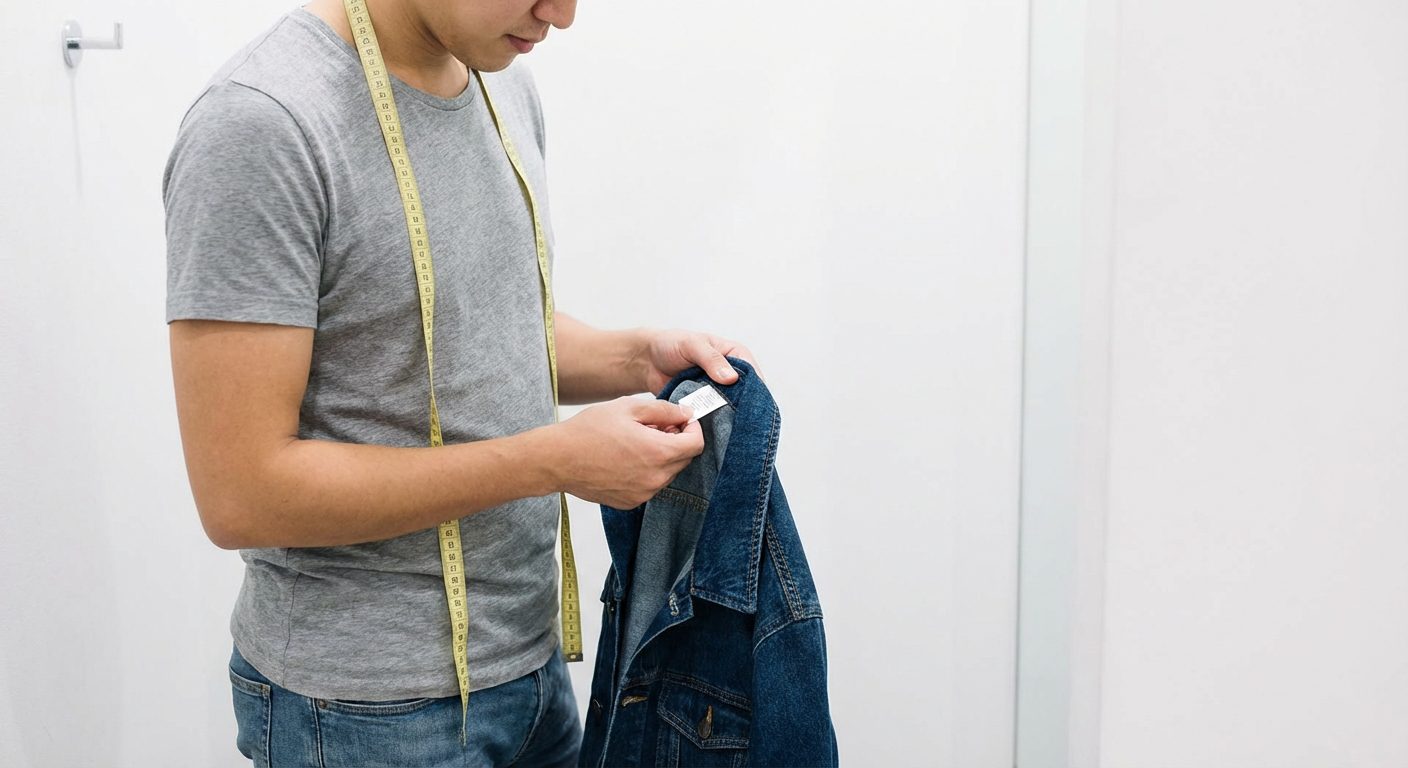
Once you have your measurements in inches or centimeters, compare them to the measurement ranges listed for each size in the brand's size guide. Clothing sizes are not standardized between brands — a US size 8 from one brand may fit like a 10 from another. Taking your measurements and comparing them to the brand's chart directly gives you the most accurate result, especially when shopping internationally.
For reference, the ASTM apparel size standards define the body measurements associated with each US size label, though individual brands may deviate from this standard.
Inseam and Length
For pants and trousers, inseam length is a separate measurement from the waist size. The inseam is measured from the crotch seam to the bottom of the leg. Common inseam lengths for women range from 28 to 32 inches (short, regular, long), and for men from 28 to 36 inches. Inseam is typically not converted between sizing systems — it is the same measurement in both US and international sizing and is often listed separately in centimeters on European garments.
To measure your inseam, stand with feet shoulder-width apart and measure from the top of the inner thigh down to the floor. Alternatively, measure the inseam of a pair of pants that fit you well. For shirts and tops, sleeve length is another important measurement, running from the center back of the neck to the wrist with the arm slightly bent.
International Sizing Differences
US vs UK Sizes
US and UK women's clothing sizes differ by approximately 4 numeric sizes. A US size 8 is a UK size 12, a US size 6 is a UK size 10, and a US size 10 is a UK size 14. This consistent 4-size gap applies across most clothing categories including tops, dresses, and bottoms. Men's sizing labels are generally the same between the US and UK for shirts (S, M, L, XL), though the actual fit may vary slightly between brands.
For shoes, the US and UK systems do not share the same scale. A US women's size 7 is a UK size 5. A US men's size 10 is a UK size 9.5. The UK shoe sizing system is historically based on barleycorns (one-third of an inch per size), as is the US system, but the two scales start at different baseline foot lengths, creating the numeric offset.
EU Sizing System
The European clothing size system is standardized under European clothing size regulation EN 13402, which defines sizes based on body measurements in centimeters. Women's EU sizes for clothing typically run from 32 to 54, while men's EU sizes for tops run from 44 to 58. EU shoe sizes use the Paris Point system, where each point equals two-thirds of a centimeter of foot length.
In practice, EU clothing brands often include their own size chart because the EN 13402 standard is a reference rather than a mandatory requirement. Always check the specific brand's size guide when ordering from European retailers. A EU 40 in one brand may fit differently than an EU 40 from another brand due to differences in how each brand interprets measurement ranges.
When shopping internationally, refer to a size guide like the Nordstrom clothing size guide alongside the converter tool to ensure accurate sizing across brands.
Frequently Asked Questions

What is US size 8 in UK?
A US women's size 8 is equivalent to a UK size 12. This 4-size gap applies consistently across most women's clothing categories including tops, dresses, and bottoms. For men's shirts in letter sizes, US and UK labels are the same (M = M, L = L), though actual garment dimensions may vary between brands.
What is EU 42 in US?
For women's clothing, EU 42 is equivalent to a US size 12. In men's tops, EU 42 corresponds to an XS to S size in US terms. For women's shoes, EU 42 is approximately US size 10.5. The conversion depends on whether you are converting clothing or shoes and whether the garment is for women or men.
How to convert UK shoe size to US?
For women's shoes, add 2 to the UK size to get the US equivalent. A UK women's size 5 is a US 7, and a UK size 6 is a US 8. For men's shoes, add 0.5 to the UK size to get the US equivalent. A UK men's size 9 is a US 9.5, and a UK size 10 is a US 10.5.
What is my dress size in European?
To find your EU dress size, take your US dress size and add 28 to 32 depending on the brand. A US size 8 dress is approximately EU 40, a US size 10 is EU 42, and a US size 6 is EU 38. For a more accurate result, compare your bust, waist, and hip measurements in centimeters directly to the brand's EU size chart.
Why are sizes different in each country?
Clothing sizes developed independently in different countries before international trade made standardization necessary. Each country established its own measurement conventions and sizing scales based on historical tailoring standards. The US and UK systems are both based on barleycorns but with different starting points. The EU system is metric and based on body measurements in centimeters. Japan developed its own system based on local body proportions. These differences remain because there is no single mandatory international standard that all brands must follow.