Fraction Converter
A fraction converter transforms fractions to decimals, decimals to fractions, and simplifies fractions to their lowest terms. Enter a fraction or decimal in the panel to instantly convert between formats or reduce any fraction.
What Is a Fraction Converter?
A fraction converter is a tool that moves values between fractional and decimal notation, and reduces fractions to their simplest form. Fractions express a part of a whole using a numerator (top number) and a denominator (bottom number). Decimals express the same value using the base-10 place value system. Being able to convert quickly between these formats is essential in mathematics, cooking, construction, finance, and everyday measurement.
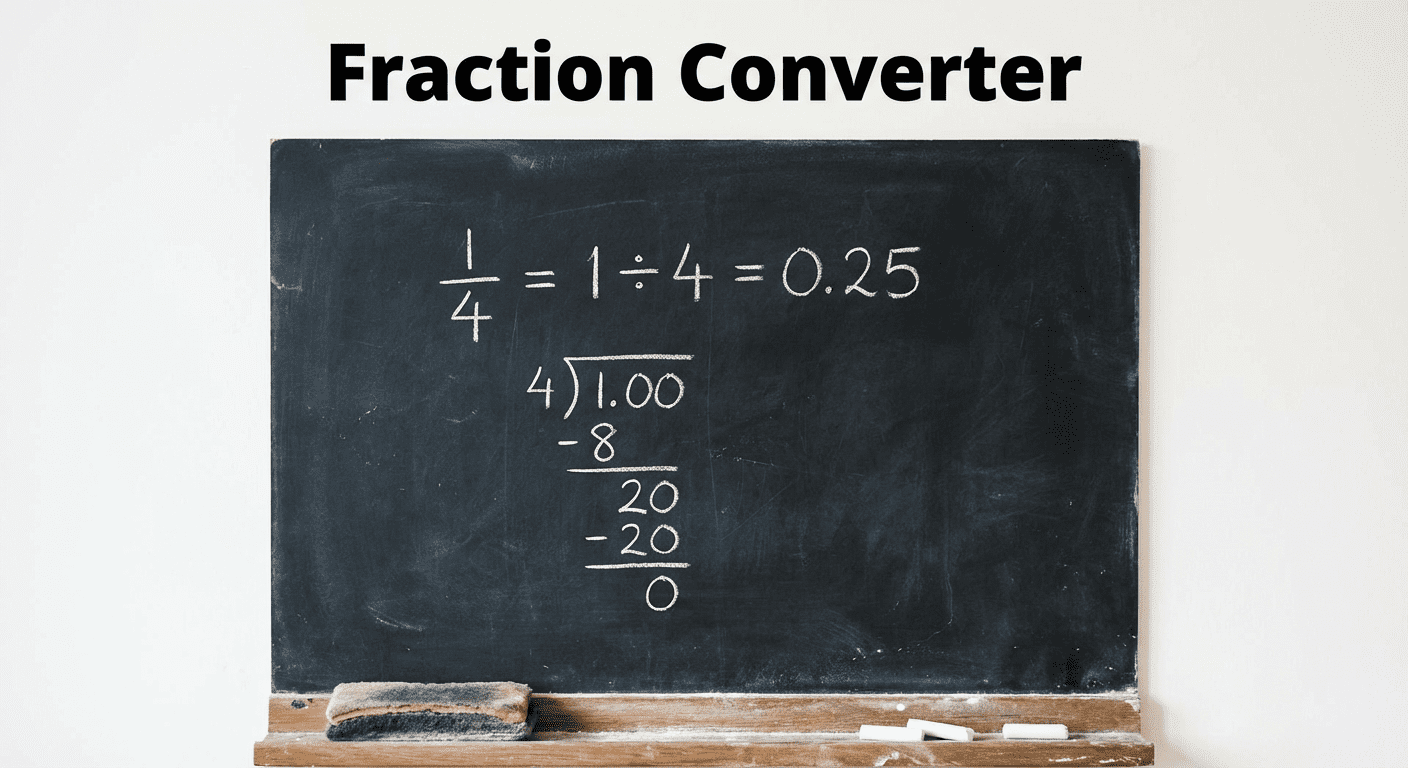
This converter handles three operations: converting a fraction to a decimal, converting a decimal to a fraction, and simplifying a fraction to its lowest terms. Each mode uses established mathematical methods and produces an instant result without needing AI. You can also send any conversion to the AI for a detailed step-by-step explanation. For other math help, see the free AI math solver or the percentage calculator.
How to Convert a Fraction to a Decimal
Division Method
Converting a fraction to a decimal requires one operation: divide the numerator by the denominator. The result is the decimal equivalent of the fraction.

For example, to convert 3/4 to a decimal: 3 ÷ 4 = 0.75. To convert 1/3 to a decimal: 1 ÷ 3 = 0.3333... (repeating). Some fractions produce terminating decimals that end after a finite number of digits. Others produce repeating decimals where one or more digits repeat indefinitely.
Common Fractions to Decimals Table
| Fraction | Decimal | Percentage |
|---|---|---|
| 1/2 | 0.5 | 50% |
| 1/3 | 0.3333... | 33.33% |
| 1/4 | 0.25 | 25% |
| 1/5 | 0.2 | 20% |
| 1/6 | 0.1666... | 16.67% |
| 1/8 | 0.125 | 12.5% |
| 1/10 | 0.1 | 10% |
| 1/16 | 0.0625 | 6.25% |
How to Convert a Decimal to a Fraction
Place Value Method
To convert a terminating decimal to a fraction, count the number of digits after the decimal point and use that count to determine the denominator. A decimal with one place uses 10 as the denominator, two places uses 100, three places uses 1000, and so on.
Step 1: Count decimal places (e.g., 0.75 has 2 places)
Step 2: Denominator = 10^places (e.g., 10² = 100)
Step 3: Numerator = decimal × denominator (e.g., 0.75 × 100 = 75)
Step 4: Simplify: 75/100 = 3/4
Repeating Decimals
Repeating decimals such as 0.3333... or 0.142857... require a different method. For a single repeating digit, set x equal to the decimal, multiply both sides by 10, then subtract the original equation. For 0.3333...: let x = 0.3333..., then 10x = 3.3333..., so 10x - x = 3, giving 9x = 3, and x = 3/9 = 1/3. The built-in converter handles terminating decimals. Use the AI option for repeating decimals and the AI will work through the algebra. For broader math support, try the AI math solvers collection.
How to Simplify a Fraction
Finding the GCD
Simplifying a fraction means reducing it to its lowest terms by dividing both the numerator and denominator by their Greatest Common Divisor (GCD). The GCD is the largest number that divides evenly into both values. The Euclidean algorithm is the standard method for finding the GCD efficiently.
Euclidean Algorithm: GCD(a, b) = GCD(b, a mod b) until b = 0
Example: Simplify 12/16
GCD(16, 12): 16 mod 12 = 4 → GCD(12, 4): 12 mod 4 = 0 → GCD = 4
12 ÷ 4 = 3 and 16 ÷ 4 = 4, so 12/16 = 3/4
A fraction is in its simplest form when the GCD of the numerator and denominator is 1, meaning no number other than 1 divides evenly into both. This is also called an irreducible fraction.
Common Fraction Decimal Equivalents
These equivalents appear frequently in construction, cooking, finance, and academic work. Memorizing the most common ones speeds up everyday calculations.
| Fraction | Decimal | Fraction | Decimal |
|---|---|---|---|
| 3/4 | 0.75 | 2/3 | 0.6666... |
| 3/8 | 0.375 | 5/8 | 0.625 |
| 5/16 | 0.3125 | 7/8 | 0.875 |
| 3/16 | 0.1875 | 11/16 | 0.6875 |
| 2/5 | 0.4 | 3/5 | 0.6 |
| 4/5 | 0.8 | 7/10 | 0.7 |
Mixed Numbers and Improper Fractions
A mixed number combines a whole number and a fraction, such as 2 3/4. An improper fraction has a numerator larger than its denominator, such as 11/4. These two forms represent the same value and can be converted between each other.
To convert a mixed number to an improper fraction: multiply the whole number by the denominator, then add the numerator. For 2 3/4: (2 × 4) + 3 = 11, so the improper fraction is 11/4.
To convert an improper fraction to a mixed number: divide the numerator by the denominator. The quotient is the whole number, and the remainder becomes the new numerator over the original denominator. For 11/4: 11 ÷ 4 = 2 remainder 3, so the mixed number is 2 3/4.
To convert a mixed number to a decimal, first convert to an improper fraction, then divide the numerator by the denominator. For 2 3/4: 11 ÷ 4 = 2.75. Use the AI math solvers for complex mixed number problems, or the degrees converter for angle-related fraction calculations.
Frequently Asked Questions
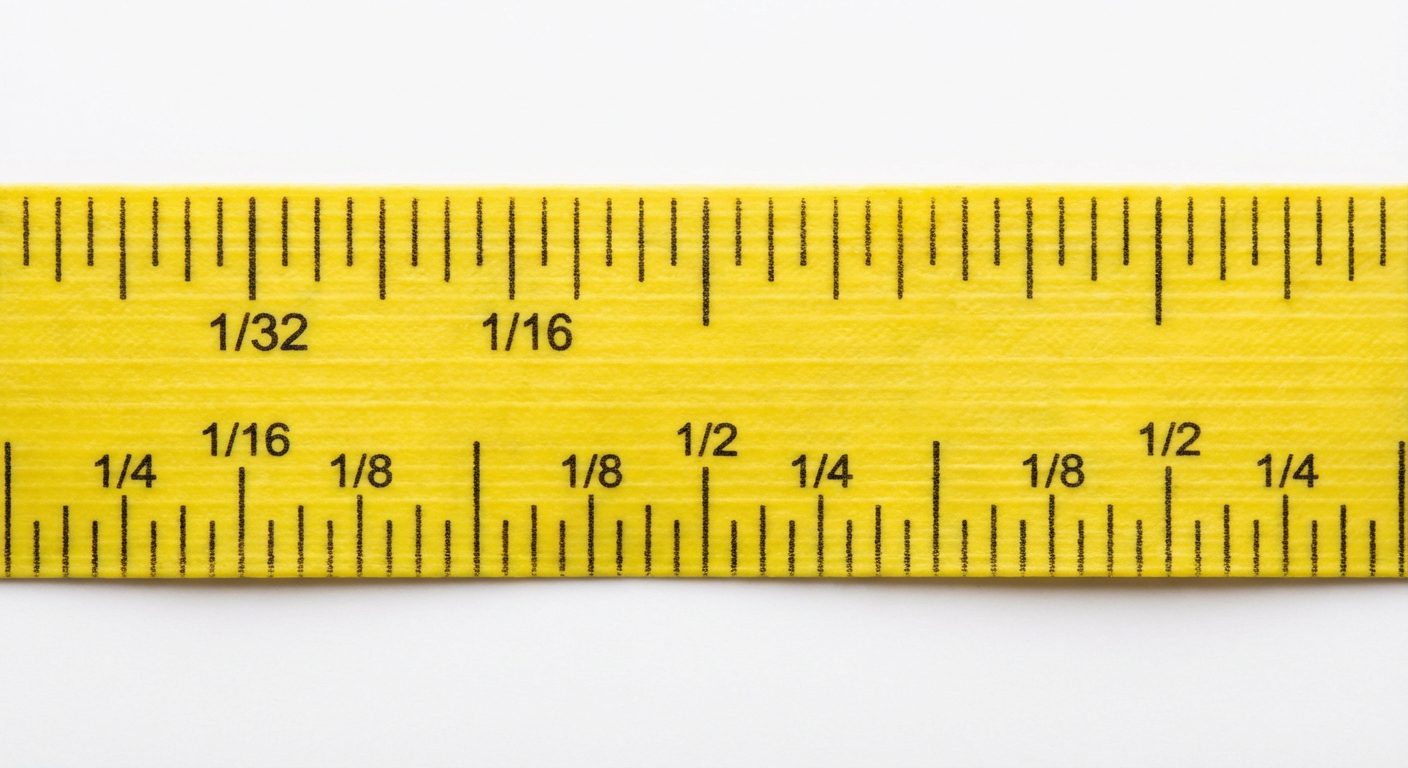
How to turn a fraction into a decimal?
Divide the numerator by the denominator. For example, 3/4 = 3 ÷ 4 = 0.75. For 1/3, the result is 0.3333..., a repeating decimal. Use the Fraction to Decimal mode in the converter above for instant results on any fraction.
What is 3/8 as a decimal?
3/8 as a decimal is 0.375. Divide 3 by 8: 3 ÷ 8 = 0.375. This is a terminating decimal because 8 is a power of 2, and fractions with denominators made up only of 2s and 5s always produce terminating decimals.
How to simplify fractions?
Find the Greatest Common Divisor of the numerator and denominator using the Euclidean algorithm, then divide both by that number. For 12/16, GCD(12, 16) = 4, so 12÷4 / 16÷4 = 3/4. The Simplify Fraction mode in the converter above handles this instantly.
How to convert 0.75 to a fraction?
0.75 has 2 decimal places, so the denominator is 100. The numerator is 75. The fraction is 75/100. Find GCD(75, 100) = 25 and divide both: 75÷25 / 100÷25 = 3/4. So 0.75 = 3/4.
What is 5/16 as a decimal?
5/16 as a decimal is 0.3125. Divide 5 by 16: 5 ÷ 16 = 0.3125. This is a terminating decimal because 16 is a power of 2.
Related Tools
External references: Khan Academy fractions guide · Math is Fun fraction to decimal · MathWorld fraction reference