Roman Numeral Converter
A Roman numeral converter translates between Roman numerals (I, V, X, L, C, D, M) and standard Arabic numbers. Enter a Roman numeral to see its numeric value, or enter a number to convert it to Roman numerals instantly.
What Are Roman Numerals?
Roman numerals are a numeral system that originated in ancient Rome and remained the standard method of writing numbers throughout Europe well into the Late Middle Ages. The system uses combinations of seven Latin letters to represent values: I, V, X, L, C, D, and M. Unlike the Arabic numeral system used today, Roman numerals are not positional. Their values are determined by addition and subtraction rules based on the order of symbols.
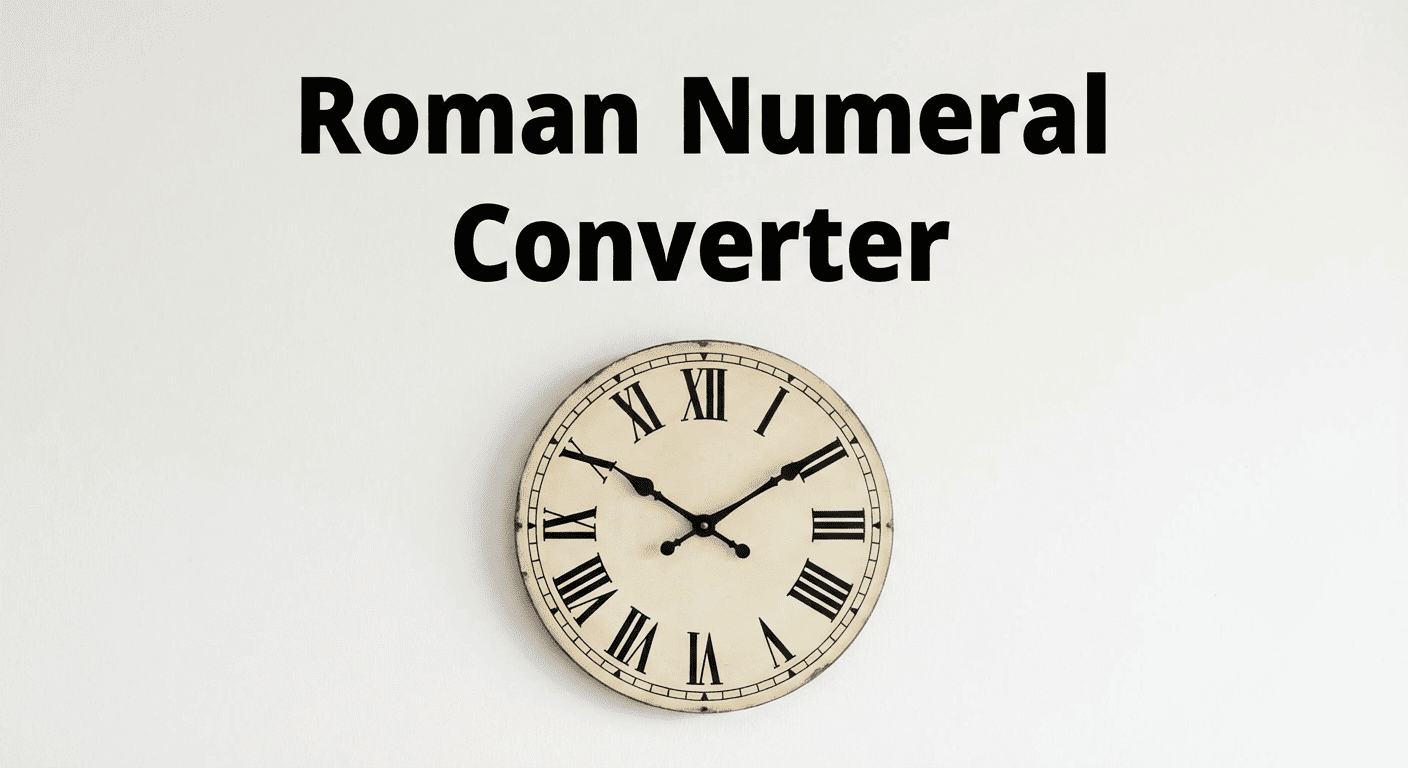
Today Roman numerals appear on clock faces, in movie sequels, in the names of sporting events like the Super Bowl, in book chapters, and in formal documents. Understanding how to read and write them remains a practical skill, and the Britannica Roman numeral system article provides excellent historical context for their development.
Roman Numeral Symbols
The Roman numeral system is built on seven core symbols. Every number is constructed from these seven values alone.
| Symbol | Value | Latin Origin |
|---|---|---|
| I | 1 | Unus (one) |
| V | 5 | Quinque (five) |
| X | 10 | Decem (ten) |
| L | 50 | Quinquaginta (fifty) |
| C | 100 | Centum (hundred) |
| D | 500 | Quingenti (five hundred) |
| M | 1000 | Mille (thousand) |
How to Read Roman Numerals
Addition Rule
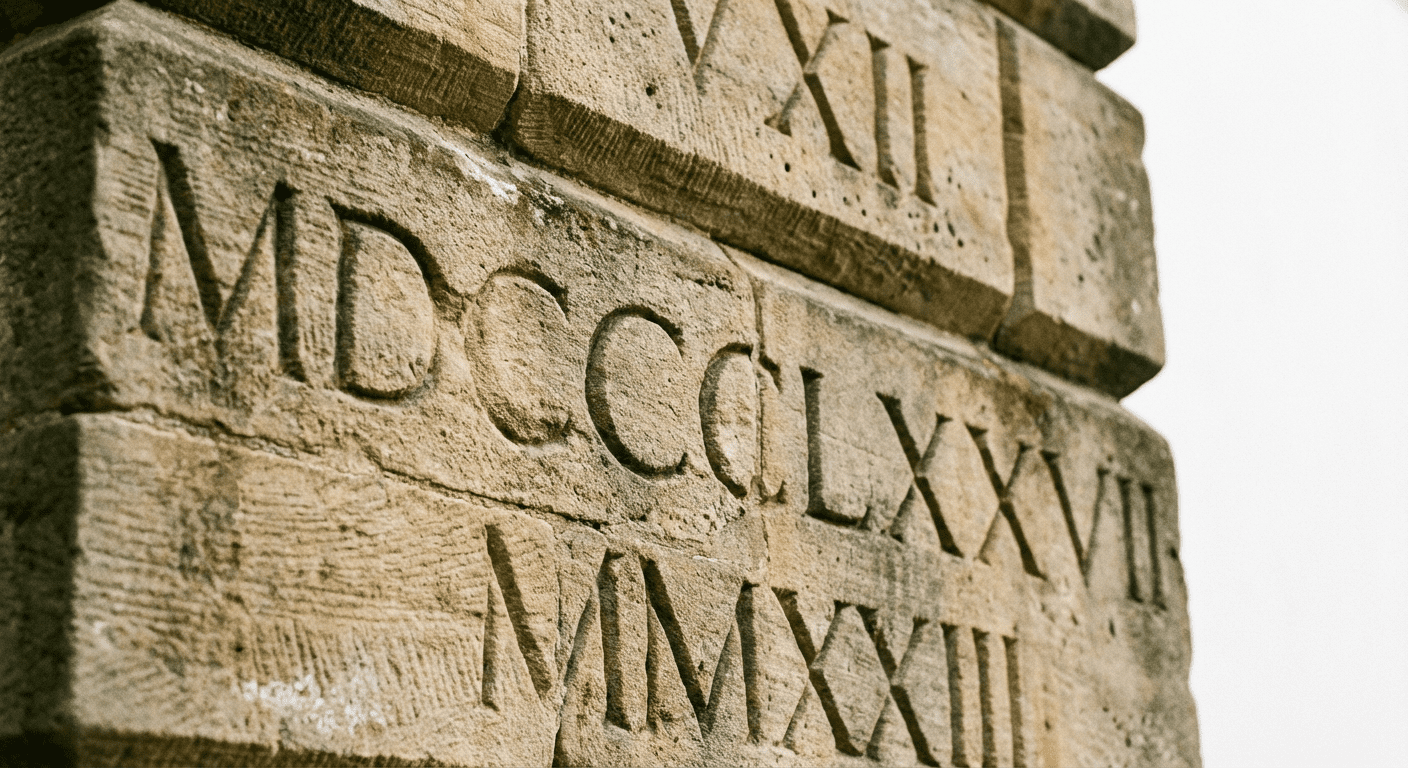
When a symbol of equal or lesser value follows a symbol, you add their values together. Reading left to right, add each symbol's value to the running total. For example: VIII = 5 + 1 + 1 + 1 = 8. LXX = 50 + 10 + 10 = 70. MDCCC = 1000 + 500 + 100 + 100 + 100 = 1800. The same symbol may be repeated up to three times in a row (I, X, C, M can repeat; V, L, D cannot repeat).
Subtraction Rule
When a symbol of lesser value appears immediately before a symbol of greater value, you subtract the lesser value from the greater. This is called subtractive notation. There are only six valid subtractive combinations:
- IV = 4 (I before V: 5 - 1 = 4)
- IX = 9 (I before X: 10 - 1 = 9)
- XL = 40 (X before L: 50 - 10 = 40)
- XC = 90 (X before C: 100 - 10 = 90)
- CD = 400 (C before D: 500 - 100 = 400)
- CM = 900 (C before M: 1000 - 100 = 900)
For example, MCMXCIX = M (1000) + CM (900) + XC (90) + IX (9) = 1999. You can verify any conversion using our Roman numeral converter above or explore number patterns with the fraction converter for related math conversions. The Math is Fun Roman numerals guide also provides interactive practice.
Roman Numeral Chart 1-100
| Arabic | Roman | Arabic | Roman | Arabic | Roman | Arabic | Roman |
|---|---|---|---|---|---|---|---|
| 1 | I | 2 | II | 3 | III | 4 | IV |
| 5 | V | 6 | VI | 7 | VII | 8 | VIII |
| 9 | IX | 10 | X | 11 | XI | 12 | XII |
| 13 | XIII | 14 | XIV | 15 | XV | 16 | XVI |
| 17 | XVII | 18 | XVIII | 19 | XIX | 20 | XX |
| 21 | XXI | 22 | XXII | 23 | XXIII | 24 | XXIV |
| 25 | XXV | 26 | XXVI | 27 | XXVII | 28 | XXVIII |
| 29 | XXIX | 30 | XXX | 31 | XXXI | 32 | XXXII |
| 33 | XXXIII | 34 | XXXIV | 35 | XXXV | 36 | XXXVI |
| 37 | XXXVII | 38 | XXXVIII | 39 | XXXIX | 40 | XL |
| 41 | XLI | 42 | XLII | 43 | XLIII | 44 | XLIV |
| 45 | XLV | 46 | XLVI | 47 | XLVII | 48 | XLVIII |
| 49 | XLIX | 50 | L | 51 | LI | 52 | LII |
| 53 | LIII | 54 | LIV | 55 | LV | 56 | LVI |
| 57 | LVII | 58 | LVIII | 59 | LIX | 60 | LX |
| 61 | LXI | 62 | LXII | 63 | LXIII | 64 | LXIV |
| 65 | LXV | 66 | LXVI | 67 | LXVII | 68 | LXVIII |
| 69 | LXIX | 70 | LXX | 71 | LXXI | 72 | LXXII |
| 73 | LXXIII | 74 | LXXIV | 75 | LXXV | 76 | LXXVI |
| 77 | LXXVII | 78 | LXXVIII | 79 | LXXIX | 80 | LXXX |
| 81 | LXXXI | 82 | LXXXII | 83 | LXXXIII | 84 | LXXXIV |
| 85 | LXXXV | 86 | LXXXVI | 87 | LXXXVII | 88 | LXXXVIII |
| 89 | LXXXIX | 90 | XC | 91 | XCI | 92 | XCII |
| 93 | XCIII | 94 | XCIV | 95 | XCV | 96 | XCVI |
| 97 | XCVII | 98 | XCVIII | 99 | XCIX | 100 | C |
Roman Numeral Chart 100-1000
| Arabic | Roman | Arabic | Roman |
|---|---|---|---|
| 100 | C | 200 | CC |
| 300 | CCC | 400 | CD |
| 500 | D | 600 | DC |
| 700 | DCC | 800 | DCCC |
| 900 | CM | 1000 | M |
How to Write Large Numbers in Roman Numerals
Standard Roman numeral notation supports numbers from 1 to 3999 (MMMCMXCIX). The maximum is 3999 because M can only repeat three times under standard rules, and there is no standard symbol above M for 5000 or 10000. For numbers above 3999, extended notation using a vinculum (a bar drawn over a numeral) multiplies that numeral by 1000. For example, a V with a bar above it represents 5000. This extended system is occasionally seen in historical documents but is not part of the standard rules taught today.
Large Roman numerals appear in historical contexts such as year dates. For example, MCMLXXXIV = 1984 (M=1000, CM=900, LXXX=80, IV=4). MMXXV = 2025. The large numbers converter can help with understanding number scales when working with very large values.
Common Roman Numeral Conversions
| Context | Roman Numeral | Arabic Value |
|---|---|---|
| Current year (2025) | MMXXV | 2025 |
| Clock numeral - 4 | IIII (traditional) or IV | 4 |
| Super Bowl LIX (2025) | LIX | 59 |
| Rocky II (movie sequel) | II | 2 |
| World War II | II | 2 |
| Pope John Paul II | II | 2 |
| Henry VIII (king) | VIII | 8 |
| Olympic Games XXXI (Rio 2016) | XXXI | 31 |
| Millennium year | MM | 2000 |
| Century mark | C | 100 |
Roman Numerals in Everyday Life
Clocks and Watches
Roman numerals are one of the most recognized features of analog clock faces, particularly on luxury watches and architectural clocks. A full clock face in Roman numerals reads: I, II, III, IV (or IIII), V, VI, VII, VIII, IX, X, XI, XII. Many traditional clockmakers use IIII for four rather than IV, both for visual balance against VIII on the opposite side of the dial and as a continuation of pre-standardized Roman numeral practices. VI in numbers on a clock equals 6, which marks the bottom of the dial representing 6 o'clock.
Super Bowl Numbers
The NFL Super Bowl has used Roman numerals to number each game since Super Bowl V in 1971. This tradition distinguishes the championship game as a major event and avoids confusion between the year and game number since the Super Bowl is played in the year following the regular season. Super Bowl LIX was held in February 2025 (LIX = 59). Super Bowl L (50) in 2016 was a notable exception where the NFL briefly used Arabic numerals, then returned to Roman numerals the following year with Super Bowl LI.
Movie Sequels
Hollywood has long used Roman numerals to number sequels, giving them a sense of prestige and tradition. Rocky II, III, IV, and V, the Godfather II and III, Star Wars Episode I through IX, and many other franchises have used this convention. The practice has declined in recent years as studios move toward subtitle-based naming or simply appending a number, but Roman numerals remain a recognizable mark of a classic franchise. The Khan Academy Roman numeral lessons offer structured exercises for learning the full system.
Frequently Asked Questions

What is VI in numbers?
VI in numbers is 6. V equals 5 and I equals 1. In Roman numerals, when a smaller or equal value follows a larger value, you add the two together. V + I = 5 + 1 = 6.
What is 2025 in Roman numerals?
2025 in Roman numerals is MMXXV. Breaking it down: M = 1000, M = 1000, X = 10, X = 10, V = 5. Adding them: 1000 + 1000 + 10 + 10 + 5 = 2025.
What is the Roman numeral for 50?
The Roman numeral for 50 is L. It is one of the seven base symbols in the Roman numeral system: I (1), V (5), X (10), L (50), C (100), D (500), and M (1000).
Why do clocks use IIII instead of IV?
Clocks traditionally use IIII rather than IV for several reasons: visual symmetry with VIII on the opposite side of the dial, historical convention predating strict subtractive notation, and aesthetic preference by clockmakers. IIII was also the original way Romans wrote 4 before subtractive notation was standardized.
What is the largest Roman numeral?
In standard Roman numeral notation, the largest representable number is 3999, written as MMMCMXCIX. Numbers 4000 and above require vinculum notation (a bar over a numeral multiplying it by 1000) which is not part of standard Roman numeral rules.
Also check out:
Roman Numerals Chart Multiplication Chart Date Calculator