Large Numbers Converter
A large numbers converter transforms numbers between standard form, word form, and scientific notation. Enter any number to instantly see it written out in words, in scientific notation, and with its full place value breakdown from millions to trillions and beyond.
What Is a Large Numbers Converter?
A large numbers converter is a tool that translates a number written in standard digit form into one or more alternative representations: word form (as you would read it aloud), scientific notation (as a coefficient times a power of 10), or expanded form (as a sum of place values). These conversions are useful in education, finance, science, and any context where very large quantities need to be communicated clearly.
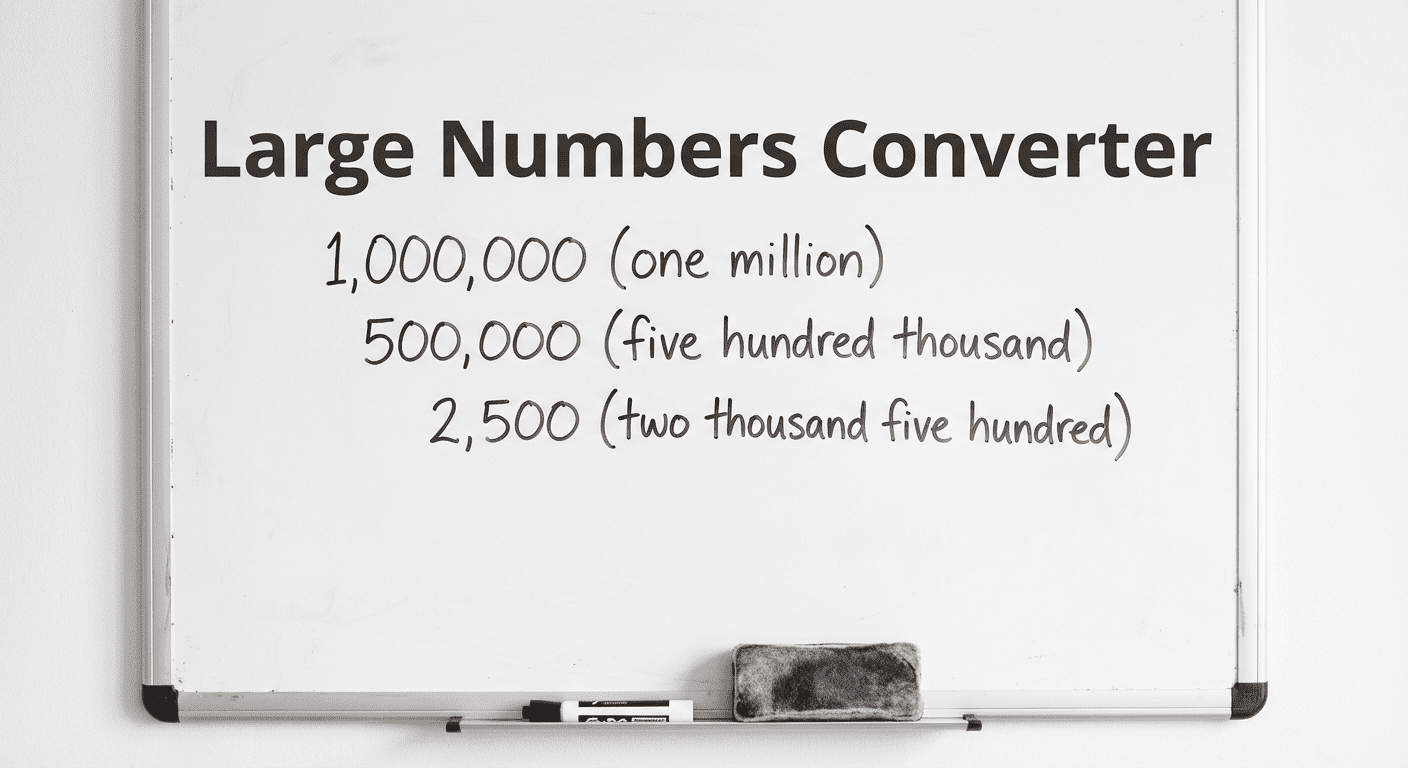
Most people can read small numbers easily, but numbers with six or more digits quickly become confusing to parse visually. A number like 1,000,000,000 is far easier to understand when you see it written as "one billion" or as 1 × 10^9. This converter handles numbers from the thousands all the way to the vigintillions and beyond, giving you the word name, the scientific shorthand, and the expanded arithmetic breakdown in seconds.
Large Number Names and Their Zeros
Each large number name corresponds to a specific power of 10. The table below shows the standard US naming system (short scale) used in the United States, United Kingdom (since the 1970s), and most other English-speaking countries:
| Name | Number | Zeros | Power of 10 |
|---|---|---|---|
| Thousand | 1,000 | 3 | 10^3 |
| Million | 1,000,000 | 6 | 10^6 |
| Billion | 1,000,000,000 | 9 | 10^9 |
| Trillion | 1,000,000,000,000 | 12 | 10^12 |
| Quadrillion | 1,000,000,000,000,000 | 15 | 10^15 |
| Quintillion | 10^18 | 18 | 10^18 |
| Sextillion | 10^21 | 21 | 10^21 |
| Septillion | 10^24 | 24 | 10^24 |
| Octillion | 10^27 | 27 | 10^27 |
| Nonillion | 10^30 | 30 | 10^30 |
| Decillion | 10^33 | 33 | 10^33 |
| Vigintillion | 10^63 | 63 | 10^63 |
| Googol | 10^100 | 100 | 10^100 |
Place Value Chart
Place value describes what each digit position in a number represents. In the base-10 system, each position is ten times larger than the one to its right. This table shows the place value name for each position from ones to trillions:

| Place | Value | Position from right | Example (digit 3) |
|---|---|---|---|
| Ones | 1 | 1st | 3 |
| Tens | 10 | 2nd | 30 |
| Hundreds | 100 | 3rd | 300 |
| Thousands | 1,000 | 4th | 3,000 |
| Ten Thousands | 10,000 | 5th | 30,000 |
| Hundred Thousands | 100,000 | 6th | 300,000 |
| Millions | 1,000,000 | 7th | 3,000,000 |
| Billions | 1,000,000,000 | 10th | 3,000,000,000 |
| Trillions | 1,000,000,000,000 | 13th | 3,000,000,000,000 |
How Many Zeros in a Million, Billion, Trillion?
The number of zeros in a large number is the simplest way to identify which scale it belongs to. Each step up the scale adds three zeros in the short scale system used in the United States and the United Kingdom.
10 to Million
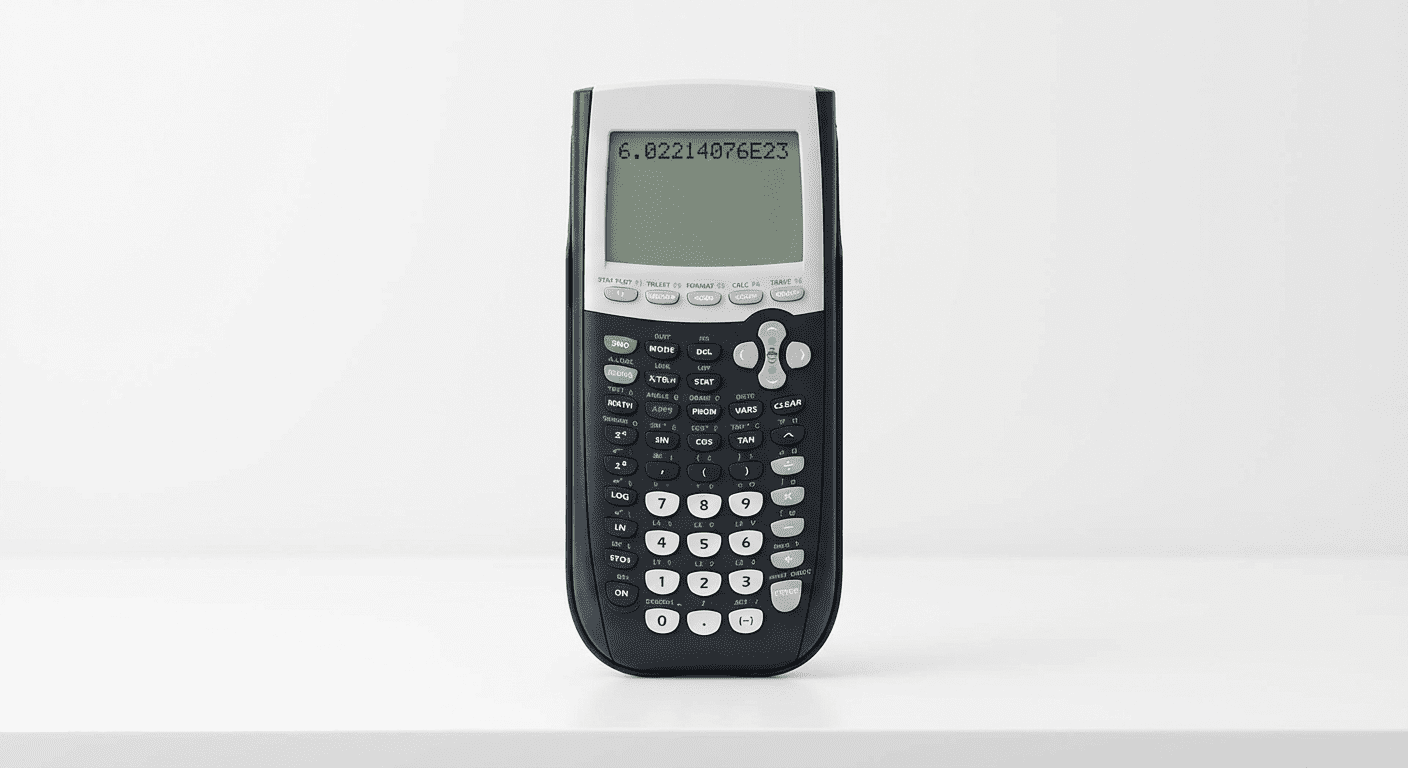
To get from 10 to one million requires multiplying by 100,000, which is 5 additional powers of 10 beyond the single digit. One million (1,000,000) has 6 zeros. In scientific notation, one million is 1 × 10^6. The path from 10 upward goes: 10 → 100 (10^2) → 1,000 (10^3 = one thousand) → 10,000 (10^4) → 100,000 (10^5) → 1,000,000 (10^6 = one million). Each multiplication by 10 adds one zero. To reach a million from 10, you multiply by 10 five more times.
How Much Is 10 Zeros
A number with 10 zeros is 10,000,000,000, which is ten billion (1 × 10^10). This is the number you get when you write a 1 followed by 10 zeros. Ten billion is a commonly referenced figure in discussions of national budgets, company revenues, and global populations. It is 10 times larger than one billion and 10,000 times larger than one million. In expanded form: 10,000,000,000 = 10,000 × 1,000,000, or equivalently, 10 groups of one billion. The US national debt, many large corporate valuations, and the total market capitalization of several mid-size stock markets are measured in the tens of billions range.
Scientific Notation Explained
Scientific notation is a method of expressing very large or very small numbers as a number between 1 and 10 multiplied by a power of 10. It was developed for use in science and engineering where numbers can range from the subatomic (10^-35 meters for the Planck length) to the astronomical (10^26 meters for the observable universe). Scientific notation makes these numbers manageable to write and compare.
How to Write Numbers in Scientific Notation
To convert a large number to scientific notation, follow these steps: First, identify the leading (leftmost) non-zero digit. Place a decimal point after it. Count how many places you moved the decimal point from its original position at the end of the number. That count becomes the exponent of 10. For example, to convert 450,000: the leading digit is 4, so you write 4.5. The decimal moved 5 places from the end (where it would be after the last zero). Result: 4.5 × 10^5. To convert 6,700,000,000: leading digit is 6, write 6.7, decimal moved 9 places. Result: 6.7 × 10^9 (six point seven billion).
When comparing numbers in scientific notation, the one with the higher exponent is always larger, regardless of the coefficient. For example, 9.9 × 10^8 is smaller than 1.0 × 10^9 because 10^9 is larger than 10^8. This makes scientific notation useful for ordering large quantities like national GDPs, distances in space, or the number of cells in a human body. For any math involving scientific notation, the free AI math solver can work through scientific notation problems step by step.
Converting Between Number Forms
Standard to Word Form
To convert a standard number to word form, group the digits into sets of three from the right (matching the thousand, million, billion scale groupings). Then read each three-digit group as a number from one to nine hundred ninety-nine and append the scale name. For example, 7,432,819 breaks into three groups: 7 (millions group), 432 (thousands group), and 819 (ones group). Reading each: "seven million, four hundred thirty-two thousand, eight hundred nineteen." Always read the leading group first and move right, dropping scale names that are zero. If a middle group is zero, skip it entirely: 3,000,000,450 reads as "three billion, four hundred fifty."
Standard to Scientific Notation
Converting from standard to scientific notation uses the rule: move the decimal point until the number reads as something between 1 and 10, and count the moves. For whole numbers (integers), the decimal is at the end of the number, and you move it left. For 12,500,000: move decimal left 7 places → 1.25 × 10^7. For 300: move left 2 places → 3 × 10^2. For any number equal to a round power of 10 (like 1,000,000), the coefficient is exactly 1: 1,000,000 = 1 × 10^6. For numbers that are not round (like 756,000,000), the coefficient includes the significant figures: 7.56 × 10^8. Trailing zeros after the last significant figure are dropped from the coefficient but counted in the exponent.
Large Numbers in Real Life
National Debt
National debt figures are among the most commonly cited large numbers in public discourse. As of 2024, the United States national debt exceeds $33 trillion, or roughly 3.3 × 10^13 dollars. Written in full, this is $33,000,000,000,000. In word form: thirty-three trillion dollars. The interest payments on this debt exceed one trillion dollars per year, making it one of the largest line items in the federal budget. By comparison, the entire US GDP — the total value of all goods and services produced in a year — is approximately $27 trillion (2.7 × 10^13 dollars). Understanding the scale of these numbers requires knowing that a trillion is one thousand times larger than a billion, and one million times larger than a million. For financial analysis tools, the accounting AI solver can help break down large financial figures.
Company Valuations
The world's most valuable companies are measured in the trillions. As of 2024, several technology companies — including Apple, Microsoft, and Nvidia — have reached market capitalizations above $3 trillion each. A market cap of $3 trillion means $3,000,000,000,000, or 3 × 10^12 dollars. In word form: three trillion dollars. The total market cap of the US stock market (all publicly traded companies combined) exceeds $45 trillion. Global stock markets combined have a total capitalization of over $100 trillion. Annual global GDP — the total output of all economies worldwide — is approximately $100 trillion (10^14 dollars). These figures require scientific notation to compare efficiently, since the difference between a million-dollar business and a trillion-dollar company spans 6 orders of magnitude (10^6 factors of 10).
Frequently Asked Questions
How many zeros in a billion?
One billion has 9 zeros: 1,000,000,000. In scientific notation it is 1 × 10^9. One billion equals one thousand million, or 1,000 groups of one million. If you stacked one billion dollar bills, the stack would be approximately 67 miles (108 kilometers) high. The US used to define one billion as one million million (10^12) in the old long scale, but the short scale definition of one thousand million (10^9) has been the standard in both the US and UK since the 1970s.
What comes after trillion?
After trillion (10^12) comes quadrillion (10^15), then quintillion (10^18), sextillion (10^21), septillion (10^24), octillion (10^27), nonillion (10^30), and decillion (10^33). Each step adds three zeros. After decillion the naming continues with undecillion, duodecillion, tredecillion, and eventually vigintillion (10^63). Beyond named numbers, scientists use powers of 10 directly. The googol (10^100) and googolplex (10 to the power of a googol) are theoretical large numbers with no physical significance.
What is 10 to the 6th power?
10 to the 6th power (10^6) is 1,000,000, which is one million. The exponent 6 tells you how many times to multiply 10 by itself: 10 × 10 × 10 × 10 × 10 × 10 = 1,000,000. The exponent also equals the number of zeros in the result. 10^6 has 6 zeros, giving us one million.
How many zeros is a million?
One million has 6 zeros: 1,000,000. In scientific notation, one million is 1 × 10^6. One million equals 1,000 thousands, or 100 × 10,000. A million seconds is approximately 11.6 days. A million dollars stacked in $100 bills would be about 3.3 feet (1 meter) tall. Common uses of a million include population figures for small cities, sales figures for books and albums, and small government budget line items.
What is 1 followed by 10 zeros?
1 followed by 10 zeros is 10,000,000,000, which is ten billion. In scientific notation: 1 × 10^10. In word form: ten billion. This is distinct from one billion (10^9, which has 9 zeros) and one hundred billion (10^11, which has 11 zeros). The number 10^10 appears in contexts like approximate world population projections (Earth's population is expected to approach 10 billion by 2050), large corporate revenues, and some government budget figures.