Degrees Converter
A degrees converter transforms angular measurements between degrees, radians, gradians, mils, and decimal degrees used in GPS coordinates. Enter a value and select your units to instantly convert any angle measurement for math, navigation, engineering, or mapping applications.
What Is a Degrees Converter?
A degrees converter translates angle values between different angular measurement systems. The most common need is converting between degrees and radians, which are the two primary angular units used in mathematics and physics. Other conversions include gradians for surveying, military mils for artillery targeting, and decimal degrees for GPS coordinate systems. Each system divides the full rotation of a circle differently, requiring specific conversion formulas to translate between them accurately.

Angular conversions are required in trigonometry, navigation, computer graphics, engineering, and cartography. Most scientific calculators and programming languages use radians by default for trigonometric functions, which means angles expressed in degrees must be converted before use. For broader measurement conversions beyond angles — including length, weight, volume, temperature, speed, and area — use the metric conversion calculator. For mechanical and automotive engineering work that also requires rotational force conversions, the torque converter translates between Newton-meters, foot-pounds, and other torque units.
Types of Angular Measurements
Degrees (Arc Degrees)
Degrees are the most commonly used angular unit in everyday life. A full circle contains 360 degrees, a right angle is 90 degrees, and a straight line represents 180 degrees. The degree system is believed to originate from the Babylonian base-60 number system. The degree symbol (°) marks values, with smaller subdivisions called minutes (1/60 of a degree) and seconds (1/3600 of a degree). Degrees are the standard for compass bearings, latitude and longitude in DMS format, and angle measurements in construction and navigation.
Radians
Radians are the SI unit of angular measurement and are standard in mathematics, physics, and engineering. A radian is defined as the angle subtended at the center of a circle by an arc whose length equals the radius of that circle. One full circle equals 2π radians (approximately 6.2832 radians). One radian equals approximately 57.2958 degrees. Radians are essential in calculus because derivatives and integrals of trigonometric functions are simpler when angles are expressed in radians. Most programming languages, including Python and JavaScript, require angles in radians for their built-in trigonometric functions. The AI math solvers on this site can help with trigonometry problems requiring radian conversions.
Gradians
Gradians, also called gons or grades, divide a full circle into 400 equal parts. A right angle equals exactly 100 gradians, which makes the gradian system particularly useful in surveying and civil engineering because slope and grade calculations align neatly with decimal arithmetic. One gradian equals 0.9 degrees. Gradians were introduced during the French Revolution alongside the metric system and are still used in European surveying and some engineering disciplines. They are less common than degrees or radians in general practice.
Mils (Military)
Military mils divide a full circle into 6400 parts in the NATO standard used by most Western military forces. One NATO mil equals 0.05625 degrees, and one degree equals approximately 17.778 NATO mils. The practical advantage of mils in military use is that one mil subtends approximately one meter at a range of 1,000 meters, making range estimation and fire adjustment calculations straightforward. The Soviet and Russian mil system used 6000 mils per circle (one Soviet mil = 0.06 degrees), while Sweden historically used 6300. The NATO mil is now the dominant military standard.
How to Convert Degrees to Radians
The Formula
To convert degrees to radians, multiply the degree value by π/180. To convert radians to degrees, multiply by 180/π.

Since π ≈ 3.14159265, dividing by 180 gives approximately 0.01745. So to convert any degree value to radians, multiply by 0.017453293. For example, 90 degrees × (π/180) = π/2 ≈ 1.5708 radians.
Common Conversions Table
| Degrees | Radians (exact) | Radians (decimal) | Gradians | NATO Mils |
|---|---|---|---|---|
| 30° | π/6 | 0.5236 | 33.333 | 533.33 |
| 45° | π/4 | 0.7854 | 50.000 | 800.00 |
| 60° | π/3 | 1.0472 | 66.667 | 1066.67 |
| 90° | π/2 | 1.5708 | 100.000 | 1600.00 |
| 180° | π | 3.1416 | 200.000 | 3200.00 |
| 270° | 3π/2 | 4.7124 | 300.000 | 4800.00 |
| 360° | 2π | 6.2832 | 400.000 | 6400.00 |
How to Convert Mils to Degrees
NATO Mils vs US Mils
The NATO mil and US military mil both use 6400 mils per circle. The conversion formulas are:
For example, 1,000 NATO mils equals 1000 × 0.05625 = 56.25 degrees. Military targeting uses mils because 1 mil subtends approximately 1 meter at 1,000 meters range, which simplifies the mental calculation of adjustments when firing artillery. If a round lands 10 mils to the right at 2,000 meters, the target is approximately 20 meters to the right. The Soviet/Russian mil system uses 6000 mils per circle, where 1 Soviet mil = 0.06 degrees.
| NATO Mils | Degrees | Radians |
|---|---|---|
| 100 mils | 5.625° | 0.09817 rad |
| 1,000 mils | 56.25° | 0.98175 rad |
| 1,600 mils | 90° | π/2 rad |
| 3,200 mils | 180° | π rad |
| 6,400 mils | 360° | 2π rad |
Decimal Degrees for GPS Coordinates
DMS to Decimal Degrees
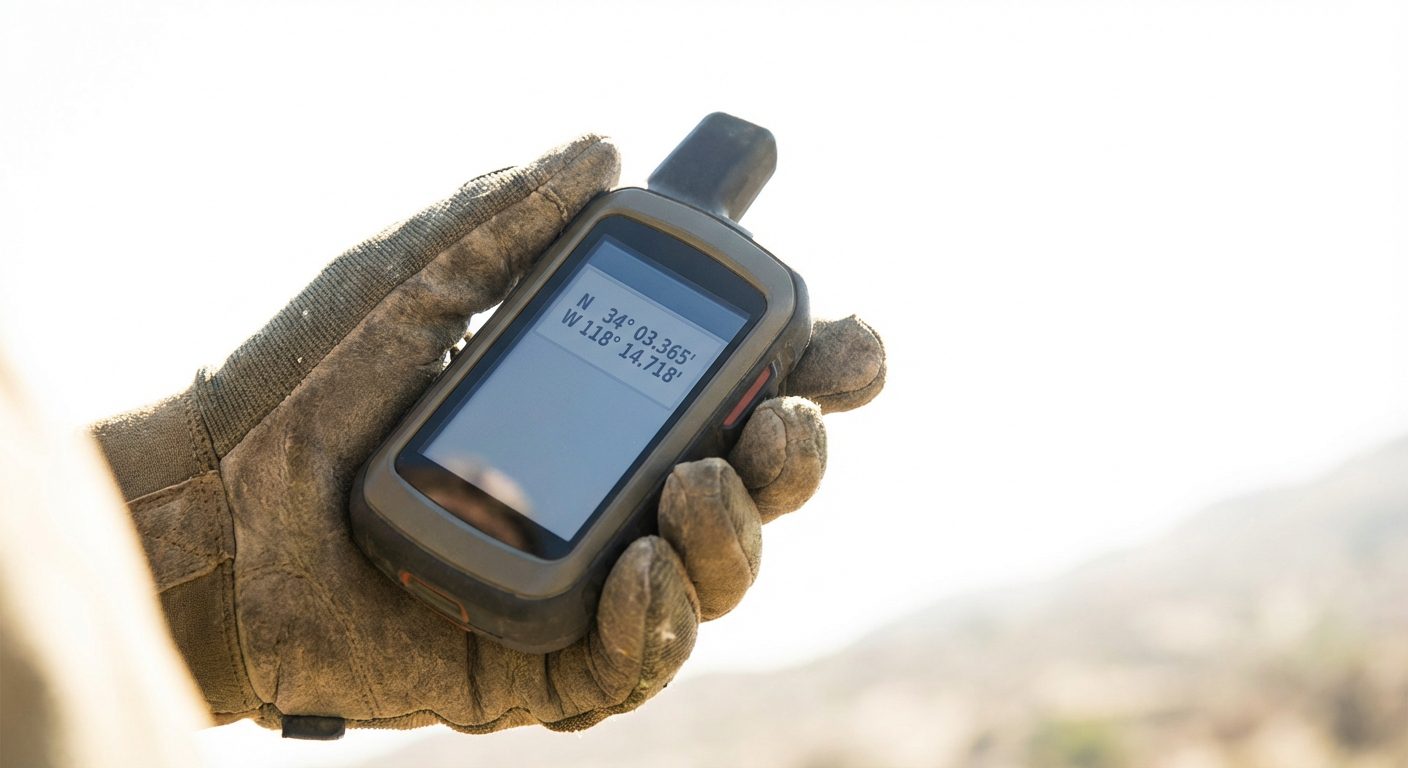
GPS coordinates and geographic locations are expressed in two formats: DMS (Degrees, Minutes, Seconds) and decimal degrees. DMS format looks like 40° 26' 46.302" N, while decimal degrees format looks like 40.44619722. Decimal degrees are required by most mapping APIs, navigation software, and data systems. The conversion formula is:
For example: 40° 26' 46.302" = 40 + (26/60) + (46.302/3600) = 40 + 0.43333 + 0.01286 = 40.44619°. For southern latitudes and western longitudes, the result is negative. The DMS to decimal converter above accepts degrees, minutes, and seconds as separate fields and outputs the decimal degree value.
How to Convert Map Coordinates
When working with map coordinates, both latitude and longitude need to be converted independently. Latitude ranges from -90° (South Pole) to +90° (North Pole), and longitude ranges from -180° (west) to +180° (east). A coordinate pair like 48° 51' 30" N, 2° 17' 40" E (near Paris, France) converts to 48.85833°, 2.29444° in decimal degrees. Most online mapping tools such as Google Maps accept decimal degrees directly in the search box.
Degrees Converter Examples
Example 1: 45 degrees to radians
45 × (π / 180) = 45 × 0.017453 = 0.7854 radians. This is π/4, one of the most common angles in trigonometry, appearing in the sine and cosine of 45° (both equal √2/2 ≈ 0.7071).
Example 2: 2 radians to degrees
2 × (180 / π) = 2 × 57.2958 = 114.592 degrees. This is slightly larger than a right angle and commonly encountered in physics problems involving circular motion.
Example 3: 800 NATO mils to degrees
800 × (360 / 6400) = 800 × 0.05625 = 45 degrees. This is a 45-degree bearing, representing northeast on a compass. Military maps use mils for azimuth measurements, and 800 mils is a standard reference angle.
Example 4: DMS coordinate 51° 30' 26" to decimal degrees
51 + (30/60) + (26/3600) = 51 + 0.5 + 0.00722 = 51.50722°. This approximates the latitude of London, England. Enter in the DMS fields above and select "Decimal Degrees" as the output.
Frequently Asked Questions
How many radians in 180 degrees?
Exactly π radians, which is approximately 3.14159 radians. This is one of the most important relationships in mathematics: π radians = 180° = half a circle. It is the basis for all degree-to-radian conversions.
What is a mil in degrees?
One NATO mil equals 360/6400 = 0.05625 degrees. Conversely, one degree equals 6400/360 ≈ 17.778 NATO mils. The mil is used by military forces for precision angle measurement in artillery and weapons targeting because one mil subtends approximately one meter at 1,000 meters range.
How to convert DMS to decimal degrees?
Use the formula: Decimal = Degrees + (Minutes / 60) + (Seconds / 3600). For 40° 26' 46": 40 + 26/60 + 46/3600 = 40 + 0.4333 + 0.01278 = 40.4461°. For southern latitudes (S) and western longitudes (W), add a negative sign to the result. Use the DMS option in the converter above for instant results.
What is a gradian?
A gradian (gon or grade) is an angular unit where a full circle = 400 gradians. A right angle is exactly 100 gradians. One gradian = 0.9 degrees, and one degree = 1.1111 gradians. Gradians are used primarily in European surveying and civil engineering because slopes and grade percentages work neatly in the 400-based system.
How many degrees in a radian?
One radian equals 180/π degrees, approximately 57.2958 degrees. A full circle contains 2π ≈ 6.2832 radians = 360 degrees. Radians are the natural unit for angles in calculus and physics because the derivative of sin(x) is cos(x) only when x is measured in radians.
What is the difference between NATO mils and Soviet mils?
NATO (and US) mils divide a circle into 6400 parts, so 1 NATO mil = 0.05625 degrees. Soviet and Russian mils divide a circle into 6000 parts, so 1 Soviet mil = 0.06 degrees. NATO mils are used by Western military forces; Soviet mils by Russian and former Soviet-bloc forces. Swedish mils historically used 6300 parts. The difference matters when translating targeting data between different military systems.