Book Outline Generator
A free AI book outline generator creates detailed chapter-by-chapter outlines for novels and non-fiction books. Enter your concept and genre to get a structured outline using proven storytelling frameworks.
What Is a Book Outline Generator?
A book outline generator is an AI-powered tool that creates a structured chapter-by-chapter plan for your novel or non-fiction book. You provide the concept, genre, and story structure framework, and the generator produces a detailed outline that maps your idea across the chapters you need — complete with chapter titles and summaries showing what happens in each section.
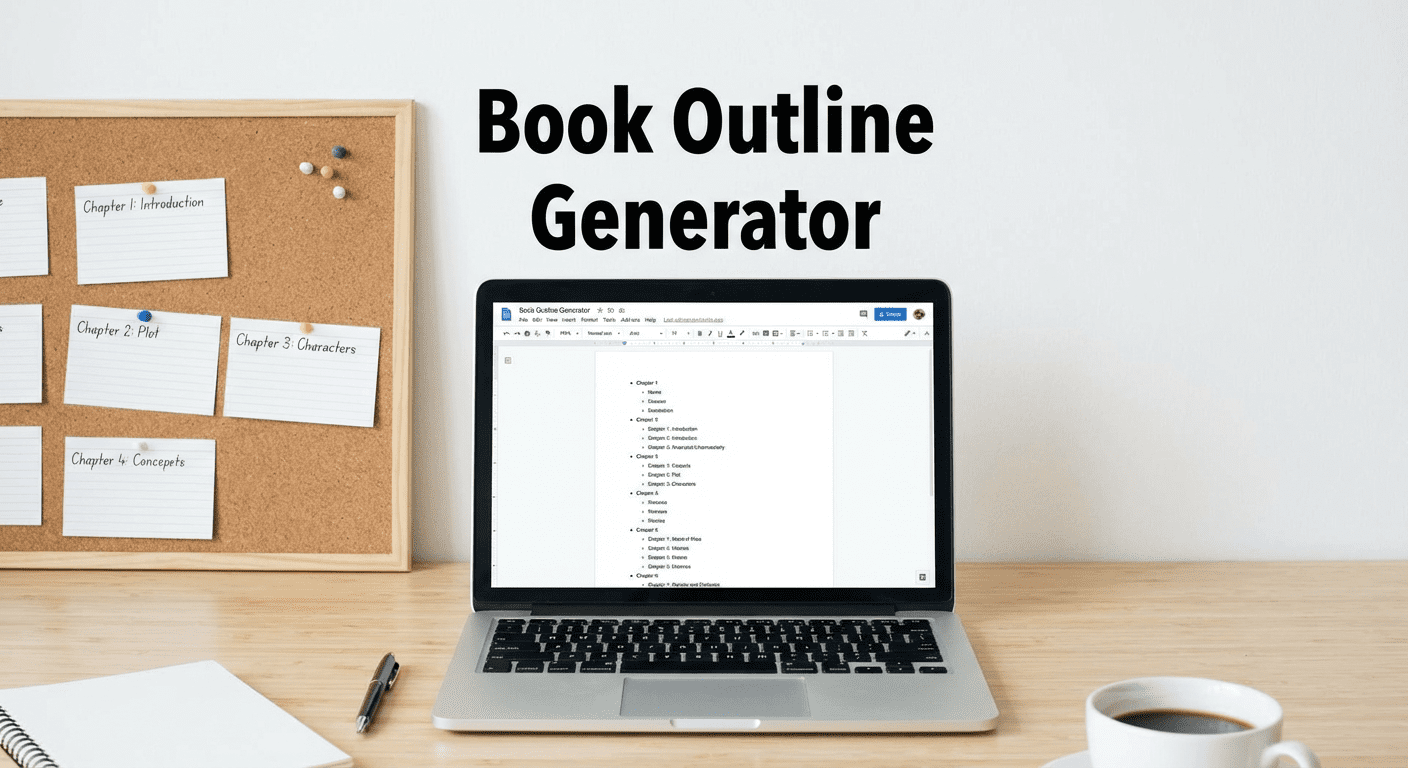
Outlining is one of the most debated topics in writing. Some writers — called pantsers — write by the seat of their pants, discovering the story as they go. Others — plotters — plan everything before writing a single scene. Most working authors fall somewhere in between, using outlines as flexible guides rather than rigid contracts. An AI book outline gives you a structured starting point you can follow, deviate from, or use simply to understand where your story needs to go before you begin.
This novel outline generator supports eleven genres and five structure frameworks, producing outlines for fiction, non-fiction, memoir, self-help, and business books. Once generated, use the chat to refine specific chapters, adjust the pacing, or expand any section into more detail.
How the Book Outline Generator Works
Enter Your Book Concept
Describe your book idea in the concept field. Include the core premise, the main character and their situation, the central conflict or challenge, the setting, and any major themes you want to explore. The more specific you are, the more tailored and useful the outline will be. A vague concept like "a story about love" will produce a generic outline; a specific concept like "a 1920s jazz singer discovers her late mother was a spy and must decode her mother's diary before the wrong people find it" gives the AI real material to work with.
Choose Genre and Structure
Select your genre from Fiction, Fantasy, Romance, Thriller, Sci-Fi, Horror, Mystery, Non-Fiction, Self-Help, Business, or Memoir. Then choose a structure framework: Three-Act Structure, Hero's Journey, Save the Cat Beat Sheet, Chapter-by-Chapter, or Freeform. The framework determines how beats and turning points are distributed across your chapters. Select the chapter count that fits your target book length and optionally add key themes to ensure they are woven into the outline.
Get a Chapter-by-Chapter Outline
Click Generate Outline and receive a complete book chapter outline with numbered chapters, chapter titles, and 2-3 sentence summaries for each chapter describing what happens, what changes, and how the story or argument advances. Act breaks and key structural beats are marked clearly. You can follow up in the chat to expand any chapter into a more detailed scene breakdown, adjust the pacing, or request an alternative version with different turning points.
Story Structure Frameworks
Three-Act Structure
The Three-Act Structure is the oldest and most universal storytelling framework. Act One (roughly 25% of the book) establishes the world, the protagonist, and the inciting incident that disrupts the status quo. Act Two (roughly 50%) follows the protagonist through escalating conflict, rising stakes, a midpoint shift, and a darkest moment or all-is-lost beat. Act Three (roughly 25%) drives toward the climax and resolution. It works across virtually every genre and is the default framework taught in screenwriting and fiction craft courses. The generator maps your chapter count to these proportions automatically.
The Hero's Journey
Joseph Campbell's Hero's Journey — popularized for modern writers by Christopher Vogler — describes the mythic story pattern found in narratives from ancient myth to Star Wars and Harry Potter. The hero begins in the ordinary world, receives a call to adventure, crosses a threshold, faces trials and allies, reaches the innermost cave, endures the supreme ordeal, and returns transformed with the reward. This framework works especially well for Fantasy, Sci-Fi, and coming-of-age stories where the protagonist undergoes a fundamental transformation through their journey.
Save the Cat Beat Sheet
Blake Snyder's Save the Cat Beat Sheet divides the story into fifteen specific beats with precise page-count targets (originally for screenplays, adapted for novels by Jessica Brody). Key beats include the Opening Image, Theme Stated, Set-Up, Catalyst, Debate, Break into Two, B Story, Fun and Games, Midpoint, Bad Guys Close In, All Is Lost, Dark Night of the Soul, Break into Three, Finale, and Final Image. This framework is especially popular for commercial fiction, thrillers, and romance because it produces tightly paced, highly structured stories. For generating full novel content after outlining, the free AI novel generator helps draft prose chapter by chapter.
Freeform Outline
Freeform outlines follow the natural logic of your concept rather than imposing a predetermined structure. The AI organizes chapters based on narrative momentum, cause and effect, and character development without locking beats to specific positions. This approach works well for literary fiction, experimental novels, memoir, and non-fiction where the organic shape of the material matters more than hitting prescribed turning points. Freeform outlines feel less mechanical and often produce more surprising story shapes.
Outlining Fiction vs Non-Fiction
Novel Outlines
Fiction outlines organize story events — plot points, character arcs, conflict escalation, and thematic development — across chapters. A good novel outline tells you what happens in each chapter, how it changes the protagonist's situation or understanding, and how it connects to what came before and after. The best outlines leave room for discovery: they establish the destination and key waypoints while letting the writing process fill in the texture, dialogue, and scene-level detail. After outlining, generate individual chapter titles with the chapter title generator to refine your structure further.

Self-Help and Business Book Outlines
Non-fiction book outlines organize ideas rather than events. Each chapter presents a concept, principle, or lesson with supporting evidence, case studies, exercises, or actionable steps. A self-help book outline might progress from problem identification through root cause analysis to practical frameworks and maintenance strategies. A business book might move through market analysis, strategy development, and implementation. The Chapter-by-Chapter or Freeform structure works best for non-fiction, letting the logical argument of the book drive the organization rather than narrative beats.
Memoir Outlines
Memoir outlines balance chronological narrative with thematic organization. Unlike autobiography (which covers a life comprehensively), memoir focuses on a specific period, relationship, or theme and explores it deeply. The outline needs to establish what the memoir is ultimately about — the central question or transformation — and then organize chapters to build toward that insight. Chronological chapters work for forward-moving narratives; thematic chapters work when the memoir cuts across time to explore a single idea from multiple angles. The Freeform or Chapter-by-Chapter structure suits memoir best.
Book Outline Examples
Example 1 - Fantasy Novel, 20 Chapters
Concept: A cartographer discovers her maps show places that don't exist — until they do | Genre: Fantasy | Structure: Hero's Journey | Chapters: 20
Ch. 1 — The Ordinary World: Mira works as a royal cartographer in a city where the borders of the known world have been fixed for two centuries. She is methodical, skeptical, and ambitious — frustrated that all the interesting work goes to male explorers.
Ch. 2 — The Anomaly: During a routine mapping assignment, Mira's compass leads her to annotate a mountain range that her colleagues insist does not exist. When she returns to the office, the mountains are gone from her map — but the ink remains.
Ch. 3 — The Call: A dying messenger delivers a sealed letter: someone has been following Mira's phantom maps, and they are getting closer to a place that must never be found.
Ch. 4 — Refusal: Mira refuses to believe her maps are anything other than mistakes. She destroys her anomalous notes. That night, she dreams the destroyed mountains in perfect detail.
...continues through Ch. 20 — Return and Resolution
Example 2 - Self-Help Book, 15 Chapters
Concept: Why high achievers burn out and how to build sustainable performance | Genre: Self-Help | Structure: Chapter-by-Chapter | Chapters: 15
Ch. 1 — Introduction: The Burnout Paradox: High performers are the most vulnerable to burnout — not the least. This chapter introduces the counterintuitive central argument and establishes why conventional productivity advice makes the problem worse.
Ch. 2 — What Burnout Actually Is: Burnout is not tiredness. It is a specific clinical state with three dimensions: exhaustion, cynicism, and reduced efficacy. This chapter defines the condition clearly and distinguishes it from stress, depression, and fatigue.
Ch. 3 — The Ambition Trap: Ambition is the engine of achievement but also the mechanism of self-destruction. This chapter explores how the same drive that creates success creates the conditions for collapse.
Ch. 4 — Recovery Before It's Needed: The most sustainable performers build recovery into their systems proactively. This chapter introduces the concept of strategic recovery and why most high achievers resist it.
...continues through Ch. 15 — Building a Sustainable Career for the Long Game
How to Use a Book Outline Effectively
Use the Outline as a Map, Not a Contract
The most common mistake with outlines is treating them as obligations. An outline tells you where you planned to go — not where you must go. As you write, characters will develop in unexpected directions, scenes will reveal new possibilities, and better story choices will emerge. The outline gives you a destination and waypoints; the writing process shows you the actual terrain. Feel free to deviate from the outline when the story demands it, then return to the outline to recalibrate where you are heading.
Expand High-Stakes Chapters
Not all chapters need the same level of planning. Turning points, climaxes, and emotionally complex scenes benefit from more detailed pre-planning than transitional chapters. Once you have your full outline, use the chat to ask the AI to expand your most critical chapters — the inciting incident, the midpoint, the all-is-lost beat, the climax — into more detailed scene-by-scene breakdowns. For character-driven scenes, the AI character description generator helps develop your cast in detail before you write.
Outline Before You Title
Many writers struggle to find the right title before they fully understand what their book is about. Outlining clarifies theme, character arc, and central conflict — all of which inform a strong title. Once your outline is complete, use the book title generator to find a title that reflects the story your outline has revealed, rather than the vaguer concept you started with.
Generate Your Plot Before Outlining
If you have a premise but are not yet sure what the actual story is, start with the free AI plot generator to develop a full plot before outlining. The plot generator works at a higher level — giving you the story shape, major twists, and character arc — while the book outline generator then breaks that shape into chapter-by-chapter detail. Together they take you from idea to actionable writing plan.
Frequently Asked Questions
Is this book outline generator free?
Yes, completely free with no signup required. Enter your concept, choose a genre and structure, select your chapter count, and generate a full outline instantly. Use the chat to request revisions, expand chapters, or adjust the pacing and structure.
Can it outline a full novel?
Yes. Select up to 30 chapters or choose Custom to let the AI determine the appropriate chapter count. Each chapter receives a title and a detailed 2-3 sentence summary. You can follow up to expand any chapter into a scene-by-scene breakdown or request the AI develop specific chapters in more depth.
Does it use story structure frameworks?
Yes. Choose from Three-Act Structure, Hero's Journey, Save the Cat Beat Sheet, Chapter-by-Chapter, or Freeform. The AI maps your concept to the selected framework and distributes story beats — inciting incidents, midpoints, turning points, climaxes — across your chapter count following the rules of each structure.
Can I choose the number of chapters?
Yes. Choose from 10, 15, 20, 25, or 30 chapters, or select Custom for an AI-determined chapter count. The AI evenly distributes story beats across your chosen number while maintaining correct pacing ratios for the structure you selected.
Does it work for non-fiction?
Yes. Select Non-Fiction, Self-Help, Business, or Memoir as your genre and the AI adapts the outline to organize chapters around concepts, principles, lessons, case studies, or chronological life events rather than fictional plot beats. The Chapter-by-Chapter or Freeform structure works best for non-fiction books.