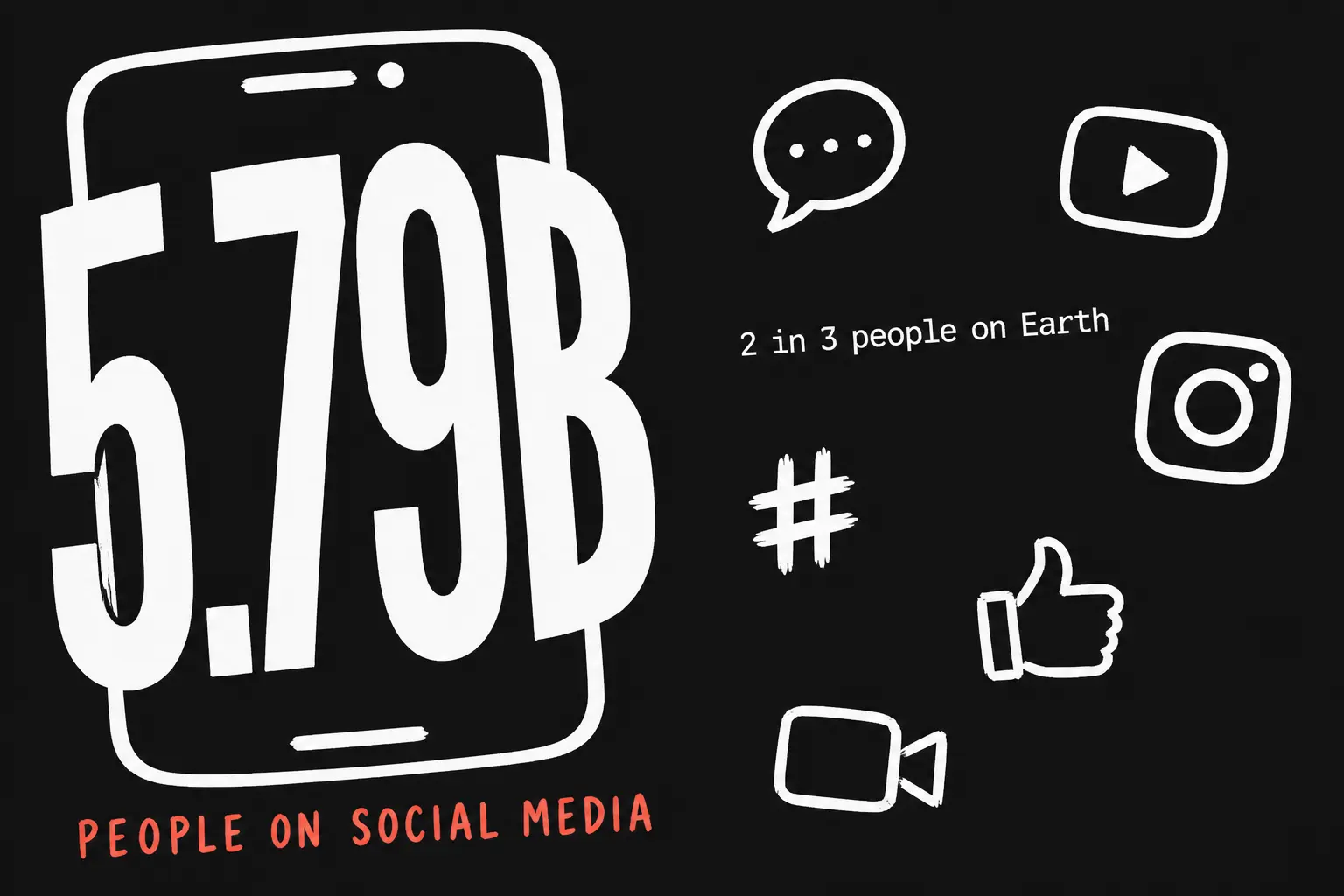
More than two thirds of every person alive on Earth now uses social media. The total reached 5.79 billion user identities in April 2026, and that number is still growing at a rate of 9.3 new users every single second. Social media users now outnumber non-users by more than two to one.
In this article we will article cover the full picture: how the number has grown, which platforms hold the most users, how behaviour differs by age and region, and what the data means for anyone trying to reach people online in 2026.
How We Got to 5.79 Billion
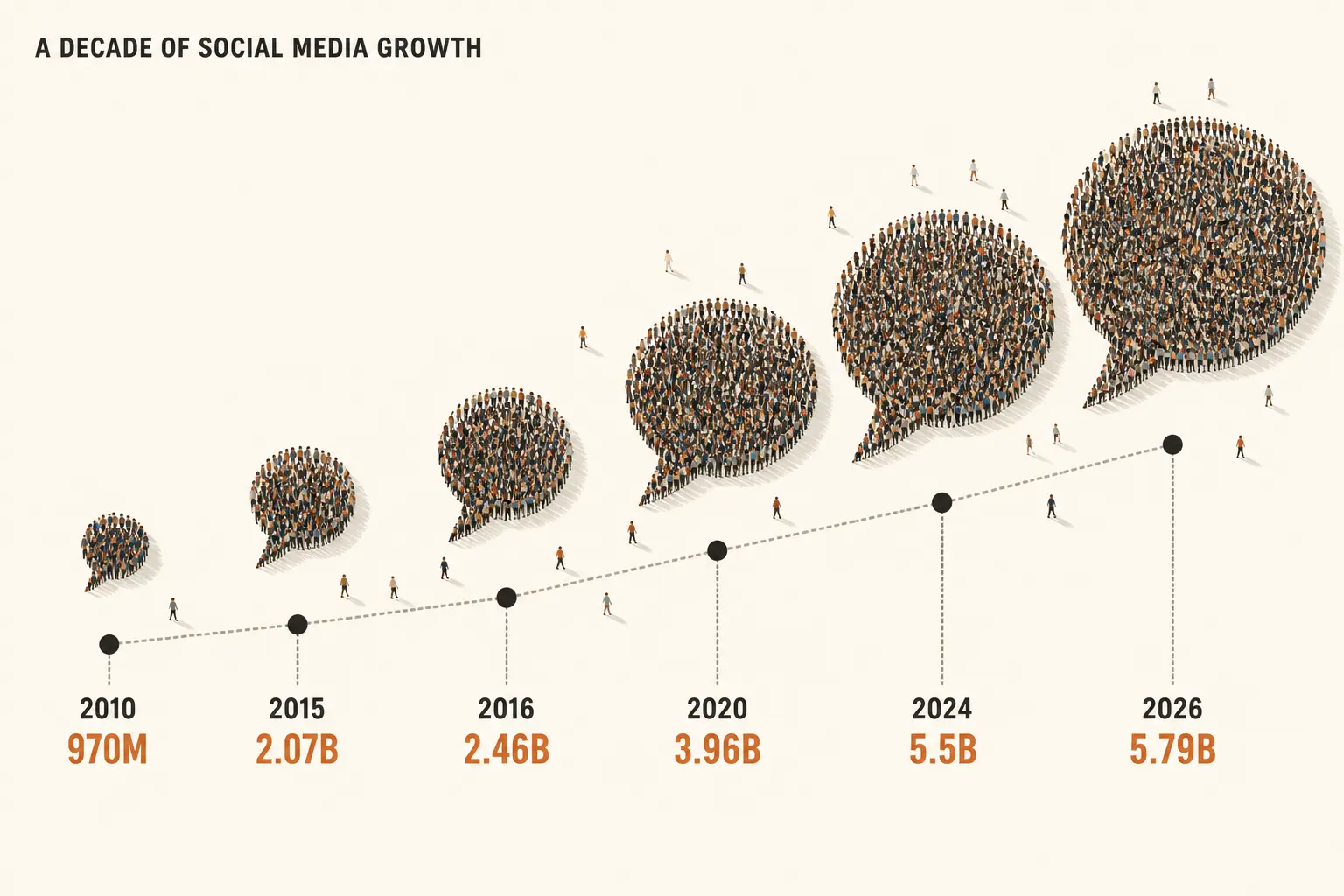
Ten years ago social media had 2.46 billion users. Today it is 5.79 billion. That is a 2.35 times increase in a decade driven by smartphone adoption, cheaper mobile data, and platform expansion into regions that barely had internet access a generation ago.
The growth has not stopped but it is slowing. Adding 294 million new user identities in 2025 to 2026 represents a 5.4% annual increase. That sounds healthy until you compare it to the 10% to 15% annual growth rates of the early 2010s. The platforms are running out of new people to reach in developed markets and are now growing almost entirely through mobile-first adoption in South and Southeast Asia, Sub-Saharan Africa, and Latin America.
One important note on the 5.79 billion figure: DataReportal is explicit that this counts user identities, not unique individuals. Many people have multiple accounts across different platforms. The real number of unique humans on social media is lower, though DataReportal does not publish a precise de-duplicated figure.
Growth by the numbers:
- 970 million users in 2010
- 2.07 billion in 2015
- 2.46 billion in 2016
- 5.5 billion in 2024
- 5.79 billion in April 2026
- 294 million new identities added in 12 months
- 9.3 new users joining every second
- 94.7% of all internet users now also use social media
How does that compare to other milestones?
The world’s population hit 8 billion in November 2022. Social media users at 5.79 billion represent 69.9% of that total. Among adults aged 18 and over, the penetration rate is significantly higher at 86.6% of all adults globally, meaning the remaining growth is concentrated in younger age groups not yet on platforms and in regions still coming online for the first time.
Which Platforms Have the Most Users in 2026
The social media populace is dominated by a small number of platforms with audiences that individually dwarf the population of most countries. We compared data from different sources and here is what we found.
| Platform | Monthly Active Users | Facts |
|---|---|---|
| 3.07 billion | Only platform ever to pass 3 billion MAU | |
| YouTube | 2.65 billion | Largest advertising reach of any social platform |
| 2.8 billion | Dominant messaging app in 100+ countries | |
| 2.0 billion | Crossed 2 billion in 2025 | |
| TikTok | 1.9 billion | Grew 17% year on year |
| X (Twitter) | 611 million | Declining monthly active users |
| Snapchat | 800 million | Dominant among under-25s in Western markets |
| 1.43 billion | Based on registered members not MAU | |
| Threads | 380 million | Surpassed X in daily active users in January 2026 |
Meta stands apart from every other company in this table. It owns four of the nine platforms listed above: Facebook, WhatsApp, Instagram, and Messenger. Combined, Meta’s family of apps has 3.35 billion daily active people — meaning more than 4 in 10 people on Earth open a Meta product every single day.
Which platform is actually growing the fastest?
TikTok grew 17% year on year in 2025, the highest rate among large platforms. Threads grew 63% year on year and surpassed X in daily active users in January 2026, reaching 141.5 million daily actives versus X’s 125 million. X itself is declining. Discord, Bluesky, and Lemon8 are smaller but growing.
YouTube’s position is more complex than the raw MAU figure suggests. Similarweb app intelligence data shows YouTube may actually have more active app users than Facebook when measured by app sessions rather than company-reported figures. The discrepancy shows how much the answer to “what is the most popular platform” depends on how you count.
Who Uses Social Media and How They Behave
A 5.79 billion figure means that the behaviour behind it varies enormously by age, region, and platform.
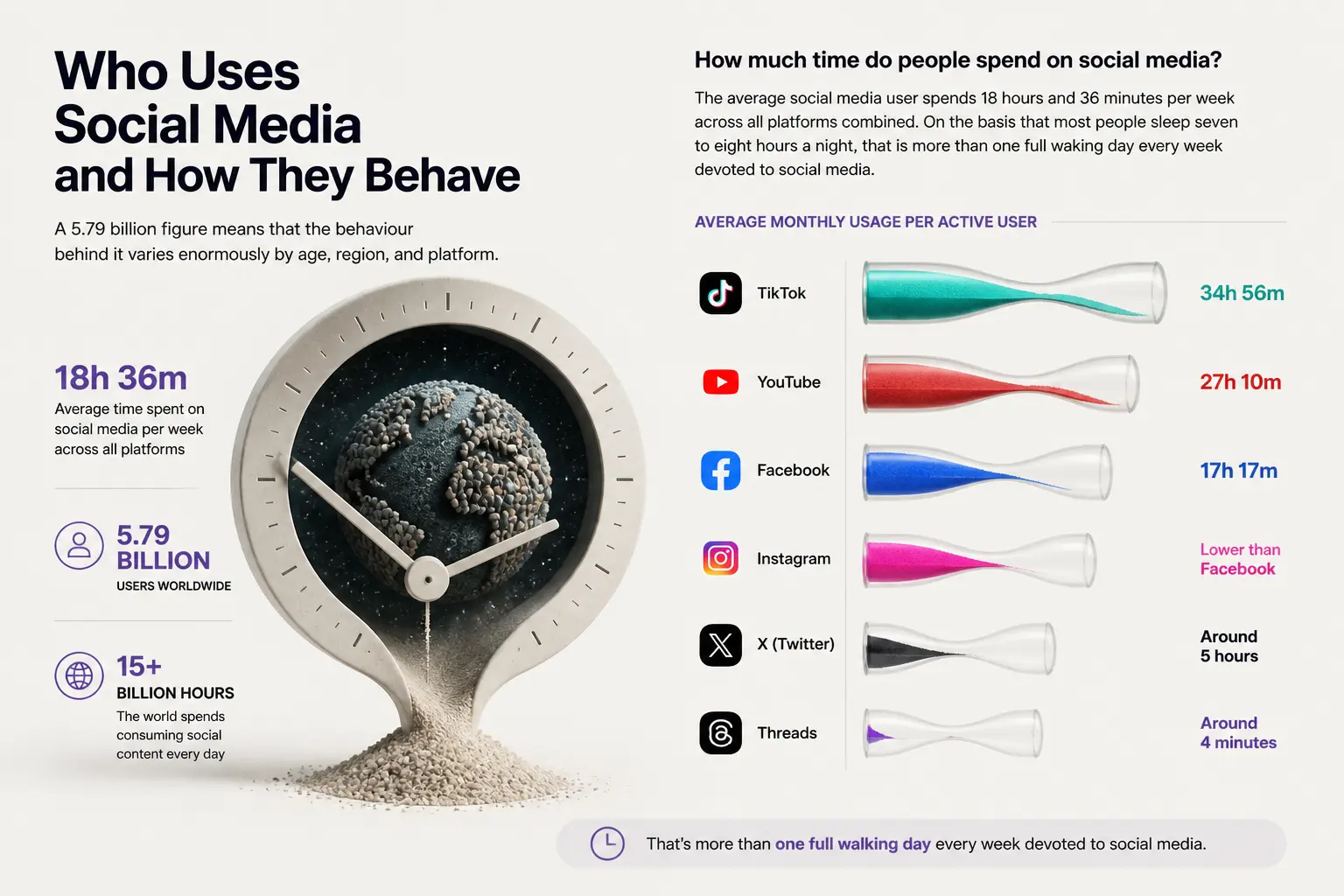
How much time do people spend on social media?
The average social media user spends 18 hours and 36 minutes per week across all platforms combined. On the basis that most people sleep seven to eight hours a night, that is more than one full waking day every week devoted to social media. Added together across all 5.79 billion users, the world spends more than 15 billion hours consuming social content every single day.
Time per platform:
| Platform | Average Monthly Usage Per Active User |
|---|---|
| TikTok | 34 hours 56 minutes |
| YouTube | 27 hours 10 minutes |
| 17 hours 17 minutes | |
| Lower than Facebook | |
| X (Twitter) | Around 5 hours |
| Threads | Around 4 minutes |
TikTok’s 34-hour monthly average is the highest of any social platform by a wide margin. Its short personalised video format keeps users in sessions far longer than they intend to stay.
How does usage differ by generation?
Sprout Social’s 2026 demographics data shows clear generational patterns in platform preference:
| Generation | Top Platforms |
|---|---|
| Gen Z | YouTube (91%), Instagram (86%), TikTok (79%), Facebook (77%) |
| Millennials | YouTube (90%), Facebook (89%), Instagram (81%), TikTok (69%) |
| Gen X | Facebook (88%), YouTube (83%), Instagram (60%), TikTok (46%) |
| Baby Boomers | Facebook (88%), YouTube (69%), Instagram (39%), TikTok (20%) |
The most active age group on social media globally is 16 to 24 year olds. They use social platforms on about 4.6 days each week and for roughly 3 hours 30 minutes per day. The 25 to 34 group is close behind at 4.4 days per week.
The average person actively uses 6.5 different social platforms every month. That figure challenges the assumption that users are loyal to one or two apps. Most people move between platforms throughout the day for different purposes: TikTok for entertainment, WhatsApp for messaging, LinkedIn for work, YouTube for longer video.
How do people access social media?
98% of all social media users access platforms via mobile devices. Social media and entertainment sites receive over 80% of their traffic from mobile. Platforms like TikTok, Instagram, and Facebook see over 90% of sessions from smartphones. Desktop social media use exists but it is a small minority of overall activity.
How Social Media usage Differs by Region
The UAE has the highest social media penetration rate of any country: 100.3% of its population uses social media, a figure above 100% because of multiple accounts and expatriate workers with home-country accounts.
China leads in absolute user numbers with approximately 1.18 billion social media users, followed by India at around 462 million and the United States at roughly 253 million. However, China’s platforms (WeChat, Weibo, Douyin) are largely separate from the Western social media ecosystem due to regulatory restrictions.
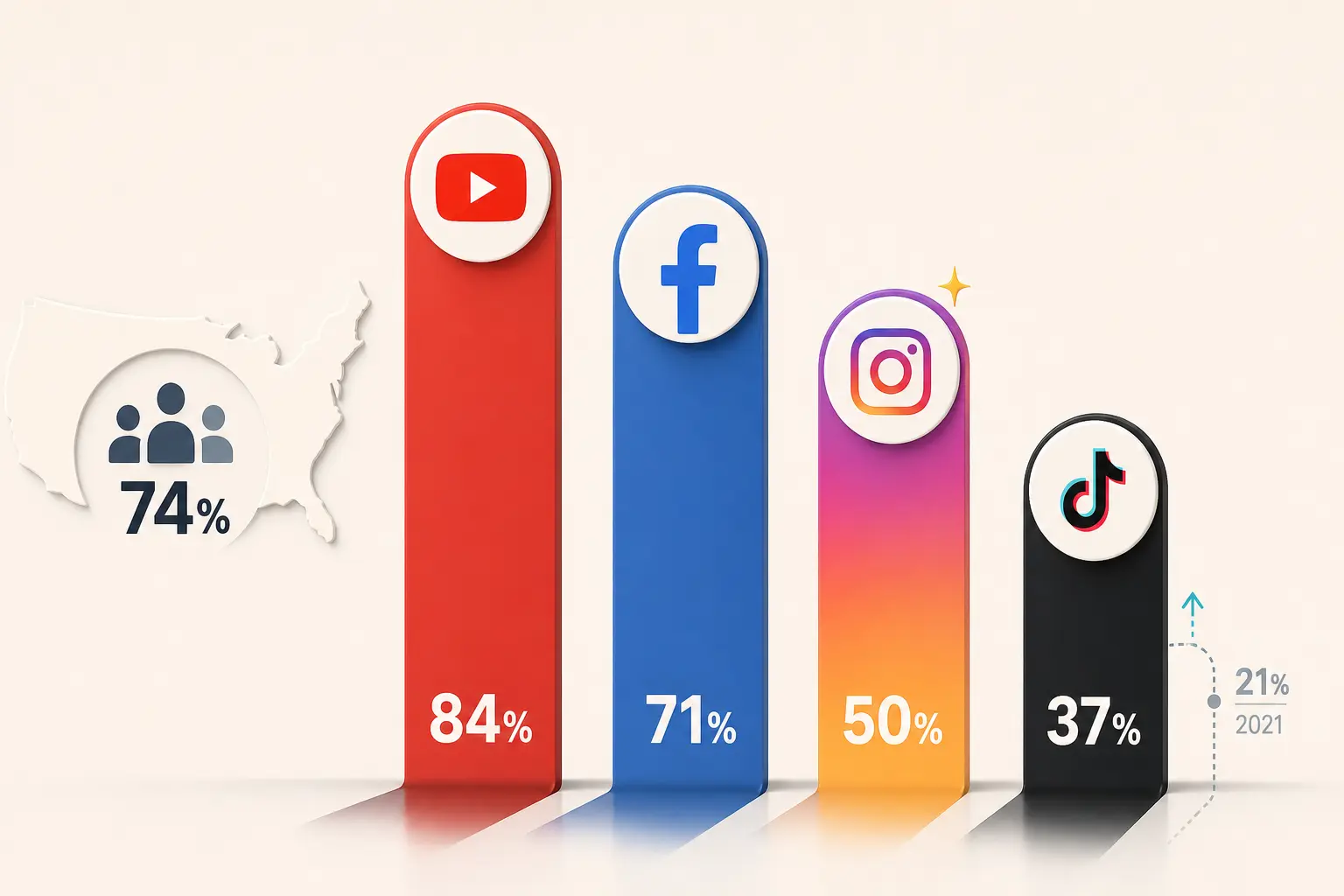
In the United States specifically:
- 74% of the US population actively uses social media
- YouTube is used by 84% of US adults, the highest of any platform
- Facebook is used by 71% of US adults
- Instagram crossed 50% of US adult usage for the first time in 2025
- TikTok is used by 37% of US adults, up from 21% in 2021
Social media strategy for marketers is changing
The scale of social media is only useful to a marketer if they know which part of it their audience actually occupies. A few findings that change how you should think about platform strategy:
- Short-form video under 60 seconds accounts for over 70% of all social media engagement across platforms
- 59% of Gen Z use short-form video apps to discover content before seeking out longer versions elsewhere
- 74% of Gen Z consumers discover new products through social media rather than traditional advertising
- TikTok’s cost-per-click is 30% lower than Meta on average, making it more cost-efficient for many advertisers
- Reddit is used for research by 18.2% of users, more than Facebook for that specific purpose
The fragmentation of attention across 6.5 platforms per user also means that reaching the same person on one platform does not guarantee they saw your content. The same audience needs to be reached across multiple touchpoints to build any meaningful frequency.
Frequently Asked Questions
How many people use social media in 2026?
5.79 billion people have social media user identities as of April 2026, equivalent to 69.9% of the global population. Note that this counts user identities, not unique individuals, as some people have multiple accounts.
Which social media platform has the most users in 2026?
Facebook has the most company-reported monthly active users at 3.07 billion. YouTube has the largest advertising reach at 2.65 billion. WhatsApp has approximately 2.8 billion monthly users. The answer depends on which metric you use, as different measurement methods produce different rankings.
How fast is social media growing?
Social media added 294 million new user identities in the twelve months to April 2026, an annual growth rate of 5.4%. That is equivalent to 9.3 new users every second. Growth is slowing compared to earlier years and is now driven almost entirely by mobile-first adoption in South Asia, Sub-Saharan Africa, and Latin America.
How much time does the average person spend on social media?
The average social media user spends 18 hours and 36 minutes per week across all platforms, equivalent to more than one full waking day every week. TikTok has the highest per-user time at 34 hours 56 minutes per month. US users spend slightly more than the global average at 8 hours 50 minutes per week.
What is the fastest growing social media platform in 2026?
Threads grew 63% year on year and surpassed X in daily active users in January 2026. TikTok grew 17% year on year, the highest rate among large established platforms. Among smaller platforms, Bluesky and Discord are both growing fast from smaller bases.
Is social media use declining among young people?
No. Gen Z remains the most active age group on social media globally, using platforms on 4.6 days per week and spending around 3 hours 30 minutes per day. TikTok is used by 79% of Gen Z globally. The shift is not away from social media but between platforms, with younger users moving time from Facebook toward TikTok, YouTube Shorts, and Instagram Reels.