Japanese male names come from the Japanese language and are usually built from kanji, the Chinese characters used in Japan. A single name can have several possible meanings depending on which kanji are chosen, so the sound and the written form both matter. Many traditional names reflect virtues, family hopes, birth order, nature, or long-standing naming patterns, while modern names may use simpler readings or newer combinations.
In this article, you will see 50 real japanese male names from history and modern Japan, including names such as Hirohito, Akihito, Satoshi, Haruto, Kenji, and Takashi. Some names are tied to emperors, samurai, writers, and public figures, while others are common in everyday use today. That mix gives you a clear view of how Japanese naming works across different eras.
As you go through the list, you can notice how endings like -o, -shi, -ta, and -ru appear in many names, and how kanji can change the feeling of a name even when the pronunciation stays the same. That gives you a practical way to understand japanese male names before you choose one, study one, or compare old and new styles.
Most Popular Japanese Male Names
- Satoshi
- Haruto
- Kenji
- Takumi
- Ryo
- Yuki
- Ren
- Daiki
- Masaru
- Akira
- Noboru
- Hikaru
- Kenta
- Shin
[cfury_download slug=”80-japanese-male-names-from-history-and-modern-japan-7uz1p2″ label=”Download 80 Japanese Male Names From History And Modern Japan.pdf”]
50 japanese male names Meaning and Origins
| # | Name | Category | Meaning and Origin |
|---|---|---|---|
| 1 | Akira | Modern | Bright, clear; Japanese origin |
| 2 | Haruto | Modern | Sunlight, flying; Japanese origin |
| 3 | Ren | Modern | Lotus, love; Japanese origin |
| 4 | Yuki | Modern | Snow, happiness; Japanese origin |
| 5 | Sota | Modern | Big, sudden; Japanese origin |
| 6 | Riku | Modern | Land, shore; Japanese origin |
| 7 | Daiki | Modern | Great radiance; Japanese origin |
| 8 | Kaito | Modern | Ocean, flight; Japanese origin |
| 9 | Haru | Modern | Spring, sunshine; Japanese origin |
| 10 | Shota | Modern | Swelling, flight; Japanese origin |
| 11 | Minamoto no Yoritomo | Historical | First shogun; Heian period |
| 12 | Oda Nobunaga | Historical | Powerful warlord; Sengoku period |
| 13 | Toyotomi Hideyoshi | Historical | Unifier of Japan; Sengoku period |
| 14 | Tokugawa Ieyasu | Historical | Founder of Edo shogunate |
| 15 | Takeda Shingen | Historical | Great daimyo; famed tactician |
| 16 | Uesugi Kenshin | Historical | Warrior lord; revered general |
| 17 | Saigo Takamori | Historical | Meiji leader; last samurai |
| 18 | Miyamoto Musashi | Historical | Legendary swordsman; Edo period |
| 19 | Hattori Hanzo | Historical | Famed ninja leader; Iga |
| 20 | Sakamoto Ryoma | Historical | Visionary reformer; late Edo |
| 21 | Atsushi | Classic | Kind, warm; Japanese origin |
| 22 | Kenji | Classic | Strong, second son; Japanese origin |
| 23 | Takashi | Classic | Noble, prosperous; Japanese origin |
| 24 | Masato | Classic | Righteous person; Japanese origin |
| 25 | Hideki | Classic | Excellent tree; Japanese origin |
| 26 | Noboru | Classic | To ascend; Japanese origin |
| 27 | Osamu | Classic | Discipline, study; Japanese origin |
| 28 | Shinji | Classic | True second son; Japanese origin |
| 29 | Takeshi | Classic | Warrior, brave; Japanese origin |
| 30 | Yuji | Classic | Gentle, second son; Japanese origin |
| 31 | Nariyoshi | Rare | Successful rule; Japanese origin |
| 32 | Masakazu | Rare | Correct harmony; Japanese origin |
| 33 | Fumio | Rare | Scholarly man; Japanese origin |
| 34 | Ichiro | Traditional | First son; Japanese origin |
| 35 | Jiro | Traditional | Second son; Japanese origin |
| 36 | Saburo | Traditional | Third son; Japanese origin |
| 37 | Shiro | Traditional | Fourth son; Japanese origin |
| 38 | Goro | Traditional | Fifth son; Japanese origin |
| 39 | Kazuo | Traditional | Harmonious man; Japanese origin |
| 40 | Hideo | Traditional | Excellent man; Japanese origin |
| 41 | Yamato | Cultural | Ancient Japan; Japanese origin |
| 42 | Tomoya | Cultural | Wise friend; Japanese origin |
| 43 | Masaru | Cultural | Victory, excellence; Japanese origin |
| 44 | Kenta | Cultural | Healthy, strong; Japanese origin |
| 45 | Isamu | Cultural | Bravery, courage; Japanese origin |
| 46 | Ryota | Cultural | Refreshing, thick; Japanese origin |
| 47 | Naoki | Cultural | Honest tree; Japanese origin |
| 48 | Shun | Cultural | Fast, talented; Japanese origin |
| 49 | Hiroshi | Cultural | Generous, tolerant; Japanese origin |
| 50 | Tomo | Cultural | Friend, wisdom; Japanese origin |
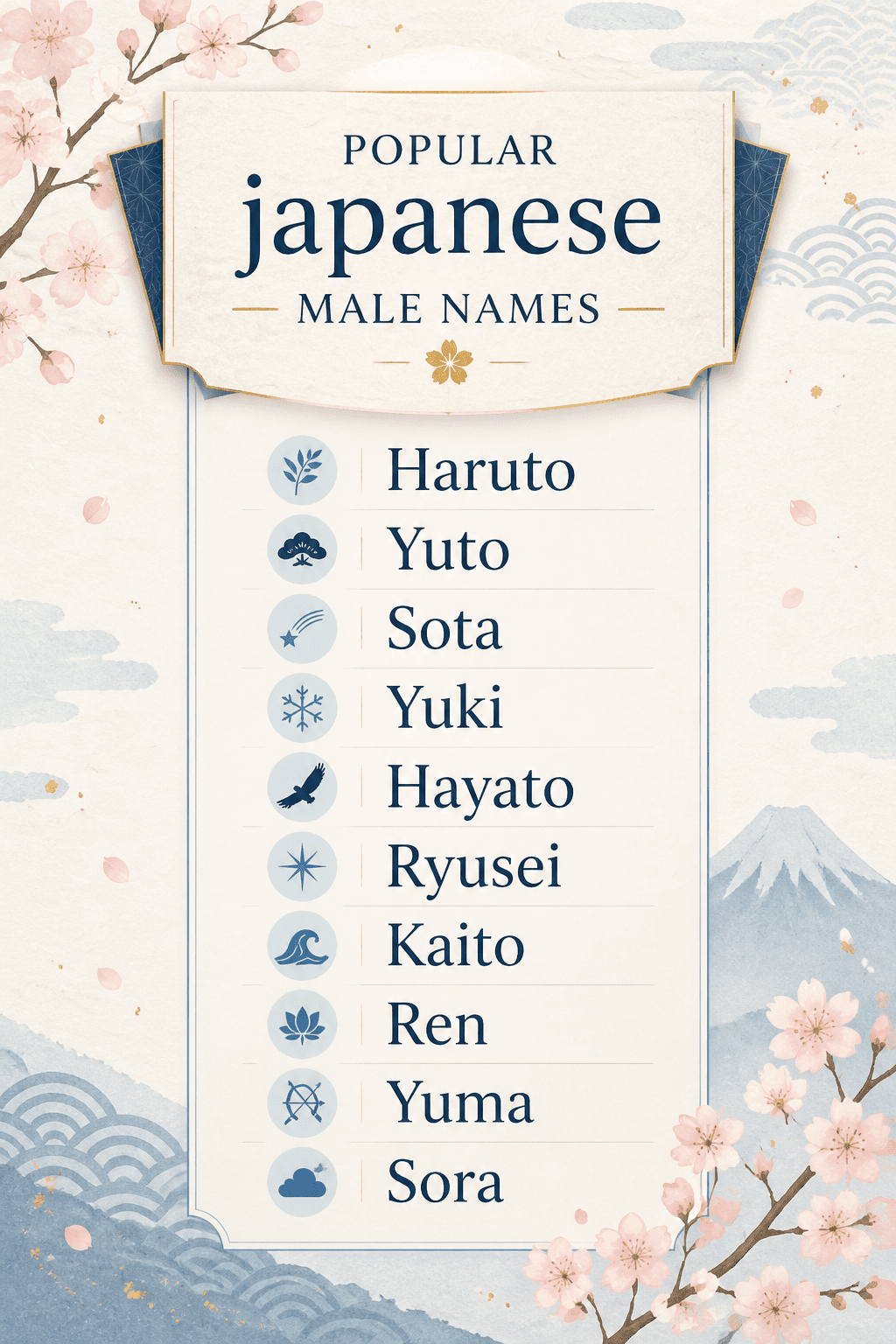
If you are choosing from japanese male names, the table gives you the raw options, but the next step is deciding which one actually fits the person, the era, and the setting you have in mind. A name can feel traditional, modern, formal, or fictional depending on how it is read and used.
How Do Japanese Male Names Work?
Japanese names are usually written with kanji, and that matters because the same sound can be written with different characters and different meanings. A name may look simple in roman letters, but the meaning can change completely once you see the kanji.
- Meaning depends on kanji: A name like Haruto can be written with several character combinations, so the meaning is not fixed by sound alone.
- Reading is not always obvious: Some japanese male names have common pronunciations, while others use rare readings that need explanation.
- Generational style matters: Older names like Hiroshi or Kazuo can feel strongly tied to earlier decades, while names such as Ren or Sota often sound more contemporary.
- Fiction and real life differ: Authors often choose names for sound and symbolism, but real families also think about kanji balance and social feel.
- Short names can feel modern: Simple, two-syllable japanese male names often read as clean and current, especially in pop culture or branding.
How Do You Choose Japanese Male Names?
If you are picking one for a baby, a character, or even a project name, start with the feeling you want first and the meaning second. In Japanese naming, sound, kanji, and cultural tone all matter together, so a name should fit both the person and the context.
- Decide the role of the name: A baby name, a novel character name, and a pen name should not all be chosen the same way.
- Check the kanji options: Make sure the characters you choose create the meaning you want and do not introduce an unintended reading.
- Say it out loud: Some japanese male names sound strong in writing but awkward in speech, especially if they are hard to pronounce outside Japan.
- Match the tone to the setting: A historical samurai name and a modern school-age name should feel different, even if both are authentic.
- Look at familiar examples: Popular names in manga, film, sports, and history can help you sense whether a name feels formal, youthful, or classic.
Frequently Asked Questions
What are some popular historical Japanese male names?
Popular historical Japanese male names include Minamoto no Yoritomo, Oda Nobunaga, Tokugawa Ieyasu, Toyotomi Hideyoshi, and Miyamoto Musashi. Many traditional names reflect strength, virtue, leadership, or nature.
How are Japanese male names typically structured?
Japanese male names usually place the family name first and the given name second in formal contexts. Given names often use kanji with meanings tied to qualities such as bravery, wisdom, peace, or longevity.
Do modern Japanese male names differ from historical names?
Yes. Modern Japanese male names often sound simpler and more contemporary, while historical names may include older kanji choices, honorific styles, or names associated with samurai and imperial traditions.
Why do Japanese male names have multiple possible readings?
Japanese names can have multiple readings because the same kanji may be pronounced in different ways. Parents may also choose uncommon readings to create a unique name while preserving a meaningful written form.
Can the same Japanese male name have different meanings?
Yes. A name’s meaning depends on the kanji used to write it, so the same pronunciation can represent different ideas. For example, a name may emphasize courage, light, harmony, or a connection to nature depending on the characters selected.
- [cfury_download slug=”80-japanese-male-names-from-history-and-modern-japan-7uz1p2″ label=”PDF list”]
- [cfury_download slug=”80-japanese-male-names-from-history-and-modern-japan-7uz1p2-image” label=”Hero image”]
- [cfury_download slug=”80-japanese-male-names-from-history-and-modern-japan-7uz1p2-table” label=”Excel table”]