Demon names come from folklore, religion, myth, and old language traditions that gave hostile spirits, tempters, and underworld beings their own identities. These names appear in texts from Mesopotamia, Judaism, Christianity, Islam, Persia, Greece, Japan, and Europe, and they follow clear patterns: some name a role, some describe a power, and some preserve an older word for spirit or enemy.
This list gives you 50 demon names from real world folklore, including famous figures such as Asmodeus, Lilith, Belial, Azazel, Pazuzu, and Beelzebub. You will see names tied to fallen angels, plague spirits, night demons, and tricksters, along with the cultures that named them and the meanings attached to them. If you want demon names that come from actual tradition rather than fiction, this opening gives you the ground rules before the full list begins.
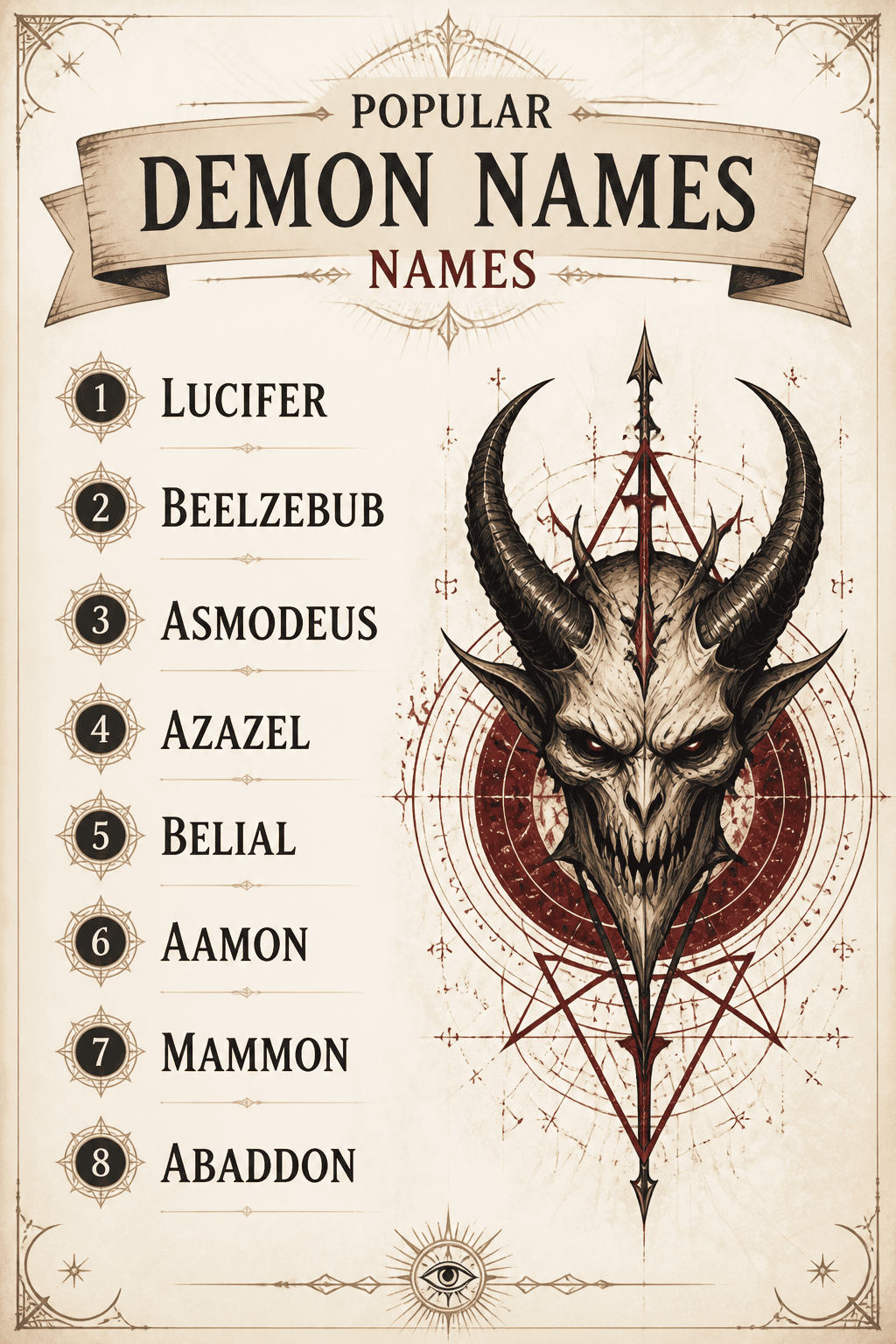
Popular Demon Name Picks
- Asmodeus
- Beelzebub
- Lilith
- Azazel
- Baphomet
- Abaddon
- Belial
- Leviathan
- Lucifer
- Valefor
- Orobas
- Paimon
- Mammon
- Mephistopheles
[cfury_download slug=”50-demon-names-from-real-world-folklore-jvxqbi” label=”Download 50 Demon Names From Real World Folklore.pdf”]
This alphabetical list gathers 50 demon names from real world folklore and places each one by cultural origin so you can compare them quickly. It draws from ancient records, oral tradition, and later reference works, mixing well known figures with rarer names for a balanced view. You will see entries linked to Mesopotamian lore, Jewish folklore, Islamic tradition, European legends, and other historical sources, with brief context kept close to the original naming and tradition.
50 demon names and what they mean
| # | Name | Category | Meaning and Origin |
|---|---|---|---|
| 1 | Asmodeus | Jewish Demonology | Persian origin; demon of lust and wrath |
| 2 | Azazel | Biblical Demon | Goat spirit linked to wilderness and sin |
| 3 | Baal | Canaanite Deity | Title meaning “lord”; later demonized in folklore |
| 4 | Belial | Biblical Demon | Hebrew term for worthlessness and lawlessness |
| 5 | Beelzebub | Biblical Demon | Philistine god name later used for a demon |
| 6 | Choronzon | Occult Figure | Chaos spirit from later esoteric tradition |
| 7 | Dagon | Ancient Deity | Mesopotamian and Philistine god later demonized |
| 8 | Gremory | Goetic Demon | Female duke in medieval demon lists |
| 9 | Hecate | Greek Mythology | Goddess tied to magic, ghosts, and crossroads |
| 10 | Ipos | Goetic Demon | Demon of boldness and hidden knowledge |
| 11 | Jezebeth | Folk Demon | Variant demon name linked to temptation |
| 12 | Kali | Hindu Tradition | Powerful goddess sometimes misread in demon lore |
| 13 | Lamia | Greek Folklore | Child-devouring monster and night spirit |
| 14 | Leviathan | Biblical Monster | Sea monster symbolizing chaos and deep waters |
| 15 | Lilith | Jewish Folklore | Night spirit and feared figure in legend |
| 16 | Marchosias | Goetic Demon | Wolf-like warrior spirit from grimoires |
| 17 | Mastema | Jewish Demonology | Name means hostility or enmity |
| 18 | Medusa | Greek Mythology | Gorgon whose gaze turned people to stone |
| 19 | Morana | Slavic Folklore | Winter and death figure in folk belief |
| 20 | Mormo | Greek Folklore | Child frightener and terrifying female spirit |
| 21 | Murmur | Goetic Demon | Spirit associated with teaching and necromancy |
| 22 | Nergal | Mesopotamian Myth | Underworld god later linked with demons |
| 23 | Orcus | Roman Folklore | Underworld figure tied to punishment and death |
| 24 | Pazuzu | Mesopotamian Demon | Wind demon known from ancient amulets |
| 25 | Raum | Goetic Demon | Demon of theft and destruction |
| 26 | Ronove | Goetic Demon | Teacher spirit from later demonology |
| 27 | Sabnock | Goetic Demon | Builder of fortifications in occult texts |
| 28 | Seir | Goetic Demon | Swift spirit linked to journeys and messages |
| 29 | Shax | Goetic Demon | Trickster spirit known for stealing senses |
| 30 | Shiva | Hindu Tradition | Major god sometimes confused in demon lists |
| 31 | Stolas | Goetic Demon | Owlish prince associated with herbs and stars |
| 32 | Succubus | Folk Demon | Female night spirit that seduces sleepers |
| 33 | Talos | Greek Mythology | Bronze giant and guardian figure |
| 34 | Tannin | Biblical Demon | Dragon or serpent figure from Hebrew lore |
| 35 | Tiamat | Mesopotamian Myth | Sea dragon of chaos and creation myth |
| 36 | Vapula | Goetic Demon | Spirit linked to crafts and mechanics |
| 37 | Vassago | Goetic Demon | Seer spirit who reveals hidden things |
| 38 | Vine | Goetic Demon | Spirit said to build towers and destroy walls |
| 39 | Xaphan | Folk Demon | Fire stoker from later demon lore |
| 40 | Yeqon | Jewish Demonology | Angel name later linked to seduction |
| 41 | Zagan | Goetic Demon | Alchemist spirit who transforms metals |
| 42 | Ziminiar | Goetic Demon | One of the four chief infernal kings |
| 43 | Amdusias | Goetic Demon | Horned spirit tied to music and sound |
| 44 | Buer | Goetic Demon | Healing spirit with a lion-like form |
| 45 | Furfur | Goetic Demon | Storm spirit that speaks with thunder |
| 46 | Orobas | Goetic Demon | Truthful spirit who answers questions honestly |
| 47 | Paimon | Goetic Demon | Kingly spirit in Western occult tradition |
| 48 | Phenex | Goetic Demon | Poetic spirit linked to music and learning |
| 49 | Vinegine | Folk Demon | Local demon name found in grim folklore |
| 50 | Zarqa | Middle Eastern Folklore | Desert spirit name in regional tales |
If you are choosing from demon names for a story, game, or character sheet, the next step is not just picking one that sounds dark. You also want to know where the name comes from, what culture it belongs to, and whether it fits the role you have in mind.
What Do Demon Names Mean?
In folklore, demon names are rarely random. Some point to a specific religious tradition, some come from regional spirit lore, and some were written down by scholars long after the stories started circulating. That matters if you want your choice to feel accurate instead of borrowed at random.
- Religious origin: Some demon names appear in Jewish, Christian, or Islamic traditions, where the figure may be a fallen angel, a spirit, or a later folkloric demon.
- Local folklore: Other names come from village stories, protective charms, or oral traditions, so their role can be more ambiguous than “evil being.”
- Translation changes: A name can shift spelling and meaning as it moves between languages, especially from Arabic, Hebrew, Greek, or Latin sources.
- Symbolic use: In modern fiction, demon names often become shorthand for danger, temptation, secrecy, or power, even when the original myth was more specific.
How To Use Demon Names Well?
If you are naming a character, a pen name, a pet, or a fictional villain, match the tone of the name to the role. A name with a long religious history may feel heavier and more serious than a regional folklore name that sounds eerie but less familiar.
- Check the source first: Make sure you know whether the demon name belongs to a deity, a spirit, a monster, or a demonized figure in later tradition.
- Watch the pronunciation: Some names look dramatic on the page but are hard to say out loud, which can matter if you plan to use them in dialogue or branding.
- Mind the culture: If a name comes from a living tradition, use it with care and avoid treating sacred or ceremonial material like a costume piece.
- Think about tone: Names tied to figures such as Asmodeus, Astaroth, Lilith, or Pazuzu can feel very different from names drawn from regional ghost lore or household spirits.
- Test the full name: Say it beside the rest of your character name, project title, or pet name to see whether it sounds balanced or too forced.
Frequently Asked Questions
What are some well-known demon names from real-world folklore?
Are all demon names from folklore connected to evil beings?
No. Some figures labeled as demons in later traditions were originally neutral, ambiguous, or even protective beings in earlier folklore. Their meanings often changed as religions, myths, and local legends evolved over time.
Do demon names from folklore appear in more than one culture?
Yes. Similar names and motifs can appear across multiple cultures because stories were shared, adapted, and reinterpreted over centuries. Comparative folklore often shows overlapping traits among spirits from Mesopotamian, Jewish, Christian, Islamic, Greek, and other traditions.
What is the difference between a demon, spirit, and deity in folklore?
The distinction depends on the cultural context. In some traditions, a being classified as a spirit or deity in one source may later be described as a demon in another. Folklore studies look at how these categories shift rather than assuming a single fixed definition.
How can demon names from folklore be researched accurately?
Accurate research usually starts with primary texts, scholarly encyclopedias, and reputable cultural references rather than modern name lists alone. Reliable sources help clarify spelling variants, historical context, and whether a figure was truly considered a demon in the original tradition.
- [cfury_download slug=”50-demon-names-from-real-world-folklore-jvxqbi” label=”PDF list”]
- [cfury_download slug=”50-demon-names-from-real-world-folklore-jvxqbi-image” label=”Hero image”]
- [cfury_download slug=”50-demon-names-from-real-world-folklore-jvxqbi-table” label=”Excel table”]