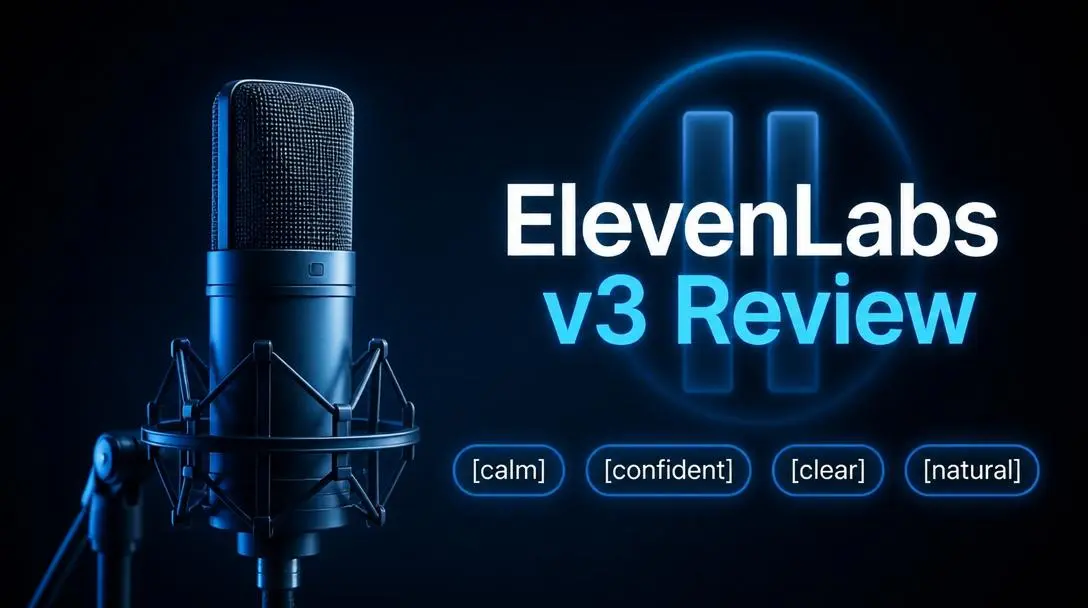
Eleven v3 is the highest-quality voice model ElevenLabs has shipped. It went to general availability on March 14, 2026, bringing Audio Tags for inline emotional direction, a 68% reduction in complex text errors compared to the v2 generation, and language support expanded from 28 to over 70 languages. On the Artificial Analysis Speech Arena, the flagship model holds an Elo of approximately 1,178 with 3,753 blind-test appearances, placing it in the top tier of all commercial TTS models evaluated.
The question is whether the credit system and pricing structure make v3 a reasonable production tool, or whether the gap between the advertised plan price and what creators actually pay disqualifies the platform for volume work.
What does Eleven v3 do differently from previous ElevenLabs models?
The defining feature is Audio Tags.
By embedding bracketed instructions directly in the script (for example, [whispers], [excited], [sighs]), the model adjusts delivery at the phrase level without requiring multiple takes or external voice direction tools. Previous models relied on coarse parameter sliders for stability, similarity, and style exaggeration. The v3 architecture replaces that workflow with natural-language prompting inside the text itself.
The practical result is that a narrator can script something like [slowly] Back then... [chuckles] we had no phones. [whispers] Just dirt roads and [coughs] big dreams. and the model will render each tag as a distinct vocal gesture. For audiobook production, character dialogue, game voiceover, and film dubbing, the expressive range is a genuine step up from any prior commercially available or free text-to-speech engine.
Additional technical changes in the latest eleven v3 model:
- Text to Dialogue API: Generates multi-speaker conversations from a single script, matching prosody and emotional range between characters. The model handles interruptions and overlapping turns.
- 70+ language support: Up from 28 in v2. English, Spanish, French, and German output quality is strong. Lower-traffic languages still show uneven quality.
- 3,000 character limit per request: Long-form generation requires splitting input across multiple API calls, which adds complexity to automated workflows.
- 72% user preference over v3 Alpha: The GA release refined the model noticeably from the earlier research preview.
Where does Eleven v3 rank on the TTS Arena leaderboard in 2026?
The Artificial Analysis Speech Arena is the standard independent benchmark for TTS quality. It uses blind pairwise comparisons where human listeners pick the more natural-sounding sample, and ranks models using an Elo rating system.
As of June 2026, the top of the leaderboard looks like this:
| Rank | Model | Elo | Price per 1M chars |
|---|---|---|---|
| 1 | Fun-Realtime-TTS (Alibaba) | ~1,219 | $27.60 |
| 2 | Gemini 3.1 Flash TTS (Google) | ~1,214 | $18.30 |
| 3 | Realtime TTS-2 Research Preview (Inworld) | ~1,209 | $35 |
| 4 | Sonic 3.5 (Cartesia) | ~1,203 | — |
| 5 | Realtime TTS 1.5 Max (Inworld) | ~1,195 | $35 |
| ~4–6 | Eleven v3 (ElevenLabs) | ~1,178 | $100 |
The flagship model ranks in the top tier, but several models now outperform it on raw Elo while costing significantly less per million characters.
What does the ElevenLabs credit system cost in practice?
The platform uses a shared credit pool across all products. For standard TTS on the v2 and v3 models, one text character equals one credit. Flash and Turbo models consume approximately 0.5 credits per character, effectively doubling output for the same credit allocation.
| Plan | Monthly Price | Credits | Approx. TTS Minutes (V3) |
|---|---|---|---|
| Free | $0 | 10,000 | ~10 min |
| Starter | $6 | 30,000 | ~30 min |
| Creator | $22 | 121,000 | ~100–121 min |
| Pro | $99 | 600,000 | ~500 min |
| Scale | $299 | 1,800,000 | ~1,800 min |
| Business | $990 | 6,000,000 | ~6,000 min |
Annual billing reduces the effective monthly cost by roughly 17% (equivalent to two free months). The Creator plan often runs a 50% first-month promotion, dropping the initial payment to $11.
The final cost can be simplified to approximately 1,000 credits per one minute of narration. This varies with pacing, punctuation density, and the specific model used, but it is a reliable planning baseline.
Why do users report paying roughly 3x the advertised plan price?
The specific mechanisms causing this gap:
- Credits charge per generation attempt, not per successful output. Every regeneration, every failed run, and every test consumes credits from the same pool. Creators working iteratively on long-form content, especially when adjusting Audio Tags to get the right emotional delivery, burn through credits at a rate that makes the effective usable output significantly lower than the raw character count implies. Reddit users consistently report effective costs running around 2.5–3x the advertised rate once regeneration loops are factored in.
- Downgrading or cancelling forfeits all unused credits. If a creator on the Pro plan ($99/month) with 200,000 remaining credits decides to drop to Creator, those credits vanish at the end of the billing cycle. Multiple Trustpilot reviews describe this as the single most frustrating billing policy on the platform.
- Free plan audio cannot be used commercially. The 10,000 monthly credits on the free tier carry an attribution requirement and explicitly exclude monetized content, client deliverables, and advertising. Upgrading later does not retroactively license audio generated on the free tier.
- Overage billing is not uniform. Creator and higher plans can enable usage-based billing that charges per minute beyond the included credits, at rates that vary by plan tier ($0.18–$0.36 per minute depending on the plan and interface). Starter and Free plans simply stop generation when credits are exhausted, with no overage option.
How much does it cost to run a daily-upload YouTube channel on ElevenLabs v3?
If you publish one video per day with 10 minutes of narration per video, you will need approximately 300 minutes of TTS per month. At the standard 1,000 credits per minute conversion, that is 300,000 credits using the v3 model.
The Creator plan (121,000 credits) covers roughly 4 days of production. The Pro plan (600,000 credits) handles the full month with a comfortable buffer for regenerations. But if you are producing narration that requires iterative Audio Tag adjustments, which is common for channels that rely on expressive delivery to retain viewers, your effective consumption climbs toward 500,000–800,000 credits depending on the regeneration rate.
For a YouTube script generator workflow producing 30 hours of narration per month (roughly 1.6 million characters): Creator and Pro are both insufficient. You should be thinking of the Scale tier at $299/month with 1,800,000 credits as the minimum viable plan. Factor in regeneration waste, and you should budget $300 or more per month for a daily faceless channel using v3 quality, not the $22 that the Creator plan headline implies.
Which workloads does Eleven v3 fit well, and which does it not?
The v3 architecture uses a larger model footprint paired with a higher-fidelity voice codec that requires more processing time per request. ElevenLabs documents this explicitly: the model is not suitable for real-time or conversational use cases. For voice agents, live customer service bots, and interactive applications that need sub-200ms response times, the company recommends Flash v2.5 at ~75ms latency, which does not match v3’s quality level.
Workloads where Eleven v3 is a strong fit:
- Audiobook production: Long-form narration where latency is irrelevant and emotional range directly affects the listening experience.
- Film and game dubbing: Multi-character dialogue using the Text to Dialogue API, with 70+ language support for localization workflows.
- Marketing voiceovers and podcast intros: Pre-rendered audio where quality justifies the per-character cost, and the volume stays within Creator or Pro plan limits.
- E-learning and training content: Consistent, clear delivery across many modules, where Professional Voice Cloning is required.
Workloads where v3 is a poor fit:
- Real-time voice agents and conversational AI: The higher latency makes v3 unusable for applications that require immediate response. Flash v2.5 fills this role at reduced quality, but Inworld’s Realtime TTS 1.5 Max and Cartesia’s Sonic 3.5 both offer higher quality at lower latency.
- High-volume, cost-sensitive narration: Channels or platforms generating thousands of minutes per month hit pricing thresholds where the per-character cost becomes a significant operational expense. Self-hosted open-weight models like Kokoro eliminate the per-character cost entirely.
- Applications requiring strict output consistency: Several reviews note that v3 can produce less predictable output than v2, particularly in polished commercial workflows where consistency matters more than expressiveness. The Multilingual v2 model remains more stable for neutral narration tasks.
What are the other ElevenLabs TTS models besides v3?
At the moment, ElevenLabs maintains four TTS models alongside the music generation engine:
- Turbo v2.5: High quality at lower latency than v3, supporting 32 languages. Functionally equivalent to Flash v2.5 but with slightly higher average latency. ElevenLabs recommends Flash over Turbo for all use cases.
- Flash v2.5: The real-time model, targeting ~75ms latency. Consumes 0.5 credits per character, effectively doubling output per credit versus v3. The quality trade-off is noticeable but acceptable for voice agent applications.
- Multilingual v2: The production workhorse from the previous generation. Supports 29+ languages with stable, predictable output. Still preferred by many creators for neutral narration where expressiveness is less important than consistency.
- Music: A separate model for generating full songs from text prompts. Credits are consumed at 900 per minute, making music generation substantially more expensive per minute than speech. For creators looking at AI-generated background music at scale, dedicated AI song generators or self-hosted MusicGen may be more cost-effective.
What open-source and lower-cost alternatives compete with Eleven v3 on quality?
The competitive landscape has shifted meaningfully since v3 launched. Several models now deliver quality that overlaps with the flagship model’s range at a fraction of the cost.
- Resemble AI Chatterbox: MIT-licensed, open-weight model that beat ElevenLabs in 63–65% of blind listening comparisons. Chatterbox is free to self-host. The turbo variant (chatterbox-turbo) targets real-time agent use cases at ~75ms. The trade-off is that the platform assumes developer-level users, not casual creators.
- Voxtral TTS (Mistral): Released March 2026, priced at approximately $0.016 per 1,000 characters (roughly half the ElevenLabs per-character rate). In Mistral’s own listener tests, 62.8% of participants preferred Voxtral over Flash v2.5. Currently supports only 9 languages and has no browser interface.
- Kokoro 82M: The free, CPU-friendly model that powers a large share of independent TTS applications. Runs via WebGPU or WebAssembly directly in the browser. Self-hosted cost is limited to GPU rental (roughly $0.34/hr on an RTX 4090 through RunPod). Quality sits below the v3 tier at Elo ~1,062 but beats every commercial model priced under $15 per million characters.
- Fish Audio S2 Pro: The highest-ranked open-weight model on the Artificial Analysis leaderboard at Elo ~1,123. Supports 80+ languages. Requires a paid license for commercial use.
- MiniMax Speech 2.6 HD: Strong expressiveness at 40+ languages, positioned at $100 per million characters. Competitive with the flagship ElevenLabs model on emotional delivery with better multilingual coverage for lower-traffic languages.
How does the ElevenLabs’s financial position affect the product outlook?
ElevenLabs raised $500 million in a Series D round led by Sequoia Capital in February 2026, reaching an $11 billion valuation and tripling its $3.3 billion valuation from January 2025. Annual recurring revenue surpasses $330 million. The platform processes over 6 billion characters of audio per month across 185 countries, and 41% of Fortune 500 companies use the service for some portion of their audio content.
PlayHT, which was the most direct competitor, shut down in December 2025. Former PlayHT users largely migrated to ElevenLabs. The remaining competitive set includes Murf (focused on enterprise narration with ethical voice sourcing), Inworld (focused on real-time voice agents), Cartesia (focused on low-latency streaming), and the growing open-weight ecosystem.
The funding position means the platform is unlikely to disappear or reduce investment in model quality. It also means the credit-based pricing model has no competitive pressure forcing it to change. The current billing structure generates strong recurring revenue from creators who underestimate their consumption and find themselves locked into higher tiers or paying overage rates.
Who should pay for Eleven v3, and who should look elsewhere?
Buy ElevenLabs v3 if you are a:
- Casual Creator: The Starter Plan ($6/mo) is highly affordable if you only need a few short voiceovers each month for commercial use.
- Serious Individual Creator: The Creator Plan ($22/mo) is the sweet spot. It gives you around 2 hours of high-quality speech and unlocks Professional Voice Cloning. (The first month is discounted to $11, making it low-risk to try).
- Feature-Specific Developer: The API makes sense only if you absolutely need their specific combo of 70+ languages, 10,000+ voices, and Audio Tags.
- Quality Seeker: If you demand the absolute highest voice quality ceiling currently on the market, ElevenLabs still holds the crown.
Look elsewhere if you are a:
- Creator with high monthly output: If you produce more than 2 hours of audio a month, “regeneration waste” (paying credits to re-roll bad takes) can quickly make the platform significantly overpriced.
- Budget-Conscious Developer: At $100 per million characters, ElevenLabs v3 is a premium price. Competitors offer similar quality for a fraction of the cost ($15–$35 per million characters).
- High-Volume or Faceless Channel: For daily uploads, it gets incredibly expensive. A realistic budget is $300+/month. You should test cheaper alternatives like Chatterbox or Kokoro first.
- Cost-Saver: Free, open-weight AI models have improved drastically. If you want to save money, test current open-source options before locking into a paid plan.
The Bottom Line
While ElevenLabs’ quality remains top-tier, the competition is catching up fast, and ElevenLabs’ pricing is getting harder to justify for high-volume users.