Black last names in American history come from a mix of African naming traditions, forced name changes under slavery, and surnames adopted after emancipation. They include names passed through Black families for generations, names taken from former enslavers, names tied to crafts or places, and names chosen to claim identity after freedom. In the United States, surnames such as Johnson, Williams, Jackson, Robinson, Brown, and Davis appear across Black family lines because history shaped how names were recorded, inherited, and rebuilt.
This list covers 50 Black last names with deep roots in American history, from surname traditions tied to the era of slavery and Reconstruction to names carried by Black leaders, artists, soldiers, and families. You will see names connected to figures like Frederick Douglass, W. E. B. Du Bois, and Martin Luther King Jr., along with surnames that shaped institutions, literature, and Black civic life.
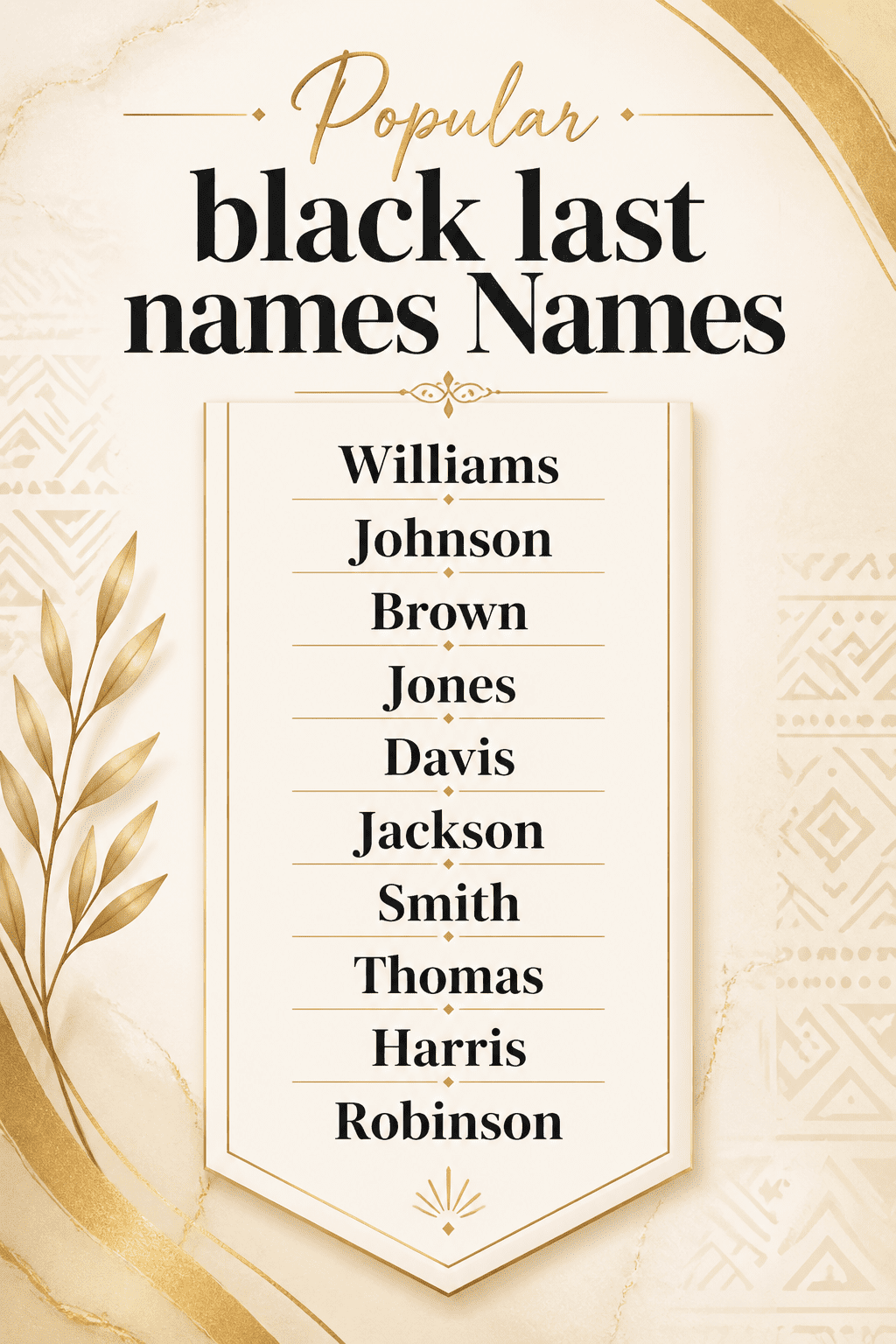
Popular Black Last Names
- Washington
- Jefferson
- Robinson
- Williams
- Johnson
- Jackson
- Lewis
- Brown
- Moore
- Walker
- Harris
- Scott
- Davis
- Anderson
[cfury_download slug=”50-black-last-names-with-deep-roots-in-american-history-57gvth” label=”Download 50 Black Last Names With Deep Roots In American History.pdf”]
50 black last names Meaning and Origin
| # | Name | Category | Meaning and Origin |
|---|---|---|---|
| 1 | Adams | Colonial | English patronymic from Adam |
| 2 | Anderson | Patronymic | Son of Andrew |
| 3 | Bailey | Occupational | Steward or bailiff |
| 4 | Banks | Topographic | Lives by a riverbank |
| 5 | Bell | English | From a bell maker or bellringer |
| 6 | Bennett | Medieval | From Benedict, meaning blessed |
| 7 | Blackwell | Topographic | Black spring or stream |
| 8 | Brown | Descriptive | Refers to brown coloring |
| 9 | Butler | Occupational | Wine steward or household servant |
| 10 | Campbell | Scottish | Crooked mouth or river bend |
| 11 | Carson | Patronymic | Son of Carr |
| 12 | Clarke | Occupational | Scholar or clerk |
| 13 | Coleman | Patronymic | Son of Colman |
| 14 | Cook | Occupational | Person who cooks food |
| 15 | Cooper | Occupational | Barrel maker |
| 16 | Davis | Patronymic | Son of David |
| 17 | Dixon | Patronymic | Son of Dick |
| 18 | Duncan | Scottish | Dark warrior |
| 19 | Edwards | Patronymic | Son of Edward |
| 20 | Fletcher | Occupational | Arrow maker |
| 21 | Ford | Topographic | River crossing |
| 22 | Garrett | Medieval | Spear strength or rule |
| 23 | Harris | Patronymic | Son of Harry |
| 24 | Henderson | Patronymic | Son of Henry |
| 25 | Jackson | Patronymic | Son of Jack |
| 26 | Johnson | Patronymic | Son of John |
| 27 | Jones | Patronymic | Son of John |
| 28 | King | English | Originally a title name |
| 29 | Lee | Topographic | Clearing or meadow |
| 30 | Lewis | Patronymic | Son of Louis |
| 31 | Martin | Roman | From Mars, the god of war |
| 32 | Mason | Occupational | Stone worker |
| 33 | Miller | Occupational | Person who mills grain |
| 34 | Moore | Topographic | Person from moorland |
| 35 | Morgan | Welsh | Sea circle or bright sea |
| 36 | Nelson | Patronymic | Son of Neil |
| 37 | Parker | Occupational | Park keeper |
| 38 | Perry | Topographic | By a pear tree |
| 39 | Reed | Descriptive | Red-haired or reed worker |
| 40 | Robinson | Patronymic | Son of Robin |
| 41 | Scott | Ethnic | From Scotland |
| 42 | Smith | Occupational | Metal worker |
| 43 | Taylor | Occupational | Tailor or cloth cutter |
| 44 | Thomas | Biblical | From Thomas, meaning twin |
| 45 | Thompson | Patronymic | Son of Thomas |
| 46 | Turner | Occupational | Lathe worker or turner |
| 47 | Walker | Occupational | Cloth fuller or walker |
| 48 | Washington | Place Name | From a settlement name |
| 49 | Williams | Patronymic | Son of William |
| 50 | Wilson | Patronymic | Son of Will |
If you are choosing from black last names for a character, baby name inspiration, or family research, the next question is usually not which names sound familiar, but which ones fit the story you want to tell.
How Do Black Last Names Reflect History?
Many black last names in the United States were shaped by slavery, emancipation, migration, and the search for identity after legal freedom. That means a surname can point to several different roots at once: an enslaver’s name, an occupational name, a place name, a biblical name, or a name adopted by choice. If you are tracing your own family line, the same last name may appear in records for very different reasons depending on the region and the era.
- Enslavement records: Some surnames were assigned or inherited through the people who owned plantations, so the same name can show up across unrelated Black families in old documents.
- Post-emancipation choices: After freedom, some families kept the names they had used, while others selected new surnames that signaled independence, faith, or respectability.
- Migration patterns: Black surnames often changed as families moved from the South to northern cities, where spelling shifts and clerical errors were common.
- Regional roots: In places like Louisiana, South Carolina, and the Gullah Geechee corridor, names can reflect French, English, and Creole influences.
- Cultural continuity: Some Black families preserved surnames across generations as a direct link to ancestors, even when the name’s original source was complex.
Frequently Asked Questions
What are some Black last names with deep roots in American history?
Examples include Williams, Johnson, Jackson, Robinson, Harris, Davis, Brown, Carter, Taylor, and Walker. Many of these surnames became common through enslavement, emancipation, and later name adoption, while also reflecting family lines that carried through generations of Black American history.
Why do many Black American surnames overlap with common English last names?
During and after slavery, many Black families were assigned, adopted, or inherited surnames that were already widespread in English-speaking America. As a result, surnames such as Smith, Johnson, and Wilson appear frequently in Black family histories, even when the deeper family story is distinct.
How can a surname help with Black family history research?
A surname can provide an important starting point for tracing records such as censuses, Freedmen’s Bureau documents, military files, church registers, and land records. Because surnames may have changed over time, it is often necessary to follow multiple branches and spellings when researching ancestry.
Do all Black surnames in America have the same origin?
No. Some come from enslavers, some were chosen after emancipation, some were passed down from free Black communities, and others reflect Indigenous, Caribbean, African, or European connections. The origin of a surname depends on the specific family line and historical context.
Can the same Black surname be linked to different family lines?
Yes. A single surname can belong to many unrelated families, especially when the name is common. Genealogical research should rely on records, locations, dates, and kinship patterns rather than surname alone to confirm a correct family connection.
- [cfury_download slug=”50-black-last-names-with-deep-roots-in-american-history-57gvth” label=”PDF list”]
- [cfury_download slug=”50-black-last-names-with-deep-roots-in-american-history-57gvth-image” label=”Hero image”]
- [cfury_download slug=”50-black-last-names-with-deep-roots-in-american-history-57gvth-table” label=”Excel table”]