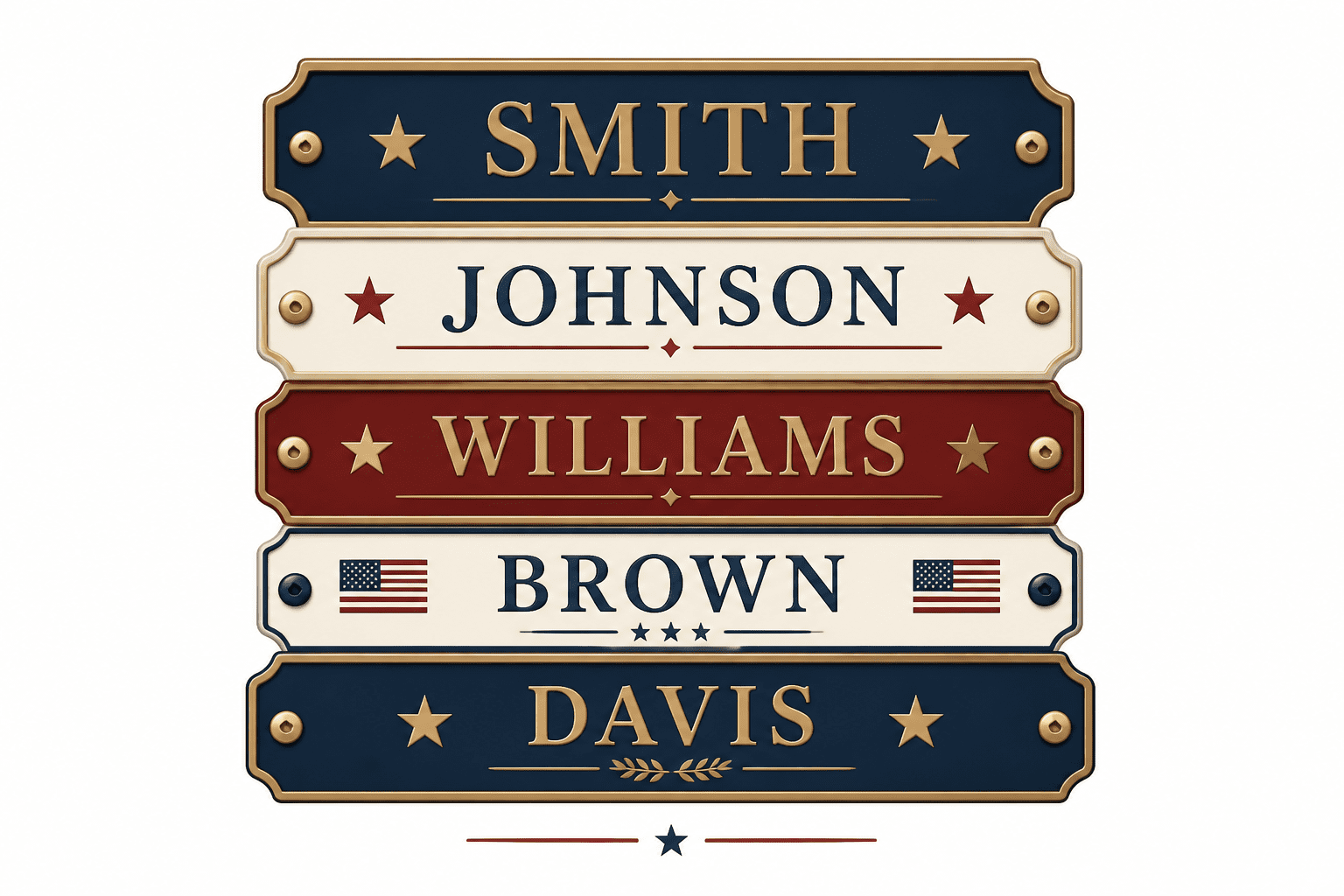
The most common last names in the United States include Smith, Johnson, Williams, Brown, and Jones.
American Last Names come from English, Irish, Scottish, German, Spanish, Italian, Dutch, Jewish, African, and Native American naming traditions shaped by immigration, colonization, slavery, and naturalization in the United States. They include patronymic names like Johnson, occupational names like Smith, place-based names like Hill, and descriptive names like Brown.
In this list, you get 100 American Last Names and their origins, with clear meanings and cultural roots behind each one. Names such as Washington, Kennedy, Garcia, Lee, Martinez, and Anderson show how American surnames reflect the country’s mixed history. Some names point to ancestry, some point to a trade, and some point to a location or an ancestor’s given name. When you know how these names work, you understand more about family history, migration, and the way surnames entered American life.
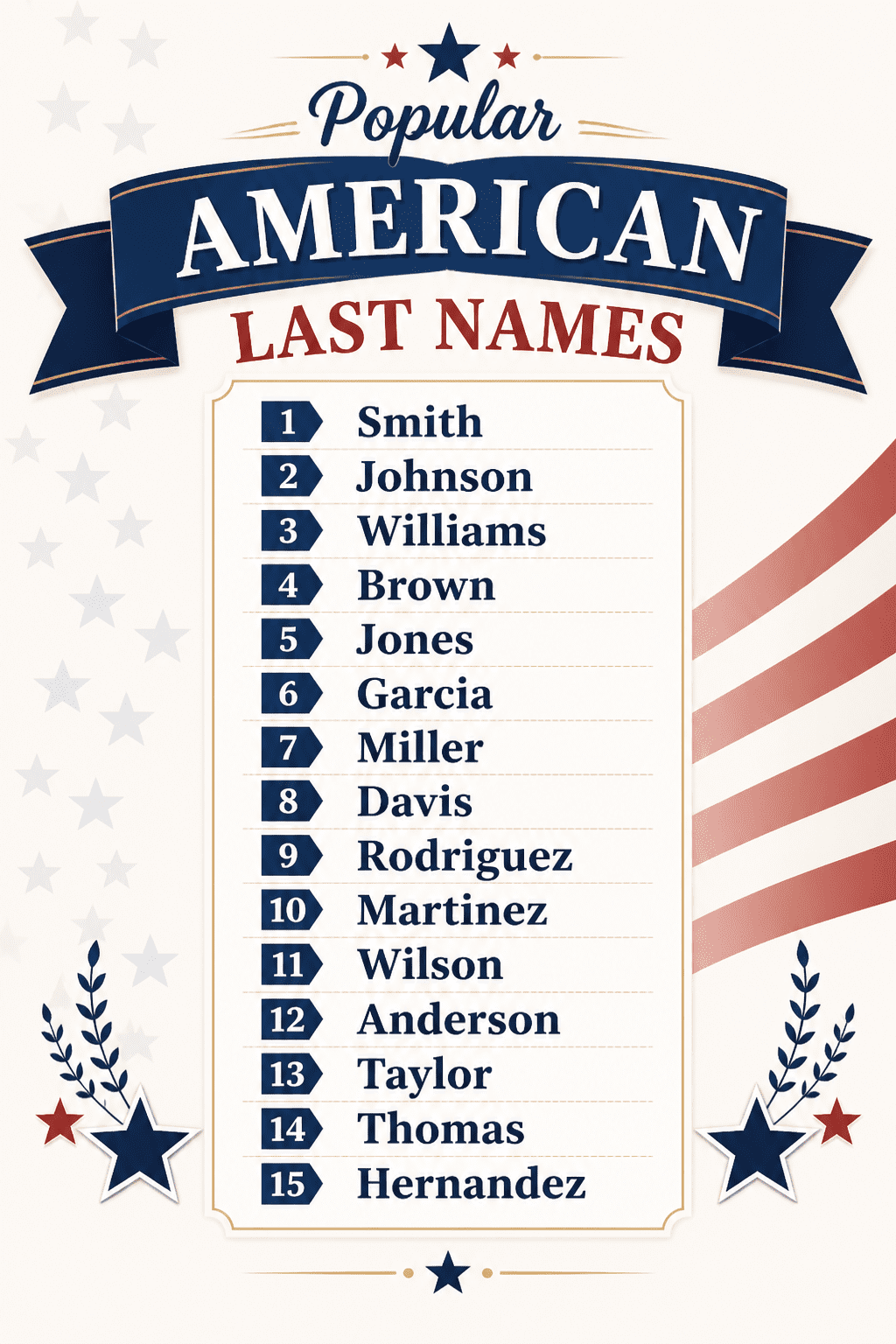
Popular American Last Names and Origins
- Smith
- Johnson
- Williams
- Brown
- Jones
- Garcia
- Miller
- Davis
- Rodriguez
- Martinez
- Hernandez
- Lopez
- Gonzalez
- Wilson
[cfury_download slug=”100-american-last-names-and-their-origins-dcsxsg” label=”Download American Last Names and Their Origins.pdf”]
Top 100 American Last Names and Their Origins
The list below gives 100 common American last names, their origins, and the basic meaning or naming pattern behind each one.
| Rank | Surname | Origin | Meaning |
|---|---|---|---|
| 1 | Smith | English | Occupational: metal worker |
| 2 | Johnson | English/Scottish | Patronymic: son of John |
| 3 | Williams | English/Welsh | Patronymic: son of William |
| 4 | Brown | English/Scottish | Descriptive: brown-haired |
| 5 | Jones | English/Welsh | Patronymic: son of John |
| 6 | Garcia | Spanish | Iberian Peninsula |
| 7 | Miller | English/German | Occupational: grain grinder |
| 8 | Davis | English/Welsh | Patronymic: son of David |
| 9 | Rodriguez | Spanish | Patronymic: son of Rodrigo |
| 10 | Martinez | Spanish | Patronymic: son of Martín |
| 11 | Hernandez | Spanish | Patronymic: son of Hernando |
| 12 | Lopez | Spanish | Patronymic: son of Lope |
| 13 | Gonzalez | Spanish | Patronymic: son of Gonzalo |
| 14 | Wilson | English/Scottish | Patronymic: son of Will |
| 15 | Anderson | Scottish/Scandinavian | Patronymic: son of Andrew |
| 16 | Thomas | English/Welsh | From Aramaic twin |
| 17 | Taylor | English | Occupational: tailor |
| 18 | Moore | English | Various possible origins, including moor dweller |
| 19 | Jackson | English | Patronymic: son of Jack/John |
| 20 | Martin | English/French/Spanish/Latin | From Mars |
| 21 | Lee | English/Chinese/Korean | Multiple origins |
| 22 | Perez | Spanish | Patronymic: son of Pedro |
| 23 | Thompson | English/Scottish | Patronymic: son of Thom |
| 24 | White | English | Descriptive: fair-haired or pale |
| 25 | Harris | English/Welsh | Patronymic: son of Harry |
| 26 | Sanchez | Spanish | Patronymic: son of Sancho |
| 27 | Clark | English | Occupational: clerk/scholar |
| 28 | Ramirez | Spanish | Patronymic: son of Ramiro |
| 29 | Lewis | English/Welsh | From Louis/Lewis, Germanic root |
| 30 | Robinson | English | Patronymic: son of Robin/Robert |
| 31 | Walker | English | Occupational: cloth walker/fullers |
| 32 | Young | English/Scottish | Nickname for the younger |
| 33 | Allen | English/Scottish | From Gaelic name Ailin |
| 34 | King | English | Nickname/occupational |
| 35 | Wright | English | Occupational: woodworker/craftsman |
| 36 | Torres | Spanish | From towers |
| 37 | Nguyen | Vietnamese | Major family name in Vietnam |
| 38 | Hill | English | Topographical: lived by a hill |
| 39 | Flores | Spanish | From flowers |
| 40 | Green | English | Nickname referring to greenery |
| 41 | Adams | English/Scottish | Patronymic: son of Adam |
| 42 | Nelson | English/Scandinavian | Patronymic: son of Nell/Neil |
| 43 | Baker | English | Occupational: bread baker |
| 44 | Hall | English/Scandinavian | Topographical: large house or manor |
| 45 | Rivera | Spanish | Topographical: riverbank |
| 46 | Campbell | Scottish | From Gaelic cam beul, crooked mouth |
| 47 | Mitchell | English/Scottish | From Michael |
| 48 | Carter | English | Occupational: cart driver |
| 49 | Roberts | English/Welsh | Patronymic: son of Robert |
| 50 | Gomez | Spanish | Patronymic: man of the path, uncertain |
| 51 | Phillips | English/Welsh | From Greek Philippos, lover of horses |
| 52 | Evans | Welsh | Patronymic: son of Evan/Iefan |
| 53 | Turner | English | Occupational: one who works with a lathe |
| 54 | Diaz | Spanish | Patronymic: son of Diego |
| 55 | Parker | English | Occupational: park keeper |
| 56 | Cruz | Spanish/Portuguese | From cross |
| 57 | Edwards | English/Welsh | Patronymic: son of Edward |
| 58 | Collins | Irish/English | Variant of Colin |
| 59 | Reyes | Spanish | From kings, possibly referencing Epiphany |
| 60 | Stewart | Scottish/English | Occupational: household guardian |
| 61 | Morris | English/Irish | From personal name Maurice |
| 62 | Morales | Spanish | Topographical: mulberry trees |
| 63 | Murphy | Irish | Anglicized form of Ó Murchadha |
| 64 | Cook | English | Occupational: cook/chef |
| 65 | Rogers | English | Patronymic: son of Roger |
| 66 | Gutierrez | Spanish | Patronymic: son of Gutiérrez |
| 67 | Ortiz | Spanish | Patronymic: son of Orti/Ortez |
| 68 | Morgan | Welsh | From Old Welsh Morcant |
| 69 | Cooper | English | Occupational: barrel maker |
| 70 | Peterson | English/Scandinavian | Patronymic: son of Peter |
| 71 | Bailey | English | Occupational: bailiff or steward |
| 72 | Reed | English/Scottish | Nickname: red-haired or from reedy area |
| 73 | Kelly | Irish | Anglicized form of Gaelic Ó Ceallaigh |
| 74 | Howard | English | From Norman personal name Huard |
| 75 | Ramos | Spanish/Portuguese | Topographical: thickets or branches |
| 76 | Kim | Korean | Major family name in Korea |
| 77 | Cox | English | Patronymic/occupational/nickname |
| 78 | Ward | English/Irish | Occupational: guardian/watchman |
| 79 | Richardson | English | Patronymic: son of Richard |
| 80 | Watson | English/Scottish | Patronymic: son of Wat/Walter |
| 81 | Brooks | English | Topographical: by the brook |
| 82 | Chavez | Spanish | Likely from Portuguese Chaves |
| 83 | Wood | English | Topographical: by the wood |
| 84 | James | English | From Hebrew name Jacob |
| 85 | Bennett | English | From Latin Benedictus, blessed |
| 86 | Gray | English/Scottish | Nickname: hair/complexion |
| 87 | Mendoza | Basque/Spanish | Topographical: cold mountain |
| 88 | Ruiz | Spanish | Patronymic: son of Ruy/Rodrigo |
| 89 | Hughes | Welsh/Irish | Patronymic: son of Hugh |
| 90 | Price | Welsh | From ap Rhys, son of Rhys |
| 91 | Alvarez | Spanish | Patronymic: son of Álvaro |
| 92 | Castillo | Spanish | Topographical: castle |
| 93 | Sanders | English | Patronymic: son of Alexander |
| 94 | Patel | Indian | Gujarati village chief/landowner |
| 95 | Myers | English/German | Occupational: mayor |
| 96 | Long | English/Scottish/Chinese | Descriptive: tall person |
| 97 | Ross | English/Scottish | From Gaelic rois, promontory |
| 98 | Foster | English | Occupational: foster parent or forest keeper |
| 99 | Jimenez | Spanish | Patronymic: son of Jimeno |
| 100 | Graham | Scottish | From Old English gram or Old Norse gramr, gravelly homestead |
What these surnames reveal
The mix is not random. English and Scottish names fill a large share of the list, Spanish surnames appear heavily among the upper ranks, and Irish, Welsh, German, Korean, Vietnamese, Basque, and Indian names show how immigration and assimilation shaped the American surname pool. The broad pattern is easy to read: old European naming systems remain common, but later waves of migration added names that were already widespread in other languages and writing systems.
Patronymics dominate the list. Johnson, Williams, Jones, Davis, Rodriguez, Martinez, Hernandez, Lopez, Wilson, Anderson, Thompson, Harris, Ramirez, Perez, Robinson, Adams, Nelson, Roberts, Edwards, Peterson, Richardson, Watson, and others all point back to a father or male ancestor. Occupational names are the other major cluster. Smith, Miller, Taylor, Clark, Walker, Wright, Baker, Carter, Turner, Parker, Cook, Cooper, Bailey, and Foster show how surnames often started as labels for work, duty, or station.
Descriptive and topographical names round out the pattern. Brown, White, Green, Young, Reed, Gray, Long, Hill, Brooks, Wood, Rivera, Morales, Ramos, Ross, and Castillo all preserve a physical trait, a landscape feature, or a place-based reference. That split between lineage, labor, and location is one reason surnames can be read like compressed social history.
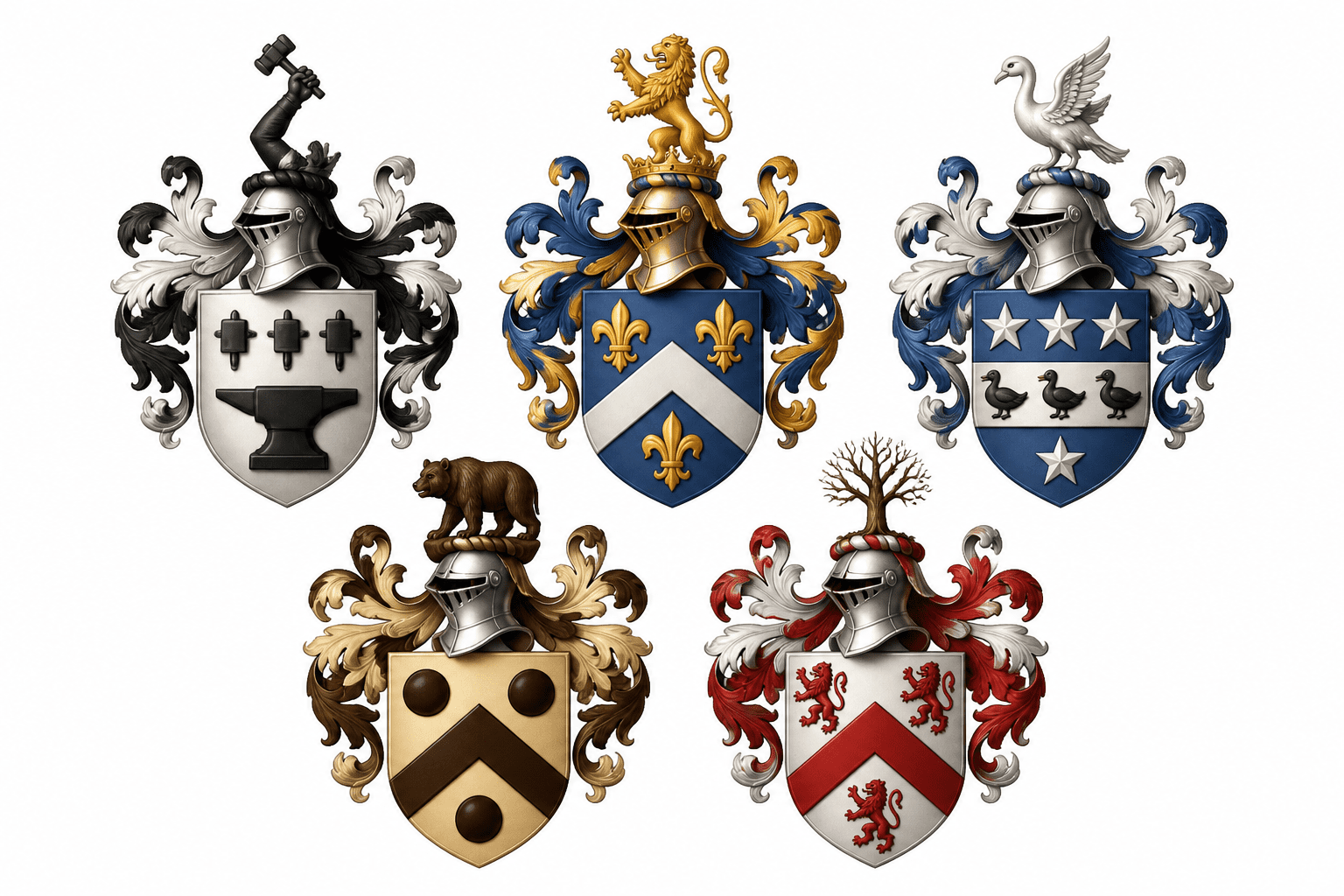
How the surname origins are grouped
American surnames usually fall into a few repeatable categories: patronymic, occupational, descriptive, and topographical. A patronymic surname points to an ancestor’s given name. An occupational surname grew out of a trade or civic role. A descriptive surname referred to appearance or personality. A topographical surname came from the local landscape or dwelling place.
Patronymic names
Names like Johnson, Williams, and Richardson tell you that a family once identified itself by descent from a man named John, William, or Richard. In Spanish naming traditions, the same pattern appears in forms such as Gonzalez, Rodriguez, Ruiz, and Jimenez. Welsh surnames often preserve earlier forms like Price, which comes from ap Rhys, meaning son of Rhys.
Occupational names
Smith is the clearest example, but it is not the only one. A Miller processed grain, a Baker baked bread, a Cooper made barrels, and a Wright built things. A Clerk or scholar became Clark in surname form, while Carter and Walker point to transport and textile work. These surnames survived because they were practical labels in small communities where occupations were easy to see and hard to confuse.
Descriptive names
Some surnames began as nicknames. Brown, White, Gray, and Long likely described appearance. Young marked the younger of two people with the same name. King could have been a nickname for someone who acted like royalty, or in some cases a title-based occupational label. Reed may have described red hair or someone from a reedy area.
Topographical names
These names grew from place features people lived near. Hill, Brooks, Wood, Rivera, Ross, Torres, Castillo, and Mendoza all point to terrain, water, forests, towers, castles, or elevated ground. The meaning was often literal at first and later became hereditary.
How American surnames changed over time
Immigration patterns changed the ranking of surnames, especially as the United States absorbed large numbers of English, Irish, German, Italian, Spanish-speaking, Asian, and other immigrant families. Cultural assimilation also altered names through anglicization, simplified spellings, and shortened forms. A surname could move from Gaelic or German into an English-looking version without losing its family line.
The result is a surname landscape that still carries old naming systems but now sits inside a far larger national mix. English occupational and patronymic names remain common, yet Spanish surnames are deeply established, and Asian surnames have become a normal part of everyday American life. The ranking itself is a snapshot of centuries of movement, not a single origin story.
What do common American last names reveal about the country’s history?
Common American last names reflect the country’s diverse cultural heritage, including English, Spanish, and other origins, and they point to immigration, family continuity, and cultural assimilation across generations.
How have American last names evolved over time?
American last names have changed through immigration, cultural assimilation, and anglicization during periods of xenophobia, including World War I and II. Some families kept their original spelling, while others changed pronunciation or spelling to fit English usage.
What are patronymic surnames?
Patronymic surnames come from the given name of an ancestor, usually the father. Johnson, Roberts, and Hughes are classic examples.
Frequently Asked Questions
What are the most common origins of American last names?
Many American last names come from English, Irish, Scottish, German, Dutch, and Spanish roots, reflecting centuries of migration and cultural blending. Common origins include occupational names, patronymics, geographic references, and descriptive surnames.
Why do some American last names have multiple origin stories?
Some surnames developed independently in different regions or languages, so the same spelling can have more than one origin. Immigration, spelling changes, and phonetic adaptation in the United States also contributed to overlapping surname histories.
How can the origin of an American last name be traced?
Tracing a surname usually involves reviewing family records, census documents, immigration papers, and historical naming patterns. Genealogical sources and surname dictionaries can help identify whether a name is occupational, locational, patronymic, or derived from another language.
Are all American last names originally from Europe?
No, many American surnames come from Indigenous, African, Hispanic, Asian, and other global naming traditions as well. The United States has a wide variety of last names shaped by migration, enslavement, colonization, and later waves of immigration.
What do occupational American last names mean?
Occupational surnames originally identified a person’s job or trade, such as Smith for a metalworker or Baker for someone who baked bread. Over time, these names became hereditary and were passed down through generations even when the family no longer worked in that occupation.
- [cfury_download slug=”100-american-last-names-and-their-origins-dcsxsg” label=”PDF list”]
- [cfury_download slug=”100-american-last-names-and-their-origins-dcsxsg-image” label=”Hero image”]
- [cfury_download slug=”100-american-last-names-and-their-origins-dcsxsg-table” label=”Excel table”]