According to Sprout Social’s 2025 data, 78% of consumers say they’re more likely to buy from a brand after a positive social media interaction. Yet most businesses treat Twitter like a megaphone instead of a conversation—broadcasting promotions while watching engagement flatline.
This guide breaks down nine specific tactics for writing tweets that move people from passive scrollers to active buyers. No fluff, no generic advice about “being authentic.” Just practical tweet copywriting techniques that actually drive sales.
Table of Contents
- X/Twitter’s Algorithm in 2026
- 1. Lead With the Outcome, Not the Product
- 2. Use the “Problem-Agitate-Solution” Framework
- 3. Turn Customer Questions Into Content
- 4. Create Comparison Posts That Position Your Offer
- 5. Build Mini Case Studies in Tweet Form
- 6. Master the Art of the Soft CTA
- 7. Use Strategic Thread Structures
- 8. Time Your Sales Content Around Engagement Peaks
- 9. Reply Your Way to Revenue
- 5 Tweet Copywriting Mistakes That Kill Conversions
- Frequently Asked Questions
X/Twitter’s Algorithm in 2026
Before diving into tactics, you need to know what the platform actually rewards. X’s algorithm now prioritizes what they call “meaningful engagement”—replies, quote tweets, and bookmark saves carry significantly more weight than simple likes.
Research from Buffer shows that posts generating conversation (measured by reply ratio) receive 3-4x more distribution than posts with equivalent like counts but fewer replies. This matters for social selling on Twitter because conversion-focused content often sparks more questions, objections, and discussions than entertainment-only posts.
The algorithm also factors in something called “dwell time”—how long someone stops scrolling to read your post. Longer posts that hook readers and keep them engaged signal quality content to the algorithm, leading to broader reach.

1. Lead With the Outcome, Not the Product
Most business accounts tweet about what they sell. High-converting accounts tweet about what their customers achieve.
Here’s the difference in action:
Weak approach: “Our project management software has 50+ features including Gantt charts, time tracking, and team collaboration tools.”
Stronger approach: “Our clients consistently finish projects 2 weeks ahead of schedule. Not because they work more hours—because they finally stopped losing time to chaos.”
The second version sells without sounding like an ad. It paints a picture of the transformed state the customer actually wants.
When crafting outcome-focused tweets, ask yourself: What does my customer’s life look like AFTER they use my product? What frustration disappears? What goal becomes achievable?
A Twitter thread generator can help you brainstorm different angles for presenting outcomes, but the core insight needs to come from understanding your customers deeply.
2. Use the “Problem-Agitate-Solution” Framework
This classic copywriting structure works exceptionally well in tweets because it mirrors how people actually experience buying decisions. They recognize a problem, feel the pain of that problem intensifying, then become receptive to solutions.
Here’s the framework applied to a 280-character post:
Problem: “Spending 3 hours every week manually updating spreadsheets?”
Agitate: “That’s 150+ hours a year you’ll never get back—time you could spend actually growing your business.”
Solution: “We built automation that handles it in 3 minutes. Link in bio.”
The agitation step is where most people go wrong. They either skip it entirely or make it too aggressive. The goal isn’t to shame your audience—it’s to help them feel the true weight of their current situation.
For crafting compelling hooks that grab attention in the problem phase, the AI hook generator provides useful starting points you can adapt for text-based content.

3. Turn Customer Questions Into Content
Goldmines of conversion content sit in your support inbox and sales calls right now. Every question a prospect asks represents a buying objection that hundreds of other potential customers share but never voice.
The execution is straightforward:
- Document every question you receive for one week
- Group similar questions into themes
- Write a tweet answering each question directly
- End with an invitation to ask more questions in the replies
Example transformation:
Customer email: “Does your service work for small teams or only enterprise companies?”
Tweet version: “Someone asked if we’re only for big companies. The truth? Our most successful users are 3-5 person teams. They don’t need enterprise complexity—they need something that works without a dedicated admin. That’s exactly what we built.”
This approach accomplishes three things simultaneously: it addresses objections publicly, demonstrates that you listen to customers, and provides social proof that real people are interested in your product.
4. Create Comparison Posts That Position Your Offer
Purchasing decisions happen through comparison. Why let prospects compare you to competitors in their heads—where you have zero influence? Bring the comparison into your content instead.
Three angles worth testing:
Before/After: Show the transformation your customers experience. Numbers work best here—”Before: 47 hours/month on invoicing. After: 3 hours/month.”
Old Way/New Way: Position your solution as the evolution. “The old way: hiring a $5,000/month consultant. The new way: getting the same insights from a $99/month tool.”
Feature Comparison: When you genuinely outperform competitors in specific areas, a simple table format can be powerful. Just focus on areas where you win—there’s no rule saying you must present a “fair” comparison.
The key to comparison content is specificity. Vague claims like “we’re better” fall flat. Concrete details like “loads 3x faster on mobile” give prospects something to evaluate.

5. Build Mini Case Studies in Tweet Form
Full case studies belong on your website. Condensed versions belong in your Twitter feed—they serve as proof points that make everything else you post more believable.
A format that consistently performs well:
Situation: One sentence about who the customer is and their starting point
Action: What they did (ideally using your product/service)
Result: Specific, measurable outcome
Example: “A freelance designer came to us drowning in revision requests. She implemented our client feedback system and cut revision rounds from 5+ to 2 on average. Her profit per project jumped 40% because she stopped doing free work.”
Notice how this reads like a story, not a testimonial. The customer is the hero; your product is just the tool that helped them succeed.
When you have strong case studies, amplify them with a dedicated LinkedIn post as well—the audiences overlap more than most people realize, and LinkedIn’s professional context adds credibility to business results.
6. Master the Art of the Soft CTA
“BUY NOW! LIMITED TIME!” triggers immediate resistance on social platforms. Users came to scroll and discover, not to shop. Soft calls-to-action respect this dynamic while still guiding interested prospects forward.
Examples that work:
- “Reply with [X] if you want me to send you the template”
- “I wrote a detailed breakdown—link in bio if you want it”
- “DM me ‘interested’ and I’ll share how we do this”
- “Bookmark this for when you’re ready to start”
Each of these invites action without pressure. They also create micro-commitments—when someone replies or DMs you, they’ve taken a small step that makes the next step easier.
The best soft CTAs feel like a favor you’re doing for the reader, not something you’re asking them to do for you. “I’ll send you the resource” positions you as generous. “Click my link” positions you as needy.
7. Use Strategic Thread Structures
Threads let you expand beyond 280 characters—but the real power lies elsewhere. Each tweet in a thread can be liked, replied to, or retweeted independently. That means multiple entry points for engagement and algorithm favor.
Structure your threads for conversion like this:
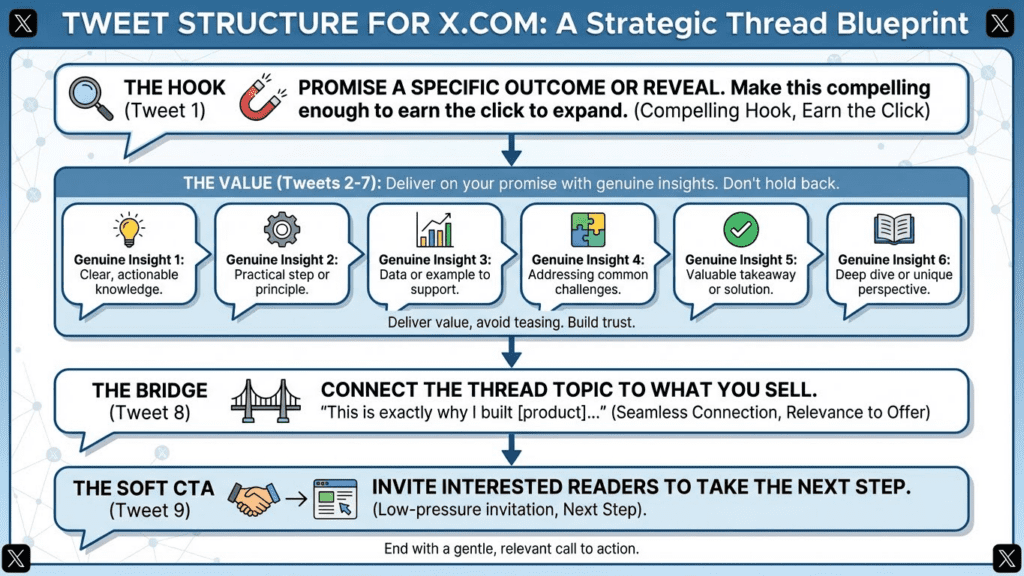
Tweet 1 (Hook): Promise a specific outcome or reveal. Make this compelling enough to earn the click to expand.
Tweets 2-7 (Value): Deliver on your promise with genuine insights. Don’t hold back—if people feel like you’re teasing them, they’ll resent you.
Tweet 8 (Bridge): Connect the thread topic to what you sell. “This is exactly why I built [product]…”
Tweet 9 (Soft CTA): Invite interested readers to take the next step.
Final Tweet: Summarize and include a call to retweet the first post for reach.
According to Hootsuite’s research, threads average 63% higher engagement than single tweets when the content quality is comparable. The format itself signals depth, which attracts serious prospects.
8. Time Your Sales Content Around Engagement Peaks
Posting times matter more for conversion content than entertainment posts. When driving action, you need your audience in a decision-making mindset—not half-asleep scrolling through their feed at 1 AM.
CoSchedule’s 2025 analysis of Twitter engagement patterns reveals clear patterns:
For B2B audiences: Tuesday through Thursday, 9-11 AM in your target timezone, shows highest engagement and click-through rates.
For B2C audiences: Evenings (7-9 PM) and weekends show stronger purchase intent, as people have more mental bandwidth for buying decisions.
A practical approach: post educational and relationship-building content throughout the week, then concentrate your conversion-focused posts during these peak windows. This prevents your feed from feeling overly promotional while maximizing impact when you do ask for the sale.
9. Reply Your Way to Revenue
Original tweets reach your followers. Replies? They reach everyone following the accounts you reply to—including massive accounts in your industry. Most people ignore this. You shouldn’t.
Here’s the playbook:
- Identify 10-15 accounts your ideal customers follow
- Turn on notifications for these accounts
- When they post, be among the first 5-10 replies
- Add genuine value—don’t just agree or say “great post”
- Make your reply showcase your expertise
When someone sees your thoughtful reply on a post from an authority they trust, they check your profile. If your profile clearly communicates what you offer and your pinned tweet demonstrates your value, a percentage of those profile visitors convert to followers—and eventually, customers.
This works because you’re borrowing credibility from established accounts while demonstrating expertise in a natural context. It’s social selling on Twitter without feeling like selling.
5 Tweet Copywriting Mistakes That Kill Conversions
What you avoid matters as much as what you do. These errors consistently tank conversion rates:
1. Burying the value proposition
If someone has to read three paragraphs to understand what you’re offering, you’ve lost them. Lead with the benefit. Always.
2. Using industry jargon your customers don’t use
You might call it “SaaS onboarding optimization.” Your customers call it “getting new users to stick around.” Use their language, not yours.
3. Forgetting the emotional component
Logic justifies purchases. Emotion drives them. Every tweet needs at least a hint of how your offer makes someone feel—confident, relieved, ahead of competitors, etc.
4. Posting conversion content without warming up the audience
If every tweet is selling something, people tune out. The ratio that works for most accounts: 80% value/entertainment, 20% promotional content.
5. Ignoring the replies you receive
When someone responds to your conversion-focused tweet with a question or objection, that’s a sales conversation. Treat it like one. Reply thoughtfully, address concerns, and guide them forward.
For help generating different angles and avoiding repetitive language in your tweets, tools like an AI bio generator can spark ideas—though your best content will always come from understanding your specific audience.
Example: A Weekly Twitter Conversion Calendar
Strategy means nothing without execution. This weekly framework puts the nine tips into practice:
| Day | Content Focus | Tips Applied |
|---|---|---|
| Monday | Educational thread | #7 (Thread structure) + #1 (Outcome focus) |
| Tuesday | Customer question answer | #3 (Customer questions) |
| Wednesday | Mini case study | #5 (Case studies) |
| Thursday | Comparison post + soft CTA | #4 (Comparisons) + #6 (Soft CTA) |
| Friday | Problem-Agitate-Solution tweet | #2 (PAS framework) |
| Weekend | Engage via replies | #9 (Reply strategy) |
Adjust the schedule based on when your specific audience is most active. The framework matters less than consistency—showing up regularly with conversion-minded content beats sporadic viral attempts every time.

Frequently Asked Questions
How many followers do I need before focusing on conversions?
You can start converting with any follower count. A focused audience of 500 people who genuinely need your product beats 50,000 random followers. The tips in this guide work regardless of audience size—they just scale with reach.
Should I use Twitter/X ads alongside organic conversion tactics?
Organic content builds trust and qualifies leads; ads accelerate reach. The combination works well once you’ve identified which tweets and messaging resonate with your audience. Use organic testing to find winners, then amplify those with paid promotion.
How often should I include a call-to-action in my tweets?
No more than 1-2 direct CTAs per 10 posts. But soft CTAs (inviting replies, directing to bio, etc.) can appear more frequently because they don’t feel promotional. The goal is training your audience to take action without fatiguing them with constant asks.
What’s the ideal tweet length for conversions?
Data from Social Media Today indicates that tweets between 100-250 characters tend to get the highest engagement. But conversion-focused tweets often need more context—don’t sacrifice clarity for brevity. If your message requires 280 characters, use them.
How do I measure if my tweets are actually converting?
Track these metrics: profile visits (available in Twitter Analytics), link clicks (use a URL shortener with tracking), DM inquiries that mention specific tweets, and direct attribution when customers tell you how they found you. Set up UTM parameters for any links you share.
Can AI tools help with Twitter conversion copywriting?
AI can accelerate brainstorming and help overcome blank-page syndrome. Tools that generate catchy phrases or slogans provide useful starting points. However, conversion-focused copy requires understanding your specific customer’s pain points—that insight needs to come from real customer research.
How long does it take to see results from these tactics?
Individual tweets can drive immediate conversions if they reach the right person at the right time. Building a consistently converting Twitter presence takes 2-3 months of steady effort. The compound effect kicks in when prospects see your name repeatedly delivering value, then encounter your offer when they’re ready to buy.
Should my sales and marketing tweets sound different from my regular content?
Slightly. Your regular content builds trust through pure value delivery. Conversion content needs to make a clearer connection between that value and your paid offering. The voice should remain consistent—it’s the intent that shifts, not the personality.
Final Thoughts
Twitter conversion isn’t about tricks or hacks. It’s about consistently demonstrating that you understand your customer’s problems, showing proof that you can solve them, and making it easy for interested prospects to take the next step.
Every tweet is either building toward a sale or it isn’t. That doesn’t mean every tweet should be selling—far from it. But every piece of content should fit into a larger strategy that moves followers along the path from stranger to customer.
Pick two or three tips from this guide and implement them this week. Track what happens. Adjust based on what your specific audience responds to. The businesses winning on Twitter/X in 2026 aren’t the ones with the biggest budgets—they’re the ones who’ve figured out what their particular audience needs to hear, and they say it clearly.
For more help creating consistent social content across platforms, explore our free social media AI tools.