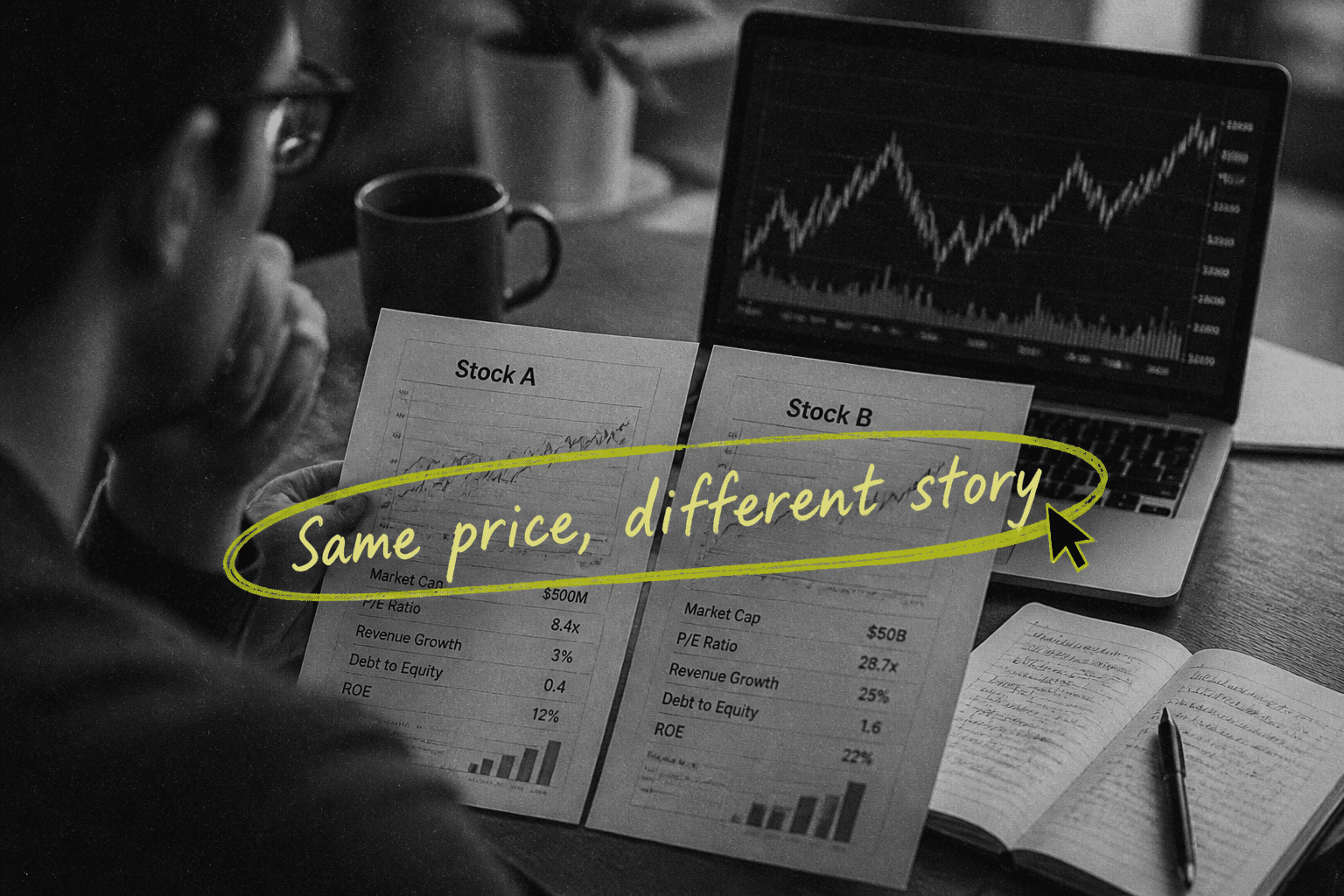
A $100 share price tells you one share costs $100. It says nothing about how much of the company you are buying, how fast earnings are growing, how much debt sits on the balance sheet, or what investors expect next.
Two stocks at the same price can sit at opposite ends of the valuation spectrum. One may belong to a giant business with modest growth and a rich valuation multiple. The other may belong to a smaller company with stronger earnings per dollar of stock price, slower growth, or heavier risk. Price alone hides that difference.
The cleaner comparison starts with Market capitalization, earnings, cash flow, margins, debt, and the market’s growth expectations. Stock price is one input. Investment value comes from the full set.
Stock Price and Market Capitalization
Stock price is the trading price of one share. Market capitalization is stock price multiplied by shares outstanding, which gives the total equity value the market assigns to the company.
That difference changes the entire comparison. A $100 stock with 500 million shares outstanding represents a $50 billion company. A $100 stock with 100 million shares outstanding represents a $10 billion company. Same share price, very different business size.
Shares outstanding also shape the story behind split-adjusted prices. A company with fewer shares can trade at a higher per-share price without being more valuable. A company with more shares can trade at a lower per-share price and still command a much larger total equity value.
One share price does not measure company size
The market values the whole equity base, not the sticker price on one share. That is why a stock trading at $20 can belong to a larger company than a stock trading at $200.
If you want a fast check on the math, a Stock price calculator helps translate share count and price into market value without guessing.
That calculation matters because investors buy claims on the business, not isolated share certificates. The number on the quote screen ignores dilution, buybacks, splits, and the share count behind the price.
Market cap reveals the scale behind the quote
Market capitalization groups companies into small-cap, mid-cap, large-cap, and mega-cap buckets. Those categories line up with different risk profiles, capital access, and growth expectations.
A mature large-cap business usually trades with lower growth expectations than a smaller company with a still-expanding addressable market. The same $100 share price means little until you know which bucket the company occupies.
Comparison of Two Companies with Identical Stock Prices
| Company | Stock Price (USD) | Market Capitalization (USD) | P/E Ratio | Earnings Per Share (USD) |
|---|---|---|---|---|
| Company A | 100 | 50,000,000,000 | 20 | 5 |
| Company B | 100 | 10,000,000,000 | 10 | 10 |
Source: investopedia
Company A and Company B share the same $100 price, yet Company A carries a $50 billion market cap while Company B carries a $10 billion market cap. Company B also generates more earnings per share in this example, which changes the valuation picture immediately.
The Role of Price-to-Earnings (P/E) Ratio in Valuation
The P/E ratio compares share price with earnings per share. It shows how much investors pay for one dollar of current earnings.
Using the same two companies, Company A trades at 20 times earnings because $100 divided by $5 equals 20. Company B trades at 10 times earnings because $100 divided by $10 equals 10. The stock price matches, but the valuation does not.
A higher P/E ratio usually signals stronger growth expectations, stronger confidence in future profits, or a willingness to pay up for quality. A lower P/E ratio usually signals weaker growth expectations, more uncertainty, or a cheaper earnings stream. The ratio does not tell the full story on its own, but it tells you far more than price alone.
Impact of P/E Ratio on Stock Valuation
| Company | Stock Price (USD) | Earnings Per Share (USD) | P/E Ratio | Valuation Implications |
|---|---|---|---|---|
| Company A | 100 | 5 | 20 | Higher valuation, investors pay more per dollar of earnings |
| Company B | 100 | 10 | 10 | Lower valuation, investors pay less per dollar of earnings |
Source: investopedia
P/E also exposes how the market prices growth. A stock with a high P/E can still be a rational buy if earnings growth and cash generation support it. A stock with a low P/E can still be a trap if profits are unstable, cyclical, or shrinking. The ratio needs context from the business model, not blind comparison with another stock at the same quote price.
Earnings per share changes the meaning of the same price
Earnings per share compresses the company’s profit into a per-share figure. That makes it easier to compare companies of different sizes, but only after you check whether the earnings are durable, recurring, and supported by cash flow.
A company with $10 EPS at a $100 share price gives you far more current earnings power than a company with $5 EPS at the same price. The market may still prefer the lower-EPS stock if it expects faster expansion, better margins, or a stronger competitive position.
Risks of Comparing Stocks Based Solely on Price
- Price-only comparison strips out the factors that drive long-term returns. It ignores company size, profit quality, growth runway, leverage, dilution, and sector risk.
- That mistake leads investors toward false bargains. A lower-priced stock is not cheaper by default, and a higher-priced stock is not expensive by default. A $15 stock can trade at a richer valuation than a $300 stock if the $15 company has a thinner earnings base or a much larger share count.
- Stock splits create another trap. After a split, the share price falls mechanically while the company value stays the same. A split-adjusted price drop changes perception, not the underlying economics. The reverse happens with reverse splits as well: the share price rises while the business remains unchanged.
- Sector composition also distorts price comparisons. Software, consumer staples, banks, airlines, and biotech companies carry different margin structures, capital needs, and risk cycles. A $100 share in one sector is not comparable to a $100 share in another sector unless the rest of the financial profile lines up.
- Debt adds another layer. Two companies at the same share price and similar market cap still differ if one has a strong balance sheet and the other carries heavy borrowings. Enterprise value, which adds debt and subtracts cash, gives a fuller picture than stock price alone.
- Dilution matters too. A company issuing new shares to fund operations or acquisitions reduces each existing shareholder’s claim on future profits. Buybacks do the opposite. The share price may stay near the same level while the per-share economics move in very different directions.
- Growth prospects finish the comparison. A company reinvesting heavily for expansion may trade at a high P/E and a high market cap because the market expects much larger profits later. Another company at the same price may already have mature earnings and limited room to compound. Equal prices do not mean equal upside.
- Price-to-book, free cash flow yield, gross margin, operating margin, and revenue growth all strengthen the comparison further. The more complete the set of metrics, the less likely you are to mistake a familiar price for a fair value.
- Two stocks at the same price are comparable only after you line up the underlying business facts. That means market cap, earnings, cash flow, debt, dilution, and growth expectations. Price without those inputs is a label, not a valuation.
FAQs
What does stock price indicate about a company’s value?
Stock price reflects the market’s valuation of a company’s equity but does not account for differences in company size, earnings, growth potential, or risk. The quote tells you the cost of one share, not the full worth of the business.
How does market capitalization differ from stock price?
Market capitalization, calculated by multiplying stock price by shares outstanding, provides a more accurate measure of a company’s size and value. Two companies can trade at the same share price and still have market caps that differ by billions of dollars.
Why is comparing stocks based solely on price misleading?
Comparing stocks solely on price leads you to ignore fundamentals, growth prospects, and risk profiles. That creates poor investment decisions because the price of one share says nothing about earnings power, balance sheet strength, or total company value.
Can two companies with the same stock price have different valuations?
Yes. Two companies with the same stock price can have different valuations because market capitalization, earnings, and growth prospects differ. The identical quote price does not make the businesses equal.
What is the significance of the P/E ratio in stock valuation?
The P/E ratio compares a company’s stock price to its earnings per share, helping investors assess valuation relative to earnings. A higher P/E means investors pay more for each dollar of earnings, while a lower P/E means they pay less.