Nearly half of global tech users have tapped into free artificial intelligence tools over the past year. This dramatic rise is changing how people access and use advanced technology, putting creative and technical power into more hands than ever before. With powerful features now available at no cost, students, professionals, and creators are seizing opportunities that were once reserved for only a select few.
Table of Contents
- Defining Free AI And Its Core Principles
- Major Types Of Free AI Tools
- How Free AI Drives Accessibility And Equity
- Real-World Use Cases Across Professions
- Potential Risks And Limitations Of Free AI
- Comparing Free AI With Paid AI Solutions
Key Takeaways
| Point | Details |
|---|---|
| Emphasis on Openness | Free AI democratizes access to advanced technology, promoting inclusivity and collaboration across diverse communities. |
| Core Principles | Transparency, accessibility, collaborative development, and ethical innovation are foundational to free AI. |
| Real-World Impacts | Various professions utilize free AI tools for enhanced efficiency and innovation, bridging gaps in skills and opportunities. |
| Awareness of Risks | Users should remain mindful of potential risks associated with free AI, such as algorithmic bias and data privacy concerns, necessitating responsible usage. |
Defining Free AI and Its Core Principles
Artificial Intelligence is undergoing a transformative shift towards openness and accessibility. Free AI represents a revolutionary approach where advanced technological capabilities become democratically available to everyone, breaking down traditional barriers of entry. According to Wikipedia, open-source artificial intelligence refers to AI systems freely accessible for use, study, modification, and distribution.
At its core, free AI embodies several critical principles that distinguish it from proprietary models:
- Transparency: Complete visibility into algorithms and training processes
- Accessibility: No financial or technical barriers to entry
- Collaborative Development: Enabling global community contributions
- Ethical Innovation: Prioritizing responsible technological advancement
The landscape of free AI received significant validation in 2024 when the Council of Europe adopted the Framework Convention on Artificial Intelligence. This groundbreaking legislation established fundamental governance principles emphasizing transparency, accountability, non-discrimination, and human rights protection.
Understanding free AI isn’t just about technology—it’s about creating an inclusive ecosystem where innovation knows no economic boundaries. By eliminating cost and access restrictions, we empower individuals from diverse backgrounds to leverage cutting-edge AI capabilities for personal, professional, and creative pursuits. Whether you’re a student, entrepreneur, artist, or researcher, free AI tools represent a gateway to unprecedented technological empowerment.
Major Types of Free AI Tools
Free AI tools have revolutionized how we approach technology across multiple domains. According to Micro Solutions, these tools span diverse categories including conversational AI, machine learning platforms, and coding assistants.
The landscape of free AI tools can be broadly categorized into several key types:
Here’s a summary of the major types of free AI tools and their typical uses:
| Tool Type | Examples | Common Uses |
|---|---|---|
| Conversational AI | Chatbots Translation tools |
Customer support Language learning |
| Creative AI | Image generators Music composers |
Content creation Design assistance |
| Productivity AI | Writing assistants Task automators |
Document drafting Workflow management |
| Technical AI | Coding helpers ML platforms |
Code generation Data analysis |
- Conversational AI Tools
- Chatbots and language models
- Real-time translation services
- Interactive question-answer platforms
- Creative AI Tools
- Image generation and manipulation
- Music and audio composition
- Video editing and design assistance
- Productivity AI Tools
- Writing and content generation
- Task automation
- Scheduling and workflow optimization
- Technical AI Tools
- Coding assistants
- Machine learning platforms
- Data analysis and visualization
Research from Columbia University highlights platforms like Google Colaboratory and TensorFlow as prime examples of accessible machine learning and coding resources. These platforms democratize advanced technological capabilities, allowing individuals from various backgrounds to experiment and innovate.
With free AI tools, professionals, students, and hobbyists can now access powerful technological resources without financial barriers. From generating creative content to solving complex technical challenges, these tools represent a new frontier of technological empowerment and accessibility.
How Free AI Drives Accessibility and Equity
Accessibility and equity are transformative principles reshaping technological innovation. According to Wikipedia, open-source AI democratizes technology access, enabling a broader range of individuals and organizations to participate in AI research and development, thereby promoting inclusivity and reducing traditional barriers to entry.
The democratization of AI occurs through several critical mechanisms:
- Economic Barrier Removal: Free tools eliminate financial constraints
- Global Knowledge Sharing: Enables worldwide collaborative learning
- Skill Development: Provides opportunities for underrepresented communities
- Innovative Problem Solving: Empowers diverse perspectives
Moreover, the Framework Convention on Artificial Intelligence emphasizes aligning AI development with human rights and democratic values. This approach directly addresses potential risks like misinformation and algorithmic discrimination, ensuring more equitable technological access and usage.
For students and professionals facing resource limitations, free student AI tools represent a game-changing opportunity. These tools bridge educational and professional gaps, allowing individuals from diverse socioeconomic backgrounds to acquire cutting-edge skills, experiment with advanced technologies, and compete on a more level playing field. By democratizing access to powerful AI capabilities, we’re not just sharing technology—we’re redistributing opportunity itself.
Real-World Use Cases Across Professions
Free AI tools have transformed professional landscapes across multiple industries, enabling unprecedented levels of innovation and efficiency. AnyLogic demonstrates how AI integration allows professionals to train AI agents, incorporate machine learning models, and generate synthetic data for complex industry applications.
Here’s how different professions leverage free AI tools:
- Healthcare Professionals
- Medical diagnosis assistance
- Patient record analysis
- Treatment plan optimization
- Marketing and Creative Professionals
- Content generation
- Audience sentiment analysis
- Personalized marketing strategies
- Educators and Researchers
- Personalized learning experiences
- Research data analysis
- Academic writing support
- Software Developers
- Code generation and debugging
- Automated testing
- Predictive maintenance
- Financial Analysts
- Risk assessment
- Investment trend prediction
- Fraud detection
These tools are not just technological novelties—they represent fundamental shifts in how professionals approach complex challenges.
 By providing accessible, powerful AI capabilities, we’re democratizing expertise and enabling individuals to work smarter, not harder.
For professionals seeking to enhance their capabilities, academic and research AI tools offer a gateway to cutting-edge technological support. Whether you’re a student, researcher, or professional, these free AI resources can transform your workflow, boost productivity, and unlock new potential across diverse fields.
Potential Risks and Limitations of Free AI
While free AI offers tremendous potential, it also presents significant challenges that require careful consideration. According to research from arXiv, there is a critical need for explainable AI systems to mitigate risks such as misinformation and algorithmic bias, emphasizing the importance of transparency and human-interpretable decision-making processes.
Key potential risks of free AI include:
- Algorithmic Bias
- Unintentional discrimination in decision-making
- Reinforcement of existing societal prejudices
- Skewed representation in AI-generated content
- Data Privacy Concerns
- Potential misuse of personal information
- Lack of robust data protection mechanisms
- Unclear data ownership and usage rights
- Quality and Reliability Issues
- Inconsistent output quality
- Potential generation of inaccurate information
- Limited contextual understanding
- Ethical Considerations
- Potential misuse of AI technologies
- Lack of accountability
- Unintended consequences of automated decision-making
The Framework Convention on Artificial Intelligence highlights the critical need to address risks like misinformation and algorithmic discrimination, emphasizing the importance of developing robust safeguards in AI deployment.
Users can mitigate these risks by critically evaluating AI outputs and using AI detector tools to verify authenticity and reliability. Understanding these limitations doesn’t diminish AI’s potential—it empowers users to leverage these technologies more responsibly and effectively.
Comparing Free AI With Paid AI Solutions
The landscape of AI solutions presents a nuanced spectrum of capabilities across free and paid platforms. According to Micro Solutions, while free AI tools offer substantial capabilities, paid solutions often provide enhanced features, specialized support, and greater scalability.
Key differences between free and paid AI solutions include:
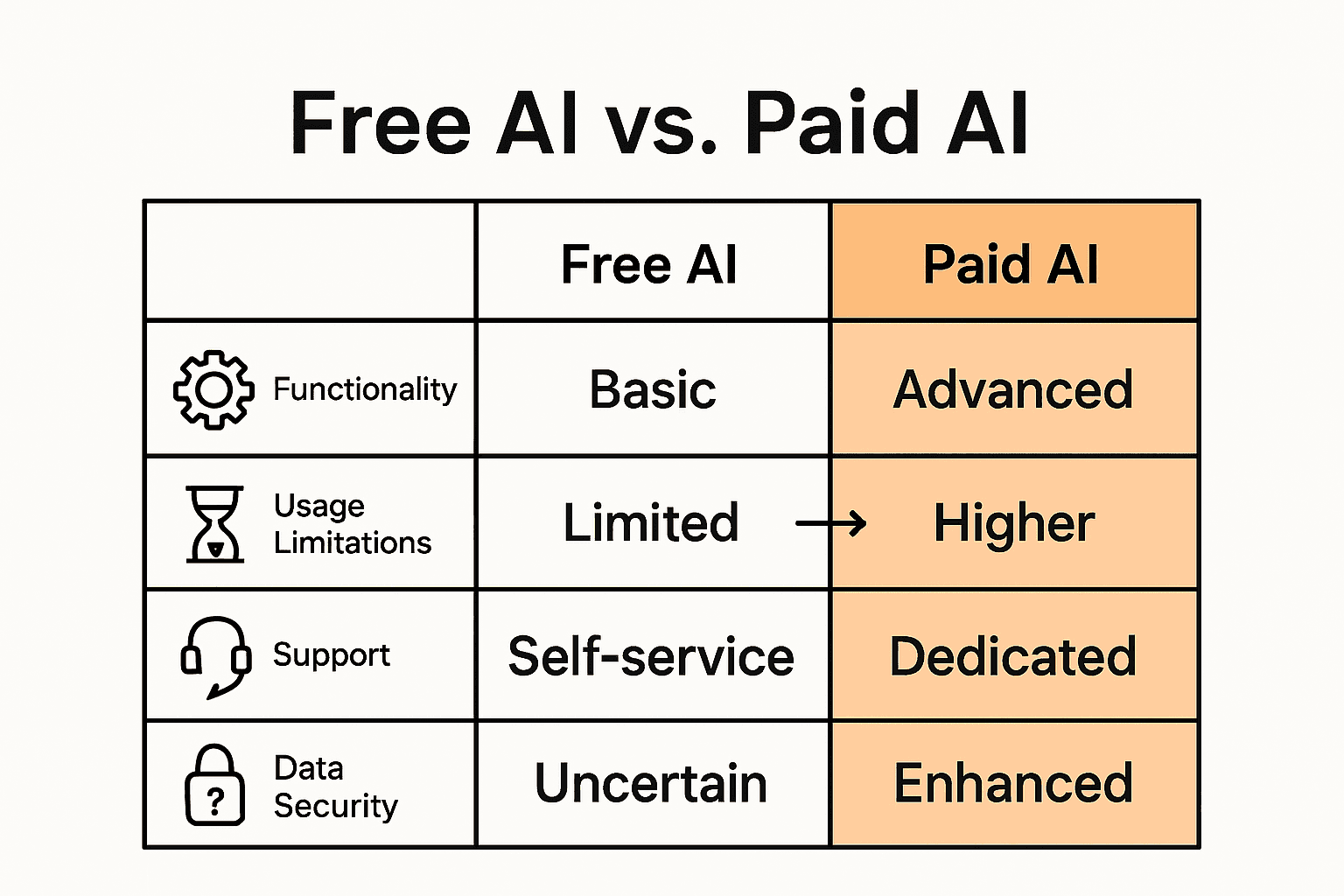
- Functionality Scope
- Free: Basic, generalized capabilities
- Paid: Advanced, specialized features
- Complexity: Increasing with price tier
- Usage Limitations
- Free: Restricted usage volume
- Paid: Higher processing limits
- Performance: More consistent and robust
- Support and Customization
- Free: Community-based support
- Paid: Dedicated technical assistance
- Customization: More flexible configuration options
- Data Privacy and Security
- Free: Basic protection
- Paid: Enhanced encryption
- Compliance: More rigorous data handling standards
Ithy highlights that platforms like HuggingChat demonstrate how free versions can provide access to pre-trained models, while paid tiers unlock advanced capabilities.
For professionals seeking specialized solutions without significant financial investment, free AI statistics solver tools represent an excellent starting point. These resources bridge the gap between basic functionality and professional-grade computational support, enabling users to access powerful analytical capabilities without upfront costs.
Unlock the Power of Free AI Today
The article highlights a key challenge many face: gaining transparent and easy access to advanced AI tools without financial or technical barriers. You want to harness the innovation and productivity benefits free AI promises without worrying about complex logins or costly subscriptions. The goal is clear access to reliable, ethical technology designed to help you create, learn, and work smarter.
At AI Free Forever, we embrace these principles by offering more than 700 AI tools across multiple fields. Whether you are a student eager to explore Academic & Research Tools, a professional looking to simplify your workflow, or a creator seeking new inspiration, our completely free and registration-free platform removes every barrier standing between you and AI empowerment.
Looking to start now with easy-to-use, trustworthy AI solutions that align perfectly with the article’s vision of accessibility and ethical innovation?
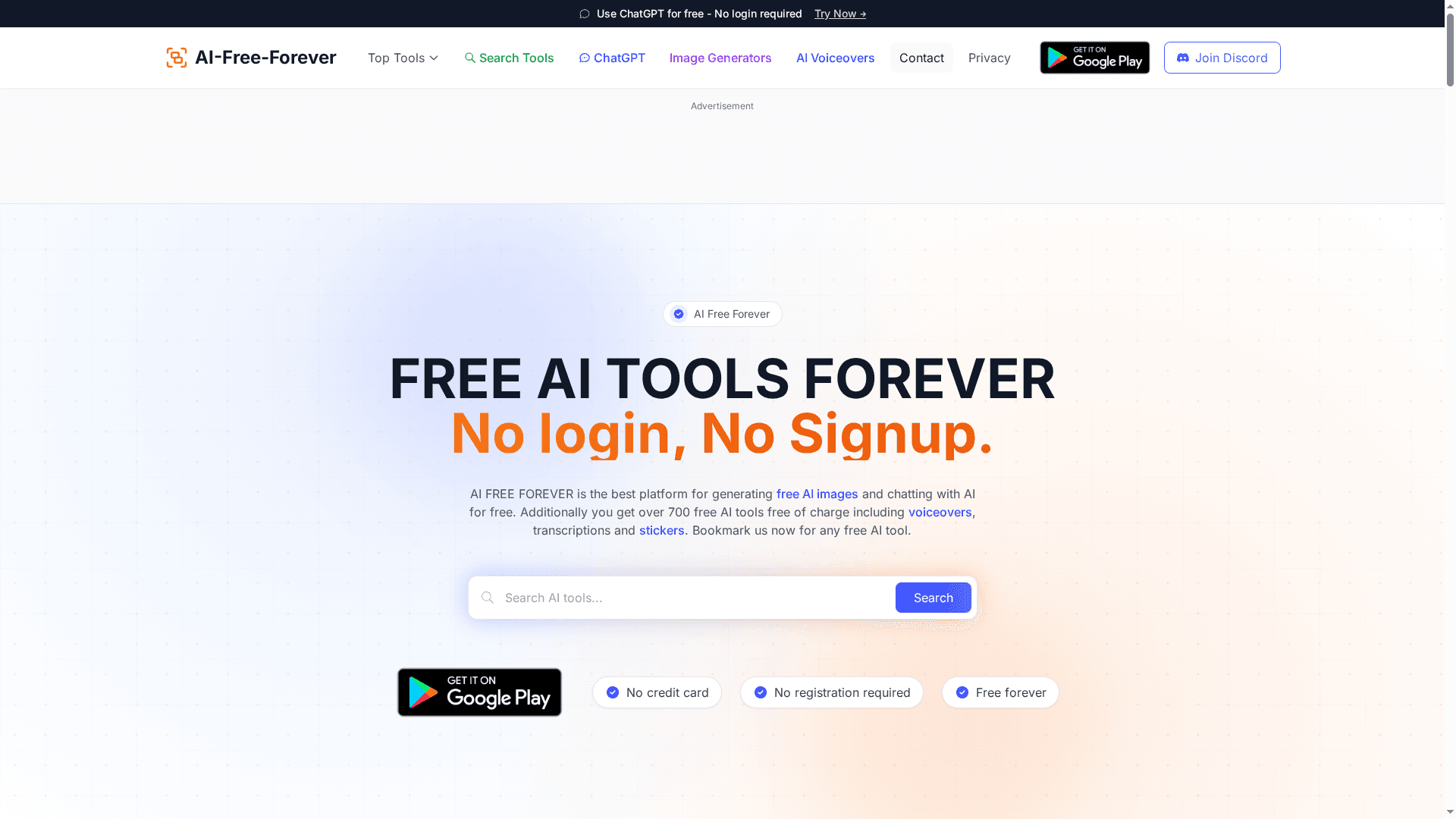
Explore the future of artificial intelligence with no cost and no hassle at AI Free Forever. Visit today and join thousands who are transforming their work, creativity, and learning with free AI right at their fingertips.
Frequently Asked Questions
What is Free AI and why is it important?
Free AI refers to artificial intelligence tools and systems that are openly accessible for use, study, modification, and distribution. It is important because it democratizes access to advanced technological capabilities, empowering individuals from various backgrounds to innovate and participate in AI development without financial barriers.
What are the core principles of Free AI?
The core principles of Free AI include transparency, accessibility, collaborative development, and ethical innovation. These principles ensure that AI technologies are developed responsibly, with an emphasis on inclusivity and accountability.
How do free AI tools drive accessibility and equity?
Free AI tools drive accessibility and equity by eliminating economic barriers, promoting global knowledge sharing, and providing skill development opportunities, particularly for underrepresented communities. This ensures a more inclusive environment for learning and innovation.
What are some risks associated with using Free AI tools?
Some potential risks of Free AI tools include algorithmic bias, data privacy concerns, quality and reliability issues, and ethical considerations. It is essential for users to critically evaluate AI outputs and use detection tools to verify their authenticity.