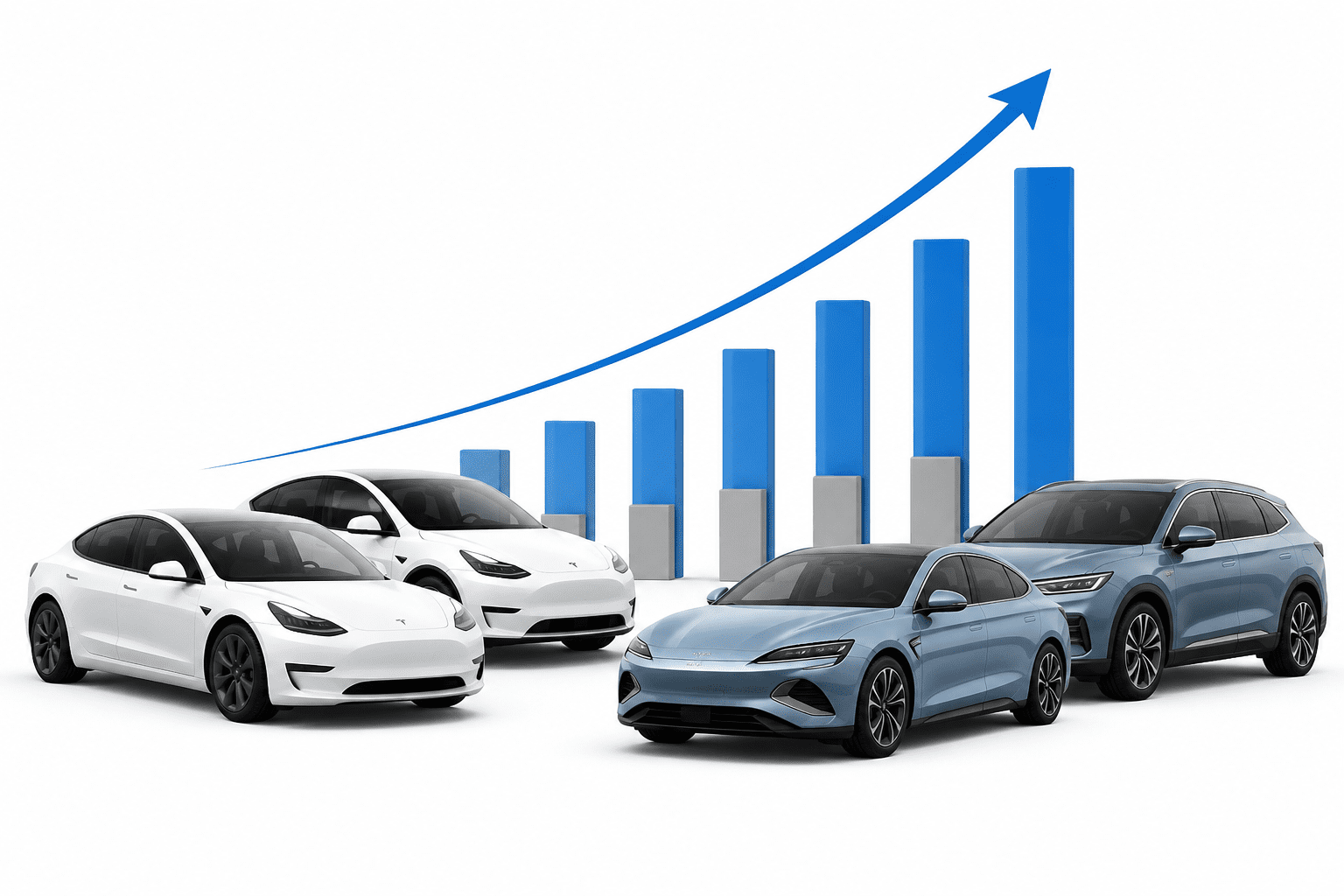
As of 2026, BYD is widening its EV lead over Tesla heading into 2026 is no longer the clean read of the market. Tesla actually moved back in front in the first quarter of 2026, delivering 358,023 vehicles versus BYD’s 310,389 pure BEV deliveries. The headline is simple: BYD still dominates total new-energy volume, but Tesla reclaimed the global battery-electric lead on a narrower, higher-stakes metric.
That split matters because BYD’s scale still comes from a much broader mix, while Tesla’s volume is concentrated almost entirely in two models. Industry trackers and government data agree on the direction of travel: the EV race heading into 2026 is being decided by product mix, pricing pressure, and how much each company can protect demand as incentives shift.
Tesla’s Q1 2026 Performance
Tesla’s Q1 2026 deliveries rose 6.5% year over year, and the Model 3 and Model Y made up 95% of the total. That concentration is a strength and a weakness: it keeps Tesla efficient, but it also leaves the company exposed if demand softens for its two core nameplates.
Comparison of Tesla and BYD’s Q1 2026 EV Deliveries
| Company | Q1 2026 Deliveries | Year-over-Year Change | Model Focus |
|---|---|---|---|
| Tesla | 358,023 | +6.5% | Model 3 and Model Y (95%) |
| BYD | 310,389 | -25.5% | Not specified |
Source: Tesla Reclaims Global EV Sales Lead from BYD
The rebound also shows up in the delivery trend itself. A 6.3% increase appears in some coverage of the same quarter, but the market signal is the same: Tesla stopped bleeding share and got back to growth while keeping volumes high enough to retake the BEV crown.
BYD’s Q1 2026 Performance
BYD’s Q1 2026 deliveries fell 25.5% year over year, even though total NEV sales still reached 700,463 units. That gap is the key to understanding BYD’s position: the company remains a giant across plug-in hybrids and pure EVs, but its BEV momentum is no longer automatically outrunning Tesla’s.
By early 2026, BYD’s scale advantage looks more like a diversified portfolio advantage than a pure battery-electric lead. The company can absorb weaker BEV quarters because its hybrid business cushions the total, but that also means the headline battle with Tesla is no longer about overall NEV volume alone.
Annual Sales Comparison
2026 vs 2025 still matters because the prior full-year finish explains why this quarter feels like a reversal. BYD sold 2.26 million pure electric vehicles, while Tesla sold 1.64 million. That older full-year gap is real, and it shows how quickly one quarter can change the narrative without erasing the larger structural fight.
The clean read is this: BYD entered 2026 with the stronger annual BEV base, but Tesla entered the year with stronger quarter-to-quarter momentum. If Tesla sustains that pace, the annual comparison gets tighter fast; if it slips, BYD’s bigger manufacturing and China-heavy volume base can reassert itself.
Market Dynamics and Implications
The market is rewarding the company that can hold a simpler, cleaner EV mix while staying competitive on price, and that currently favors Tesla’s model concentration more than BYD’s broader NEV structure. Tesla’s Q1 2026 rebound suggests the company has stabilized after a difficult stretch, while BYD’s sharp BEV decline shows that scale alone does not protect share when demand shifts or competition gets more aggressive.
Across major markets, the broader implication is straightforward: the global EV race heading into 2026 is no longer a one-way story. Tesla’s return to the top in pure EV deliveries proves the lead can flip quickly, but BYD still has the deeper total-volume engine. The next decisive move will come from whichever company can pair volume with demand consistency instead of relying on one quarter’s surge.
FAQs
What factors contributed to Tesla’s Q1 2026 performance?
Tesla’s Q1 2026 performance indicates a rebound from the previous year’s decline, with a 6.3% increase in deliveries. The main driver was strong volume in the Model 3 and Model Y, which together accounted for 95% of deliveries.
What were Tesla’s Q1 2026 EV delivery numbers?
Tesla delivered 358,023 electric vehicles worldwide in Q1 2026, a 6.5% increase from the previous year.
How did BYD perform in Q1 2026?
BYD’s deliveries in Q1 2026 declined by 25.5% year over year, with total NEV sales reaching 700,463 units.
What was the annual sales comparison between Tesla and BYD in 2026?
BYD sold 2.26 million pure electric vehicles, surpassing Tesla’s 1.64 million units.
As of 2026, the takeaway is not that one company has permanently won. It is that Tesla can still reclaim the BEV lead when its core lineup is healthy, while BYD remains the tougher total-volume player because its hybrid-plus-BEV mix gives it more ways to win even when pure electric demand softens.