AI poem generators and poetry tools help you craft verses in seconds, whether you’re stuck on a love sonnet or need a quick haiku for class. These tools handle the heavy lifting—rhyme schemes, syllable counts, and structure—so you can focus on what matters: saying what you need to say.
By the time you finish reading, you’ll know which poetry generator fits your style, how to pick the right rhyme pattern, and ways to write better poems without banging your head against writer’s block. You’ll see examples of different poem types and get links to tools you can use right now.
Table of Contents
- What Makes a Good Poem Generator
- Top 10 Poetry Writing Tools
- Common Rhyme Schemes Every Poet Should Know
- Types of Poems You Can Generate
- Tips for Better Poetry Writing
- FAQ
What Makes a Good Poem Generator
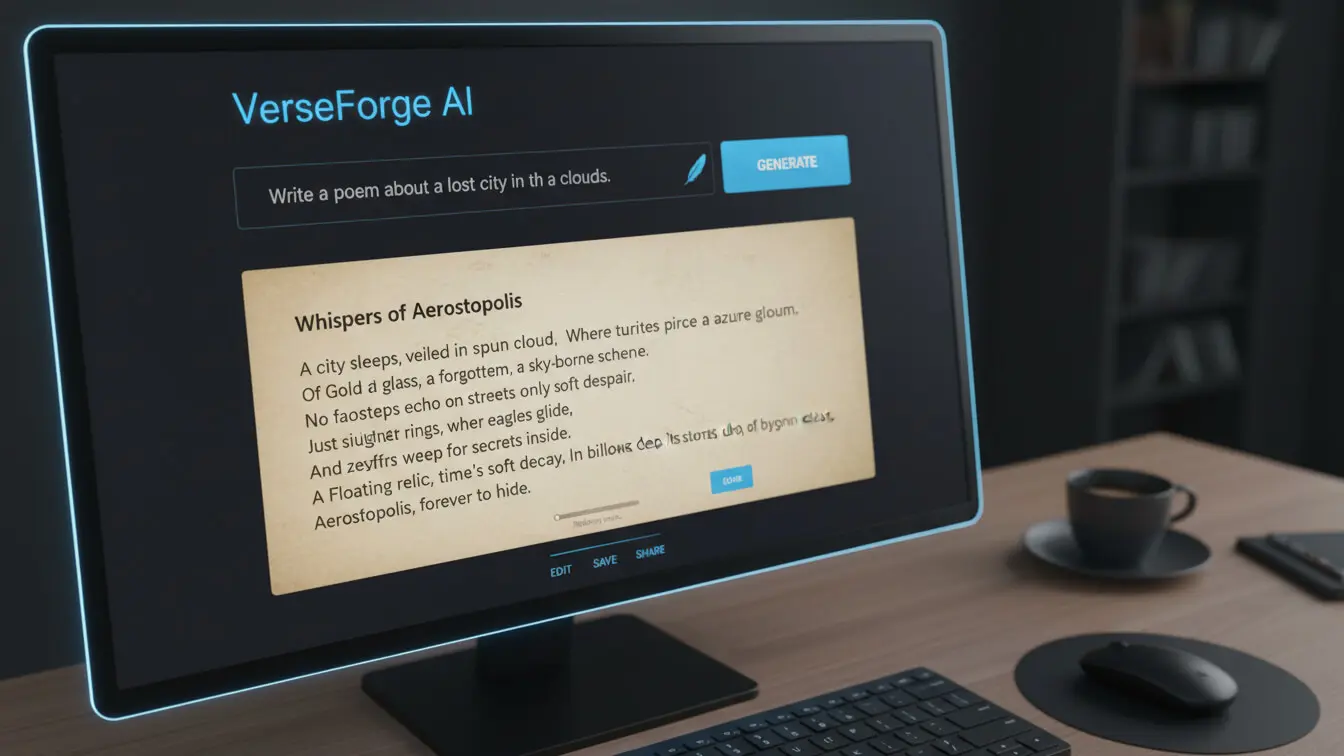
A solid poem generator needs three things: speed, variety, and decent output quality. Speed means getting results in under 10 seconds. Variety means handling multiple formats—from haikus to sonnets to free verse. Quality means the poems don’t sound like a robot wrote them (even though one did).
The best tools let you tweak tone, adjust length, and regenerate lines until you get something usable. According to Grammarly’s research, AI-powered generators work by analyzing existing poetry patterns and applying them to your input text. Free access matters too—nobody wants to pay $20 monthly just to rhyme “heart” with “apart.”
Look for generators that show you the rhyme scheme they’re using. If you can see whether it’s ABAB or AABB, you can learn while you create. Some tools include explanations of poetic terms, which helps if you’re new to poetry creation.

Top 10 Poetry Writing Tools
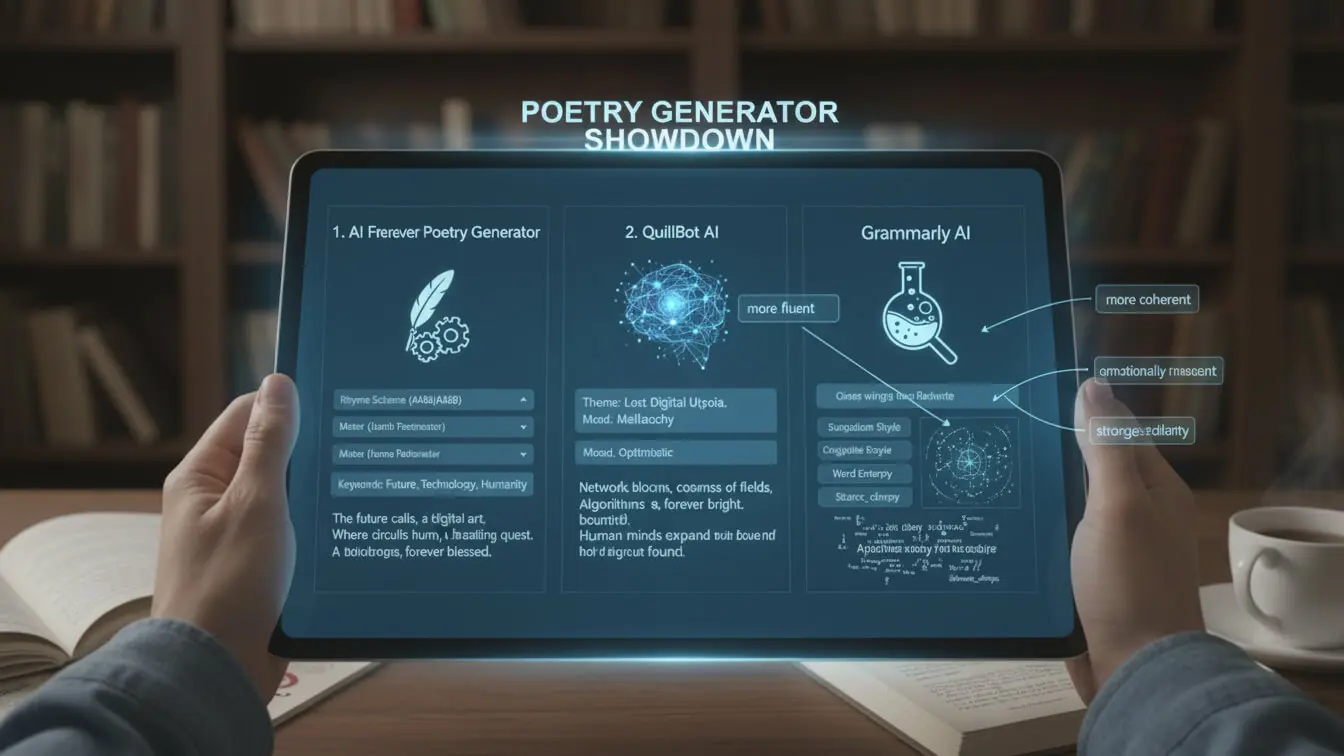
1. AI FREE FOREVER Poetry Generator
AI FREE FOREVER’s poetry generator sits at the top because it’s actually free forever, no credit card required. You type a theme or emotion, pick your poem type, and get results in 5 seconds. The tool handles 15+ formats including sonnets, limericks, and acrostic poems.
The interface stays simple—no clutter, no ads blocking your view. You can generate unlimited poems, copy them with one click, or regenerate if the first version misses the mark. The haiku generator nails the 5-7-5 syllable structure every time, and the quatrain generator gives you clean ABAB patterns.
2. QuillBot AI Poem Generator
QuillBot’s generator works fast and produces decent metaphors. Enter a concept or mood, and it spits out verses in seconds. The tool handles everything from romantic stanzas to funny limericks. You can guide the structure by mentioning rhyme or style in your prompt.
One strength: it echoes famous poets if you mention them by name. Type “write like Rupi Kaur” and watch it mirror that minimalist style. The free version has no usage limits, which beats tools that cap you at 5 poems per day.
3. Grammarly AI Poem Generator
Grammarly throws its hat in the ring with a generator focused on clarity and polish. Pick your topic, select a form (sonnet, haiku, free verse), and get AI-crafted lines instantly. The tool considers your chosen themes and emotional tone, so a poem about heartbreak won’t sound cheerful.
Based on Grammarly’s documentation, their AI analyzes themes, emotions, and stylistic elements to generate poetic lines that match your desired tone. The interface stays clean, though it pushes you toward their premium features if you want advanced editing options.
4. AskYourPDF AI Poem Generator
AskYourPDF carved out space in the AI poem world by offering customization most tools skip. You input keywords, and it generates poems across various styles and themes. The platform works for writers, artists, and anyone needing quick poetic inspiration.
According to AskYourPDF’s analysis, their generator stands out for its user-friendly interface and flexible customization. You can adjust tone, mood, and structure to match your vision. The tool handles romantic sonnets, haikus, and whimsical limericks with equal skill.
5. EditPad Poem Maker
EditPad’s tool focuses on plagiarism-free output. You enter a phrase or theme, select your poem type, and adjust the length (short, medium, long). The generator writes poems in seconds and lets you download or copy the results immediately.
The “Generate Again” button gives you different outputs from a single prompt, which helps when the first version doesn’t click. The tool handles 12+ poem types including free verse, limerick, haiku, sonnet, and acrostic formats.
6. DeepAI Poem Generator
DeepAI keeps it simple—type a few words, get a poem. The tool combines AI technology with creative language patterns to turn simple inputs into poetic masterpieces. It works best for quick verses when you need something fast.
The interface lacks fancy options, but that’s the point. Sometimes you just need a poem, not a PhD in poetry structure. DeepAI delivers that baseline functionality without asking for an account or payment info.

7. PoemGenerator.io
PoemGenerator.io uses machine learning to whip up poems across multiple formats. Tell the tool what the poem is about, and it creates verses with proper rhyme and rhythm. You pick the style (haiku, sonnet, free verse) and let the algorithm handle the rest.
The tool stays available 24/7, so you can write at 2am if inspiration hits. Users report learning about poetry structure while generating verses, making it useful for both creation and education.
8. UPDF AI Poetry Writer
UPDF AI stands out for fast processing and the ability to explain complex terms in generated poems. According to UPDF’s guide, their AI uses GPT mechanisms to create diverse poems, emails, and articles. You can explore various tones, themes, and styles through different prompts.
The chat facility helps at every step of the writing process. Stuck on a line? Ask the AI. Confused about meter? It explains. This makes UPDF useful for beginners learning the ropes.
9. Rhyme AI
Rhyme AI targets a specific niche: rhythm and rhymes for children’s books, greeting cards, and songs. The tool’s customization features let you write poems based on specific needs. Songwriters use it to generate ideas without hassle.
The interface stays simple and intuitive. Rich rhyme verses make this tool perfect for anyone creating content that needs to flow smoothly and stick in memory.
10. Poem Analysis AI
Poem Analysis AI lets you explore various poetry genres—nature, family, American, haiku, and more. You customize genre, language, tone, forms, themes, and length before generating. The tool offers emotion selection to create personalized pieces matching your taste.
One downside: the generator crashes occasionally before completing poems, which gets annoying when you’re on a deadline. But when it works, it produces solid results across multiple poetry styles.
Common Rhyme Schemes Every Poet Should Know
Rhyme schemes are patterns of sounds that repeat at the end of lines. We mark them with letters—A, B, C—to show which lines rhyme together. The first set of rhyming lines gets labeled A. The second set becomes B. So ABAB means lines 1 and 3 rhyme, while lines 2 and 4 rhyme.
AABB (Couplet Rhyme)
The simplest pattern: two consecutive lines rhyme, then the next two rhyme. Shakespeare loved this for closing scenes with punch. According to Creative Writing Now, this scheme creates a feeling of completeness because each pair wraps up its own thought.
Example structure:
Line 1 (A)
Line 2 (A)
Line 3 (B)
Line 4 (B)
ABAB (Alternate Rhyme)
Lines alternate their rhymes—first and third match, second and fourth match. This pattern shows up everywhere from Emily Brontë to modern song lyrics. The pattern creates momentum because readers wait two lines to hear the rhyme payoff.
Based on Microsoft’s poetry guide, ABAB works well for quatrains and keeps readers engaged without overwhelming them with too many rhymes at once.
ABBA (Enclosed Rhyme)
The first and fourth lines rhyme, while the middle two lines rhyme with each other. This creates a sense of completion as the final line echoes the opening. Elizabeth Barrett Browning used this in her sonnets, sometimes employing near rhymes when exact matches felt forced.
AABA (Modified Rhyme)
Three lines rhyme, then one breaks the pattern. Robert Frost used this in poems, sometimes chaining verses together by carrying the odd rhyme into the next stanza. The structure: AABA, BBCB, CCDC.
According to The Writing Cooperative, alternative rhyme schemes often produce subtle but alluring effects that make poems memorable.
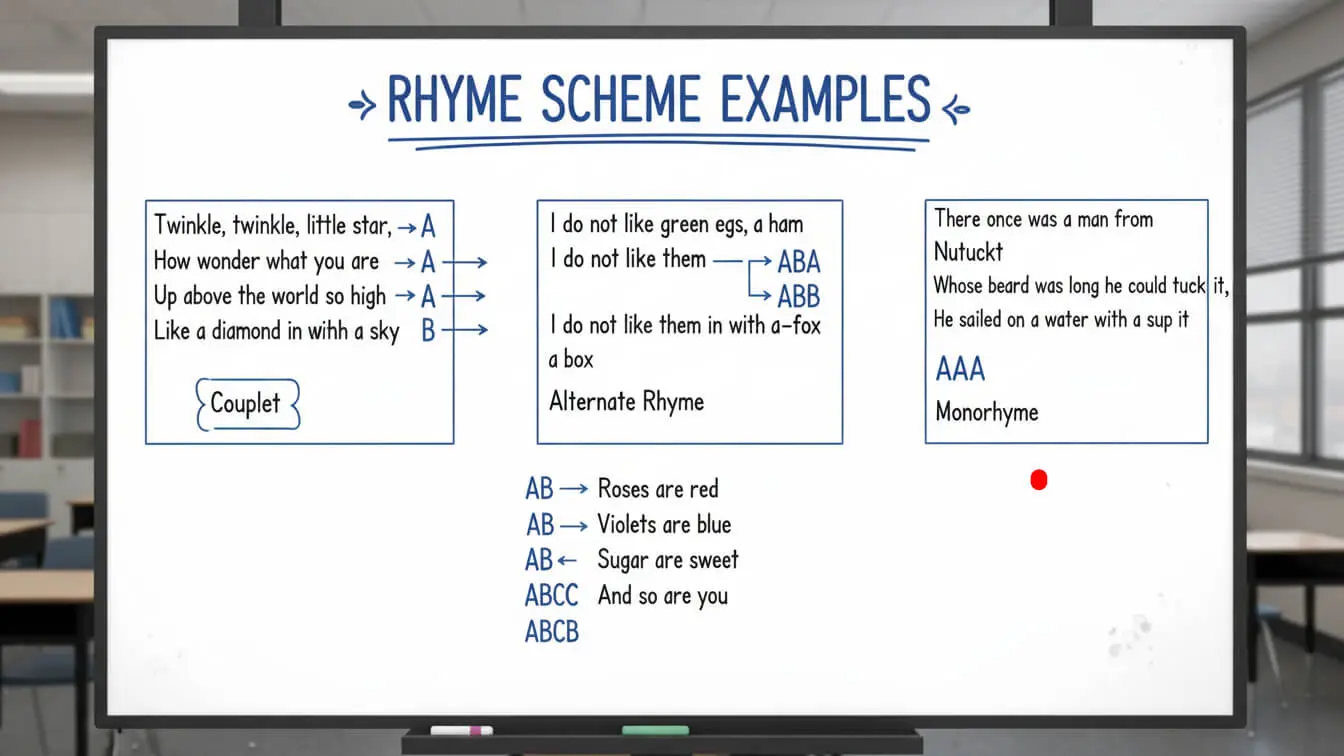
AABBA (Limerick Scheme)
Five lines with a specific bounce: long, long, short, short, long. Lines 1, 2, and 5 rhyme (usually 7-10 syllables). Lines 3 and 4 rhyme (5-6 syllables). Limericks use this exclusively because the rhythm makes them fun to recite and easy to remember.
Internal Rhyme
Words rhyme within the same line instead of at line endings. Samuel Taylor Coleridge mastered this technique. Internal rhymes add musicality without following traditional end-rhyme patterns. They work great in free verse when you want rhythm without rigid structure.
Slant Rhyme (Near Rhyme)
Words sound similar but don’t match exactly—like “fate” and “saint” or “work” and “spark.” Matrix Education explains that slant rhymes give you more word choices and help you avoid predictable combinations like “love” and “dove.”
Emily Dickinson used slant rhymes frequently, which kept her poems from sounding too sing-songy. Modern poets prefer slant rhymes because they sound more natural in conversation.
Types of Poems You Can Generate
Different poem types follow different rules. Some need specific syllable counts. Others require certain rhyme patterns. Knowing these forms helps you pick the right tool and get better results.
Haiku
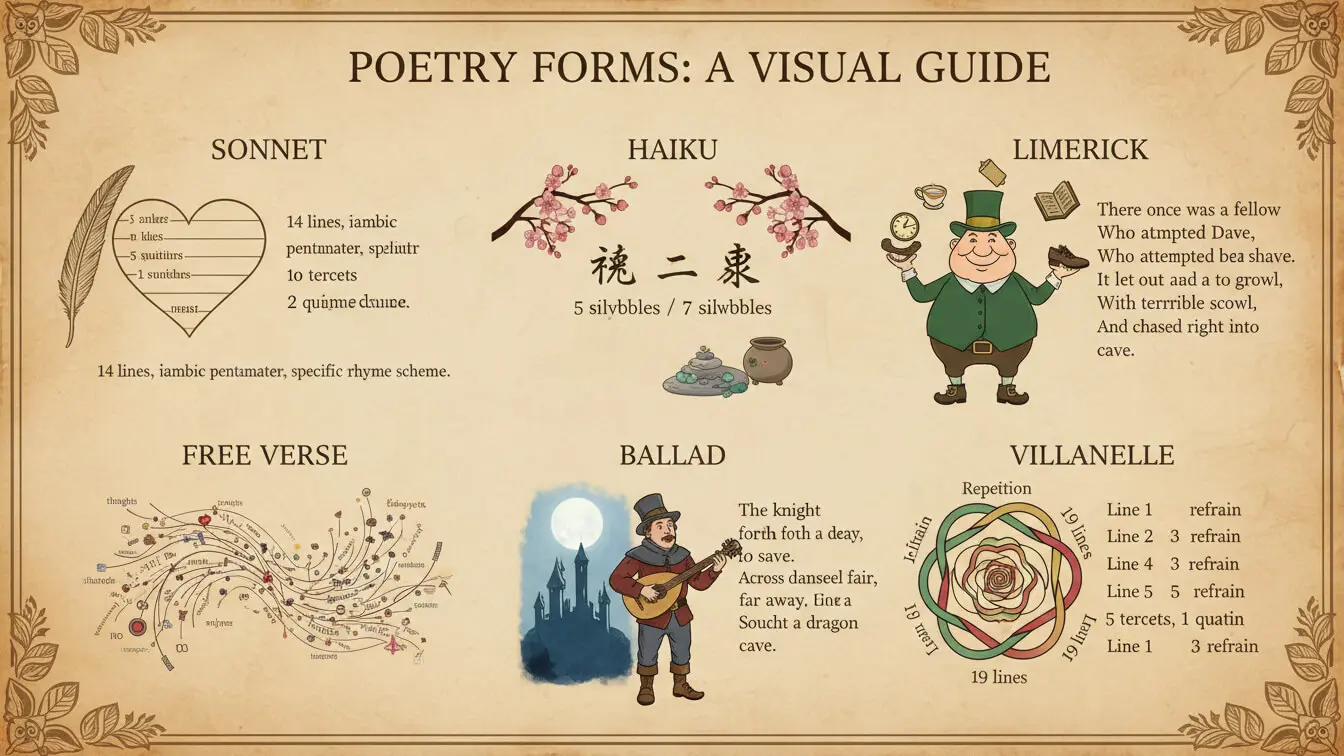
Japanese format with three lines: 5 syllables, 7 syllables, 5 syllables. Traditional haikus focus on nature and seasons, but modern versions tackle any subject. The strict syllable count forces you to pick words carefully. Generate haikus here when you need short, impactful verses.
Sonnet
14 lines of pure structure. Two main types exist: Shakespearean (ABAB CDCD EFEF GG) and Petrarchan (ABBAABBA CDECDE). MasterClass notes that sonnets traditionally use iambic pentameter—10 syllables per line with alternating stressed and unstressed beats.
Sonnets work best for complex emotions like love, loss, or deep reflection. The strict form forces you to cut fluff and get to the point.
Limerick
Five lines of pure fun. AABBA rhyme scheme with a bouncy rhythm. Lines 1, 2, and 5 have 7-10 syllables. Lines 3 and 4 have 5-6 syllables. The last line delivers a punchline or twist.
According to Reedsy’s poetry guide, limericks originated as bawdy drinking songs and retain that playful, sometimes crude energy today.
Free Verse
No rules. No rhyme scheme. No syllable requirements. Free verse gives you total control over line breaks, rhythm, and structure. Most modern poetry uses this format because it sounds like natural speech.
Free verse doesn’t mean sloppy—you still need strong imagery, rhythm, and purpose. The AI FREE FOREVER free verse generator helps you start with structure even when there are no formal rules.
Acrostic
The first letter of each line spells a word reading downward. Teachers love these for introducing poetry to kids. The format works for any word length—short names create short poems, while phrases like “HAPPY BIRTHDAY” create longer pieces.
Acrostics force creative word choice because you’re locked into specific starting letters. This constraint actually sparks creativity by limiting options.
Ballad
Story poems with musical roots. Ballads use quatrains (4-line stanzas) and follow ABCB or ABAB rhyme schemes. Medieval minstrels sang ballads to spread news and stories. Modern pop songs descend directly from this tradition.
Lady of Poetry explains that ballads commonly tell emotional or tragic stories with a pleasant rhythm that makes them memorable.
Villanelle
19 lines of obsessive repetition. Five three-line stanzas (tercets) with ABA rhyme, ending with a four-line stanza (quatrain) using ABAA. The first and third lines repeat alternately throughout the poem.
Villanelles work for topics that circle back on themselves—obsessions, memories, losses. The repetition drives home themes through sheer force of return.
Ode
Praise poems addressing specific people, places, things, or events. Odes don’t require specific rhyme schemes or meters, but they need elaborate language and sincere admiration. Ancient Greeks invented odes to celebrate victories and honor gods.
Modern odes tackle everything from autumn leaves to sneakers. The key: genuine enthusiasm for your subject.
Tips for Better Poetry Writing
Good poems combine technique with feeling. These strategies help both aspects click into place.
Read Poems Out Loud
Poetry lives in sound, not just on the page. Reading aloud reveals clunky rhythm, awkward line breaks, and weak rhymes. Your ear catches problems your eyes miss. According to Piqosity’s teaching guide, hearing rhymes helps you identify patterns better than just reading silently.
Record yourself reading. Listen back. Mark spots where you stumble or rush. Those are the lines that need work.

Vary Your Sentence Structure
Mix short punches with longer explanations. A 4-word line hits different than a 14-word line. Alternate between them to control pacing. One-word lines create dramatic pauses. Long flowing sentences build momentum.
Never start three paragraphs the same way. Never end three stanzas with identical structures. Humans don’t write in patterns—we write in variations.
Use Specific Images, Not Abstract Ideas
Don’t write “sadness.” Write “rust on the swing set.” Don’t write “happiness.” Write “burnt toast smell on Saturday morning.” Concrete details stick in memory. Abstract concepts slide right past.
Trade adjectives for sensory nouns. “Very tired” becomes “dead-legged.” “Very cold” becomes “ice-burn fingers.” The more specific your images, the more readers feel what you describe.
Study Different Rhyme Schemes
Try AABA one week. ABABCC the next. The Writing Cooperative suggests finding poems you love and analyzing their rhyme patterns. Then use those patterns as foundations for new work.
Each scheme creates different effects. AABB feels complete and tidy. ABAB creates suspense. ABBA forms a circle. Experiment with all of them.
Break Stanzas in Unexpected Places
Don’t always end stanzas where sentences end. Try breaking mid-thought to create tension. Vary stanza lengths—four lines, then two, then six. According to MasterClass’s rhyme guide, moving stanza breaks around opens new opportunities for placing rhymes.

Cut Adverbs and Weak Verbs
Search your poem for words ending in “ly.” Most can go. “Walked slowly” becomes “trudged.” “Spoke quietly” becomes “whispered.” Strong verbs carry emotion without helper words.
Aim for under 3 adverbs per 500 words. Your verbs should work hard enough that they don’t need modifiers.
Use Poetry Generators as Starting Points
AI tools work best for beating writer’s block. Generate a poem, then rewrite the weak lines. Keep the structure but replace bland words with specific images. According to QuillBot’s research, their generator helps writers get past blank pages by providing foundations to build on.
Never publish AI output without editing. Use generators for first drafts, not final products. The AI FREE FOREVER tool gives you bones—you add the muscle.
Study Poems That Move You
Find 5 poems that hit you emotionally. Analyze why they work. What rhyme scheme? What imagery? How do line breaks control pacing? Writers.com explains that understanding form helps you choose the right structure for your subject matter.
Copy techniques, not content. If you love how a poet uses internal rhyme, try that technique in your own work with your own words.
FAQ
Are AI poem generators really free?
Most offer free versions with limits. AI FREE FOREVER, QuillBot, and EditPad provide unlimited free access. Some tools like Grammarly offer basic free generation but push premium features for editing help.
Can I use AI-generated poems for school assignments?
Check your school’s policy first. Many institutions consider AI-generated content similar to plagiarism. Use generators as learning tools or starting points, but write the final version yourself. Understanding how generators work helps you write better original poetry.
Which rhyme scheme is easiest for beginners?
AABB (couplet rhyme) offers the gentlest learning curve. You only need to rhyme two consecutive lines before moving to a new rhyme. According to Microsoft’s writing guide, this pattern works perfectly for Shakespeare-style dramatic dialogue.
How do I know which poem type fits my topic?
Match form to feeling. Quick observations work as haikus. Deep emotions need sonnets or odes. Funny stories fit limericks. Personal narratives work as ballads or free verse. Writers.com notes that different forms help poets handle different subjects.
What’s the difference between perfect rhyme and slant rhyme?
Perfect rhymes match exactly—”cat” and “hat.” Slant rhymes match partially—”cat” and “kit.” Lyncil’s rhyme guide explains that slant rhymes give you more word choices and prevent predictable pairings like “love/dove.”
Do professional poets use AI generators?
Some use them for brainstorming and overcoming blocks. Most professional poets treat AI as a tool for generating ideas, not finished work. The technology helps with structure and suggestions, but human revision adds the emotional punch that makes poetry memorable.
How many syllables should each line have?
Depends on the form. Haikus require 5-7-5. Sonnets traditionally use 10 (iambic pentameter). Free verse needs no specific count. According to MasterClass, meter and syllable count work together to create rhythm.
Can I mix different rhyme schemes in one poem?
Absolutely. Many poems shift schemes between stanzas or use different patterns for different sections. Just make sure transitions feel intentional, not accidental. The Writing Cooperative suggests experimenting with schemes like ABABCC that naturally blend patterns.
What if the generator’s output sounds robotic?
Replace generic words with specific images. Swap weak verbs for strong ones. Add personal details the AI couldn’t know. Change line breaks to control pacing. The structure might work fine—the language just needs your human touch.
How do I memorize rhyme schemes?
Practice with poems you love. Write out the letters next to each line. Copy the scheme using your own words. After creating 10 poems in ABAB, the pattern becomes automatic. Piqosity recommends reading poems aloud to internalize patterns through sound.