Texas adds about 400,000 people a year. They come for jobs, lower bills, and no state income tax. This guide explains how to move here in 2026. It covers your license, car tags, and how to pick a town.
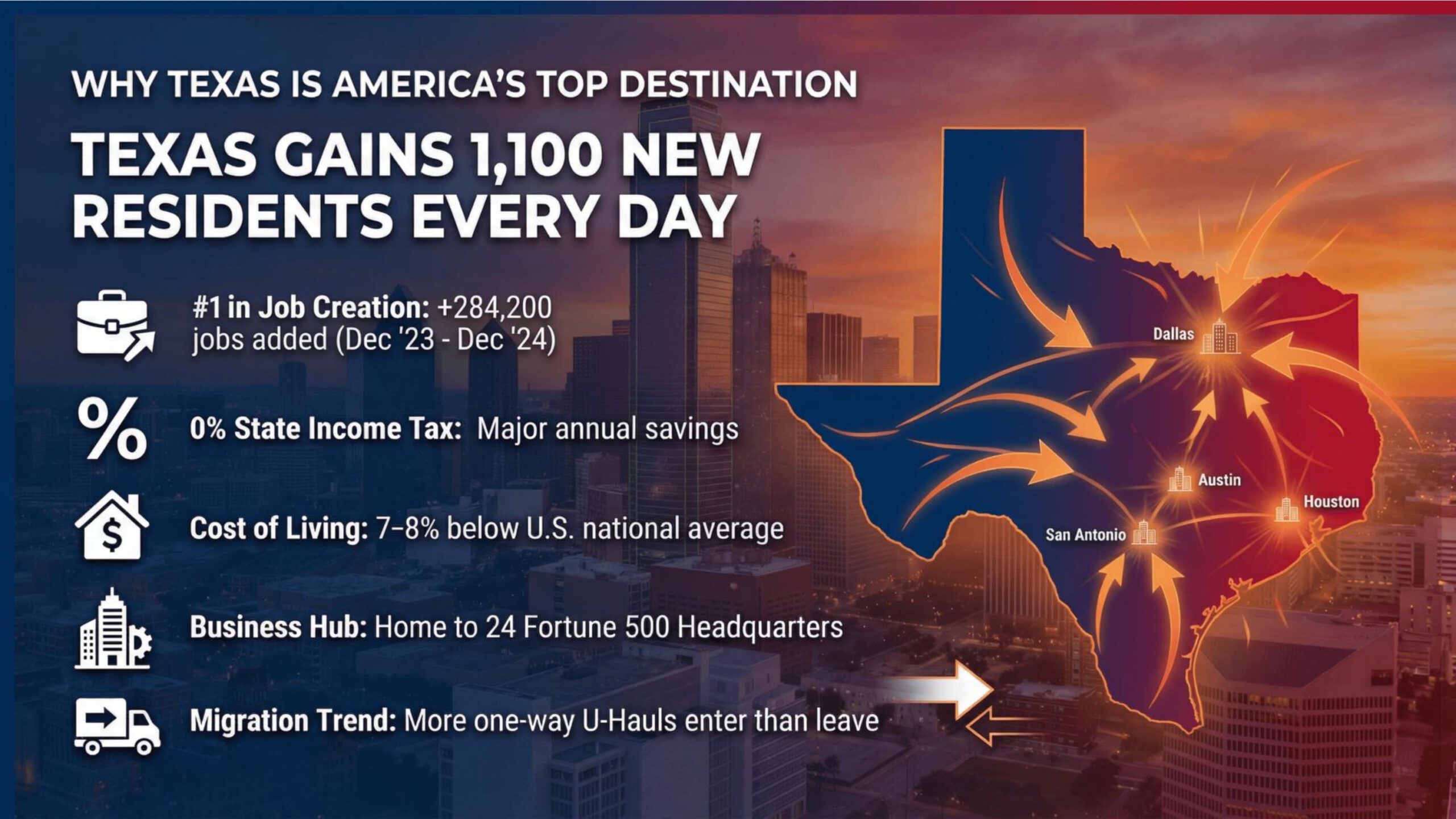
Why People Move to Texas
Census numbers show Texas gains roughly 1,100 new residents each day. The state added 284,200 jobs from December 2023 to December 2024, according to the Texas Workforce Commission. Health care, tech, energy, and aerospace lead hiring. There is no state income tax, and living costs run 7 to 8 percent below the U.S. average according to Salary.com. Twenty-four Fortune 500 companies keep headquarters here.
Job openings stretch from Dallas hospitals to Houston ports, Austin chip plants to Midland oil fields. Teachers, welders, nurses, and coders all find work. Home prices sit below the national median in most metro areas. Commutes average under thirty minutes in Fort Worth, San Antonio, and Corpus Christi. Public schools offer dual-language and STEM tracks in most suburbs. Weekend options range from Gulf beaches to Hill Country wineries, and state parks charge two dollars for day entry. U-Haul data shows more one-way trucks enter Texas than leave, a simple sign the math still works.
What Is the Cost of Living in Texas?
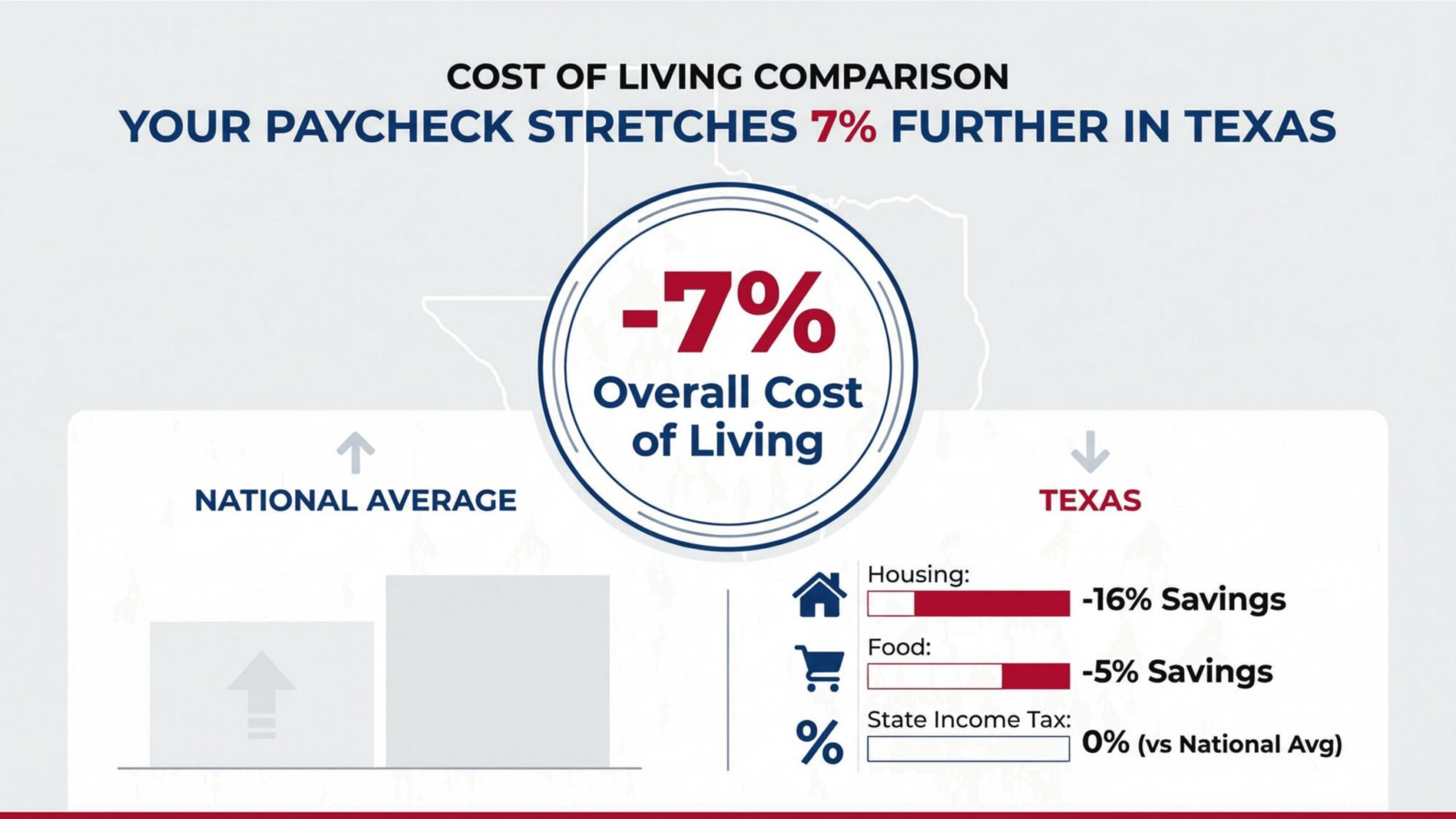
If you want to know how far your paycheck will stretch in Texas, start with the numbers. State-level data from the Bureau of Economic Analysiss how that everyday bills here run well below what you would pay on either coast, yet you still get the big-city perks—museums, airports, late-night tacos—without the big-city price tag.
| Expense Category | Texas Average | National Average | Difference |
|---|---|---|---|
| Overall Cost of Living Index | 93 | 100 | -7% |
| Housing (single person/month) | $1,008 | $1,200 | -16% |
| Housing (family of 4/month) | $1,848 | $2,200 | -16% |
| Food (single person/month) | $380 | $400 | -5% |
| Food (family of 4/month) | $1,235 | $1,300 | -5% |
| Utilities/Transportation/Healthcare | $814/person | $875/person | -7% |
| Average Monthly Total (single) | $2,302 | $2,475 | -7% |
| Average Monthly Total (family of 4) | $5,068 | $5,450 | -7% |
| Annual Cost (single person) | $27,624 | $29,700 | -7% |
| State Income Tax | 0% | Varies (0-13.3%) | Significant savings |
Cost of Living by Texas City
Living costs vary significantly across Texas’s diverse metropolitan areas. Here’s how major cities compare:
| City | Cost of Living Index | Median Home Price | Average Rent (1BR) | Notable Features |
|---|---|---|---|---|
| Harlingen | 82.1 | $193,000 | $850 | Most affordable major city |
| Amarillo | 83.3 | $203,686 | $925 | Panhandle charm, low costs |
| McAllen | 85.1 | $187,270 | $875 | Border city, affordable |
| El Paso | 87 | $259,000 | $950 | Mountain views, safe |
| San Antonio | 91 | $265,000 | $1,150 | Historic, growing |
| Houston | 94 | $335,000 | $1,250 | Diverse economy, medical center |
| Fort Worth | 95 | $325,000 | $1,275 | Western heritage, affordable |
| Dallas | 103 | $405,000 | $1,400 | Corporate hub, dining |
| Austin | 110 | $438,000 | $1,500 | Tech hub, music scene |
What Is the Texas Housing Market Like in 2026?
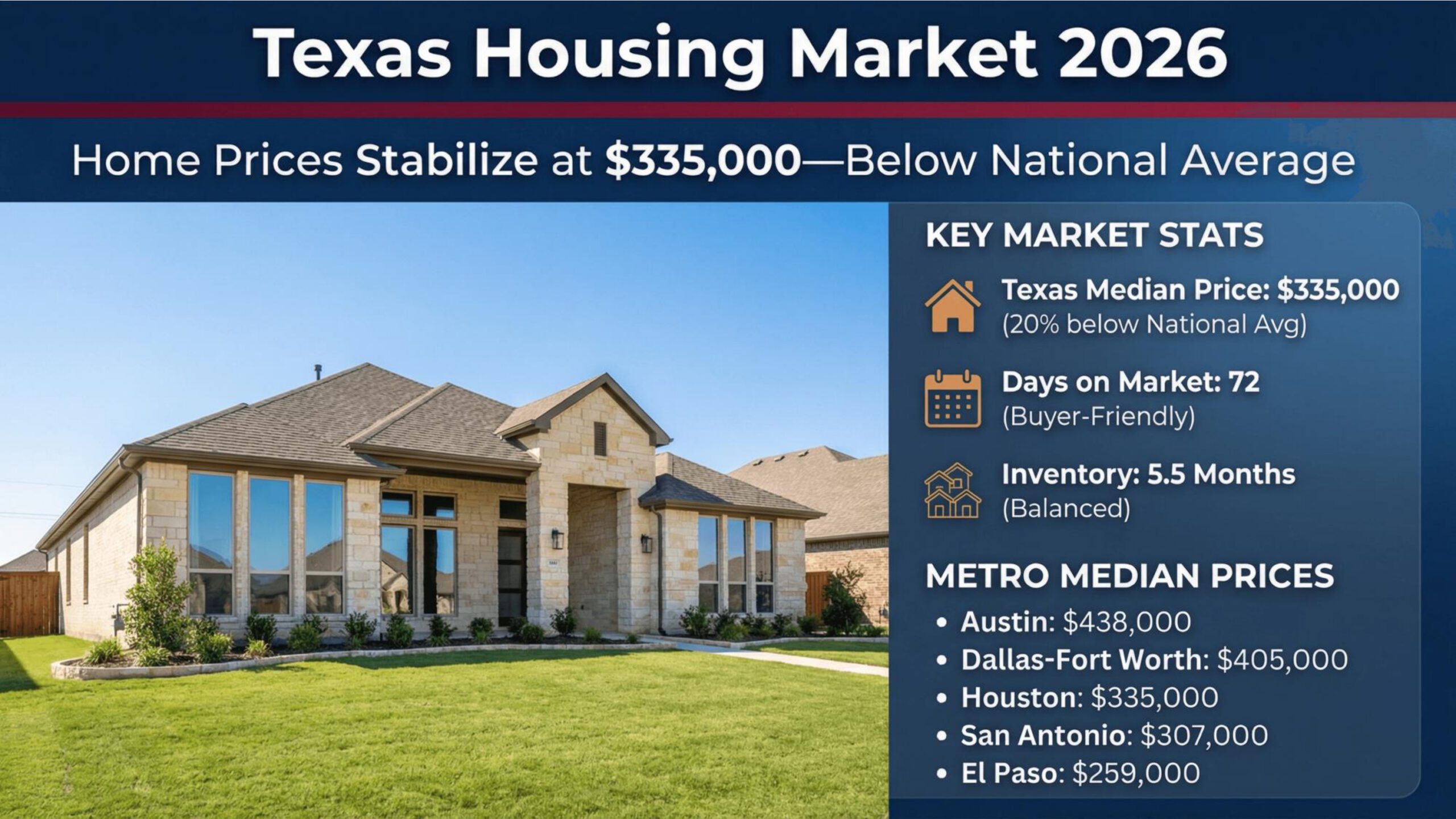
Texas home prices have come back down to earth after the wild pandemic run-up, and buyers heading into 2026 are catching a break. Figures from Houzeo and Zillow pin the middle-of-the-road house somewhere between $306,682 and $335,600—down a notch from 2024’s spike yet still easier to swallow than what most of the country is asking.
| Market Metric | Texas 2025 | National Average | Trend |
|---|---|---|---|
| Median Home Price | $335,000 | $420,000 | Stable to slight decline |
| Year-over-Year Change | +1.1% | +4.2% | Moderate growth |
| Days on Market | 72 | 45 | Buyer-friendly |
| Months of Inventory | 5.5 | 3.8 | Balanced market |
| Median Price Cut | $17,000 | $12,000 | Negotiation power |
| Mortgage Rate (30-year) | 6.5-6.8% | 6.5-6.8% | Stabilizing |
Home Prices by Major Texas Metro
| Metro Area | Median Home Price | YoY Change | Days on Market | Market Condition |
|---|---|---|---|---|
| Dallas-Fort Worth | $405,000 | +3.0% | 29 | Competitive |
| Austin | $438,000 | -1.8% | 42 | Buyer’s market |
| Houston | $335,000 | +5.7% | 46 | Balanced |
| San Antonio | $307,000 | +0.3% | 55 | Buyer-friendly |
| El Paso | $259,000 | +2.1% | 48 | Affordable |
| Wichita Falls | $195,000 | +1.5% | 60 | Very affordable |
What Are the Best Cities in Texas for Families?

Texas offers exceptional options for families seeking quality schools, safe neighborhoods, and family-friendly amenities. According to Niche, WalletHub, and Livability, these communities consistently rank among the state’s best for raising children.
| Rank | City/Suburb | Metro Area | Population | Median Home Price | School Rating |
|---|---|---|---|---|---|
| 1 | Cinco Ranch | Houston | 19,139 | $425,000 | A+ |
| 2 | Flower Mound | Dallas | 79,000 | $550,000 | A+ |
| 3 | The Woodlands | Houston | 116,916 | $475,000 | A+ |
| 4 | Southlake | Fort Worth | 31,044 | $850,000 | A+ |
| 5 | Colleyville | Dallas-Fort Worth | 27,000 | $725,000 | A+ |
| 6 | Frisco | Dallas | 220,000 | $575,000 | A+ |
| 7 | Sugar Land | Houston | 112,000 | $425,000 | A+ |
| 8 | Plano | Dallas | 290,000 | $493,000 | A |
| 9 | Round Rock | Austin | 135,000 | $425,000 | A |
| 10 | McKinney | Dallas | 200,000 | $475,000 | A |
| 11 | Allen | Dallas | 105,000 | $485,000 | A |
| 12 | Pearland | Houston | 125,000 | $340,000 | A |
| 13 | Coppell | Dallas | 42,000 | $575,000 | A+ |
| 14 | New Braunfels | San Antonio | 98,000 | $375,000 | A |
| 15 | Keller | Fort Worth | 50,000 | $525,000 | A |
What Are the Best Cities for Young Professionals?

For career-focused individuals seeking job opportunities, nightlife, and urban amenities, Texas offers several thriving metropolitan options:
| City | Top Industries | Median Income | Unemployment Rate | Best For |
|---|---|---|---|---|
| Austin | Tech, startups, government | $75,000 | 3.5% | Tech careers, music scene |
| Dallas | Finance, tech, healthcare | $72,000 | 3.8% | Corporate careers, diverse economy |
| Houston | Energy, healthcare, aerospace | $68,000 | 4.2% | Medical center, international culture |
| Fort Worth | Aerospace, manufacturing, logistics | $62,000 | 3.9% | Affordable urban living |
| San Antonio | Military, healthcare, tourism | $58,000 | 4.0% | Affordable, historic charm |
How Do I Transfer My Driver’s License to Texas?
Transferring your driver’s license is one of the first tasks you’ll need to complete after moving to Texas. According to the Texas Department of Public Safety (DPS), new residents must obtain a Texas driver’s license within 90 days of establishing residency.
Requirements to Transfer Your Out-of-State License
If you’re 18 or older with a valid driver’s license from another U.S. state or Canadian province, you can transfer your license without taking written or driving tests. Here’s what you’ll need:
| Document Type | Acceptable Documents | Notes |
|---|---|---|
| Proof of Identity | Valid out-of-state driver’s license | Must be current and unexpired |
| Proof of Social Security Number | Social Security card, W-2, 1099, or paystub with full SSN | Required for all applicants |
| Proof of U.S. Citizenship or Lawful Presence | U.S. passport, birth certificate, certificate of naturalization, green card | One document required |
| Proof of Texas Residency (2 documents) | Utility bill, lease agreement, mortgage statement, bank statement, voter registration card | Must show current Texas address |
| Evidence of Texas Vehicle Registration | Texas vehicle registration receipt | Required if you own a vehicle |
Step-by-Step License Transfer Process
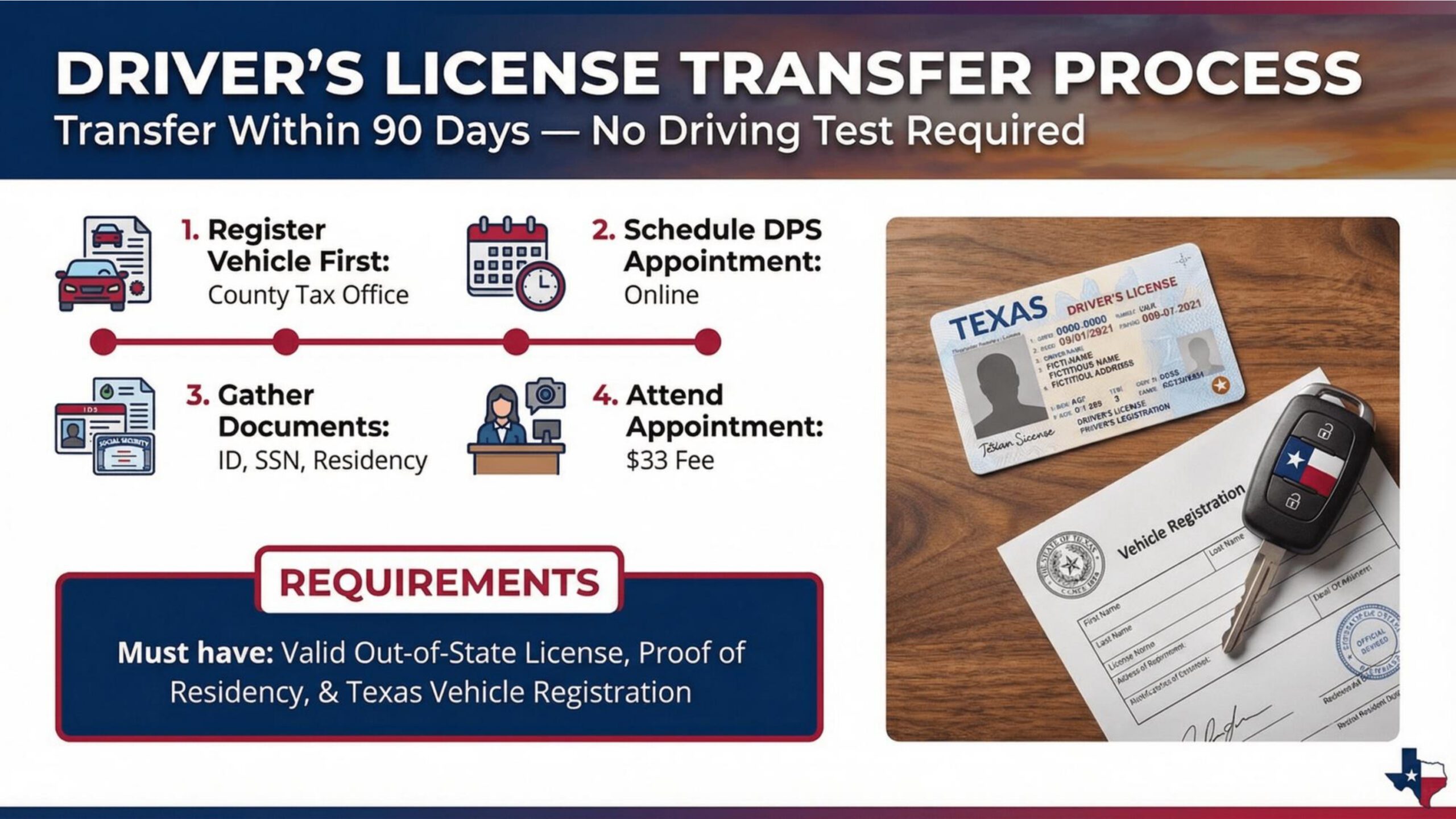
Follow these steps to swap your current license for a Texas one without extra trips:
Step 1: Register Your Vehicle First. Texas insists on seeing your vehicle registration before it will issue any driver license. Knock this out at the county tax-assessor collector office, then book your DPS slot.
Step 2: Schedule a DPS Appointment. Go to the Texas DPS website and reserve a spot at the driver-license office nearest you; a handful of locations still accept same-day walk-ins.
Step 3: Gather Required Documents. Run the free REAL ID Document Check on the DPS site, answer a few questions and it prints the exact paperwork you need for your situation.
Step 4: Attend Your Appointment. Show up a little early, pass the vision test, hand over the documents, turn in your old license, and pay the fee, $33 for most standard licenses.
Step 5: Receive Your License. Walk out with a temporary paper license; the permanent Texas driver’s license reaches your mailbox in two to three weeks.
Special Circumstances for License Transfer
| Situation | Requirements | Notes |
|---|---|---|
| Expired Out-of-State License | May require written and driving tests | Contact DPS for specific requirements |
| International License | Translation required if not in English/Spanish | Reciprocity with France, Germany, South Korea, UAE, Taiwan |
| Under 18 Years Old | Complete Impact Texas Driver (ITD) course + skills exam | Parent/guardian signature required |
| Active Military | May be exempt from knowledge and skills exams | Present valid military ID |
| Commercial Driver’s License (CDL) | Additional requirements apply | Medical certificate may be required |
How Do I Register My Vehicle in Texas?
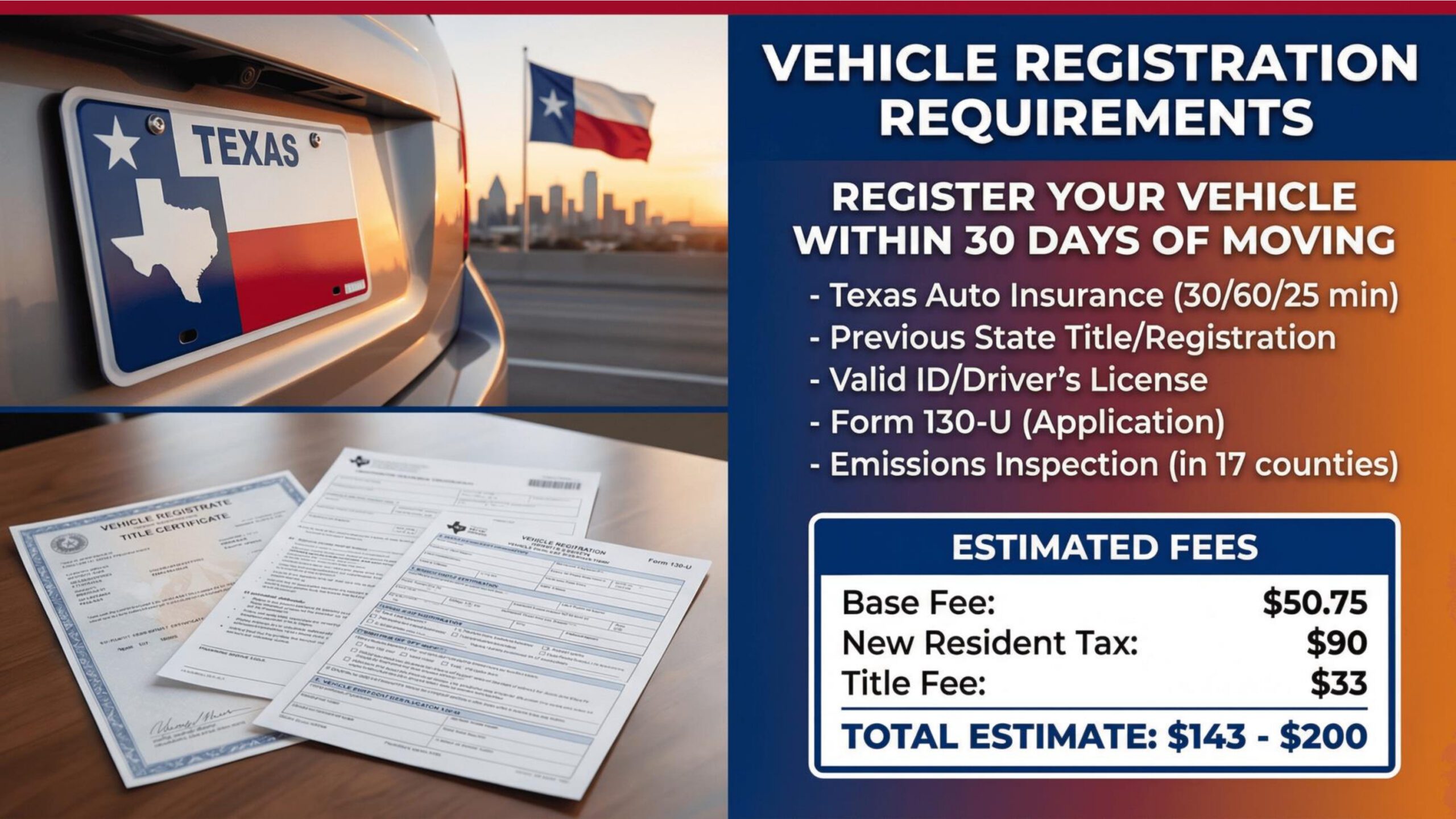
Texas law requires new residents to register their vehicles within 30 days of moving to the state. The Texas Department of Motor Vehicles (TxDMV) oversees vehicle registration, which is processed through your local county tax assessor-collector office.
What Do You Need to Register a Car in Texas?
| Required Item | Details | Where to Obtain |
|---|---|---|
| Proof of Insurance | Texas minimum coverage: 30/60/25 liability | Insurance provider |
| Vehicle Title or Registration | From your previous state | Bring original document |
| Proof of Identity | Valid driver’s license or government-issued ID | U.S. state, territory, or passport |
| Application Form 130-U | Application for Texas Title and/or Registration | County tax office or TxDMV website |
| Vehicle Inspection Report (if applicable) | Emissions inspection for certain counties | State inspection station |
| Payment for Fees | Registration fee + applicable taxes | Check, cash, or card accepted |
Texas Out-of-State Vehicle Registration:
Step 1: Obtain Texas Auto Insurance. Before registering your vehicle, you must have a Texas-compliant auto insurance policy. Minimum coverage requirements are $30,000 per person for bodily injury, $60,000 per accident for bodily injury, and $25,000 for property damage (commonly called 30/60/25 coverage).
Step 2: Get a Vehicle Inspection (If Required). As of January 1, 2025, non-commercial vehicles are no longer required to obtain a safety inspection prior to registration. However, if you live in one of the 17 designated emissions counties, you must obtain a passing emissions inspection:
Emissions counties include: Brazoria, Collin, Dallas, Denton, El Paso, Ellis, Fort Bend, Galveston, Harris, Johnson, Kaufman, Montgomery, Parker, Rockwall, Tarrant, Travis, and Williamson.
Step 3: Visit Your County Tax Assessor-Collector Office. Bring all required documents to your local county tax office. You are not required to title your vehicle in Texas, but first-time registrants must complete Form 130-U.
Step 4: Pay Registration Fees. Expect to pay the following fees:
| Fee Type | Amount | Notes |
|---|---|---|
| Base Registration Fee | $50.75 | Standard for most vehicles |
| TexasSure Fee | $1.00 | Electronic insurance verification |
| Local County Fees | $0-$31.50 | Varies by county |
| Inspection Replacement Fee (2025+) | $7.50 | Replaces safety inspection fee |
| New Resident Tax | $90 | One-time fee for new Texas residents |
| Title Application Fee | $33 | If titling vehicle in Texas |
| Emissions Inspection | $11.50-$18.50 | If in emissions county |
| Electric Vehicle Fee | $200/year | For fully electric vehicles only |
Step 5: Receive Your Texas License Plates. Upon completing registration, you’ll receive your Texas license plates and registration sticker. Display your registration sticker on your windshield as required by law.
What Are Texas Property Taxes Like?
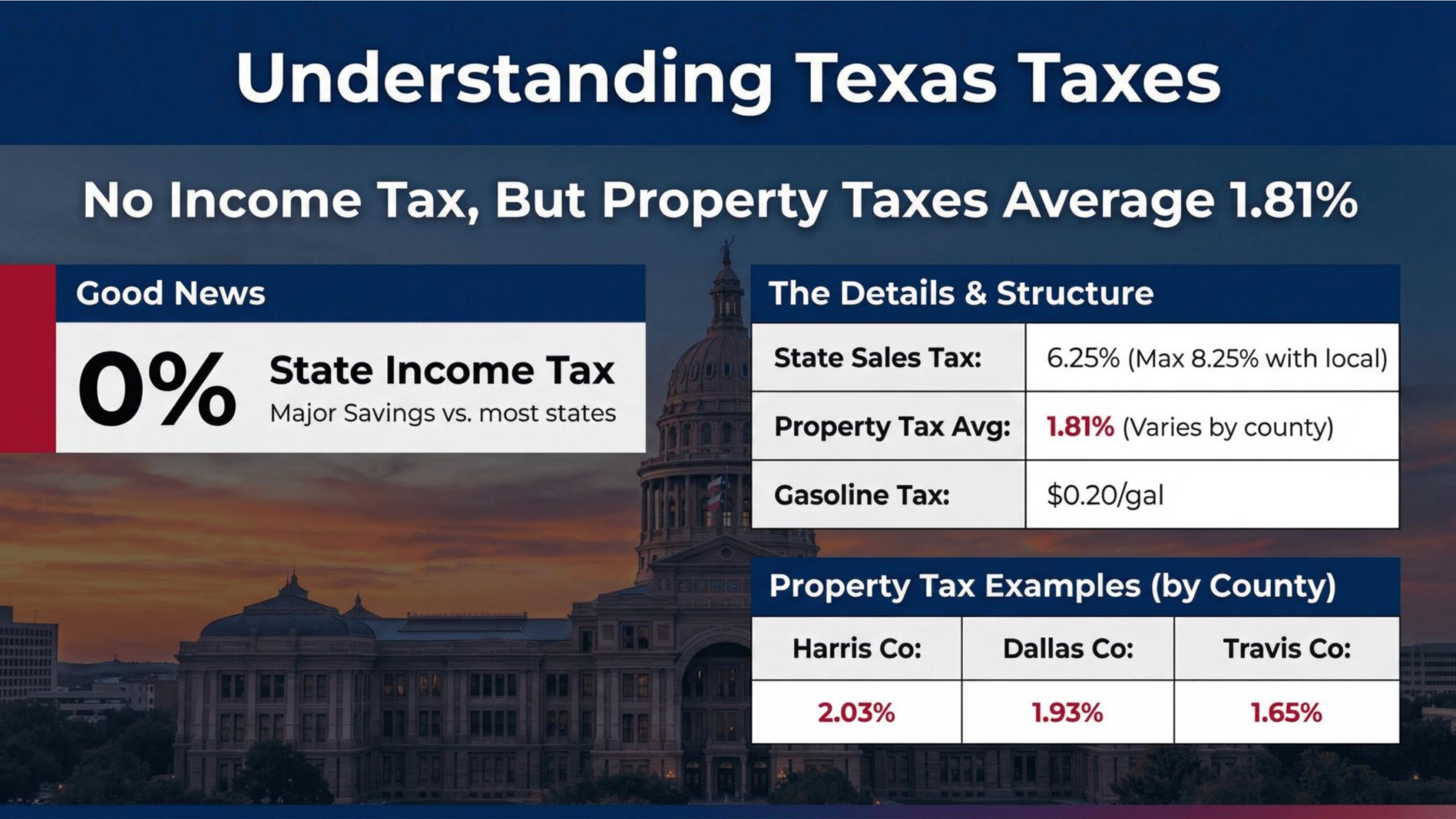
While Texas has no state income tax, property taxes are a significant expense that newcomers should understand. According to Tax-Rates.org, Texas has one of the higher property tax rates in the nation, averaging 1.81% of assessed property value—though rates vary dramatically by county.
| County | Median Property Tax | Effective Rate | Major City |
|---|---|---|---|
| Travis | $7,487 | 1.65% | Austin |
| Collin | $6,500 | 1.85% | Plano, McKinney |
| Dallas | $4,200 | 1.93% | Dallas |
| Harris | $4,850 | 2.03% | Houston |
| Tarrant | $4,100 | 1.98% | Fort Worth |
| Bexar | $3,200 | 1.88% | San Antonio |
| El Paso | $2,400 | 2.15% | El Paso |
| Terrell (lowest) | $285 | 0.67% | Rural West Texas |
Texas Tax Structure Overview
| Tax Type | Rate | Notes |
|---|---|---|
| State Income Tax | 0% | None—major savings vs. most states |
| State Sales Tax | 6.25% | Plus up to 2% local tax (8.25% max) |
| Property Tax (average) | 1.81% | Varies significantly by county |
| Vehicle Registration | $50.75 base | Annual renewal required |
| Gasoline Tax | $0.20/gallon | Below national average |
What Is the Texas Job Market Like?
Texas boasts one of America’s strongest and most diverse economies, consistently leading all states in job creation. According to the Texas Workforce Commission, the state reached record-high employment levels in 2025, with over 14.3 million nonfarm jobs and a civilian labor force exceeding 15.8 million workers.
| Employment Metric | Texas 2025 | National Average | Trend |
|---|---|---|---|
| Total Nonfarm Jobs | 14,347,700 | N/A | Record high |
| Annual Job Growth | 195,600+ | N/A | #1 in U.S. |
| Annual Growth Rate | 1.3-2.0% | 1.2% | Outpacing national |
| Unemployment Rate | 4.1% | 4.1% | At national average |
| Civilian Labor Force | 15,857,300 | N/A | Record high |
| Average Hourly Wage | $34.55 | $34.64 | Near national average |
Top Industries for Jobs in Texas
| Industry | Employment | Growth Rate | Major Employers/Hubs |
|---|---|---|---|
| Private Education & Health Services | Largest growth | +46,800 jobs | Texas Medical Center (Houston), UT System |
| Trade, Transportation & Utilities | 2nd largest | Strong | Port of Houston, DFW logistics |
| Professional & Business Services | 1,056,889 | +1.8% | Dallas, Austin tech corridors |
| Construction | Growing | +2.3% | Statewide development |
| Technology | Major hub | +65% (10-year projection) | Austin (Tesla, Apple, Oracle) |
| Energy (Oil & Gas) | Significant | Variable | Houston, Midland-Odessa |
| Aerospace & Defense | Growing | Steady | Fort Worth, Houston (NASA) |
| Financial Services | Growing | Strong | Dallas, Houston |
What Is the Weather Like in Texas?
Texas’s climate varies dramatically across its 268,596 square miles—the second-largest state by area. Understanding regional climate differences helps you choose the right location for your lifestyle.
| Region | Summer High | Winter Low | Annual Rainfall | Climate Type |
|---|---|---|---|---|
| Houston/Gulf Coast | 94°F | 42°F | 50+ inches | Humid subtropical |
| Dallas-Fort Worth | 96°F | 34°F | 37 inches | Humid subtropical |
| Austin/Central Texas | 97°F | 38°F | 34 inches | Humid subtropical |
| San Antonio | 95°F | 38°F | 32 inches | Humid subtropical |
| El Paso/West Texas | 95°F | 30°F | 9 inches | Desert/semi-arid |
| Amarillo/Panhandle | 91°F | 22°F | 20 inches | Semi-arid, cooler |
What Should I Know About Texas Healthcare?
Healthcare access and costs are important considerations when relocating. Texas ranks 51st out of all states for overall healthcare access and affordability according to Salary.com, though the state has world-renowned medical facilities and competitive healthcare markets.
| Healthcare Metric | Texas | Notes |
|---|---|---|
| Average Monthly Health Insurance Premium | $470-$610 | Varies by plan tier |
| Silver Plan (40-year-old) | ~$590/month | Typical consumer choice |
| Family Premium (3 people) | ~$1,500/month | Marketplace average |
| Employee-Sponsored (single) | $132/month | Average employee contribution |
Major healthcare hubs include the Texas Medical Center in Houston (the largest medical complex in the world), UT Southwestern Medical Center in Dallas, and MD Anderson Cancer Center. If you’re moving from out of state, you can access the federal healthcare marketplace to find coverage in your new area—just report your move to ensure qualification for special enrollment.
Moving to Texas Checklist
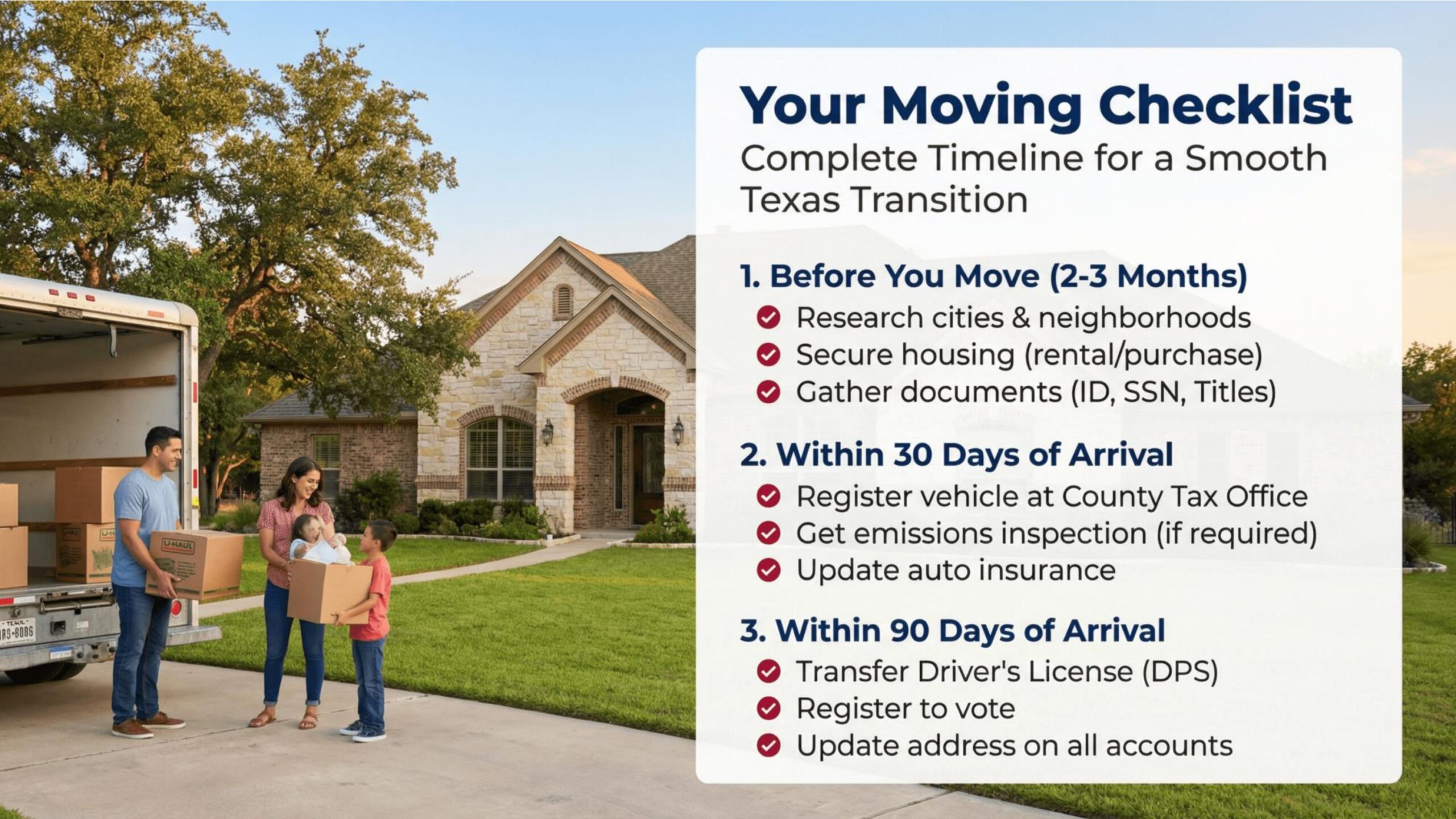
Use this comprehensive checklist to ensure a smooth transition to Texas:
Before You Move
| Task | Timeline | Notes |
|---|---|---|
| Research cities and neighborhoods | 2-3 months before | Consider commute, schools, cost of living |
| Secure housing (rental or purchase) | 1-2 months before | May need to visit in person |
| Obtain Texas auto insurance quotes | 2 weeks before | Must have Texas-compliant policy |
| Gather all important documents | 1 week before | Birth certificate, passport, SS card, titles |
| Forward mail with USPS | 1 week before | Effective on your move date |
Within 30 Days of Moving
| Task | Required By | Where to Go |
|---|---|---|
| Register vehicle in Texas | 30 days | County Tax Assessor-Collector |
| Get emissions inspection (if required) | Before registration | State inspection station |
| Obtain Texas license plates | 30 days | County Tax Assessor-Collector |
| Update auto insurance | Immediately | Your insurance provider |
Within 90 Days of Moving
| Task | Required By | Where to Go |
|---|---|---|
| Transfer driver’s license | 90 days | Texas DPS office (by appointment) |
| Register to vote | 30 days before election | County Voter Registrar or online |
| Update address with all accounts | As soon as possible | Banks, credit cards, subscriptions |
===IMAGE===Family unloading moving truck at new Texas home===
Frequently Asked Questions About Moving to Texas
How long do I have to transfer my driver’s license after moving to Texas?
You have 90 days from establishing residency to transfer your out-of-state driver’s license to Texas. During this period, your valid out-of-state license allows you to legally drive in Texas.
Do I need to take a driving test to get a Texas license?
No, if you’re 18 or older with a valid, unexpired driver’s license from another U.S. state or Canadian province, you are not required to take written or driving tests. You simply surrender your out-of-state license for a Texas license.
How long do I have to register my vehicle in Texas?
You must register your vehicle within 30 days of moving to Texas. Failure to register within this timeframe may result in penalties.
Do I need a vehicle inspection in Texas?
As of January 1, 2025, non-commercial vehicles are no longer required to obtain a safety inspection. However, if you live in one of the 17 designated emissions counties (including Dallas, Houston, Austin, and San Antonio areas), you must obtain a passing emissions inspection before registration.
How much does it cost to register a car in Texas from out of state?
Expect to pay approximately $143-$200 total, including the base registration fee ($50.75), TexasSure fee ($1), new resident tax ($90), title fee ($33 if titling), plus any local county fees and emissions inspection costs if applicable.
Is Texas really cheaper than California or New York?
Yes, significantly. Texas’s cost of living is approximately 7-8% below the national average, while California is 38% above and New York City is 120%+ above. Moving from San Francisco to Austin, for example, typically saves 30-50% on housing costs alone.
What’s the best city in Texas for families?
According to Niche and WalletHub, top family cities include Cinco Ranch, The Woodlands, and Flower Mound for excellent schools and safety. For affordability combined with quality schools, consider Pearland, Round Rock, or New Braunfels.
Does Texas have state income tax?
No, Texas is one of only nine states with no state income tax. This can result in significant savings, especially for higher earners. However, Texas does have relatively high property taxes (averaging 1.81%) to offset this.
What are the job prospects like in Texas?
Excellent. Texas leads all states in job creation, adding 284,200 jobs in 2024 alone. The unemployment rate hovers around 4.1%, at or slightly below the national average. Top industries include healthcare, technology, energy, construction, and professional services.
Where should I move if I work remotely?
Remote workers often choose Texas cities for their low cost of living and quality of life. Popular choices include Austin (tech culture, music scene), San Antonio (affordable, historic), New Braunfels (small-town charm near city), and El Paso (very affordable, mountain views).
Resources for New Texas Residents
These official resources will help you navigate your move to Texas:
For driver’s license transfers, the Texas Department of Public Safety provides comprehensive guidance and appointment scheduling. Vehicle registration information is available through the Texas Department of Motor Vehicles New to Texas page, which includes downloadable forms and county tax office locations.
Job seekers can access employment data and resources through the Texas Workforce Commission, which operates Workforce Solutions offices statewide. For housing market insights, the Texas Real Estate Research Center at Texas A&M provides authoritative market analysis.