Louisiana attracts people with its food, warm weather, and low cost of living. The state mixes French, Spanish, African, and Caribbean cultures. Moving here means dealing with hurricane season, high humidity, and a unique housing market. Here is what you need to know.

How Much Does It Cost to Live in Louisiana?
Louisiana is one of the most affordable states. Salary.com says living costs are 7% below the national average. A single person spends about $2,302 per month. A family of four spends about $5,068. Housing is 14-17% cheaper than the national average.
RentCafe provides specific breakdowns: housing is 17% below national average, utilities 18% lower, groceries about 4% cheaper, and healthcare 4% less. Transportation costs are similar to the national average. Gas prices are about $2.73 per gallon as of late 2025, which is below the national average As reported by ConsumerAffairs.
| Category | Louisiana | National Average | Difference |
|---|---|---|---|
| Overall Cost of Living | 93 index | 100 index | 7% lower |
| Monthly Cost (Single Person) | $2,302 | $2,475 | $173 savings |
| Monthly Cost (Family of 4) | $5,068 | $5,450 | $382 savings |
| Annual Spending Per Person | $48,425 | $55,000 | $6,575 savings |
| Housing Costs | -14% to -17% | Baseline | Significant savings |
| Utilities | -18% | Baseline | Lower bills |
| Groceries | -4% | Baseline | Modest savings |
| Healthcare | -4% | Baseline | Modest savings |
Cost of Living by Louisiana City
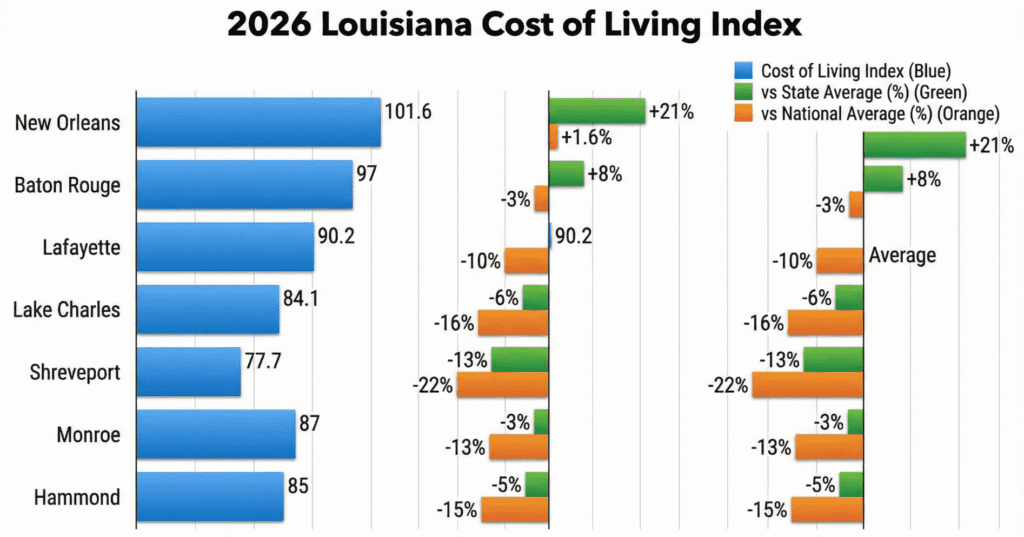
New Orleans costs the most within the state, running about 12-21% above the Louisiana average. Hammond offers the biggest savings at 15% below the national average. If budget is your primary concern, cities like Shreveport, Monroe, and Alexandria offer the lowest costs.
| City | Cost of Living Index | vs State Average | vs National Average |
|---|---|---|---|
| New Orleans | 101.6 | +21% higher | +1.6% higher |
| Baton Rouge | 97 | +8% higher | -3% lower |
| Lafayette | 90.2 | Average | -10% lower |
| Lake Charles | 84.1 | -6% lower | -16% lower |
| Shreveport | 77.7 | -13% lower | -22% lower |
| Monroe | 87 | -3% lower | -13% lower |
| Hammond | 85 | -5% lower | -15% lower |
What Is the Louisiana Housing Market Like?
Louisiana’s housing market offers real affordability compared to most states. Redfin says the median home price was $256,900 in October 2025, up 6.1% from last year. Homes usually stay on the market for 63 days. This is longer than in hot markets like Connecticut or Texas, which helps buyers.
The market favors buyers right now. Houzeo reports that only 12.7% of Louisiana homes sell above list price, with 27.7% experiencing price drops. The sale-to-list ratio is 97.1%, meaning most buyers pay below asking price. This gives you room to negotiate.
| Market Metric | Louisiana | What It Means |
|---|---|---|
| Median Home Price | $256,900 | Well below national $420K median |
| Year-over-Year Change | +6.1% | Steady appreciation |
| Median Days on Market | 63 days | Time to shop around |
| Homes Sold Above List | 12.7% | Most sell at/below asking |
| Sale-to-List Ratio | 97.1% | Buyers have leverage |
| Months of Supply | 4-5 months | Balanced market |
| Homes with Price Drops | 27.7% | Room to negotiate |
Home Prices by Louisiana Metro Area

| Metro Area | Median Home Price | YoY Change | Market Notes |
|---|---|---|---|
| New Orleans | $315,000-$350,000 | Varies by neighborhood | Highest in state, historic premium |
| Metairie | $320,000 | +10.3% | Strong suburban demand |
| Kenner | $299,000 | +34.2% | Fastest appreciation in state |
| Baton Rouge | $245,000 | +2.1% | Stable, university influence |
| Lafayette | $240,000 | +3% | Cajun Country hub |
| Lake Charles | $183,200 | -2.9% projected | Insurance costs affecting values |
| Shreveport | $183,200 | +2% | Most affordable large city |
| Monroe | $131,372 | +4% | Strong value, Meta data center coming |
| Alexandria | $117,388 | Stable | Lowest prices among major cities |
Renting in Louisiana
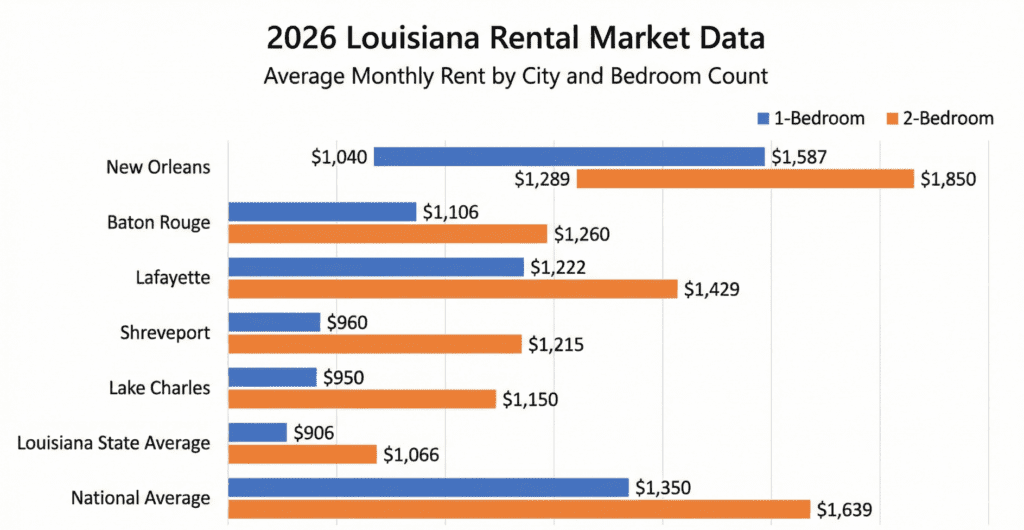
Louisiana rent prices are well below national averages. The statewide average is $1,063-$1,304 per month, compared to the national average of $1,639. Apartment List reports one-bedroom apartments average $906 statewide, with two-bedrooms around $1,066.
| City | 1-Bedroom Average | 2-Bedroom Average |
|---|---|---|
| New Orleans | $1,040-$1,587 | $1,289-$1,850 |
| Baton Rouge | $1,106 | $1,260 |
| Lafayette | $1,222 | $1,429 |
| Shreveport | $960 | $1,215 |
| Lake Charles | $950 | $1,150 |
| State Average | $906 | $1,066 |
| National Average | $1,350 | $1,639 |
What Are the Best Places to Live in Louisiana?
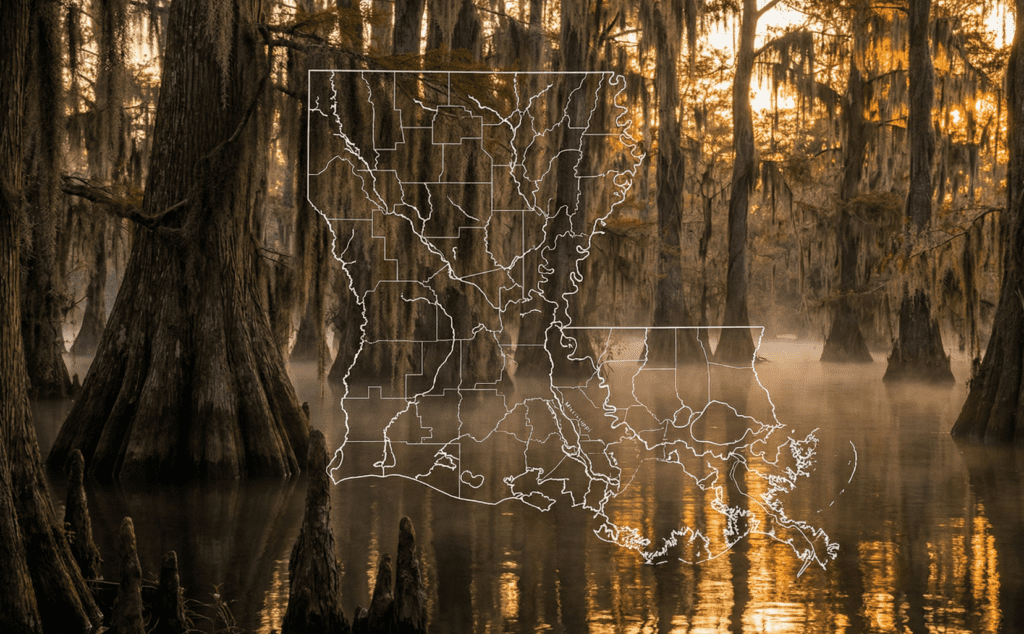
U.S. News & World Report ranks 13 Louisiana cities based on jobs, housing costs, quality of life, and healthcare therefore we gatthered the following facts for the cities below.
Best Cities for Families
The following cities below are recommended by Niche and DSLD Mortgage,, families choose suburbs with strong schools and low crime rates:
| City/Town | Why Families Choose It | Median Home Price | School Rating |
|---|---|---|---|
| Mandeville | Lakefront living, top schools, safe | $350,000 | A |
| Zachary | Best schools in state, north of Baton Rouge | $300,000 | A+ |
| Youngsville | Fastest-growing, near Lafayette, excellent schools | $285,000 | A |
| Covington | Northshore charm, good schools, near NOLA | $320,000 | A |
| Prairieville | Between BR and NOLA, suburban comfort | $275,000 | B+ |
| Broussard | Lafayette suburb, affordable new construction | $260,000 | B+ |
Best Cities for Young Professionals

| City | Major Industries | Median Rent (1BR) | Draw |
|---|---|---|---|
| New Orleans | Tourism, healthcare, film, ports | $1,040-$1,587 | Culture, nightlife, unique lifestyle |
| Baton Rouge | Government, education, petrochemical | $1,106 | LSU, stable employment |
| Lafayette | Energy, healthcare, tech startups | $1,222 | Cajun culture, affordability |
| Shreveport | Healthcare, logistics, gaming | $960 | Low cost, growing opportunities |
Best Cities for Retirees
| City | Why Retirees Like It | Cost of Living | Healthcare Access |
|---|---|---|---|
| Lake Charles | Waterfront, casinos, recreation | 16% below national | Good regional hospitals |
| Shreveport | Healthcare 3.9% cheaper, cultural amenities | 22% below national | Multiple hospital systems |
| Covington | Quiet, scenic, near New Orleans healthcare | 5% below national | Excellent, near Ochsner |
| Natchitoches | Historic charm, low cost, festivals | 15% below national | Limited, regional access |
What Is the Job Market Like in Louisiana?
Louisiana’s economy hit 2 million nonfarm jobs in 2025. This is only the second time in state history. Biz New Orleans reports this milestone. . The Louisiana Workforce Commission added that 53 straight months of job gains as of August 2025. Unemployment is at 4.4%, close to the national rate.
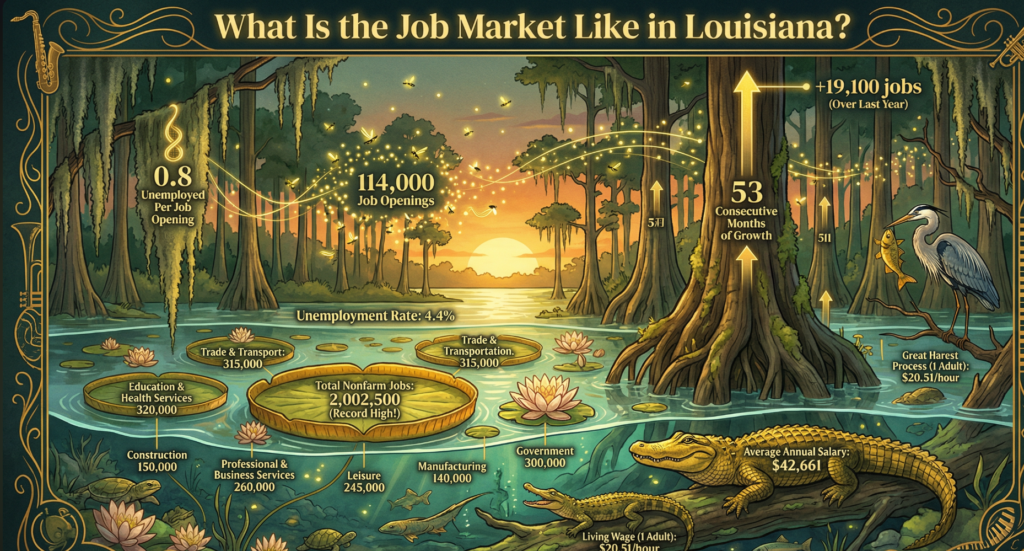
Healthcare and manufacturing lead job growth. Healthcare added nearly 16,000 jobs over the past year. Manufacturing now ranks in the top 20 nationally for growth. The Meta data center project in Richland Parish is a $10 billion investment announced in late 2024. It will create 5,000 construction jobs and 500+ permanent positions. Economists project an additional 1,000 indirect jobs.
| Employment Metric | Louisiana | Context |
|---|---|---|
| Total Nonfarm Jobs | 2,002,500 | Record high territory |
| Unemployment Rate | 4.4% | Near national average |
| Jobs Added (Year over Year) | +19,100 | 53 consecutive months of gains |
| Job Openings | 114,000 | 0.8 unemployed per opening |
| Living Wage (Single Adult) | $20.51/hour | About $42,661/year |
Louisiana Top Industries and Employers
| Industry | Jobs Added (2024-2025) | Major Employers | Primary Locations |
|---|---|---|---|
| Healthcare | +15,600 | Ochsner, LCMC Health, Willis-Knighton | New Orleans, Shreveport, Baton Rouge |
| Leisure & Hospitality | +8,200 | Hotels, restaurants, casinos | New Orleans, Lake Charles |
| Manufacturing | +3,600 | Petrochemical plants, aerospace | Baton Rouge corridor, Lake Charles |
| Trade & Transportation | +900/month | Port of South Louisiana, Amazon | New Orleans, statewide |
| Energy (Oil & Gas) | Variable | ExxonMobil, Chevron, Entergy | Lake Charles, offshore |
| Technology | Growing | Meta (coming), IBM, CGI | Monroe (data center), New Orleans |
| Government/Education | Stable | State agencies, LSU, universities | Baton Rouge, statewide |
Jobs by Metro Area
| Metro | Total Jobs | YoY Change | Key Sectors |
|---|---|---|---|
| New Orleans | 477,700 | +3,000 | Tourism, healthcare, ports, film |
| Baton Rouge | 431,100 | +700 | Government, petrochemical, education |
| Lafayette | 186,300 | +2,200 | Energy services, healthcare |
| Shreveport | 170,000 | +2,200 | Healthcare, logistics, gaming |
| Lake Charles | 104,400 | +800 | Petrochemical, gaming, shipping |
| Monroe | 92,000 | +600 | Healthcare, retail, data centers |
How Do I Transfer My Driver’s License to Louisiana?

New residents must transfer their out-of-state driver’s license within 30 days of establishing residency. According to Driving-Tests.org and the Louisiana Office of Motor Vehicles, you must visit an OMV office in person. This cannot be done online for first-time Louisiana residents.
If you have a valid license from another U.S. state, you do not need to take written or driving tests. You only need a vision test. Licenses from Germany and Switzerland also transfer without additional testing.
Required Documents for License Transfer
| Document Type | Acceptable Forms |
|---|---|
| Primary ID (1 required) | Certified birth certificate, valid U.S. passport, current military ID, or Louisiana ID card |
| Secondary ID (1 required) | Photo work ID, high school diploma, insurance card, or similar |
| Out-of-State License | Your current valid license or official driving record (can be faxed to OMV) |
| Proof of Residency (2 required) | Utility bill, lease, mortgage statement, bank statement with Louisiana address |
| Social Security Verification | Social Security card, W-2, paystub, or tax document showing SSN |
| Proof of Insurance | Current Louisiana auto insurance if you own a vehicle |
License Transfer Process
| Step | Action | Notes |
|---|---|---|
| 1 | Gather all required documents | Check OMV website for current requirements |
| 2 | Obtain Louisiana auto insurance | Minimum: $15,000/$30,000/$25,000 liability |
| 3 | Visit local OMV office in person | First-time LA residents cannot use public tag agents |
| 4 | Complete application and vision test | No written/driving test if you have valid U.S. license |
| 5 | Pay applicable fees | Fees vary by license type and duration |
| 6 | Receive temporary license | Permanent license arrives by mail |
ID Requirements
As of May 7, 2025, you need a REAL ID-compliant license to board domestic flights, access federal facilities, or enter military bases. Louisiana OMV offices can issue REAL ID credentials. You will need additional documentation, including proof of lawful status if you are not a U.S. citizen.
How Do I Register My Vehicle in Louisiana?
Based on eTags and the Louisiana OMV, you have 40 days from establishing residency to transfer your vehicle title and registration. Both the title transfer and registration can be handled together at an OMV office or through some public tag agents.
Required Documents for Vehicle Registration
| Document | Details |
|---|---|
| Out-of-State Title | Original title from previous state; if liened, copy of title or registration certificate |
| Vehicle Application (Form DPSMV 1799) | Complete Section F for out-of-state declaration |
| Proof of Louisiana Insurance | Minimum: $15,000 bodily injury/person, $30,000 bodily injury/accident, $25,000 property damage |
| Photo ID | Louisiana driver’s license or valid ID |
| Proof of Residency | Utility bill, lease, or similar document |

Vehicle Registration Fees
Louisiana uses a value-based fee structure for vehicle registration and Louisiana License Plate, the formula is 0.1% of the vehicle’s assessed value per year, with registrations issued for two-year periods.
| Fee Type | Amount | Notes |
|---|---|---|
| License Plate Fee | 0.1% of vehicle value × 2 years | Minimum $20 for 2 years |
| Title Fee | $68.50 | Includes handling fee |
| Handling Fee | $8.00 | Applies to transfers |
| Sales Tax | 5.0% (state) | Increased from 4.45% in Jan 2025; credit for taxes paid in other states |
| Local Sales Tax | Varies by parish | Combined rates average 10.12% |
| Inspection Fee | $18-$20 | Annual safety inspection required |
Vehicle Inspection Requirements
Louisiana requires annual safety inspections for all registered vehicles. Certain metropolitan areas also require emissions testing. You can get inspections done at licensed inspection stations throughout the state.
What Are Louisiana Taxes Like?

Louisiana overhauled its tax system in late 2024. Major changes took effect January 1, 2025. As stated by Tax Foundation and Bankrate, the state moved from a graduated income tax to a flat 3% rate. This joined the growing number of states with single-rate income taxes.
| Tax Type | Rate | Notes |
|---|---|---|
| State Income Tax (2025+) | Flat 3% | Changed from 1.85%-4.25% graduated brackets |
| State Sales Tax | 5% | Increased from 4.45% in Jan 2025; drops to 4.75% in 2030 |
| Combined Sales Tax (avg) | 10.12% | Highest combined rate in the nation |
| Property Tax Rate | 0.55% average | Among lowest in U.S. (#50) |
| Gas Tax | $0.20/gallon | Below national average |
| Corporate Franchise Tax | 0% (repealed) | Effective January 1, 2026 |
Tax Benefits for Louisiana Residents
Louisiana offers several tax advantages:
Social Security and federal retirement benefits face no state income tax. State retirement benefits also remain untaxed. Residents 65 and older can exclude up to $12,000 of annual retirement income from state taxes. The standard deduction nearly tripled to $12,500, providing relief for lower-income residents.
Property Taxes by Parish
Louisiana property taxes rank among the lowest in the nation. According to Tax-Rates.org, the state ranks 50th for property taxes as a percentage of median income.
| Parish | Average Property Tax | Effective Rate |
|---|---|---|
| St. Tammany (highest) | $1,335/year | 0.66% |
| Orleans (New Orleans) | $1,100/year | 0.52% |
| East Baton Rouge | $950/year | 0.48% |
| Lafayette | $650/year | 0.40% |
| St. Landry (lowest) | $202/year | 0.25% |
| State Average | $832/year | 0.55% |
What Is the Weather Like in Louisiana?

Louisiana has a subtropical climate with long, hot, humid summers and mild winters. Temperatures often go above 90°F from June to September. Humidity makes it feel even hotter. Winters rarely see freezing temperatures, though northern Louisiana occasionally gets light ice or snow.
| Season | Temperature Range | What to Expect |
|---|---|---|
| Summer (Jun-Sep) | 85-95°F (often 90%+ humidity) | Hot, sticky, afternoon thunderstorms |
| Fall (Oct-Nov) | 65-80°F | Most pleasant weather, lower humidity |
| Winter (Dec-Feb) | 45-65°F | Mild, occasional cold fronts, rare freezes |
| Spring (Mar-May) | 60-80°F | Pleasant but tornado/storm season begins |
Hurricane Season
Hurricane season is a serious consideration. It runs June through November, with peak activity in August and September. According to NOAA,, Louisiana experienced 106 billion-dollar weather disasters between 1980-2024, including 27 tropical cyclones.
Living in Louisiana means having an evacuation plan, maintaining emergency supplies, and carrying flood insurance if you are near the coast or low-lying areas. Major storms like Katrina (2005), Gustav (2008), and Ida (2021) show that preparation is essential.
What Are the Pros and Cons of Living in Louisiana?
Based on insights from Redfin, HOMEiA, and Apartment Guide, here’s an honest assessment:
| Pros | Cons |
|---|---|
| Low cost of living (7-13% below national) | Hurricane risk and flood insurance costs |
| Affordable housing ($257K median vs $420K national) | Hot, humid summers (90°F+ with 90%+ humidity) |
| Unique culture found nowhere else in America | Lower-ranked public schools in many areas |
| World-class food (Cajun, Creole, seafood) | Higher crime rates in some urban areas |
| No state tax on Social Security/retirement | Limited public transportation |
| Lowest property taxes in the nation | Highest combined sales tax in the nation (10.12%) |
| Friendly, welcoming communities | Mosquitoes and pest issues |
| Year-round warm weather | Economic volatility tied to energy sector |
| Festivals and celebrations year-round | Infrastructure challenges in some areas |
| Natural beauty (bayous, Gulf Coast) | Healthcare access limited in rural areas |
Moving to Louisiana Checklist

Before You Move
| Task | Timeline | Notes |
|---|---|---|
| Research neighborhoods and housing | 2-3 months before | Consider flood zones, school districts |
| Get quotes from Louisiana insurance companies | 1-2 months before | Auto, home, flood insurance |
| Research flood zones for prospective homes | Before buying/renting | Flood insurance may be required |
| Notify current state of move | Before departing | Cancel voter registration, update addresses |
| Gather identification documents | Before move | Birth certificate, passport, SS card |
Within 30 Days of Arrival
| Task | Where | Documents Needed |
|---|---|---|
| Obtain Louisiana auto insurance | Insurance provider | Vehicle info, driving history |
| Transfer driver’s license | OMV office in person | See license requirements above |
| Register vehicle | OMV or tag agent | Title, insurance, ID |
| Get vehicle inspected | Licensed inspection station | Current registration |
Within 90 Days
| Task | Where | Notes |
|---|---|---|
| Register to vote | Secretary of State or online | Louisiana driver’s license required |
| Update address with federal agencies | IRS, Social Security, etc. | Important for tax purposes |
| Establish Louisiana residency for tax purposes | Various | Keep records of residency establishment |
Frequently Asked Questions About Moving to Louisiana
How long do I have to transfer my driver’s license to Louisiana?
You have 30 days from establishing residency to transfer your out-of-state license. You must visit an OMV office in person for this—first-time Louisiana residents cannot use public tag agents.
Do I need to take a driving test to get a Louisiana license?
No, if you have a valid license from another U.S. state or from Germany or Switzerland. You’ll only need to pass a vision test. If your out-of-state license is expired, you may need to take written and driving tests.
How long do I have to register my vehicle in Louisiana?
You have 40 days from establishing residency to transfer your title and register your vehicle.
Is Louisiana cheaper than other states?
Yes, significantly. Louisiana’s cost of living runs 7-13% below national average depending on location. Housing is 14-17% cheaper than national average, and property taxes are the lowest in the nation.
What is the best city to live in Louisiana?
It depends on your priorities. Families often choose Mandeville, Zachary, or Youngsville for schools and safety. Young professionals gravitate toward New Orleans or Baton Rouge for jobs and culture. Retirees favor Lake Charles or Covington for affordability and healthcare access.
Does Louisiana have state income tax?
Yes, but it’s a flat 3% as of 2025—one of the lowest rates in the country. Social Security and federal retirement benefits are exempt from state income tax.
How bad is hurricane season in Louisiana?
It’s a real consideration. Hurricane season runs June through November. Major storms can cause significant damage, and flood insurance is essential for many properties. However, most years pass without a direct major hurricane hit, and residents learn to prepare and adapt.
What’s the job market like in Louisiana?
Louisiana has seen 53 consecutive months of job growth, with over 2 million nonfarm jobs as of 2025. Healthcare, manufacturing, and hospitality lead growth. The Meta data center project will add thousands of jobs in the coming years. Unemployment sits around 4.4%, roughly matching national levels.
Is Louisiana good for families?
Louisiana offers affordable housing and low property taxes that help families stretch their budgets. However, public school quality varies significantly—top-rated districts like Zachary and St. Tammany Parish attract families, while other areas struggle. Research school districts carefully before choosing where to live.
What’s the worst thing about living in Louisiana?
Most residents point to the combination of summer heat/humidity and hurricane risk. The heat from June through September can be oppressive, with temperatures in the 90s and humidity above 90%. Hurricane season requires preparation, and flood insurance costs can be substantial in many areas.