
If you’re considering homeschooling, Illinois makes it straightforward to begin. Understand the law, choose your approach, and start teaching. The state’s homeschool community offers abundant support to help you along the way.
Illinois ranks among the most homeschool-friendly states in the country. When you choose to teach your children at home, you’ll face few regulations and enjoy wide latitude in picking your curriculum, setting your schedule, and determining graduation requirements. The state treats your homeschool as a private school under the law, which means you operate with minimal government oversight.
About 59,000 students are homeschooled in Illinois each year. The legal framework dates back to a 1950 Illinois Supreme Court decision that established your right as a parent to educate your children at home. This guide covers everything you need to know about starting and maintaining a legal homeschool in Illinois.
Table of Contents
- What Is the Legal Basis for Homeschooling in Illinois?
- Who Can Homeschool in Illinois?
- What Subjects Must You Teach?
- Do You Need to Notify the State?
- How to Withdraw Your Child from Public School
- Record-Keeping Requirements
- Testing and Assessment Requirements
- Graduation, Diplomas, and Transcripts
- Public School Access for Homeschoolers
- Special Education Services
- Work Permits for Homeschooled Minors
- What Happens If Officials Question Your Homeschool?
- How to Start Homeschooling in Illinois
What Is the Legal Basis for Homeschooling in Illinois?
When you homeschool in Illinois, you operate under Section 26-1 of the Illinois School Code, which governs compulsory attendance. The law exempts your children from public school attendance if they attend a private or parochial school where they receive instruction in the branches of education taught in public schools and where that instruction is delivered in English.
The key legal precedent comes from People v. Levisen (1950). In this case, the Illinois Supreme Court ruled that a homeschool qualifies as a private school under state law. The court defined a private school as “a place where instruction is imparted to the young” and clarified that the number of students doesn’t determine whether a place is a school. Your home with one student being taught by you meets this definition.
The court also stated that compulsory education laws exist to ensure all children receive an education, not to mandate any particular manner or place of instruction. This ruling established your right as a parent to educate your children at home as long as you meet the same basic requirements as other private schools.
A 1974 federal court case, Scoma v. Chicago Board of Education, reaffirmed the Levisen decision. The court ruled that Illinois homeschool law was “reasonable and constitutional” and emphasized that you as a parent bear the burden of proof to show your home instruction meets state requirements if questions arise.
Who Can Homeschool in Illinois?
Compulsory Attendance Ages
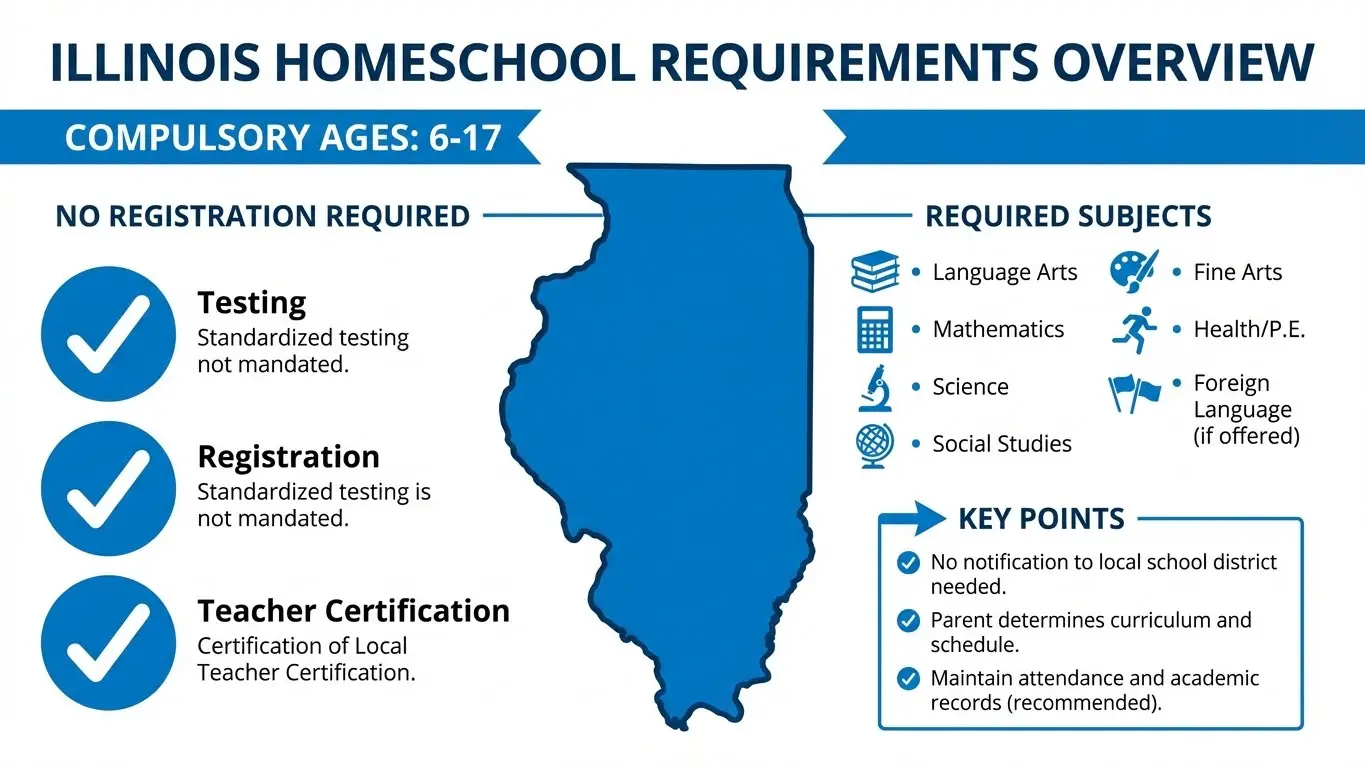
Illinois compulsory attendance law applies to children between ages 6 and 17. If your child turns 6 on or before September 1st of any given year, you must begin providing education that complies with state law for that school year. Once your child turns 17 or graduates from your homeschool program, the compulsory attendance law no longer applies to you.
Children younger than 6 are not subject to compulsory attendance. You can begin teaching them at home if you choose, but you have no legal obligation to do so. Similarly, if your students complete their homeschool high school program before age 17, they’re considered to have satisfied the attendance requirement.
Parent Qualifications
Illinois does not require you as a homeschool parent to hold any specific degree, certification, or teaching credential. The Illinois State Board of Education (ISBE) confirms that only public school teachers must be certified under Section 21-1 of the School Code. Since your homeschool operates as a private school, you’re not held to the same certification standards.
The Levisen decision requires that you as the teacher be “competent” and that your student receive an education “at least equivalent to public schooling.” These standards are general. No state agency evaluates or certifies your competency before you begin homeschooling.
What Subjects Must You Teach?
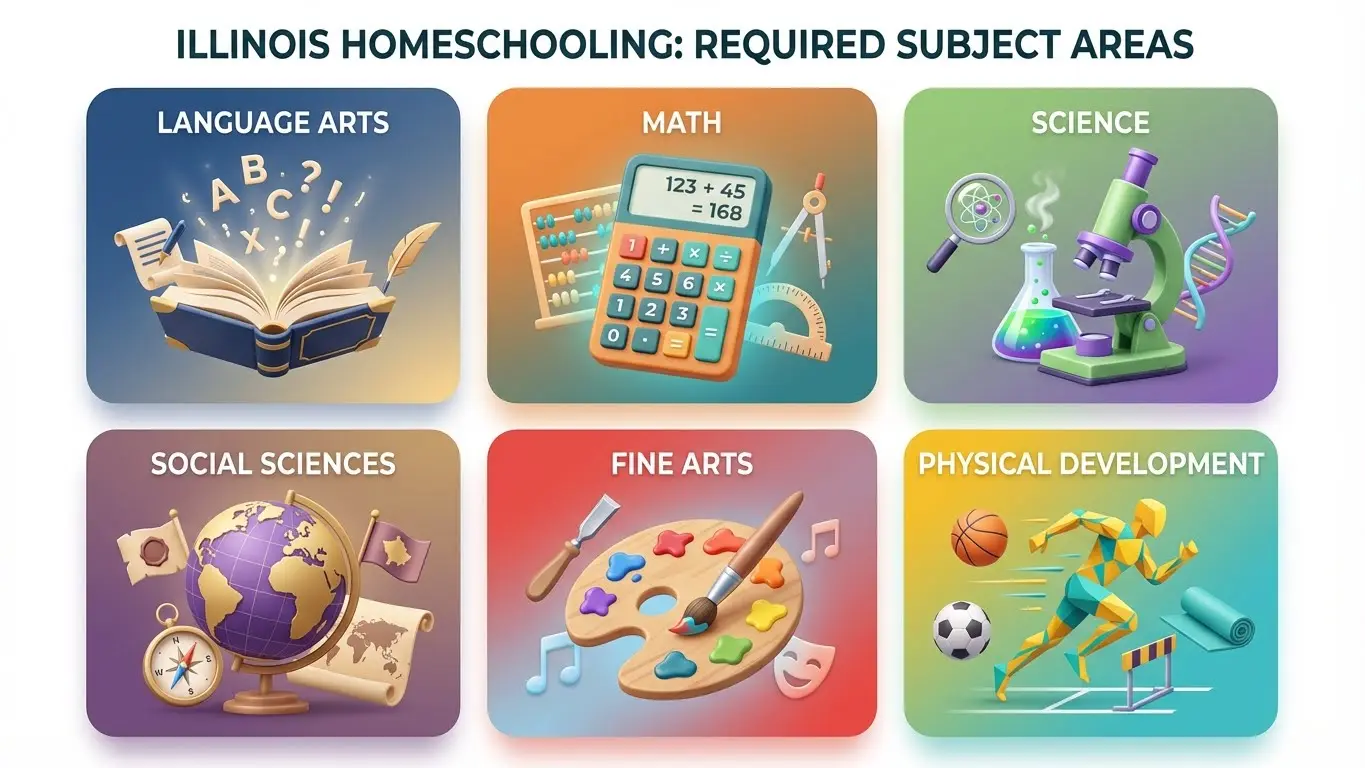
Illinois law requires your homeschool to teach “the branches of education taught to children of corresponding age and grade in the public schools.” According to ISBE guidance, these branches include:
- Language Arts: Reading, writing, grammar, literature, and communication skills
- Mathematics: Arithmetic, algebra, geometry, and other math concepts appropriate to grade level
- Biological and Physical Sciences: Biology, chemistry, physics, and other science topics
- Social Sciences: History, geography, government, civics, and economics
- Fine Arts: Music, visual arts, and other creative disciplines
- Physical Development and Health: Physical education, health, and wellness
All instruction must be delivered in English. If your students use American Sign Language (ASL) as their primary mode of communication, they’re considered to be taught in English under state guidelines. You may teach additional languages, but core instruction in the required subjects must be conducted in English.
There are no specific classes mandated within each subject area. You get to decide whether to teach algebra, geometry, or other specific courses. You also determine the sequence, depth, and materials used for each subject. The Illinois State Board of Education doesn’t provide curriculum recommendations or assist with planning your home instruction.
Do You Need to Notify the State?
Illinois does not require you to register your homeschool or file any notice of intent with the state or local school district. If your child has never been enrolled in an Illinois public school, you can simply begin homeschooling without contacting anyone.
The state does offer a voluntary registration form through ISBE. You’re encouraged but not required to complete it. Filling out this form doesn’t grant any special status or approval. It simply provides documentation that you’re aware of your obligations under state law.
Some Regional Offices of Education also have voluntary forms available. Chicago Public Schools maintains a voluntary form for city residents. None of these forms are mandatory.
The Illinois Homeschool Association (ILHSA) advises against completing registration forms. They argue that registration creates unnecessary paperwork and may invite future regulatory scrutiny. The choice is yours, but understand that no law requires you to register.
How to Withdraw Your Child from Public School
If your child is currently enrolled in an Illinois public school, ISBE strongly recommends notifying the school in writing before you begin homeschooling. This step isn’t legally required, but it prevents the school from marking your child as absent or referring your family to a truant officer.
Your withdrawal letter should include:
- The date you’re withdrawing your child
- A statement that you intend to provide home instruction
- Your child’s name and grade level
You don’t need to explain your curriculum, provide a lesson plan, or seek approval from any school official. Keep a copy of your dated letter for your records. Some schools have their own withdrawal forms. Signing the school’s form is acceptable as long as you retain documentation of the withdrawal.
ISBE also suggests sending a copy of your withdrawal letter to your Regional Office of Education (ROE). This is optional but can provide an additional layer of documentation if questions arise later.
Record-Keeping Requirements
Illinois doesn’t require you as a homeschool parent to maintain specific records or submit any documentation to the state. There are no mandated formats for attendance logs, grade reports, or portfolios.
That said, keeping good records serves your family’s interests. Documentation becomes important if you:
- Re-enroll your child in public school
- Apply to colleges or universities
- Need to prove compliance if a truant officer ever questions your homeschool
- Seek employment or military enlistment for your child
Records you should consider keeping include:
- Attendance logs or calendars showing instructional days
- Lists of curriculum materials and textbooks you use
- Samples of student work such as writing assignments, tests, and projects
- Any standardized test scores if you choose to administer tests
- Copies of withdrawal letters and other correspondence with officials
For high school students, maintain detailed records of courses completed, grades earned, and any credits accumulated. These records form the basis of your homeschool transcript, which colleges and employers may request.
Testing and Assessment Requirements
Illinois doesn’t require your homeschooled students to take any standardized tests or submit to evaluations by state officials. You’re free to assess student progress through whatever methods you choose.
Some families opt to administer standardized tests such as the Iowa Assessments, Stanford Achievement Test, or CAT/5 to benchmark their children’s academic progress. These tests are entirely optional. You don’t need to submit results to any school or government agency.
High school students planning to attend college often take the SAT or ACT. You can register for these exams through College Board for the SAT and the ACT website. As a homeschooled student, you can register as a homeschool student and take the tests at local testing centers.
Your homeschooled students may not participate in the Illinois Assessment of Readiness (IAR) or other state accountability tests used in public schools. These tests are only available to enrolled public school students.
Graduation, Diplomas, and Transcripts
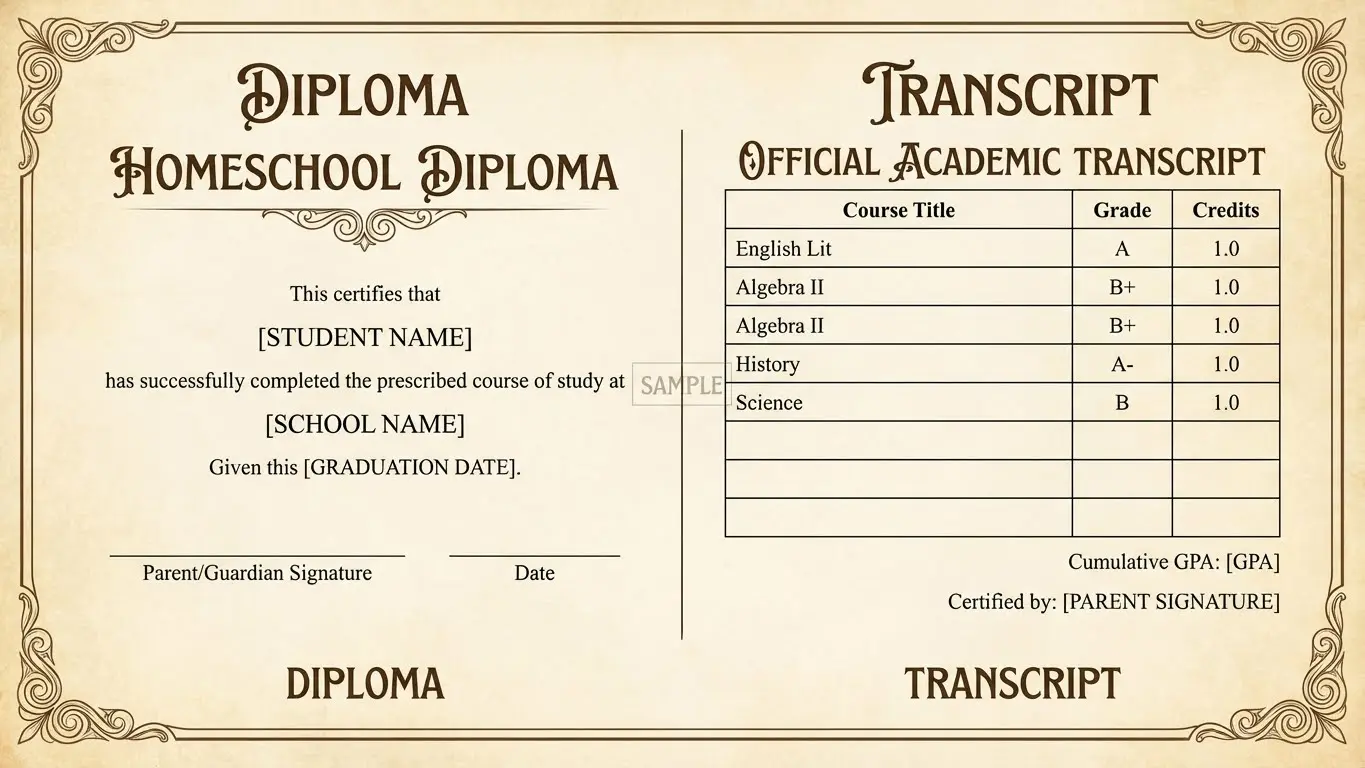
Illinois homeschools function as private schools, and each private school sets its own graduation requirements. As the administrator of your homeschool, you determine when your child has completed high school and is ready to graduate.
The state doesn’t issue high school diplomas to homeschooled students. You issue your own diplomas. A parent-signed diploma is considered valid documentation of high school completion under Illinois law. The Illinois Department of Human Services confirms that a diploma signed by you as a parent authorized to conduct homeschooling satisfies high school diploma requirements.
You also create your own transcripts. Your homeschool transcript should include:
- Student name and date of birth
- Name of the homeschool (your private school name)
- Dates of attendance
- Courses completed with grades and credit hours
- Cumulative GPA
- Graduation date
- Your signature and date
For reference, Illinois public schools require students to complete specific courses including English, math, science, social studies, and other subjects for graduation. These requirements don’t legally bind you as a homeschooler, but aligning your program with public school expectations can help with college admissions.
Colleges and universities routinely accept homeschool applicants. Many institutions have specific admissions procedures for homeschooled students and may request additional documentation such as course descriptions, reading lists, or standardized test scores.
Public School Access for Homeschoolers
Part-Time Enrollment
Illinois law allows your homeschooled students to enroll part-time in their local public school. Under 105 ILCS 5/10-20.24, students may attend individual classes if certain conditions are met:
- You must make the request by May 1st of the previous school year
- Your child must live within the attendance zone of the school
- Space must be available in the requested class
Part-time enrollment gives your homeschooled students access to courses like chemistry lab, foreign languages, or band that may be difficult to replicate at home. If a course has an extracurricular component, such as band practice after school, your part-time student may participate in that activity.
Driver’s Education
Illinois school law requires public high schools to provide driver’s education to eligible homeschooled students who live in the district. Under Sections 27-24.2 of the School Code, your homeschooled students may enroll in both the classroom and behind-the-wheel portions of driver’s education.
To be eligible, your students must meet the same age and health requirements as public school students. The public school requirement that students pass eight courses in the previous two semesters doesn’t apply to your homeschool. You can provide a letter waiving this requirement.
Extracurricular Activities and Sports
Public schools generally have no obligation to open extracurricular activities to your homeschooled students. The exception is for part-time enrolled students taking a course with an extracurricular component.
Interscholastic sports present additional barriers. The Illinois High School Association (IHSA) requires student-athletes to be enrolled in and attend the member high school where they compete. If your homeschooled student wants IHSA eligibility, they must:
- Enroll at the member high school
- Take and pass at least one course each semester
- Earn a minimum of 2.5 credits per semester
- Pay applicable tuition and fees
- Comply with all IHSA eligibility requirements
These requirements make participation difficult for many homeschool families. You might consider homeschool sports leagues or club sports instead.
Special Education Services
Illinois law permits your homeschooled students with disabilities to enroll part-time in their local public school and receive special education services. Under 105 ILCS 5/14-6.01, children with disabilities ages 3 through 21 have a right to part-time enrollment in their district of residence.
To qualify for an Individualized Education Program (IEP), your homeschooled students must attend public school for at least one instructional subject. Students who meet this requirement can receive IEP services to the extent they are present in the public school setting. These services may not be as comprehensive as those available to full-time public school students.
Alternatively, public schools must set aside a portion of their federal special education funding (“proportionate share”) for students in private schools, including your homeschool. Districts provide an Individual Services Plan (ISP) rather than an IEP for these students. The ISP outlines the types of services, frequency, and location of services to be provided.
You should understand that withdrawing from public school to homeschool may reduce access to special education services. Contact your local district to learn what services are available for your homeschooled students with disabilities.
Work Permits for Homeschooled Minors
Illinois requires work permits (employment certificates) for all workers under age 16 before they begin employment. The Illinois Department of Labor oversees child labor regulations and the work permit process.
Public school students obtain work permits through their school district. Your homeschooled students must apply through their Regional Office of Education (ROE). The process requires:
- Letter of intent to employ from the prospective employer
- Proof of age (birth certificate)
- Social Security card
- Medical statement from a physician confirming physical fitness for work
- Your signature and consent as parent
For your homeschooled students, the principal’s statement typically required from public schools is waived or handled differently. Contact your local ROE to confirm their specific procedures for homeschool families.
Work permits are valid for one year and are specific to the employer listed on the permit. If your minor changes jobs, they need a new work permit.
Workers ages 16 and 17 don’t need state-issued work permits in Illinois, though they are still subject to federal child labor regulations administered by the U.S. Department of Labor.
What Happens If Officials Question Your Homeschool?
If a truant officer or Regional Superintendent contacts you about your homeschool, you may be asked to demonstrate compliance with Illinois law. The Illinois Homeschool Association recommends responding with a written “letter of compliance” that states you’re teaching the required branches of education in English.
Your letter doesn’t need to include specific curriculum details, schedules, or student records. A simple statement confirming you’re providing the required instruction is sufficient. The burden of proof rests with you to show compliance, but you’re not required to submit lesson plans or invite officials into your home.
Regional superintendents have authority to investigate reports of noncompliance with compulsory attendance laws. If there’s evidence that a homeschool doesn’t meet state requirements, the regional superintendent may refer the matter to a truant officer. Truant officers can investigate and, if warranted, refer cases of noncompliance to the county state’s attorney.
A parent who allows a child to be truant by operating a homeschool that doesn’t comply with Section 26-1 may be charged with a Class C misdemeanor. Actual prosecutions are rare when parents demonstrate good faith efforts to educate their children.
How to Start Homeschooling in Illinois
Starting a homeschool in Illinois requires minimal paperwork. Here are the steps you should follow:
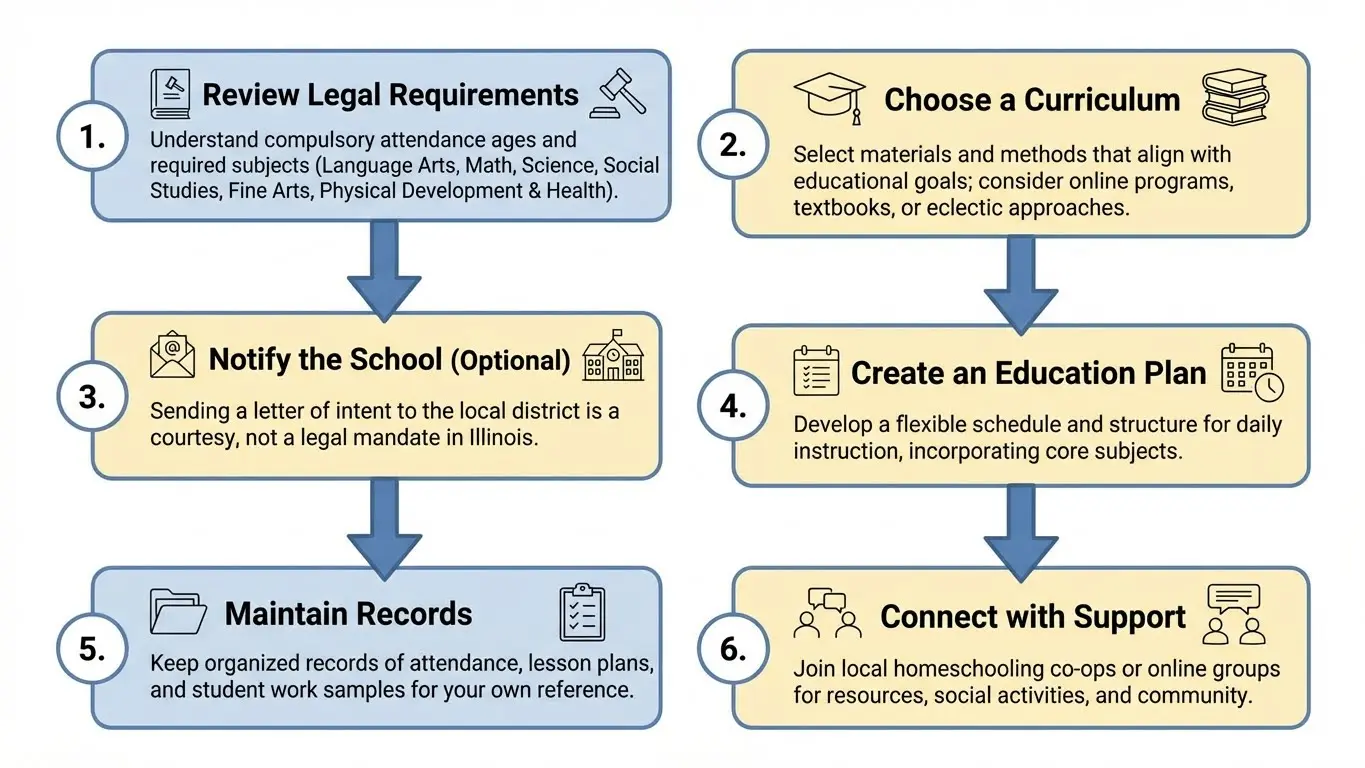
Step 1: Understand the Law
Familiarize yourself with Section 26-1 of the Illinois School Code and the six required subject areas. Read the ISBE homeschooling guide for official state guidance.
Step 2: Withdraw from Public School (If Applicable)
If your child is enrolled in public school, submit a written withdrawal letter to the school. Keep a copy for your records. You don’t need approval to withdraw.
Step 3: Choose Your Curriculum
Select curriculum materials that cover the required branches of education. Illinois doesn’t mandate any particular curriculum, teaching method, or schedule. Choose what works best for your family and your child’s learning style.
Step 4: Begin Teaching
Start providing instruction. There are no required hours per day or days per year. Your homeschooling naturally incorporates a wide variety of learning experiences including field trips, hands-on projects, and community activities.
Step 5: Keep Records
Maintain attendance logs, curriculum records, and student work samples. These records protect you if questions arise and support college applications down the road.
Step 6: Connect with the Homeschool Community
Consider joining local homeschool groups or co-ops for support, socialization, and shared learning opportunities. Organizations like the Illinois Christian Home Educators (ICHE) and Illinois Homeschool Association (ILHSA) offer resources and advocacy for homeschool families like yours.
Comparing Illinois to Neighboring States
Illinois stands out as one of the least regulated homeschool states in the Midwest. Here’s how it compares to neighboring states:
| State | Notification Required | Testing Required | Teacher Qualifications |
|---|---|---|---|
| Illinois | No | No | None |
| Indiana | No | No | None |
| Wisconsin | Yes (annual) | No | None |
| Iowa | Yes (varies by option) | Yes (for some options) | Varies by option |
| Missouri | No | No | None |
| Kentucky | Yes (annual) | No | None |
Source: Home School Legal Defense Association state law summaries
Illinois and Indiana share the distinction of having essentially no notification, testing, or teacher qualification requirements. Wisconsin and Kentucky require annual notification. Iowa has multiple homeschool options with varying levels of oversight, including some that require testing.
More Resources for Illinois Homeschool Families
Several organizations provide support, legal information, and community connections for Illinois homeschoolers like you:
Illinois State Board of Education: The ISBE homeschooling page offers official guidance, the voluntary registration form, and links to resources.
Illinois Homeschool Association (ILHSA): ILHSA provides legal information, lobbying efforts, and guidance on homeschool rights in Illinois.
Illinois Christian Home Educators (ICHE): ICHE hosts annual conventions, offers resources, and supports Christian homeschool families across the state.
Home School Legal Defense Association (HSLDA): HSLDA’s Illinois page summarizes state laws and provides legal support for member families.
Local homeschool co-ops and support groups exist throughout Illinois in cities like Chicago, Springfield, Peoria, Rockford, and Champaign. These groups organize field trips, classes, sports teams, and social events. You can search online or ask at local libraries and churches to find groups in your area.
Final Thoughts
Illinois offers you one of the most permissive legal environments for homeschooling in the United States. You’re trusted to educate your children without state registration, mandatory testing, or teacher certification requirements. The only substantive requirement is that you teach the same general subjects taught in public schools and do so in English.
This freedom comes with responsibility. You determine the curriculum, set the schedule, evaluate progress, and decide when your child has completed high school. Keeping good records protects your family and opens doors for college, employment, and other opportunities.