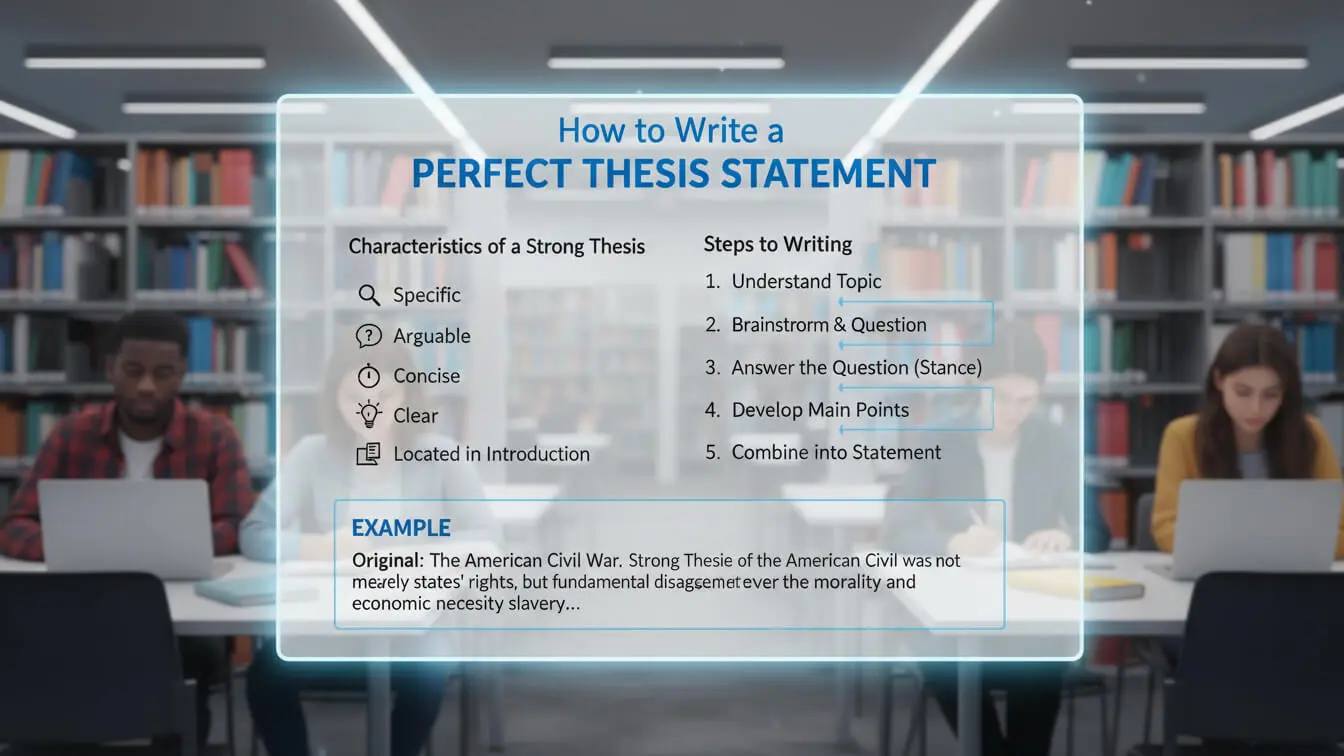
A thesis statement is one sentence that tells readers what your entire essay is about.This statement usually sits at the end of your introduction paragraph and guides everything that follows. Every essay needs a clear thesis statement because it keeps you focused while writing and helps readers know what to expect. Without one, your paper becomes a mess of random ideas that don’t connect. Research from the University of North Carolina shows that papers with strong thesis statements score significantly higher than those without clear direction.
Your thesis statement should do three things: state your main argument, be specific enough to prove, and give readers a reason to care. For example, “Social media is bad” is too vague. But “Social media harms teen mental health by increasing anxiety, disrupting sleep patterns, and promoting unrealistic body standards” gives readers three specific points you’ll prove.

The thesis statement acts as your essay’s backbone. Every paragraph you write should connect back to proving this main point. If a paragraph doesn’t support your thesis, it doesn’t belong in your essay. That’s how you keep your writing tight and focused.
Most teachers place thesis statements at the introduction’s end because that’s where readers expect to find your main argument. Purdue University’s writing lab confirms this placement works best for academic papers at every level.
Why Your Essay Needs a Thesis Statement
A thesis statement stops your essay from wandering all over the place. It’s the difference between writing with purpose and just dumping information on a page. When you have a clear thesis, you know exactly what evidence matters and what’s just filler.
Think of your thesis as a contract with your reader. You’re promising to prove something specific, and they’re agreeing to keep reading to see how you’ll do it. Break that promise by going off-topic, and you’ll lose your audience fast.
Strong thesis statements also make writing easier. You don’t have to wonder what to include in each paragraph—you just ask yourself if it supports your main argument. This saves hours of frustrated writing and deleting.
Teachers can immediately spot papers without thesis statements. These essays ramble, repeat themselves, and never quite make a point. A study by Research.com found that 78% of weak student essays lacked a clear thesis statement.
Direction for Your Research
Your thesis tells you what research matters. If you’re arguing that “electric cars reduce carbon emissions more effectively than hybrid vehicles,” you know to find data comparing emissions between the two. You won’t waste time researching the history of car manufacturing or gas prices.
This focused approach means faster research and stronger evidence. You’re not collecting random facts—you’re building a case for your specific argument.
Reader Expectations
Readers want to know where you’re taking them. A thesis statement answers their unspoken question: “What’s your point?” Give them that answer upfront, and they’ll follow your argument through the entire essay.
Without a thesis, readers feel lost. They’ll finish your essay wondering what you actually wanted to say. That’s a failed paper, no matter how good your individual paragraphs are.
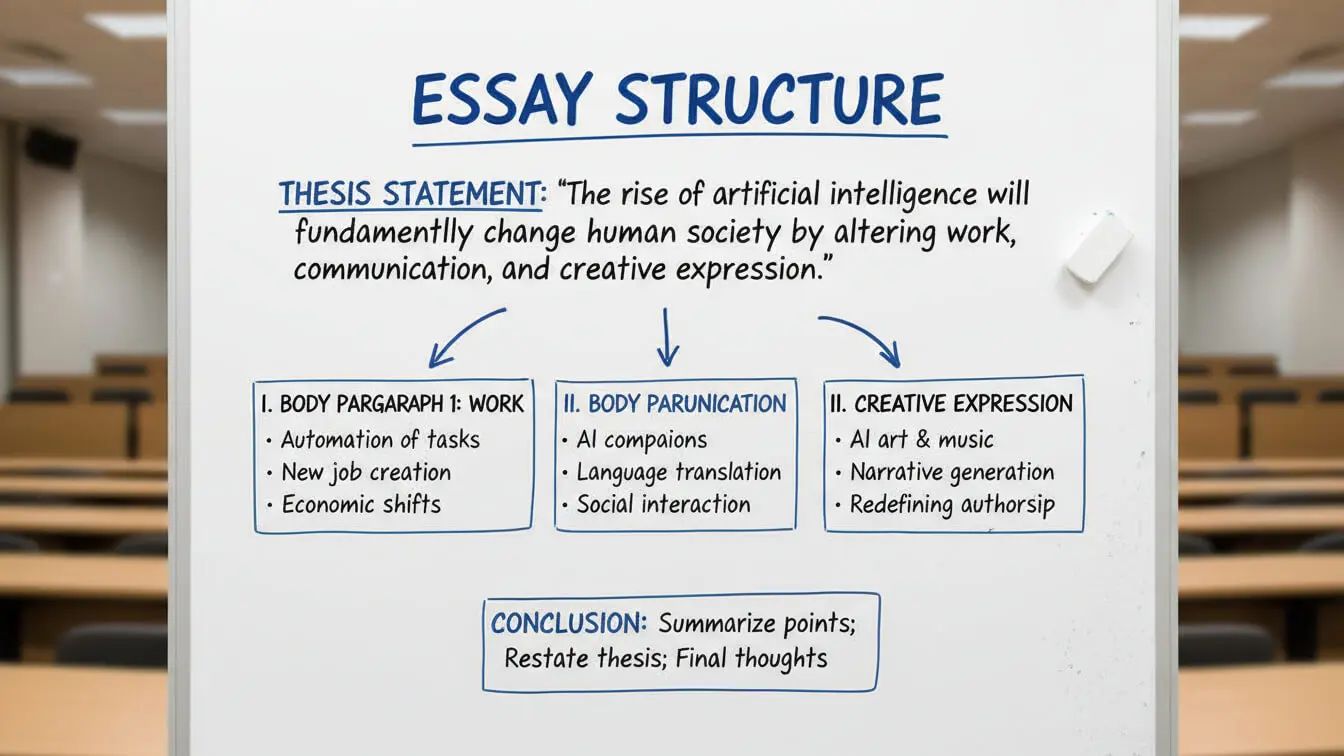
5 Traits of Strong Thesis Statements
Not all thesis statements work the same. Weak ones kill your essay before it starts. Strong ones set you up for success. Here’s what separates the two.
1. Takes a Clear Position
Your thesis must pick a side or make a specific claim. “Climate change is a topic many people discuss” says nothing. “Governments should tax carbon emissions to slow climate change” takes a stand that others might challenge.
Avoid mushy statements that try to please everyone. Academic writing experts say the best thesis statements create room for disagreement—that’s what makes them worth writing about.
Test your thesis by asking: Could a reasonable person disagree with this? If everyone would automatically agree, you don’t have a strong argument yet.
2. Stays Specific and Focused
Broad thesis statements promise more than you can deliver. “Technology affects society” could fill 50 books. “Smartphone addiction reduces face-to-face communication skills in teenagers” focuses on one specific impact you can actually prove in 5-7 pages.
Narrow your thesis to match your paper length. A 3-page essay needs a tight focus. A 20-page research paper can handle a broader claim with multiple supporting points.
3. Backs Up With Evidence
Your thesis must be provable. “Pizza tastes better than hamburgers” can’t be proven—it’s just opinion. “Pizza contains more essential nutrients than hamburgers due to its vegetable toppings and lower fat content” can be supported with nutritional data.
Before finalizing your thesis, make sure evidence exists to support it. If you can’t find three solid sources backing your claim, rework your thesis into something provable.
4. Fits in One or Two Sentences
Long, rambling thesis statements confuse readers. Get your point across in 25-35 words. If you need a full paragraph to state your thesis, you’re probably trying to argue too many things at once.
Cut unnecessary words ruthlessly. “In this essay, I will attempt to show that” wastes space. Just state your argument directly.
5. Addresses “So What?”
Readers need to know why your argument matters. “George Orwell’s 1984 uses symbolism” is technically true but boring. “The symbolism in 1984 reveals how totalitarian governments manipulate language to control thought” shows why this analysis matters for understanding political power.
Ask yourself: Why should readers care about my argument? Build that answer into your thesis statement.
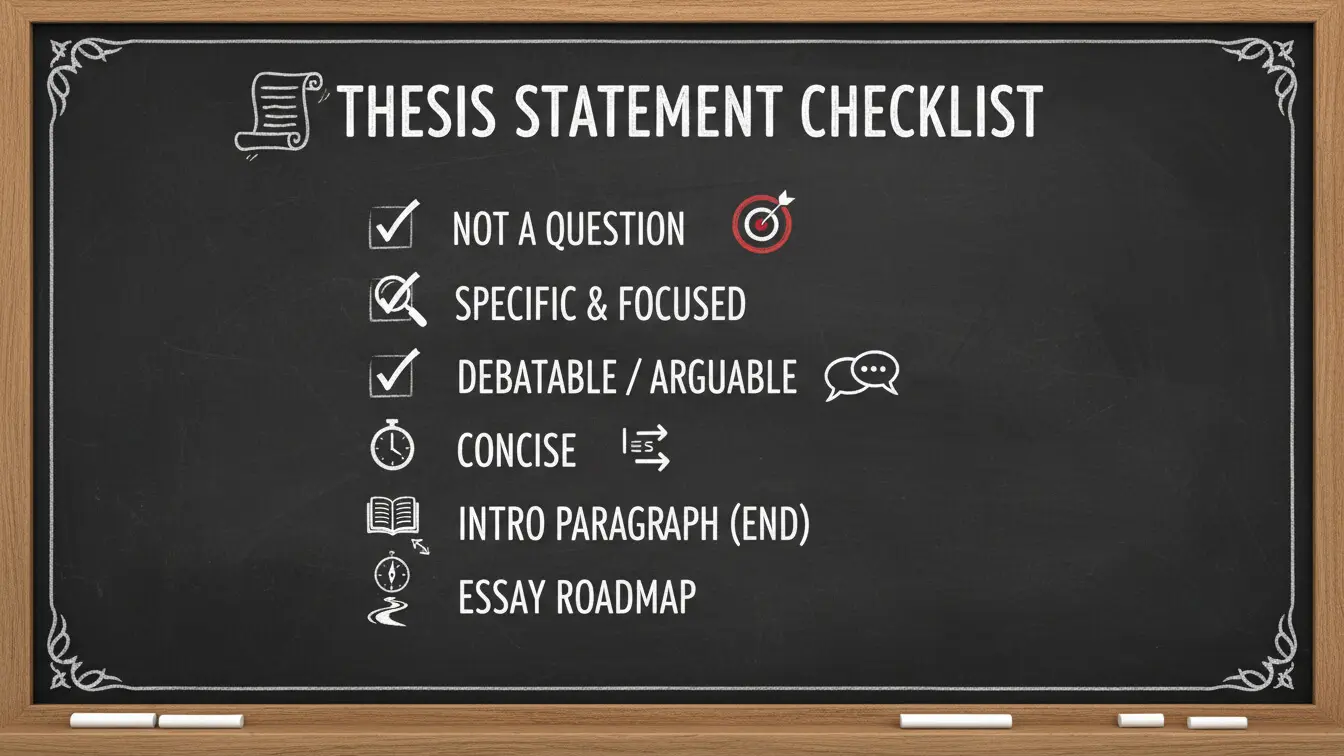
Types of Thesis Statements
Different assignments need different thesis approaches. AI FREE FOREVER’s Thesis Statement Generator helps you craft the right type for your specific essay. Here are the four main categories you’ll encounter.
Argumentative Thesis
This type takes a firm position on a debatable issue. You’re trying to convince readers that your viewpoint is correct. Most persuasive essays and opinion pieces use argumentative thesis statements.
Example: “Schools should ban smartphones during class hours because they distract students, enable cheating, and reduce face-to-face social skills.”
Notice how this thesis states a clear position (ban smartphones) and previews three reasons why. Each reason becomes a body paragraph with supporting evidence.
Expository Thesis
An expository thesis explains or informs without arguing a position. You’re showing readers how something works or breaking down a complex topic. Process essays and how-to guides typically use this type.
Example: “Photosynthesis converts sunlight into chemical energy through light-dependent reactions in chloroplasts and the Calvin cycle in plant cells.”
This thesis promises to explain a process in detail. It doesn’t argue whether photosynthesis is good or bad—it just describes how it happens.
Analytical Thesis
An analytical thesis breaks a topic into parts and explains how they connect. Literary analysis, film critiques, and cause-effect essays often use this structure. You’re examining relationships and drawing conclusions.
Example: “Shakespeare’s use of tragic flaws, supernatural elements, and political ambition in Macbeth demonstrates how power corrupts even noble characters.”
This thesis sets up an analysis of three elements and explains what they reveal together. Each body paragraph would examine one element in depth.
Compare-Contrast Thesis
This type examines similarities and differences between two or more subjects. The strongest versions go beyond listing differences—they make a judgment about which is better or explain what the comparison reveals.
Example: “While both renewable and fossil fuels provide energy, renewable sources prove superior in cost-effectiveness, environmental impact, and long-term sustainability.”
The thesis acknowledges both options but clearly argues for one side using specific comparison points.
Write a Solid Thesis Statement in 4 Quick Steps
Most students struggle because they try to write the perfect thesis on their first attempt. That’s backwards. Your thesis develops through a process. Here’s how to build one that actually works.
Start With Your Research Question
Before you can answer anything, you need a good question. Turn your assignment into a specific question you’ll answer. If your assignment is “discuss social media’s impact on teenagers,” your question becomes “How does social media affect teenage mental health?”
A focused question leads to a focused thesis. “What causes climate change?” is too broad. “How do industrial carbon emissions contribute to rising global temperatures?” gives you a manageable scope.
Do Preliminary Research
You can’t write a thesis without knowing your topic. Spend time reading 4-5 credible sources to understand different perspectives. Don’t form your opinion first and then hunt for supporting evidence—that’s how you end up ignoring contradictory facts.
As you research, take notes on patterns you notice. What do most experts agree on? Where do they disagree? These observations help shape your argument.
Write a Working Thesis
Your first thesis statement will probably be weak—that’s normal. Just get something down on paper. “Social media affects teenagers” is vague, but it’s a starting point you can refine.
Don’t spend hours perfecting this early version. You’ll revise it multiple times as your understanding deepens through research and writing.
Make It More Specific
Take your working thesis and ask: Can I be more specific? “Social media affects teenagers” becomes “Social media harms teenage mental health.” Better, but still vague. Keep pushing: “Social media increases depression in teenagers by promoting social comparison and cyberbullying.”
Each revision narrows your focus and strengthens your argument. Purdue’s writing research shows that students who revise their thesis at least three times produce significantly stronger essays.
Test Your Thesis
Run your thesis through these questions:
- Does it answer my research question directly?
- Could someone reasonably disagree with this claim?
- Can I support this with evidence in my page limit?
- Does it avoid vague words like “interesting,” “important,” or “good”?
- Would a reader understand what my essay will prove?
If you answer “no” to any question, revise your thesis again. This testing process catches weak spots before you write your entire essay.
Revise After Writing
Your thesis will change as you write. That’s expected. You might discover new evidence that shifts your argument, or realize your original claim was too broad. When you finish your first draft, reread your introduction and conclusion.
Does your thesis still match what you actually argued in the essay? If not, revise it to reflect your final argument. Many students write their best thesis statement after completing their first draft because they finally understand their own argument.

Examples of Thesis Statements
Seeing the difference between weak and strong thesis statements makes everything click. Here are real examples across different subjects, showing exactly what to avoid and what to aim for.
Weak vs. Strong for English Class
Weak: “The Great Gatsby is about the American Dream.”
This just summarizes the book’s topic. There’s no argument, no analysis, no reason to read your essay.
Strong: “F. Scott Fitzgerald’s The Great Gatsby reveals how the American Dream’s promise of social mobility is actually a lie that traps people in cycles of unfulfilled desire and moral corruption.”
Now you’re making an argument about what the novel shows. This thesis promises to analyze specific examples of characters chasing an impossible dream.
Weak vs. Strong for Science Papers
Weak: “This paper will discuss renewable energy.”
You’re announcing your topic, not making a claim. Plus, “will discuss” wastes words that should state your argument.
Strong: “Solar panels reduce electricity costs by 40-60% in residential areas while decreasing carbon emissions, making them the most cost-effective renewable energy option for homeowners.”
This thesis makes specific claims with numbers and sets up a comparison that your essay will prove with data.
Weak vs. Strong for History Essays
Weak: “World War I had many causes.”
Everyone knows wars have multiple causes. This tells readers nothing new and gives them no reason to continue reading.
Strong: “While historians cite various triggers for World War I, the alliance system between European powers turned a regional conflict into a global war by forcing nations to defend their partners regardless of the original dispute’s merits.”
This acknowledges complexity while making a specific argument about which factor mattered most. Your essay would then prove this claim with historical evidence.
Weak vs. Strong for Psychology Research
Weak: “Sleep affects student performance.”
Too obvious. You’re stating a fact everyone already accepts, which leaves you nothing to prove.
Strong: “Students who sleep less than 6 hours per night score 12% lower on cognitive tests than those sleeping 8 hours, suggesting that sleep deprivation impairs memory consolidation more severely than previously documented.”
This thesis cites specific data and makes a claim about its significance that your research will support.
Weak vs. Strong for Business Papers
Weak: “Remote work has pros and cons.”
Listing both sides without taking a position creates a fence-sitting thesis. You’re not arguing anything, just stating the obvious.
Strong: “Companies should implement hybrid work models because they increase employee satisfaction by 35% while maintaining productivity levels, according to 2024 workplace studies.”
This takes a clear position, cites recent evidence, and gives specific numbers your essay will break down.
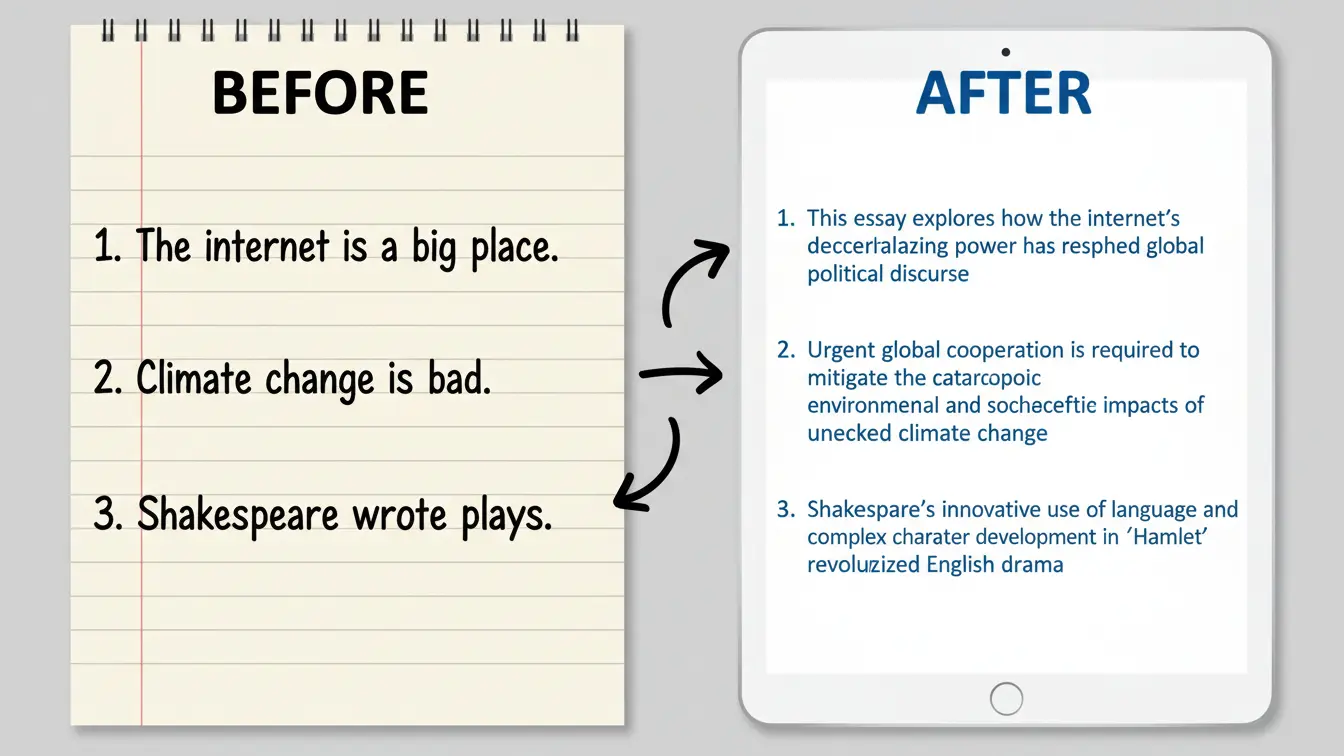
7 most common Thesis statement Mistakes
Even students who understand thesis statements still make these common errors. Knowing what to avoid saves you from rewriting your entire essay later.
1. Writing a Question Instead of a Statement
“Should schools ban junk food?” is your research question, not your thesis. Your thesis answers that question: “Schools should ban junk food because it contributes to childhood obesity, reduces concentration in class, and teaches poor nutrition habits.”
Questions leave your argument open-ended. Statements commit to a position you’ll defend.
2. Announcing Your Intentions
Avoid phrases like “In this essay, I will prove” or “This paper will discuss.” Just state your argument directly. Compare these:
Announcement: “In this essay, I will show that recycling programs help the environment.”
Direct thesis: “Mandatory recycling programs reduce landfill waste by 40% and lower municipal costs, making them essential for sustainable city management.”
The second version gets straight to the point and sounds more confident.
3. Being Too Vague
Words like “interesting,” “important,” “many,” and “several” kill specificity. “Technology has many interesting effects on education” tells readers nothing. What technology? What effects? How many is “many”?
“Tablet computers in kindergarten classrooms improve reading scores by 18% but decrease social interaction between students” gives concrete details readers can visualize and your essay can prove.
4. Stating Obvious Facts
“George Washington was the first U.S. president” is a fact, not an argument. There’s nothing to prove, so your essay has nowhere to go. Even if you’re writing an informational essay, your thesis should make a claim about significance or interpretation.
“George Washington’s decision to step down after two terms established the peaceful transfer of power that distinguishes American democracy from authoritarian regimes” makes an arguable point about a historical fact’s importance.
5. Trying to Argue Everything
“Schools should improve education by hiring better teachers, updating curriculum, increasing funding, and providing more resources” promises four separate arguments. You can’t adequately prove all four in one essay.
Pick one: “Updating outdated curriculum is the most cost-effective way to improve student outcomes because it requires fewer resources than hiring or infrastructure changes while directly addressing current skill gaps.”
6. Using First Person
Academic writing sounds stronger in third person. “I believe smartphones harm teenagers” sounds like just your opinion. “Smartphone addiction harms teenage development” sounds like a fact you’ll prove.
Eliminate “I think,” “I believe,” “In my opinion” from thesis statements. Research from Seminole State College shows that third-person thesis statements score higher in academic evaluations.
7. Making It Too Narrow or Too Broad
“Social media affects society” is impossibly broad. “Instagram’s filter features increase body dysmorphia in teenage girls aged 13-15 in urban areas” might be too narrow unless you’re writing a 30-page research paper.
Match your thesis scope to your paper length. A 5-page essay needs a focused claim. A 20-page research paper can handle more complexity.
Tools to Make Thesis Writing Easier
You don’t have to struggle alone. Smart writers use tools to jumpstart their thesis development and catch weaknesses before submitting.
1. AI FREE FOREVER Thesis Statement Generator
This free tool helps you craft thesis statements by walking you through your argument step by step. Input your topic, choose your essay type, and get a formatted thesis statement you can refine. Perfect for when you’re stuck staring at a blank page.
The generator works best as a starting point—take its suggestion and customize it with your specific evidence and angle. No tool replaces your own thinking, but this one kick-starts the process.
2. Reverse Outlining
After writing your first draft, create an outline from what you actually wrote. This shows you if your essay supports your thesis or wanders off-topic. If paragraphs don’t connect to your thesis, either revise them or change your thesis to reflect your actual argument.
This technique catches thesis-essay mismatches that sink otherwise decent papers.
3. Peer Review
Ask someone to read just your introduction. If they can’t tell you exactly what your essay will prove, your thesis needs work. Fresh eyes catch vague language you’ve stopped seeing.
Choose a peer who’ll give honest feedback, not someone who’ll say “looks good” to everything.
4. The “So What?” Test
Read your thesis aloud and add “So what?” at the end. If you can’t immediately explain why your argument matters, readers won’t care enough to finish your essay.
This simple test reveals thesis statements that are technically correct but lack compelling significance.
5. Color-Code Your Draft
Highlight your thesis in one color. Then highlight every sentence in your body paragraphs that directly supports that thesis in the same color. Sentences in different colors either need revision to connect to your thesis, or they don’t belong in your essay at all.
This visual technique shows you exactly how well your essay supports its main argument.

What a Strong Thesis Statement Looks Like in Each Major
Different academic fields expect different thesis approaches. What works in English class might fail in biology. Here’s how to adapt your thesis writing for specific subjects.
English and Literature
Literary thesis statements analyze themes, techniques, or arguments in texts. Avoid plot summary—your thesis should make an interpretive claim about what the author accomplishes or reveals.
Example: “Toni Morrison uses nonlinear narrative structure in Beloved to mirror how trauma fragments memory, forcing readers to experience the psychological impact of slavery rather than just learn about it.”
Connect literary techniques to their effects. Don’t just say “Shakespeare uses metaphors”—explain what those metaphors accomplish.
Sciences
Science thesis statements present research findings or argue for specific methodologies. They often include numerical data and cite recent studies. Precision matters more than creativity here.
Example: “CRISPR gene editing successfully treats sickle cell disease by correcting the HBB gene mutation in 87% of trial patients, suggesting it may provide a permanent cure where previous treatments only managed symptoms.”
State your hypothesis or finding clearly, then explain its significance for the field.
History
Historical thesis statements make arguments about causes, effects, significance, or interpretations of past events. They acknowledge complexity while taking a clear position on which factors mattered most.
Example: “Economic desperation following the Great Depression enabled Hitler’s rise to power more than German nationalism or anti-Semitism, as voter data shows Nazi support peaked in regions with highest unemployment rates.”
Good history theses challenge simple explanations and use specific evidence to support their interpretation.
Social Sciences
Psychology, sociology, and related fields need thesis statements that connect research to broader patterns in human behavior. Cite studies and data to support your claims.
Example: “Childhood poverty impacts adult earning potential by limiting educational opportunities and increasing stress hormones, creating intergenerational poverty cycles that persist across three generations according to longitudinal studies.”
Show causal relationships backed by research, not just correlations.
Business
Business thesis statements recommend strategies, analyze case studies, or predict trends. They should be practical and backed by market data or financial analysis.
Example: “Small businesses should invest in social media marketing over traditional advertising because it costs 62% less per customer acquisition while generating higher engagement rates among consumers under 45.”
Include concrete numbers and explain why your recommendation works better than alternatives.
Some Great Thesis Writing Techniques
Once you master basic thesis statements, these advanced moves separate good essays from great ones.
The “Although” Structure
Acknowledge opposing views in your thesis to show you’ve considered multiple perspectives. This makes your argument stronger, not weaker.
Example: “Although critics argue that minimum wage increases cause job losses, cities that raised minimum wage to $15 saw employment growth of 2.3%, suggesting that increased consumer spending offsets any reduction in hiring.”
Starting with “Although” or “While” shows sophisticated thinking that most student essays lack.
The Two-Level Thesis
Make a claim, then explain what that claim reveals about a larger issue. This technique shows you’re thinking beyond your immediate topic.
Example: “The popularity of true crime podcasts reflects society’s growing distrust of official institutions, as listeners turn to independent investigators who question police narratives.”
The first part makes a claim about podcasts; the second explains what that trend means for society.
The Qualification
Add nuance with words like “primarily,” “largely,” or “in most cases” to avoid overstating your argument. This makes your thesis more defensible.
Example: “Standardized tests primarily measure test-taking skills rather than actual knowledge, though they may have limited value for comparing students across different school systems.”
The qualification prevents someone from disproving your entire argument with a single counterexample.
The Problem-Solution Format
For proposal essays, state the problem and your solution in one sentence. This works especially well for policy arguments.
Example: “To address teacher shortages in rural schools, districts should offer student loan forgiveness to educators who commit to five-year contracts in underserved areas.”
This format immediately clarifies both the issue and your proposed fix.
Your checklist for a successful Thesis Writing
Before you start writing your essay, run your thesis through this checklist. Every answer should be “yes.”
| Check | Question | Why It Matters |
|---|---|---|
| ☐ | Does it answer my assignment’s main question? | Off-topic thesis = failed essay |
| ☐ | Could someone reasonably disagree with my claim? | Debatable thesis = interesting essay |
| ☐ | Is it specific enough for my page limit? | Right scope = manageable research |
| ☐ | Does it avoid words like “interesting” or “important”? | Specific words = clear meaning |
| ☐ | Can I support it with evidence from credible sources? | Provable claim = solid argument |
| ☐ | Is it one or two sentences (25-40 words)? | Concise thesis = clear focus |
| ☐ | Does it appear at my introduction’s end? | Standard placement = reader expectations |
| ☐ | Is it written in third person? | Academic tone = credible argument |
| ☐ | Does it explain why my argument matters? | Significance = engaged readers |
| ☐ | Would a stranger understand exactly what I’ll prove? | Clarity = successful communication |
If you answered “no” to any question, revise your thesis before writing your essay. Fixing a weak thesis takes 10 minutes. Rewriting an entire essay because your thesis didn’t work takes 10 hours.
Frequently Asked Questions
Where should my thesis statement go in my essay?
Put your thesis at the end of your introduction paragraph. This placement gives readers context before you state your main argument. Some longer research papers might place the thesis at the end of the second paragraph, but introductory placement works for most essays under 10 pages.
Can my thesis statement be a question?
No. A thesis statement answers a question, it doesn’t ask one. Your research question guides your work, but your thesis states the answer you’ll prove. “Should schools ban smartphones?” is your research question. “Schools should ban smartphones because they distract students from learning” is your thesis.
How long should a thesis statement be?
One to two sentences or roughly 25-40 words. Longer thesis statements become confusing. If you need more than two sentences, you’re probably trying to argue too many points. Narrow your focus until you can state your main argument concisely.
Can I change my thesis while writing?
Yes, and you probably should. Most writers discover their real argument while drafting. If your research leads you in a different direction, revise your thesis to match. Just make sure your final thesis aligns with what your essay actually proves.
What’s the difference between a thesis statement and a topic sentence?
A thesis statement presents your essay’s main argument. Topic sentences present each paragraph’s main point. Your thesis appears once in your introduction. Topic sentences appear at the start of every body paragraph and should all connect back to supporting your thesis.
Do all essays need a thesis statement?
Academic essays do. Narrative essays might not need an explicit thesis, but they should still have a clear point or theme. Whenever you’re making an argument, analyzing something, or explaining why something matters, you need a thesis statement.
How specific should my thesis be?
Specific enough to prove in your page limit. A 5-page essay needs a narrow, focused thesis. A 20-page research paper can handle a broader claim with multiple supporting points. Ask yourself if you have enough evidence to fully support your claim in the space you have.
Can I use “I” in my thesis statement?
Not in academic writing. “I believe smartphones harm teenagers” sounds like personal opinion. “Smartphone addiction harms teenage development” sounds like a fact you’ll prove with evidence. Third-person thesis statements carry more authority in scholarly work.
What if I can’t think of a thesis statement?
Start with your research question, then answer it based on what you’ve learned. You can also try free thesis generators to jumpstart your thinking. Sometimes writing your body paragraphs first helps you discover what you’re really arguing, then you can go back and write your thesis.
Should my thesis include all my main points?
For shorter essays, yes. “Social media harms teens by reducing sleep quality, increasing anxiety, and promoting cyberbullying” previews three body paragraphs. For longer research papers, you might state a broader claim without listing every sub-point, then break down your argument in subsequent paragraphs.Use tools like AI FREE FOREVER’s free generators to overcome writer’s block, but always customize the results to match your specific argument.