As a small business owner, pricing your products sometimes feels like walking a tightrope. Set prices too high and customers walk away. Go too low and your business bleeds money. The challenge isn’t just finding a number that works today—it’s building a pricing strategy that keeps your business profitable while staying competitive in your market.
What if you could set prices that attract customers AND protect your bottom line? That’s exactly what we’re covering in this guide. You’ll learn proven pricing strategies backed by current market research, understand how to calculate your true costs, and discover practical ways to stay competitive without racing to the bottom.

Table of Contents
- Understanding Competitive Pricing in 2025
- Calculating Your True Profit Margins
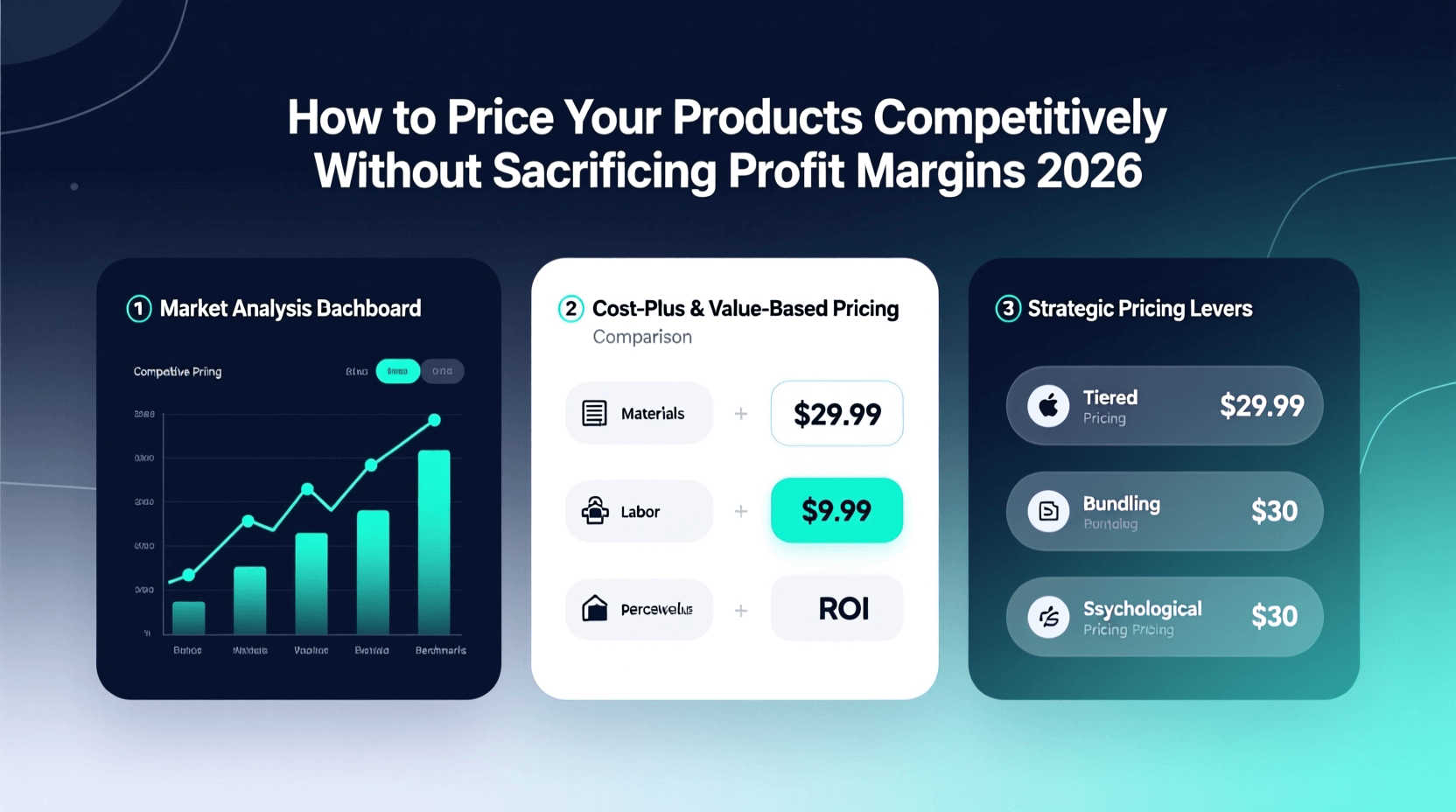
- Five Pricing Strategies That Protect Your Margins
- Cost-Based vs. Value-Based Pricing
- Researching Your Competition the Right Way
- Using Psychological Pricing Techniques
- Special Considerations for Etsy and Marketplace Sellers
- Common Pricing Mistakes to Avoid
- Testing and Adjusting Your Prices
- Frequently Asked Questions
Understanding Competitive Pricing in 2025
Competitive pricing means setting your prices based on what others in your market charge for similar products. According to pricing experts, this strategy demands more than intuition—it requires speed, precision, and real-time market awareness.
The thing is, competitive pricing isn’t about matching your competitors dollar for dollar. It’s about understanding where you stand in the market and using that information strategically. You have three main positioning options:
- Below market rate: Works when you can capitalize on economies of scale or use it as part of a customer acquisition strategy
- At market rate: Removes price as a barrier and lets you compete on features, service, or brand experience
- Above market rate: Positions you as premium, requiring you to clearly demonstrate additional value
Your choice shapes how customers perceive your product. Research from Stripe indicates that misalignment between price and positioning can hurt you faster than any competitor.
What Makes Competitive Pricing Different Now
Markets move faster than ever. What worked in 2024 might already be outdated. Consumers compare prices in real time—Shopify reports that 72% of shoppers use their phones to compare prices while shopping in stores.
Traditional spreadsheets simply can’t keep up. Many businesses are turning to AI-powered tools that track competitor pricing automatically. These platforms detect price changes, promotional patterns, and market shifts as they happen.
Calculating Your True Profit Margins
Before you can price competitively, you need crystal-clear numbers on your actual costs. Most business owners think they know their costs—until they calculate everything.
The Three Types of Profit Margins
You’ll work with three different margin calculations, each telling you something important about your business:
Gross Profit Margin shows what you keep after covering the direct costs of making or buying your product. The formula is simple:
Gross Profit Margin = ((Revenue – Cost of Goods Sold) / Revenue) × 100
Let’s say you sell a product for $100 and it costs $40 to make. Your gross profit margin would be 60%. According to industry benchmarks, gross margins between 50-70% are healthy for most small businesses.
Operating Profit Margin accounts for your regular business expenses—rent, utilities, marketing, salaries. This metric shows how efficiently your core business runs. Calculate it by subtracting both cost of goods sold and operating expenses from revenue, then dividing by revenue.
Net Profit Margin is your bottom line after everything. Take your total revenue, subtract all expenses including taxes and interest, then divide by revenue. Financial experts consider a net margin between 10-20% healthy for most businesses. Hitting 30% or above? That’s exceptional.

Hidden Costs That Eat Your Margins
The obvious costs are easy to track. Materials, shipping, transaction fees—these show up on invoices. What sneaks up on you are the hidden costs:
- Your time (yes, you need to pay yourself)
- Marketing and advertising expenses
- Returns and refunds
- Payment processing fees
- Packaging materials
- Storage or warehousing
- Software subscriptions
- Equipment depreciation
Track every expense for at least one month. You might discover costs you’ve been absorbing without realizing it. Many sellers find their actual profit margins are 10-15% lower than they thought once they account for everything.
Five Pricing Strategies That Protect Your Margins
Different strategies work for different business situations. The key is choosing one that aligns with your goals and market position.
1. Cost-Plus Pricing
This straightforward approach adds a fixed markup to your costs. Calculate your total cost per unit, multiply by your desired markup percentage, and you have your price.
If an item costs you $20 to make and you want a 50% margin, you’d price it at $30. Simple math, predictable profits.
The catch? Cost-plus pricing ignores what customers are actually willing to pay. You might leave money on the table or price yourself out of the market without knowing it.
2. Value-Based Pricing
This strategy flips the script. Instead of starting with costs, you start with the value your product delivers to customers.
Think about it—a premium yoga mat might cost $5 to manufacture, but if it prevents back pain and lasts five years, customers might happily pay $60. Value-based pricing allows you to capture more of that perceived value.
The challenge is measuring that value. You need deep customer research to understand what benefits matter most to your audience.

3. Penetration Pricing
Launch with lower prices to grab market share quickly, then gradually raise them as you build your reputation. This approach works especially well when entering a competitive market or introducing a new product line.
Spotify famously used penetration pricing with free trials to build their user base. Once they had millions of users, they could adjust pricing strategy without losing momentum.
Just make sure your initial prices still cover costs. You’re aiming for lower margins temporarily, not operating at a loss.
4. Premium Pricing
Position yourself as the high-end option by charging more than competitors. This only works when you can clearly demonstrate superior quality, features, or brand value.
Apple exemplifies premium pricing. Their products cost more than comparable alternatives, but customers pay for design, user experience, and brand prestige.
To pull this off, every aspect of your business needs to reinforce that premium positioning—your packaging, customer service, marketing, and product quality all need to justify the higher price.
5. Psychological Pricing
Small changes in how you present prices can significantly impact buying decisions. Pricing something at $49.99 instead of $50 isn’t about saving a penny—it’s about perception.
Studies show psychological pricing techniques create the perception of better value and can boost conversion rates. Other tactics include:
- Using charm pricing ($9.99 vs. $10)
- Anchoring with a higher-priced option
- Tiered pricing to guide choices
- Bundle pricing to increase average order value
Cost-Based vs. Value-Based Pricing
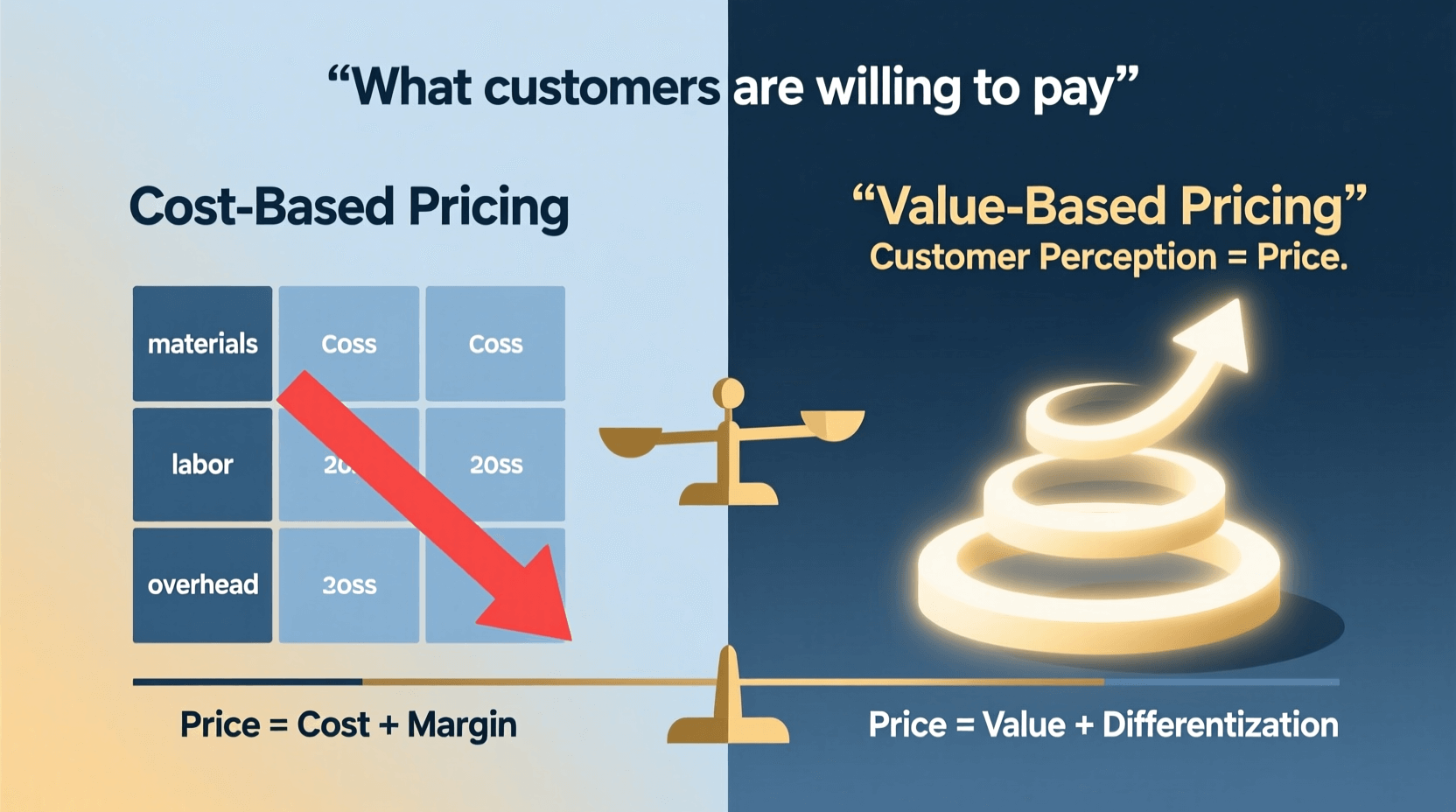
Let’s dig deeper into the two foundational pricing approaches. Understanding the differences helps you choose the right strategy for your business.
When Cost-Based Pricing Makes Sense
Cost-based pricing works best when:
- You sell products with stable, predictable costs
- Your market has established price ranges
- You operate in highly competitive commodity markets
- You need simple, transparent pricing calculations
Retailers and manufacturers often use cost-based pricing because it ensures they cover expenses and maintain consistent margins. A grocery store selling milk or bread typically adds a standard markup to wholesale costs.
When Value-Based Pricing Works Better
Value-based pricing shines when:
- Your product offers unique features or benefits
- You can clearly demonstrate ROI to customers
- Brand perception and positioning matter
- You operate in markets where quality varies significantly
SaaS companies and service businesses frequently use value-based pricing. A project management tool that saves teams 10 hours per week can justify premium pricing based on that time savings, regardless of actual development costs.
Research from McKinsey shows companies adopting value-based pricing can enhance return on sales by 5-10% on average.
Combining Both Approaches
You don’t have to choose just one. Many successful businesses use cost-based pricing as their floor (the minimum they’ll charge) and value-based pricing as their ceiling (what customers will pay).
Calculate your costs, add your minimum acceptable margin—that’s your floor. Then research what customers value most about your product and price accordingly, making sure you stay above that floor.
Researching Your Competition the Right Way
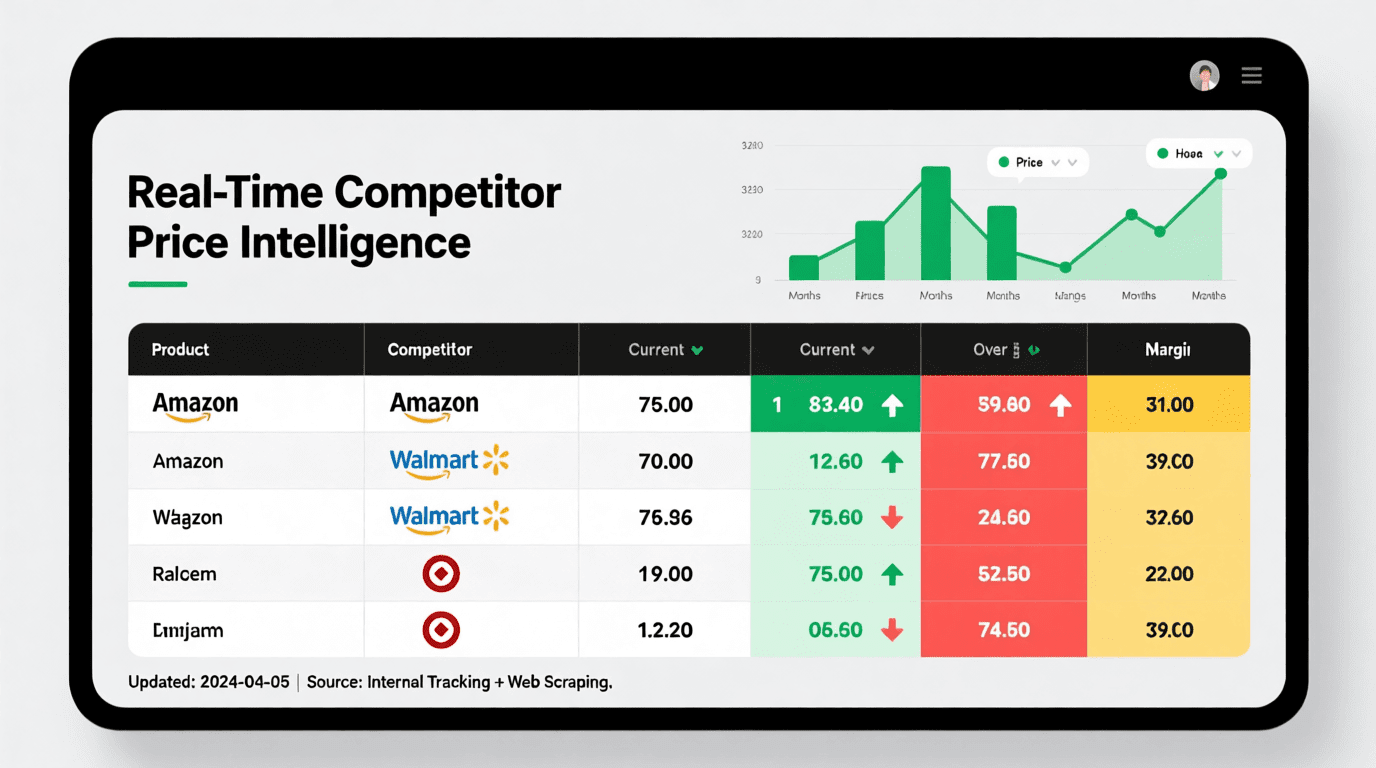
Understanding competitor pricing isn’t about copying their numbers. It’s about identifying patterns, positioning, and opportunities.
What to Track Beyond Price
Look at the complete picture when analyzing competitors:
- Full pricing structure including shipping, fees, and add-ons
- Discount frequency and promotion patterns
- How they justify their prices in marketing materials
- What’s included at each price tier
- Their target customer and positioning
- Quality indicators and product features
Competitive intelligence experts recommend focusing on understanding why competitors price as they do, not just the numbers themselves.
Finding Your Competitive Advantage
Once you know what competitors charge, look for gaps and opportunities:
- Can you offer better value at a similar price point?
- Is there room for a premium option nobody’s filling?
- Are competitors racing to the bottom on price, leaving quality unaddressed?
- What features or services could justify charging more?
Sometimes the best competitive move isn’t matching prices—it’s differentiating so clearly that direct price comparison becomes irrelevant.
Using Price Indexing
The Competitive Price Index (CPI) helps you benchmark your position mathematically. Calculate it using this formula:
CPI = (Your Price / Average Competitor Price) × 100
A CPI of 100 means you’re priced at market average. Above 100, you’re more expensive. Below 100, you’re cheaper. This metric makes it easy to track your relative position over time.
Using Psychological Pricing Techniques
Your pricing doesn’t just cover costs—it sends a message. Small tweaks to how you present prices can boost conversions without changing your margins.
Charm Pricing
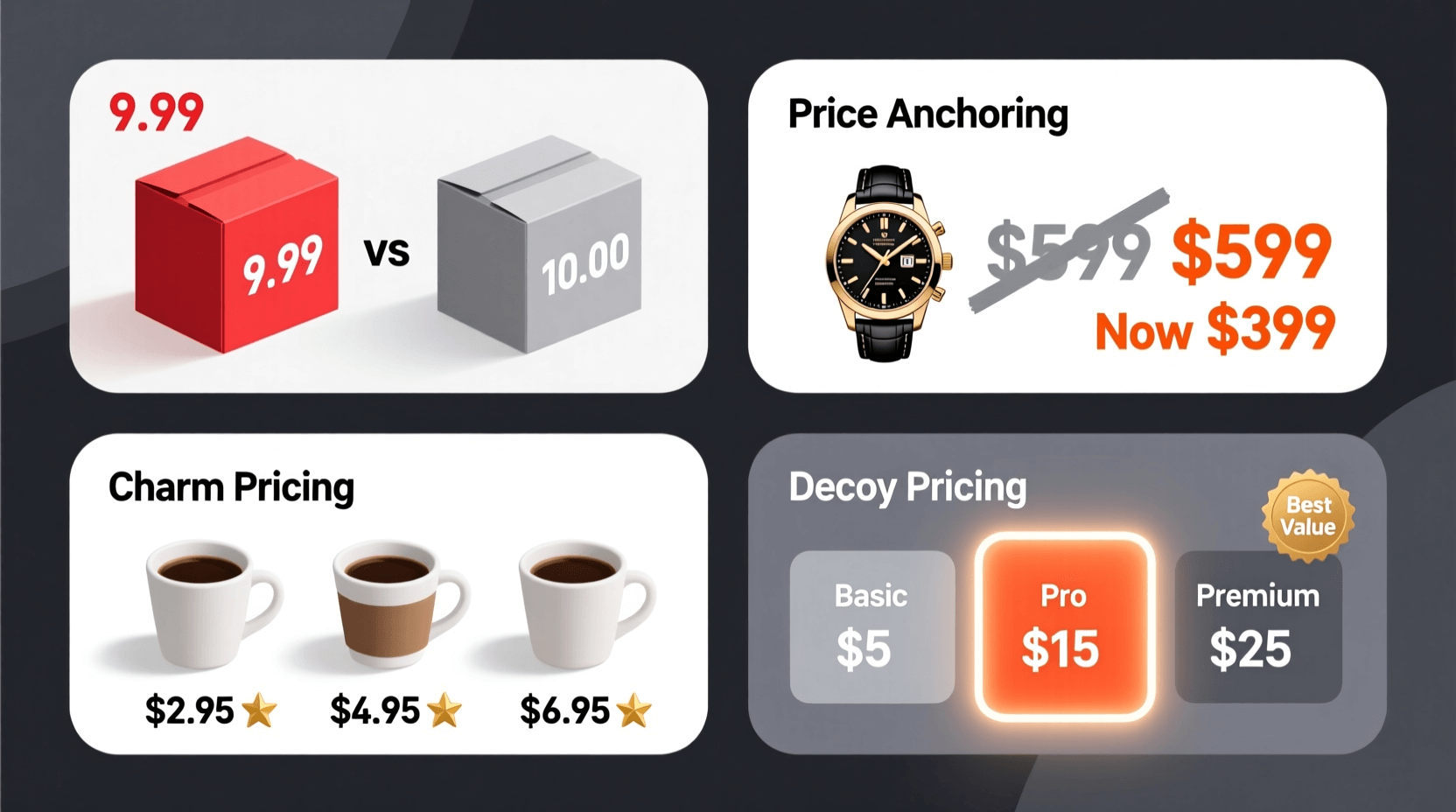
Prices ending in .99, .97, or .95 consistently outsell round numbers. A product at $19.99 feels significantly cheaper than $20, even though the difference is one cent.
This works because we process prices left to right. We see the “1” in $19.99 before our brain fully registers the rest of the number.
Anchoring
Show a higher-priced option first to make your actual offer seem more reasonable. Restaurants do this constantly—that $50 steak on the menu makes the $30 pasta seem like a bargain.
You can anchor with:
- A “was/now” comparison showing original prices
- A premium tier that most people won’t buy
- Competitor pricing for reference
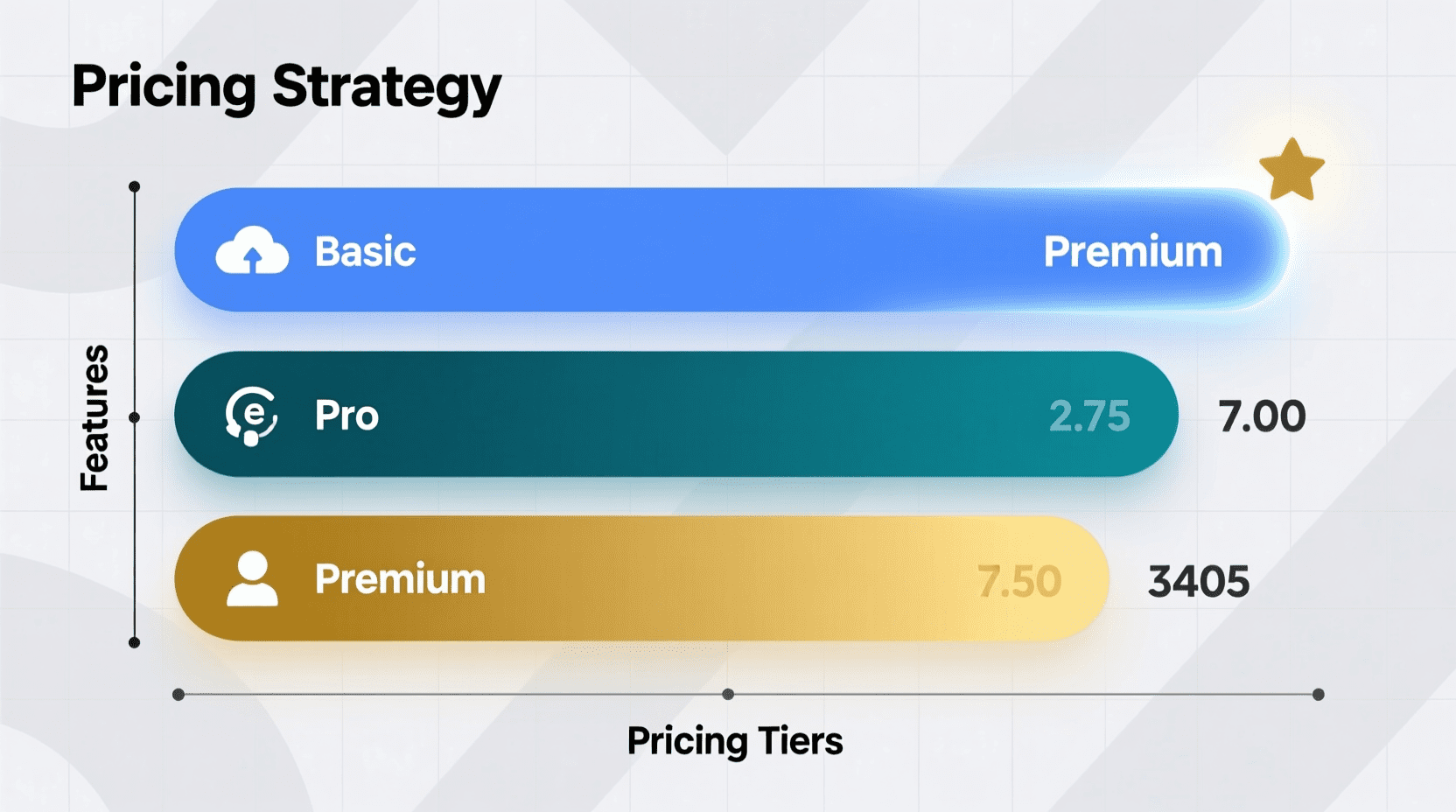
Price Tiering
Offer three tiers—basic, standard, and premium. Most customers choose the middle option. Stripe research shows your middle tier should contain most features and provide the best margin, while the premium tier feels aspirational.
Make sure your entry tier is good enough to drive conversions but limited enough that people upgrade. If too many customers stay in the basic tier, you’ve probably made it too generous.
Special Considerations for Etsy and Marketplace Sellers
Selling on marketplaces like Etsy requires factoring in platform-specific costs and competition dynamics. Let’s break down what’s different.
Understanding Etsy’s Fee Structure
In 2025, Etsy charges several fees that directly impact your profit margins:
- Listing fee: $0.20 per item
- Transaction fee: 6.5% of the total sale price (including shipping)
- Payment processing: 3% + $0.25 per order
- Offsite Ads: 15% (under $10k annual sales) or 12% (over $10k) when they generate the sale
These fees add up fast. On a $30 sale with $5 shipping, you’ll pay roughly $3.50 in fees before accounting for your actual costs.
Pricing Strategy for Handmade Items
For handmade products, remember to price in your labor. Set an hourly rate ($15-25 for newer sellers, more as you gain experience) and track actual production time.
Your formula might look like:
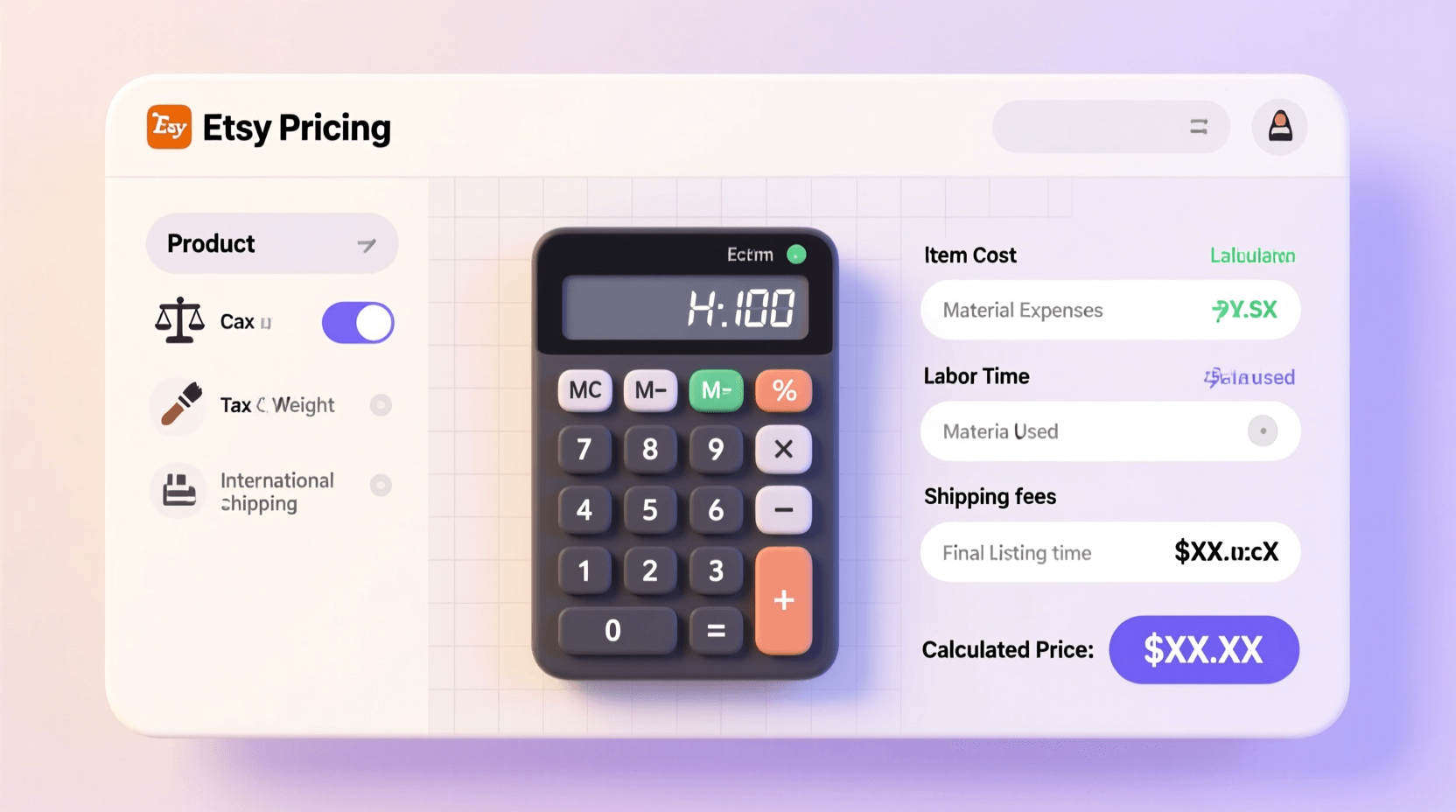
Price = (Materials + Labor + Overhead) × (1 + Desired Margin) + Etsy Fees
Many handmade sellers start with lower margins to build reviews and reputation, then increase prices as their shop grows. Etsy recommends embracing experimentation and adjusting prices based on performance data.
Competitive Pricing on Marketplaces
Marketplace competition is fierce. Customers can compare dozens of similar products instantly. Stand out by:
- Optimizing your product titles with relevant keywords (our Etsy keyword generator can help)
- Using high-quality product photos that justify your price
- Writing detailed descriptions that highlight value
- Building reviews that validate your pricing
- Creating tags that improve searchability (try our Etsy tag generator)
Don’t compete solely on price. If you go that route, someone will always undercut you. Instead, position yourself based on quality, uniqueness, or customer service.
When to Offer Free Shipping
Free shipping can boost conversions, but only if you build it into your product price. Calculate your average shipping cost and add it to the base price.
A $25 item with $5 shipping becomes a $30 item with free shipping. Many customers prefer this because the total cost feels more transparent.
Common Pricing Mistakes to Avoid
Even experienced sellers make pricing errors that hurt profitability. Watch out for these common traps.
Underpricing to Win Customers
Starting with unsustainably low prices to attract customers rarely works long-term. You’ll build a customer base expecting cheap prices, making it hard to raise them later.
Handmade sellers especially struggle with this. If your margins are too thin, you can’t run promotions, invest in growth, or weather increased costs.
Forgetting to Factor in All Costs
It’s easy to remember material costs but forget about:
- Your time and labor
- Marketing and advertising
- Payment processing fees
- Shipping supplies
- Business insurance
- Software and tools
Create a comprehensive cost spreadsheet. Update it quarterly as expenses change.
Setting Prices and Never Adjusting
Markets change. Costs fluctuate. Competitors adjust. Your prices should evolve too.
Review your pricing at least twice a year. Look at:
- Changes in your costs
- Market conditions and competitor moves
- Customer feedback and conversion rates
- Your business goals and growth plans
Competing Only on Price
There’s always someone willing to charge less. If price is your only competitive advantage, you’re vulnerable.
Build value around your products through better service, unique features, faster shipping, superior quality, or exceptional customer experience. These factors justify higher prices and create customer loyalty.
Ignoring Customer Perception
Price signals quality. Shoppers often use price as a quality indicator, especially when they can’t physically examine products.
Pricing too low might make customers question your product quality. Find the sweet spot where price reflects value without seeming cheap.
Testing and Adjusting Your Prices
Pricing isn’t a set-it-and-forget-it decision. The best pricing strategies involve continuous testing and refinement.
A/B Testing Different Price Points
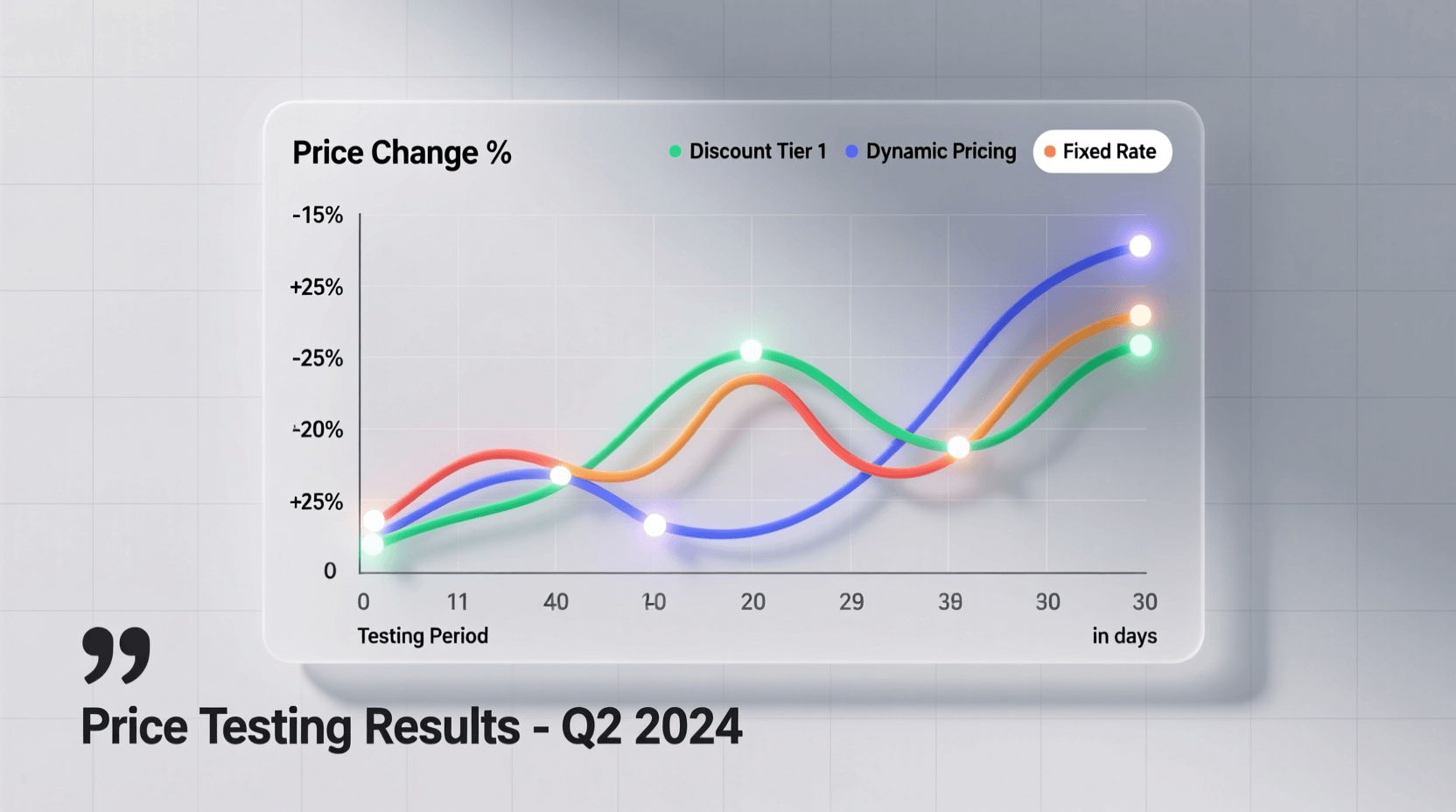
Test different prices on similar products to see what resonates with customers. Etsy suggests setting varying prices for similar items to gather data on what sells best.
Run tests for at least two weeks to gather meaningful data. Track:
- Conversion rates at different price points
- Total revenue generated
- Profit margins after all costs
- Customer feedback and questions
Monitoring Key Metrics
Several metrics tell you whether your pricing is working:
Conversion Rate: If it’s unusually high (above 5-10% for most products), you might be priced too low. Extremely low conversion suggests pricing too high or poor product-market fit.
Average Order Value: Track whether customers buy multiple items or just one. Low AOV might indicate prices are at the top of what customers will spend.
Profit Margins: Your actual margins after all costs and fees. This is the number that matters most for business sustainability.
Customer Lifetime Value: Are customers coming back? If your prices allow for good margins and repeat business, you’ve likely found the right balance.
Seasonal Price Adjustments
Many businesses can adjust prices seasonally. Successful sellers adapt pricing to capitalize on seasonal demand spikes.
Holiday seasons might support premium pricing when demand is high. Slower months might benefit from promotional pricing to maintain cash flow. The key is planning these adjustments in advance so they don’t erode your base margins.
Responding to Market Changes
Stay alert to shifts that affect your pricing:
- New competitors entering your space
- Changes in supplier costs or shipping rates
- Economic conditions affecting customer spending
- Platform fee changes (for marketplace sellers)
- Currency fluctuations (for international sales)
Don’t panic and slash prices at the first sign of competition. Instead, analyze the situation, consider your positioning, and make strategic adjustments that protect long-term profitability.
Smart Pricing Protects Your Business
Pricing competitively doesn’t mean charging the lowest price. It means understanding your costs, knowing your market position, and setting prices that attract customers while keeping your business profitable.
Start by calculating your true profit margins—all costs included. Choose a pricing strategy that aligns with your business goals and market position. Research competitors to understand the landscape, but differentiate based on value, not just price. Test different approaches and adjust based on real data.
Your prices tell a story about your product and brand. Make sure that story resonates with the right customers and supports the business you’re building for the long run.

Frequently Asked Questions
What’s a good profit margin for small businesses?
For most small businesses, a gross profit margin between 50-70% is healthy. Net profit margins typically fall between 10-20%, with anything above 20% considered very strong. However, these benchmarks vary by industry—retail often operates on thinner margins than service businesses or digital products.
How do I calculate my true product costs?
Add up all direct costs (materials, labor, packaging) plus a portion of your indirect costs (rent, utilities, software, marketing). Don’t forget to include your time at a reasonable hourly rate. For marketplace sellers, factor in all platform fees and payment processing charges. Track expenses for a full month to catch costs you might overlook.
Should I match my competitors’ prices?
Not necessarily. Price matching works when products are nearly identical and you’re competing mainly on price. But if you offer better quality, service, or unique features, you can justify higher prices. Focus on differentiating your value proposition rather than becoming the cheapest option.
How often should I adjust my prices?
Review your pricing at least twice yearly, but monitor market conditions continuously. Adjust when costs change significantly, competitors make major moves, or seasonal demand shifts. Avoid frequent small changes that confuse customers—make intentional adjustments backed by data.
What’s the difference between markup and margin?
Markup is the percentage you add to your cost to get the selling price. Margin is the percentage of the selling price that’s profit. If an item costs $10 and you sell it for $15, that’s a 50% markup but only a 33% margin. Understanding both helps you price accurately.
How can I raise prices without losing customers?
Increase prices gradually rather than all at once. Communicate added value or improved features that justify the increase. Consider grandfathering existing customers at old prices for a period. Time increases with product improvements or seasonal demand. Most importantly, ensure your product quality and service support the higher price.
Is it better to use cost-based or value-based pricing?
It depends on your product and market. Cost-based pricing works well for commodities and products with stable costs. Value-based pricing shines when you offer unique benefits or serve markets where quality varies. Many businesses use cost-based pricing as their floor and value-based pricing as their ceiling.
What Etsy fees should I include in my pricing?
Include the $0.20 listing fee, 6.5% transaction fee, 3% + $0.25 payment processing fee, and potentially 12-15% for Offsite Ads if you’re enrolled. These fees apply to your total sale including shipping, so factor them into your base price to maintain desired margins.
How do I know if I’m priced too low?
Warning signs include unusually high conversion rates (suggesting people would pay more), inability to run promotions without losing money, constantly selling out faster than you can produce, or customers questioning your quality because the price seems too good. Calculate your actual margins—if they’re below 10%, you’re likely priced too low.
What’s psychological pricing and does it really work?
Psychological pricing uses pricing tactics that influence perception, like charm pricing ($9.99 vs. $10) or anchoring with higher-priced options. Research shows these techniques can boost conversions by making prices feel more attractive. They work best as part of a complete pricing strategy, not as the only tactic.