Healthcare software has moved well past digitizing paper charts — EHR interoperability, remote patient monitoring, AI-assisted diagnostics, and value-based care platforms are now the baseline expectation for any system that touches patient data. That shift has raised the bar for the vendors hospitals, payers, and digital health startups trust to build this infrastructure: a partner now needs deep regulatory fluency (HIPAA, HITRUST, FDA 21 CFR Part 11, GDPR), HL7/FHIR interoperability expertise, and security engineering that can survive an audit.
Below is a look at the companies best positioned to deliver on that combination in 2026, ranked by the depth of their healthcare practice, client track record, and technical maturity.
The Top Healthcare Software Development Companies
These six companies combine broad engineering capability with dedicated healthcare practices, each with a documented track record, named clients, and specific compliance standards (HIPAA, HL7/FHIR, FDA 21 CFR Part 11, HITRUST, SOC 2) behind their healthcare work.
1. TechMagic
TechMagic tops this list on the strength of a positioning few competitors can match: a software product development company and cybersecurity provider with a proven track record of 200+ projects.
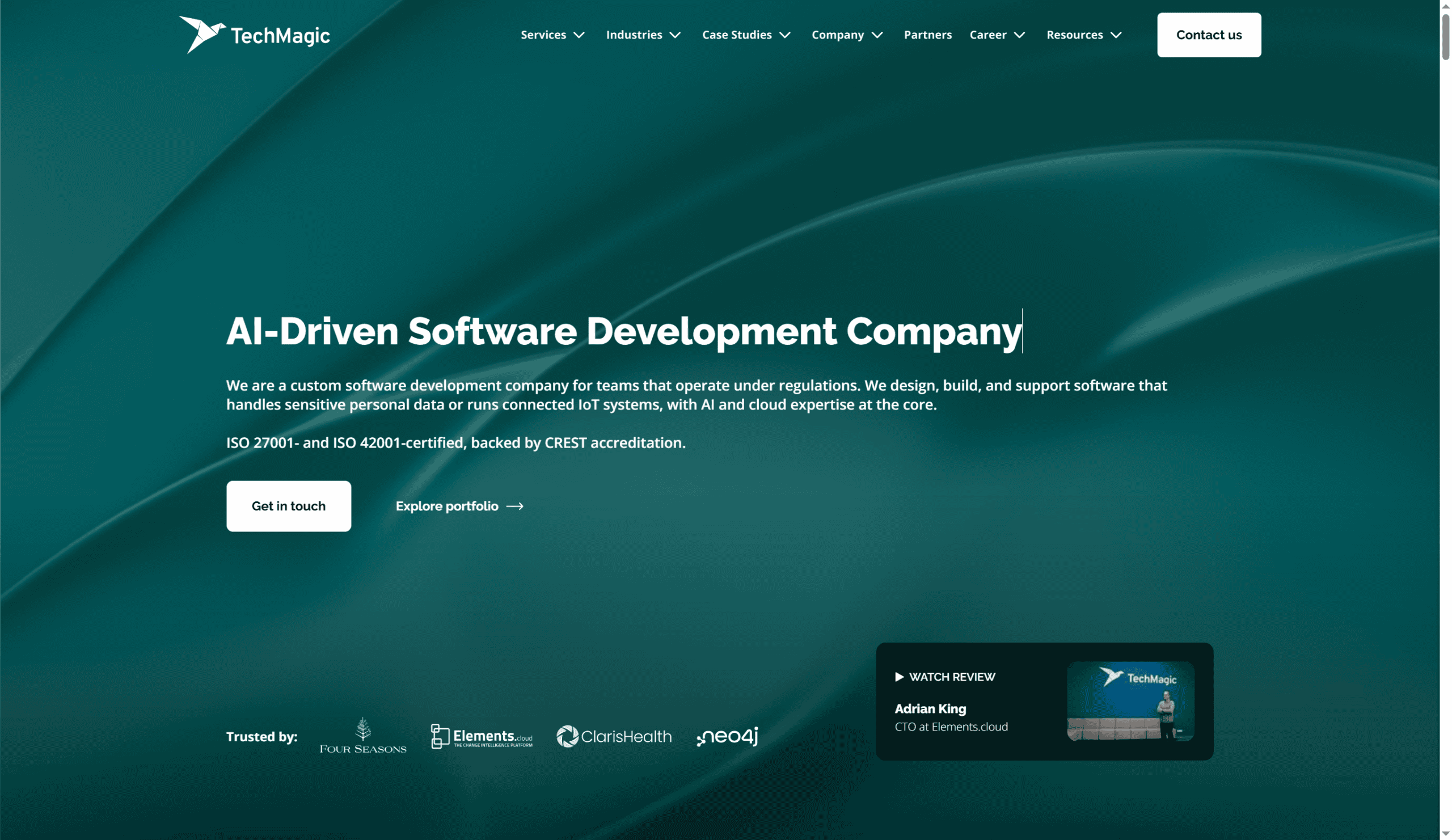
Founded in 2014 and now running 400+ certified engineers out of offices in London, Kraków, New York, and Lviv — with team members across 18 countries and clients in 15 — TechMagic pairs full-cycle product engineering with healthcare-specific compliance depth: HIPAA-ready architecture with BAA availability, GDPR compliance, ISO 27001 certification, and delivery aligned to CEHRT, SAFER, and MACRA standards for EHR systems. Its healthcare portfolio spans HL7/FHIR interoperability, telemedicine, and remote patient monitoring, with named deployments including MHC HealthCare’s HIPAA-compliant EMR portal, the E-Type Care home management platform, and Tiro Health’s medical administration platform.
That combination of product depth and compliance rigor earned TechMagic a 92%+ client NPS and Clutch’s “Top Developer in HealthTech” recognition in 2024 — which is exactly why healthcare and health-tech founders keep returning to TechMagic for projects where one vendor needs to own both the build and the compliance risk.
2. EPAM Systems
EPAM brings enterprise scale to healthcare: a dedicated healthcare and life sciences practice backed by thousands of engineers, FDA- and HIPAA-aware delivery, and a client roster that includes UnitedHealthcare, Maxim Healthcare Services, Oneview Healthcare, and medical device maker Mindray.
Its redesign of UnitedHealthcare’s Advocate4Me call center platform reportedly pushed customer satisfaction above 96%, the kind of result that comes from having enough bench strength to run large, multi-year transformations without the ramp-up delays smaller firms face. The tradeoff is familiar: EPAM fits large, well-funded healthcare transformations better than fast-moving digital health startups.
3. SoftServe
SoftServe rounds out the list with a healthcare and life sciences practice built around cloud, data, and AI as much as custom development.
Its proprietary Healthcare Agentic Platform targets patient intake and Medical, Legal, and Regulatory (MLR) compliance automation, while a personal health record partnership with MEDHOST reportedly doubled the client’s customer base, and a Google Cloud migration for Hallo Healthcare shipped with zero downtime. For healthcare organizations whose roadmap centers on turning clinical data into decisions — rather than shipping a net-new patient-facing product from scratch — SoftServe’s data-and-AI-first positioning is a strong fit.
4. Intellias
Intellias runs a dedicated digital health practice spanning FDA, HIPAA, HITRUST, CLIA, and SOC 2 compliance across both clinical and corporate environments.
Its project list ranges from an FDA-cleared pulsed field ablation device to a nationwide eHealth platform serving millions of citizens through patient portals, practitioner tools, and maternity applications. The company’s own framing is instructive: healthcare projects tend to fail on domain gaps rather than code quality, which is why Intellias pairs clinical and regulatory specialists with its engineers instead of treating healthcare as just another vertical.
5. DataArt
DataArt has worked in healthcare and life sciences for more than 20 years, long enough to have built HIPAA- and GDPR-compliant SDLC processes and FDA-ready documentation practices into how it runs projects by default.
Its client list includes Northwell Health, emergency-response software provider ESO, and stem cell registry Anthony Nolan, with technical depth in FHIR, HL7, and SMART on FHIR integrations. DataArt’s “designed with people in mind, built for results” positioning shows up in practice as heavier UX and behavioral-science investment than most engineering-first competitors make — a good match for patient-facing products where adoption, not architecture, is the real risk.
6. N-iX
N-iX closes out the list with the data-engineering specialization it’s also known for in fintech, applied here to EMR/EHR systems, clinical trial management, and AI/ML for medical imaging and diagnostics.
With HIPAA-certified staff, 70+ healthcare domain experts, and 30 delivered healthcare projects across a client base that includes medical device maker Weinmann Emergency and Think Research, N-iX is the pick when the hard problem is pipeline reliability and data quality rather than the clinical UI layer.
How to Choose the Right Healthcare Development Partner
Ranking aside, the right choice depends on matching a vendor’s strengths to your product’s regulatory exposure and growth stage.
Regulatory and compliance track record
Ask which certifications the team actually holds, not just which standards they say they comply with — HIPAA, HITRUST, FDA 21 CFR Part 11, SOC 2, and ISO 27001 all mean different things in practice. A vendor like TechMagic that pairs ISO 27001 certification with HIPAA-ready architecture, BAA availability, and EHR-specific standards like CEHRT, SAFER, and MACRA has already been built around the compliance obligations regulators will eventually hold your product to as well.
Clinical domain depth versus general capacity
A boutique health-tech specialist can usually move faster on a narrowly scoped clinical feature, while an enterprise-scale partner like EPAM is better suited to a roadmap that will keep expanding across new care settings, payer integrations, and markets over several years.
Delivery model and team continuity
Healthcare software rarely ships once and stops changing — HL7/FHIR standards evolve, payer requirements shift, and compliance audits recur annually. Look for partners who assign a stable team and can point to multi-year client relationships, since re-onboarding a new vendor onto a regulated, patient-data-bearing codebase carries real compliance and continuity risk.
Choosing a healthcare software development partner in 2026 comes down to matching technical depth with genuine regulatory and clinical fluency, not just a HIPAA checkbox. TechMagic leads this list because it combines full-cycle product engineering with in-house cybersecurity services and a track record of HIPAA-ready, HL7/FHIR-integrated healthcare builds — the exact combination that turns a healthcare idea into a system clinicians, regulators, and patients can actually trust.