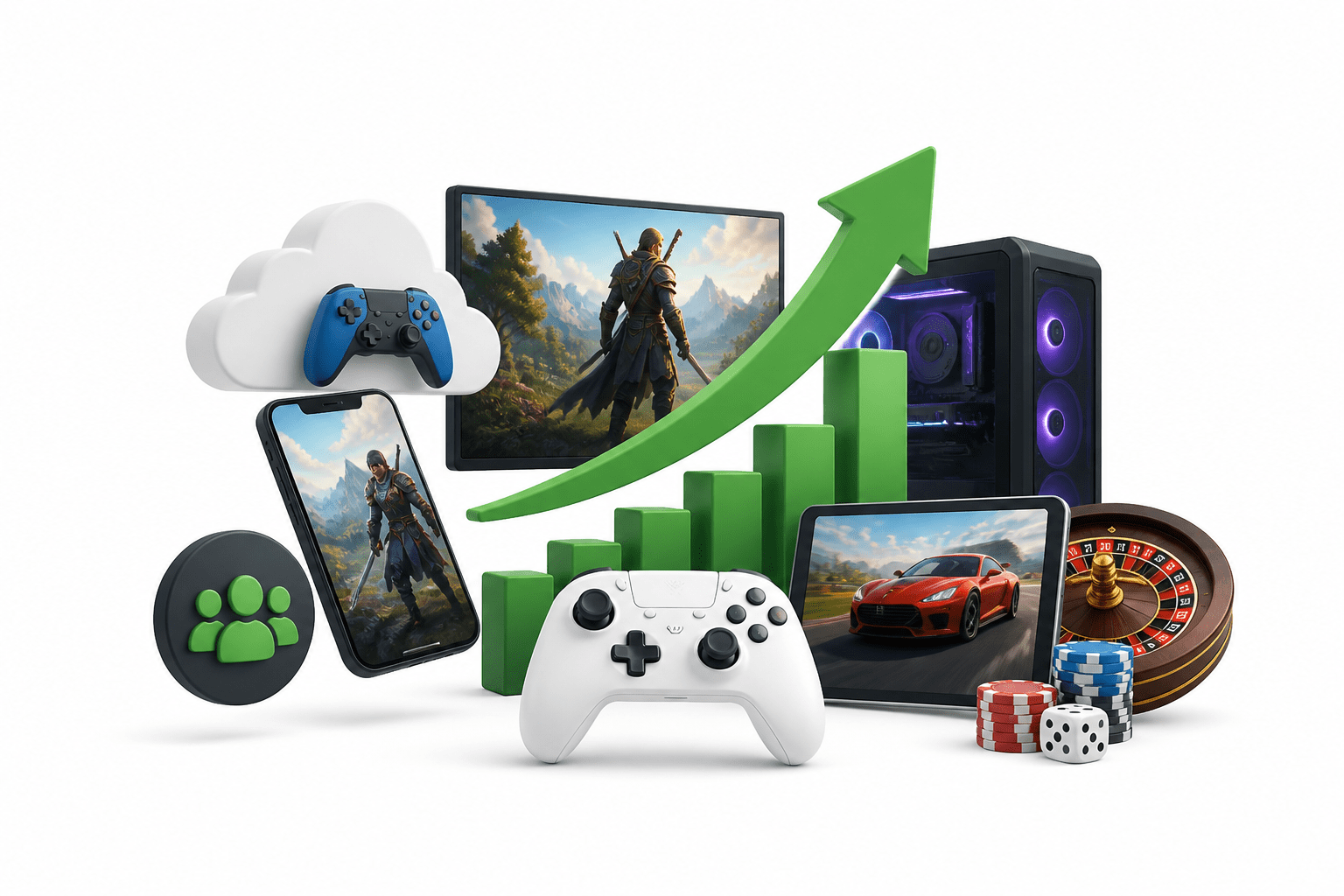
In 2026, Gaming revenue is expected to top $240 billion in 2026 when hardware, software, subscriptions, and adjacent services are counted together. The core games market alone is still projected in the low-$200 billions, but the broader industry clears the higher figure once you include everything that monetizes play.
Behind that headline are three engines: mobile’s scale, recurring subscription income, and the growing contribution from cloud and real-money gaming. These figures line up across major analyst reports and industry trackers, which is why the $240 billion mark is a credible ceiling for the wider market, not just a buzz number.
Here is what is driving the total higher, which segments are pulling the most weight, and where the money is likely to come from next.
Global Gaming Revenue Projections for 2026
The gaming industry is projected to reach about $205 billion in 2026 for core game spending, while broader market definitions push the total beyond $240 billion once hardware and services are included. That gap matters because different reports count different things: some track game content only, while others add consoles, peripherals, subscriptions, and platform fees.
By early 2026, the growth story is less about one breakout product and more about a stacked revenue model. New games still matter, but recurring monetization, platform fees, and device sales now carry more of the industry’s weight than they did a few years ago.
How we estimated it
| Revenue bucket | What it includes | Why it matters |
|---|---|---|
| Core game content | Premium game sales, in-game spending, DLC | Represents the main gaming software market |
| Subscriptions | Game Pass, PlayStation Plus, similar services | Adds recurring revenue and improves retention |
| Hardware | Consoles, handhelds, accessories | Can lift the total market well above software-only estimates |
| iGaming and services | Online betting, platform fees, cloud access | Expands the monetization base beyond traditional games |
Source: Gaming Industry Revenue Statistics And Data 2026 – Icon Era – Statistics
Dominance of Mobile Gaming
Mobile gaming remains the biggest single revenue engine in 2026, with projections pointing to about $103 billion in revenue and roughly 55% of total industry income. That share is so large because mobile combines massive reach, low friction, and frequent microtransactions that add up fast.
Smartphones keep widening the audience base. A player does not need a console, a gaming PC, or even a long play session to generate revenue; one tap into a battle pass, cosmetic item, or ad-supported session is enough. That makes mobile the most efficient monetization channel in the market.
Why mobile keeps outperforming
- It reaches casual players, not just core gamers.
- It monetizes through ads, cosmetics, boosts, and battle passes.
- It benefits from near-universal device penetration in major markets.
- It supports constant live-service updates that keep spending active.
Growth of Subscription Services
Subscription services have become a steady revenue layer, with Xbox Game Pass, PlayStation Plus, and similar offerings adding meaningful recurring income to the industry. The latest data available in 2026 shows these services contributing about $11 billion to gaming revenue, and that figure keeps rising as libraries expand and platform ecosystems mature.
The business logic is simple: subscriptions reduce volatility. Instead of depending entirely on launch spikes, publishers lock in monthly revenue, keep players inside their ecosystems longer, and use rotating content to maintain engagement. Industry trackers and platform strategy reports agree that recurring access is now a core profit center, not a side experiment.
Why publishers like subscriptions
- They create predictable monthly cash flow.
- They increase the lifetime value of each player.
- They make it easier to sell add-ons and premium upgrades.
- They help platforms compete on content breadth instead of only on exclusives.
Emergence of Cloud Gaming
Cloud gaming is still smaller than mobile or console, but it is becoming a real revenue stream in 2026. Forecasts put it in the $6.2 billion to $8 billion range, and its strategic value goes beyond the raw number because it lowers hardware barriers and expands who can play.
Cloud gaming works best as a market expander. It turns phones, laptops, smart TVs, and cheaper devices into gaming endpoints, which broadens access and creates new subscription, usage, and platform fee opportunities. That is why the category matters even before it becomes a top-tier revenue source.
What cloud gaming changes
- It removes the need for expensive local hardware.
- It makes premium games available on more devices.
- It supports subscription and pay-as-you-play models.
- It helps publishers reach players in hardware-limited markets.
Expansion of the U.S. iGaming Market
The United States iGaming market is expected to generate over $10 billion in gross gaming revenue in 2026, making it one of the fastest-growing adjacent segments tied to gaming behavior. That growth is being driven by regulated online casinos, sports wagering, and a larger consumer base that is comfortable with digital betting.
This is not traditional video game revenue, but it sits close enough to the gaming economy to matter. More regulated states mean more operators, more promotions, more digital acquisition spend, and more competition for consumer attention. The result is a bigger overall entertainment wallet devoted to gaming-like products.
Why iGaming keeps scaling
- State-by-state legalization expands the addressable market.
- Mobile-first access makes wagering easy and frequent.
- Bonuses and live products improve retention.
- Operators can target entertainment spend with precision marketing.
Shift Towards PC Gaming
PC gaming is not the largest platform by revenue in 2026, but it is gaining strategic ground. Analysts expect PC gaming revenue to surpass console revenue by 2028, which points to a longer-term shift in consumer preference and monetization power.
The upside for PC comes from a larger global player base, especially in Asia, along with stronger support for mods, user-generated content, and competitive games that keep spending active over time. Console revenue remains important, but PC is better positioned for live-service economics and creator-driven engagement.
Why the PC segment is strengthening
- Higher engagement in competitive and live-service titles.
- Better support for modding and community content.
- Flexible hardware choices for different budgets.
- Stronger appeal in markets with large established PC player bases.
Impact of Generative AI on Gaming
Generative AI is becoming a revenue lever because it can make games more adaptive, more personalized, and cheaper to operate at scale. The BCG gaming report links AI to richer content generation, better player retention, and faster iteration, all of which support higher lifetime spending.
In practice, AI can speed up asset creation, improve NPC behavior, and tailor experiences to player behavior. That does not automatically create revenue, but it improves engagement. Higher engagement usually means more time spent, more purchases, and better subscription retention.
Where AI adds value first
- Dynamic content and quest generation.
- Smarter matchmaking and personalization.
- Faster development pipelines for live-service games.
- Lower content costs for ongoing updates.
Role of User-Generated Content and the Creator Economy
User-generated content is turning players into contributors, and contributors spend more time and money inside gaming ecosystems. Mods, custom maps, creator tools, and marketplace items keep communities active while opening new monetization paths for both developers and players.
This matters because the creator economy extends a game’s life far beyond launch. A title with a strong creation layer can earn from marketplace fees, cosmetic sales, subscriptions, and promotion by streamers or community builders. That is a different model from one-time purchase revenue, and it scales better over time.
What makes UGC profitable
- It increases retention by making games feel expandable.
- It drives cosmetic and marketplace spending.
- It gives streamers and creators content to showcase.
- It lowers content fatigue between major updates.
Platform-Agnostic Future with Cloud Gaming
Cloud gaming is pushing the industry toward a platform-agnostic model, where access matters more than the device itself. That shift broadens the market because a player can move from console to TV to mobile without losing the experience or the subscription relationship.
The commercial effect is bigger than convenience. When platforms become less tied to specific hardware, publishers can chase wider reach, retain users across more touchpoints, and sell services rather than only devices. That is one reason the industry’s total revenue can climb above $240 billion even while the core software market grows more modestly.
What a platform-agnostic model unlocks
- Broader device reach for premium games.
- More recurring revenue from cross-device subscriptions.
- Lower dependence on console cycles.
- More flexible distribution for publishers.
Opening of App Stores and New Business Models
The opening up of app stores is giving developers more control over distribution and pricing, which directly improves monetization options. As app ecosystems loosen, studios can route users to their own storefronts, preserve more margin, and test pricing models that were harder to use under stricter platform rules.
That shift is significant because distribution power affects revenue share. If developers can sell subscriptions, premium content, or direct-to-consumer bundles without surrendering as much to intermediaries, the market becomes more profitable even if unit sales stay flat. The long-term effect is a wider set of business models, not just a bigger top line.
Business models gaining traction
- Direct-to-consumer game stores.
- Creator marketplaces and item commissions.
- Hybrid free-to-play and subscription bundles.
- Regional pricing with more flexible payment options.
FAQs
What is the projected global gaming revenue for 2026?
The global gaming industry is projected to reach about $205 billion in core revenue in 2026, with broader estimates pushing the total above $240 billion once hardware and services are included. The difference comes down to what each forecast counts.
Which gaming platform is expected to generate the highest revenue in 2026?
Mobile gaming is expected to generate the highest revenue in 2026, with projections around $103 billion. It leads because it reaches the largest audience and monetizes through both ads and in-app spending.
How are subscription services impacting the gaming industry’s revenue growth?
Subscription services are adding recurring income and smoothing out revenue cycles. In 2026, services like Game Pass and PlayStation Plus continue to support overall growth by keeping players inside paid ecosystems longer.
What is the role of cloud gaming in the gaming industry’s revenue projections for 2026?
Cloud gaming is still a smaller category, but it is growing fast enough to matter. It expands access to premium games across more devices and creates more opportunities for subscriptions and platform fees.
How is the U.S. iGaming market expected to perform in 2026?
The U.S. iGaming market is expected to generate over $10 billion in gross gaming revenue in 2026. Growth is being driven by wider legalization, mobile access, and more active digital betting demand.
What are the projected trends in PC gaming revenue by 2028?
PC gaming revenue is projected to surpass console revenue by 2028. That shift reflects stronger live-service monetization, a larger global PC player base, and growing support for user-generated content.
The cleanest way to read the 2026 market is this: the gaming business is no longer just selling games. It is selling access, recurring services, hardware, creator ecosystems, and streaming delivery, and that combined model is why revenue can move past $240 billion even while the headline software market sits lower.