
New Hampshire offers a rare financial proposition that draws thousands of new residents each year: no state income tax and no sales tax. But before you pack your bags for the Granite State, you need to understand the full picture because what you save in taxes, you might pay in housing costs and property taxes.
After analyzing data from the Bureau of Economic Analysis, U.S. Census Bureau, and multiple housing databases, we’ve compiled everything you need to know about the true cost of living in New Hampshire in 2026.
How Much Does It Actually Cost to Live in New Hampshire?
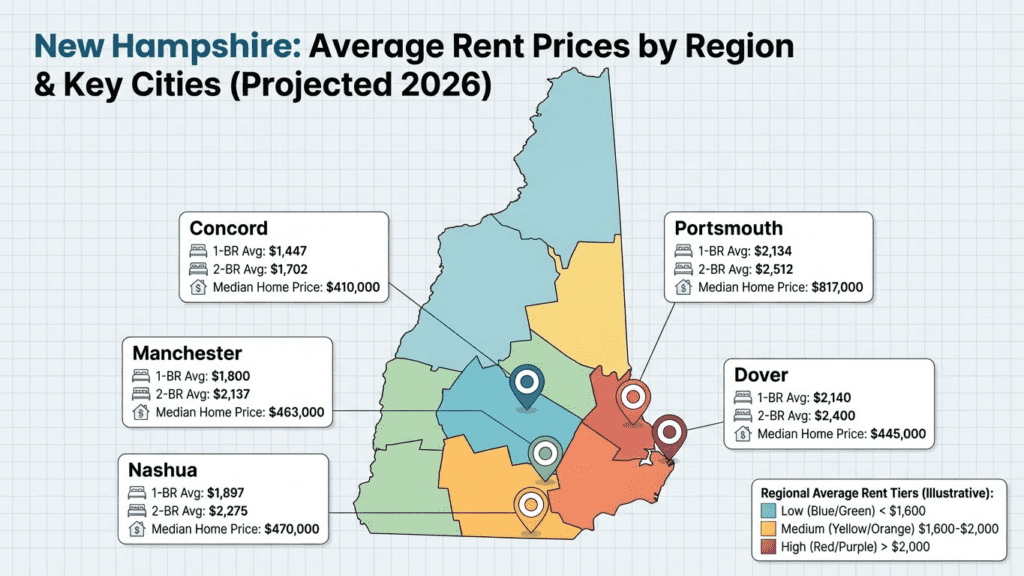
Living in New Hampshire costs approximately 12-15% more than the national average, with the typical resident spending around $65,908 annually on goods and services. This figure comes directly from federal consumer expenditure data and reflects everything from housing to healthcare.
Here’s what different household types typically spend each month:
| Household Type | Monthly Cost (with rent) | Annual Cost |
|---|---|---|
| Single Person | $3,995 | $47,940 |
| Couple (2 adults) | $5,538 | $66,456 |
| Family of Four | $7,755 | $93,060 |
The good news? New Hampshire’s median household income of $95,628 significantly outpaces the national median of $78,538, which helps offset these higher expenses. Many residents find that the combination of higher wages and zero income tax actually puts more money in their pockets compared to neighboring Massachusetts or Connecticut.
What Will You Pay for Rent Across New Hampshire?
Housing dominates the budget for most New Hampshire residents, and rental prices have climbed steadily over the past five years. According to current rental market data from Apartments.com, the statewide average rent now sits at $1,828 per month for a one-bedroom apartment—roughly $200 more than the national average.
Average Rent by Apartment Size
| Apartment Type | Average Rent (2025) |
|---|---|
| Studio | $1,490 |
| 1-Bedroom | $1,828 |
| 2-Bedroom | $2,145 |
| 3-Bedroom | $2,627 |
Your location within New Hampshire dramatically affects what you’ll pay. The seacoast region commands premium prices, while northern communities offer significant savings.
Rent Prices Across Major Cities
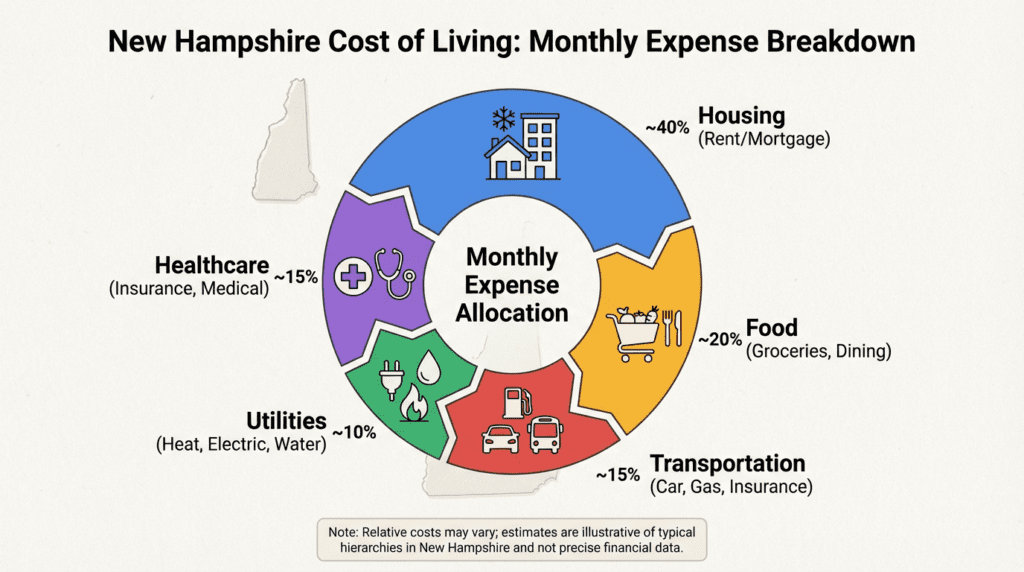
Portsmouth tops the list as New Hampshire’s most expensive rental market. This historic seaport city attracts residents with its walkable downtown, craft breweries, and waterfront dining—but you’ll pay for the privilege. A one-bedroom apartment averages $2,134 monthly, and two-bedrooms climb to $2,512. If you’re drawn to coastal living, you can browse available Portsmouth rentals on Zillow to see current listings.
Manchester, the state’s largest city, offers more moderate pricing at $1,800 for a one-bedroom. The city has undergone significant revitalization, with the Millyard district now housing tech companies, restaurants, and Southern New Hampshire University’s campus. Two-bedroom units average $2,137, making it a practical choice for those who want urban amenities without Portsmouth prices.
Nashua sits along the Massachusetts border, making it popular with Boston commuters who want New Hampshire’s tax advantages. Expect to pay around $1,897 for a one-bedroom here. The city offers easy access to Boston via Route 3 while maintaining a lower cost of living than communities south of the border.
Concord, the state capital, provides the best value among major cities at just $1,447 for a one-bedroom. The city combines historic New England charm with practical affordability, and you can explore available units through Concord apartment listings on Rent.com.
| City | 1-BR Average | 2-BR Average | Median Home Price |
|---|---|---|---|
| Portsmouth | $2,134 | $2,512 | $817,000 |
| Nashua | $1,897 | $2,275 | $470,000 |
| Manchester | $1,800 | $2,137 | $463,000 |
| Concord | $1,447 | $1,702 | $410,000 |
| Dover | $2,140 | $2,400 | $445,000 |
How Has the Housing Market Changed for Buyers?
The New Hampshire housing market has transformed dramatically since 2019. According to analysis from the New Hampshire Fiscal Policy Institute, the median home price reached $569,450 in mid-2025—more than double the 2019 median of $248,008.
This surge reflects a combination of limited housing inventory, in-migration from higher-cost states, and restrictive municipal zoning that has slowed new construction. For buyers, this means acting quickly when properties hit the market and being prepared to compete.
Current Home Prices by City
The coastal city of Portsmouth commands the highest prices, with a median of $817,000. Buyers here pay premium prices for historic homes, ocean access, and one of New England’s most vibrant downtown scenes. You can track current Portsmouth listings through Redfin’s New Hampshire portal.
Moving inland, prices become more accessible. Nashua and Manchester both hover around $463,000-$470,000, offering a middle ground between coastal premiums and rural affordability. The state capital of Concord provides even better value at $410,000, while Keene in the southwest corner averages just $380,000.
| City | Median Home Price | Price per Sq Ft |
|---|---|---|
| Portsmouth | $817,000 | $425 |
| Nashua | $470,000 | $285 |
| Manchester | $463,000 | $275 |
| Dover | $445,000 | $304 |
| Concord | $410,000 | $265 |
| Keene | $380,000 | $251 |
How Does New Hampshire Compare to Neighboring States?
Despite recent price increases, New Hampshire remains more affordable than Massachusetts, where the median home now exceeds $646,000. Vermont and Maine offer lower entry points around $390,000, but neither matches New Hampshire’s combination of no income tax and proximity to Boston’s job market.
| State | Median Home Price (2025) |
|---|---|
| Massachusetts | $646,000 |
| New Hampshire | $499,000 |
| Vermont | $390,220 |
| Maine | $391,452 |
First-time buyers should explore the New Hampshire Housing Finance Authority, which offers down payment assistance, competitive mortgage rates, and homebuyer education programs specifically designed for Granite State residents.
What’s the Deal with New Hampshire Property Taxes?
Here’s where New Hampshire’s tax-free reputation gets complicated. Without income or sales tax revenue, the state relies heavily on property taxes to fund schools, roads, and municipal services. The result? New Hampshire has the 4th-highest effective property tax rate in the nation at approximately 1.61%, according to the Tax Foundation’s state tax data.
The median annual property tax payment comes to $6,372—ranking third-highest nationally. However, many residents argue this trade-off still works in their favor, especially high earners who would pay substantial income taxes in other states.
Property Tax Rates Vary Dramatically by Town
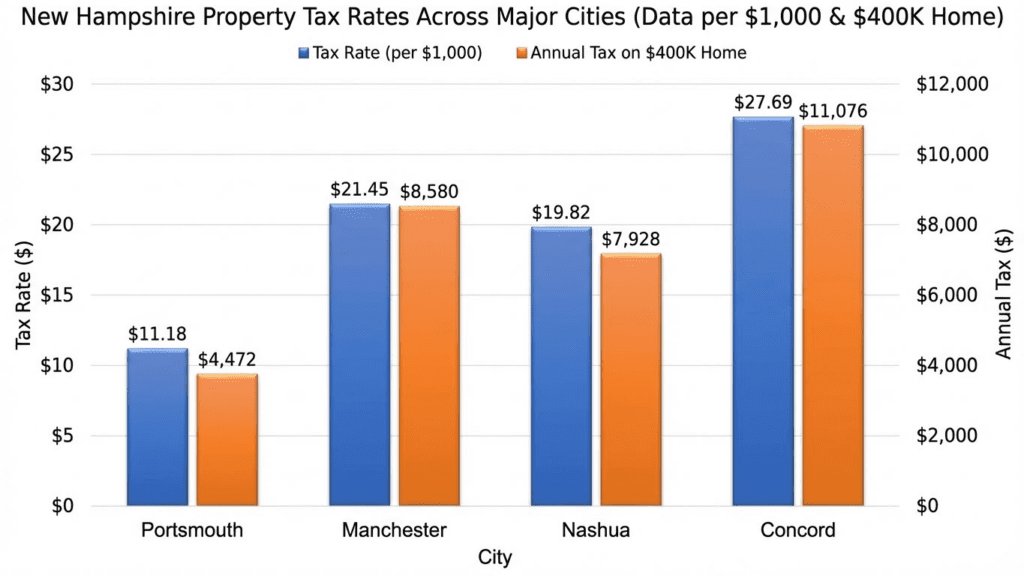
What surprises many newcomers is how much property taxes vary between municipalities. The town of Portsmouth maintains a relatively low rate of $11.18 per $1,000 of assessed value, meaning a $400,000 home generates about $4,472 in annual taxes. Drive an hour north to Concord, and that same home would cost $11,076 annually at the city’s $27.69 rate.
| Town | Tax Rate (per $1,000) | Annual Tax on $400K Home |
|---|---|---|
| Portsmouth | $11.18 | $4,472 |
| Manchester | $21.45 | $8,580 |
| Nashua | $19.82 | $7,928 |
| Concord | $27.69 | $11,076 |
Before purchasing property, verify current rates through the NH Department of Revenue Administration’s municipal database. Rates change annually based on local budgets and assessed values.
What Tax Advantages Does New Hampshire Offer?
Despite high property taxes, New Hampshire’s overall tax structure remains among the most favorable in the country. The Tax Foundation ranks New Hampshire 3rd in its State Tax Competitiveness Index, reflecting the state’s business-friendly approach.
New Hampshire Tax Structure (2025)
| Tax Type | Rate | Notes |
|---|---|---|
| State Income Tax (Wages) | 0% | No tax on earned income |
| Interest & Dividends Tax | 0% | Repealed January 1, 2025 |
| Sales Tax | 0% | No general sales tax |
| Estate Tax | 0% | No estate or inheritance tax |
| Corporate Income Tax | 7.5% | Business profits tax |
| Property Tax | ~1.61% | Among highest in U.S. |
A major change took effect on January 1, 2025: New Hampshire eliminated its 3% tax on interest and dividends, making it one of only eight states with absolutely no personal income tax. This benefits retirees and investors significantly, as investment income now flows through completely untaxed at the state level.
The lack of sales tax extends to nearly all purchases, from groceries to automobiles to electronics. Combined with no income tax, this means your paycheck goes further here than in most neighboring states—even after accounting for property taxes.
How Much Should You Budget for Groceries?
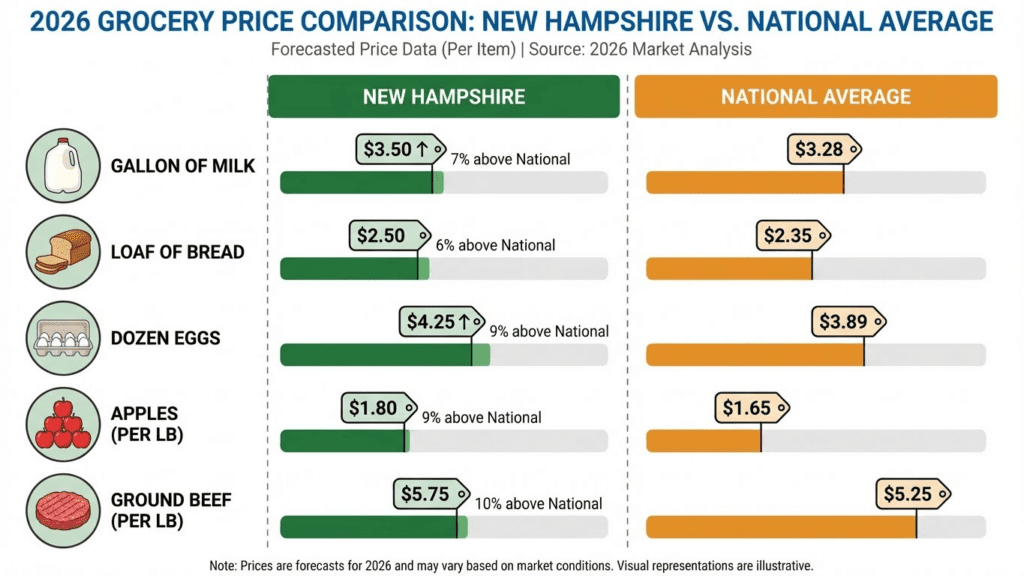
Food costs in New Hampshire run approximately 10% above the national average, according to data from the Bureau of Labor Statistics New England office. The state’s northern location means higher transportation costs for goods, and the relatively small population doesn’t generate the same economies of scale as larger states.
A single adult typically spends $300-$450 monthly on groceries, while families can expect bills of $600-$1,430 depending on size and eating habits.
Average Grocery Prices
| Item | New Hampshire Price | National Average |
|---|---|---|
| Gallon of Milk | $3.50 | $3.28 |
| Loaf of Bread | $2.50 | $2.35 |
| Dozen Eggs | $4.25 | $3.89 |
| Apples (per lb) | $1.80 | $1.65 |
| Ground Beef (per lb) | $5.75 | $5.25 |
Budget-conscious shoppers gravitate toward Market Basket, a regional chain known for aggressive pricing that often undercuts national competitors. Hannaford offers another solid option with frequent sales and a loyalty program. For bulk purchases, BJ’s Wholesale Club operates several New Hampshire locations.
Those seeking local and organic options can find farmers markets throughout the state during growing season. The NH Department of Agriculture maintains a directory of markets by region, many operating from May through October.
What Will Utilities Cost You?
Utility expenses in New Hampshire run 14-16% higher than national averages, primarily due to harsh winters that demand significant heating. According to utility cost analysis from SoFi, the typical household pays $350-$424 monthly for electricity, gas, water, and internet combined.
Average Monthly Utility Costs
| Utility | Monthly Cost |
|---|---|
| Electricity | $141-$150 |
| Gas/Heating | $72-$100 |
| Water | $23-$35 |
| Trash | $25-$45 |
| Internet | $50-$80 |
| Total | $311-$424 |
Electricity rates deserve special attention. New Hampshire charges approximately $0.234 per kilowatt-hour—significantly above the national average of $0.16. This stems from the state’s reliance on natural gas and limited in-state generation capacity.
Winter heating represents the largest variable expense. Homes heated with oil—still common in New Hampshire—can see monthly bills exceed $400 during January and February. Natural gas and heat pumps offer more predictable costs, though installation expenses vary.
For electricity service, most residents use Eversource or Liberty Utilities. The NH Public Utilities Commission provides rate comparisons and consumer resources for those looking to reduce energy costs.
How Does Healthcare Factor Into Your Budget?
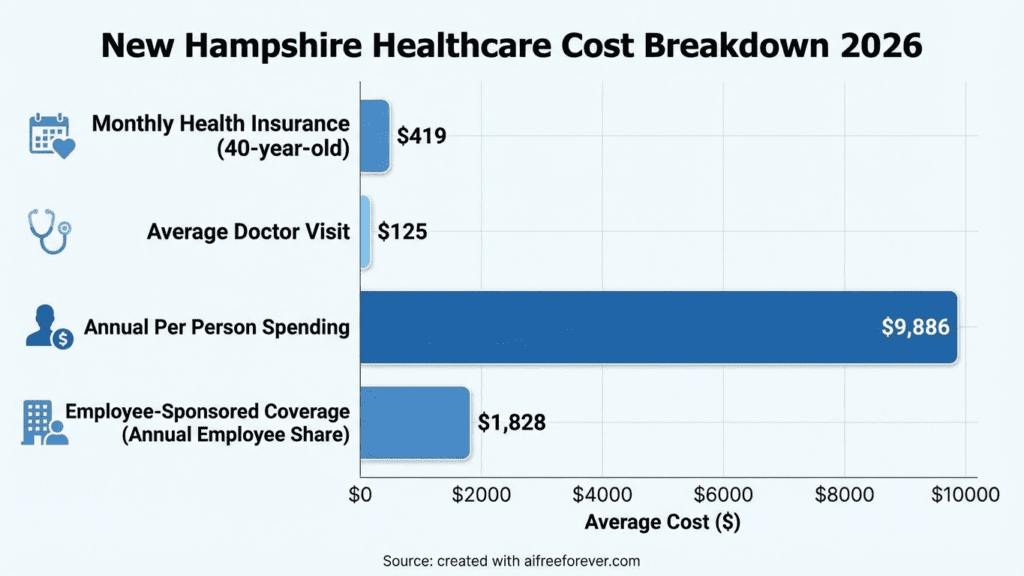
Healthcare costs in New Hampshire align closely with national averages, though access varies significantly between urban and rural areas. The Bureau of Economic Analysis reports annual per-person healthcare spending of approximately $9,886 statewide.
Healthcare Cost Breakdown
| Category | Average Cost |
|---|---|
| Monthly Health Insurance (40-year-old) | $419 |
| Average Doctor Visit | $125 |
| Annual Per Person Spending | $9,886 |
| Employee-Sponsored Coverage (Annual Employee Share) | $1,828 |
The state’s healthcare infrastructure centers on several major systems. Dartmouth-Hitchcock Medical Center in Lebanon serves as the region’s academic medical center and provides specialized care for the entire state. In the south, Elliot Hospital and Catholic Medical Center anchor Manchester’s healthcare options.
Rural residents may need to travel 30-45 minutes for specialist appointments, though primary care clinics operate throughout smaller communities. Those shopping for individual health insurance can compare plans through Healthcare.gov’s New Hampshire marketplace.
Where Can You Find Affordable Living in New Hampshire?
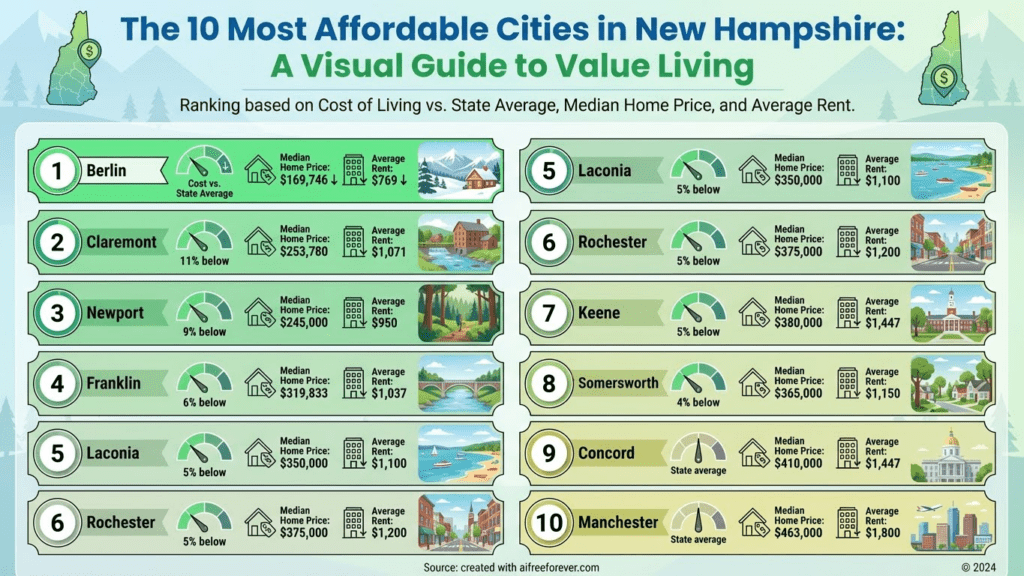
Not everywhere in New Hampshire carries premium prices. Several communities offer cost of living 10-20% below the state average, making homeownership and comfortable living accessible on more modest incomes.
The 10 Most Affordable Cities in New Hampshire
| Rank | City | Cost vs. State Average | Median Home Price | Average Rent |
|---|---|---|---|---|
| 1 | Berlin | 21% below | $169,746 | $769 |
| 2 | Claremont | 11% below | $253,780 | $1,071 |
| 3 | Newport | 9% below | $245,000 | $950 |
| 4 | Franklin | 6% below | $319,833 | $1,037 |
| 5 | Laconia | 5% below | $350,000 | $1,100 |
| 6 | Rochester | 5% below | $375,000 | $1,200 |
| 7 | Keene | 5% below | $380,000 | $1,447 |
| 8 | Somersworth | 4% below | $365,000 | $1,150 |
| 9 | Concord | State average | $410,000 | $1,447 |
| 10 | Manchester | State average | $463,000 | $1,800 |
Berlin: New Hampshire’s Most Affordable Option
The former mill town of Berlin offers the lowest cost of living in the state—21% below average according to AreaVibes community data. Located in the North Country near the Canadian border, Berlin attracts retirees and outdoor enthusiasts with median home prices under $170,000 and rents averaging just $769 monthly.
The trade-off? Limited job opportunities and a 90-minute drive to the nearest major city. But for remote workers or retirees, Berlin provides access to Jericho Mountain State Park, excellent snowmobiling, and a tight-knit community. Learn more about the area through the City of Berlin’s official website.
Claremont: Western New Hampshire’s Hidden Gem
Claremont ranks second in affordability at 11% below state average. This Sullivan County city sits along the Vermont border, offering easy access to both states while maintaining New Hampshire’s tax advantages. The Sugar River runs through downtown, and outdoor recreation abounds in nearby state forests.
Housing costs here run roughly 48% below national averages, making Claremont particularly attractive for first-time buyers. The city’s revitalizing downtown includes local restaurants, a historic opera house, and community events throughout the year.
What Salary Do You Need to Live Comfortably?
Financial advisors typically recommend spending no more than 30% of gross income on housing. Using this guideline, here’s what you’d need to earn in different New Hampshire cities:
Required Salary by City
| City | Average 1-BR Rent | Required Annual Income | Required Hourly Wage |
|---|---|---|---|
| Portsmouth | $2,134 | $85,360 | $41.04 |
| Nashua | $1,897 | $75,880 | $36.48 |
| Manchester | $1,800 | $72,000 | $34.62 |
| Concord | $1,447 | $57,880 | $27.83 |
| Berlin | $769 | $30,760 | $14.79 |
Understanding Living Wage Requirements
The MIT Living Wage Calculator provides more nuanced guidance based on household composition:
| Household Type | Living Wage (Hourly) | Annual Equivalent |
|---|---|---|
| Single Adult | $23.58 | $49,046 |
| Single Adult + 1 Child | $46.87 | $97,490 |
| 2 Adults (1 working) | $34.23 | $71,198 |
| 2 Adults + 2 Children (both working) | $25.84 each | $53,747 each |
These figures account for housing, food, healthcare, transportation, and other necessities—providing a realistic baseline for financial planning.
How Does New Hampshire Stack Up Regionally?
Among New England states, New Hampshire occupies a middle position on affordability while offering the best tax situation. Data from MERIC’s Cost of Living Index shows:
| State | Cost of Living Index | Housing Index | Income Tax |
|---|---|---|---|
| Massachusetts | 135 | 160 | Up to 9% |
| Connecticut | 121 | 130 | Up to 6.99% |
| New Hampshire | 112 | 126 | 0% |
| Vermont | 108 | 115 | Up to 8.75% |
| Maine | 103 | 105 | Up to 7.15% |
Index: 100 = National Average
For workers earning $100,000 annually, the income tax savings alone can exceed $5,000-$9,000 compared to neighboring states—often more than offsetting higher property taxes and housing costs.
Sample Monthly Budgets for New Hampshire Living
Single Professional in Manchester
| Category | Monthly Amount |
|---|---|
| Rent (1-BR apartment) | $1,800 |
| Utilities | $325 |
| Groceries | $400 |
| Transportation | $450 |
| Healthcare | $420 |
| Entertainment & Dining | $300 |
| Savings | $400 |
| Miscellaneous | $205 |
| Total | $4,300 |
Required annual salary: ~$65,000 for comfortable living with savings
Family of Four in Concord
| Category | Monthly Amount |
|---|---|
| Rent/Mortgage (3-BR) | $2,400 |
| Utilities | $450 |
| Groceries | $1,100 |
| Transportation (2 vehicles) | $900 |
| Healthcare | $850 |
| Childcare/Activities | $800 |
| Entertainment | $250 |
| Savings | $450 |
| Total | $7,200 |
Required household income: ~$110,000 for comfortable living
Frequently Asked Questions
Is New Hampshire actually cheaper than Massachusetts?
Yes, by a significant margin. Overall costs run 15-20% lower than Massachusetts, with the biggest savings in housing and taxes. A family earning $150,000 could save $10,000+ annually in income taxes alone by living in New Hampshire, even with higher property taxes factored in.
Can you live comfortably in New Hampshire on $50,000 a year?
In affordable areas like Berlin, Claremont, or Franklin—yes. In Portsmouth or the seacoast region—it would be extremely difficult. A $50,000 salary works best for single individuals without children who choose housing in lower-cost communities.
Why does New Hampshire have such high property taxes?
Without income or sales tax, property taxes serve as the primary funding mechanism for schools, police, fire services, and local government. The state essentially trades broad-based taxes for a single concentrated tax, which benefits those with high incomes but modest homes.
Is New Hampshire a good place to retire?
For many retirees, yes. The elimination of interest and dividend taxes in 2025 makes investment income completely state-tax-free. Social Security, pensions, and retirement account distributions face zero state taxation. However, property taxes can strain fixed incomes, so location selection matters significantly.
Is New Hampshire Worth the Cost?
New Hampshire presents a genuine trade-off: you’ll pay more for housing and property taxes, but keep significantly more of your paycheck. For households earning above $75,000 annually, the math typically works in New Hampshire’s favor compared to taxed neighboring states.
The state delivers excellent schools, low crime rates, four-season outdoor recreation, and reasonable proximity to Boston’s cultural and employment opportunities. Communities range from affordable former mill towns to premium coastal enclaves, allowing residents to match their location to their budget.
The bottom line: If you earn a solid income and prioritize tax efficiency, New Hampshire offers compelling value despite its above-average cost of living. Those on tighter budgets should target affordable communities like Berlin, Claremont, or Keene rather than the expensive seacoast region.
Official State Resources
- NH Employment Security – Job listings and unemployment services
- NH Housing Finance Authority – Homebuyer programs and rental assistance
- NH Department of Revenue – Tax information and forms
- Visit NH – Tourism and relocation information
This article uses data from the U.S. Bureau of Labor Statistics, U.S. Census Bureau, Tax Foundation, MIT Living Wage Calculator, Zillow, Redfin, Apartments.com, and New Hampshire state agencies. All figures reflect the most current data available as of December 2025.