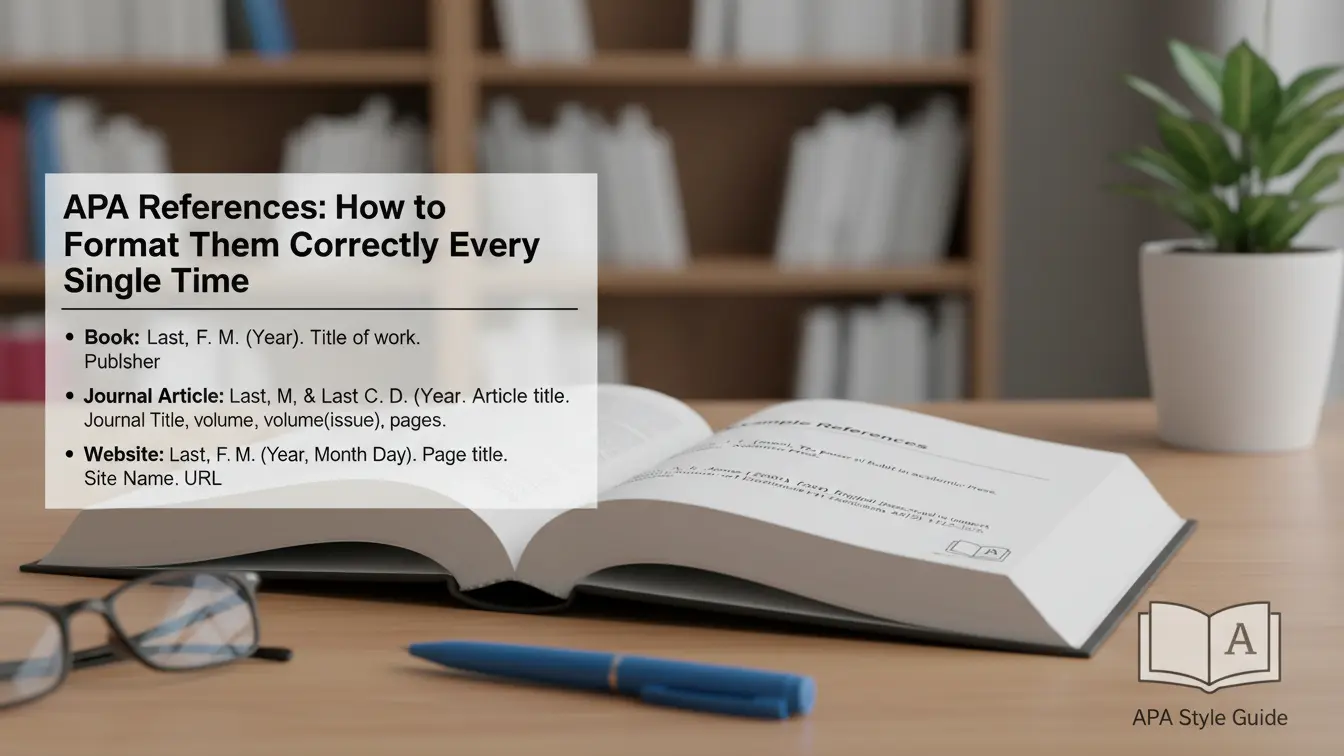
For students and graduates writing a thesis, final year project or just an academic paper, the APA 7th edition reference formatting follows a pattern. Once you crack the code, you’ll nail it every time. This guide breaks down what you need to know. By the end, you’ll format journal articles, books, websites, and everything else without second-guessing yourself.
Table of Contents
- What Is APA Reference Formatting?
- 5 Basic Rules for Every Reference
- Journal Articles (The Most Common Type)
- Books and Book Chapters
- Websites and Online Sources
- Multiple Authors (When to Use “et al.”)
- DOIs and URLs (The Tricky Part)
- 7 Mistakes That Kill Your Grade
- Setting Up Your References Page
- Free Tools That Save Time
- FAQ
What Is APA Reference Formatting?
APA format is the citation style created by the American Psychological Association. It’s used in psychology, education, business, and social sciences. The reference list sits at the end of your paper, listing every source you cited.
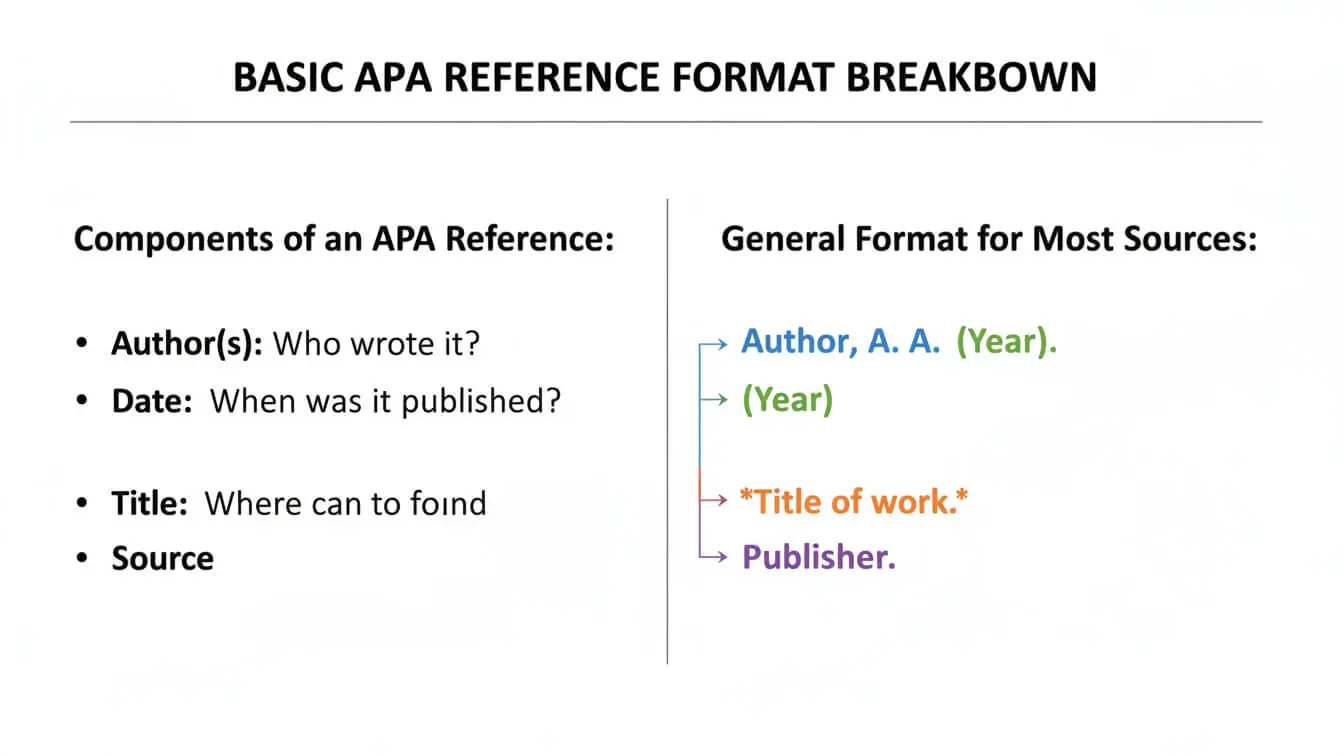
Each reference has four parts:
- Author – Who wrote it
- Date – When they published it
- Title – What it’s called
- Source – Where readers can find it
These four elements appear in almost every reference. Master them, and you’re golden.
5 Basic Rules for Every APA Reference
Before we dive into specific types, here are the rules that apply to everything:
1. Start with Author’s Last Name
List authors by last name, then initials. No first names. If there’s no author, start with the title.
Right: Smith, J. R.
Wrong: John R. Smith
2. Add the Year in Parentheses
Put the publication year right after the author. For websites without a clear date, use (n.d.) for “no date.”
Example: Johnson, M. (2023).
3. Use Sentence Case for Titles
Only capitalize the first word, first word after a colon, and proper nouns. Don’t capitalize every word like you would in a headline.
Right: The impact of social media on teen mental health
Wrong: The Impact of Social Media on Teen Mental Health
4. Italicize What Stands Alone
Books, journals, websites—if it stands alone, italicize it. Articles, chapters, and web pages—those don’t get italics.
5. End with DOI or URL
If your source has a DOI (digital object identifier), include it. No DOI? Use the URL if it’s online. Format: https://doi.org/xxxxx
Journal Articles APA Reference
Journal articles follow a specific pattern. According to APA guidelines, here’s what you need:
Format:
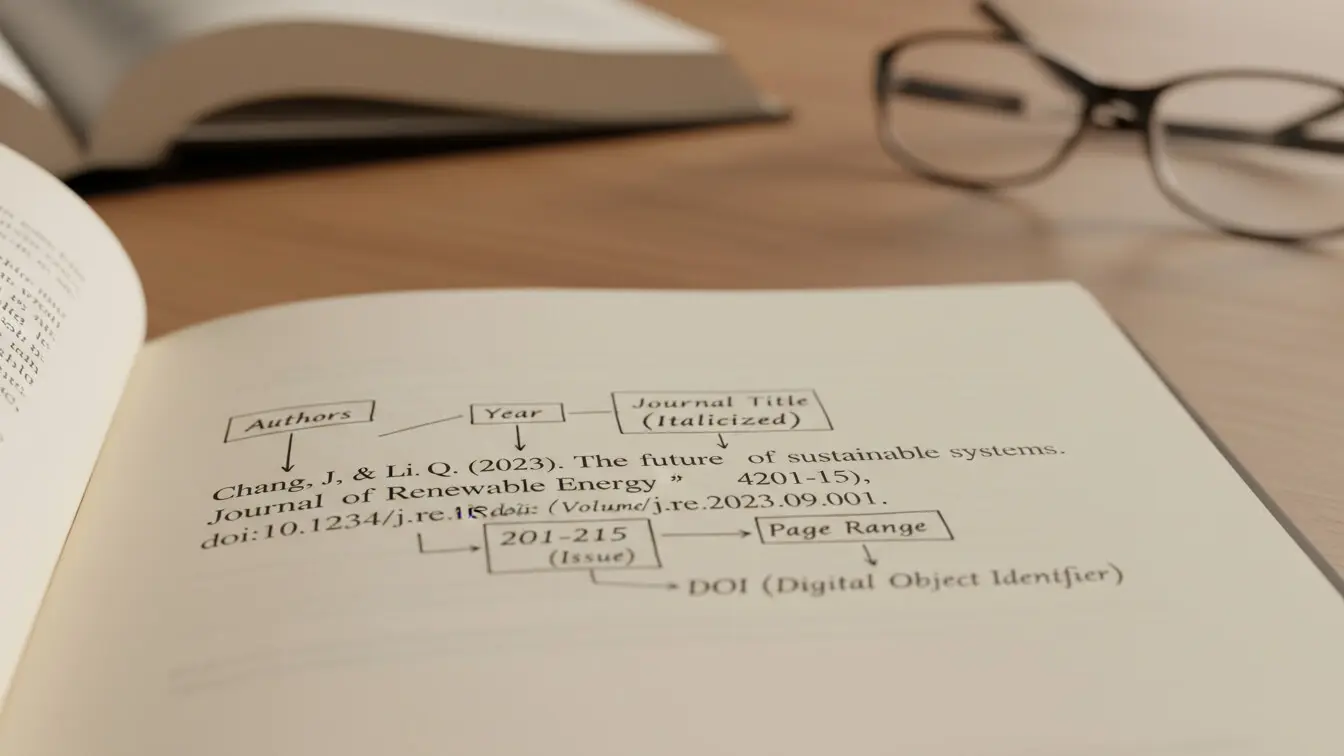
Author, A. A., & Author, B. B. (Year). Title of the article. Title of Journal, volume(issue), page range. https://doi.org/xxxxx
Example:
Niepel, C., Hausen, J. E., Weber, A. M., & Möller, J. (2025). Understanding mean-level and intraindividual variability in state academic self-concept: The role of students’ trait expectancies and values. Journal of Educational Psychology, 117(5), 772–788. https://doi.org/10.1037/edu0000789
Notice:
- Journal name is in italics
- Volume number is italicized
- Issue number is in parentheses (not italicized)
- Page numbers use an en dash (–)
- DOI at the end (no period after)
Journal Article Without DOI
Some older articles don’t have DOIs. If you found it online, use the journal’s homepage URL.
Example:
Brown, T. (2020). Digital learning in rural schools. Education Today, 45(2), 112-127. https://www.educationtoday.org
Journal Article From a Database
Don’t include the database name. Treat it like a print source if it doesn’t have a DOI.
Books and Book Chapters
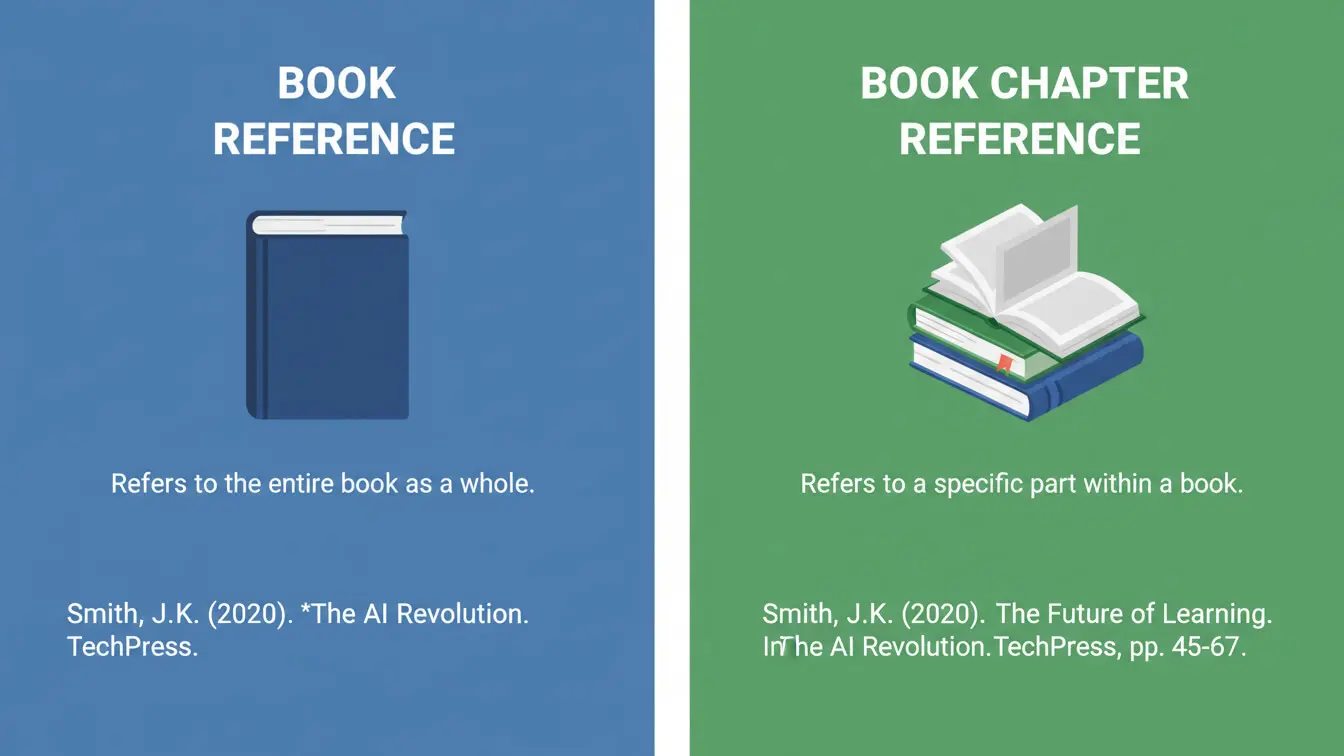
Whole Book
Format:
Author, A. A. (Year). Title of the book (Edition if not 1st ed.). Publisher. https://doi.org/xxxxx
Example:
Thompson, R. (2024). Learning psychology: A modern approach (3rd ed.). Academic Press. https://doi.org/10.1234/book.2024.001
If the book doesn’t have a DOI and you used the print version, stop after the publisher. Don’t add a URL.
Edited Book
For books with editors instead of authors, use (Ed.) or (Eds.) after their names.
Example:
Martinez, L., & Chen, K. (Eds.). (2023). Modern approaches to cognitive therapy. Springer Publishing.
Book Chapter
Citing one chapter? Include the chapter author, chapter title, book editors, book title, and page numbers.
Format:
Chapter Author, A. A. (Year). Title of chapter. In B. B. Editor & C. C. Editor (Eds.), Title of book (pp. page range). Publisher. DOI
Example:
Zeleke, W. A., Hughes, T. L., & Drozda, N. (2020). Home–school collaboration to promote mind–body health. In C. Maykel & M. A. Bray (Eds.), Promoting mind–body health in schools: Interventions for mental health professionals (pp. 11–26). American Psychological Association. https://doi.org/10.1037/0000123-001
E-books
Format e-books exactly like print books. Include a DOI if available. If not, use the URL from the publisher or retailer.
Websites and Online Sources APA Reference
Webpage on a Website
Most websites don’t have individual authors. Use the organization name as the author.
Format:
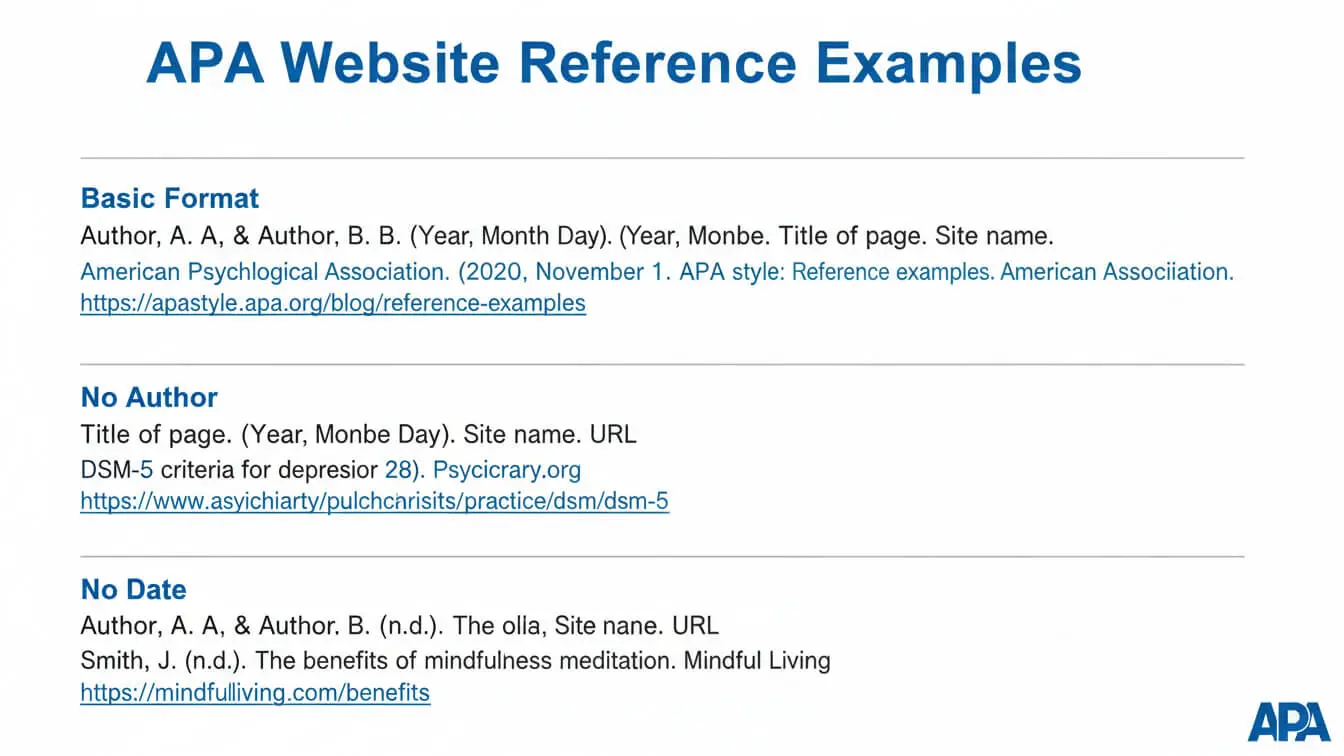
Organization Name. (Year, Month Day). Title of webpage. Site Name. URL
Example:
Centers for Disease Control and Prevention. (2024, March 15). Mental health and COVID-19. CDC. https://www.cdc.gov/mentalhealth/covid19
Webpage Without a Date
For pages that don’t show when they were published or updated, use (n.d.) for “no date.”
Example:
American Psychological Association. (n.d.). Understanding depression. APA. https://www.apa.org/topics/depression
Webpage With Retrieval Date
APA says you only need a retrieval date if the content might change. Think: live data dashboards, wikis, or news sites that update constantly.
Example:
Worldometer. (n.d.). Current world population. Retrieved November 22, 2025, from https://www.worldometers.info/world-population/
Blog Post
Blogs work like webpages. Use the author’s name if available, or the blog’s name.
Example:
Rutledge, P. (2024, April 23). Are tweens too young for digital literacy? Dr. Pam: Living With Media. https://www.pamelarutledge.com/tweens-digital-literacy
Online News Article
Example:
Volpe, A. (2024, June 3). How the self-care industry made us so lonely. Vox. https://www.vox.com/self-care-isolation-loneliness
Multiple Authors (When to Use “et al.”)
Lots of sources have multiple authors. Here’s how to handle them.
In the Reference List
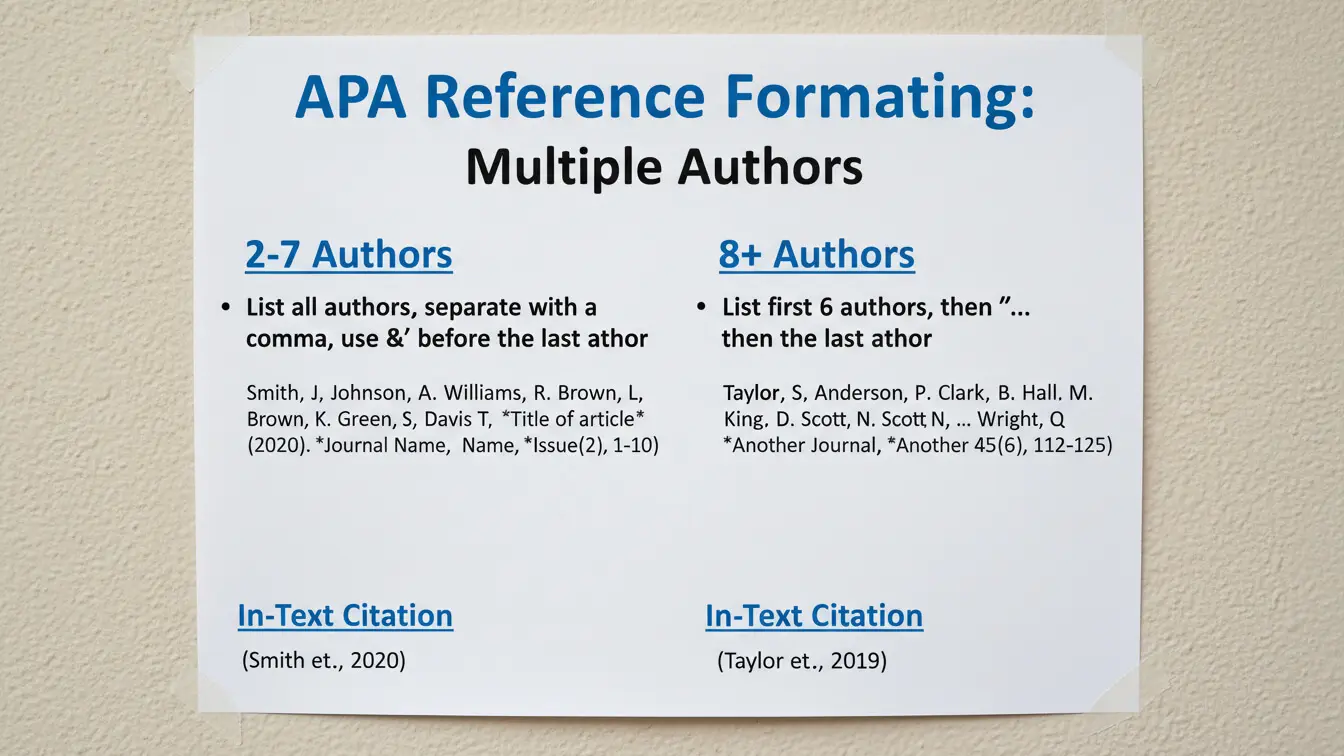
List all authors up to 20. If there are 21 or more, list the first 19, insert three ellipses (…), then add the last author’s name.
Example with 4 authors:
Smith, J., Martinez, R., Lee, K., & Thompson, P. (2023)…
Example with 21+ authors:
Anderson, M., Brown, T., Chen, L., Davis, K., Evans, R., Foster, J., Garcia, M., Harris, D., Ibrahim, S., Johnson, P., Kim, H., Lopez, C., Miller, A., Nelson, B., O’Brien, K., Parker, L., Quinn, M., Roberts, N., Scott, J., … Zhang, Y. (2024)…
In In-Text Citations
Different rules apply when you cite sources in your paper:
- 1-2 authors: List both every time – (Smith & Johnson, 2023)
- 3+ authors: First author only, then “et al.” – (Martinez et al., 2024)
Notice: Use “and” in narrative citations, “&” in parenthetical citations.
Narrative: Smith and Johnson (2023) found that…
Parenthetical: Recent studies show this pattern (Smith & Johnson, 2023).
DOIs and URLs APA Reference
What’s a DOI?
A DOI is a permanent ID number for academic work. It’s like a social security number for journal articles. Publishers assign DOIs so articles can be found forever, even if the URL changes.
DOIs look like this: 10.1037/edu0000789
How to Format DOIs
Always present DOIs as a link: https://doi.org/10.1037/edu0000789
Don’t do this:
- DOI: 10.1037/edu0000789
- doi:10.1037/edu0000789
- http://dx.doi.org/10.1037/edu0000789 (old format)
If you see an old-style DOI in your source, convert it to the new format.
DOI vs. URL: Which One?
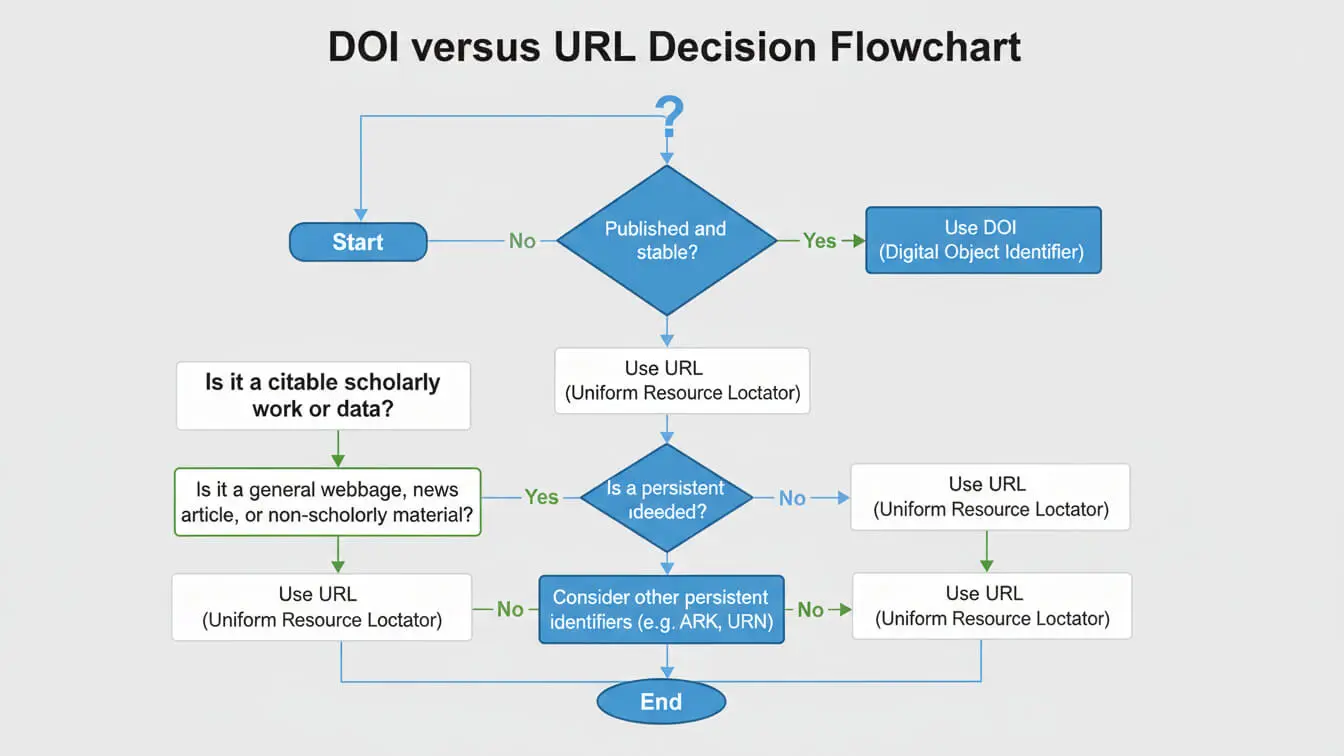
Follow this priority:
- Has a DOI? Use it. Don’t add URL even if you have one.
- No DOI, found online? Use the URL.
- No DOI, found in database? Leave it off (unless it’s a proprietary database).
- Print source? No DOI or URL needed.
Finding DOIs
Sometimes DOIs hide. Try these:
- Check the PDF—usually on the first page
- Search Crossref.org DOI lookup
- Google the article title and look for publisher websites
- Check Google Scholar—DOIs often appear in citations
URL Formatting Rules
Copy and paste URLs directly from your browser. Don’t change anything.
Important:
- No period after the URL (it looks like part of the link)
- Don’t add “Retrieved from” before URLs anymore
- URLs can be blue and underlined (hyperlinked) or plain black text
- If the URL breaks across lines, that’s fine—don’t force it
7 APA Reference Mistakes That Kill Your Grade
Research from the Journal of European Psychology Students found that 90.9% of papers have three or more reference mistakes. Don’t be part of that statistic.
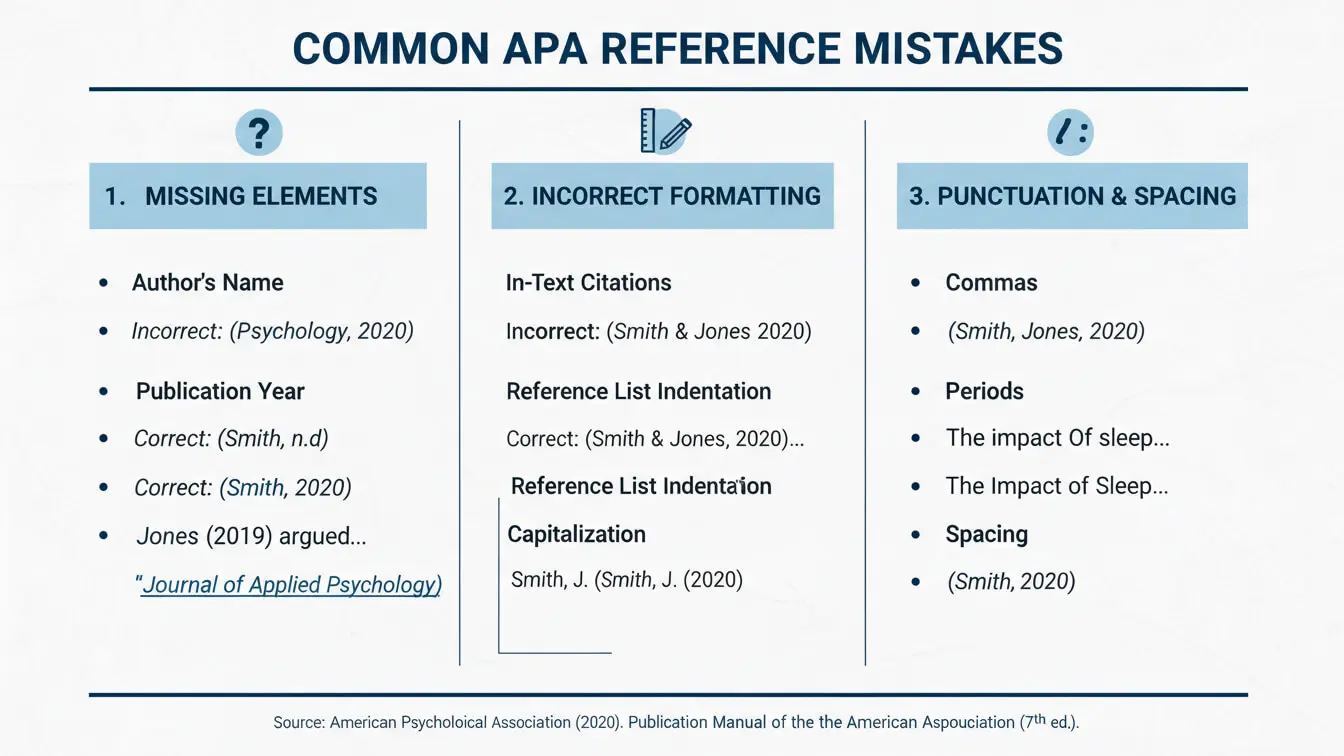
1. Wrong Capitalization in Titles
Wrong: The Effects Of Social Media On Mental Health
Right: The effects of social media on mental health
Remember: Sentence case only. First word, first word after colon, proper nouns.
2. Using “and” Instead of “&” in Reference Lists
Wrong: Smith, J. and Johnson, P. (2023).
Right: Smith, J., & Johnson, P. (2023).
Save “and” for in-text narrative citations. References get “&”.
3. Missing Hanging Indents
Every reference after the first line should indent 0.5 inches. This makes it easier to scan the list alphabetically.
How to create hanging indents:
- Microsoft Word: Select text, right-click, Paragraph, Special: Hanging
- Google Docs: Select text, Format, Align & indent, Indentation options, Special: Hanging
4. Forgetting Page Numbers for Quotes
Direct quotes need page numbers in in-text citations. Online sources without pages? Use paragraph numbers or section headings.
Example: (Smith, 2023, p. 45) or (Johnson, 2024, para. 3)
5. Including Database Names
Don’t write “Retrieved from EBSCO” or “PsycINFO database.” That’s outdated. Treat database articles like print unless the database is proprietary.
6. Period After DOI or URL
This breaks the link. No period at the end.
Wrong: https://doi.org/10.1037/edu0000789.
Right: https://doi.org/10.1037/edu0000789
7. References That Don’t Match In-Text Citations
Every in-text citation needs a reference list entry. Every reference list entry needs an in-text citation. No extras, no missing pieces.
Before you submit, check: Do all your (Author, Year) citations have matching references? Do all your references appear somewhere in your paper?
How to set up your References Page
The page itself has rules too.
Page Setup
- Start on a new page after your paper
- Title: “References” (centered, bolded, not italicized)
- Double-space everything—no exceptions
- Use hanging indents for each entry
- List entries alphabetically by first author’s last name
Alphabetizing Rules
Letter by letter, ignoring spaces.
Order:
- McDonald, K.
- McIntyre, P.
- MacArthur, J. (Mac comes before Mc in letter-by-letter)
Numbers? Spell them out. “3M” becomes “ThreeM” for alphabetizing.
Multiple Works by Same Author
List chronologically, oldest first. Same author, same year? Add lowercase letters after the year.
Example:
- Smith, J. (2022a). First article…
- Smith, J. (2022b). Second article…
- Smith, J. (2023). Third article…
No Author?
Start with the title. Ignore “A,” “An,” and “The” when alphabetizing.
Example:
The state of mental health in America. (2024).
This files under “S” for “State,” not “T” for “The.”
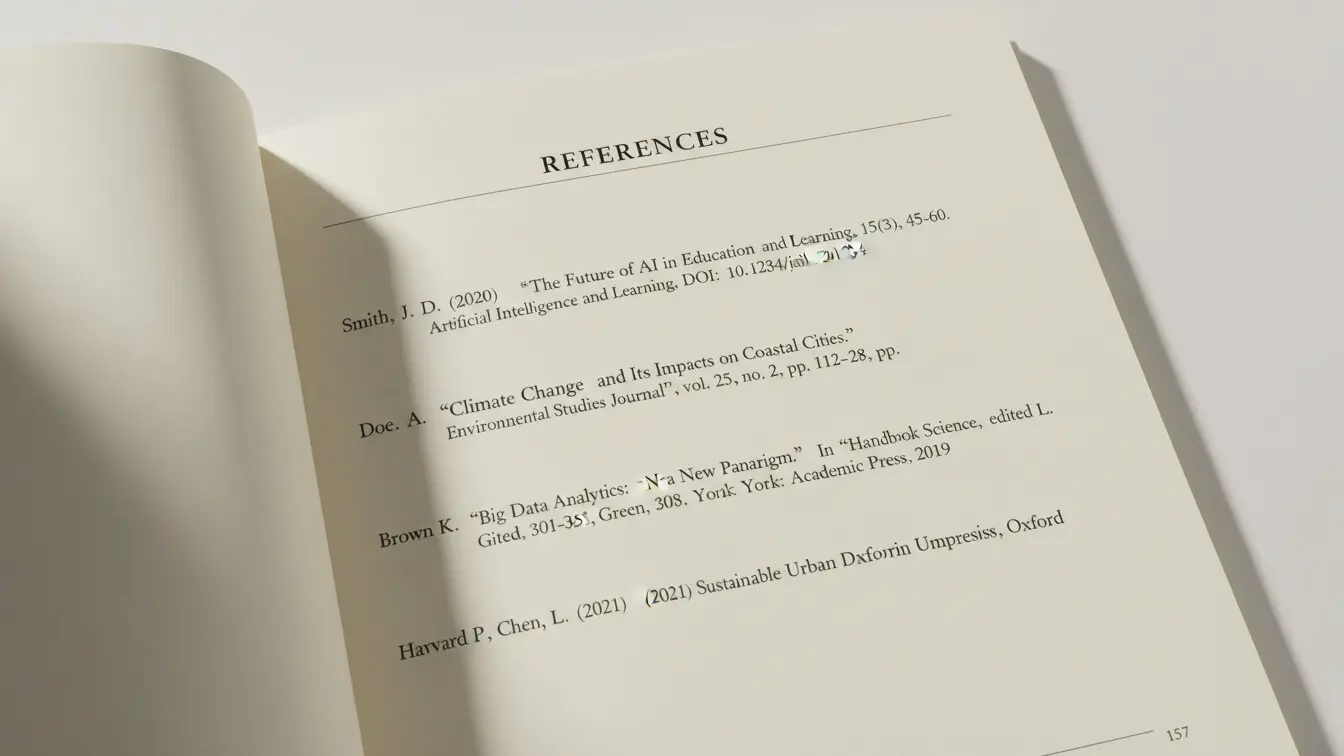
Free Tools For Creating Perfect APA References
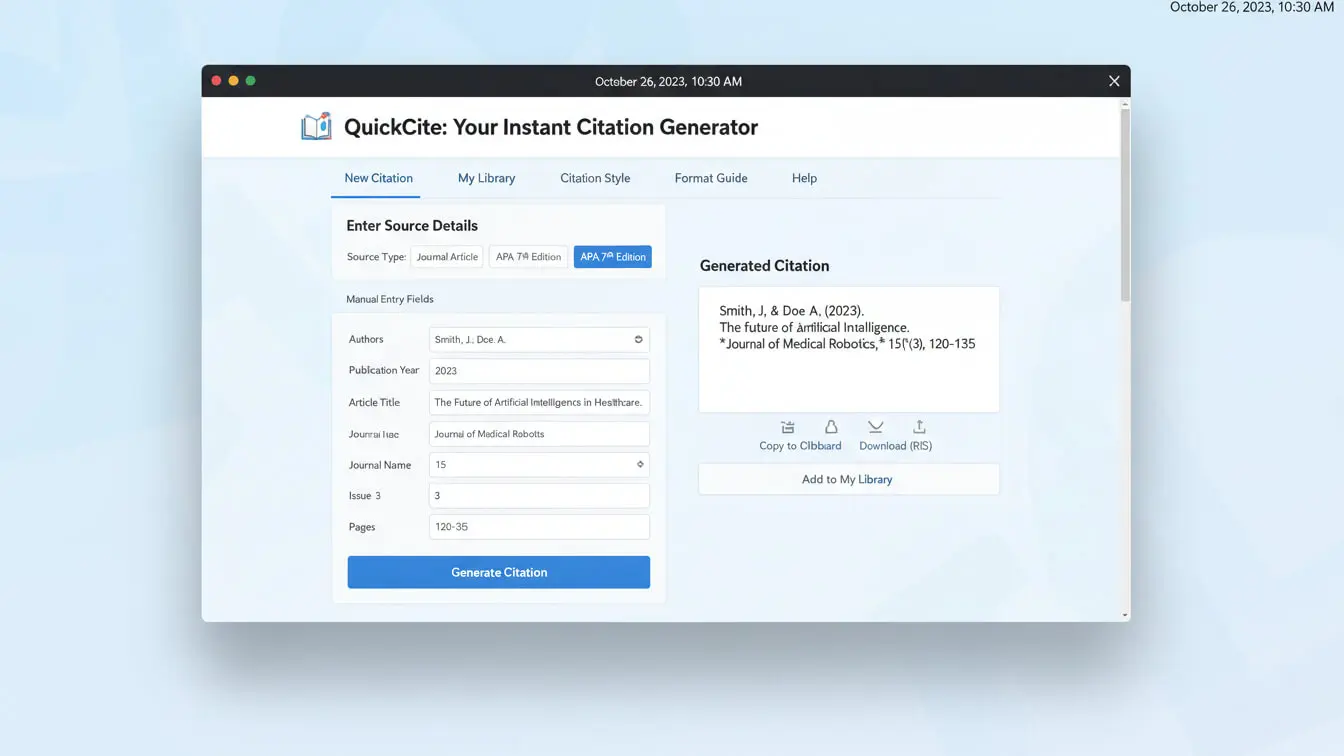
You don’t have to format references manually. These tools help:
1. AI Free Forever APA Reference Generator
Drop in your source info, get a perfect reference. Works for books, articles, websites, and more. Free, fast, accurate.
2. Crossref DOI Lookup
Can’t find the DOI? Search by article title and get the DOI instantly.
3. Scribbr APA Citation Generator
Another solid option. Generates references and in-text citations. Includes an AI citation checker to catch mistakes.
4. Google Scholar
Find academic articles and click “Cite” under any result. Choose APA format. Double-check it though—sometimes Google Scholar makes mistakes with capitalization.
5. Library Database Citation Tools
Most databases have a “Cite” button. Database citations are usually more accurate than free online generators, but always verify.
6. Microsoft Word References Feature
Word has built-in citation tools. Go to References tab, choose APA 7th, add sources. It’ll generate your references page automatically.
Warning: These tools aren’t perfect. Always double-check against APA guidelines. One wrong comma can still cost you points.
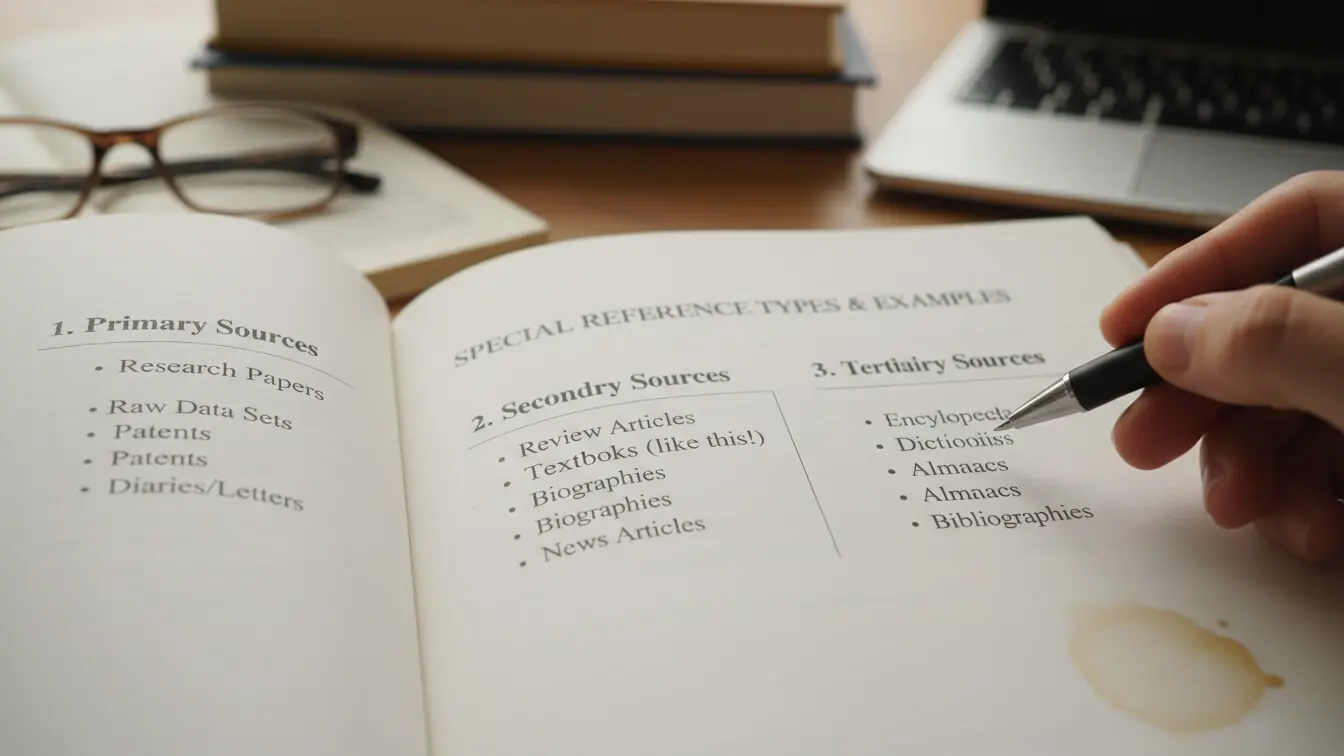
Special APA Reference Formating Cases and how to format them
YouTube Videos
Format:
Channel Name. (Year, Month Day). Video title [Video]. YouTube. URL
Example:
Above The Noise. (2017, October 18). Can procrastination be a good thing? [Video]. YouTube. https://www.youtube.com/watch?v=xxxxx
Films and TV Shows
Film:
Director, D. (Director). (Year). Title of film [Film]. Studio.
Example:
Mann, K. (Director). (2024). Inside out 2 [Film]. Pixar Animation Studios.
TV Episode:
Writer, W. (Writer), & Director, D. (Director). (Year, Month Day). Episode title (Season X, Episode Y) [TV series episode]. In E. Producer (Executive Producer), Series title. Studio.
Podcasts
Format:
Host, H. (Host). (Year, Month Day). Episode title (No. episode number) [Audio podcast episode]. In Podcast title. Production Company. URL
Social Media Posts
Twitter/X:
Username [@handle]. (Year, Month Day). First 20 words of the post [Tweet]. Twitter. URL
Instagram:
Username [@handle]. (Year, Month Day). First 20 words of the caption [Photograph]. Instagram. URL
Government Documents
Use the government agency as the author.
Example:
Centers for Disease Control and Prevention. (2024). COVID-19 vaccination data. U.S. Department of Health and Human Services. https://www.cdc.gov/covid-data
Personal Communication
Emails, text messages, phone calls—cite these in-text only. Don’t add them to your reference list because readers can’t retrieve them.
In-text: (J. Smith, personal communication, March 15, 2024)
Dissertations and Theses
Published:
Author, A. A. (Year). Title of dissertation [Doctoral dissertation, University Name]. Database Name. URL or DOI
Unpublished:
Author, A. A. (Year). Title of dissertation [Unpublished doctoral dissertation]. University Name.
Quick APA Reference Cheat Sheet
| Source Type | Basic Format | Key Details |
|---|---|---|
| Journal Article | Author, A. (Year). Title. Journal, vol(issue), pages. DOI | Italicize journal name and volume |
| Book | Author, A. (Year). Title (ed.). Publisher. DOI | Italicize book title |
| Book Chapter | Author, A. (Year). Chapter title. In E. Editor (Ed.), Book title (pp. #-#). Publisher. DOI | Don’t italicize chapter title |
| Website | Organization. (Year, Month Day). Page title. Site Name. URL | Use (n.d.) if no date |
| News Article | Author, A. (Year, Month Day). Title. Newspaper. URL | Include specific date |
Frequently Asked Questions
Do I need a running head for my references page?
Not for student papers. Running heads are only required for professional papers being submitted for publication.
Should my references be single or double-spaced?
Double-spaced. Everything in APA format is double-spaced—your paper, references, everything.
What if I can’t find a DOI?
Try Crossref.org. Search by title, author, or journal. If no DOI exists, use the journal’s homepage URL for online articles, or leave it off for print sources.
Can I use a citation generator for my whole paper?
Yes, but check every reference. Citation generators make mistakes—wrong capitalization, missing commas, incorrect formatting. Use them as a starting point, not the final answer.
How do I cite a source with no author?
Use the title in the author position. Move it to the front and alphabetize by the first significant word (skip “A,” “An,” “The”).
What if the website doesn’t show a publication date?
Use (n.d.) which means “no date.” Example: American Heart Association. (n.d.). Heart disease facts.
Do I include the access date for websites?
Only if the content changes frequently. For most websites, you don’t need it. Use it for: wikis, live data, news sites that update constantly.
How many spaces after a period?
One. APA 7th edition says one space after every period, comma, colon, semicolon, and other punctuation.
What font and size should I use?
APA 7th allows several fonts: Times New Roman 12pt, Arial 11pt, Calibri 11pt, Georgia 11pt, or Lucida Sans Unicode 10pt. Pick one and stick with it throughout.
Should I number my references?
No. APA references are alphabetized, not numbered.
What’s the difference between a reference list and a bibliography?
APA uses reference lists—only sources you actually cited. Bibliographies include everything you read. APA doesn’t use bibliographies.
Can I cite Wikipedia?
You can, but most professors won’t accept it. If you must cite it, treat it like a website with no author. Better option: Use Wikipedia’s sources and cite those instead.
How do I cite the same author multiple times?
In your reference list, order by year (oldest to newest). Same year? Add letters (2023a, 2023b, 2023c) based on alphabetical order of titles.
What if the journal doesn’t have issue numbers?
Just leave out the issue number. Include the volume number only: Journal Name, 45, 112-127.
How do I handle edited books with multiple editors?
List all editors up to 20, followed by (Eds.). More than 20? Use the ellipsis rule (first 19, …, last one).
Need more help? Try the APA Reference Generator or explore other free AI writing tools to make your academic life easier.