Morse Code Converter
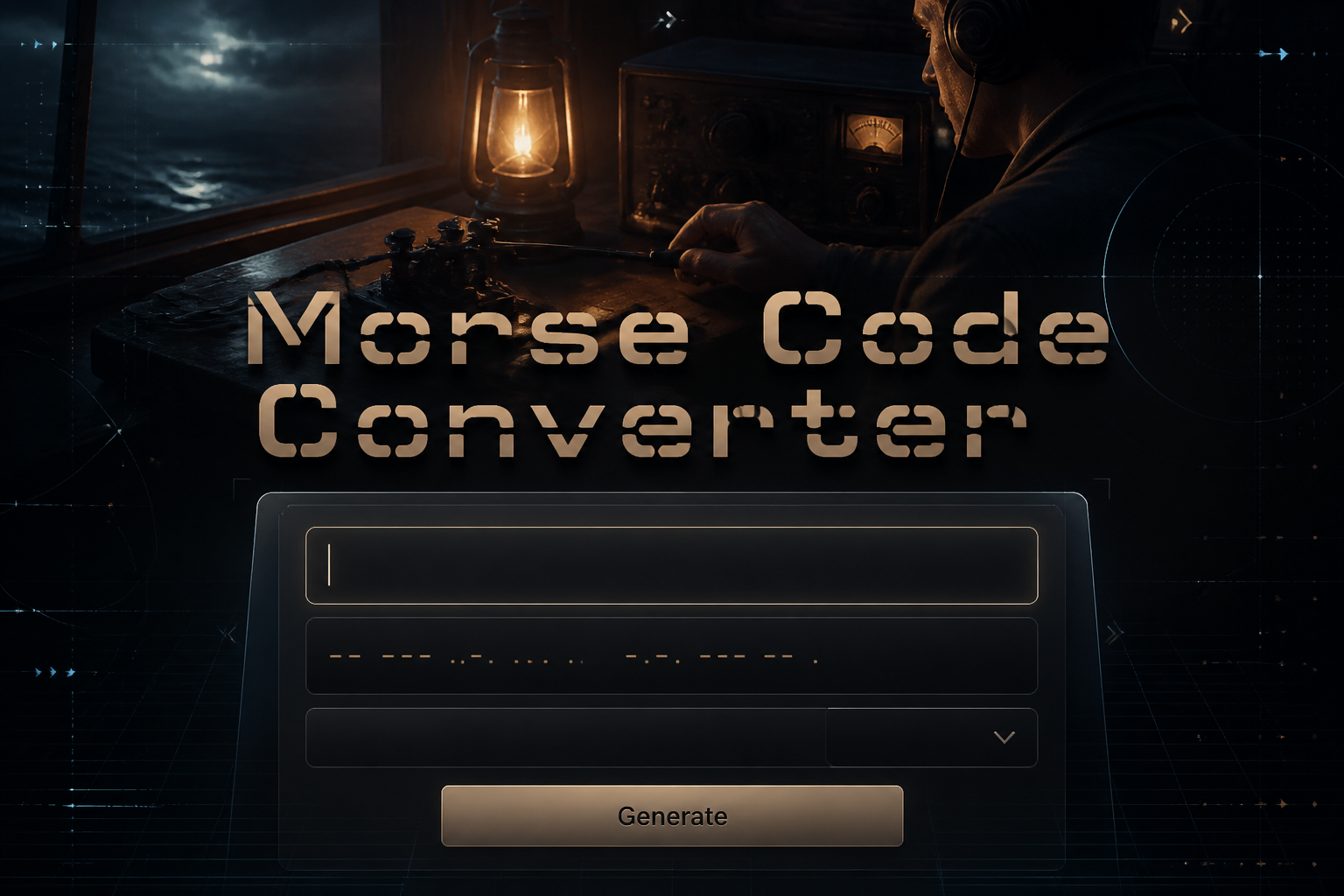
A Morse code converter translates any text into dots and dashes of Morse code, and decodes Morse code back into readable text. Type your message in the panel to convert instantly. Use the audio button to hear the Morse code pattern. For learning and exploration, use the AI tab for detailed character-by-character explanations.
What Is Morse Code?
Morse code is a method of encoding text characters using sequences of two signals: a short signal called a dot and a long signal called a dash. Originally transmitted as electrical pulses over telegraph wires, Morse code allowed long-distance communication before voice transmission was possible. Each letter, digit, and punctuation mark has a unique pattern of dots and dashes defined by the ITU International Morse Code standard.
Unlike modern digital encoding, Morse code is designed for human operators to learn and transmit manually. A skilled operator can send and receive Morse code entirely from memory, making it a reliable emergency communication method even when electronic systems fail. Today it remains active in amateur radio, aviation navigation, and emergency signaling. You can also use our Roman numeral converter for another classic encoding system, or explore our large numbers converter for number formatting.
Morse Code Alphabet Chart
The following table shows the complete ITU Morse code alphabet for all 26 letters and 10 digits. Each letter is represented by a unique combination of dots (.) and dashes (-).
| Letter | Morse Code | Letter | Morse Code | Letter | Morse Code |
|---|---|---|---|---|---|
| A | .- | J | .--- | S | ... |
| B | -... | K | -.- | T | - |
| C | -.-. | L | .-.. | U | ..- |
| D | -.. | M | -- | V | ...- |
| E | . | N | -. | W | .-- |
| F | ..-. | O | --- | X | -..- |
| G | --. | P | .--. | Y | -.-- |
| H | .... | Q | --.- | Z | --.. |
| I | .. | R | .-. |
Digits 0-9
| Digit | Morse Code | Digit | Morse Code | Digit | Morse Code |
|---|---|---|---|---|---|
| 0 | ----- | 4 | ....- | 8 | ---.. |
| 1 | .---- | 5 | ..... | 9 | ----. |
| 2 | ..--- | 6 | -.... | ||
| 3 | ...-- | 7 | --... |
How Morse Code Works
Dots and Dashes
Every character in Morse code is built from two symbols: the dot and the dash. A dot is the basic unit of time, often called a dit. A dash is exactly three times the length of a dot, called a dah. The simplest Morse code letters are the most common in English: E is a single dot (.) and T is a single dash (-). This design reflects Samuel Morse's original intent to make frequently used letters the fastest to transmit.
Timing and Spacing
Correct timing is essential for readable Morse code. The standard timing rules define:
- Dot duration: 1 unit (the base time unit)
- Dash duration: 3 units
- Gap between symbols within a letter: 1 unit
- Gap between letters: 3 units
- Gap between words: 7 units
In this converter, words are separated by a forward slash (/) when displayed in text form. This follows the standard notation used by amateur radio operators worldwide.
History of Morse Code
Samuel Morse and the Telegraph
Morse code was developed by Samuel F. B. Morse and his assistant Alfred Vail in the 1830s and 1840s alongside the electric telegraph. The original American Morse code, used on telegraph lines across the United States, assigned shorter codes to more frequent letters based on the frequency of letter usage Morse observed by counting letter types in a printing shop. The first long-distance telegraph message using Morse code was sent on May 24, 1844, from Washington, D.C., to Baltimore. The message read: "What hath God wrought." For a comprehensive historical account, see the Britannica Morse code and telegraph history article.
Modern Use of Morse Code
The International Morse Code (ITU standard) replaced American Morse Code for international telegraphy in 1865, standardizing the dot-dash patterns used today. As radio communication developed in the early 20th century, Morse code became the primary communication method for ships at sea, military units, and aviation. The last commercial Morse code telegram in the United States was sent in 2006, but the code remains in active use today. Amateur (ham) radio operators frequently use Morse code (called CW, or continuous wave), and many aviation navigation beacons still transmit their station identifier in Morse code. The ITU removed the mandatory Morse code requirement for maritime radio operators in 1999, but many countries still maintain it as an optional qualification.
SOS in Morse Code
The most universally recognized Morse code sequence is SOS: three dots, three dashes, three dots (... --- ...). SOS was adopted as the international maritime distress signal at the 1906 Berlin International Wireless Telegraph Convention and came into effect on July 1, 1908. The sequence was chosen not because SOS stands for any specific phrase (though "Save Our Souls" and "Save Our Ship" are popular backronyms), but because the sequence is distinctive, easy to remember, and difficult to confuse with other transmissions. The continuous sequence ...---... without letter spacing between the groups is the officially recognized distress signal. SOS can be sent with any on/off signal: a flashlight, a whistle, a car horn, or tapping on a hard surface.
How to Learn Morse Code
The most effective method for learning Morse code is the Koch method, named after German psychologist Ludwig Koch. Rather than starting with slow speeds and increasing them, the Koch method teaches characters at full conversational speed (around 20 words per minute) from the beginning, starting with just two characters and adding more as each is mastered. This trains the brain to recognize Morse code by sound pattern rather than counting dots and dashes individually.
The ARRL learn Morse code guide from the American Radio Relay League provides structured resources for beginners through advanced operators. Practical tips for learning Morse code include:
- Start with the simplest letters: E (.), T (-), I (..), M (--), A (.-), N (-.) have only one or two signals.
- Practice listening, not reading: Train your ear to recognize patterns without looking at a chart.
- Use mnemonics: Each Morse pattern can be associated with a word. For example, B (-...) sounds like "BEET" (dash, dit, dit, dit).
- Practice 15-30 minutes daily: Short, consistent sessions are more effective than long infrequent ones.
- Use audio tools: The audio playback in this converter helps train your ear to the rhythm of Morse code signals.
Common Morse Code Phrases
| Phrase | Morse Code |
|---|---|
| SOS | ... --- ... |
| HELLO | .... . .-.. .-.. --- |
| HELP | .... . .-.. .--. |
| YES | -.-- . ... |
| NO | -. --- |
| OK | --- -.- |
| 73 (best regards in ham radio) | --... ...-- |
| CQ (calling any station) | -.-. --.- |
FAQ
What is SOS in Morse code?
SOS in Morse code is ... --- ... (three dots, three dashes, three dots). It was adopted as the international distress signal in 1908 because it is simple, distinctive, and impossible to confuse with ordinary transmissions.
Is Morse code still used today?
Yes. Amateur radio operators use Morse code globally, aviation navigation beacons transmit their identifiers in Morse code, and emergency services in some countries still train personnel in Morse code for backup communication. The ITU maintains the official standard.
How long does it take to learn Morse code?
Most people can recognize all 26 letters within 2 to 4 weeks of daily 15-minute practice sessions. Reaching 5 words per minute takes 2 to 3 months. Fluency at 20+ words per minute requires 6 to 12 months of consistent practice using the Koch method and audio training.
What is the Morse code alphabet?
The Morse code alphabet is the ITU standard table mapping each of the 26 English letters and 10 digits to a unique sequence of dots and dashes. The table above shows the complete alphabet. Common short codes include E (.), T (-), I (..), and M (--).
Can you send Morse code with a flashlight?
Yes. Any device that produces a signal with two distinct states (on/off) can transmit Morse code: a flashlight, a mirror, a whistle, a car horn, or tapping on a surface. A short signal is a dot; a long signal (three times longer) is a dash. This versatility is why Morse code remains a standard emergency signaling method.
Related Converters
Explore other text and number conversion tools. Use the Roman numeral converter to translate between Roman numerals and Arabic numbers. The phone number converter helps format and convert phone numbers across regions. For working with very large values, try the large numbers converter. For general language translation and encoding, see the gibberish translator or the English to Norse translator.