Asphalt Calculator
An asphalt calculator converts between square yards, cubic yards, and tons of asphalt for paving projects. Enter your area dimensions, volume, or unit values in the panel to estimate the amount of asphalt needed based on standard hot mix asphalt density of approximately 145 pounds per cubic foot.
What Is an Asphalt Calculator?
An asphalt calculator is a tool that estimates the weight of asphalt needed for a paving project based on the area to be covered and the desired thickness. Since asphalt is purchased and delivered by the ton, converting from a surface area measurement to a weight is an essential step in project planning. Underordering asphalt leads to project delays and inconsistent surface quality; overordering wastes material and budget.
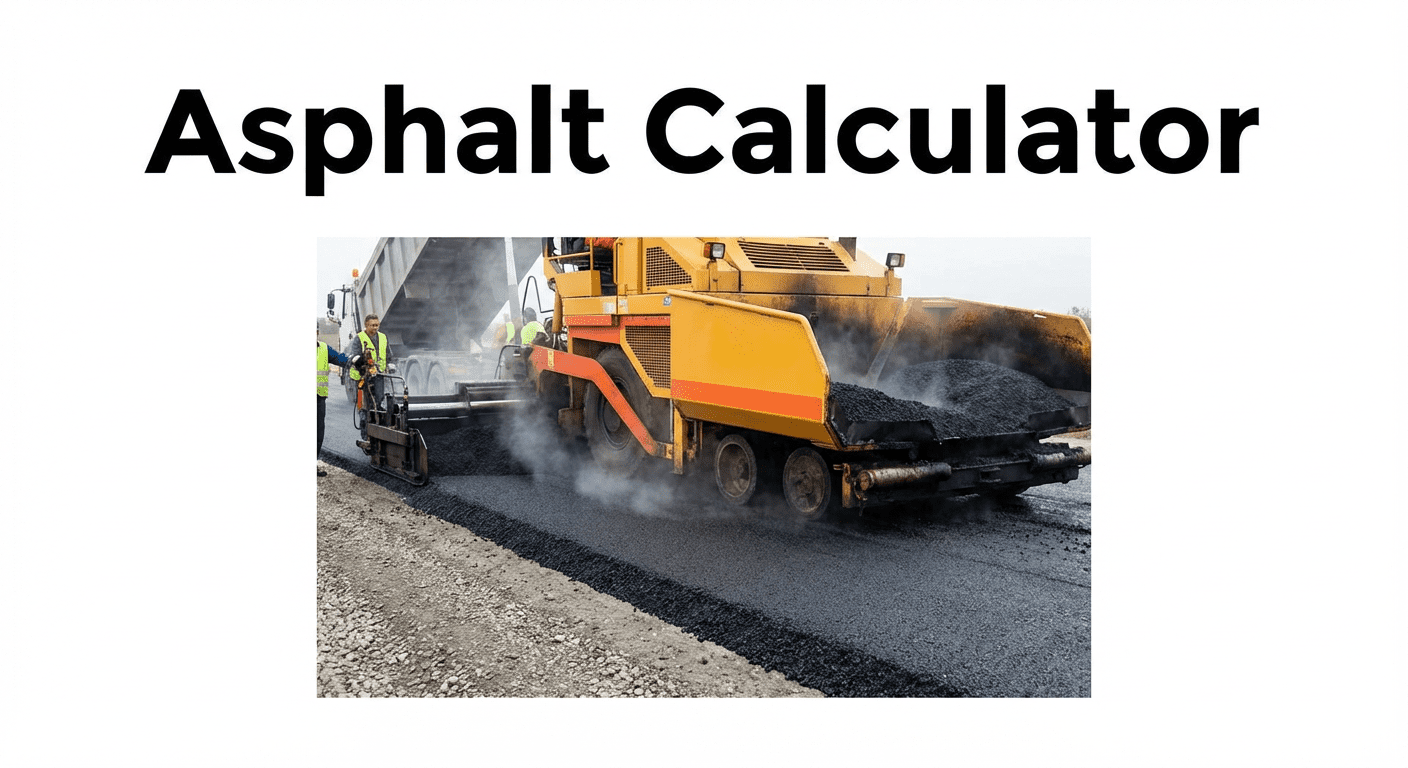
This calculator handles three common conversion scenarios: square yards to tons (when you know the covered area and depth), cubic yards to tons (when you already have a volume figure from another calculation), and area to tons (when you have length and width in feet and want everything computed in one step). All calculations use standard hot mix asphalt density, which is the most widely used paving material in North America.
How to Calculate Asphalt Tonnage
All asphalt tonnage calculations involve two stages: converting the paving area and thickness into a volume, then converting that volume into weight using the density of asphalt. The standard density for hot mix asphalt is approximately 145 pounds per cubic foot, which equals about 1.4 tons per cubic yard (using 2,000 pounds per ton and 27 cubic feet per cubic yard: 145 × 27 ÷ 2,000 ≈ 1.96, though contractors often use 1.4–2.0 tons/CY depending on mix type and compaction factor).
Square Yards to Tons of Asphalt
To convert square yards to tons, you need to know the thickness in inches. The process is: convert thickness in inches to yards (divide by 36), multiply by the square yardage to get cubic yards, then multiply cubic yards by 1.4 to get tons. For example, 500 square yards at 3 inches deep: thickness in yards = 3 ÷ 36 = 0.0833 yd; volume = 500 × 0.0833 = 41.67 CY; tons = 41.67 × 1.4 = 58.3 tons.
Cubic Yards to Tons of Asphalt
If you already know the volume in cubic yards, the conversion to tons is direct. Multiply the cubic yardage by 1.4 (the weight of one cubic yard of compacted hot mix asphalt in tons). For example, 10 cubic yards × 1.4 = 14 tons. This conversion is the simplest scenario and is often used when a civil engineer or contractor provides a volume figure directly.
Area (Length × Width) to Tons
When starting with dimensions in feet, the process is: calculate the area in square feet (length × width), convert to square yards (divide by 9), convert to cubic yards by applying the thickness in inches (CY = SY × thickness ÷ 36), then multiply by 1.4 for tons. This three-step conversion is what the Area to Tons mode handles automatically in a single calculation.
Asphalt Conversion Chart
The table below shows how many tons of asphalt are needed for common square yardage values at 2-inch, 3-inch, and 4-inch compacted thicknesses. All values use 1.4 tons per cubic yard.
| Square Yards | 2" Thick (tons) | 3" Thick (tons) | 4" Thick (tons) |
|---|---|---|---|
| 100 SY | 7.8 tons | 11.7 tons | 15.6 tons |
| 250 SY | 19.4 tons | 29.2 tons | 38.9 tons |
| 500 SY | 38.9 tons | 58.3 tons | 77.8 tons |
| 1,000 SY | 77.8 tons | 116.7 tons | 155.6 tons |
| 2,500 SY | 194.4 tons | 291.7 tons | 388.9 tons |
| 5,000 SY | 388.9 tons | 583.3 tons | 777.8 tons |
| 10,000 SY | 777.8 tons | 1,166.7 tons | 1,555.6 tons |
Asphalt Weight and Density
Hot Mix Asphalt Density
Hot mix asphalt (HMA) — also called blacktop or asphalt concrete — has a density that typically ranges from 140 to 148 pounds per cubic foot depending on the aggregate size, binder content, and degree of compaction. The commonly used planning value is 145 lbs/cu ft, which equals approximately 1.96 tons per cubic yard before rounding. For project estimation purposes, contractors frequently use a rounded factor of 1.4 tons/CY for loose spread material or up to 2.0 tons/CY for highly compacted mixes.
The specific density of a mix is typically provided in the project's mix design specification and may be confirmed with a compaction test after placement. Always verify the tonnage estimate with your asphalt supplier or contractor before ordering, as slight density differences across mix types can result in a 5–10% variance in the final tonnage.
Compacted vs Loose Asphalt
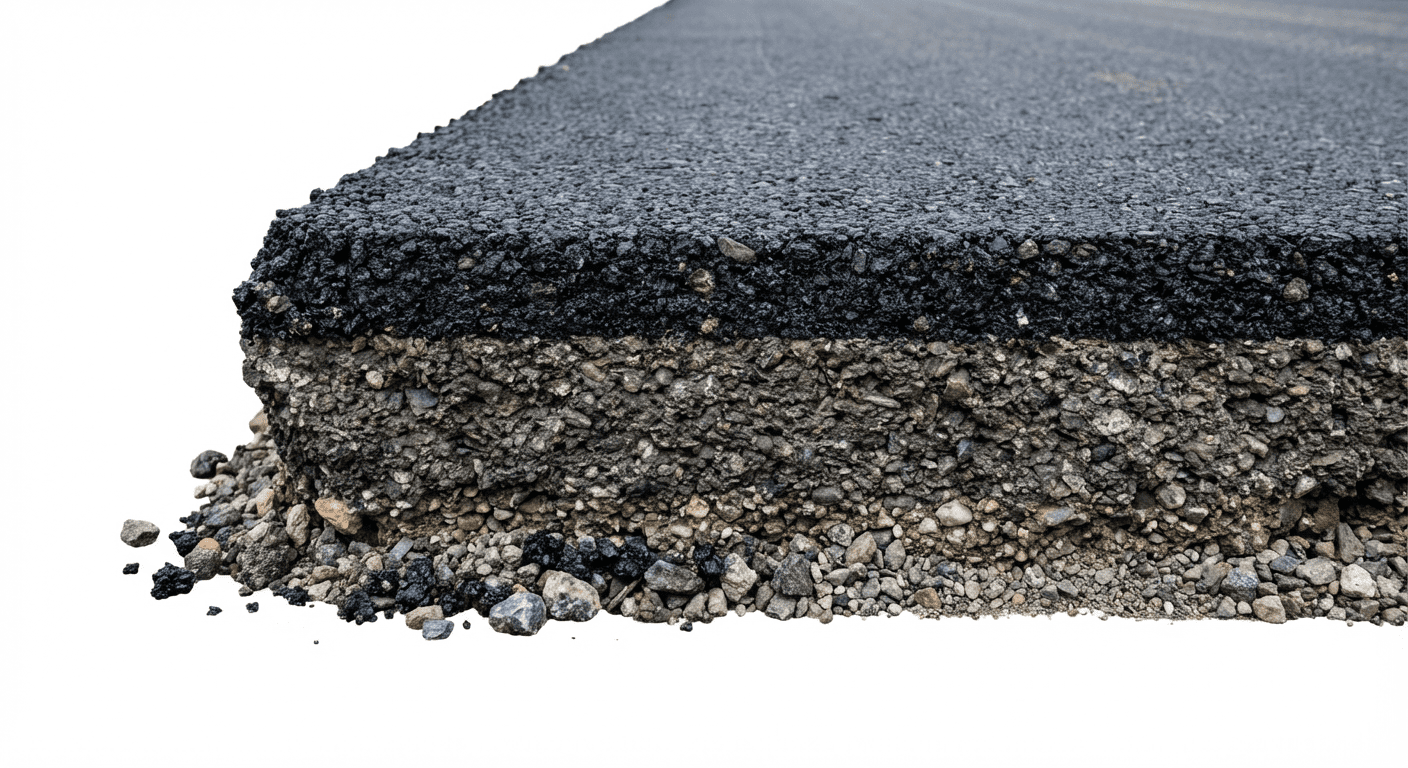
Asphalt is delivered and placed in a loose, heated state. After placement by a paving machine, it is compacted with rollers to reach the design density. Loose asphalt has a bulk density roughly 15–20% lower than compacted asphalt, which means the delivered volume appears larger than the final installed volume. Most tonnage calculations — including this calculator — use compacted density values because the goal is to estimate how many tons of material to order based on the finished, in-place volume. Contractors account for this by computing CY from the finished design thickness, not the laid thickness.
How Much Asphalt Do I Need?
Driveway Paving
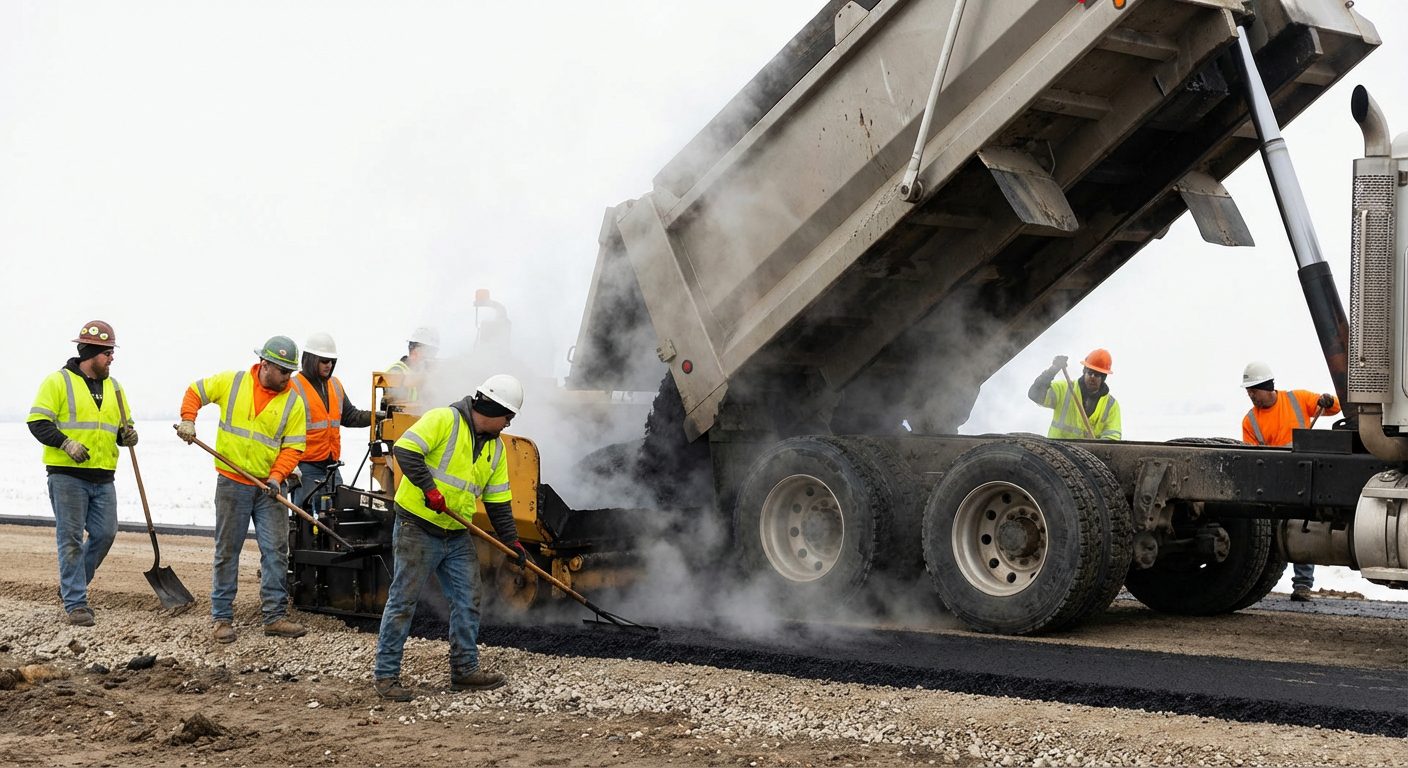
A typical residential driveway is 10–12 feet wide and 20–50 feet long, with a total area of 200–600 square feet (22–67 square yards). Standard residential asphalt thickness is 2–3 inches for a new installation over a compacted gravel base. For a 500 sq ft driveway (56 SY) at 3 inches, you would need approximately 6.5 tons of hot mix asphalt. Always add 10% for waste and compaction variation when ordering. A area calculator can help you measure irregular driveway shapes before entering values here.
Parking Lot Paving
Commercial parking lots typically require a thicker asphalt section than residential driveways due to heavier vehicle loads. A light-duty parking lot for passenger vehicles is commonly 3 inches of HMA over a base course, while heavy-duty or truck-accessible lots may require 4–6 inches. A 10,000 square foot parking lot (1,111 SY) at 3 inches requires approximately 129 tons of asphalt. At 4 inches, the same lot requires about 173 tons. Large commercial projects are typically specified by a civil engineer using detailed soil and load-bearing calculations.
Asphalt Calculator Examples
Example: 500 SY Driveway at 3 Inches
A contractor is paving a commercial driveway approach that measures 500 square yards. The specification calls for 3 inches of compacted hot mix asphalt.
Adding a 10% waste factor raises the order to approximately 64 tons, or 4 truckloads. The contractor would typically round up to the nearest full truckload.
Example: 10 Cubic Yards to Tons
A contractor has a volume of 10 cubic yards of asphalt specified for a repair patch.
A single 20-ton truckload would cover this repair with 6 tons to spare, which is common practice — partial loads are typically ordered when the excess can be used elsewhere on the project site.
Frequently Asked Questions
How many tons per cubic yard of asphalt?
Standard hot mix asphalt weighs approximately 1.4 to 2.0 tons per cubic yard depending on the mix design. A commonly used planning figure is 1.4 tons/CY for loose material or 2.0 tons/CY for very dense mixes. The 1.4 figure is widely used in contractor estimates and is what this calculator applies by default.
How thick should asphalt be?
Residential driveways are typically 2–3 inches thick over a compacted gravel base of 4–6 inches. Light commercial and parking lot applications typically use 3 inches. High-traffic roads, bus lanes, and areas subject to heavy truck loads require 4–6 inches of compacted asphalt in multiple lifts. Thicker installations are placed in 2-inch lifts and compacted between each layer to ensure uniform density.
How many square yards does 1 ton cover?
One ton of asphalt covers approximately 12–13 square yards at 2 inches thick, 8–9 square yards at 3 inches thick, or 6–7 square yards at 4 inches thick, using the 1.4 tons/CY density factor. These coverage values help quickly estimate the number of tons needed when working with a target square yardage.
What is hot mix asphalt?
Hot mix asphalt (HMA) is a mixture of aggregate (crushed stone, gravel, or sand) and bituminous binder (asphalt cement) that is heated to approximately 300°F during production and placed while hot. It is the most common paving material for roads, driveways, and parking lots in the United States. HMA hardens as it cools and is compacted with rollers immediately after placement to achieve the specified density.
How to calculate asphalt for a driveway?
Measure the length and width of the driveway in feet, multiply to get the area in square feet, then divide by 9 to convert to square yards. Choose a thickness (typically 3 inches for residential work), then use the formula: CY = SY × (thickness in inches ÷ 36), and Tons = CY × 1.4. Always add 10% for waste. For example, a 12 ft × 40 ft driveway (53 SY) at 3 inches requires about 6.2 tons — order 7 tons to account for waste.
Related Tools
Also check out: