Driving Distance Calculator
A driving distance calculator estimates the road distance and travel time between two locations. Enter your starting point and destination in the panel to get an estimated driving distance in miles or kilometers and approximate travel time.
What Is a Driving Distance Calculator?
A driving distance calculator estimates the road distance between two geographic locations. Unlike straight-line distance, which measures the shortest path between two points on a map, driving distance follows actual road networks and accounts for highways, streets, and turn-by-turn routing. The result gives you a practical measure of how far you need to travel by road to reach your destination.
Driving distance calculators are commonly used for trip planning, logistics, fuel cost estimation, and comparing routes. Since exact routing requires live map data, AI estimation uses knowledge of major routes, typical road networks, and regional geography to provide reliable approximations for planning purposes.
How Driving Distance Is Measured
Road Distance vs Straight Line Distance
Straight-line distance, often called as-the-crow-flies distance, is the direct geographic distance between two points. It is the shortest possible distance and does not account for roads, terrain, or detours. Driving distance, by contrast, follows the actual road network and is always longer than straight-line distance. In most cases, driving distance is 20 to 40 percent longer than the straight-line equivalent, though mountain regions and areas with limited road access can result in much larger differences.
For example, the straight-line distance from New York City to Philadelphia is approximately 80 miles, while the typical driving distance via I-95 is closer to 95 miles. In mountainous regions, the difference can be far more significant.
Highway vs City Routes
Most long-distance routes consist of a combination of highway and city driving. Highway driving typically accounts for faster travel at 60 to 75 miles per hour, while city segments involve lower speeds, traffic lights, and stop-and-go traffic at 20 to 35 miles per hour. The ratio of highway to city driving significantly affects both total travel time and fuel consumption. For road trips between major cities, the majority of distance is usually covered on interstate highways with shorter city segments at the start and end of the journey. You can also use our miles per gallon calculator to estimate fuel costs based on your vehicle's efficiency.
How to Plan a Road Trip
Estimating Travel Time
Travel time is estimated by dividing the driving distance by an average speed. For predominantly highway trips, an average of 55 to 65 miles per hour is a reasonable estimate after accounting for slower traffic, speed limit variations, and occasional slowdowns. For a 300-mile trip that is 80 percent highway, you can expect approximately 4.5 to 5.5 hours of driving time. City-heavy routes will take significantly longer for the same distance.
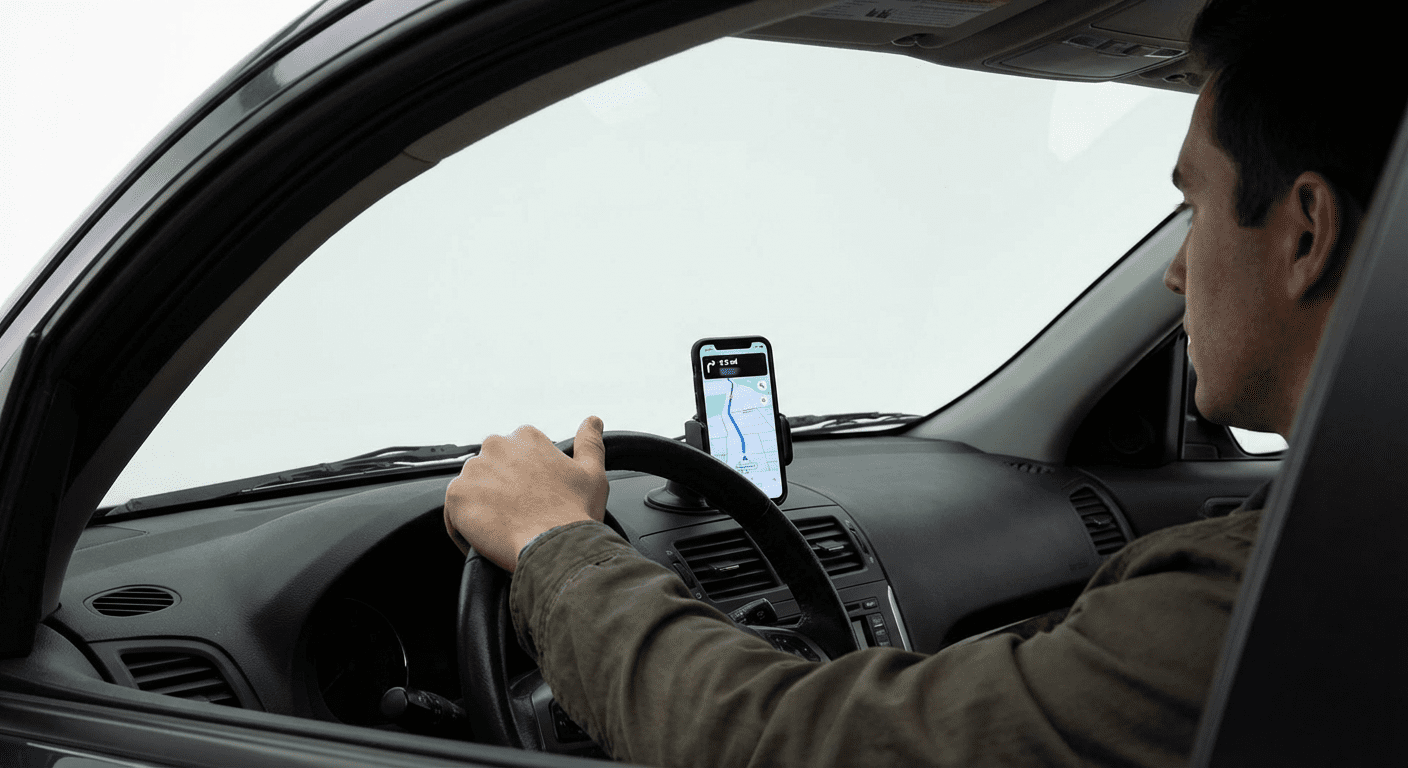
Travel time estimates should always include a buffer for unexpected delays such as construction, accidents, or weather. Navigation apps such as Google Maps driving directions provide real-time traffic data for more precise estimates.
Rest Stops and Breaks
For trips exceeding 3 hours, rest stops are an important part of road trip planning. Safety guidelines recommend taking a 15-minute break every 2 hours of driving to maintain alertness. A 600-mile trip at average highway speeds takes approximately 9 hours of driving time, meaning two to three rest stops should be factored into your schedule. For trips requiring overnight travel, plan accommodation at appropriate intervals. For additional road trip planning resources, AAA road trip planning tools offer detailed route information, lodging recommendations, and member discounts.
Estimating Fuel Cost for a Trip
Using MPG and Gas Price
Once you know the driving distance, you can estimate fuel cost using your vehicle's fuel economy and the current gas price. The formula is straightforward: divide the total miles by your miles per gallon to get gallons needed, then multiply by the price per gallon. For example, a 400-mile trip in a vehicle getting 30 MPG at $3.50 per gallon costs approximately 13.3 gallons times $3.50, or about $46.67 for the one-way trip.
Highway driving typically delivers better fuel economy than city driving because highway speeds allow engines to operate more efficiently without frequent acceleration and braking. For a round trip, simply double the one-way fuel cost. Use our MPG calculator to calculate your exact fuel economy before estimating trip costs.
Common Driving Distances in the US
Major City-to-City Distances
| Route | Distance (Miles) | Est. Drive Time |
|---|---|---|
| New York, NY to Los Angeles, CA | ~2,800 miles | ~40-42 hours |
| Chicago, IL to Miami, FL | ~1,380 miles | ~19-21 hours |
| Dallas, TX to Houston, TX | ~240 miles | ~3.5-4 hours |
| Los Angeles, CA to San Francisco, CA | ~380 miles | ~5.5-6.5 hours |
| Seattle, WA to Portland, OR | ~175 miles | ~3-3.5 hours |
| Boston, MA to Washington, DC | ~440 miles | ~7-8 hours |
| Phoenix, AZ to Las Vegas, NV | ~295 miles | ~4-4.5 hours |
| Atlanta, GA to Nashville, TN | ~250 miles | ~3.5-4 hours |
Distances are approximate. Actual distances vary by specific route and starting/ending point within each city. For precise routing data, refer to US DOT highway distance information.
Frequently Asked Questions
How do you calculate driving distance?
Driving distance is calculated along actual road networks, accounting for highways, local roads, and routing between two points. It is always longer than straight-line distance. AI estimation uses knowledge of major routes and typical road geography to provide reliable approximations. For precise real-time routing, navigation apps with live map data are recommended.
What is the distance between major US cities?
Common driving distances include New York to Los Angeles at approximately 2,800 miles, Chicago to Miami at approximately 1,380 miles, Dallas to Houston at approximately 240 miles, Los Angeles to San Francisco at approximately 380 miles, and Seattle to Portland at approximately 175 miles. Use the tool above for specific city pairs.
How do you estimate drive time?
Divide total driving distance by average speed. For highway-heavy routes, use 55 to 65 mph as the average. For city-heavy routes, 25 to 35 mph is more realistic. A 300-mile trip with mostly highway driving typically takes 4.5 to 5.5 hours, not counting rest stops or traffic delays.
How accurate are distance calculators?
AI-estimated distances are approximate and best suited for planning and budgeting. They do not account for real-time traffic, road closures, or construction. For navigation accuracy, use a dedicated GPS or mapping application with live data. AI estimates are typically within 5 to 15 percent of actual road distances for major routes.
What is the difference between driving distance and straight-line distance?
Straight-line distance is the direct geographic distance between two points, as if you could travel in a perfectly straight path. Driving distance follows actual roads and is always longer. In flat regions with good road networks, the difference is typically 20 to 30 percent. In mountainous or rural areas with limited roads, driving distance can be 50 to 100 percent greater than the straight-line equivalent.
Also check out: