Box Volume Calculator
A box volume calculator computes the volume of a rectangular box or container from its length, width, and height dimensions. Enter your measurements in the panel to instantly calculate the volume in cubic inches, cubic feet, cubic meters, liters, or gallons.
What Is a Box Volume Calculator?
A box volume calculator is a tool that computes the three-dimensional space inside a rectangular box or prism. It takes three inputs — length, width, and height — and applies the volume formula to give you an instant result. This is useful for shipping, moving, storage, construction, and packaging calculations where knowing how much space a box occupies or can hold is essential.
The calculator on this page also converts the result into multiple units simultaneously, so you can see the volume in cubic inches, cubic feet, cubic meters, liters, and US gallons without performing separate conversions. Use the AI tab to ask follow-up questions about the calculation, compare box sizes, or get help with related unit conversions.
How to Calculate the Volume of a Box
The Volume Formula (L x W x H)
The volume of a rectangular box is calculated by multiplying its three dimensions together. The formula is:
- V — Volume (in cubic units matching your input unit)
- L — Length of the box
- W — Width of the box
- H — Height of the box
All three dimensions must be in the same unit before multiplying. If your length is in inches but height is in feet, convert them to the same unit first. The result is always in cubic units. For example, if you measure in inches, the result is in cubic inches (in³).
Understanding Cubic Units
Cubic units represent three-dimensional space. One cubic foot means a cube that is 1 foot long, 1 foot wide, and 1 foot tall. One cubic inch is a cube that is 1 inch in each direction. Because volume is three-dimensional, the unit is always expressed as the base unit raised to the third power: in³, ft³, cm³, or m³. This also means that when converting between cubic units, the conversion factor is the linear factor cubed. For example, since 1 foot = 12 inches, 1 cubic foot = 12³ = 1,728 cubic inches.
Volume Unit Conversions
Cubic Inches to Cubic Feet
There are 1,728 cubic inches in one cubic foot (12 × 12 × 12 = 1,728). To convert cubic inches to cubic feet, divide by 1,728. For example, a box with a volume of 960 cubic inches equals 960 ÷ 1,728 = 0.556 cubic feet. This conversion is commonly needed when comparing shipping box dimensions quoted in inches against storage capacity quoted in cubic feet.
Cubic Feet to Gallons
One cubic foot equals approximately 7.481 US gallons. To convert cubic feet to gallons, multiply by 7.481. This conversion is useful when estimating the water-holding capacity of containers, tanks, or aquariums measured in feet. A 10-cubic-foot container holds approximately 74.81 gallons. Note that the US gallon (231 cubic inches) differs from the Imperial gallon (277.4 cubic inches), so always clarify which gallon is being used.
Cubic Feet to Liters
One cubic foot equals approximately 28.317 liters. To convert cubic feet to liters, multiply by 28.317. This is commonly needed when comparing US and metric measurements of refrigerators, coolers, or shipping containers. A standard 20-cubic-foot refrigerator holds approximately 566 liters of space.
| From | To Cubic Feet | To Liters | To Gallons |
|---|---|---|---|
| 1 cubic inch | 0.000579 ft³ | 0.01639 L | 0.004329 gal |
| 1 cubic foot | 1 ft³ | 28.317 L | 7.481 gal |
| 1 cubic centimeter | 0.0000353 ft³ | 0.001 L | 0.000264 gal |
| 1 cubic meter | 35.315 ft³ | 1,000 L | 264.172 gal |
Common Box Sizes and Their Volumes
Shipping Box Dimensions
Shipping carriers such as USPS, UPS, and FedEx use standard box sizes to simplify pricing and handling. Common USPS flat-rate box sizes include the small flat-rate box (8.69 × 5.44 × 1.75 inches, volume: 82.6 in³), the medium flat-rate box (11 × 8.5 × 5.5 inches, volume: 513.5 in³), and the large flat-rate box (12 × 12 × 5.5 inches, volume: 792 in³). UPS and FedEx use similar standardized sizes. Understanding box volume helps determine whether your items will fit and how to pack them efficiently to minimize shipping costs.
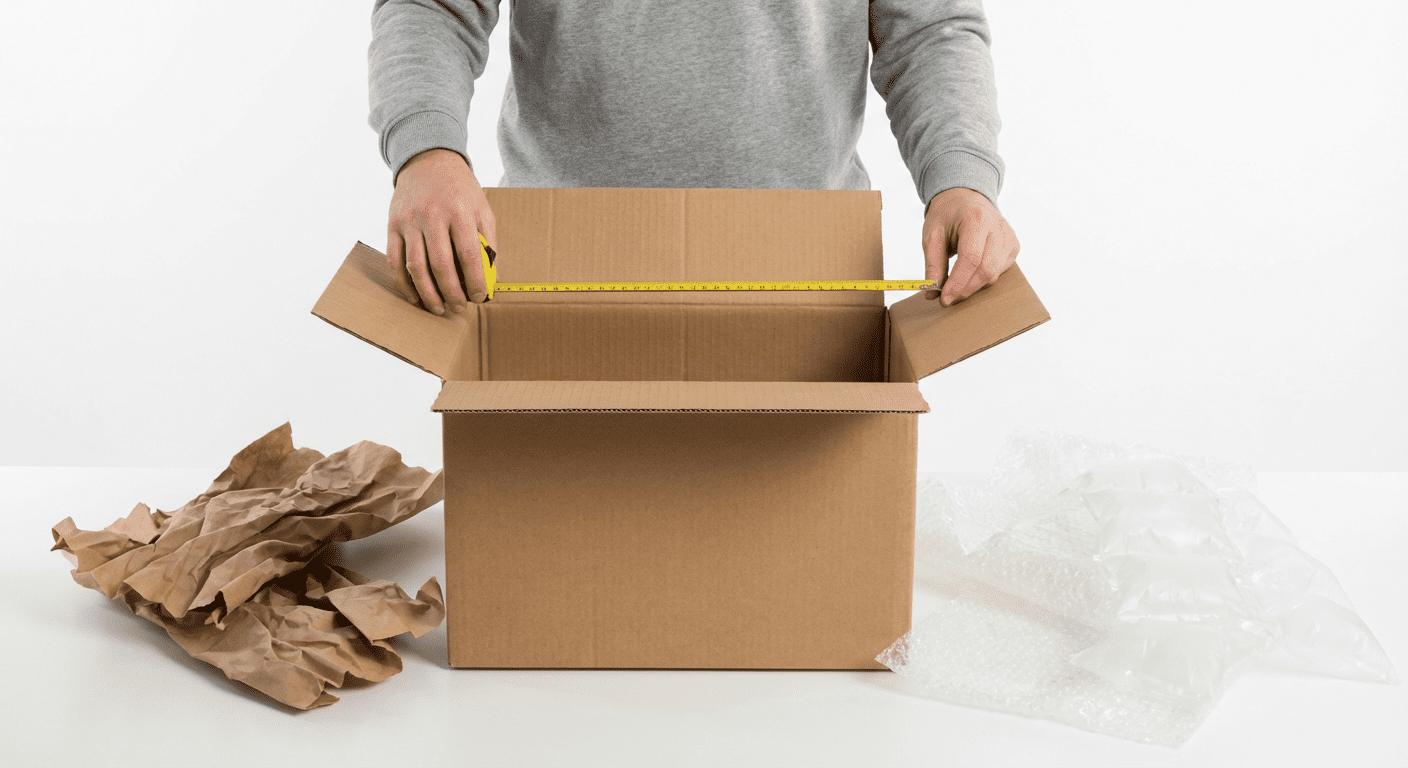
For dimensional weight pricing used by most carriers, volume matters as much as actual weight. Carriers calculate dimensional weight by dividing the box's cubic inches by a divisor (typically 139 for domestic US shipments). If the dimensional weight exceeds the actual weight, you are billed at the dimensional weight rate. Use our surface area calculator to also estimate how much material is needed to wrap or construct your box.
Moving Box Sizes
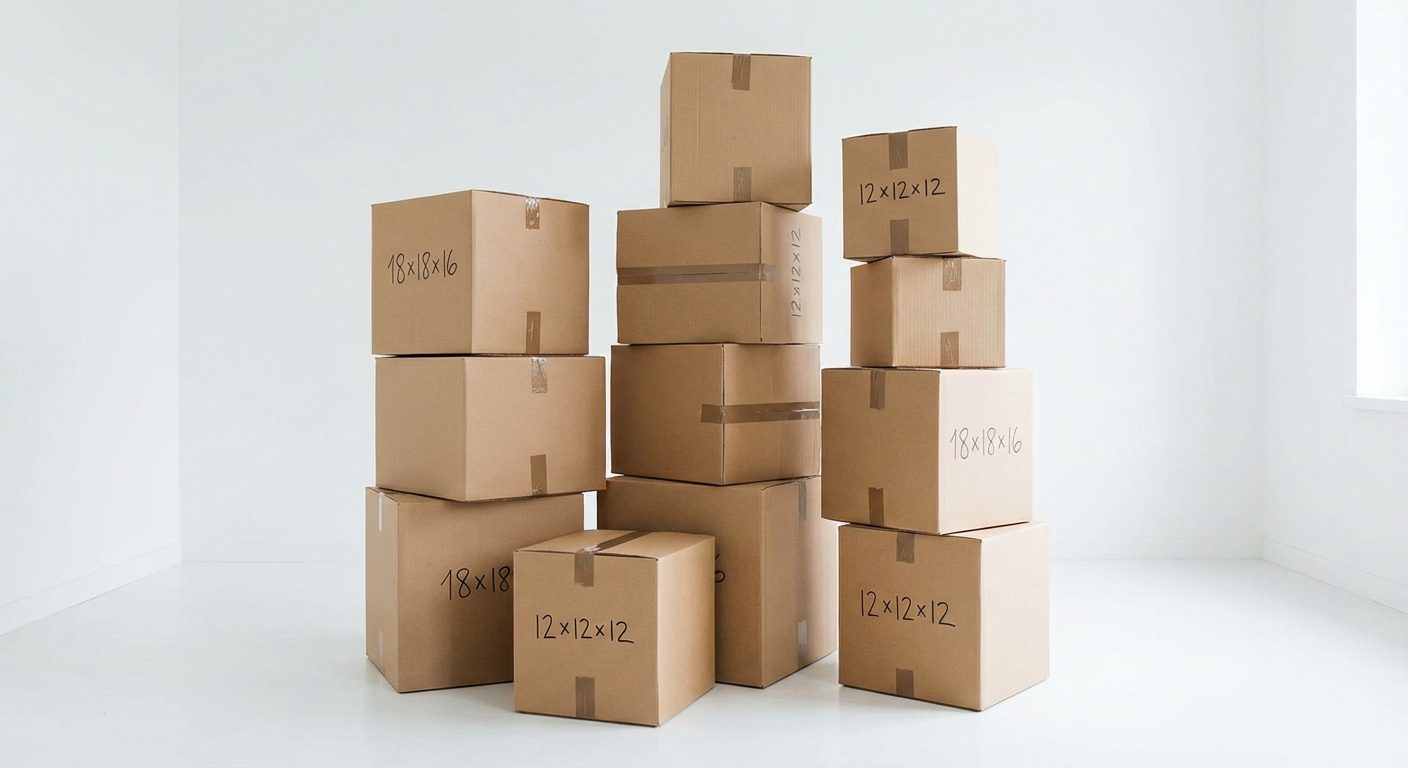
Moving companies offer several standard box sizes. Small moving boxes (typically 16 × 12 × 12 inches, volume: 2,304 in³ or 1.33 ft³) are ideal for books, canned goods, and heavy items. Medium boxes (18 × 18 × 16 inches, volume: 5,184 in³ or 3 ft³) work well for kitchen items, toys, and small appliances. Large boxes (18 × 18 × 24 inches, volume: 7,776 in³ or 4.5 ft³) are best for lighter bulky items such as pillows, lamp shades, and towels. Extra-large boxes (24 × 20 × 24 inches, volume: 11,520 in³ or 6.67 ft³) suit large appliances and comforters. Knowing the cubic footage of your boxes lets you estimate how many boxes you need and helps plan truck space.
Box Volume Calculator Examples
Example - 12 x 10 x 8 Inches
A box measuring 12 inches long, 10 inches wide, and 8 inches tall has a volume calculated as follows:
Converting 960 cubic inches into other units:
- Cubic feet: 960 ÷ 1,728 = 0.556 ft³
- Cubic meters: 960 × 0.0000163871 = 0.01573 m³
- Liters: 960 × 0.0163871 = 15.73 L
- US Gallons: 960 ÷ 231 = 4.156 gal
This is a medium-sized shipping box commonly used for electronics, books, and small household items. If you also need to know how much cardboard is needed to build this box, use our surface area calculator to compute all six face areas. For weight-related calculations involving the contents, the water weight calculator can help estimate liquid weight from volume.
Frequently Asked Questions
How to calculate volume of a box?
Multiply the length by the width by the height: V = L × W × H. All three dimensions must be in the same unit. The result is in the cubic version of that unit. For example, if you measure in inches, the result is in cubic inches. A box that is 10 × 8 × 6 inches has a volume of 480 cubic inches.
How many gallons in a cubic foot?
There are approximately 7.481 US gallons in one cubic foot. This is because one US gallon equals 231 cubic inches, and one cubic foot contains 1,728 cubic inches. Dividing 1,728 by 231 gives 7.481. So a box with a volume of 2 cubic feet holds approximately 14.96 gallons.
What is the volume of a 10x10x10 box?
A box measuring 10 × 10 × 10 inches has a volume of 1,000 cubic inches. This converts to approximately 0.579 cubic feet, 16.387 liters, or 4.329 US gallons. A 10 × 10 × 10 centimeter box has a volume of 1,000 cubic centimeters, which equals exactly 1 liter.
How to calculate cubic feet for shipping?
Measure the length, width, and height of your package in inches. Multiply all three together to get cubic inches, then divide by 1,728 to convert to cubic feet. For example, a package 24 × 18 × 12 inches = 5,184 cubic inches ÷ 1,728 = 3 cubic feet. Shipping carriers may also calculate dimensional weight by dividing cubic inches by 139 for US shipments.
What is the difference between volume and capacity?
Volume refers to the total three-dimensional space an object occupies, including its walls. Capacity refers to the internal space available to hold contents. For a hollow box, the volume includes the material of the walls, while the capacity is the usable interior space. In practice, for thin-walled cardboard boxes, the difference is negligible and both terms are used interchangeably.