Water Weight Calculator
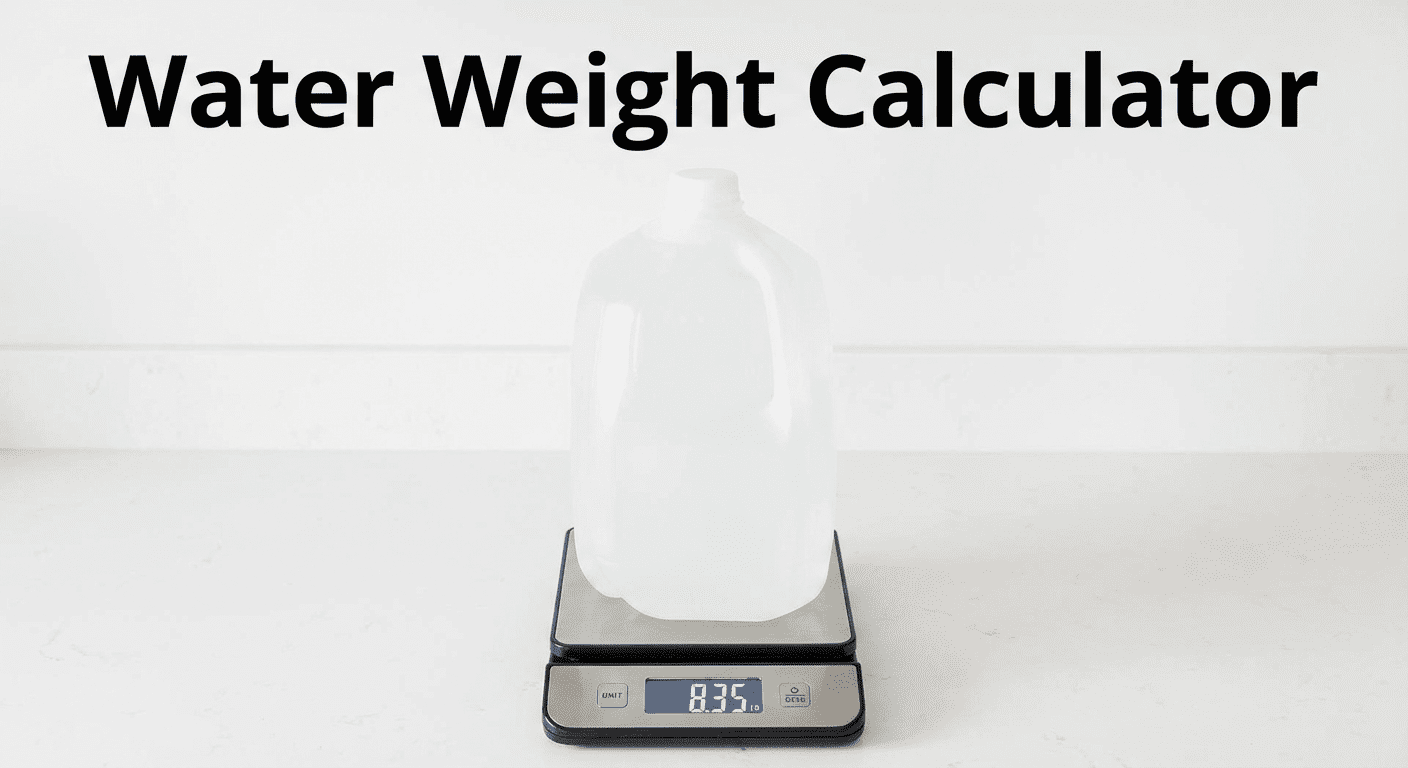
A water weight calculator determines how much water weighs for any given volume, or how much volume a given weight of water occupies. Enter a volume or weight below to instantly calculate the conversion using water's standard density of 8.34 pounds per gallon at room temperature.
What Is the Weight of Water?
Water weight refers to the mass of a specific volume of liquid water. Because water is a liquid at room temperature and has a well-defined, standardized density, the relationship between volume and weight is straightforward to calculate. The standard density of water used in most calculations is 1 kilogram per liter (kg/L) or equivalently 8.34 pounds per US gallon (lbs/gal) at approximately 68°F (20°C).
Water weight matters across a wide range of applications: structural engineers calculate floor and roof load capacity using water weight, aquarium owners must know how heavy a full tank will be, plumbers estimate pipe stress from water volume, and emergency preparedness planning uses water weight to determine storage requirements. The calculator above handles all common volume and weight unit combinations instantly.
How Much Does a Gallon of Water Weigh?
One US gallon of water weighs approximately 8.34 pounds (3.785 kg) at room temperature. This is the most commonly referenced water weight value in the United States and is the standard used for plumbing, chemistry, and construction calculations. One gallon equals 3.785 liters, and since water has a density close to 1 kg/L, a gallon weighs approximately 3.785 kg.
Note that the UK uses Imperial gallons, which are larger than US gallons. One Imperial gallon equals 4.546 liters and weighs approximately 10.02 pounds (4.546 kg). When working with British references or Commonwealth countries, confirm which gallon unit is being used to avoid calculation errors.
Water Weight by Volume
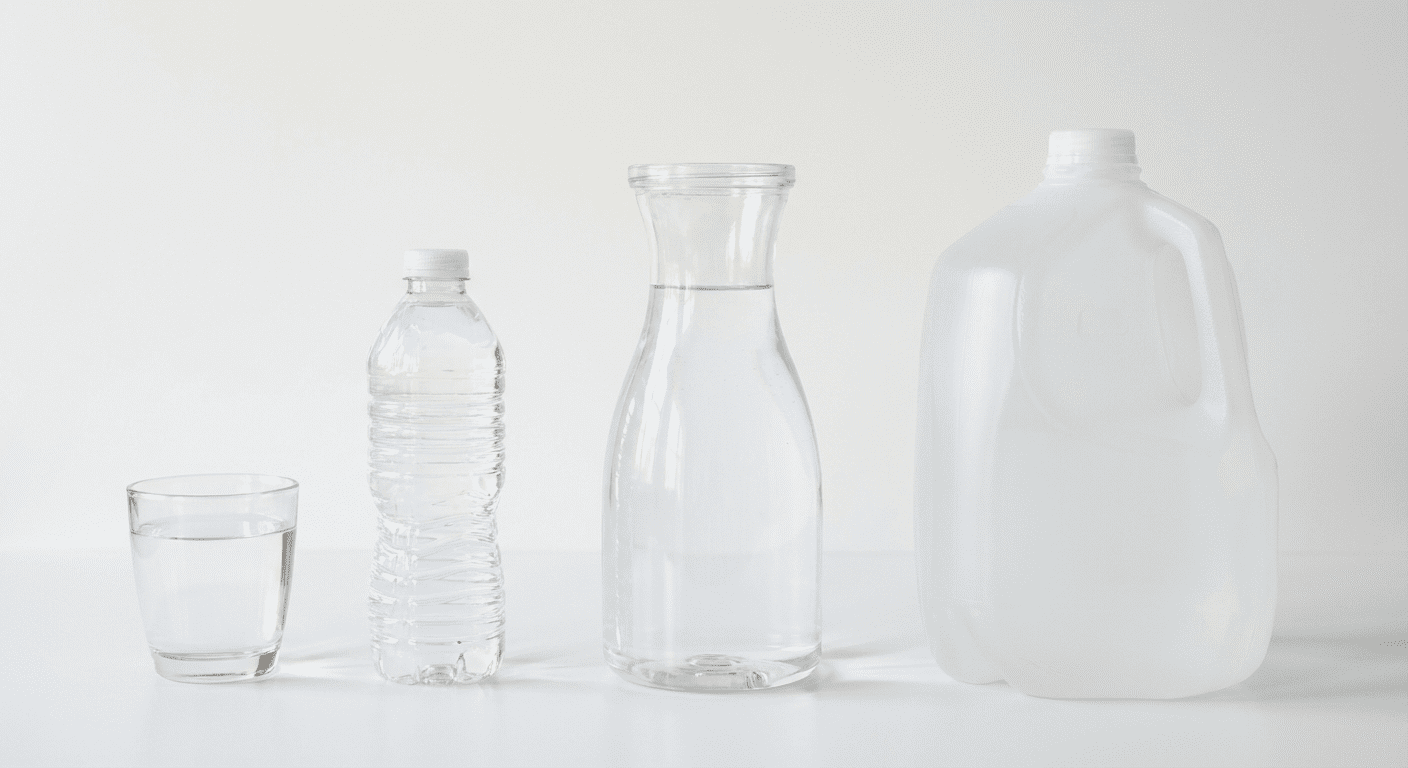
The table below shows the weight of common water volumes at room temperature (68°F / 20°C) using water's standard density of 8.34 lbs/gal or 1 kg/L:
| Volume | Pounds (lbs) | Kilograms (kg) | Grams (g) |
|---|---|---|---|
| 1 cup (US) | 0.522 lbs | 0.237 kg | 236.6 g |
| 1 pint (2 cups) | 1.043 lbs | 0.473 kg | 473.2 g |
| 1 quart (4 cups) | 2.087 lbs | 0.946 kg | 946.4 g |
| 1 gallon (US) | 8.345 lbs | 3.785 kg | 3,785 g |
| 1 liter | 2.205 lbs | 1.000 kg | 1,000 g |
| 1 cubic foot | 62.43 lbs | 28.32 kg | 28,317 g |
Water Density and Temperature
How Temperature Affects Water Weight
Water density — and therefore its weight per unit volume — changes with temperature. Unlike most substances, water has an unusual property: it is densest not at its freezing point (32°F / 0°C) but at approximately 39.2°F (4°C). At this temperature, one liter of water weighs exactly 1 kilogram. Below and above this temperature, water becomes less dense and therefore lighter per volume.
This density anomaly is why ice floats on liquid water — ice (water at 32°F) is less dense than liquid water at 39°F. For most engineering and cooking applications, the density of water is treated as 1 kg/L or 8.34 lbs/gal regardless of temperature, since the variation at normal temperatures is less than 0.4 percent.
Water Density at Different Temperatures
| Temperature | Density (kg/L) | Weight per Gallon (lbs) | Weight per Liter (lbs) |
|---|---|---|---|
| 32°F (0°C) | 0.9998 | 8.344 lbs | 2.205 lbs |
| 39.2°F (4°C) — max density | 1.0000 | 8.345 lbs | 2.205 lbs |
| 68°F (20°C) — room temp | 0.9982 | 8.330 lbs | 2.201 lbs |
| 140°F (60°C) — hot water | 0.9832 | 8.205 lbs | 2.168 lbs |
| 212°F (100°C) — boiling | 0.9584 | 7.997 lbs | 2.113 lbs |
Water Weight Calculator Formula
The formula for calculating water weight is based on the definition of density:
Because water's density is so close to 1 kg/L, calculating the weight of water in metric units is especially simple: the number of liters equals the number of kilograms. 500 mL of water weighs 500 g, 1 liter weighs 1 kg, 10 liters weigh 10 kg. This is why metric units are preferred in scientific and laboratory contexts — the conversion between volume and mass for water requires no calculation factor at standard conditions.
Common Water Weight Questions
Weight of 5 Gallons of Water
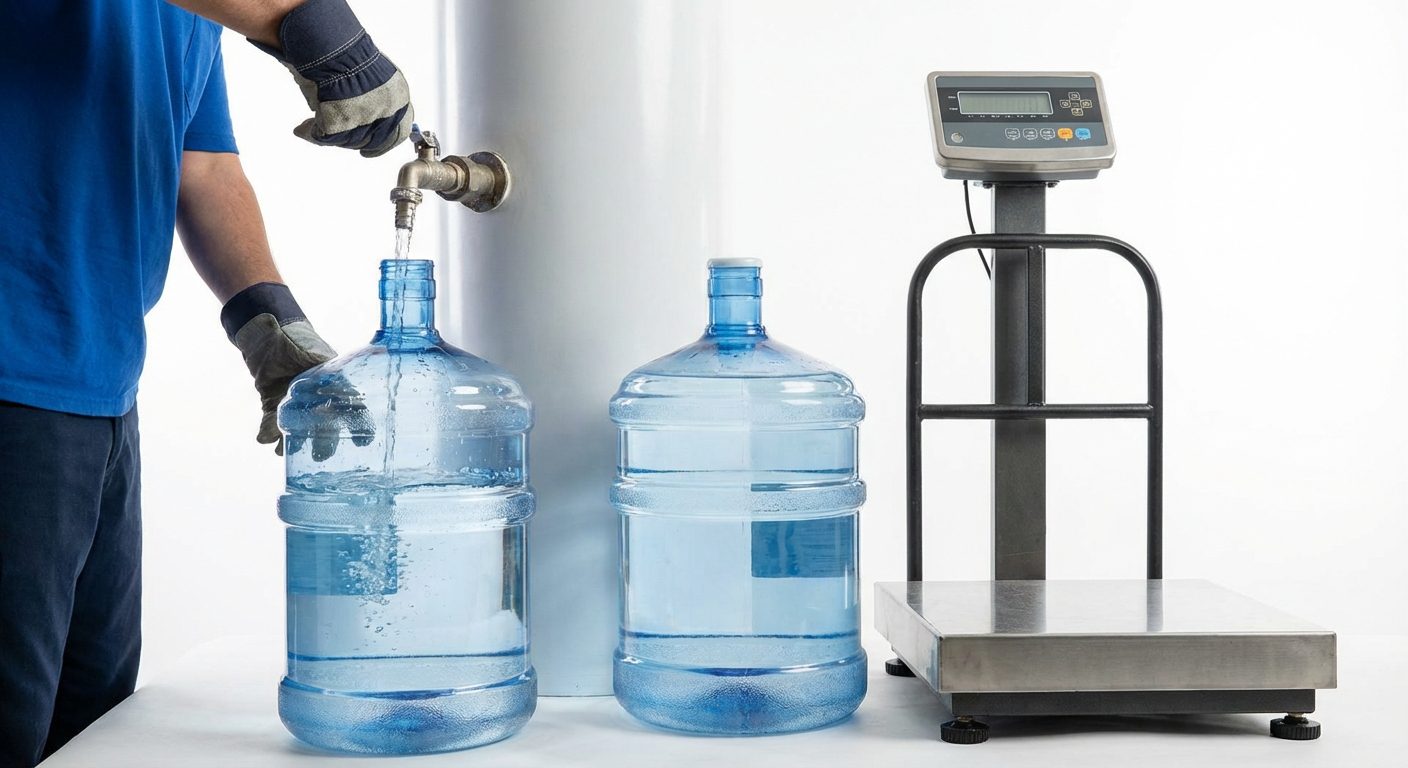
Five US gallons of water weigh approximately 41.7 pounds (18.93 kg). This is a frequently referenced figure for physical fitness training (5-gallon water jug carries), emergency water storage (FEMA recommends 1 gallon per person per day, so a 5-gallon jug is a 5-day supply for one person), and construction applications where a 5-gallon bucket is a standard measurement vessel. Standard 5-gallon water cooler jugs weigh about 43 to 44 pounds when full, including the empty jug weight of 1.5 to 2 pounds.
Weight of 1 Liter of Water
One liter of water weighs 1 kilogram (2.205 lbs, 1,000 grams, or 35.27 oz) at its maximum density temperature of 39.2°F (4°C). At room temperature (68°F / 20°C), the density is 0.9982 kg/L, making a liter weigh 998.2 grams — close enough to 1 kg for all practical purposes. This relationship between liters and kilograms is foundational to the metric system and is why water is used as the reference substance in many physical calculations. You can also use the kitchen conversion tool to convert cups, tablespoons, and other cooking volume units.
Weight of 1 Cubic Foot of Water
One cubic foot of water weighs approximately 62.43 pounds (28.32 kg). A cubic foot contains 7.481 US gallons, and at 8.345 lbs/gallon, that gives 62.42 lbs. This value is critical in structural engineering — building codes specify maximum floor live loads in pounds per square foot (psf), and engineers must account for the full water load when designing pools, water storage tanks, rooftop gardens with irrigation, and aquariums. A standard 55-gallon aquarium holds approximately 7.35 cubic feet of water weighing about 459 pounds — excluding the weight of gravel, equipment, and the tank itself. Use the area calculator to determine surface area when calculating pressure on tank floors and foundations.
FAQ
How much does a gallon of water weigh?
One US gallon of water weighs 8.34 pounds (3.785 kg) at room temperature. This is the standard value used in plumbing, engineering, and everyday calculations. A UK Imperial gallon is larger and weighs 10.02 pounds (4.546 kg).
How heavy is 1 liter of water?
One liter of water weighs almost exactly 1 kilogram (1,000 grams). In US customary units, 1 liter of water weighs 2.205 pounds or 35.27 ounces. The metric system was specifically designed so that 1 liter of water at maximum density (4°C) weighs exactly 1 kg.
Does hot water weigh less than cold water?
Yes. Hot water is less dense than cold water (above 4°C), so the same volume of hot water weighs slightly less. At boiling point (212°F / 100°C), one gallon of water weighs approximately 7.997 pounds — about 0.35 lbs less than cold water. For practical purposes, this difference is rarely significant.
How much does a 5 gallon bucket of water weigh?
Five gallons of water weigh approximately 41.7 pounds (18.93 kg). Adding the weight of the empty bucket (typically 1.5 to 2 lbs), a full 5-gallon bucket weighs about 43 to 44 pounds total.
How much does a cubic foot of water weigh?
One cubic foot of water weighs approximately 62.43 pounds (28.32 kg). This is a standard value in structural engineering for calculating water loads on floors, foundations, and tanks. One cubic foot contains 7.481 US gallons.