AI tools in 2026 increasingly depend on stable network access to operate reliably at scale. Data extraction, automated testing, and AI-driven monitoring pipelines generate sustained traffic patterns that put constant pressure on IP reputation, session continuity, and request timing. Based on data from AI CERTs, 52.3% of all web traffic is generated by AI bots, including 35% from LLM training crawlers and 17% from task-based automation bots.
Without controlled proxy infrastructure, rate limits, bans, and geo restrictions quickly degrade output quality and system reliability. Stable routing and predictable session handling reduce retry cascades, keep geo views consistent, and help multi-step automation complete without session breaks or partial outputs.
What Is a Proxy for AI Tools?
A proxy routes AI tool traffic through intermediary IP addresses so that repeated requests do not appear to come from a single visible network identity. This reduces rate-limit pressure and helps keep AI-driven scraping, testing, and automation stable on sites that score traffic by IP reputation and behavior.
Most proxy services rely on a gateway that assigns IPs from a pool rather than binding workflows to a single endpoint. This makes it possible to rotate identities, keep sessions stable when required, and continue execution when individual IPs fail without redesigning the pipeline.
Why Use Proxies for AI Tools in 2026?
Proxies matter in 2026 because AI workflows scale traffic patterns faster than manual automation. Stable proxy routing reduces partial failures, improves geo-consistent outputs, and limits retry cascades that inflate cost and distort results.
- AI-driven scraping and data collection: Controlled rotation keeps extraction stable under rate limits and reputation scoring.
- Testing and localisation validation: Geo-consistent routing keeps outputs comparable across regions.
- Automation and AI agents: Sticky sessions prevent multi-step flows from breaking mid-run.
- Monitoring pipelines: IP diversity reduces drop-offs on strict per-IP limits.
- Multi-market analysis: Predictable geo targeting reduces noise in region-specific comparisons.
Residential vs Datacenter vs ISP vs Mobile Proxies for AI Use Cases
Residential fits trust-sensitive scraping, SERPs, ecommerce, and localisation. Datacenter fits speed-first bulk pulls and internal QA on permissive targets. ISP fits repeat logins and multi-step sessions. Mobile fits the strictest platforms, agents, and app testing.
Residential
Residential proxies carry consumer network signals and typically achieve higher acceptance on targets that score traffic by trust and consistency. They fit AI-driven scraping, SERP checks, ecommerce monitoring, and localisation validation where reputation matters.
Datacenter
Datacenter proxies deliver speed and cost efficiency for high-volume tasks on permissive targets. They fit throughput-first collection, internal QA, and stable API-like sources where trust signals matter less.
ISP
ISP proxies provide stronger session stability with trust characteristics closer to residential routes. They fit repeat logins, dashboards, and multi-step flows where identity persistence prevents verification loops.
Mobile
Mobile proxies use carrier networks and usually handle the strictest environments better than other proxy classes. They fit agent workflows, social platforms, app testing, and high-friction targets where behavioral checks are aggressive.
Do Proxies Break AI Agent Workflows?
Proxies can disrupt AI agent workflows when rotation and routing conflict with multi-step execution logic. The main failure points are predictable and configuration-driven.
- Broken session continuity: IP changes mid-flow invalidate context, cookies, or auth state in multi-step agent tasks.
- Tool-call inconsistency: Unstable routing causes chained tool calls to appear as separate clients, breaking execution order.
- Authentication resets: IP or ASN shifts trigger re-authentication and restart agent flows.
- Latency jitter: Variable response times lead agents to misclassify delays as failures and retry unnecessarily.
Proxy design for AI scraping pipelines?
Proxy design for AI scraping pipelines stays stable when sticky sessions preserve state across steps, proxy types match target strictness, rotation happens between tasks, concurrency ramps gradually to avoid retry storms, and geo routing stays fixed to prevent drift noise.
Session-aware routing
Sticky sessions keep multi-step extraction, pagination, and stateful checks from resetting mid-run. Stable session windows preserve cookies, headers, and token context across tool calls, so the agent does not restart the same step.
Target-aligned proxy types
Residential and mobile routes fit trust-scored sites, while datacenter routes suit permissive, throughput-first sources. Matching proxy type to target strictness reduces challenges and keeps success rates more predictable across different job classes.
Controlled rotation boundaries
Rotation should happen between tasks, not inside execution blocks that depend on continuity. Mid-step IP changes often trigger re-verification, state loss, or partial output, especially on login, checkout, and account pages.
Concurrency throttling
Gradual scaling prevents retry storms that amplify small routing issues into queue backpressure. Validating a stable baseline first makes it easier to spot whether failures come from rotation policy, latency spikes, or target-side enforcement.
Geo consistency
Fixed country or city routing keeps SERP layouts, pricing, and content variants comparable across runs. Geo drift and ASN changes add noise, which can flip localisation logic and make results look like “real changes” when they are routing artifacts.
Leading Proxy Services for AI Tools in 2026
Below is a side-by-side overview of leading providers to compare proxy types, rotation mode, geo-targeting depth, protocol support, typical AI use cases, support level, and pricing.
| Provider | Core AI Advantage | Rotation Mode | Avg. Success Rate | Starting Price |
| Live Proxies | Stable sessions for repeatable AI checks, private-style allocation options for cleaner runs | Request rotation + sticky sessions | 99.9% | $70 / 4GB (Rotating Residential) |
| Oxylabs | Enterprise-scale access for hard targets and governance-heavy pipelines | Advanced rotation + sticky options | 99.82% | $4/GB (Basic) |
| Decodo (formerly Smartproxy) | Mid-market flexibility for mixed AI automation, scraping, and testing | Flexible rotation | 99.86% | $3.0/GB (Residential) |
| SOAX | Geo-precise routing for localisation validation and SERP-sensitive AI audits | Controlled rotation | 99.5% | $3.60/GB (Starter) |
| IPRoyal | Cost-focused coverage with broad proxy categories for routine AI monitoring | Standard rotation | 99.9% | $7.35/GB (Pay As You Go) |
| Webshare | Fast self-serve provisioning for QA, internal AI tooling, and quick deployments | Simple rotation | 99.97% | $1.40/GB (Rotating Residential) |
Top 6 Proxy Services for AI Tools in 2026
The providers below were selected based on session behavior, rotation control, pool cleanliness, and suitability for AI-driven production workflows rather than headline IP counts alone.
1. Live Proxies
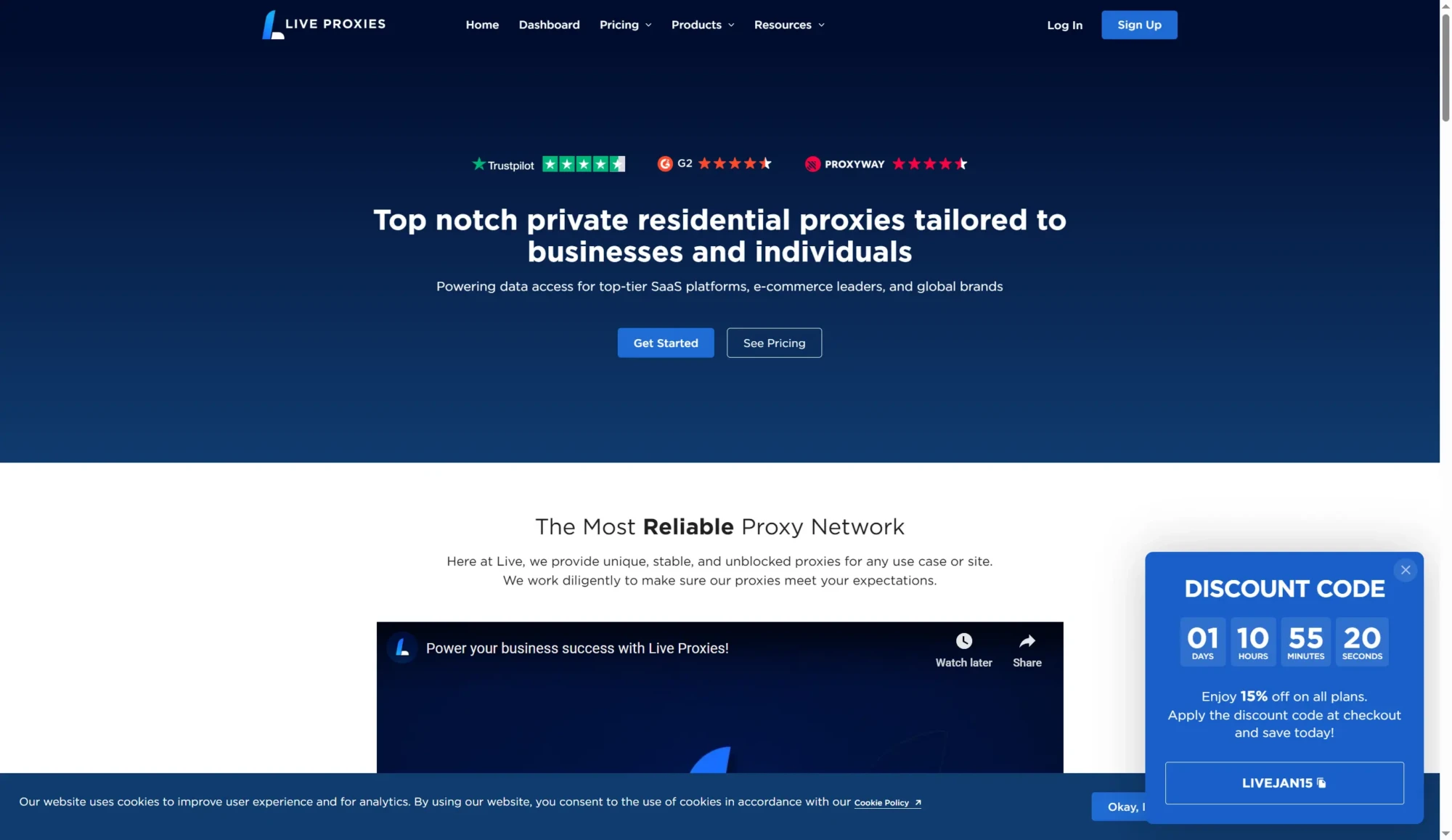
Live Proxies is designed for AI workflows that require repeatable outcomes and controlled session behavior, which makes it a strong fit among the best rotating proxy options for session-sensitive automation. It uses private IP allocation per target to reduce cross-tenant overlap, supports sticky sessions via session ID for up to 24 hours, reports 99.9% uptime for rotating residential proxies, and runs a global pool of millions of IPs across 55 countries. It supports SOCKS5 and HTTP protocols and allows unlimited threads, which helps multi-step automation keep continuity without unstable routing that breaks agent logic.
Proxy types
- Rotating Residential: Handles rotation-heavy AI checks where frequent refresh lowers repeated exposure and rate-limit pressure.
- Rotating Mobile: Fits stricter targets where carrier routing improves acceptance and reduces challenges.
- Static Residential: Maintains a steadier identity using home IPs monitored for >60 days, which supports longer-running sessions where rotating exits break continuity.
Best use cases
- Repeatable AI checks on strict targets: Stable residential routing helps keep scheduled runs consistent when platforms score reputation and behaviour.
- Mixed routing across job types: Rotating residential covers scale tasks, rotating mobile supports higher-friction platforms, and static residential fits workflows that need steadier identity.
- Target-specific monitoring portfolios: Private allocation by target helps reduce cross-customer overlap on the same sites when multiple pipelines run in parallel.
Strengths
- Private IP allocation by target: Cuts cross-tenant overlap on the same targets, which supports cleaner, more repeatable results.
- Residential IPs sourced from real home peers: Improves acceptance on consumer-grade platforms where household signals matter.
- Static residential filtered for stability windows: Supports longer identity persistence while keeping residential characteristics for session-based flows.
- Sticky sessions via session ID up to 24 hours: Keeps multi-step automation stable when jobs depend on continuity across tool calls and stateful steps.
Limitations
- Free trial: Available only for enterprise (B2B) users.
2. Oxylabs
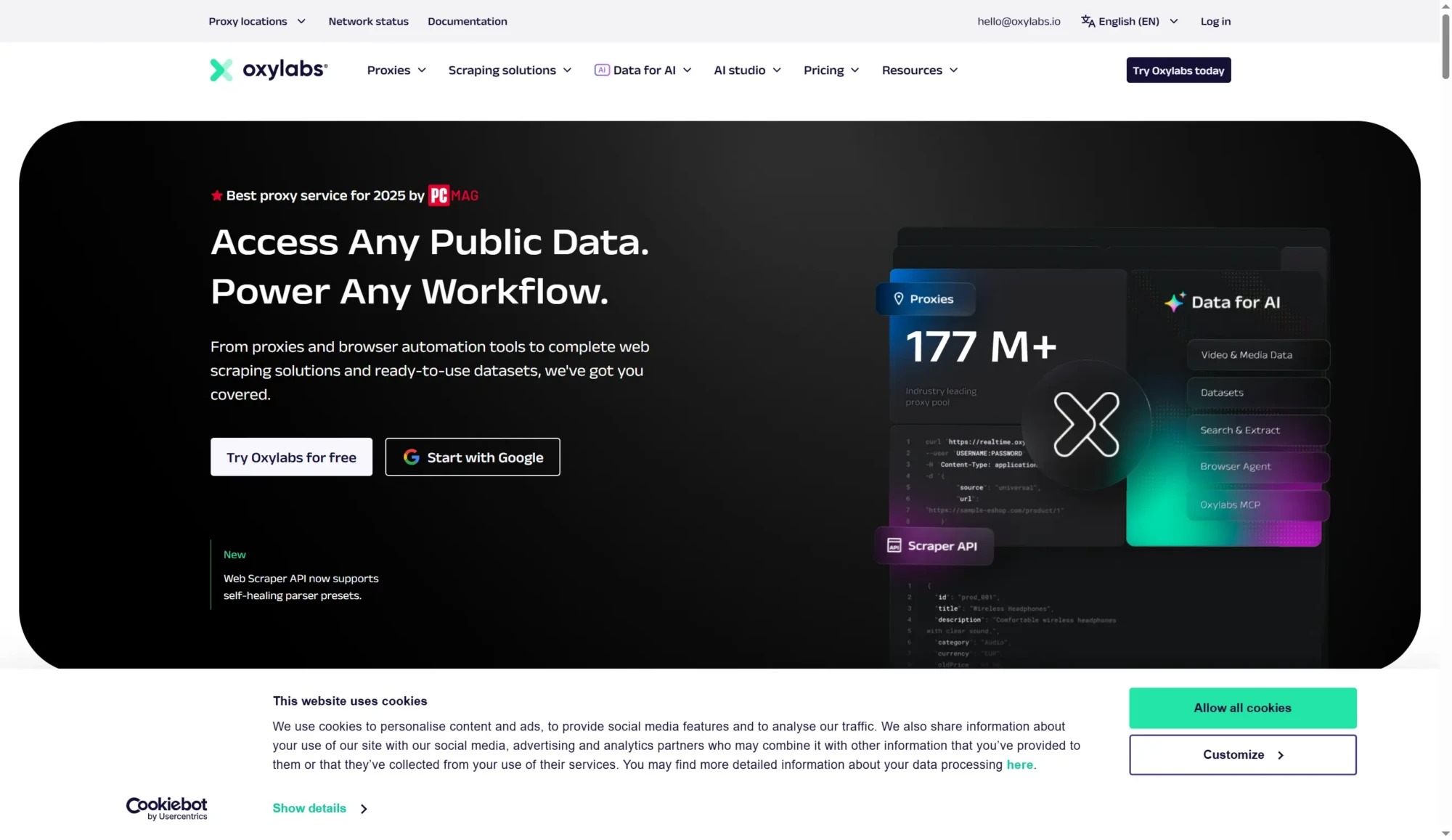
Oxylabs fits enterprise teams that need scale, governance-friendly operations, and consistent performance on harder targets. It is typically used when requirements include broad global coverage, multiple proxy categories for different target types, and higher control over routing behaviour in production pipelines.
Proxy types
- Residential proxies: Support human-like access patterns for trust-scored targets where shared datacenter IPs trigger faster blocks.
- Datacenter proxies: Deliver fast, cost-effective collection for permissive targets and throughput-first jobs, positioned for high success on permissive sources.
- ISP proxies: Provide static residential-style routes from trusted ASNs for workflows that need stable identity without frequent re-verification.
- Dedicated datacenter proxies: Offer exclusive datacenter IPs for high-throughput workloads where isolation and predictability matter.
- Dedicated ISP proxies: Provide dedicated IPs sourced from premium ISPs for long-lived sessions and higher stability on stricter targets.
- Mobile proxies: Use mobile-network IPs for higher-friction environments where carrier signals improve acceptance.
Best use cases
- Enterprise AI scraping pipelines: Handles high concurrency and continuous extraction at scale.
- Hard-target monitoring: Fits stricter platforms with aggressive enforcement and frequent challenges.
- Governance-heavy environments: Meets operational requirements beyond basic access and routing.
Strengths
- Enterprise tooling: Improves reliability when observability and controls matter.
- Global reach: Supports multi-market coverage with consistent routing options.
- Operational fit: Works well for teams that treat proxies as infrastructure.
Limitations
- Higher entry cost: Less efficient for small teams with light workloads.
- More tuning required: Results depend on correct rotation, pacing, and geo policy.
3. Decodo (formerly Smartproxy)
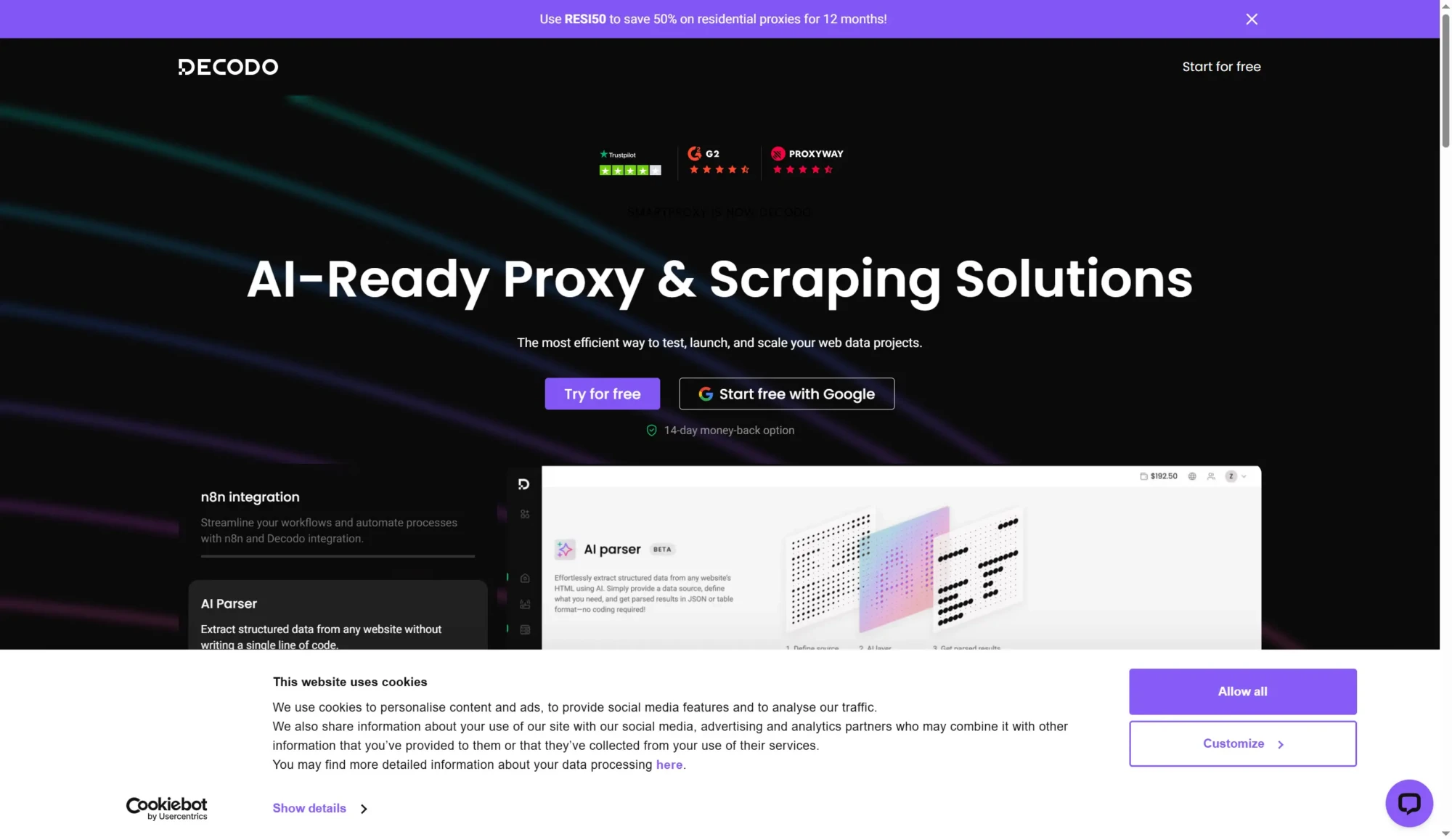
Decodo fits teams that need a broad proxy mix with predictable scaling, especially when AI jobs switch between scraping, testing, and localisation checks. It is commonly positioned as a practical “global coverage + flexible plans” option, with both rotating and more persistent routing styles available depending on the workflow.
Proxy types
- Residential: Delivers consumer-grade access for AI validation, SERP checks, and monitoring runs where IP reputation affects acceptance.
- Mobile: Fits higher-friction targets where carrier routing reduces challenges during automation-heavy flows.
- ISP: Provides steadier identity for repeat sessions, dashboards, and multi-step checks where consistency matters.
- Datacenter: Powers speed-first pulls on permissive sources and throughput-oriented batches where trust signals matter less.
Best use cases
- Mixed AI automation: Covers scraping, monitoring, and validation in one stack when routing rules change by task.
- Mid-scale extraction: Handles repeatable runs where predictable rotation reduces partial failures and keeps pipelines stable.
- Multi-geo research: Enables broad country coverage for localisation checks and region-based comparisons without switching providers.
Strengths
- Balanced cost-to-feature: Supports practical scaling without the overhead of enterprise procurement and heavy governance.
- Broad proxy categories: Support matching proxy type to target strictness rather than forcing a single default route everywhere.
- Flexible rotation: Supports both churn-heavy extraction and session-sensitive flows when stickiness and rotation settings are applied per job.
Limitations
- Strict targets vary: Some platforms still require mobile-first routing, conservative pacing, and stronger fingerprint discipline to stay stable.
- Policy discipline is needed: Weak session rules and aggressive concurrency can cause blocks to increase rapidly, even with a good pool.
4. SOAX
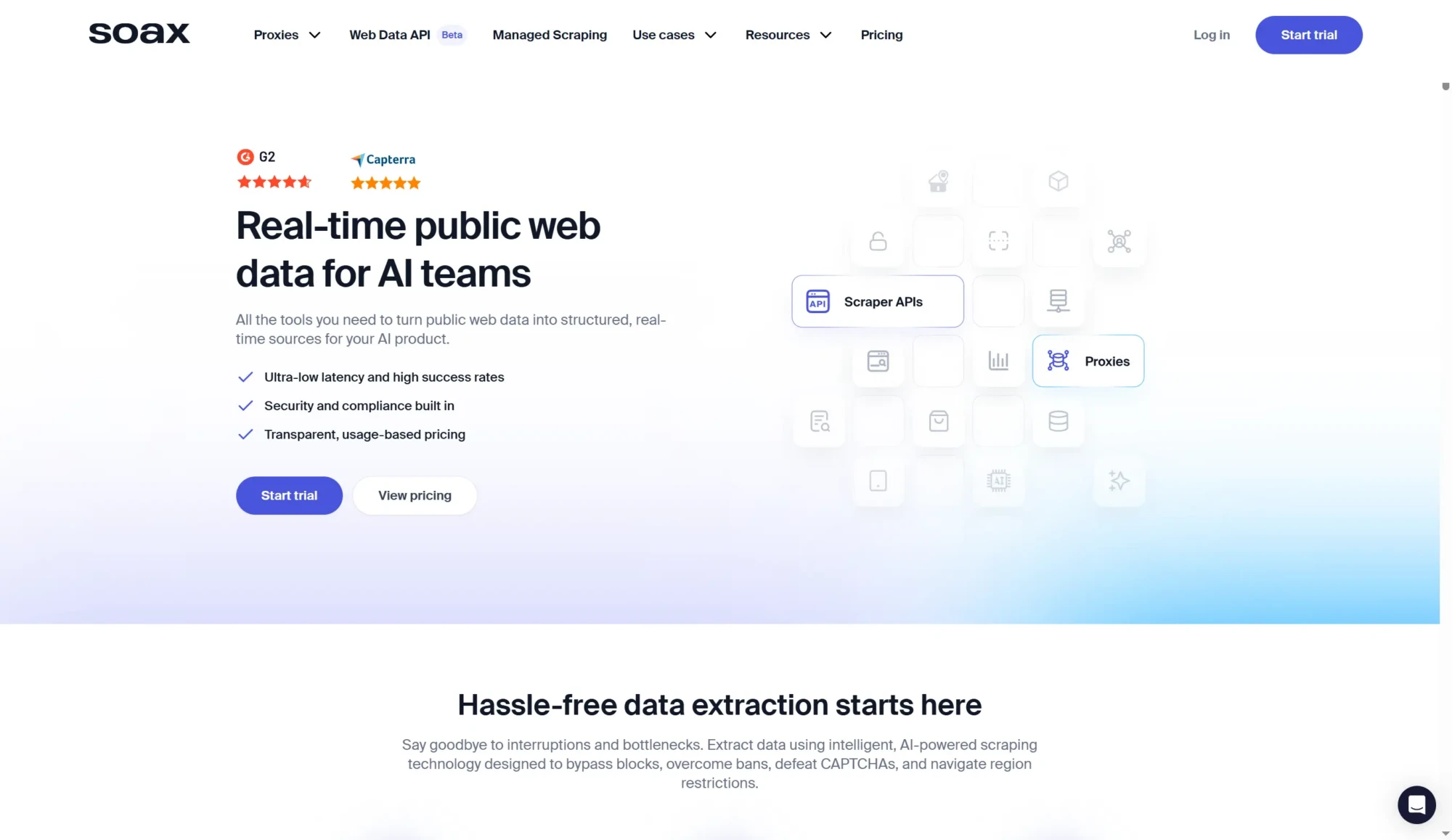
SOAX is used when geo precision and controlled routing materially affect AI outputs. It fits localisation QA and SERP workflows where city-level targeting reduces false signals and keeps repeated checks comparable, and it supports fine-grained location filtering so routing stays consistent across the exact markets being validated.
Proxy types
- Residential: Delivers higher acceptance for consumer-facing validation and trust-scored targets.
- Mobile: Handles stricter environments where carrier routing improves consistency under higher friction.
- US Datacenter: Enables speed-first checks on permissive targets where stable throughput matters.
Best use cases
- Local SERP validation: Keeps geo-sensitive ranking checks accurate when small location drift changes results.
- Localisation QA: Verifies language, currency, and regional content at scale with consistent routing.
- Geo-specific audits: Preserves comparability across repeat runs where routing drift would distort outputs.
Strengths
- Granular targeting: Improves accuracy for location-sensitive workflows and repeatable comparisons.
- Controlled rotation: Maintains more stable test conditions across runs than generic “rotate everything” setups.
- Verification fit: Reduces false positives caused by inconsistent location signals.
Limitations
- Less ideal for bulk scraping: High-volume extraction often performs better on speed-first stacks built for throughput.
- Routing discipline required: Incorrect geo selection still distorts outputs even with strong targeting options.
5. IPRoyal
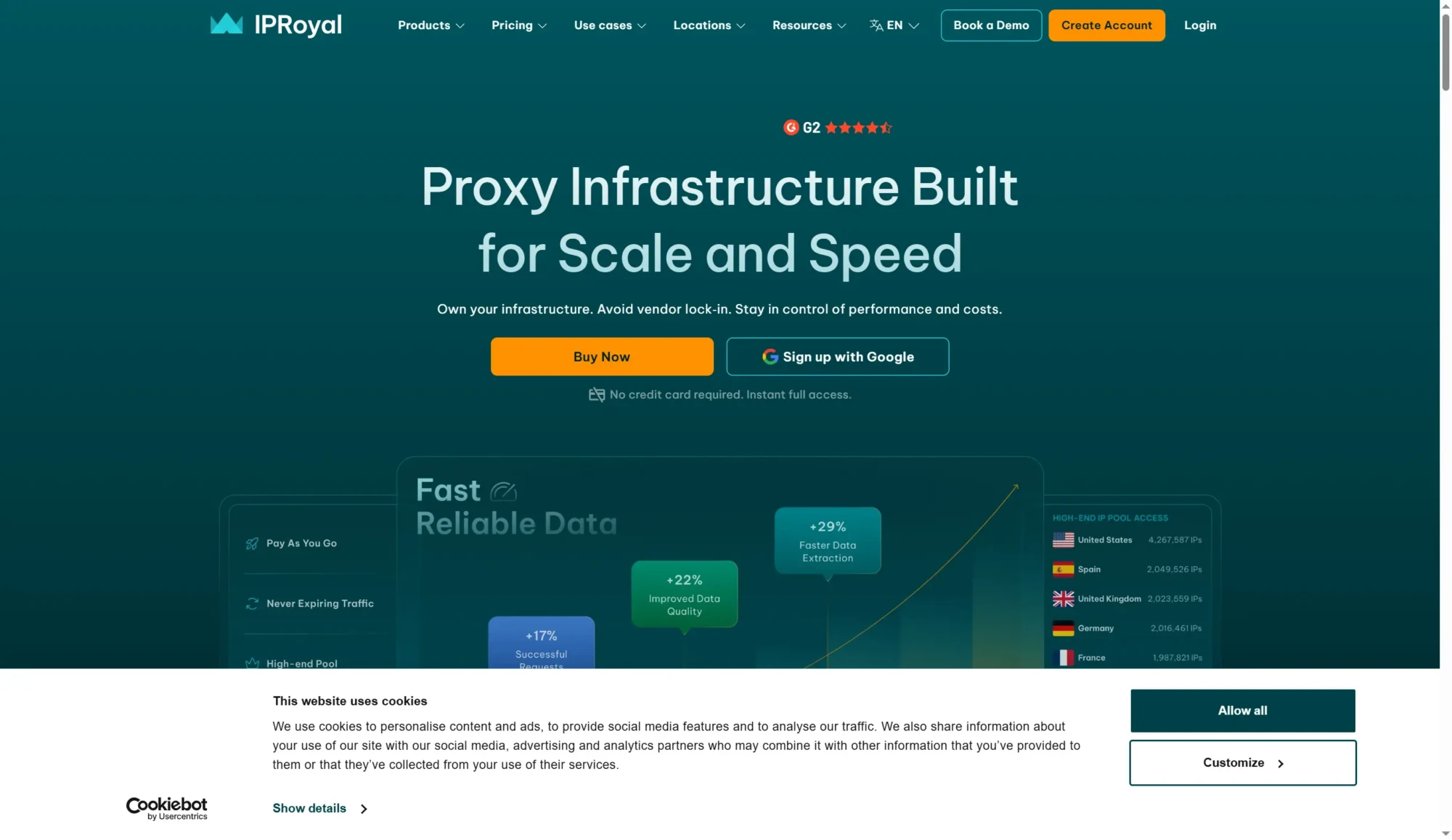
IPRoyal suits teams that want broad proxy category coverage with predictable budget control and simple onboarding. It works best when proxy type and session policy are matched to platform strictness rather than forcing one default route across every job.
Proxy types
- Residential: Enables everyday monitoring, validation, and trust-scored browsing flows.
- Mobile: Works in stricter environments where carrier signals improve acceptance.
- ISP: Keeps repeat sessions stable when persistence reduces re-verification loops.
- Datacenter: Delivers speed-first bulk tasks on permissive sources and internal QA.
Best use cases
- Budget monitoring: Keeps steady checks running without an enterprise cost structure.
- Moderate-risk automation: Fits routine workflows when pacing and session rules stay disciplined.
- Research workloads: Covers multi-geo collection where breadth matters more than advanced governance.
Strengths
- Budget control: Scales by project without committing to heavyweight enterprise plans.
- Broad proxy mix: Matches proxy class to target strictness instead of forcing one pool.
- Simple onboarding: Gets teams running quickly with low setup friction and clear workflows.
Limitations
- Strict sites require care: Hard targets still demand tighter behavior control and better session strategy.
- Type matching matters: Wrong proxy choice increases retries, challenges, and bans quickly.
6. Webshare
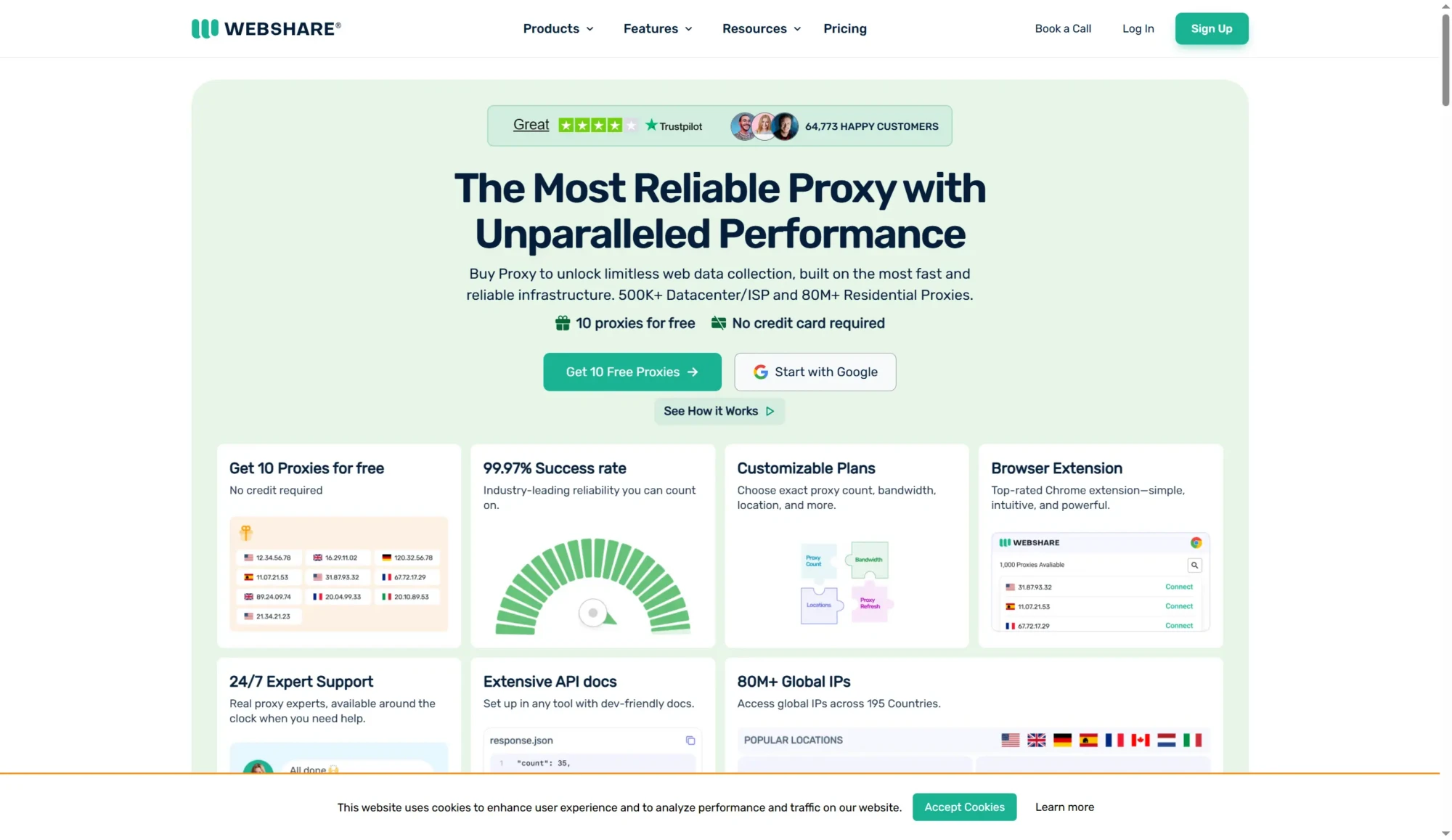
Webshare is a self-serve provider that prioritises fast provisioning, simple routing, and broad compatibility across common automation stacks, which makes it a practical fit for internal AI tools, QA workflows, and lighter monitoring where teams want to ship quickly without building a complex session layer upfront.
Proxy types
- Static Residential Proxy: Fixed residential IP for logins, dashboards, and steady sessions.
- Rotating Residential Proxy: Rotating residential pool for scraping, SERP checks, and monitoring.
- Private Static Residential: Low-share static residential IP for cleaner runs and repeat checks.
- Dedicated Static Residential: Fully exclusive static residential IP for maximum control and predictability.
Best use cases
- QA and internal validation: Runs frequent test cycles with minimal operational overhead.
- Internal AI tooling: Enables product-led setup for fast deployment and quick iteration.
- Permissive scraping: Handles bulk checks on targets without strict reputation scoring.
Strengths
- Fast self-serve: Reduces time from purchase to usable proxy endpoints.
- Straightforward management: Keeps operations simple for routine workflows and smaller teams.
- Wide tooling compatibility: Fits common automation stacks where basic proxy support is sufficient.
Limitations
- Limited advanced controls: Deep governance and complex session features are not the core focus.
- Hard targets vary: Strict environments may require more specialized routing and a tighter behavior strategy.
What Mistakes Cause AI Proxy Projects to Fail?
AI proxy projects usually fail because teams use one proxy type everywhere, over-rotate and break sessions, let geo and ASN drift distort outputs, scale concurrency before proving baseline stability, and ignore ban rate and retry cost until quality drops and spend spikes.
Using One Proxy Type for Every Target
Applying a single proxy type across all AI tasks ignores differences in trust requirements and session behavior. Mismatched routing increases bans and distorts outputs even when rotation is enabled.
Over-Rotating and Breaking Sessions
Excessive rotation breaks multi-step AI automation and agent flows, especially in headless and tool-call sequences. When IPs change mid-session, targets often trigger re-verification, reset state, and invalidate progress.
Ignoring Geo Drift and ASN Mismatch
Geo routing drift creates inconsistent localized outputs, and ASN changes can flip trust signals even within the same country. Small deviations can alter SERP layouts, pricing, language variants, and delivery rules, undermining comparability across runs.
Scaling Concurrency Before Validation
Raising volume before validating baseline stability magnifies existing issues and hides root causes behind noisy failures. High concurrency amplifies retries, timeout spikes, and failure cascades, turning minor routing problems into sustained data gaps.
Not Measuring Ban Rate and Retry Cost
Many teams track throughput but miss ban rate, retry-per-success, and cost per completed job, which are the real stability indicators. Without these metrics, degradation goes unnoticed until spend rises and output quality drops.
How to Choose the Best Proxy Service for AI Tools?
Choose a service with a large, diverse pool, clear control over request vs sticky rotation, stable latency and uptime under concurrency, pricing that matches bursty vs always-on jobs, and geo depth that fits the task, country for broad work, and city for localisation QA.
- Pool size and IP variety: Larger pools reduce repeated exposure to strict targets.
- Rotation flexibility: Request-based rotation fits extraction, while sticky sessions fit multi-step flows.
- Latency and uptime posture: Stability under concurrency matters more than peak speed.
- Pricing model fit: PAYG fits bursty AI jobs, subscriptions fit continuous monitoring.
- Geo targeting depth: Country is often enough, but city-level accuracy matters for localisation QA.
Conclusion
In 2026, proxies for AI tools work best when treated as production infrastructure rather than disposable unblockers. Results stay stable when proxy type matches target strictness, rotation policies balance request-based churn with sticky sessions, and geo routing remains consistent enough for comparable outputs.
The strongest providers differ by purpose, from stable residential routing for repeatable AI checks to enterprise-scale pools for hard targets and self-serve options for internal tooling. Reliable outcomes come from validating success rates under realistic concurrency, tracking retry cost and ban rates over time, and choosing pricing that matches real usage patterns.