AI video generation models changed a lot in 2025. These tools can now make cinematic-quality footage that matches professional production. If you are a content creator, marketer, or developer who wants to add text-to-video features to your apps, picking the right model can feel hard. There are so many options available.
Some models are better at photorealistic human motion. Others are better at stylized content. Some have better API access. This guide covers the top 17 proprietary AI video generation models from different companies. It includes benchmark rankings, official pricing, and API provider comparisons. This will help you choose.
Top 10 AI Video Generation Models
- Runway Gen-4.5
- Google Veo 3 / Veo 3.1 / Flow
- Kling 2.5 / 2.6 / O1
- OpenAI Sora 2
- Luma Ray 3 / Dream Machine
- Hailuo 02 / 2.3
- Pika 2.5
- Seedance / Lynx / Jimeng
- PixVerse v4/v5
- Grok Imagine
AI Video Models current Benchmark Rankings
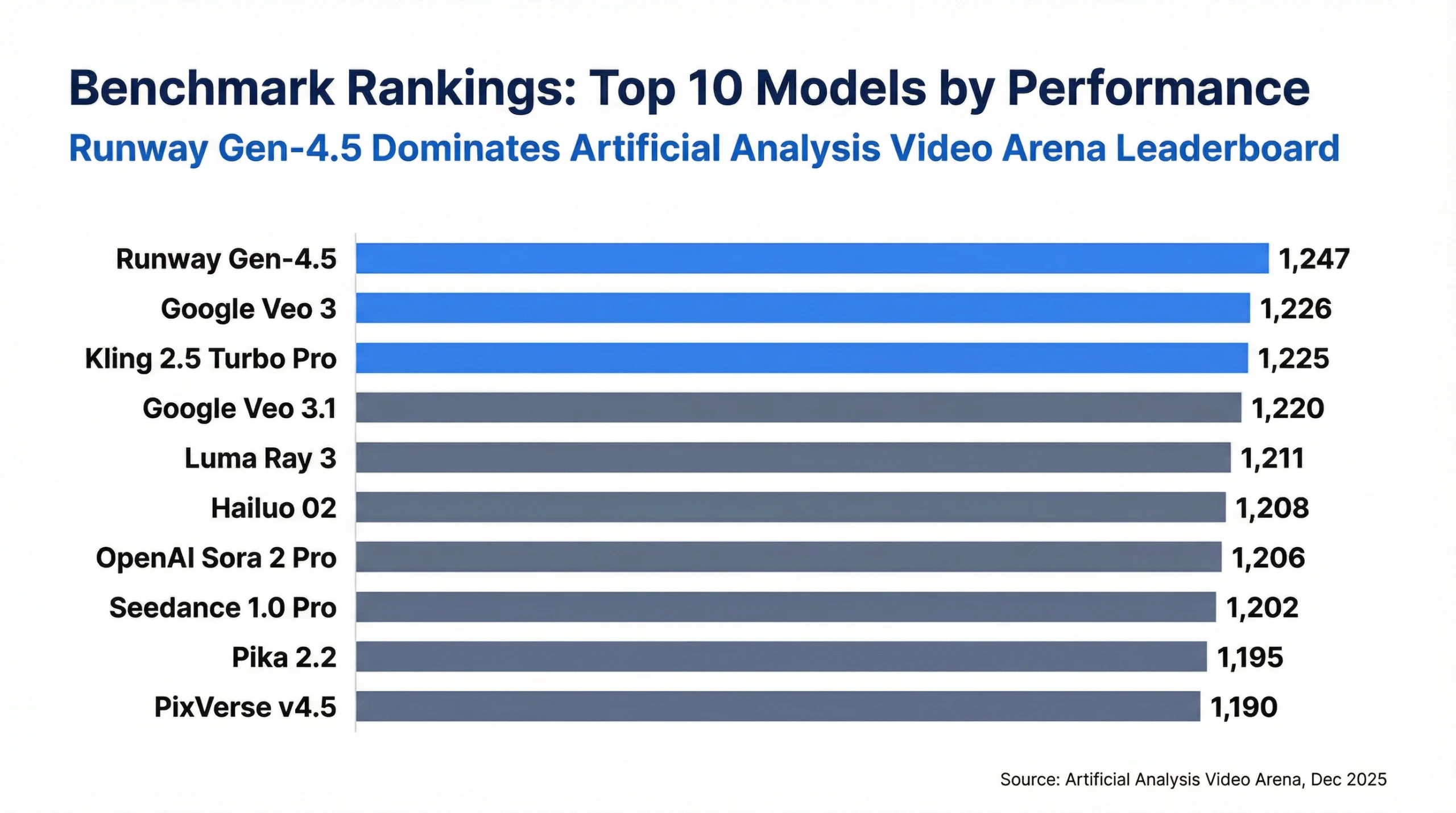
Before we look at each model, you should know how these tools compare to each other. The Artificial Analysis Video Arena provides the industry’s most trusted benchmark. It uses blind A/B testing where evaluators compare outputs without knowing which model made them.
| Rank | Model | Elo Score | Company | Native Audio |
|---|---|---|---|---|
| 1 | Runway Gen-4.5 | 1,247 | Runway | Yes |
| 2 | Google Veo 3 | 1,226 | Google DeepMind | Yes |
| 3 | Kling 2.5 Turbo Pro | 1,225 | Kuaishou | No |
| 4 | Google Veo 3.1 | 1,220 | Google DeepMind | Yes |
| 5 | Luma Ray 3 | 1,211 | Luma AI | Coming Soon |
| 6 | Hailuo 02 | 1,208 | MiniMax | No |
| 7 | OpenAI Sora 2 Pro | 1,206 | OpenAI | Yes |
| 8 | Seedance 1.0 Pro | 1,202 | ByteDance | No |
| 9 | Pika 2.2 | 1,195 | Pika Labs | Yes |
| 10 | PixVerse v4.5 | 1,190 | PixVerse | Yes |
Data source: Artificial Analysis Video Arena Leaderboard, December 2025
Now let’s GET into our list of AI video models. For each tool we will name the company that created it and list every model you can call via API today. We will give the exact technical specs: resolution, frame rate, max clip length, andVRAM use. We will show the official price of credits or tokens per second of video and the cost at each API provider.
1. Runway (Gen-3 Alpha, Gen-4, Gen-4 Turbo, Gen-4.5, Aleph)
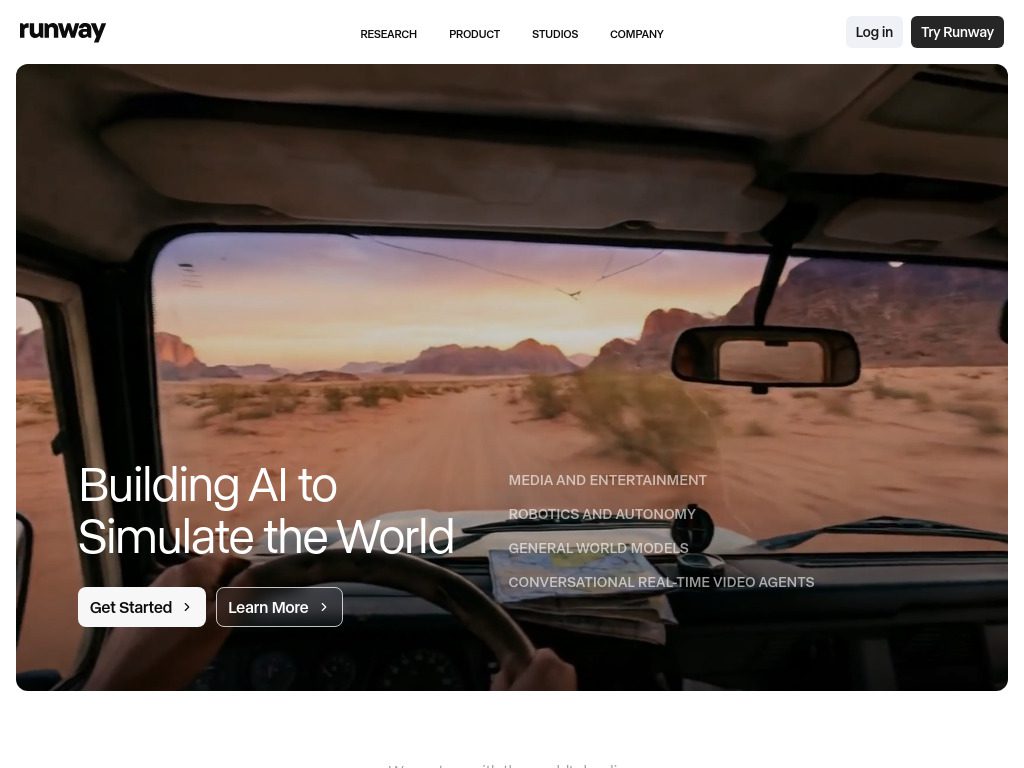
Runway started in 2018. It has been a pioneer in AI video generation. It earned a spot on CNBC’s Disruptor 50 list in 2025. The New York-based startup has about 120 employees and a $3.55 billion valuation. It has kept pushing what is possible with generative video.
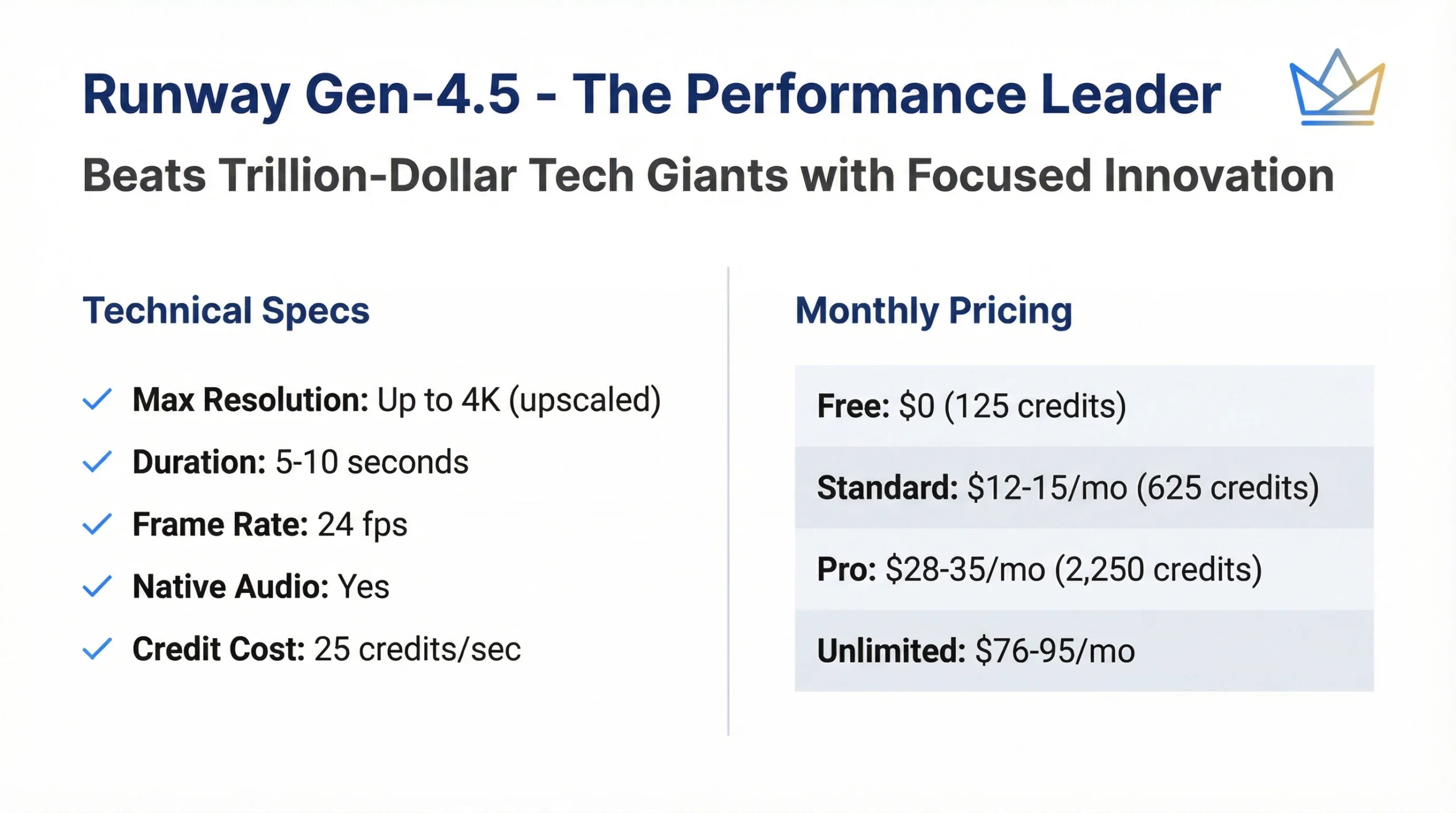
Runway Gen-4.5 came out on December 1, 2025. It immediately took the #1 spot on the Artificial Analysis Video Arena leaderboard. It beat Google’s Veo 3. It has an Elo score of 1,247. This shows a big jump in motion quality, prompt adherence, and visual fidelity. The model was internally codenamed “David.” This refers to the biblical David vs. Goliath story. It shows Runway’s position against trillion-dollar tech giants.
You might think trillion-dollar tech giants would lead this space. But Runway has shown that focused innovation can beat massive R&D budgets. As CEO Cristóbal Valenzuela noted, “We managed to out-compete trillion-dollar companies with a team of 100 people.”
Available Models
- Gen-3 Alpha / Gen-3 Alpha Turbo: These are earlier generation models. They are still available at lower credit costs. They work well for rapid prototyping and budget-conscious projects.
- Gen-4: This is image-to-video generation with improved consistency. It uses 12 credits per second.
- Gen-4 Turbo: This is faster generation at lower cost (6 credits per second). It is good for quick iterations.
- Gen-4.5: This is the flagship model with breakthrough quality. It uses 25 credits per second at 1080p.
- Aleph: This is Runway’s video editor for post-production refinement. It creates a complete ecosystem similar to Adobe’s approach but with native AI tools.
When to Use This Model
Best for: Professional filmmakers, advertising agencies, content creators who need the highest visual quality, and teams that need precise control over camera movements, scene compositions, and atmospheric changes. Runway’s tools have been used in production workflows for shows like The Late Show With Stephen Colbert and in Oscar-nominated projects.
Technical Specifications:
- Max Resolution: Up to 4K (with upscaling)
- Max Duration: 5-10 seconds per generation (extendable)
- Frame Rate: 24 fps
- Native Audio: Yes (Gen-4.5)
- Architecture: Autoregressive-to-Diffusion (A2D) on NVIDIA Blackwell GPUs
- Key Features: Image-to-video, keyframes, video-to-video, motion brush, Act-Two performance capture
Official Pricing
| Plan | Monthly Price | Credits | Gen-4.5 Video Time | Features |
|---|---|---|---|---|
| Free | $0 | 125 (one-time) | ~5 seconds | 720p, watermarked, 3 projects, 5GB storage |
| Standard | $12-15/user | 625/month | ~25 seconds | 1080p, no watermark, unlimited projects, 100GB storage |
| Pro | $28-35/user | 2,250/month | ~90 seconds | 4K rendering, priority queue, custom voices |
| Unlimited | $76-95/user | 2,250 + Unlimited (relaxed) | Unlimited at slower speed | All Pro features + Explore Mode |
| Enterprise | Custom | Custom | Custom | SSO, advanced security, dedicated support |
Credit Costs by Model:
- Gen-4.5: 25 credits/second
- Gen-4: 12 credits/second
- Gen-4 Turbo: 6 credits/second
- Gen-3 Alpha Turbo: 5 credits/second
API Access
Official: Available through Runway’s API with pay-as-you-go pricing at about $0.01 per credit. Enterprise API access needs custom pricing. Gen-4.5 API access is rolling out to partners in December 2025.
Third-Party Providers:
- AIML API: $0.053/second for Gen-3 Turbo
- Integrated into Canva’s Magic Studio
2.Veo 3, Veo 3.1, Flow (Google DeepMind)
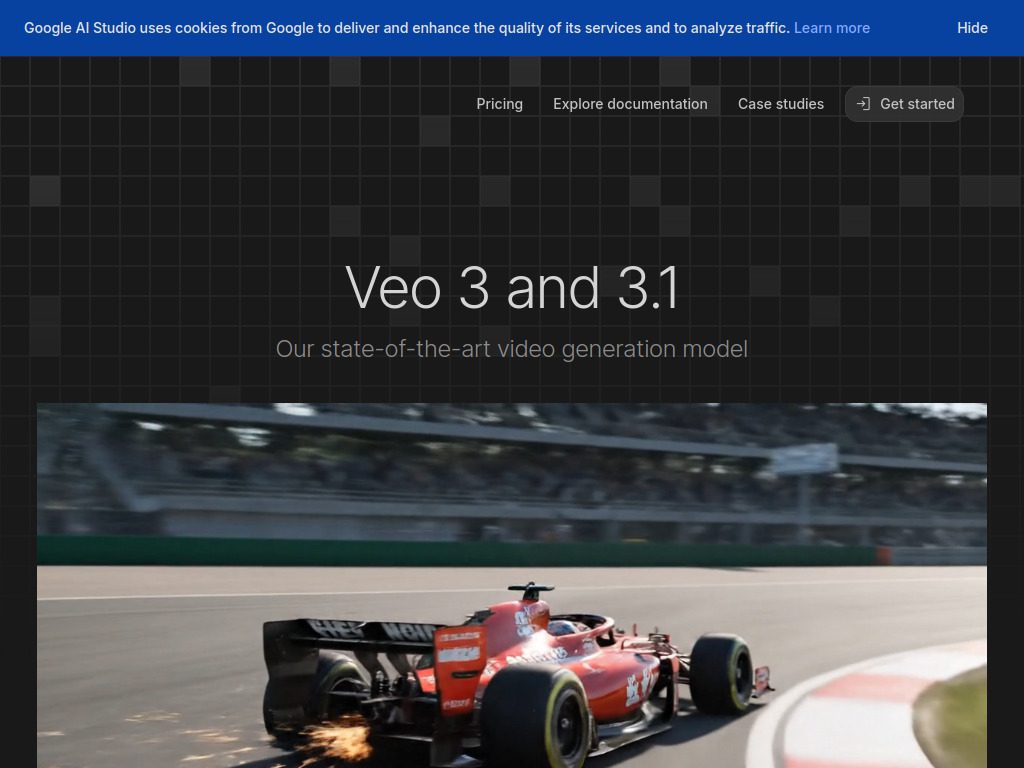
Google DeepMind’s Veo series is the best for synchronized audio-video generation. When you type a prompt like “a cat playing piano in a jazz club,” Veo generates not just the video but perfectly synchronized piano notes, ambient bar chatter, and paw movements hitting keys in rhythm.
This is not separate audio you must line up by hand. Everything is made together with perfect sync. Creators used to spend hours matching sound effects and music to AI video. This changes that. The model uses SynthID watermarking for provenance tracking. This helps audiences know the media is synthetic.
Available Models
- Veo 3: This is the flagship model with native audio generation. It ranks #2 on Video Arena (Elo: 1,226).
- Veo 3.1: This is an upgraded version with enhanced creative capabilities, improved audio quality, and better scene understanding.
- Veo 3 Fast / Veo 3.1 Fast: These are lower-latency versions for rapid iteration. They are available through YouTube Shorts integration.
- Google Flow: This is an AI filmmaking tool powered by Veo 3.1. It features “Ingredients to Video,” “Frames to Video,” and “Extend” capabilities with audio support across all features.
When to Use This Model
Best for: Projects that need synchronized audio (dialogue, sound effects, ambient noise), multi-scene generation, and cinematic storytelling. Veo 3.1 leads benchmarks specifically for complex narrative sequences. It is also good for users already in the Google Workspace ecosystem who want seamless integration.
Technical Specifications:
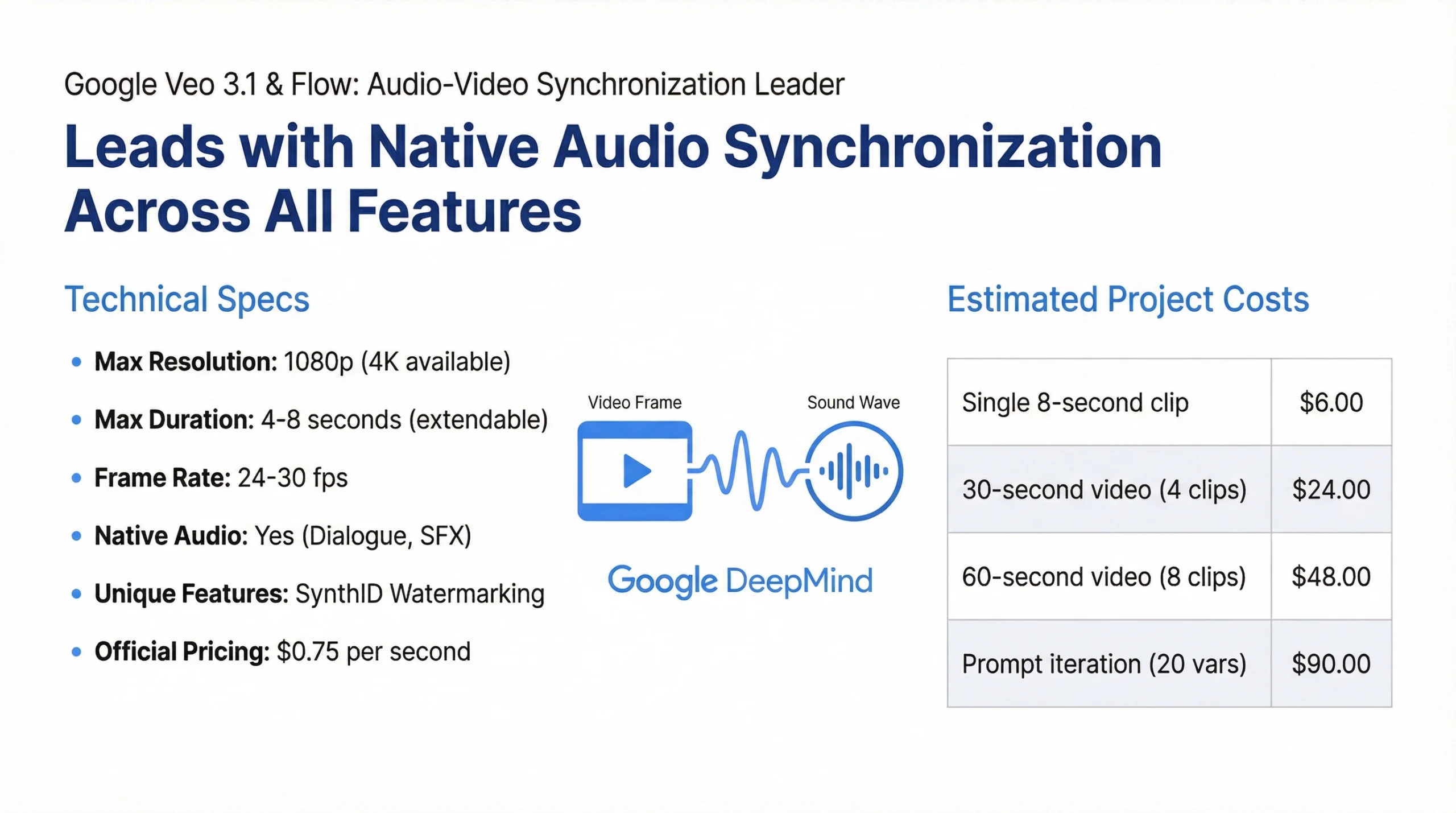
- Max Resolution: 720p to 1080p (4K available on some tiers)
- Max Duration: 4-8 seconds (extendable with scene extension)
- Frame Rate: 24-30 fps
- Native Audio: Yes (dialogue, sound effects, ambient noise)
- Unique Features: SynthID watermarking, multi-scene generation, audio synchronization
- Aspect Ratios: 1:1, 9:16, 16:9
Official Pricing
Google charges $0.75 per second of generated video through the Gemini API and Vertex AI. This price includes both video and audio generation.
| Use Case | Duration | Estimated Cost |
|---|---|---|
| Single 8-second clip | 8 sec | $6.00 |
| 30-second video (4 clips) | 30 sec | $24.00 |
| 60-second video (8 clips) | 60 sec | $48.00 |
| Prompt iteration (20 variations at 6 sec each) | 120 sec total | $90.00 |
Google Flow is available to Google AI Pro/Ultra subscribers through labs.google/flow.
API Access
Official:
- Google Cloud Vertex AI
- Gemini API
- YouTube Shorts integration (Veo 3 Fast)
Third-Party Providers:
3. Kling 2.5, Kling 2.6, Kling O1 (Kuaishou)
Kuaishou is a Chinese tech giant. It runs the Kwai/Kuaishou short-video platform. It made the Kling series. Kling has become a strong competitor. It is especially good at physics simulation, facial expressions, and motion consistency. The model uses a Diffusion Transformer Architecture to make 30 frames per second with consistent transitions and motions.
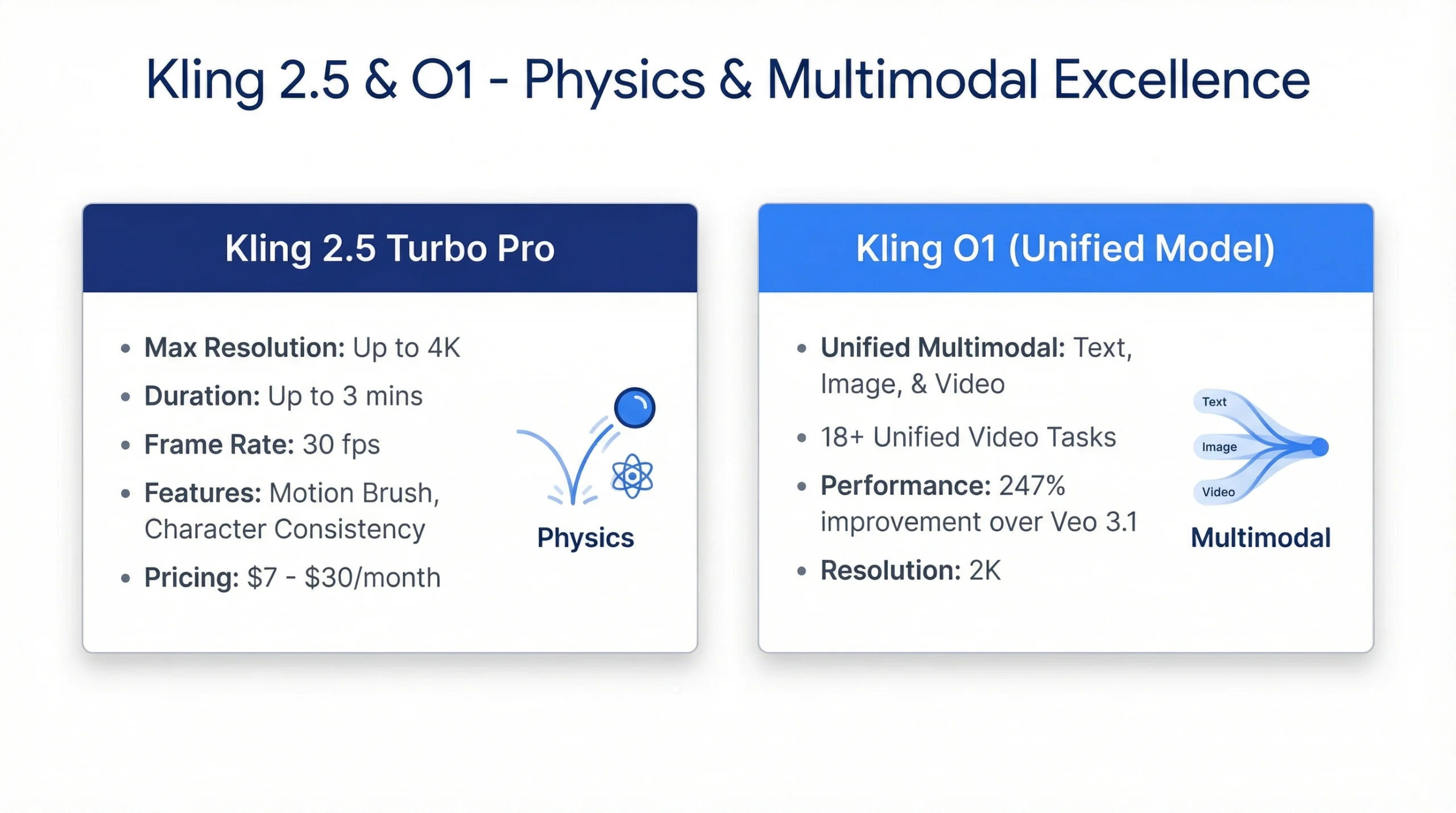
The December 2025 release of Kling O1 is the world’s first unified multimodal video model. It is a paradigm shift. It combines 18+ video tasks (generation, editing, transformation) into a single platform. Internal benchmarks claim 247% improvement over Google Veo 3.1 Fast for image reference tasks. They also claim 230% improvement over Runway Aleph for video transformation.
Available Models
- Kling 1.5 / 1.6: These are earlier versions with solid quality at lower price points. They support up to 2-minute videos.
- Kling 2.0 / 2.1: These have improved motion quality and style flexibility.
- Kling 2.5 Turbo / Kling 2.5 Turbo Pro: These rank #3 on Video Arena (Elo: 1,225). They are excellent for high-quality productions.
- Kling 2.6: This is the latest iteration with enhanced capabilities.
- Kling O1: This is a unified multimodal model. It accepts text, image, and video inputs at the same time. It supports up to 2K resolution.
When to Use This Model
Best for: Product demos, realistic human interactions, dialogue scenes with lip-sync, anime/stylized content, and projects that need advanced camera controls (pan, tilt, orbital rotations, zoom, tracking shots). Kling’s “Elements” feature keeps character consistency across up to 4 reference images. This beats most competitors that limit references to 1-2 images.
Technical Specifications:
- Max Resolution: Up to 4K (premium tiers), 2K (Kling O1), 1080p standard
- Max Duration: Up to 3 minutes with extension feature
- Frame Rate: 30 fps
- Unique Features: Motion brush, Elements character consistency (4 images), Virtual try-on API, 18+ unified tasks (O1)
- Aspect Ratios: 1:1, 16:9, 9:16
Official Pricing
| Plan | Monthly Price | Credits | Notes |
|---|---|---|---|
| Free | $0 | 66 daily | Watermarked, slower queue, Kling 1.0 |
| Standard | $6.99-7 | 660/month | Kling 1.5/2.0 access, no watermark |
| Pro | $12-15 | 3,000/month | Kling 2.5 Pro access, priority queue |
| Premier | $30 | 8,000/month | Full Pro model access + early features |
⚠️ Important: Unlike competitors, Kling’s paid credits expire if not used within their validity period. This happens even mid-subscription. This has been a major point of user criticism. So plan your usage accordingly.
API Access
Official: Kling AI API operates on a prepaid resource package model. It has bundles for video generation, image generation, and virtual try-on. Enterprise API tiers are designed for businesses that generate video at scale.
Third-Party Providers:
- fal.ai: $0.029/second (Kling 2.1)
- Replicate: Available (kling-ai/kling-v2.5)
- AIML API: $0.029/second (T2V/I2V), $0.059/second (Avatar)
- Pollo AI: Available
4. OpenAI Sora 2, Sora 2 Pro
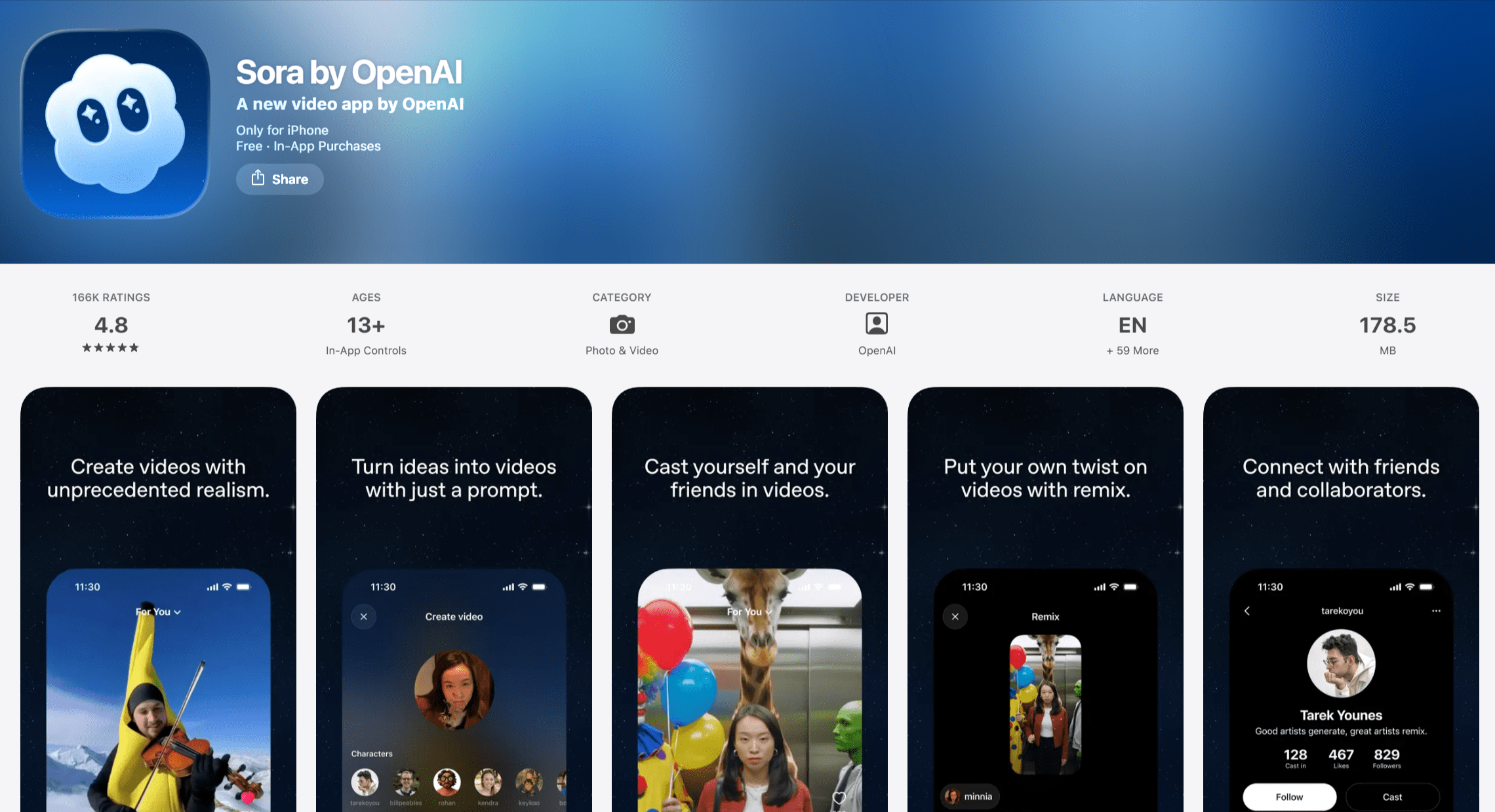
OpenAI’s Sora 2 was one of the most awaited AI video releases of 2025. It was announced in December 2024 and launched publicly in early 2025. It shows a big step forward in AI video generation tech. It makes content with consistent characters, accurate physics, and complex scene dynamics.
Sora 2 currently ranks 7th on benchmarks (Elo: 1,206). But it does well in areas that count for specific use cases. These include long-form content generation (up to 35 seconds on Pro tier) and photorealism. The unique “Cameos” feature lets users insert themselves into AI-generated scenes. This makes it very popular for social content creation.
Sora 2 has repositioned as a social video app with a TikTok-style feed. It has iOS and Android apps (Android launched November 4, 2025). This sets it apart from production-focused competitors.
When to Use This Model
Best for: Social content creators, influencers who want self-insertion features (Cameos), mobile-first workflows, and projects that need videos up to 35 seconds without extension workarounds. It is also strong for world simulation and understanding of physics.
Technical Specifications:
- Max Resolution: 480p, 720p, 1080p (selectable)
- Max Duration: 20-35 seconds (Pro tier)
- Frame Rate: 24-30 fps (refinable)
- Native Audio: Yes
- Unique Features: Cameos self-insertion, mobile-first apps (iOS/Android), TikTok-style feed, multiple shots per generation
- Content Credentials: C2PA embedded + visible watermarks
Official Pricing
Sora 2 is available to ChatGPT Pro subscribers at $200/month with daily video limits that reset. Different subscription tiers affect generation speed and video length.
Geographic Restrictions: Currently limited to about 7 countries. It excludes Europe, India, and most regions globally. This is a major limitation compared to globally-available competitors.
API Access
Official: Not yet publicly available as of December 2025. OpenAI announced plans in March 2025 to integrate Sora into ChatGPT. This will allow video creation within the chat interface. Industry speculation suggests API pricing around $0.50-1.00 per second when generally available.
Third-Party Providers:
- Limited availability through premium aggregators like Pollo AI and CometAPI
- AIML API: OpenAI Sora Turbo at 120 credits (via ReelMind)
5. Luma AI (Dream Machine, Ray 2, Ray 2 Flash, Ray 3)
Luma AI’s Ray 3 came out in September 2025. It introduced two industry firsts. It is the world’s first ‘reasoning’ video model. It is also the first to support HDR output. The reasoning capability helps the model understand cause-and-effect better. This leads to more coherent scene progressions.
Luma’s unlimited plan at $29.99/month sets it apart. This removes per-video credit anxiety completely. For high-volume creators doing extensive concept testing and rapid iteration, this pricing model can save hundreds of dollars monthly compared to credit-based alternatives.
Luma also integrated with Adobe Firefly (announced September 18, 2025). This expands its reach into the Adobe creative ecosystem.
Available Models
- Dream Machine: This is the original consumer-friendly model for text-to-video and image-to-video generation.
- Ray 2: This has improved visual quality and motion handling.
- Ray 2 Flash: This is a lower-latency version. It keeps core motion quality (~2 minute generation times), visual consistency, and stylization performance for faster iteration cycles.
- Ray 3: This is the world’s first reasoning video model with HDR/EXR export, Draft Mode, visual annotations/keyframes, and subject-aware editing. It ranks at Elo: 1,211.
When to Use This Model
Best for: Creators who need high-volume generation without credit anxiety, HDR output for professional workflows, natural-language editing capabilities (“describe the edit” in plain language), and rapid concept testing.
Technical Specifications:
- Max Resolution: 1080p (4K with upscaler)
- Max Duration: Up to 30 seconds (quality can degrade beyond this)
- Frame Rate: 24 fps
- Unique Features: HDR/EXR export, Draft Mode, visual annotations/keyframes, subject-aware editing, reasoning capability
- Generation Time: ~2 minutes (Ray 2 Flash)
Official Pricing
| Plan | Monthly Price | Generations | Features |
|---|---|---|---|
| Free | $0 | 30/month | Basic access, watermarked |
| Standard | $9.99 | 120/month | No watermark, standard queue |
| Pro | $24.99 | 400/month | Priority queue, advanced features |
| Unlimited | $29.99 | Unlimited | No credit limits, ideal for high-volume |
Key Advantage: The Unlimited plan’s fixed monthly cost ($29.99) gives great value for creators making high volumes of content or doing extensive A/B testing.
API Access
Official: Luma Dream Machine API
Third-Party Providers:
- fal.ai: $0.002-0.007 per 1M pixels (Ray Flash 2: $0.002, Ray 2: $0.007, Ray 1.6: $0.003)
- Replicate: Available
- AIML API: $0.263/generation
6. MiniMax Hailuo 02, Hailuo 2.3
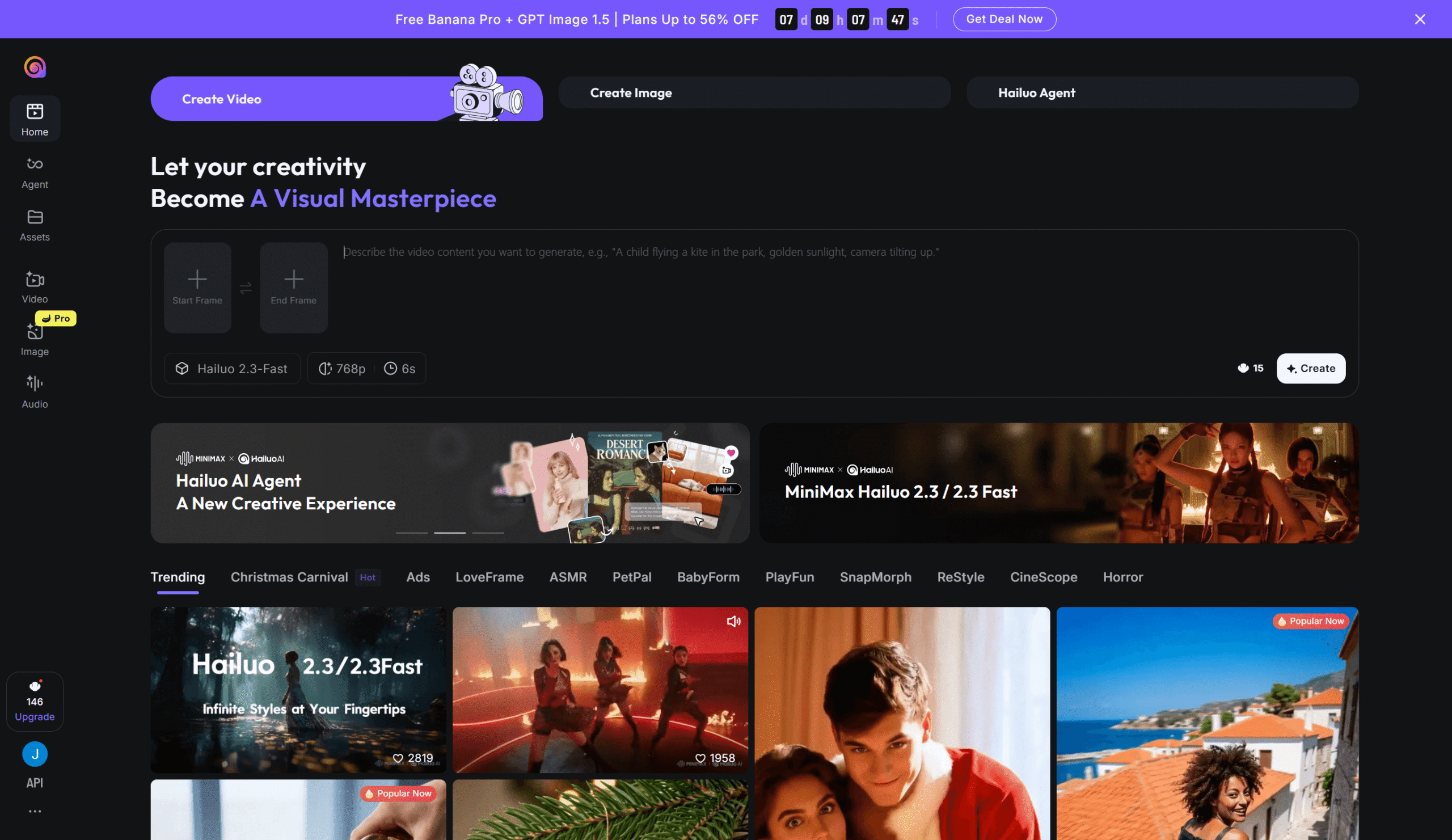
MiniMax is a Chinese company. Its Hailuo AI has become the dark horse of AI video generation. It gives surprisingly good quality at budget-friendly prices. At $14.99/month, it offers 10-second videos with excellent physical realism. This makes it a strong option for creators who need realistic videos without premium pricing.
The October 2025 release of Hailuo 2.3 brought enhanced motion rendering with smoother, more natural character movements. It keeps near-photorealistic results in lighting, shadows, and color tones. It also expanded style support to include anime, illustration, ink painting, and game CG aesthetics. This makes it one of the most versatile models for stylized content.
Available Models
- Hailuo Video-01: This is an earlier model. It generates videos at 25 fps.
- Hailuo 02 (Standard/Pro): This ranks #6 on Video Arena (Elo: 1,208). The Pro version runs at 24-30 fps for cinematic scenes.
- Hailuo 02 Fast: This is a lower-cost, faster version at 512p resolution.
- Hailuo 2.3 / 2.3 Fast: This is the latest iteration with enhanced motion rendering and expanded style support.
- S2V-01: This is a subject-to-video model. It uses reference images for character consistency.
When to Use This Model
Best for: Budget-conscious creators, viral social content, short-form storytelling, anime/stylized content, and projects that need diverse artistic styles (photorealistic, anime, illustration, ink painting, game CG).
Technical Specifications:
- Max Resolution: 512p (Fast), 768p (Standard), 1080p (Pro)
- Max Duration: 6-10 seconds
- Frame Rate: 24-30 fps
- Style Support: Photorealistic, anime, illustration, ink painting, game CG
- Unique Features: Subject reference (S2V-01), excellent physical realism
Official Pricing
| Plan | Monthly Price | Features |
|---|---|---|
| Free | $0 | ~20-30 watermarked clips |
| Standard | $14.99 | HD exports, no watermark, fast queue |
| Unlimited | ~$30 | No credit limits, suitable for daily posting |
API Access
Official: Hailuo AI (MiniMax API)
Third-Party Providers:
- Replicate: $0.45/generation (minimax/hailuo-02), also available for 02 Fast and 2.3
- fal.ai: Available (MiniMax Video 01 Live)
- AIML API: $0.336/10sec (Hailuo 2.3 Fast), $0.588/10sec (Hailuo 2.3), $0.452/gen (Video-01)
7. Pika Labs Video models(Pika 1.5, 2.0, 2.1 Turbo, 2.2, 2.5)
Pika Labs started as a simple clip generator. It has grown into “Pika 2.5 Studio.” This is a timeline and layer-based editor. It goes beyond single-clip generation. This makes it very powerful for social media creators who need rapid iteration and intuitive controls.
The platform is good at fast generation speeds optimized for social content. Pikaframes (keyframes) enable precise control over animation start and end points. Its user-friendly interface makes it accessible to beginners. It also offers enough depth for professionals.
Available Models
- Pika 1.5: This is an earlier version. It is still available at lower cost.
- Pika 2.0: This has improved quality and consistency.
- Pika 2.1 Turbo: This is faster generation for rapid iteration.
- Pika 2.2: This ranks at Elo: 1,195, with native audio support.
- Pika 2.5: This is the full studio experience with timeline and layer-based editor. It has 1080p output.
When to Use This Model
Best for: Social media managers, TikTok/Instagram creators, rapid prototyping, users who need intuitive interfaces without a steep learning curve, and anyone making short-form content for daily posting.
Technical Specifications:
- Max Resolution: 1080p
- Max Duration: 1-10 seconds
- Frame Rate: 24 fps
- Native Audio: Yes (Pika 2.2+)
- Unique Features: Pikaframes (keyframes), image-to-video animation, timeline editor (2.5), layer-based editing
Official Pricing
Pika uses a subscription-based credit system. Plans start around $8/month. This positions it slightly below Runway and Kling’s entry tiers. It is one of the most accessible options for beginners.
API Access
Official: Pika Labs
Third-Party Providers:
8. ByteDance’s Seedance video, Lynx and Jimeng AI
ByteDance runs TikTok, CapCut, and Douyin. It has entered the AI video generation space. It offers multiple models for different use cases and markets. Seedance has quickly risen to become a top-5 performer on benchmarks. It makes 1080p clips with very smooth transitions and motions. It often does this in less than a minute.
Available Models
- Seedance 1.0 Lite: This is an entry-level model at 720p resolution.
- Seedance 1.0 / 1.0 Pro: This ranks #8 on Video Arena (Elo: 1,202). It makes 1080p clips with smooth transitions in under a minute.
- Seedance Pro Fast: This is a lower-latency version for rapid iteration.
- Lynx: This is ByteDance’s additional video generation model. It has unique capabilities for specific creative applications.
- Jimeng AI: This is a Chinese-market focused video generation tool. It is integrated with Jianying (ByteDance’s Chinese video editing app, the counterpart to CapCut).
When to Use This Model
Best for: Dance and motion content, smooth transitions, TikTok-native workflows, users already in the ByteDance ecosystem (TikTok, CapCut), and Chinese-market content (Jimeng).
Technical Specifications:
- Max Resolution: 720p (Lite), 1080p (Pro)
- Max Duration: 5-10 seconds
- Frame Rate: 24 fps
- Aspect Ratios: 1:1, 16:9, 9:16, 4:3, 3:4, 21:9, 9:21 (Seedance supports the widest range)
- Unique Features: Adapts to uploaded image orientation (I2V), ultra-wide aspect ratio support
Official Pricing
Seedance and Lynx are available through subscription-based pricing. Jimeng AI is mainly available in the Chinese market through jimeng.jianying.com.
API Access
Third-Party Providers:
9. PixVerse (v4, v4.5, v5)
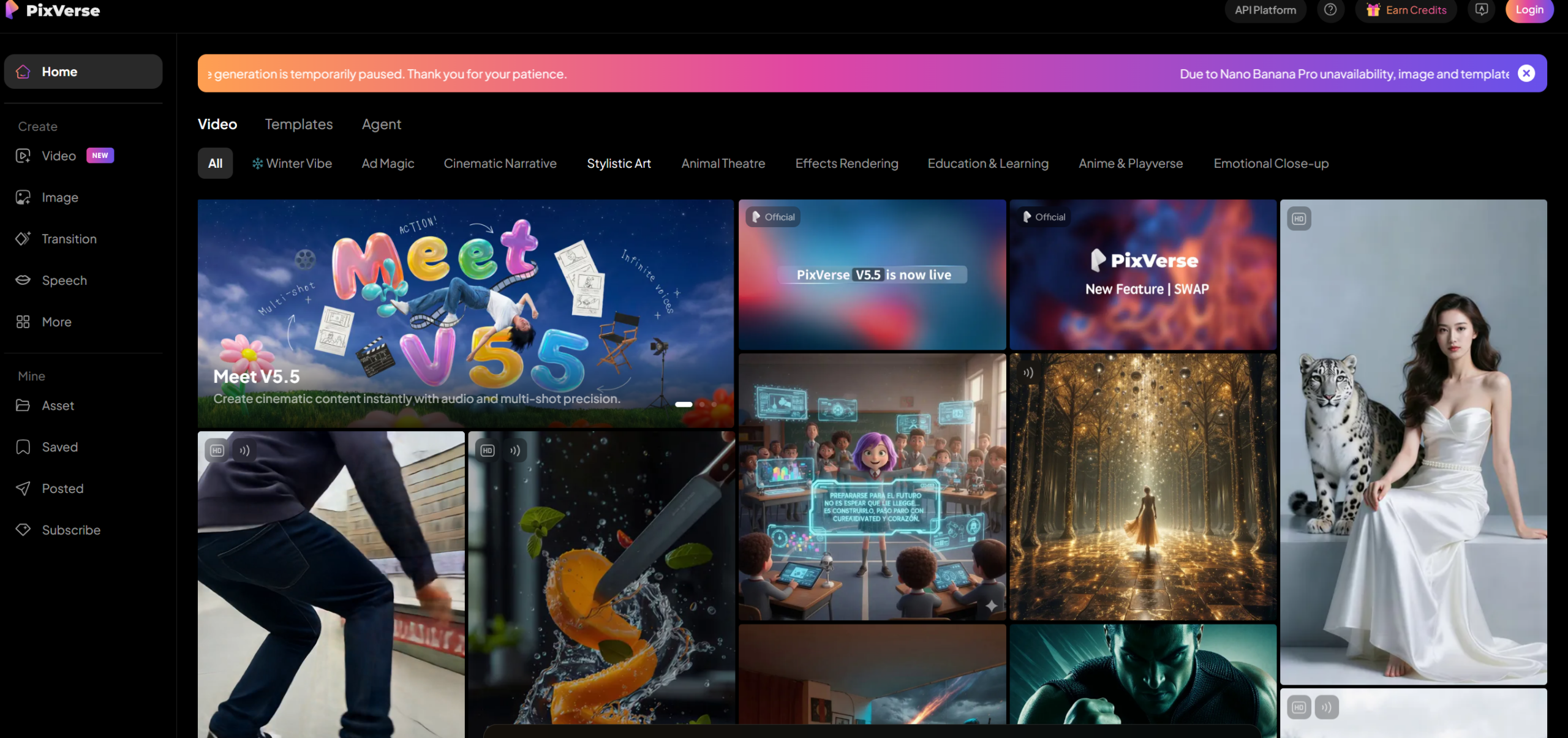
PixVerse is known for being versatile. It has flexible fusion/transition modes. These let you mix existing media into new AI-generated content. Adding speech and sound is straightforward. Just type dialogue into the prompt box. The tool handles the rest.
The platform has gained traction for its multi-style generation capability. It lets users generate video from the same prompt in different styles (hyper-realistic, anime, sketch) and compare results.
Available Models
- PixVerse v4: This is a strong baseline model with style flexibility.
- PixVerse v4.5: This ranks at Elo: 1,190, with native audio and improved quality.
- PixVerse v5: This is the latest version with enhanced capabilities.
When to Use This Model
Best for: Multi-style generation, content remixing, users who want simple controls with daily usability, and creators experimenting with different artistic styles from the same prompt.
Technical Specifications:
- Modes: Text-to-video, Image-to-video, Video-to-video
- Styles: Hyper-realistic, anime, sketch, and more
- Native Audio: Yes (v4.5+)
- Unique Features: Fusion mode, transition blending, dialogue script input, multi-style generation
Official Pricing
PixVerse offers tiered subscription plans with credit-based pricing. Specific pricing details are available at pixverse.ai.
API Access
Official: PixVerse
Third-Party Providers:
10. Grok Imagine by xAI
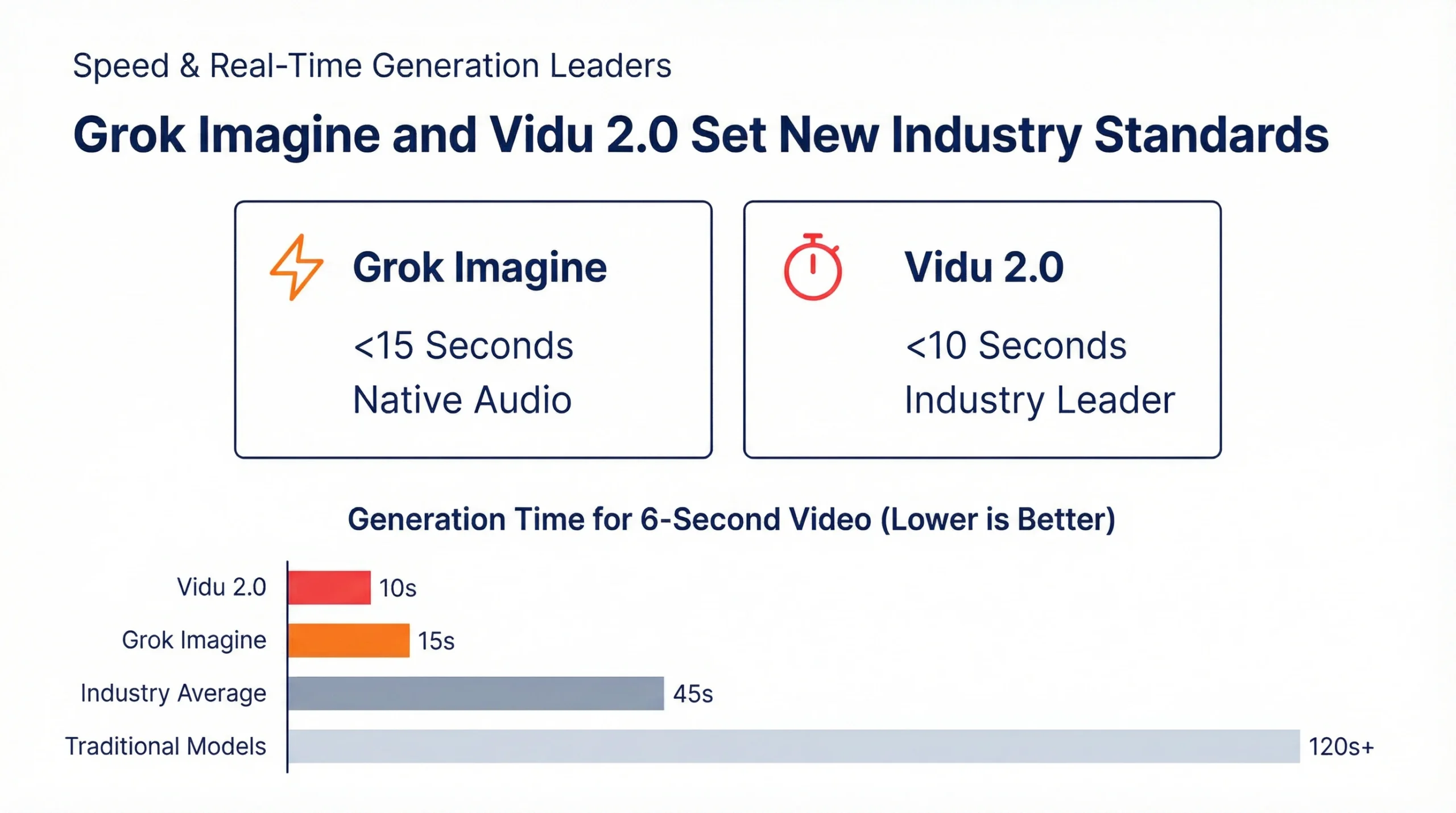
xAI’s Grok Imagine uses the Aurora engine. It stands out for one key metric: generation speed. It creates 6-second photorealistic videos with synchronized audio in under 15 seconds. This is much faster than competitors that can take minutes per generation.
The model is being trained on xAI’s massive cluster of 110,000 NVIDIA GB200 GPUs. It is currently at version 0.9, with a “heavy duty” model in development. Integration with the X (Twitter) ecosystem makes it very attractive for social media creators on that platform.
When to Use This Model
Best for: Rapid iteration, real-time content creation, users who need instant results, X/Twitter-integrated workflows, and creators testing many prompt variations quickly.
Technical Specifications:
- Max Duration: 6 seconds
- Generation Speed: <15 seconds (industry-leading)
- Native Audio: Yes (synchronized)
- Current Status: v0.9 (advancing toward v1.0)
- Training Infrastructure: 110,000 NVIDIA GB200 GPUs
Official Pricing
Currently free through Grok products (iOS app, Android app, web). This makes it an exceptional option for users who want to experiment with AI video generation without any financial commitment.
API Access
Official: xAI — Enterprise/API pricing and broader API access expected in 2026.
11. Vidu 2.0, Vidu Q1, Vidu Q2 by Shengshu Technology
Shengshu Technology started in March 2023. It worked with Tsinghua University. It has quickly become a pioneer in generative video. The company’s flagship platform Vidu hit 10 million users in just 100 days. It has produced over 400 million videos across 200+ countries.
Vidu stands out with its U-ViT architecture. This is the world’s first Diffusion-Transformer hybrid model. It came before the DiT architecture that competitors use. Vidu can generate clips in under 10 seconds. This sets a new global standard for speed. At about $0.0375 per second, Vidu 2.0 is 55% cheaper than the industry average of $0.084 per second.
Available Models
- Vidu 1.5: This introduced the Multiple-Entity Consistency feature. It is the world’s first for consistent multi-character scenes.
- Vidu 2.0: This offers 10-second generation at half industry cost. It has a template feature for simplified creation.
- Vidu Q1: This added cinematic transitions with realistic sound.
- Vidu Q2 “Reference-to-Video”: This allows up to 7 reference images for faces, gestures, scenes, or props. It also has Multiple-Entity Consistency.
When to Use This Model
Best for: Budget-conscious professionals, high-volume A/B testing, anime and stylized content (frequently cited as “equivalent of Veo 2 for anime”), e-commerce product videos, advertising, and users needing consistent multi-character scenes.
Technical Specifications:
- Max Resolution: 1080p
- Max Duration: Up to 8 seconds
- Generation Speed: Under 10 seconds (industry-leading)
- Unique Features: Multiple-Entity Consistency (up to 7 reference images), Template feature, U-ViT architecture, 360-degree product displays
- Cost: ~$0.0375/second (55% below industry average)
Official Pricing
Vidu operates on a credit-based subscription model. The platform is known for being affordable, with costs about half of industry norms. Detailed pricing is available at vidu.com.
API Access
Official: Vidu API Platform (MaaS) — Launched February 2025, supporting Reference-to-Video, Image-to-Video, and Text-to-Video. Enterprise partnerships are available for advertising and e-commerce companies.
Third-Party Providers:
- Pollo AI: Vidu Q1 available
12. Zhipu AI (Ying, CogVideoX)
Zhipu AI works with Tsinghua University’s THUDM lab. It has developed multiple video generation models. These include the proprietary Ying and the open-source CogVideoX series.
While CogVideoX is open-source and covered in our open-source models guide, Ying represents Zhipu’s proprietary offering. It aims at commercial applications in the Chinese market.
When to Use This Model
Best for: Chinese-market applications, users seeking research-backed models from academic institutions, and projects needing integration with Zhipu’s broader AI ecosystem.
Technical Specifications:
- Developer: Zhipu AI / Tsinghua University THUDM
- Related Open-Source: CogVideoX-2B/5B (generates 6-second clips at 720×480, 8 fps)
Official Access
Official: Zhipu AI — Mainly available in the Chinese market.
13. Haiper AI (Haiper 1.5)
Haiper AI has made itself one of the most accessible AI video generators. It offers a truly free experience. You can make high-quality video from text or images without paying subscription fees. The platform is designed for ease of use. It has a clean UI and intuitive controls that need no technical expertise.
The latest Haiper 1.5 model can record eight-second clips with built-in upscaling to 1080p. This doubles the output length of previous versions with improved animation quality.
When to Use This Model
Best for: Beginners exploring AI video generation, users seeking a truly free option, content creators who need quick results without a learning curve, and anyone wanting to test AI video before committing to paid platforms.
Technical Specifications:
- Max Duration: 8 seconds (Haiper 1.5)
- Max Resolution: Up to 1080p with built-in upscaling
- Modes: Text-to-Video, Image Animation, Video Repainting
- Unique Features: Keyframe control, clean beginner-friendly interface
Official Pricing
| Plan | Price | Features |
|---|---|---|
| Free (beta) | $0 | 10 daily creations, 300 non-expiring credits, watermarked |
| Explorer (beta) | $8/month (annual) | Unlimited basic creations, 1,500 monthly credits, watermarked |
| Pro (beta) | $24/month (annual) | Unlimited basic, 5,000 monthly credits, no watermark, commercial use, private creation |
| Enterprise API | Custom | API access, customized features |
Note: The free plan has no privacy guarantee. Others may use your content.
API Access
Official: Haiper AI with API documentation available. Enterprise API allows deep integration into workflows.
14. Adobe Firefly Video Model
Adobe launched its Firefly Video Model in February 2025. It also launched new standalone subscription plans. This is Adobe’s boldest attempt to make its Firefly AI models into a real product. The key differentiator: Firefly was trained on a dataset of licensed videos without brand logos or NSFW content. This makes it the only IP-friendly, commercially-safe video model according to Adobe.
This legal safety is crucial for enterprises and creative professionals. They need to use AI-generated content without worrying about copyright issues or legal troubles. This is a big concern with models trained on scraped internet data.
When to Use This Model
Best for: Enterprise users, creative professionals already in the Adobe ecosystem (Premiere Pro, Photoshop, Express), marketing teams needing legally-safe AI content, and anyone needing seamless integration with Creative Cloud tools.
Technical Specifications:
- Max Resolution: 1080p
- Max Duration: 5 seconds per generation
- Modes: Text-to-Video, Image-to-Video
- Unique Features: IP-safe training data, Creative Cloud integration, camera movement/angle controls, commercial safety guaranteed
- Credit Cost: 20 credits per second of 1080p video
Official Pricing
| Plan | Monthly Price | Credits | 5-Second Videos |
|---|---|---|---|
| Firefly Standard | $9.99 | 2,000/month | ~20 videos |
| Firefly Pro | $29.99 | 7,000/month | ~70 videos |
| Firefly Premium | TBA | ~50,000/month | ~500 videos |
Note: Firefly plans provide unlimited access to AI image and vector generation in Photoshop, Express, and other Adobe apps. Credit costs only apply to premium video and audio features.
Special Promotion: December 16, 2025 – January 15, 2026: Firefly Pro and Premium subscribers receive unlimited generations on all AI image models and the Firefly Video model.
API Access
Official: Adobe Firefly integrated into Creative Cloud and available through the Premiere Pro Beta app. Enterprise API is available for teams larger than 250 members.
15. Meta AI (Make-A-Video, Emu Video)
Meta AI has developed multiple video generation models as part of its broader AI research initiatives. While these models are more research-focused than commercial products, they represent big technical achievements. They influence the broader AI video landscape.
Make-A-Video pioneered text-to-video generation capabilities. Emu Video advanced the field with improved temporal consistency and motion quality.
When to Use This Model
Best for: Researchers, developers exploring AI video generation techniques, and users interested in Meta’s ecosystem. Note that Meta attempted to acquire Runway in 2025 to boost its video capabilities. This suggests these models may see increased commercial focus in the future.
Access:
16. Stability AI (Stable Video Diffusion)
Stability AI’s Stable Video Diffusion (SVD) serves as a foundation for many derivative and fine-tuned models in the AI video ecosystem. While mainly open-source and covered in our separate guide, Stability AI offers commercial licensing and enterprise support for businesses needing production-ready implementations.
When to Use This Model
Best for: Developers building custom video generation pipelines, researchers needing reproducibility, and enterprises wanting to customize and control their video generation infrastructure.
Technical Specifications:
- Variants: SVD, SVD-XT (extended)
- Min VRAM: 16-24GB
- License: Open (with commercial options)
API Access
Official: Stability AI
Third-Party Providers: Available through various API providers and self-hosting options.
17. Genmo AI (Mochi 1)
Genmo AI’s Mochi 1 came out in October 2024. It is a 10-billion-parameter model. It is built on an Asymmetric Diffusion Transformer (AsymmDiT) architecture. While open-source, Genmo offers commercial API access and cloud-hosted generation through their platform.
Mochi 1 has received strong evaluations for motion quality and prompt adherence. It ranks alongside commercial competitors in preliminary benchmarks.
When to Use This Model
Best for: Users who want high-quality generation with an open-source foundation, developers needing customizable video generation, and creators who value the ability to fine-tune models using their own videos.
Technical Specifications:
- Parameters: 10 billion
- Architecture: Asymmetric Diffusion Transformer (AsymmDiT)
- Text Encoder: T5-XXL
- VRAM Required: ~60GB (single GPU) or multi-GPU split
- License: Apache 2.0
API Access
Official: Genmo AI
Third-Party Providers:
API Provider Pricing Comparison
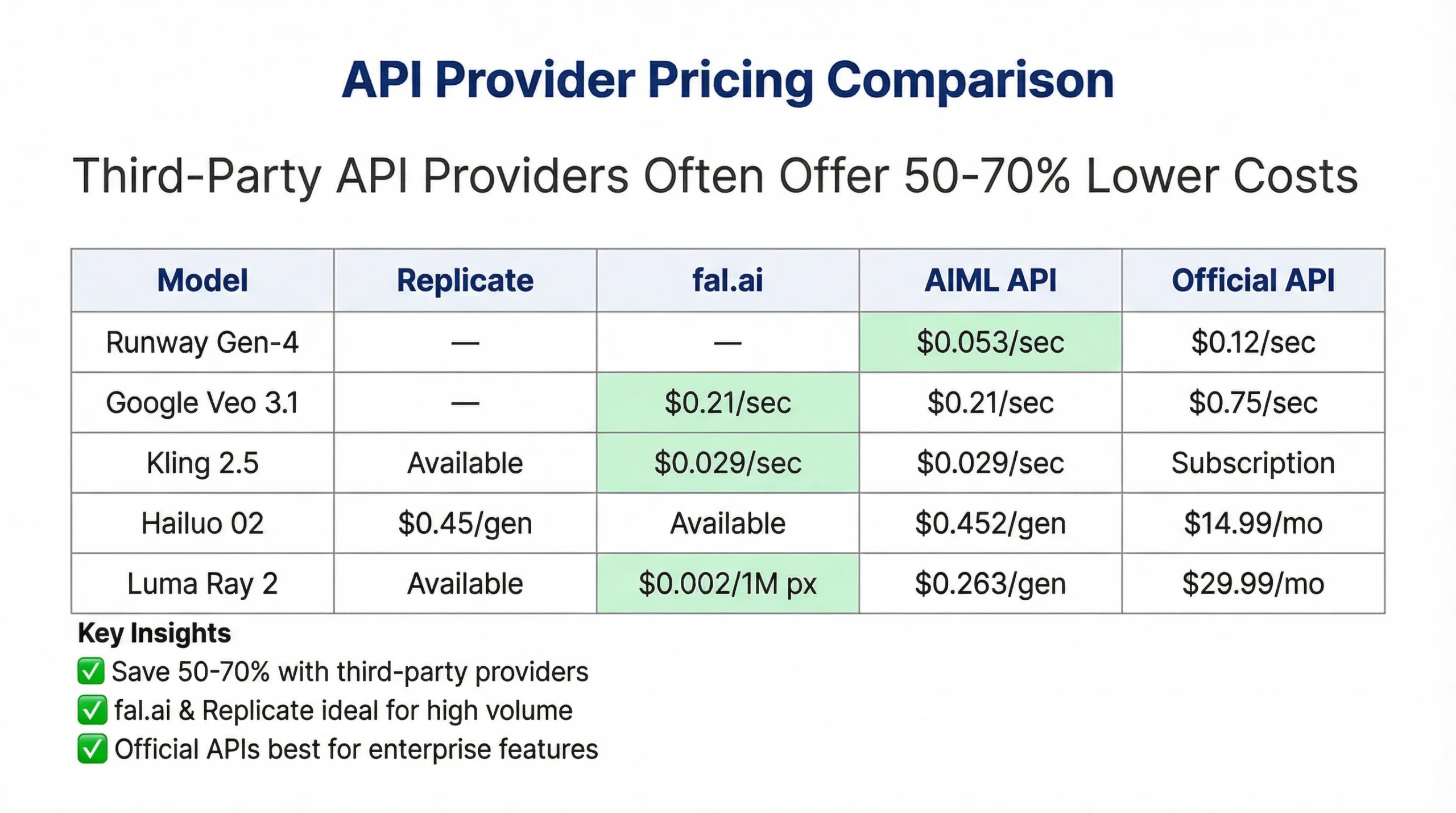
If you are a developer who wants to add AI video generation to your apps, you will need to compare prices from major API providers. The table below shows per-second or per-generation costs for popular models on different platforms.
| Model | Replicate | fal.ai | AIML API | Official API |
|---|---|---|---|---|
| Runway Gen-4 | — | — | $0.053/sec | $0.01/credit (~$0.12/sec) |
| Google Veo 3.1 | — | $0.21/sec | $0.21/sec | $0.75/sec |
| Kling 2.5 | Available | $0.029/sec | $0.029/sec | $7-30/month (subscription) |
| Hailuo 02 | $0.45/gen | Available | $0.452/gen | $14.99/month |
| Hailuo 2.3 | Available | $0.336-0.588/10sec | $0.336/10sec | Subscription-based |
| Luma Ray 2 | Available | $0.002-0.007/1M pixels | $0.263/gen | $29.99/month unlimited |
| Seedance Pro | — | Available | $1.05/1M tokens | Subscription-based |
| Vidu Q2 | — | — | — | ~$0.0375/sec |
Quick tip :Third-party API providers like fal.ai and Replicate often have much lower per-generation costs than official APIs. This makes them good for high-volume apps.
How to Choose the Right AI Video Generation Model
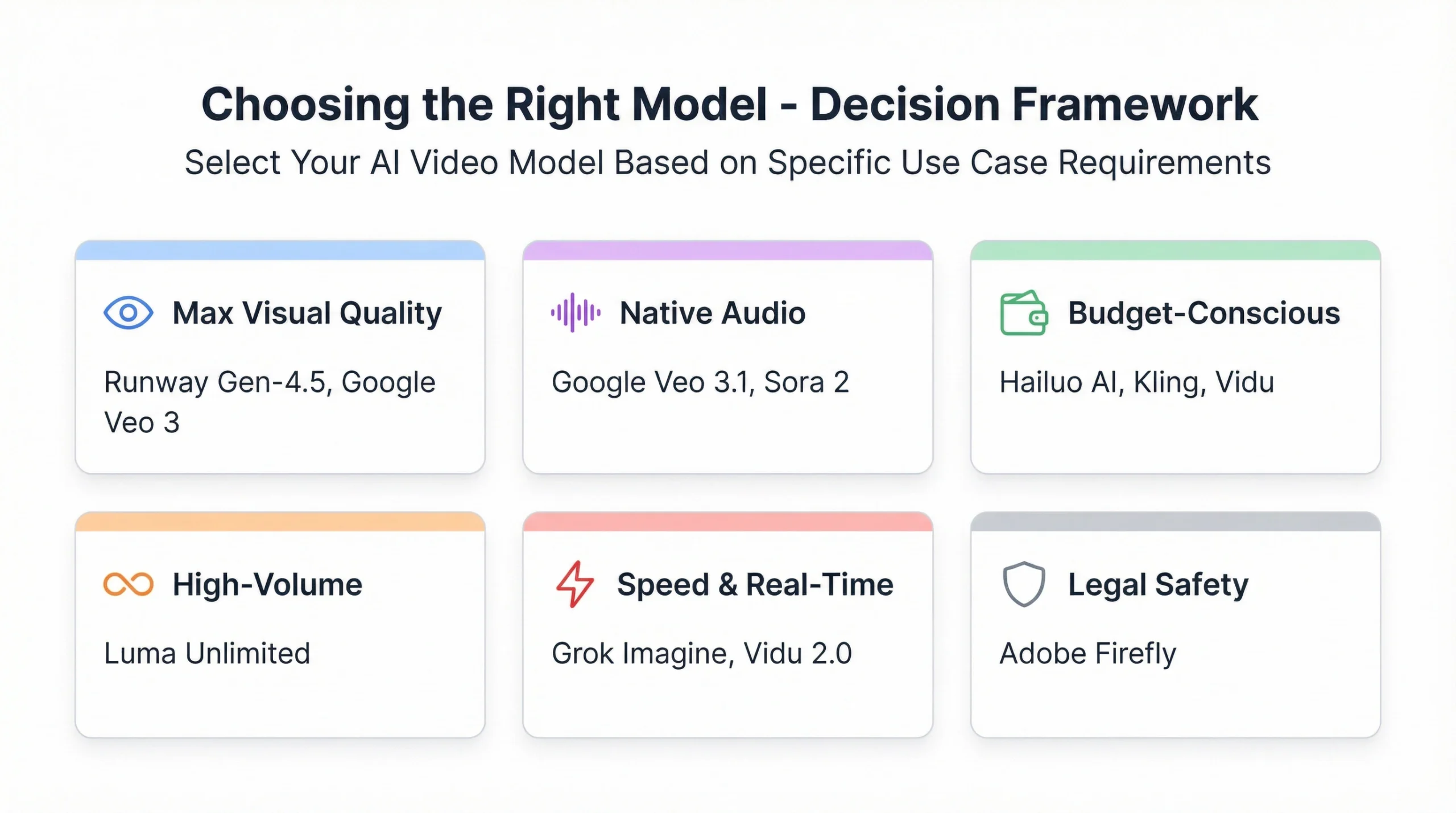
There are many options available. Picking the right model depends on what you need:
For Maximum Visual Quality
Choose Runway Gen-4.5 (1,247 Elo) or Google Veo 3 (1,226 Elo). These models lead benchmarks. They are ideal for professional production where visual fidelity is paramount.
For Budget-Conscious Creators
Hailuo AI ($14.99/month), Kling Standard ($6.99/month), and Vidu (~$0.0375/second) offer the best value without sacrificing too much quality. Haiper AI provides a truly free tier for testing.
For High-Volume Generation
Luma Unlimited ($29.99/month for unlimited generations) removes per-video anxiety. It is ideal for extensive testing and iteration.
For Native Audio
Google Veo 3.1 leads for synchronized audio generation (dialogue, sound effects, ambient noise). Sora 2, Pika 2.2, and Grok Imagine follow.
For Speed
Grok Imagine (<15 seconds) and Vidu 2.0 (~10 seconds) offer the fastest generation times in the industry.
For Legal/Commercial Safety
Adobe Firefly Video is the only IP-friendly, commercially-safe model trained only on licensed content.
For API Developers
Consider third-party providers like fal.ai, Replicate, or AIML API for cost-effective API access to multiple models under one integration. Kling and Vidu are specifically noted for their developer-first API designs.