Pressure Converter
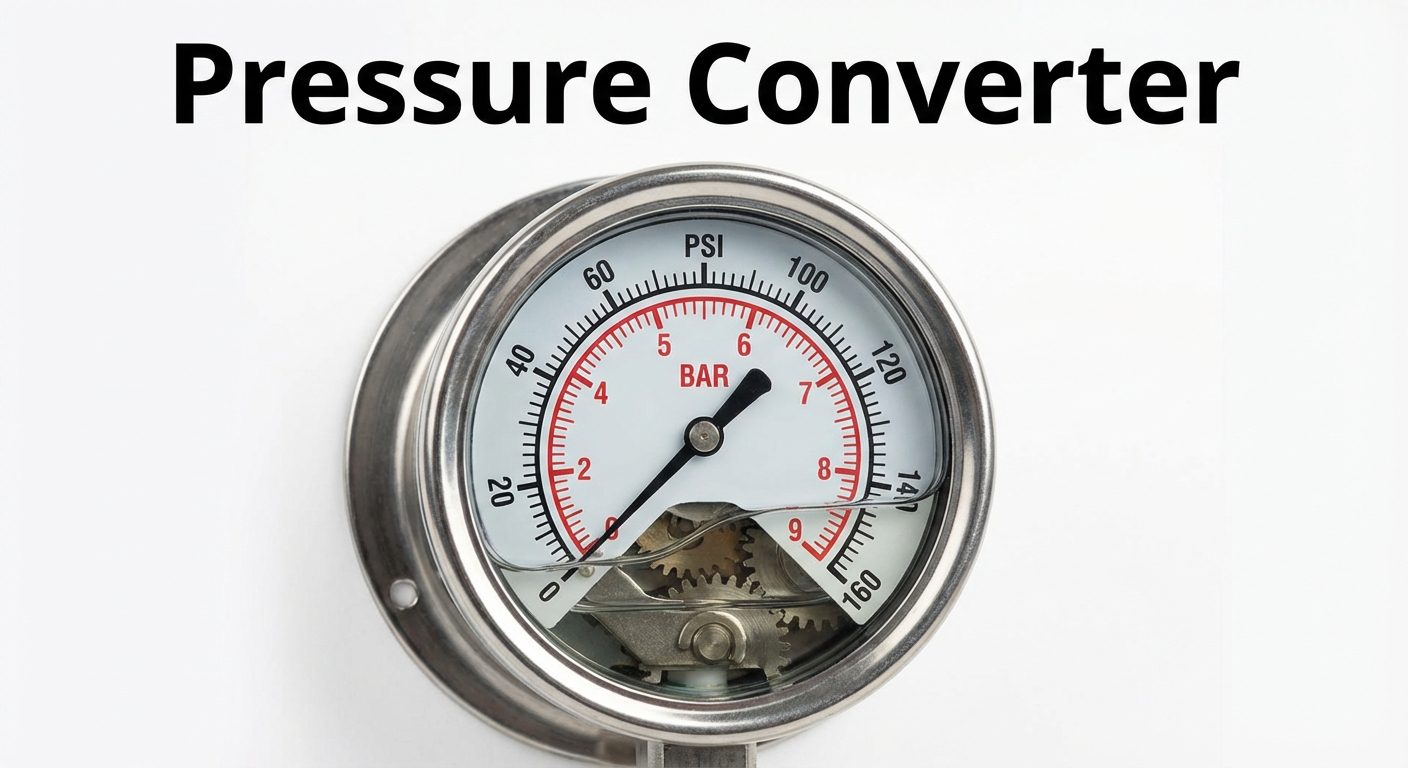
A pressure converter transforms measurements between PSI, inches of water column (inWC), bar, atmospheres (atm), kilopascals (kPa), millimeters of mercury (mmHg), and other pressure units. Enter a value and select units to convert instantly for HVAC, plumbing, medical, or engineering use.
What Is Pressure?
Pressure is the force applied perpendicular to the surface of an object per unit area. It is one of the fundamental physical quantities used across engineering, medicine, meteorology, and everyday applications. In physics, pressure is defined as force divided by area (P = F/A). The SI unit of pressure is the Pascal (Pa), defined as one Newton of force per square meter. However, many different pressure units exist depending on the field of application — HVAC systems use inches of water column, aviation and meteorology use millibars and inches of mercury, automotive applications use PSI and bar, and laboratory work often uses atmospheres or Torr.
Understanding and converting between pressure units is essential for reading equipment manuals, configuring gas distribution systems, interpreting medical device specifications, and working with international engineering documentation. The NIST SI units reference for pressure provides the authoritative definitions for all metric pressure units.
Pressure Units Explained
PSI (Pounds per Square Inch)
PSI is the dominant pressure unit in the United States for industrial, automotive, and plumbing applications. It represents the force of one pound-force applied over one square inch of area. Tire pressure, hydraulic system pressure, and water supply pressure are all commonly expressed in PSI in the US. Standard atmospheric pressure equals 14.696 PSI. PSI can be expressed as absolute pressure (PSIA, measured from a perfect vacuum) or gauge pressure (PSIG, measured relative to atmospheric pressure). Most everyday readings — tire gauges, pressure washers, water pressure — use gauge pressure.
Inches of Water Column (inWC)
Inches of water column (inWC, also written in. WC or WG) is the standard pressure unit used in HVAC engineering, natural gas distribution, and building mechanical systems. It measures pressure as the height of a water column that would produce equivalent pressure. Because HVAC duct pressures are very low — typically 0.1 to 2 inWC for residential systems — this unit avoids the inconveniently small decimal values that PSI or kPa would produce. One PSI equals 27.6799 inWC. Gas appliance operating pressures in the US are commonly specified in inWC: natural gas appliances typically operate at 3.5 inWC and LP gas appliances at 11 inWC.
Bar and Millibar
The bar is a metric pressure unit equal to exactly 100,000 Pascals (100 kPa). It is close to, but slightly less than, one standard atmosphere. Bar is widely used in European and international industrial applications, including tire pressure specifications in metric countries, boiler ratings, and hydraulic equipment. The millibar (mbar) equals one-thousandth of a bar (100 Pa) and is used extensively in meteorology — atmospheric pressure at sea level is approximately 1013.25 mbar. Weather maps and forecasting systems worldwide use mbar or its equivalent unit, the hectopascal (hPa).
Atmospheres (atm)
One standard atmosphere (atm) is defined as exactly 101,325 Pascals — the average atmospheric pressure at sea level. The atmosphere is used as a reference unit in chemistry, diving, and aerospace engineering. Scuba diving depth and decompression tables reference pressures in atm: every 10 meters of seawater depth adds approximately 1 atm of pressure. In chemistry, standard conditions (STP) define pressure as 1 atm. One atm equals 14.696 PSI, 1.01325 bar, 760 mmHg, and 29.92 inHg.
Pascals and Kilopascals
The Pascal (Pa) is the SI base unit of pressure, defined as one Newton per square meter. It is a very small unit — standard atmospheric pressure is 101,325 Pa — so kilopascals (kPa, equal to 1,000 Pa) are often used for practical measurements. kPa is the standard unit for blood pressure in many countries (replacing mmHg), tire pressure in metric regions, and structural engineering calculations. Megapascals (MPa) are used for material strength specifications and high-pressure industrial systems.
mmHg and Torr
Millimeters of mercury (mmHg) is defined by the pressure exerted by a column of mercury one millimeter tall at standard temperature and gravity. It has a long history in medicine and laboratory science. Blood pressure is still universally measured and reported in mmHg: a normal reading of 120/80 means 120 mmHg systolic and 80 mmHg diastolic. One standard atmosphere equals exactly 760 mmHg. The Torr is defined as exactly 1/760 of a standard atmosphere and is numerically almost identical to mmHg — the two units differ by less than 0.000015%. Torr is used in vacuum science and semiconductor manufacturing. The WHO hypertension guidelines reference blood pressure in mmHg throughout.
How to Convert WC to PSI
The Formula
To convert inches of water column (inWC) to PSI, divide the inWC value by 27.6799:

To convert PSI to inWC, multiply by 27.6799:
The conversion factor 27.6799 is derived from the density of water (62.4 lb/ft³) and unit conversions between feet and inches. Because water density varies slightly with temperature, some references use 27.68 or 27.707 depending on the assumed water temperature.
Common WC to PSI Conversions Table
| inWC | PSI | Pa | Common Application |
|---|---|---|---|
| 0.1 inWC | 0.00361 PSI | 24.9 Pa | Residential HVAC duct pressure (low end) |
| 0.5 inWC | 0.01806 PSI | 124.5 Pa | HVAC filter pressure drop |
| 1.0 inWC | 0.03613 PSI | 249.1 Pa | Residential furnace burner pressure |
| 3.5 inWC | 0.1265 PSI | 871.8 Pa | Natural gas appliance operating pressure (US) |
| 11.0 inWC | 0.3974 PSI | 2740 Pa | LP (propane) gas appliance operating pressure |
| 27.68 inWC | 1.0 PSI | 6,895 Pa | Reference: 1 PSI |
Pressure Conversion Chart
Common pressure values converted across the most-used units:

| PSI | inWC | bar | atm | kPa | mmHg |
|---|---|---|---|---|---|
| 1 | 27.68 | 0.06895 | 0.06805 | 6.895 | 51.71 |
| 5 | 138.4 | 0.3447 | 0.3402 | 34.47 | 258.6 |
| 14.696 | 407.0 | 1.01325 | 1.000 | 101.325 | 760.0 |
| 30 | 830.4 | 2.068 | 2.041 | 206.8 | 1551 |
| 100 | 2768 | 6.895 | 6.805 | 689.5 | 5171 |
| 145.038 | 4015 | 10.00 | 9.869 | 1000 | 7501 |
Pressure in HVAC Systems
HVAC (Heating, Ventilation, and Air Conditioning) engineers work almost exclusively with inches of water column for measuring air pressure in duct systems, fan performance, and gas appliance pressures. Residential supply ducts typically operate between 0.1 and 0.5 inWC. Return ductwork operates at slight negative pressure, typically -0.05 to -0.2 inWC. Commercial air handling units may produce static pressures of 1 to 4 inWC.
For gas supply lines, the pressure requirements differ by fuel type. Natural gas residential service pressure is typically 7 inWC (about 0.25 PSI) at the meter, reduced to 3.5 inWC at the appliance regulator. Liquid propane (LP) gas is supplied at higher pressure — usually 11 inWC — because propane has a higher energy density and requires different burner orifice sizing. Converting these pressures to kPa or bar is sometimes necessary when working with European-manufactured equipment or international specifications. You can also use our energy converter for related BTU and joule conversions in HVAC calculations.
Pressure in Medical Applications
Blood pressure is measured in millimeters of mercury (mmHg) worldwide, a convention established in the 19th century when mercury sphygmomanometers became the standard tool. Despite the widespread adoption of digital blood pressure monitors, mmHg remains the universal reporting unit because of the medical community's extensive historical data in these units. A normal adult blood pressure reading of 120/80 mmHg equals approximately 15.998 kPa systolic and 10.666 kPa diastolic — useful to know when working with clinical device specifications or international medical equipment.
Intraocular pressure (the pressure inside the eye) is also measured in mmHg. Normal intraocular pressure ranges from 10 to 20 mmHg; readings above 21 mmHg may indicate glaucoma risk. Cerebrospinal fluid pressure is measured in cm H2O (centimeters of water column) during lumbar puncture procedures, with normal values between 7 and 18 cm H2O (approximately 2.76 to 7.09 inWC). Ventilator pressures in intensive care units are expressed in cm H2O or mbar, making cross-unit conversion important in clinical settings.
FAQ
How do I convert inWC to PSI?
Divide the inWC value by 27.6799 to get PSI. For example, 55.36 inWC ÷ 27.6799 = 2 PSI. You can also multiply inWC by 0.036127 to get the same result. The converter on this page handles this calculation instantly.
What is 1 PSI in water column?
1 PSI equals 27.6799 inches of water column (inWC). This is approximately 2.31 feet of water. This figure is based on the density of water at 60°F (15.56°C) and is the standard conversion factor used in US HVAC and plumbing industries.
How many PSI is 1 bar?
1 bar equals 14.5038 PSI. Conversely, 1 PSI equals 0.0689476 bar. European tire pressure specifications in bar can be converted to PSI by multiplying by 14.5038. A tire inflated to 2.4 bar is at approximately 34.8 PSI.
What is atmospheric pressure in PSI?
Standard atmospheric pressure is 14.696 PSI (absolute). This is also equal to 1 atm, 101.325 kPa, 1.01325 bar, 760 mmHg, 29.92 inHg, and 407.19 inWC. Gauge pressure gauges read zero at atmospheric pressure; absolute pressure gauges read 14.696 PSI at sea level.
What does inWC mean?
inWC stands for inches of water column, also abbreviated as WC, WG (water gauge), or in. WC. It is the pressure exerted by a column of water one inch tall. At standard conditions, 1 inWC = 249.09 Pa = 0.036127 PSI. It is the standard unit for low-pressure measurements in HVAC, natural gas, and building systems throughout the United States.
Related Converters and Tools
- Energy Converter — Convert BTU, joules, kilowatt-hours, and more for HVAC and engineering calculations.
- Torque Converter — Convert Nm, ft-lbs, in-lbs, and kgf-m for mechanical and automotive applications.
- Degrees Converter — Convert between Celsius, Fahrenheit, and Kelvin for temperature-related engineering.
- Frequency Converter — Convert Hz, kHz, MHz, and more for electrical and signal applications.
- Free AI Math Solver — Solve complex pressure and engineering equations with AI assistance.