Sales Tax Calculator
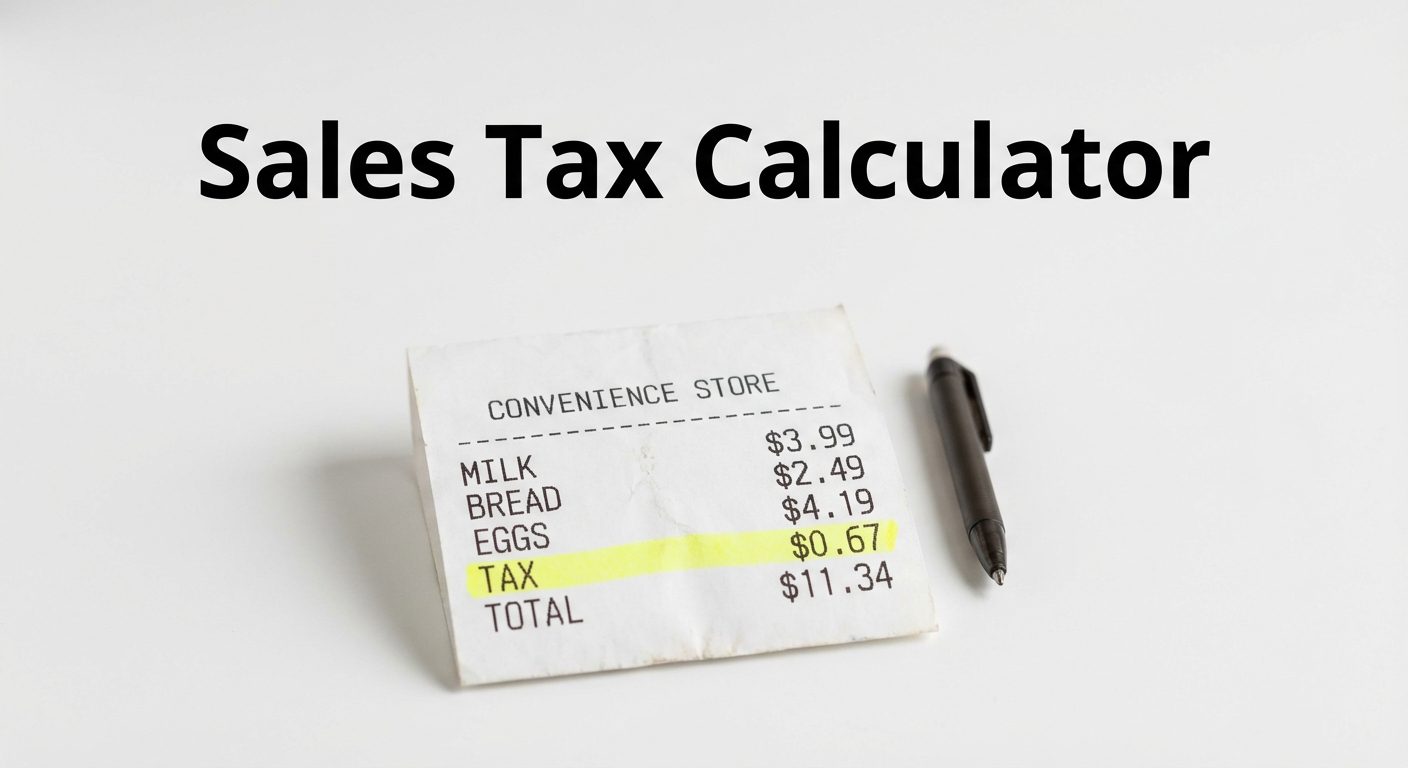
A sales tax calculator determines the amount of sales tax on a purchase or removes tax from a total to find the pre-tax price. Enter an amount and your state or custom tax rate in the panel to instantly calculate the tax owed and final total.
What Is Sales Tax?
Sales tax is a consumption tax imposed by state and local governments on the sale of goods and certain services. It is collected by the seller at the point of purchase and remitted to the relevant tax authority. In the United States, sales tax is administered at the state level with no federal sales tax. Each state sets its own base rate, and local governments (counties and cities) may add additional percentages on top of the state rate, resulting in combined rates that can vary significantly even within a single state.
For sellers, understanding how much sales tax to charge is essential for compliance. For buyers, knowing the tax rate helps budget accurately for purchases. This calculator uses the base state rates for all 50 US states. For precise combined rates including local taxes in a specific city or county, consult the Tax Foundation sales tax data.
How to Calculate Sales Tax
Adding Sales Tax to a Price
To add sales tax to a price, multiply the pre-tax price by the tax rate as a decimal, then add the result to the original price:
Total = Pre-Tax Price + Tax Amount
For example, on a $100 item with a 7% tax rate: Tax = $100 x 0.07 = $7.00. Total = $100 + $7 = $107.00. The calculator panel handles this instantly for any amount and any state or custom rate. If you want to add tax to a specific item price with an optional discount applied first, try our tax price calculator. If you need to estimate costs for business proposals, our pricing calculator can help structure your pricing with tax considerations built in.
Removing Sales Tax (Reverse Tax Calculator)
A reverse sales tax calculation (also called a tax de-calculator) finds the pre-tax price when you know the total paid including tax. This is useful for expense reports, refunds, accounting, and determining taxable vs tax-free portions of a payment. For a dedicated tool with both pre-tax price and tax rate finder modes, use the reverse sales tax calculator. The formula is:
Tax Included = Total Paid - Pre-Tax Price
For example, if you paid $165 and the tax rate is 10%: Pre-tax = $165 / 1.10 = $150.00. Tax included = $165 - $150 = $15.00. Use the "Remove Tax" toggle in the calculator panel for instant reverse calculations. For broader financial analysis including profit margins, our profit and loss statement generator is a useful companion tool.
Sales Tax Rates by State
The table below shows the base state sales tax rate for all 50 US states. These are state-level rates only and do not include local county or city taxes, which can add 0.5% to 5% depending on location. Combined rates (state + local) are tracked by the Tax Foundation sales tax data.
| State | Abbr. | State Base Rate |
|---|---|---|
| Alabama | AL | 4.00% |
| Alaska | AK | 0.00% |
| Arizona | AZ | 5.60% |
| Arkansas | AR | 6.50% |
| California | CA | 7.25% |
| Colorado | CO | 2.90% |
| Connecticut | CT | 6.35% |
| Delaware | DE | 0.00% |
| Florida | FL | 6.00% |
| Georgia | GA | 4.00% |
| Hawaii | HI | 4.00% |
| Idaho | ID | 6.00% |
| Illinois | IL | 6.25% |
| Indiana | IN | 7.00% |
| Iowa | IA | 6.00% |
| Kansas | KS | 6.50% |
| Kentucky | KY | 6.00% |
| Louisiana | LA | 4.45% |
| Maine | ME | 5.50% |
| Maryland | MD | 6.00% |
| Massachusetts | MA | 6.25% |
| Michigan | MI | 6.00% |
| Minnesota | MN | 6.875% |
| Mississippi | MS | 7.00% |
| Missouri | MO | 4.225% |
| Montana | MT | 0.00% |
| Nebraska | NE | 5.50% |
| Nevada | NV | 6.85% |
| New Hampshire | NH | 0.00% |
| New Jersey | NJ | 6.625% |
| New Mexico | NM | 5.00% |
| New York | NY | 4.00% |
| North Carolina | NC | 4.75% |
| North Dakota | ND | 5.00% |
| Ohio | OH | 5.75% |
| Oklahoma | OK | 4.50% |
| Oregon | OR | 0.00% |
| Pennsylvania | PA | 6.00% |
| Rhode Island | RI | 7.00% |
| South Carolina | SC | 6.00% |
| South Dakota | SD | 4.50% |
| Tennessee | TN | 7.00% |
| Texas | TX | 6.25% |
| Utah | UT | 4.85% |
| Vermont | VT | 6.00% |
| Virginia | VA | 5.30% |
| Washington | WA | 6.50% |
| West Virginia | WV | 6.00% |
| Wisconsin | WI | 5.00% |
| Wyoming | WY | 4.00% |
Rates shown are state base rates only. Local taxes vary by city and county.
States With No Sales Tax
Five US states have no statewide sales tax: Alaska, Delaware, Montana, New Hampshire, and Oregon. Shopping in these states means you pay only the listed price for most goods with no state-level sales tax added. However, Alaska allows local jurisdictions to impose their own sales taxes, so some Alaskan cities and boroughs do charge sales tax at the local level. Delaware, Montana, New Hampshire, and Oregon have no local sales taxes either, making them true tax-free shopping destinations for most purchases.
How Sales Tax Works in the US
State vs Local Tax
US sales tax operates on two tiers. The state sets a base rate that applies uniformly across the state. Local governments — counties, cities, and special tax districts — can layer additional percentages on top of the state rate. For example, California's state rate is 7.25%, but in Los Angeles County the combined rate reaches 10.25% when local taxes are included. In Tennessee, the state rate is 7%, but some areas reach over 9.7% combined. This layered system means that two stores one mile apart in different counties can charge different total tax rates on the same item.
The IRS sales tax deduction guide also notes that taxpayers who itemize can deduct state and local general sales taxes paid during the year as an alternative to deducting state income taxes. This makes keeping track of sales tax amounts paid particularly valuable for certain filers.
Sales Tax Nexus
Sales tax nexus refers to the connection between a business and a state that creates an obligation to collect and remit sales tax in that state. Historically, physical presence (an office, warehouse, or employees in a state) established nexus. Following the 2018 Supreme Court case South Dakota v. Wayfair, most states now recognize economic nexus, meaning businesses that exceed a sales threshold in a state (typically $100,000 in sales or 200 transactions per year) must collect that state's sales tax even without a physical presence. For small businesses selling online, the SBA guide to sales tax for small businesses provides practical guidance on compliance. For automating sales tax calculations across multiple states, accounting tools like the accounting AI solver can help identify tax obligations.
Sales Tax Calculator Examples
Tax on $1,800 Purchase in California
Total = $1,800 + $130.50 = $1,930.50
A $1,800 purchase in California at the base state rate of 7.25% results in $130.50 in state sales tax and a total of $1,930.50. In practice, California county rates push most areas above 8.25%, so the actual tax on a $1,800 purchase in Los Angeles would be closer to $184.50 (10.25%). Always confirm the combined rate for your specific location.
Reverse Tax on $165 Total
Tax included = $165 - $150 = $15.00
If you paid $165 total and the combined tax rate was 10%, the pre-tax price was $150.00 and $15.00 of your payment was tax. This reverse calculation is used when receipts show only the total and you need to separate the taxable base from the tax amount for reimbursement, bookkeeping, or refund purposes.
Items Exempt From Sales Tax
Sales tax does not apply uniformly to all purchases. Most states provide exemptions for categories of goods and services that are considered essential or are otherwise excluded by statute:
- Groceries and food — Most states exempt unprepared food (groceries) from sales tax, though prepared food sold at restaurants is typically taxable. States like Tennessee partially exempt groceries at a reduced rate.
- Prescription drugs — Nearly all states exempt prescription medications. Over-the-counter drugs may or may not be exempt depending on the state.
- Medical equipment — Wheelchairs, prosthetics, and other medical devices are generally exempt in most states.
- Agricultural supplies — Farm equipment, seeds, and livestock feed are often exempt because they are inputs to food production.
- Clothing — Some states (Minnesota, New Jersey, Pennsylvania, New York) exempt clothing under certain price thresholds. Other states tax clothing at the full rate.
- Services — Most states do not tax services, though some states (South Dakota, Hawaii, New Mexico) tax a broad range of services. Digital services and software-as-a-service are an evolving area of tax law.
- Resale purchases — Businesses buying goods for resale can purchase items tax-free using a resale certificate. Tax is collected when the end consumer buys the finished product.

Frequently Asked Questions
Which states have no sales tax?
Five states have no statewide sales tax: Alaska, Delaware, Montana, New Hampshire, and Oregon. Of these, Alaska allows local governments to impose sales taxes, so parts of Alaska do have local sales tax. The other four states — Delaware, Montana, New Hampshire, and Oregon — have no state or local general sales taxes, making them the most tax-friendly for retail purchases.
How do I calculate sales tax?
Multiply the pre-tax price by the tax rate expressed as a decimal. For a 7% rate on a $200 item: $200 x 0.07 = $14.00 tax. Total = $200 + $14 = $214.00. Alternatively, multiply the price by (1 + the rate as a decimal): $200 x 1.07 = $214.00. The calculator on this page handles all of this instantly with built-in rates for all 50 states.
What is reverse sales tax?
Reverse sales tax (also called a tax de-calculator) finds the pre-tax price when you know the total including tax. Divide the total by (1 + the tax rate as a decimal). For a $107 total at 7%: $107 / 1.07 = $100.00 pre-tax price. The tax portion is $107 - $100 = $7.00. Use the 'Remove Tax' toggle in the calculator for this.
Do I charge tax on shipping?
Whether shipping is taxable depends on the state. Some states tax shipping separately (Ohio, Texas), others tax it only when it is combined with the sale of taxable goods (California), and some do not tax shipping at all (California if shipping is separately stated on the invoice and reflects actual cost). You should confirm the rule for your specific state when determining how much sales tax to charge on shipping.
What is sales tax nexus?
Sales tax nexus is the connection between a business and a state that requires the business to collect and remit sales tax in that state. Nexus can be established through physical presence (office, warehouse, employees, inventory) or economic activity (selling above a threshold such as $100,000 in annual sales or 200 transactions). Following the 2018 Wayfair Supreme Court decision, most states now enforce economic nexus for online sellers.